
Blog Summary:
- Software development cost in Dubai ranges from AED 146,000 to AED 1,800,000 ($40,000 to $500,000+), depending on complexity, features, compliance, and scalability.
- Costs are heavily influenced by design complexity, backend architecture, integration with third-party systems, compliance measures, team size, and the choice of technology stack.
- Beyond initial estimates, expenses like licensing fees, ongoing maintenance, infrastructure scaling, and scope changes can add up and affect your total investment.
- Businesses can manage expenses by defining clear requirements, adopting a phased development approach, choosing the right hiring model, and leveraging proven frameworks and libraries.
- With over 18 years of industry expertise, Cubix has delivered secure, scalable software in Dubai and worldwide, ensuring every project drives real business value.
A million-dollar question asked by every executive when planning a software project in Dubai, UAE: What is the real software development cost, and how much should you budget before engaging a development partner?
The answer is rarely straightforward because software development is not just about coding; it’s about aligning technology with business goals. Costs vary widely depending on project complexity, required features, regulatory compliance, integrations, and long-term scalability. A simple internal tool will require a different level of investment than a full-scale enterprise system or a fintech platform handling sensitive transactions.
Cubix, a trusted name in Dubai, UAE, has been providing custom software development services in Dubai since 2008. Every project begins with clear planning, detailed requirement analysis, and transparent cost estimates, so decision-makers know exactly where their investment goes. This guide will walk you through the 2026 software development cost landscape, key pricing factors, and insights to plan your project confidently.
[blog_cta]
Software Development Cost in Dubai: 2026 Price Breakdown
The Software Development cost in Dubai in 2026 may range from AED 146,000 to AED 1,800,000 ($40,000 to $500,000+). The wide range exists because every project comes up with unique requirements and challenges.
When evaluating quotes for a software project, it’s important to understand how pricing works. In Dubai, software development rates can vary widely, so knowing the typical cost of software developers in the UAE helps you make smarter decisions. While every project has its own budget depending on scope, features, and complexity, tools like a Dubai software cost calculator can give you a rough estimate to start planning with confidence.
The table below provides an estimated cost and timeline breakdown based on project complexity.
| Project Complexity | Key Features | Estimated Cost (AED) | Estimated Cost (USD) | Typical Timeline |
| Basic
|
Standard security, simple database, push notifications | 146,000 – 220,000 | 40,000 – 60,000 | 3–6 months |
| Moderate
|
Advanced security, API integrations, social media links | 220,000 – 440,000 | 60,000 – 120,000 | 6–9 months |
| Complex
|
Robust security protocols, real-time updates, and multiple system integrations | 440,000 – 1,100,000 | 120,000 – 300,000+ | 9–12 months |
| Enterprise
|
Scalable architecture, multi-layer security, integration with legacy systems | 1,800,000+ | 500,000+ | 12–24 months |
Step-By-Step Cost Breakdown Across Different Phases
When you start building software, the development process can be divided into several stages. Each contributes to the overall development cost. From planning to deployment, every phase requires detailed planning, resources, time, and skilled developers. Knowing how your budget is allocated at each phase of the project gives you better control and fewer surprises along the way. When you understand what you are paying for, it becomes easier to plan realistically and make smarter decisions. Here’s a closer look at the main stages of software development and how costs are typically distributed across them.
| Development Stage | Estimated Cost in AED | Estimated Cost in USD | Timeline |
| Discovery & Planning | 7,345 to 36,700 | $2,000 to $10,000 | 1 to 4 weeks |
| Designing | 22,025 to 183,500 | $6,000 to $50,000 | 3 to 6 weeks |
| Development | 73,410 to 1,101,000 | $20,000 to $300,000 | 4 to 12 months |
| Testing & QA | 14,680 to 220,200 | $4,000 to $60,000 | 2 to 4 weeks |
| Deployment & Launch | 14,680 to 110,100 | $4,000 to $30,000 | 1 to 2 weeks |
| Post-Launch Support | 14,680 to 146,800 | $4,000 to $40,000 | Ongoing |
| Total | 146,800 to 1,798,300 | $40,000 to $490,000 |
Major Factors That Affect Software Development Costs in Dubai
As mentioned above, several factors affect the costs of software development in Dubai. These factors significantly impact the software’s performance and user expectations. By considering these factors upfront, you can align your project scope with your budget, prioritize features that deliver the most value, and choose the right development approach. Let’s take a closer look at the main drivers in Dubai software projects.
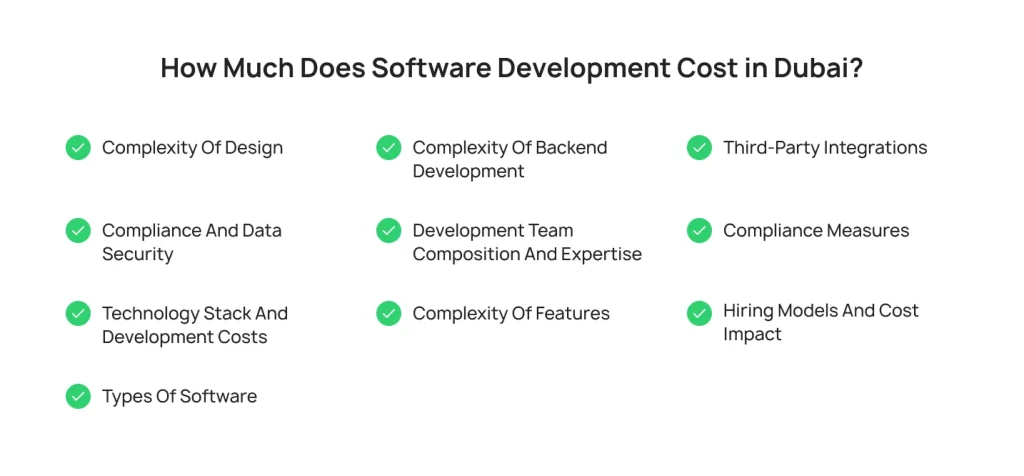
1: Complexity of Design
The design of your software directly impacts cost. Simple, straightforward interfaces with standard layouts and minimal animations are quicker and cheaper to build. On the other hand, complex designs with custom graphics, interactive elements, and multiple user flows require more time and specialized expertise, which increases the budget. However, investing in high-quality UX pays off. Statista reports that a strong user experience can boost conversations by up to 400%, making it a worthwhile consideration for businesses in Dubai aiming to stand out in this market.
Here is the cost comparison according to design complexity:
| Design Complexity | Estimated Cost in AED | Estimated Cost in USD |
| Basic UI/UX Design | 22,020 – 110,100 | $6,000 – $30,000 |
| Advanced UI/UX Design | 110,100-183,500 | $30,000-$50,000+ |
2: Complexity of Backend Development
The backend is the engine that powers your software. While users interact with the front end, the backend handles data processing, server logic, security, integrations, and the overall system performance. The more advanced your requirements are, the higher the development cost and effort. In Dubai, where many businesses operate in regulated industries like fintech, healthcare, or e-commerce, backend architecture must also meet strict security and compliance standards. These additional layers increase development time but are essential for building reliable, future-ready software.
3: Third-Party Integrations
No modern software works alone. Very few software products work well today. Most businesses need their system to connect with payment gateways, CRM tools, accounting platforms, ERP systems, marketing automation software, or cloud storage. That’s where third-party integrations come into play, and they can quietly influence your overall budget.
Some APIs plug in quickly. Others require custom configurations, data mapping, security validation, and ongoing monitoring. If your platform needs real-time synchronization or must connect with older legacy systems, the effort increases. That directly impacts your budget and timeline.
There’s also the cost beyond development. Many third-party providers often charge licensing, subscription, and transaction fees. If you’re integrating multiple services, those recurring expenses add up over time.
That’s why it’s important to decide early which integrations are truly essential. A focused approach keeps your software practical, scalable, and financially manageable.
The table shows the cost comparison based on your integration plan.
| Integration Type | Estimated Cost in AED | Estimated Cost in USD |
| Basic Integration | 7,340 – 36,750 | $2,000 – $10,000 |
| Complex Integration | 18,350-55,050 | $5,000 – $15,000+ |
4: Compliance and Data Security
Compliance and data security are essential, especially in high-demand markets like Dubai, UAE. Whether you are creating fintech solutions, healthcare platforms, e-commerce systems, or enterprise software, protecting sensitive user information and meeting legal standards is critical. The consequences of falling short, such as fines, reputational harm, and operational challenges, can be severe.
While compliance may increase development costs because it requires additional planning, testing, and security measures. Building secure system architectures, encrypting data, and ensuring protected communication channels demand a specialized set of skills. Effective security practices include encrypting data both at rest and in transit, using multi-factor authentication, securing APIs, configuring firewalls, conducting penetration tests, and performing regular audits. Although these efforts may raise initial costs, they safeguard your business, foster user trust, and reduce legal risks, ensuring your software is secure, compliant, and prepared for the future.
Below is a quick overview of common compliance and security costs.
| Security Type | Estimated Cost in AED | Estimated Cost in USD |
| Basic Security Measures | 18,350-29,360 | $5,000-$8,000 |
| Advanced Security | 55,050 – 367,000 | $15,000 $100,000+ |
5: Development Team Composition and Expertise
The size of a development team directly impacts the cost of software development. A larger team typically means higher expenses due to salaries, tools, and resources required to support additional team members. For example, a small team of 3-5 developers or freelancers may keep costs lower but could extend the timeline, especially for complex projects. On the other hand, a larger team of 10 or more professional developers can accelerate delivery, but significantly increase payroll and overhead costs.
Specialized roles, such as DevOps engineers, UI/UX designers, or data security experts, further add to the budget. Additionally, managing a bigger team often requires more robust project management tools and processes, which can also contribute to the overall cost.
Ultimately, the team size should align with the project’s complexity, timeline, and budget. Striking the right balance ensures efficient progress without unnecessary expenses.
Here are the estimated hourly rates of the development team:
| Role | Hourly Rate in AED | Hourly Rate in USD |
| Project Manager | 91-110 | $25 to $30 |
| Tech Lead (Backend/Frontend) | 102 – 110 | $35 to $40 |
| Sr. Software Developer | 91 – 110 | $30 to $35 |
| Backend Developer | 88-110 | $24 to $30 |
| DevOps Professional | 90-110 | $25 to $30 |
| Business Analyst | 75-95 | $20 to $25 |
| UX/UI Professional | 74-97 | $20 to $25 |
| QA Professional | 77-96 | $20 to $25 |
6: Compliance Measures
Compliance measures are essential security and regulatory standards embedded within software to ensure legal adherence and protect sensitive data. These measures play a critical role in safeguarding user information, mitigating legal risks, and meeting industry-specific regulations, particularly in sectors like fintech, healthcare, and e-commerce.
From a cost perspective, implementing compliance measures increases development efforts due to the need for additional security layers and structured processes. This often involves integrating features such as data encryption, multi-factor authentication, role-based access controls, secure APIs, audit logs, penetration testing, and compliance-ready cloud infrastructure. The implementation and thorough testing of these components demand specialized expertise, time, and resources, which can significantly influence the overall software development budget.
7: Technology Stack and Development Costs
The technology you choose has a direct impact on your budget. Standard programming languages and frameworks are cost-effective and suitable for most business applications.
However, advanced solutions such as AI, blockchain, AR/VR, or IoT require specialized expertise, deeper integrations, and extended development time, which increases costs. Cloud infrastructure also adds scalability benefits but comes with ongoing hosting and security expenses.
Selecting the right technology stack is about balancing innovation, performance, and overall investment.
| Technology | Why It Affects Cost | Estimated Cost in AED | Estimated Cost in
USD |
| Standard Tech Stack (Java, Python, Web Frameworks) | Widely available expertise, faster development, lower implementation complexity | 183,500 to 440,400 | $50,000 to $120,000 |
| Artificial Intelligence (AI) | Requires specialized developers, data modeling, and advanced testing | 440,400 to 917,500 | 120,000 to 250,000+ |
| AR/VR | Advanced graphics, hardware compatibility, and performance optimization | 440,400 to 917,500 | $120,000 to 250,000+ |
| Internet of Things (IoT) | Hardware integration, real-time data processing, backend complexity | 440,400 to 917,500 | $120,000 to 250,000+ |
| Cloud Infrastructure (AWS, Azure, GCP) | Ongoing hosting, security configuration, and usage-based billing | 220,200 to 552,000 | $60,000 to $150,000 |
| Blockchain | Complex architecture, security protocols, and integration effort | 440,400 to 917,500 | $120,000 to 250,000+ |
8: Complexity of Features
The features you decide to include in your custom software development can quickly shape your overall budget. If your software only needs core functionality like user login, basic dashboards, and simple data management, development stays relatively straightforward.
But once you add advanced capabilities such as real-time notifications, payment gateways, AI-powered suggestions, custom workflows, or multi-language support, the workload increases. Each additional feature requires more coding, testing, and backend support.
The key is balance. Focusing on must-have features first keeps costs under control, while leaving room to expand as your business grows.
| Feature Complexity | Key Features | Estimated Cost
(AED) |
Estimated Cost
(USD) |
Timeline |
| Basic
|
User login, simple dashboard, basic reporting | 7,340 to 14,680 | 2,000 to 4,000 | 3–6 months |
| Moderate
|
Payment integration, social media links, API connections | 22,020 to 55,200 | 6,000 to 15,000 | 6–9 months |
| Advanced
|
Real-time updates, AI/ML features, advanced analytics | 55,200 to 137,800 | 15,000 to 37,500 | 9–12 months |
| Enterprise
|
Multi-tier security, geo-location/maps integration, legacy system integration | 137,800 to 367,500 | 37,500 to 100,000 | 12–24 months |
9: Hiring Models and Cost Impact
The hiring model you choose directly impacts your software development budget, offering different levels of flexibility, control, and cost.
- Fixed-Price Model: Best for well-defined projects, with scope, timeline, and cost set upfront. However, it can be limiting if requirements evolve.
- Time & Material Model: Ideal for dynamic or complex projects, as you pay for actual hours and resources. While flexible, costs can fluctuate with scope changes.
- Dedicated Team Model: With a professional company like Cubix, you get a full team exclusively dedicated to your project. While this model involves a higher monthly commitment, it ensures seamless long-term alignment, rapid scaling, and deep integration with your business goals.
Your choice should align with your project’s complexity, budget flexibility, and desired level of involvement.
| Hiring Model | Estimated Cost in AED | Estimated Cost in USD |
| In-House Team
|
110,200 to 552,000 | $30,000 to $150,000 |
| Freelancers
|
22,020 to 110,200 | $6,000 to $30,000 |
| Outsourcing Company
|
55,200 to 220,200 | $15,000 to $60,000 |
10: Types of Software
When planning a software development project in Dubai, the type of software you choose plays a pivotal role in determining the overall cost. Each category comes with unique requirements, influencing the budget significantly. Here’s a detailed look at how different software types impact development costs:
| Software Type | Overview | Estimated Cost in AED | Estimated Cost in USD |
| Minimum Viable Product (MVP) | Core-featured, budget-friendly for idea validation. | 36,750 to 220,200 | 10,000 to 60,000 |
| Enterprise Software | Scalable, secure solutions for large businesses.
|
220,200 to 1,840,000 | 60.000 το 500,000 |
| Mobile Applications | iOS/Android apps, from simple to complex.
|
220,500+ | 60,000+ |
| SaaS Platforms | Cloud-based, subscription-driven software.
|
146,800 to 366,800 | 40,000 to 100,000 |
| ERP Software | Manages business operations centrally.
|
183,500 to 1,101,000 | 50,000 to 300,000 |
| CRM Software | Enhances customer relationship management.
|
146,800 to 366,800 | 40,000 to 100,000 |
| HR Software | Streamlines employee and payroll processes. |
146,800 to 366,800 | 40,000 to 100,000 |
| Inventory Management Software |
Tracks and optimizes stock levels. | 146,800 to 366,800 | 40,000 to 100,000 |
| Educational Software | Supports e-learning and virtual classrooms.
|
146,800 to 366,800 | 40,000 to 100,000 |
Unveiling Hidden Costs in Custom Software Development
Now that you understand the primary factors influencing software development costs in Dubai, it is equally important to consider the less visible expenses that can impact your overall budget. Beyond the core development scope, certain hidden cost elements can arise during or after the project lifecycle, affecting the total investment required.
Below are commonly overlooked cost areas businesses should plan for:
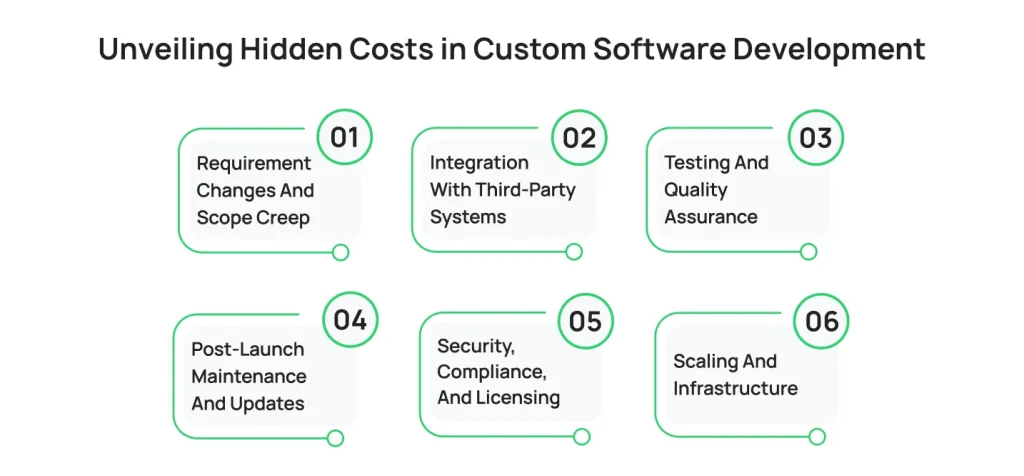
Requirement Changes and Scope Creep
Even a well-defined project plan can change as development progresses. New feature requests or modifications, known as scope creep, require extra development time, resources, and testing. Clear communication with your development team and a detailed project scope from the start can help minimize these unexpected costs.
Integration with Third-Party Systems
Custom software often needs to connect with existing tools, databases, or external platforms. These integrations may be more complex than anticipated, requiring specialized expertise. Additionally, many third-party services come with licensing or subscription fees, which add to recurring costs. Early assessment of integration requirements helps reduce surprises.
Testing and Quality Assurance
Thorough testing is essential to deliver secure, reliable, and high-performing software. This includes functional testing, performance evaluation, and security audits. Allocating realistic budgets for quality assurance ensures that your software is robust, but it can increase development costs if underestimated.
Post-Launch Maintenance and Updates
Launching software is just the beginning. Regular updates, bug fixes, and performance optimizations are necessary to keep it secure and efficient. Maintenance costs can accumulate over time, so businesses must plan for ongoing support in their overall budget.
Security, Compliance, and Licensing
Meeting data protection laws, industry-specific regulations, and global security standards is critical in Dubai. Implementing encryption, multi-factor authentication, audit logs, and compliance checks adds cost. On top of this, licensing fees for software tools, APIs, or proprietary frameworks further contribute to the total investment.
Scaling and Infrastructure
As your business grows, software may need to support more users, data, or features. Scaling requires additional cloud hosting, server upgrades, and performance optimizations. These infrastructure improvements, along with the associated development effort, add another layer to the overall cost.
Strategies to Optimize Software Development Costs in Dubai
Building custom software doesn’t mean stretching your budget unnecessarily. With careful planning, smart resource allocation, and strategic decisions, businesses in Dubai can control costs while still achieving high-quality results. Here are seven proven strategies to optimize development costs effectively:
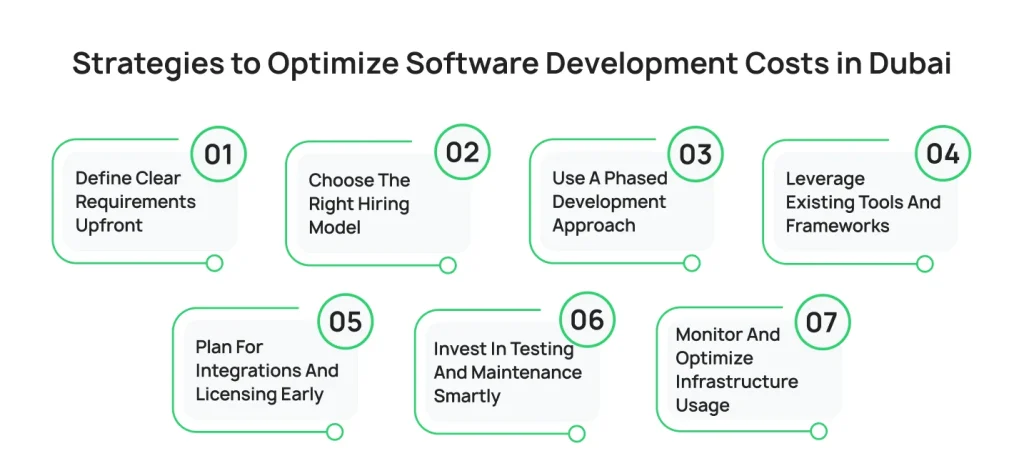
Define Clear Requirements Upfront
A detailed project scope is the foundation of cost control. By identifying essential features, workflows, and technical requirements before development begins, you can minimize surprises and avoid unnecessary iterations. Strategic methods include:
- Conducting workshops with stakeholders to capture business goals and functional needs.
- Prioritizing must-have versus nice-to-have features for phased development.
- Creating visual wireframes or prototypes to clarify expectations with the development team.
Clear documentation reduces the risk of scope creep, helps the team work efficiently, and ensures that every development hour contributes directly to business value.
Choose the Right Hiring Model
The engagement model can dramatically impact your overall expenditure. Each model, fixed-price, time-and-material, or dedicated team, has its advantages, and the right choice depends on your project:
- Fixed-price: Ideal for projects with a well-defined scope. Provides predictable costs and deadlines.
- Time-and-material: Best for evolving or complex projects where flexibility is required. You pay for actual development hours.
- Dedicated team: Suitable for large-scale, long-term projects. Ensures consistent focus and expertise, reducing delays and miscommunication.
Strategically selecting the model based on project complexity, team expertise, and timeline ensures you maximize value while controlling unnecessary overhead.
Use a Phased Development Approach
Developing software in phases, starting with a Minimum Viable Product (MVP), allows businesses to test their ideas before committing to full-scale investment. Strategic methods include:
- Launching an MVP to validate core functionalities and gather user feedback.
- Iteratively adding advanced features based on real-world usage and demand.
- Measuring performance and adoption before scaling the infrastructure or feature set.
This approach reduces upfront costs, minimizes risks of building unneeded features, and ensures that each development phase contributes measurable value.
Leverage Existing Tools and Frameworks
Building every component from scratch is often unnecessary and expensive. Using pre-built frameworks, libraries, and APIs can significantly reduce development effort. Strategic methods include:
- Choosing mature, well-documented frameworks with community support.
- Reusing tested modules or microservices for common functionalities.
- Integrating open-source tools for analytics, authentication, or reporting rather than custom-building them.
This not only saves time and money but also improves reliability and reduces long-term maintenance challenges.
Plan for Integrations and Licensing Early
Third-party integrations and software licenses can be a major cost driver if not addressed during the planning phase. Strategic methods include:
- Mapping out all external systems, APIs, and software services your project depends on.
- Negotiating subscription fees, licensing terms, and usage plans in advance.
- Factoring in recurring costs such as cloud-based tools, analytics platforms, or payment gateways.
Early planning prevents unexpected expenses mid-project and allows you to choose cost-effective, scalable solutions.
Invest in Testing and Maintenance Smartly
Testing and maintenance are often underestimated but are essential to avoid expensive fixes later. Strategic methods include:
- Implementing automated testing for repeated scenarios to reduce manual effort.
- Scheduling periodic updates and patch management to maintain security and performance.
- Prioritizing testing for high-impact areas such as security, payment flows, and critical business logic.
By allocating sufficient resources strategically, you can prevent downtime, ensure quality, and reduce long-term technical debt.
Monitor and Optimize Infrastructure Usage
Software infrastructure, especially in cloud-based environments, can become a hidden cost if not managed properly. Strategic methods include:
- Regularly monitoring server usage, storage, and bandwidth consumption.
- Scaling resources dynamically based on real-time demand instead of over-provisioning.
- Choosing cost-effective cloud plans and optimizing database queries, caching, and load distribution.
This approach ensures you only pay for what you use while maintaining performance and scalability, avoiding unnecessary recurring expenses.
Why Choose Cubix for Your Software Project
Understanding software development costs in Dubai is only part of the picture. The real success comes from working with a partner who can deliver secure, scalable, and efficient solutions. Cubix, a trusted software development company in Dubai, has been turning ideas into reliable software since 2008, helping businesses in Dubai and globally achieve measurable results.

Here’s what makes Cubix the right choice:
- Structured Development Approach: Every project follows a clear, agile workflow to meet deadlines, stay within budget, and maintain top-notch quality.
- Experienced Professionals: Our team of 350+ developers, designers, and strategists brings years of hands-on experience to handle complex software requirements.
- Cutting-Edge Technology: From AI and blockchain to IoT and cloud solutions, we build software that’s ready for the future.
- Business-Focused Solutions: Cubix aligns your software with Dubai’s market demands to ensure relevance, efficiency, and long-term value.
- Proven Success Stories: At Cubix, results speak for themselves. Since 2008, we’ve helped over 600 satisfied clients in Dubai and worldwide turn ideas into impactful software solutions, delivering quality, innovation, and measurable results.
[blog_cta_2]
Final Thoughts
You now have a clear picture of what shapes software development costs in Dubai, from pricing ranges and technical complexity to hidden expenses and smart cost-control strategies. The real difference, however, lies in choosing a partner who can balance quality, scalability, and budget without cutting corners.
Cubix is a trusted name that combines global expertise in delivering custom software, mobile applications, enterprise platforms, and AI-powered solutions. With a structured development approach and transparent planning process, our team ensures you understand where every dirham is invested. From MVP development to large-scale digital ecosystems, we focus on building secure, scalable solutions aligned with your long-term business goals.
If you’re planning a software project in the UAE, this is the right time to move forward with clarity and confidence.
Book a consultation with Cubix to receive a tailored cost estimate built around your exact requirements. Let’s build software that drives real business growth.
Frequently Asked Questions
1. How much does software development cost in Dubai?
The cost of custom software development in Dubai can range from AED 146,000 to AED 1,800,000, depending on project complexity, required features, compliance needs, and scalability. Simple internal tools are more affordable, while enterprise-grade platforms or fintech solutions with advanced security and integrations demand higher investment.
2. How long does it take to develop software in Dubai?
Timelines vary based on project size and complexity. Basic applications may take 3–6 months, moderately complex systems 6–9 months, and large enterprise solutions or highly integrated platforms can take 12–24 months. Proper planning and phased development help keep delivery on track.
3. What factors influence software development costs in Dubai?
Several elements drive cost, including design complexity, backend architecture, third-party integrations, compliance requirements, technology stack, and the size and expertise of the development team. Hidden costs like licensing, infrastructure, and ongoing maintenance can also affect the total investment.
4. What types of software can I develop, and how does this affect cost?
Different types of software have unique requirements. MVPs are cost-effective for testing ideas, while mobile apps, SaaS platforms, ERP, CRM, and enterprise software involve more development effort, integrations, and security measures, which increase the overall budget.
5. Why should I choose Cubix for my software development project in Dubai?
Cubix has been delivering reliable, secure, and scalable software since 2008. Our experienced team aligns technology with your business goals, provides transparent cost estimates, and ensures timely delivery, helping businesses in Dubai and globally achieve measurable results and long-term value.