Blog Summary
- Blockchain development cost in Dubai ranges from AED 110,000 to AED 2,000,000+ ($30,000 to $550,000+), based on complexity, features, and scalability.
- Basic blockchain apps cost much less than advanced solutions like DeFi platforms or enterprise systems.
- The UAE blockchain ecosystem is growing rapidly with strong adoption across industries.
- The UAE has recorded over $34 billion in digital asset activity, reflecting rising market demand
- Additional costs include smart contract audits, infrastructure, compliance, and maintenance
- Success depends on clear planning, defined requirements, and choosing the right development approach.
[blog_cta]
Blockchain development in Dubai is no longer an emerging trend; it has become a strategic necessity for businesses aiming to build secure, transparent, and scalable digital systems. As industries such as finance, real estate, logistics, and government accelerate their digital transformation, demand for blockchain solutions continues to rise sharply in 2026. The cost of developing a blockchain application in Dubai typically ranges from AED 110,000 to AED 2,000,000+ ($30,000 – $550,000+), depending on complexity, functionality, and compliance requirements. While basic applications like MVPs and wallets remain relatively affordable, advanced systems such as DeFi platforms, NFT marketplaces, and enterprise blockchain networks require significantly higher investment due to security and scalability needs.
Cubix, a trusted blockchain development company, specializes in delivering secure, scalable, and enterprise-grade blockchain solutions for businesses in Dubai, combining strong architecture, advanced security, and future-ready digital systems.
This blog will guide you through the complete cost structure, key pricing drivers, and practical insights to help you make informed decisions in Dubai’s evolving blockchain ecosystem.
Blockchain Development Cost in Dubai: 2026 Overview
Blockchain systems are fundamentally different from traditional applications. They operate on decentralized infrastructure, rely on smart contracts, and require significantly higher security validation.
Because of this, pricing is not fixed. It scales with technical depth and business complexity.
Cost Overview by Project Type
| Project Type | Cost (AED) | Timeline | Use Case |
| Basic Blockchain Apps | AED 110,000 – AED 220,000 | 3–6 months | MVPs, wallets |
| Mid-Level dApps | AED 220,000 – AED 650,000 | 6–9 months | SaaS platforms, integrations |
| Enterprise Blockchain | AED 650,000 – AED 2,000,000+ | 9–18+ months | Large-scale ecosystems |
Why Blockchain Development Costs Vary in Dubai
Many businesses assume blockchain development follows a fixed pricing model.
In reality, blockchain projects are priced based on technical depth, not just development hours.
Unlike conventional applications, blockchain systems involve decentralized infrastructure, smart contracts, irreversible transactions, and significantly higher security standards. This makes planning and architecture far more critical from the beginning.
Several factors directly influence the final blockchain development cost:
- Smart contract complexity and logic depth
- Blockchain platform selection (Ethereum, Hyperledger, BSC, etc.)
- Security architecture and audit requirements
- Integration with external systems and APIs
- Compliance and UAE regulatory obligations
- Experience level of the development team
- Infrastructure scaling and long-term maintenance needs
Because blockchain systems are often immutable after deployment, businesses must invest more heavily in planning, testing, and validation upfront.
This increases initial development costs but significantly reduces operational risks, security vulnerabilities, and expensive post-launch failures.
With this foundation in mind, let’s look at how blockchain app development costs scale based on actual project complexity.
Detailed Breakdown of Blockchain App Development Cost in the UAE Market
Many businesses start evaluating blockchain projects with the assumption that pricing can be pinned to a fixed number. In reality, that approach rarely holds. In the UAE, blockchain development cost is shaped by the technical ambition of the product, the complexity of its architecture, and the level of security and scalability it demands.
A simple decentralized application and a full-scale enterprise blockchain ecosystem are not just different in size; they are fundamentally different engineering challenges with entirely different investment structures.
To bring clarity to this, here’s a structured breakdown of how costs typically scale based on real-world project complexity.
Cost Breakdown by Project Complexity
| Project Type | Key Features | Estimated Cost (AED) | Estimated Cost (USD) | Timeline |
| Basic | Wallet integration, simple transactions, basic smart contracts | 110,000 – 220,000 | $30,000 – $60,000 | 3 – 6 months |
| Moderate | dApp development, API integrations, user roles, dashboards | 220,000 – 550,000 | $60,000 – $150,000 | 6 – 9 months |
| Advanced | DeFi features, NFT modules, real-time processing, and high security | 550,000 – 1,200,000 | $150,000 – $325,000 | 9 – 12 months |
| Enterprise | Full ecosystem, compliance systems, scalability, integrations | 1,200,000 – 2,000,000+ | $325,000 – $550,000+ | 12 – 18+ months |
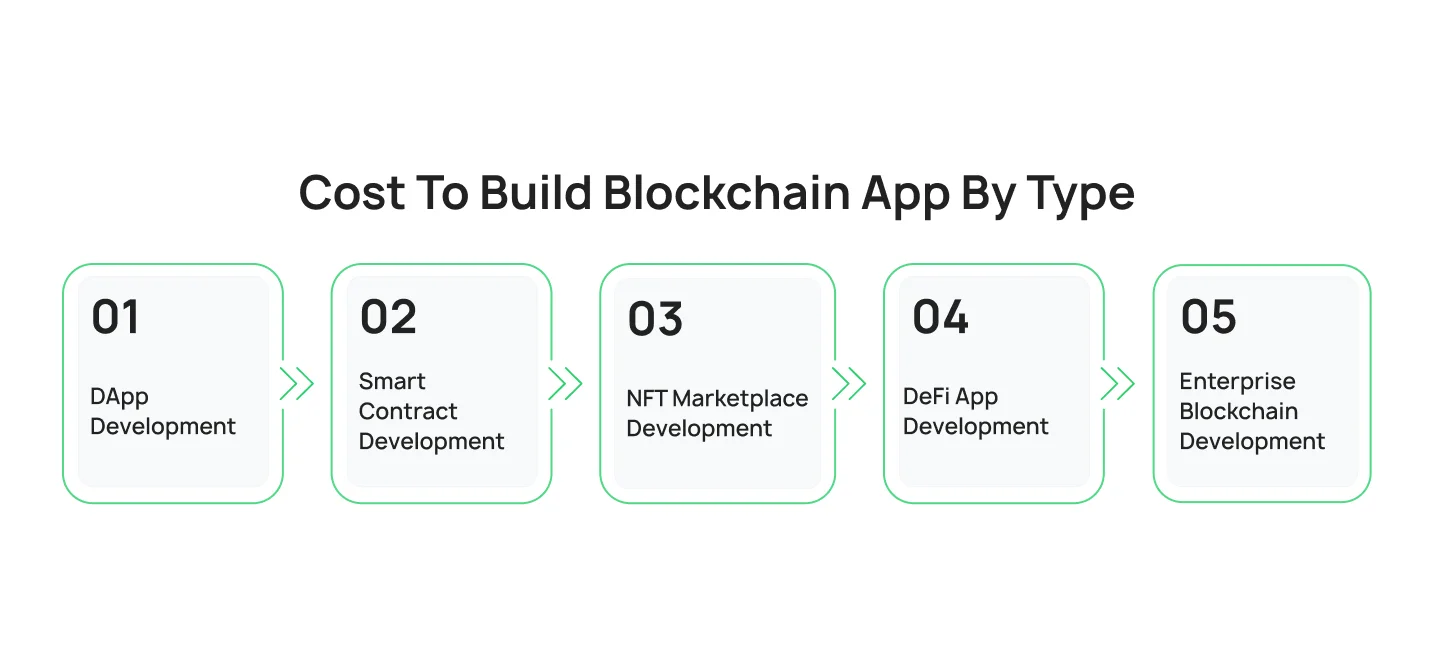
Cost to Build Blockchain App by Type
Different blockchain applications come with different technical requirements. Below is a detailed breakdown based on the most common use cases.
- dApp Development
The cost of dApp development depends on how decentralized your application is and how many features it includes.
- Estimated Cost: AED 220,000 – AED 600,000
- Timeline: 4 – 9 months
Includes:
- Smart contract logic
- Frontend interface
- Wallet integration
- Backend services
dApps are one of the most common blockchain products because they combine usability with decentralized functionality.
- Smart Contract Development
Smart contracts are the backbone of any blockchain application. Pricing changes depending on the depth of functionality and system design.
Estimated Cost: AED 15,000 – AED 150,000+
- Timeline: 2 – 6 weeks
Factors affecting cost:
- Contract complexity
- Number of functions
- Audit requirements
- Blockchain platform
A simple contract is affordable, but complex contracts with multiple conditions and integrations require more time and testing.
- NFT Marketplace Development
NFT platforms require multiple components to work together, which increases overall costs.
- Estimated Cost: AED 300,000 – AED 900,000+
- Timeline: 6 – 12 months
Includes:
- NFT minting system
- User marketplace
- Wallet integration
- Payment processing
- Royalty management
The cost increases further if you add advanced features like auctions, multi-chain support, or analytics.
- DeFi App Development
DeFi platforms are among the most complex blockchain applications due to their financial logic and security needs.
- Estimated Cost: AED 500,000 – AED 1,500,000+
- Timeline: 8 – 14 months
Includes:
- Lending/borrowing systems
- Liquidity pools
- Staking mechanisms
- Smart contract automation
These apps require strong security and auditing, which significantly increases development costs.
- Enterprise Blockchain Development
Enterprise blockchain solutions are built for scalability, performance, and integration with existing systems.
- Estimated Cost: AED 800,000 – AED 2,000,000+
- Timeline: 10 – 18+ months
Includes:
- Private blockchain networks
- ERP/CRM integrations
- High-level security
- Data management systems
This category represents the highest level of blockchain development pricing due to its complexity and long-term requirements.
Blockchain App Development Cost Breakdown by Phase
When planning a blockchain project, understanding how your budget is distributed across each stage helps you make better decisions and avoid unexpected expenses. Similar to software development, blockchain projects follow a structured lifecycle, but with additional focus on security, smart contracts, and testing.
Each phase contributes directly to the overall blockchain development cost in Dubai, and skipping or underestimating any stage can lead to higher costs later.
| Development Stage | Estimated Cost (AED) | Estimated Cost (USD) | Timeline |
| Discovery & Planning | 10,000 – 40,000 | $3,000 – $11,000 | 1 – 3 weeks |
| UI/UX Design | 25,000 – 180,000 | $7,000 – $50,000 | 3 – 6 weeks |
| Development | 100,000 – 1,000,000+ | $27,000 – $270,000+ | 4 – 12 months |
| Testing & QA | 20,000 – 200,000 | $5,500 – $55,000 | 2 – 4 weeks |
| Deployment | 15,000 – 100,000 | $4,000 – $27,000 | 1 – 2 weeks |
| Post-Launch Support | 15,000 – 150,000+ | $4,000 – $40,000+ | Ongoing |
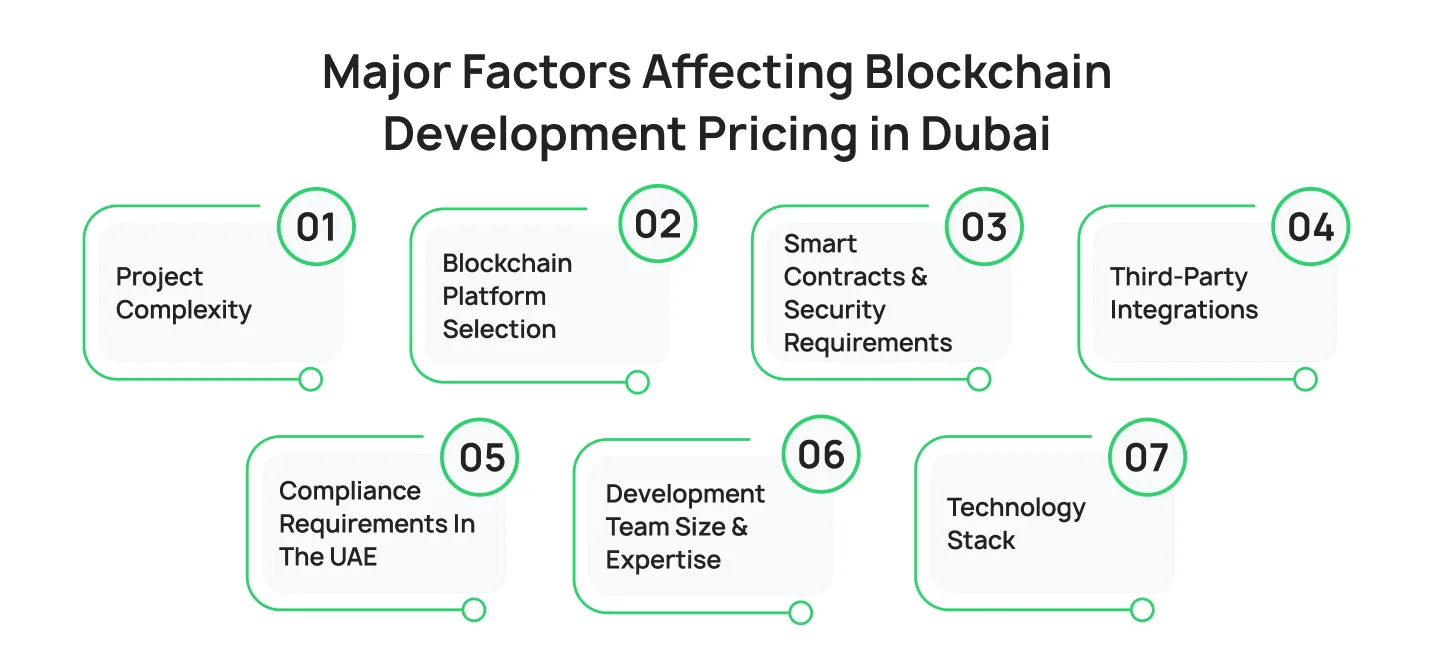
Major Factors Affecting Blockchain Development Pricing in Dubai
As discussed earlier, the blockchain development cost in Dubai can vary significantly from one project to another. This is because blockchain systems are not standard applications. They require deeper planning, stronger security, and often involve financial or sensitive data.
Understanding these cost drivers helps you plan your budget more accurately and avoid unnecessary expenses.
1. Project Complexity
Costs increase as the architecture moves from simple applications to enterprise-grade systems.
A basic application with limited functionality will require less time and fewer resources. On the other hand, a complex system with advanced features such as DeFi logic, multi-user roles, or real-time processing will increase both development time and cost.
More complexity means:
- More development hours
- More testing cycles
- Higher chances of revisions
This directly increases the overall blockchain development pricing.
2. Blockchain Platform Selection
The platform you choose has a direct impact on development cost.
Popular options include:
- Ethereum
- Binance Smart Chain
- Hyperledger
Each platform has different requirements, tools, and development complexity.
For example:
- Ethereum offers flexibility but requires higher gas optimization efforts
- Hyperledger is suitable for enterprise use, but it needs specialized expertise
Choosing the wrong platform can lead to higher long-term costs, so this decision must be made carefully during the planning phase.
3. Smart Contracts & Security Requirements
Smart contracts are a core part of any blockchain application. The more complex your contracts are, the more time and expertise they require.
Cost increases due to:
- Multiple contract functions
- Complex business logic
- Need for audits and testing
Security is a major concern in blockchain. According to Chainalysis, billions of dollars have been lost globally due to smart contract vulnerabilities and exploits. This is why companies invest heavily in audits and secure development practices.
Strong security measures include:
- Contract audits
- Penetration testing
- Encryption
- Secure key management
All of these add to the smart contract development cost, but they are essential.
4. Third-Party Integrations
Most blockchain applications need to connect with external systems.
Common integrations include:
- Payment gateways
- KYC/AML verification systems
- External APIs
- Enterprise tools
Some integrations are simple, while others require custom development and ongoing maintenance.
These integrations increase:
- Development time
- Testing effort
- Long-term costs
5. Compliance Requirements in the UAE
Dubai has a growing regulatory framework for blockchain and digital assets. This makes compliance an important cost factor.
Depending on your application, you may need to consider:
- Data protection laws
- Financial regulations
- Licensing requirements
For example, regulatory bodies like VARA define rules around digital asset operations.
Compliance adds cost because it requires:
- Legal consultation
- Additional security measures
- Documentation and reporting
However, it also reduces risks and ensures long-term sustainability.
6. Development Team Size & Expertise
The team you choose directly impacts your budget.
A small team may reduce costs but increase development time. A larger team can deliver faster but comes with higher expenses.
Typical roles include:
- Blockchain developers
- Frontend and backend developers
- UI/UX designers
- QA engineers
- Project managers
Experienced developers charge more, but they reduce errors, improve quality, and save time in the long run.
7. Technology Stack
The technology stack plays a major role in determining the final cost.
Standard technologies are more affordable because developers are widely available. However, blockchain requires specialized tools and expertise.
Advanced technologies such as:
- AI integration
- Real-time analytics
- Cross-chain functionality
can increase development effort and cost.
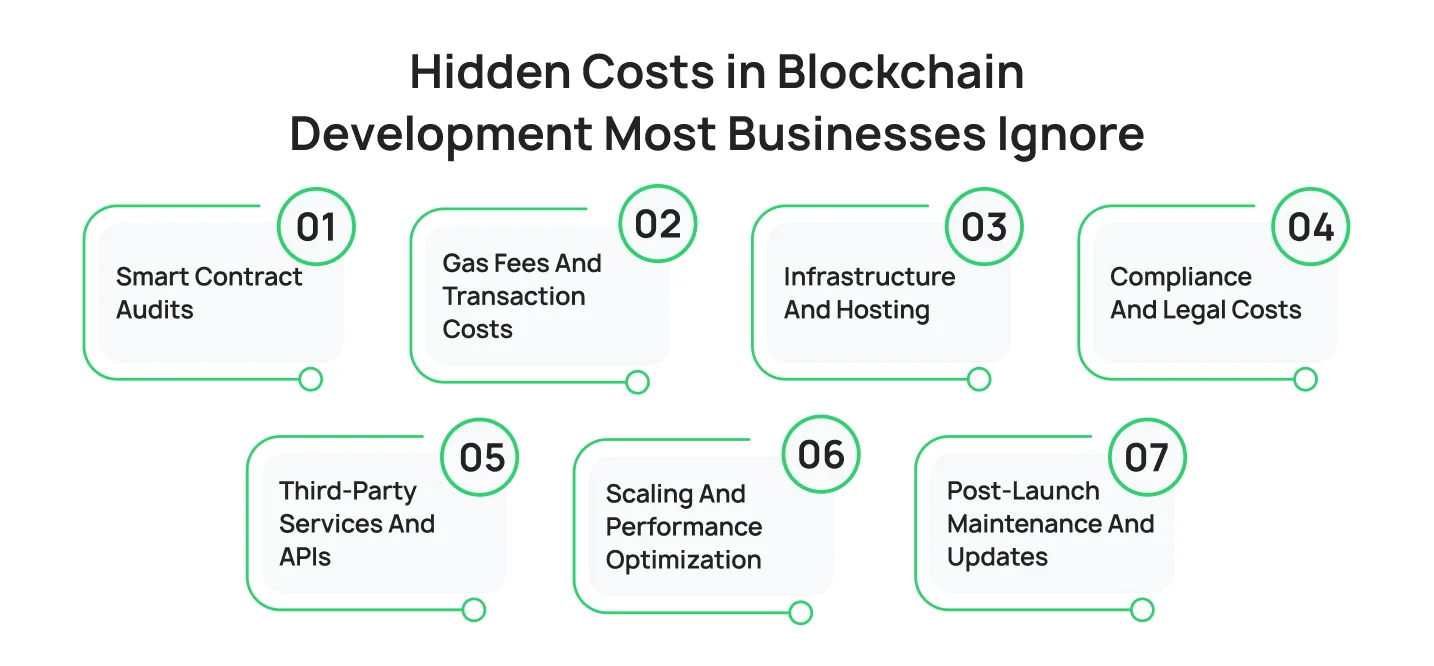
Hidden Costs in Blockchain Development Most Businesses Ignore
When estimating the blockchain development cost in Dubai, most businesses focus only on design and development. In reality, several hidden costs can significantly increase your total investment if they are not planned from the start.
Understanding these costs early helps you avoid budget overruns and ensures your project remains financially manageable.
1. Smart Contract Audits
Smart contracts cannot be easily changed after deployment. Any vulnerability can lead to serious financial loss.
This is why audits are essential.
- Estimated Cost: AED 20,000 – AED 200,000+
What it includes:
- Code review
- Vulnerability testing
- Logic validation
Audits are a major part of the smart contract development cost, especially for DeFi or financial applications.
2. Gas Fees and Transaction Costs
Blockchain networks require fees to process transactions.
For example:
- Ethereum gas fees can fluctuate based on network demand
- High traffic increases costs
These costs are often ignored during planning but can become significant after launch, especially for applications with frequent transactions.
3. Infrastructure and Hosting
Even though blockchain is decentralized, your application still needs infrastructure.
This includes:
- Cloud hosting (AWS, Azure, etc.)
- Node services
- APIs and backend servers
- Estimated Cost: AED 5,000 – AED 50,000+ per month
As your user base grows, infrastructure costs increase due to higher usage and scaling requirements.
4. Compliance and Legal Costs
Dubai has a structured regulatory environment for blockchain and digital assets.
Businesses may need:
- Legal consultation
- Licensing support
- Compliance documentation
Regulatory bodies like VARA require certain standards for blockchain-based businesses.
These costs vary widely but are essential for long-term operations.
5. Third-Party Services and APIs
Many blockchain applications rely on external services such as:
- KYC/AML verification
- Payment gateways
- Analytics tools
These services often charge:
- Subscription fees
- Transaction-based fees
Over time, these recurring costs can add up and affect your overall budget.
6. Scaling and Performance Optimization
As your application grows, you may need to:
- Upgrade infrastructure
- Optimize smart contracts
- Improve performance
Scaling is not a one-time cost. It requires ongoing investment to maintain speed, reliability, and user experience.
7. Post-Launch Maintenance and Updates
Launching your app is only the beginning.
Ongoing costs include:
- Bug fixes
- Feature updates
- Security patches
- Performance improvements
- Estimated Cost: 15% – 25% of the initial development cost annually
Ignoring maintenance can lead to system failures, security risks, and poor user experience.
Blockchain Development Pricing Models in Dubai
When planning your project, choosing the right pricing model is just as important as estimating the blockchain development cost in Dubai. The pricing structure you select will affect your flexibility, control, and overall budget.
Each model works differently, so understanding them helps you make smarter financial decisions.
Common Pricing Models
| Pricing Model | Best For | Cost Range (AED) | Flexibility |
| Fixed Price | Small, well-defined projects | 110,000 – 300,000 | Low |
| Time & Material | Medium to complex projects | 220,000 – 1,000,000+ | High |
| Dedicated Team | Long-term or enterprise projects | 80,000 – 300,000/month | Very High |
1. Fixed Price Model
This model works best when your project scope is clear from the beginning.
How it works:
- Total cost is agreed up front
- Timeline and deliverables are fixed
Pros:
- Predictable budget
- Clear deadlines
Cons:
- Limited flexibility
- Changes can increase cost
This model is suitable for MVPs or simple blockchain applications with defined requirements.
2. Time and Material Model
In this model, you pay based on actual hours worked and resources used.
How it works:
- Cost depends on development time. The scope can evolve during the project.
Pros:
- Flexible
- Suitable for complex projects
Cons:
- Cost may increase if the scope expands
This is the most common model for projects where requirements are not fully finalized.
3. Dedicated Team Model
This model gives you a full team working exclusively on your project.
How it works:
- Monthly cost for a team
- Long-term collaboration
Pros:
- Full control
- Faster development
- Better scalability
Cons:
- Higher monthly commitment
This model is ideal for enterprise projects or businesses building large blockchain ecosystems.
Strategies to Optimize Blockchain Development Cost
Building a blockchain application does not mean overspending. With the right approach, you can control your budget while still achieving high-quality results.
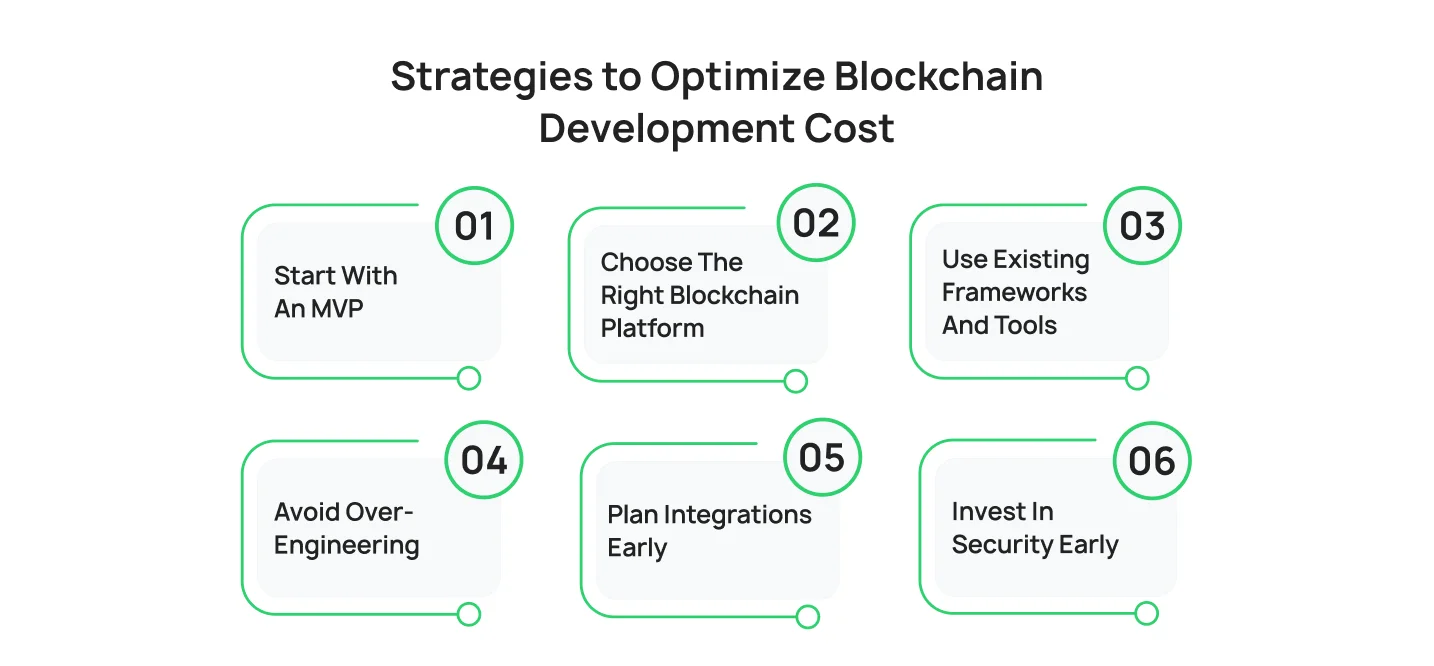
1. Start with an MVP
Instead of building everything at once, focus on a Minimum Viable Product.
This allows you to:
- Test your idea
- Gather user feedback
- Reduce initial investment
You can add advanced features later based on real user needs.
2. Choose the Right Blockchain Platform
Selecting the right platform can save both time and cost.
For example:
- Ethereum offers flexibility, but it can have higher costs
- Other platforms may provide lower fees depending on the use case
Choosing wisely reduces long-term operational expenses.
3. Use Existing Frameworks and Tools
Building everything from scratch increases cost and time.
Instead:
- Use proven libraries
- Leverage existing frameworks
- Integrate ready-made solutions
This speeds up development and reduces risk.
4. Avoid Over-Engineering
Many businesses try to add too many features at once.
This leads to:
- Higher development cost
- Longer timelines
- Unnecessary complexity
Focus on essential features first, then expand gradually.
5. Plan Integrations Early
Third-party integrations can become expensive if not planned.
Identify:
- Required APIs
- External tools
- Ongoing subscription costs
Early planning helps you control both development and operational expenses.
6. Invest in Security Early
Security is often seen as an additional cost, but ignoring it can be far more expensive.
Early investment in:
- Secure architecture
- Smart contract audits
- Proper testing
reduces risks and avoids costly fixes later.
ROI of Blockchain Development in the UAE

Understanding the blockchain development cost in Dubai is important, but the real decision comes down to value. Businesses invest in blockchain not just for technology, but for long-term efficiency, transparency, and new revenue opportunities.
Blockchain reduces reliance on intermediaries, which lowers operational costs over time. It also improves data transparency, making processes faster and more reliable across industries such as finance, supply chain, and real estate.
According to Deloitte, blockchain solutions can reduce operational costs by 30% to 50% in processes that involve intermediaries or manual verification. This is one of the main reasons enterprises continue to invest in blockchain despite higher initial costs.
Where Blockchain Delivers Value
- Cost Reduction: Eliminates intermediaries and manual processes
- Transparency: Real-time and tamper-proof data
- Security: Strong encryption and decentralized structure
- Automation: Smart contracts reduce manual work
- New Revenue Streams: Tokenization, digital assets, and transaction fees
Long-Term Perspective
The cost to build a blockchain app may seem high initially, but businesses that focus on long-term scalability and efficiency often see strong returns over time.
Companies that adopt blockchain early also gain a competitive advantage, especially in markets like Dubai, where digital transformation is growing rapidly.
Future Trends in Blockchain Development 2026
Blockchain technology continues to evolve, and its future in the UAE looks strong. Businesses planning to invest should also consider upcoming trends that can influence both cost and strategy.
1. AI and Blockchain Integration
AI is being combined with blockchain to improve automation, data analysis, and decision-making. This increases development complexity but also adds significant business value.
2. Growth of Web3 Applications
Web3 is expanding rapidly, with more decentralized platforms and applications entering the market. This is increasing the demand for blockchain developers and influencing blockchain development pricing globally.
3. Tokenization of Assets
Real-world assets such as real estate, art, and commodities are being tokenized on blockchain. This trend is gaining traction in the UAE and is expected to drive new business models.
4. Enterprise Adoption
Large organizations are increasingly adopting blockchain for internal operations, supply chain management, and data security.
This is driving demand for enterprise blockchain development cost solutions and more advanced infrastructure.
Why Choose Cubix for Blockchain Development in Dubai

Understanding cost is only part of the process. The real success comes from working with a team that can deliver secure, scalable, and reliable blockchain solutions.
Cubix has been providing software and blockchain development services since 2008, helping businesses in Dubai and globally build high-performance digital products.
What Makes Cubix Different
- Structured Development Approach: Every project follows a clear process, from planning to deployment, ensuring timely delivery and controlled costs.
- Experienced Team: Our developers and engineers have experience across multiple industries and blockchain platforms.
- Focus on Security: We prioritize secure development practices, including smart contract audits and system protection.
- Scalable Solutions: Our systems are designed to grow with your business, ensuring long-term value.
Proven Results: With hundreds of successful projects, Cubix delivers solutions that align with business goals and market demands.
[blog_cta_2]
Final Thoughts
The blockchain app development cost in the UAE varies widely based on project requirements, complexity, and long-term goals. From simple MVPs to enterprise-grade platforms, every blockchain solution requires careful planning and a clear understanding of cost drivers.
The key to success is not just minimizing cost but investing wisely. Businesses that focus on scalability, security, and the right development strategy are more likely to achieve strong results.
If you are planning to build a blockchain application in Dubai, the best approach is to start with clear requirements, choose the right technology, and work with an experienced development partner.
Frequently Asked Questions
1. How much does blockchain development cost in Dubai?
Blockchain development cost in Dubai typically ranges from AED 110,000 to AED 2,000,000+, depending on complexity, features, security level, and scalability requirements.
2. How long does it take to build a blockchain app?
A basic blockchain application may take 3–6 months, while complex or enterprise solutions can take 9–18+ months.
3. What is the cost of smart contract development?
The smart contract development cost ranges from AED 15,000 to AED 150,000+, depending on complexity and security requirements.
4. What is the cost of dApp development?
The cost of dApp development typically ranges from AED 220,000 to AED 600,000, depending on features and integrations.
5. Is blockchain development expensive in the UAE?
Blockchain development can be more expensive than traditional software due to security, decentralization, and compliance requirements. However, it offers strong long-term value.
6. What factors affect blockchain development pricing?
Key factors include project complexity, platform selection, security requirements, integrations, compliance, and development team expertise.