Key Takeaways
- E-commerce development cost in Dubai usually ranges from AED 8,000 to AED 150,000+, depending on the platform, features, and business goals.
- The cost to build an e-commerce website in Dubai is shaped by platform choice, design quality, integrations, and product scale, not just development hours.
- Shopify and WooCommerce are cost-effective for startups, while custom ecommerce development costs increase for advanced features and scalability.
- Hidden costs like payment gateways, maintenance, hosting, and third-party tools can significantly impact the total budget.
- Choosing the right development approach early helps avoid rebuilding costs and supports long-term growth.
[blog_cta]
Dubai is no longer treating e-commerce as a side channel. It has become a core way businesses sell and grow. The UAE ecommerce market is expected to reach $9.2 billion by 2026, showing why more companies are investing in online stores.
This raises a common question: how much does e-commerce development cost in Dubai?
The answer varies. A basic store costs far less than a custom platform with advanced features and integrations. Many guides oversimplify this. Companies like Cubix often see that pricing depends more on business goals than just features.
E-commerce Development Cost in Dubai 2026 Price Breakdown
The e-commerce development cost in Dubai varies by project and is usually divided into pricing tiers. A basic e-commerce store can start from AED 10,000 to AED 20,000, while advanced custom platforms, multivendor marketplaces, or enterprise solutions can exceed AED 150,000. This wide range reflects differences in features, business complexity, and overall project scope, which is why quotes can vary significantly across Dubai and UAE agencies.
Here is a cleaner way to think about it:
| Project Type | Estimated Cost in AED | Estimated Cost in USD | Typical Timeline |
| Basic e-commerce store | 10,000 to 20,000 | 2,700 to 5,400 | 2 to 4 weeks |
| Growth-focused branded store | 20,000 to 45,000 | 5,400 to 12,250 | 1 to 2 months |
| Advanced e-commerce website | 45,000 to 90,000 | 12,250 to 24,500 | 2 to 4 months |
| Custom e-commerce platform | 90,000 to 180,000 | 24,500 to 49,000 | 4 to 8 months |
| Multivendor or enterprise marketplace | 180,000+ | 49,000+ | 6 months and above |
These figures are not random. They reflect the way commercial projects expand in cost once businesses move beyond a standard template setup. At the lower end, you are usually looking at a pre-built theme, limited page customization, a manageable product catalog, and a simple payment flow. At the higher end, the cost rises because development starts including custom logic, integration work, deeper UX planning, multi-role admin controls, vendor systems, custom APIs, and stronger infrastructure planning.
What a basic e-commerce budget usually gets you
A lower-budget ecommerce website in Dubai is usually suitable for a startup, a niche retailer, or a business testing online demand for the first time. This level often includes:
- a pre-designed theme
- core store pages
- product upload for a limited number of items
- standard checkout
- Basic payment setup
- responsive mobile layout
This type of build works best when speed matters more than heavy customization. It helps a business launch fast, validate demand, and avoid over-investing too early.
What a mid-range budget usually gets you
Once a business wants stronger branding and better store functionality, the budget moves up. This is where the cost to build an e-commerce website in Dubai starts reflecting conversion needs, not just launch needs. A mid-range ecommerce build often includes:
- custom-designed homepage and key landing pages
- category structure planning
- advanced filtering
- better product page layouts
- shipping and payment integrations
- basic SEO setup
- stronger mobile user experience
This range usually suits growing brands that want a store that looks more established and converts better than a standard off-the-shelf setup.
What pushes e-commerce costs into the higher bracket
The upper range is where the project stops being a simple storefront and starts becoming a real commerce system. Costs rise faster when the business needs:
- custom features
- multilingual functionality
- ERP or CRM integrations
- large product catalogs
- custom checkout flows
- customer account logic
- subscription models
- B2B pricing
- multivendor architecture
- advanced security and compliance workflows
This is also where the custom e-commerce development cost becomes harder to estimate with one generic number, because the quote depends on how the business operates behind the scenes, not just what users see on the front end. UAE ecommerce businesses also need to account for legal and tax handling realities, including VAT treatment for ecommerce transactions, which adds another practical layer to planning.
Why are Dubai prices often higher than expected
Many businesses expect e-commerce pricing to match low-cost offshore markets, but that is rarely the case. Projects often require stronger branding, better performance, mobile optimization, and smooth integration with local operations.
With rapid e-commerce growth, high internet usage, and a supportive digital environment, businesses in the UAE build stores with long-term scaling in mind. So instead of asking for the cheapest option, the real focus should be on what your business needs to perform and grow effectively.
What Decides the Cost to Build an E-commerce Website in Dubai
Once you understand the general price ranges, the next step is to understand why those prices change.
This is where most businesses make mistakes. They compare two quotes without knowing what is actually included inside them. One quote may look cheaper, but it often leaves out things that will be required later.
The e-commerce development cost is not decided by one factor. It is shaped by multiple layers that work together. When these layers increase, the cost increases with them.
Platform Choice
The platform is one of the first and most important decisions. It directly impacts both your initial investment and your ongoing costs.
Shopify E-commerce Development Cost
Shopify is one of the most widely used e-commerce platforms. It works on a subscription model where businesses pay monthly based on the plan they choose.
According to Shopify’s official pricing, plans vary depending on features, scalability, and business size.
From a development perspective, Shopify:
- reduces initial setup time
- provides built-in hosting and security
- allows faster launch
However, it comes with:
- monthly subscription fees
- paid apps for advanced features
- limited deep customization compared to custom builds
This makes Shopify a strong option for startups and small to mid-sized businesses that want to launch quickly.
WooCommerce E-commerce Development Cost
WooCommerce is a flexible option built on WordPress. The core software is free, but the actual cost comes from:
- hosting
- premium themes
- plugins
- maintenance
- security setup
WooCommerce works well when:
- You want more control over customization
- You already use WordPress
- You want flexibility without full custom development
The cost may look lower at the start, but it spreads over time through add-ons and technical maintenance.
Custom E-commerce Development Cost
Custom e-commerce development is built specifically for your business.
This approach is used when:
- Your business model is unique
- You need custom workflows
- You require deep integrations
- Scalability is a priority
Custom builds cost more because:
- Everything is developed from scratch
- The backend architecture is tailored
- Testing and security are more extensive
This is usually where the e-commerce platform development cost reaches the higher end.
Design Quality and User Experience
Design is not just about visual appearance. It affects how users navigate your store, find products, and complete purchases.
A basic template design is quick to implement and cost-effective. A custom design requires:
- UX research
- wireframing
- UI design
- testing
Research by Cubix shows that improving user experience can significantly increase conversion rates.
This is why businesses that focus on conversions invest more in design. The cost increases, but the return is usually higher.
Product Catalog Size and Structure
The size and structure of your product catalog have a direct impact on development effort.
A small store:
- fewer categories
- simple navigation
- basic filtering
A large store:
- complex category hierarchy
- advanced filtering
- search optimization
- bulk product handling
For example:
- 50 products require a simple setup
- 1,000+ products require planning, structuring, and automation
The more complex your catalog becomes, the more time is needed for development and optimization.
Custom Features and Functionality
Features are one of the biggest cost drivers in e-commerce development.
Basic features include:
- product pages
- cart and checkout
- user accounts
Advanced features include:
- real-time inventory updates
- AI-based recommendations
- subscription models
- loyalty programs
- multi-language support
- custom checkout flows
Each feature adds:
- development time
- testing effort
- backend logic
This is where many businesses underestimate the cost. Adding features later is often more expensive than planning them early.
Third Party Integrations: E-commerce websites rely heavily on external systems.
Common integrations include:
- payment gateways
- shipping providers
- CRM systems
- ERP systems
- marketing tools
Some integrations are simple plugins. Others require:
- API development
- data synchronization
- security handling
For example, connecting your store with a warehouse system or courier API increases both cost and complexity.
Payment Systems and Transaction Costs
Payment processing is essential for e-commerce.
Providers like Stripe charge transaction-based fees depending on usage.
These costs are not part of development, but they affect your total investment over time.
Businesses in Dubai also need to consider:
- local payment gateways
- currency handling
- transaction fees
Ignoring these costs can create budgeting issues after launch.
Security and Compliance Requirements
Security is a core part of e-commerce development, especially in markets like Dubai.
You need to protect:
- customer data
- payment information
- transactions
The UAE also has regulatory and tax requirements. The Federal Tax Authority outlines how VAT applies to e-commerce transactions and digital sales.
Implementing compliance and security includes:
- SSL encryption
- secure payment systems
- user data protection
- access control
These elements increase development effort but are essential for long-term business stability.
Development Team and Expertise
The team working on your project also impacts cost.
A typical e-commerce project may involve:
- project manager
- UI/UX designer
- frontend developer
- backend developer
- QA tester
A small team may reduce cost but extend timelines. A larger, experienced team can deliver faster, but at a higher cost.
The right balance depends on:
- project complexity
- timeline
- budget
Timeline and Urgency
Faster delivery often increases cost.
If a project needs to be completed quickly:
- More developers may be assigned
- timelines become compressed
- Testing cycles are tighter
This increases overall development cost.
Why These Factors Matter
When you combine all these factors, you start to see why e-commerce development costs vary so much.
Two businesses may both want an e-commerce website, but:
- One may need a simple store
- The other may need a full platform
That difference is what changes the budget.
The key is not just to ask for a price. The key is to understand what you are paying for and how it aligns with your business goals.
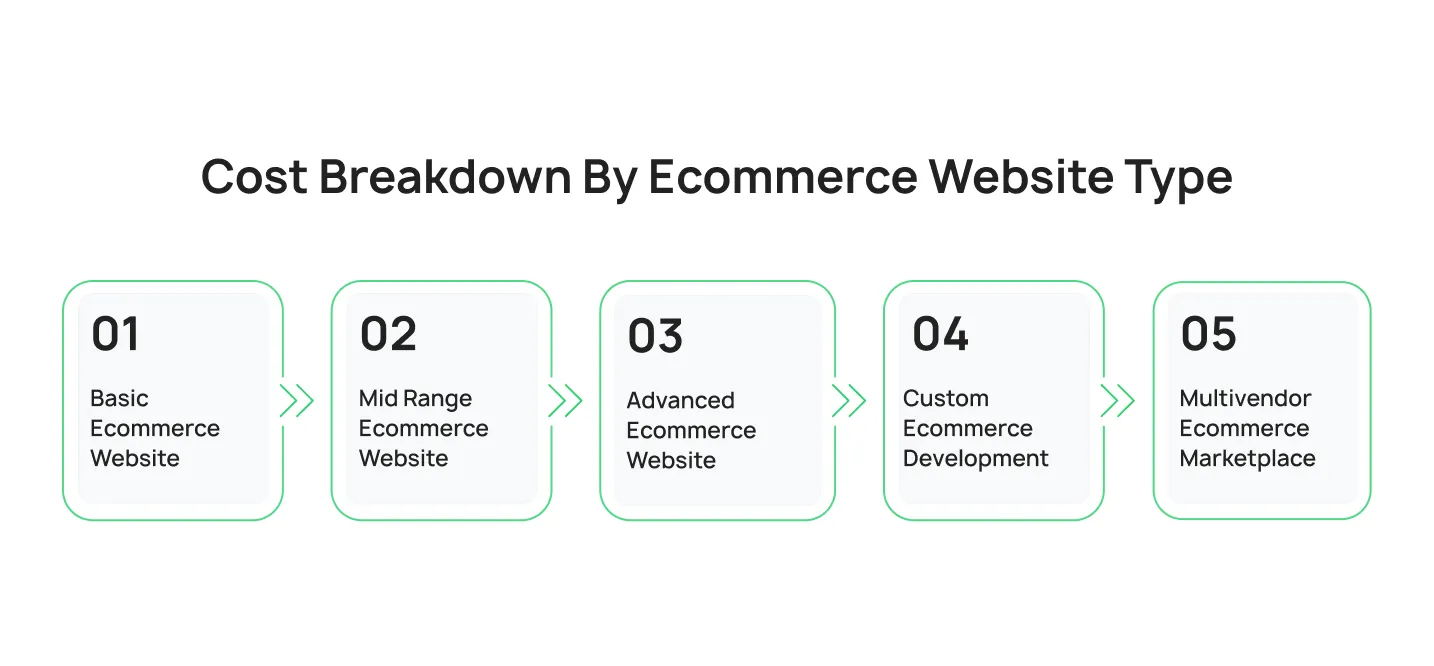
Cost Breakdown by E-commerce Website Type
Now that you understand what drives pricing, the next step is to break down how cost changes based on the type of e-commerce website you are building.
This is important because many businesses compare quotes without realizing they are comparing completely different types of projects.
A basic store, a branded ecommerce site, and a multivendor marketplace are not in the same category. Each one requires a different level of planning, development, and backend structure.
Basic E-commerce Website
This is the entry-level ecommerce setup. It is usually built using a pre-designed theme with minimal customization.
Best for:
- startups
- small retailers
- businesses testing online demand
What it includes:
- homepage and basic pages
- product listings
- standard checkout
- simple payment integration
- mobile responsive layout
Estimated Cost: AED 10,000 to AED 20,000
At this level, the focus is on speed and affordability. The goal is to launch quickly without investing heavily in custom features.
However, this setup has limitations. As your business grows, you may need to redesign or rebuild parts of the store.
Mid-Range E-commerce Website
This level is where businesses start investing in branding, structure, and performance.
Best for:
- growing ecommerce brands
- businesses with a larger product catalog
- Companies focusing on conversions
What it includes:
- custom homepage design
- structured categories and navigation
- product filtering
- optimized product pages
- payment and shipping integrations
- basic SEO setup
Estimated Cost: AED 20,000 to AED 45,000
At this stage, the store is no longer just functional. It is built to perform better and support growth.
Advanced E-commerce Website
This level introduces deeper functionality and stronger backend support.
Best for:
- established ecommerce businesses
- brands with complex requirements
- businesses scaling operations
What it includes:
- advanced UI and UX
- custom features
- integration with third-party tools
- improved performance optimization
- scalable structure
Estimated Cost: AED 45,000 to AED 90,000
This is where the e-commerce website development cost in the UAE starts reflecting a long-term strategy rather than just an initial launch.
Custom E-commerce Development
Custom e-commerce development is built around specific business needs.
Best for:
- unique business models
- B2B ecommerce
- subscription-based platforms
- businesses with complex workflows
What it includes:
- custom backend logic
- tailored user experience
- integration with ERP or CRM systems
- flexible and scalable architecture
Estimated Cost: AED 90,000 to AED 180,000+
This level requires more planning, more development time, and more testing. It is not just about building a website. It is about building a system that supports your operations.
Multivendor E-commerce Marketplace
This is one of the most complex e-commerce setups.
Best for:
- marketplace businesses
- platforms connecting buyers and sellers
- large-scale ecommerce operations
What it includes:
- vendor registration and dashboards
- commission management
- product approval workflows
- multi-user access control
- payment splitting logic
Estimated Cost: AED 180,000 to AED 300,000+
The multivendor ecommerce marketplace cost is higher because it requires multiple systems working together, not just a single storefront.
Shopify vs WooCommerce vs Custom Ecommerce Development
Choosing the right platform is one of the most important decisions you will make. It directly affects both your initial cost and your long-term expenses.
Here is a clear comparison:
| Platform | Best For | Cost Range | Ongoing Cost | Limitation |
| Shopify | Startups and small businesses | Low to Medium | Monthly subscription + apps | Limited deep customization |
| WooCommerce | Flexible and scalable stores | Low to Medium | Hosting + plugins + maintenance | Requires technical management |
| Custom Development | Large or complex businesses | High | Maintenance + infrastructure | Higher upfront cost |
Shopify E-commerce Development Cost
Shopify is designed for ease of use and quick setup.
Advantages:
- fast launch
- built-in hosting
- secure payment system
- minimal technical management
Cost factors:
- monthly subscription
- paid apps
- transaction fees
This makes Shopify a strong option for businesses that want to start quickly without dealing with technical complexity.
WooCommerce E-commerce Development Cost
WooCommerce offers more flexibility but requires more involvement.
Advantages:
- full control over customization
- large plugin ecosystem
- suitable for content-driven ecommerce
Cost factors:
- hosting and server setup
- premium plugins
- ongoing maintenance
- security management
WooCommerce can be cost-effective initially, but long-term costs depend on how the store evolves.
Custom E-commerce Development Cost
Custom development gives full control over functionality and scalability.
Advantages:
- tailored features
- scalable architecture
- integration flexibility
Cost factors:
- A higher development effort
- longer timelines
- ongoing maintenance
This option is best when your business needs something that standard platforms cannot provide.
Choosing the Right E-commerce Approach
The biggest mistake businesses make is choosing based on price alone.
Instead, you should choose based on:
- Your current business stage
- Your expected growth
- Your operational complexity
For example:
- A startup may benefit from Shopify
- A growing brand may prefer WooCommerce
- A large business may need custom development
The right choice reduces long-term cost and avoids rebuilding your store later.
Step-by-Step E-Commerce Development Cost by Project Phase
To understand e-commerce development costs properly, you need to see how the budget is distributed across different stages.
Most businesses only focus on the final quote, but the real clarity comes from understanding where the money actually goes.
A structured e-commerce project usually follows these phases:
| Development Phase | Estimated Cost Share | What It Covers | Timeline |
| Discovery and Planning | 5% – 10% | business goals, feature planning, wireframes | 1–2 weeks |
| UI and UX Design | 10% – 20% | layouts, user journeys, design systems | 2–4 weeks |
| Frontend Development | 15% – 25% | visual interface, responsiveness | 2–6 weeks |
| Backend Development | 25% – 35% | logic, database, integrations | 4–12 weeks |
| Integration Setup | 10% – 15% | payments, shipping, APIs | 2–4 weeks |
| Testing and QA | 10% – 15% | bug fixing, performance checks | 1–3 weeks |
| Launch and Deployment | 5% | go-live setup, final checks | 1 week |
Why this breakdown matters
This structure shows that development is not just about coding. Planning, design, integration, and testing all contribute to the final cost.
For example:
- Skipping planning often leads to higher costs later
- Weak design affects conversion performance
- Poor testing leads to post-launch issues
A well-structured project reduces risk and avoids unnecessary spending.
Hidden Costs Most Dubai E-commerce Businesses Miss
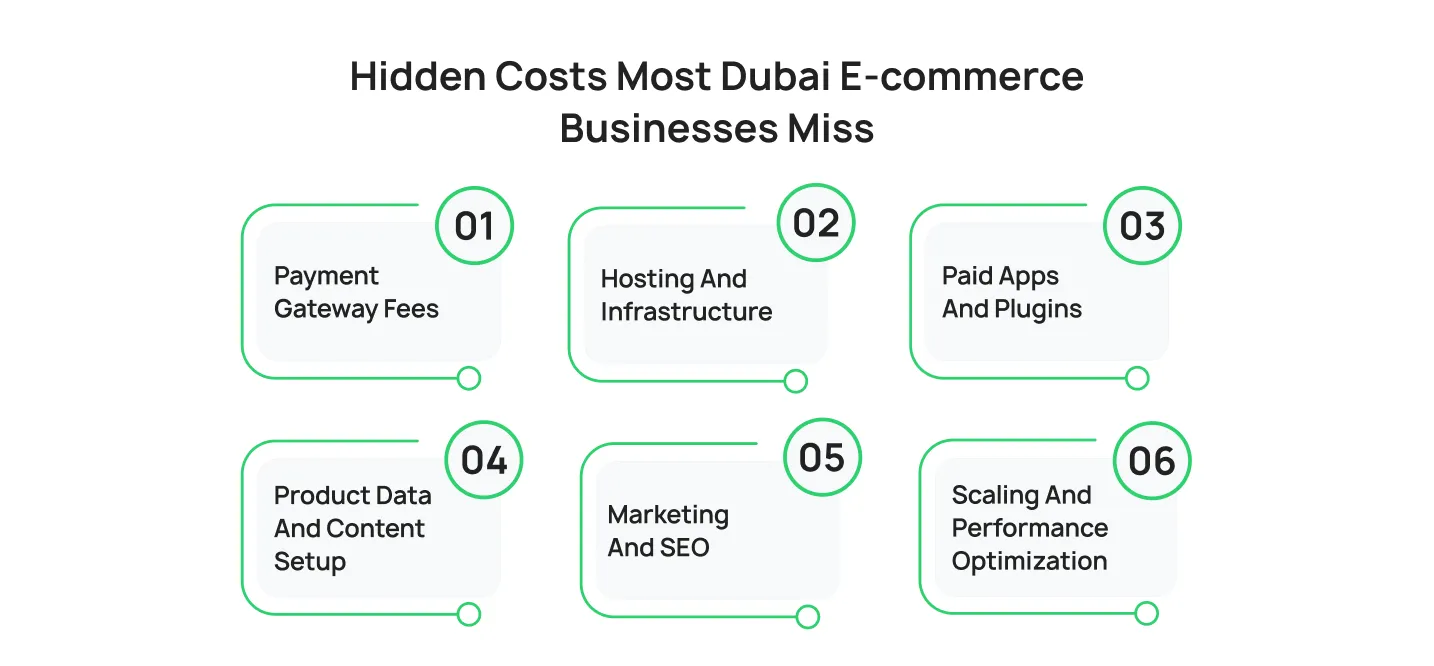
Many businesses calculate only the development cost and ignore ongoing or indirect expenses. This creates budgeting problems after launch.
Here are the most important hidden costs to consider:
Payment Gateway Fees
Every e-commerce transaction includes processing fees.
Payment providers like Stripe charge per transaction based on volume and region.
In Dubai, businesses may also use local payment gateways, which come with:
- setup fees
- monthly charges
- transaction percentages
These costs continue as long as your store is active.
Hosting and Infrastructure
Youe-commercece website needs hosting to run.
Costs depend on:
- traffic volume
- storage
- performance requirements
Cloud hosting grows with your business, which is good for scalability but adds recurring cost.
Paid Apps and Plugins
Many e-commerce features are not built from scratch. They rely on third-party tools.
Examples:
- email marketing tools
- analytics tools
- upsell and cross-sell apps
- inventory management plugins
These tools often charge monthly fees, which increase over time.
Product Data and Content Setup
Adding products is not just about uploading images.
It includes:
- product descriptions
- SEO optimization
- categorization
- image editing
For large stores, this becomes a high cost in both time and resources.
Marketing and SEO
Launching a store does not guarantee sales.
You need:
- search engine optimization
- paid advertising
- content marketing
These are ongoing investments, not one-time costs.
Scaling and Performance Optimization
As your business grows, your website must handle:
- more users
- more products
- higher traffic
This requires:
- server upgrades
- performance tuning
- database optimization
Scaling is a hidden cost that many businesses only realize later.
E-commerce Website Maintenance Cost
Maintenance is not optional. It is a continuous part of running an e-commerce business.
The e-commerce website maintenance cost depends on the size and complexity of your store.
What maintenance includes
- security updates
- plugin and system updates
- bug fixing
- backups
- performance monitoring
- small feature improvements
Estimated Monthly Cost
| Store Type | Monthly Cost (AED) |
| Small Store | 500 – 1,500 |
| Medium Store | 1,500 – 3,000 |
| Large Store | 3,000 – 5,000+ |
Why maintenance matters
Without maintenance:
- security risks increase
- performance drops
- user experience suffers
Over time, ignoring maintenance can lead to higher costs due to major fixes or rebuilds.
E-commerce Website Development Cost in the UAE vs Dubai
The e-commerce website development cost in the UAE varies, but Dubai usually sits at the higher end.
This is because:
- Businesses demand better design quality
- Competition is stronger
- user expectations are higher
- integrations are more advanced
Other emirates may offer lower pricing, but Dubai projects often focus more on long-term growth and scalability.
How to Reduce E-commerce Development Cost Without Hurting Growth
Reducing cost does not mean cutting important features. It means making smarter decisions.
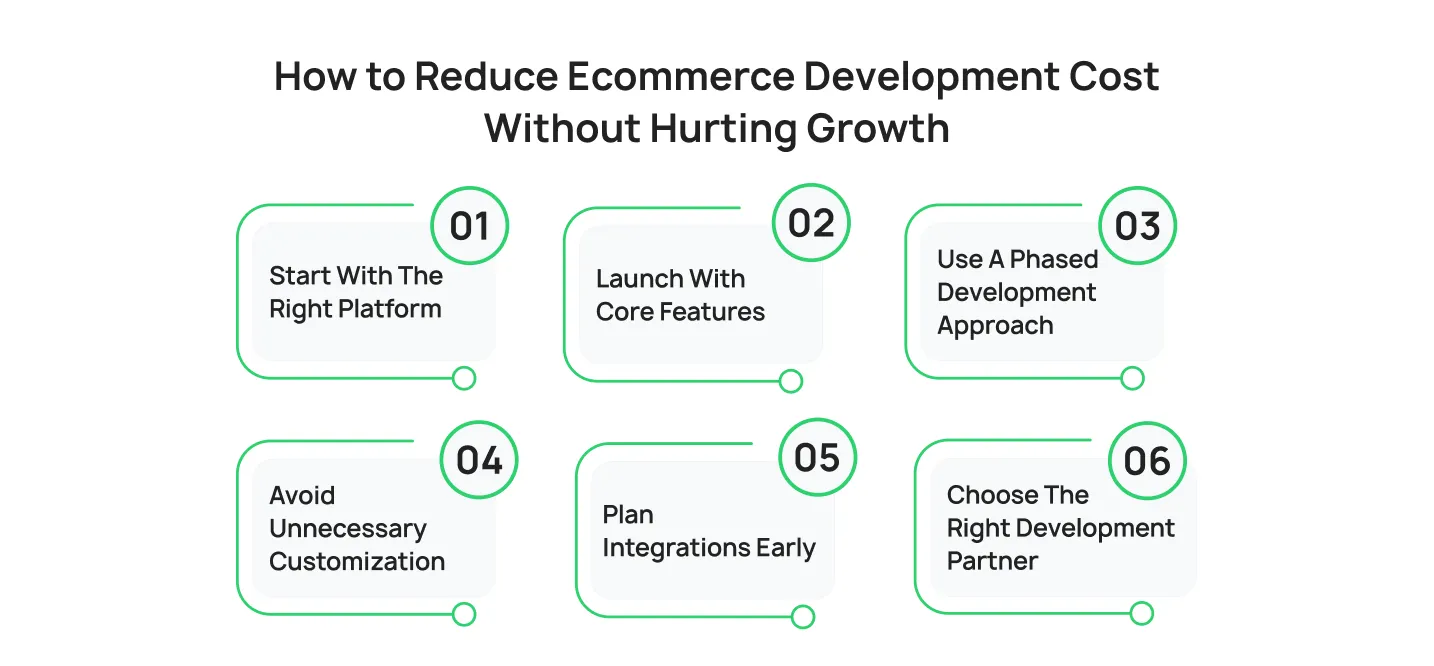
Start with the Right Platform
Choose a platform that fits your current needs. Avoid overbuilding in the early stage.
Launch with Core Features
Focus on essential functionality first:
- product pages
- checkout
- payment system
Additional features can be added later.
Use a Phased Development Approach
Instead of building everything at once:
- Launch a basic version
- test performance
- expand based on results
This reduces risk and controls cost.
Avoid Unnecessary Customization
Custom features increase cost quickly. Use existing tools where possible.
Plan Integrations Early
Late changes in integrations can increase both cost and development time.
Choose the Right Development Partner
An experienced team can:
- reduce errors
- improve efficiency
- avoid rework
This saves money in the long run.
Why Businesses in Dubai Invest More in E-commerce Development
Dubai is a competitive e-commerce market where businesses focus on quality and performance.
According to the International Trade Administration, the UAE has one of the most developed e-commerce markets in the region, driven by high digital adoption and strong infrastructure.
This leads to higher investment in:
- better user experience
- faster performance
- advanced features
- scalable platforms
Businesses that invest properly are more likely to succeed in this competitive environment.
Top E-commerce Development Companies in Dubai
Choosing the right partner matters just as much as understanding the e-commerce development cost. A good company does not just build a store. It helps you plan, launch, and scale your ecommerce business the right way.
Here are some of the top e-commerce development companies in Dubai:
1. Cubix
Cubix is a well-known e-commerce development company in Dubai that works with businesses across different stages, from startups to large-scale platforms. The company provides solutions across Shopify, WooCommerce, and custom e-commerce development.
Cubix is often chosen for:
- custom ecommerce platforms
- multivendor marketplace development
- scalable backend systems
- integrations with CRM, ERP, and payment gateways
It is a strong option for businesses that need more than a basic e-commerce website and want to build for long-term growth.
2. Digital Gravity
Digital Gravity is a Dubai-based agency offering e-commerce development along with branding and digital solutions. The company focuses on building user-friendly e-commerce websites with modern design and performance in mind.
3. GCC Marketing
GCC Marketing provides e-commerce development services combined with digital marketing support. They are often chosen by businesses that want both website development and online growth services in one place.
4. Si3 Digital
Si3 Digital specializes in e-commerce website development with a focus on UI/UX and performance. They offer solutions across Shopify and WooCommerce for small to mid-sized businesses.
5. Digital Graphiks
Digital Graphiks offers e-commerce website design and development services in Dubai. The company focuses on building functional and visually structured e-commerce stores for different business types.
How to Choose the Right E-commerce Development Company
Before selecting a company, businesses should focus on:
- experience with e-commerce platforms
- ability to handle integrations
- Understanding of the UAE market
- post-launch support
- scalability of solutions
The e-commerce development company cost may vary, but the real value comes from choosing a partner that can support your business beyond the launch stage.
Final Thoughts
The e-commerce development cost depends on your business goals, platform choice, and feature requirements. A simple store may cost a few thousand dirhams, while a full ecommerce platform can require a much larger investment. The key is to understand what each cost includes and how it supports your business. Choosing the right approach at the start helps avoid unnecessary expenses later and ensures your e-commerce store is built for growth.
[blog_cta_2]
Frequently Asked Questions
1. How much does e-commerce development cost in Dubai?
It typically ranges from AED 10,000 to AED 150,000+, depending on complexity and features.
2. What is the cost to build an e-commerce website in Dubai?
For basic stores, it starts around AED 10,000 and increases based on customization and integrations.
3. What is an e-commerce website’s maintenance cost in Dubai?
Maintenance usually costs between AED 500 and AED 5,000 per month.
4. What affects the cost of an e-commerce development company?
Platform choice, features, integrations, and team expertise all impact the cost.
5. Which platform is best for e-commerce in Dubai?
It depends on your business size. Shopify works well for startups, WooCommerce for flexibility, and custom development for large-scale businesses.