Key Takeaways
- The UAE gaming market hit roughly USD 1,260.4 million in 2025 and is growing at a 7.69% CAGR through 2034.
- Mobile gaming drives over 54% of gaming revenue in the UAE, making it the default starting point for most developers.
- Starting a studio requires a Game Development or Software Development trade license, with costs starting from around AED 6,600/year in some free zones.
- Hiring in-house developers costs AED 200,000–320,000+ per year, plus 20–40% in overhead for visas, insurance, and gratuity.
- Working with an established studio like Cubix cuts out the setup, hiring, and ramp-up time entirely.
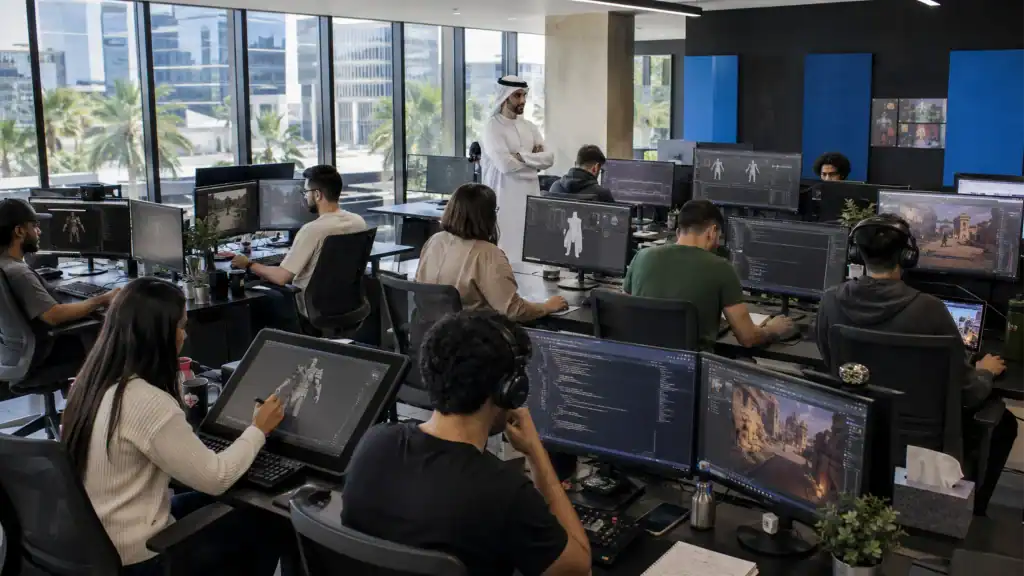
If you had asked someone ten years ago whether Dubai or Abu Dhabi would become serious names in game development, they might have laughed. Today, nobody’s laughing. The UAE gaming market hit roughly USD 1,260.4 million in 2025 and is on track to grow at a compound annual growth rate of 7.69% through 2034, according to IMARC Group. That’s not a small, quiet niche anymore. That’s a real industry, with real money, real studios, and real jobs.
We’ll walk through the costs, the legal steps, the top studios already here, and the tools indie developers are using right now. And if at any point you decide you’d rather skip the DIY route and just partner with a proven game development company in Dubai, we’ll get to that too.
Let’s get into it.
Why the UAE Is Becoming a Real Game Development Hub
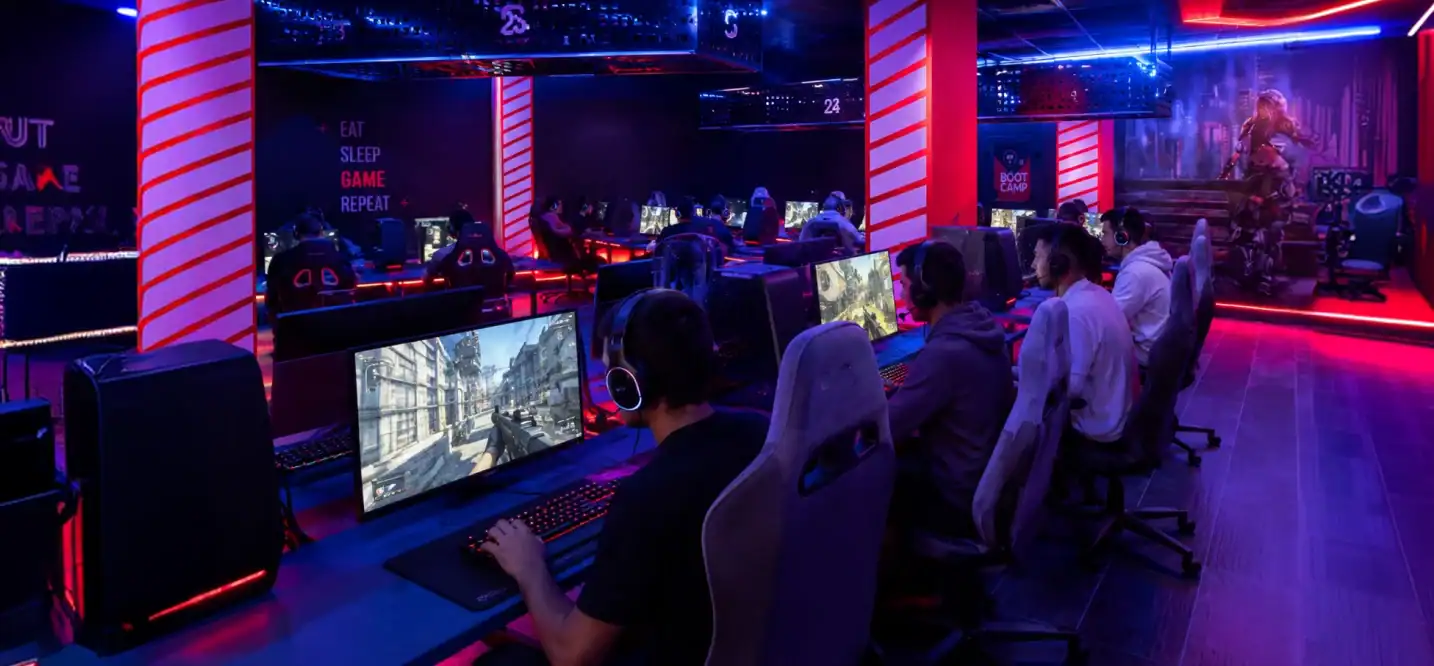
A few years ago, most game studios in the Middle East were small teams working on mobile puzzle games or outsourced contracts for bigger foreign publishers. That’s changing fast, and the numbers back it up.
The broader UAE games market is expected to reach USD 751.97 million in 2025, growing at roughly 4.67% annually to hit USD 944.72 million by 2030. By that same year, the country is projected to have around 2.2 million active gamers, with an eye-popping average revenue per user of USD 1.85 thousand, one of the highest ARPU figures in the region. That tells you something important: UAE gamers don’t just play, they spend.
Zoom out to the wider region and the picture gets even bigger. The Middle East gaming market as a whole is estimated at USD 5.14 billion in 2026, up from USD 4.56 billion in 2025, and is projected to reach USD 9.32 billion by 2031, a CAGR of 12.66%. Cloud and streaming gaming platforms are growing even faster within that, at roughly 16.74% CAGR, thanks to 5G rollouts and regional data center investment.
A few things are driving this growth:
- Government backing. Initiatives like the Dubai Program for Gaming 2033 and the Abu Dhabi Gaming initiative aren’t just PR moves. They come with funding, infrastructure support, and talent development programs designed to pull international studios into the region and grow homegrown ones.
- Mobile-first habits. Mobile gaming is the dominant segment in the UAE, accounting for more than 54% of gaming revenue. Nearly everyone has a smartphone and fast internet here, which makes mobile the easiest entry point for both players and developers.
- A young, engaged audience. Across the UAE, Saudi Arabia, and Egypt (often grouped together as the “MENA-3” markets), about 76% of gamers are under the age of 35, and 73% actively engage with esports content. That’s a young, plugged-in audience that’s only going to get bigger.
- Esports momentum. The MENA-3 gaming markets combined are expected to reach USD 2.79 billion in 2026, growing at close to a 10% CAGR, with esports tournaments and infrastructure investment playing a big part.
Put it all together, and you get a market that’s no longer “emerging.” It’s already here, and it’s growing faster than most of the world.
How to Officially Start a Game Development Studio in Dubai
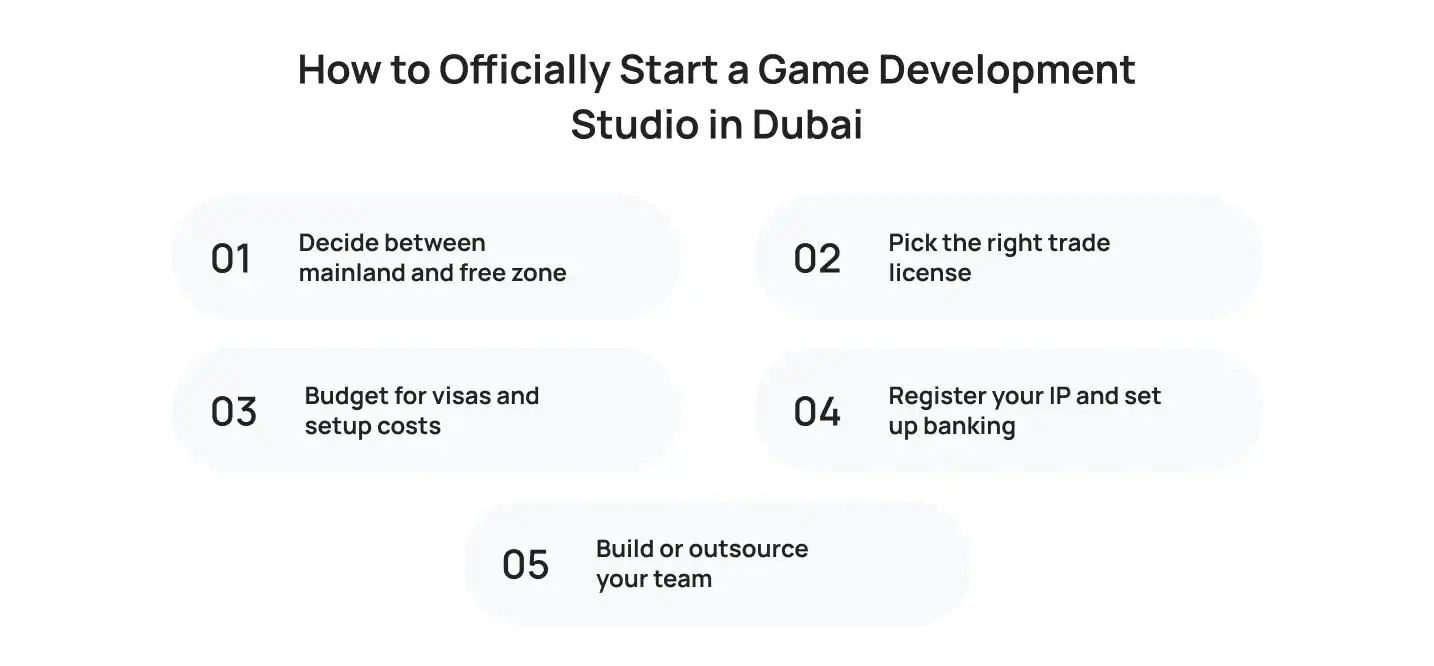
Okay, so the market looks good. But how do you actually start a studio here legally? It’s more straightforward than people assume, but there are a few decisions you’ll need to make early on.
Step 1: Decide between mainland and free zone
This is the first fork in the road. A free zone license is usually the faster, more popular route for game studios because it typically allows 100% foreign ownership, offers tax benefits, and doesn’t require a local sponsor. Zones like Dubai Internet City, Dubai Media City, and Innovation City in Ras Al Khaimah are all popular with game and software companies.
A mainland license, on the other hand, lets you operate anywhere in the UAE and take on government contracts, but the setup process can involve a few more steps.
Step 2: Pick the right trade license
You’ll need a Game Development or Software Development trade license, depending on how the authority categorizes your activity. Costs vary depending on the free zone or emirate, but as a starting point, licenses from zones like Innovation City RAK begin at around AED 6,600 per year. Larger free zones in Dubai can run higher depending on office space requirements and the number of visas you need.
Step 3: Budget for visas and setup costs
Don’t just budget for the license. You’ll also need to factor in:
- Employment visa costs (roughly AED 5,000–8,000 per employee annually)
- Mandatory health insurance (AED 2,000–6,000 per employee per year)
- Office space, even if it’s a flexi-desk to start
- Equipment: laptops, dev licenses, security tools
Most founders underestimate this part. The license fee is just the entry ticket, the real cost of getting a small studio running usually lands closer to 20–40% above the base numbers you see advertised.
Step 4: Register your IP and set up banking
Once your license is issued, you’ll want to register your studio’s intellectual property (game titles, branding, source code ownership structures) and open a corporate bank account. This step trips a lot of first-time founders up because UAE banks can be particular about documentation for gaming and tech companies, so it’s worth budgeting extra time here.
Step 5: Build or outsource your team
This is where a lot of studios hit a wall. Building an in-house team from scratch in Dubai is possible, but hiring, visa sponsorship, and payroll admin take time and money most early-stage studios don’t have. That’s exactly why many founders choose to partner with an established studio instead of building from zero, more on that in the next section.
How Much Does It Cost to Hire a Game Developer in the UAE?
This is probably the question on your mind, so let’s be direct about it.
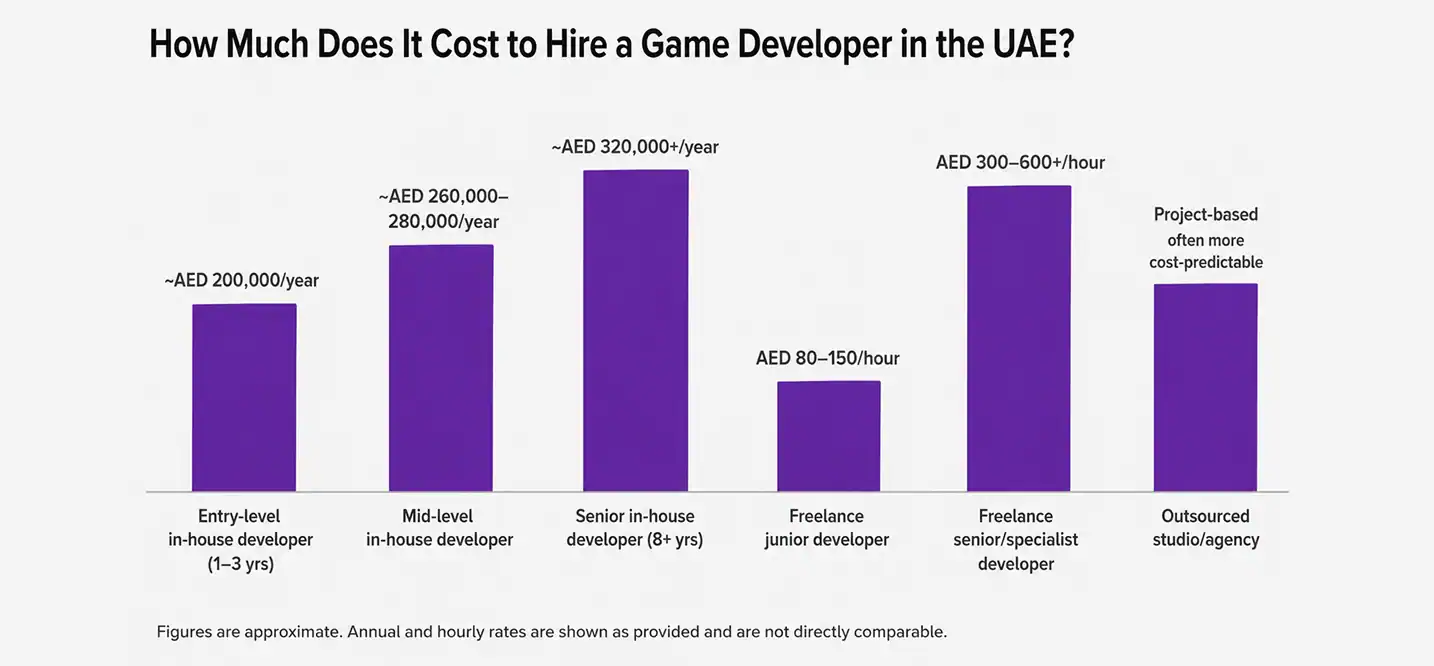
Game developer pay in the UAE varies a lot depending on experience, specialization, and whether you’re hiring full-time, contract, or freelance. Here’s a rough breakdown based on current market data:
| Hiring Type | Approximate Cost |
| Entry-level in-house developer (1–3 yrs) | ~AED 200,000/year |
| Mid-level in-house developer | ~AED 260,000–280,000/year |
| Senior in-house developer (8+ yrs) | ~AED 320,000+/year |
| Freelance junior developer | AED 80–150/hour |
| Freelance senior/specialist developer | AED 300–600+/hour |
| Outsourced studio/agency | Project-based, often more cost-predictable |
For context, the average game developer salary in Dubai sits around AED 282,380 per year, or roughly AED 136 per hour, according to compensation data from SalaryExpert, about 7% higher than the UAE-wide average. Game designers specifically average around AED 265,000 per year.
But salary is only part of the picture. When you hire in-house, you’re also paying for:
- Visa sponsorship and renewal
- Health insurance
- Gratuity (end-of-service benefits, usually 15–21 days of salary per year of service)
- Office space and equipment
Add it all up, and most businesses find their real cost of hiring in the UAE runs 20–40% higher than the base salary alone. A developer earning AED 20,000 a month can end up costing the company closer to AED 26,000–30,000 a month once everything is factored in.
So which route makes sense? If you need one or two specific skill sets for a short burst, freelancers can work well. If you’re building a long-term product with an evolving roadmap, an in-house team gives you more control but costs more and takes longer to assemble. And if you want speed, predictable budgeting, and a team that’s already shipped games before, working with an established game development company in Dubai is usually the most efficient path, you skip the hiring, visa paperwork, and ramp-up time entirely.
How To Grow After Building a Studio?

Building a great game is only half the challenge. The other half is getting it in front of the right people.
The right approach depends on your business model, but studios that invest in both visibility and localization early are better positioned to grow in the region.
Building Visibility Among UAE Gaming Clients
For B2B game studios, traditional search engine optimization is no longer the only way potential clients discover development partners. Many businesses now use AI-powered search and research tools to compare game development companies before visiting individual websites.
This makes Answer Engine Optimization (AEO) and Generative Engine Optimization (GEO) increasingly important. These strategies structure website content, case studies, service pages, and press materials so AI-assisted platforms such as ChatGPT, Perplexity, and Google AI Overviews can understand and reference the studio when users search for development partners.
For example, potential clients may search for:
- Best mobile game development company in the UAE
- Top game development studios in Dubai
- Hire game developers in the UAE
- UAE game development company for mobile games
- Game development outsourcing services in the GCC
Building an Event Pipeline in the UAE
GITEX Global in Dubai remains one of the region’s largest technology events and can provide access to enterprise decision-makers, technology partners, investors, and government stakeholders.
Gaming-focused events, UAE Gaming Federation initiatives, local game development meetups, and startup communities also create opportunities to connect with developers and potential collaborators.
Does Arabic Localization Matter?
For B2C game publishers, reaching players requires more than launching a game globally and relying on English-language marketing. Arabic-speaking players represent a major opportunity across the UAE and wider GCC, but many international studios still treat Arabic localization as an afterthought.
- Native Arabic UI and in-game content
- Right-to-left (RTL) interface support
- Arabic app store listings and game descriptions
- Arabic-language social media content
Best Tools & Software Suites for Indie Developers in the Region
If you’re going the indie route rather than hiring a studio, your engine choice matters a lot. Here’s how the major options stack up for developers building in or for the UAE market.
Unity remains the most popular choice for indie and mobile-first developers in the region, mainly because of its lower learning curve, huge asset store, and strong support for 2D and mobile games, which lines up well with the UAE’s mobile-dominant market.
Unreal Engine is the go-to if you’re aiming for high-fidelity 3D visuals or console-quality graphics. It has a steeper learning curve, but the visual quality it produces out of the box is hard to match, and it’s increasingly used by mid-size studios in the region chasing PC and console releases.
Godot has been gaining traction with solo developers and small teams thanks to being free, open-source, and lightweight, a solid option if you’re bootstrapping and don’t want engine licensing costs eating into a tight budget.
Beyond the engine itself, regional developers also need to think about things that are easy to overlook:
- Localization tools, since Arabic (including right-to-left text support) is a must for reaching the local audience
- App Store and Play Store compliance, since the UAE has specific content guidelines that differ from other markets
- Payment gateway integration suited to regional preferences, if you’re building anything with in-app purchases
Picking the right tool isn’t just about what’s popular globally, it’s about what fits the kind of game you’re building and the market you’re building it for.
Mobile Game Development in the UAE: A Growing Niche on Its Own
It’s worth calling out mobile game development separately, because it’s arguably the single biggest opportunity in the UAE right now. With mobile accounting for over half of all gaming revenue in the country, and smartphone penetration among the highest in the world, building for mobile-first isn’t optional anymore, it’s the default.
This is also where the line between “game development” and general app development starts to blur. A lot of studios building games in the UAE are the same ones building broader consumer apps, because the skill sets overlap so heavily, UI/UX for touch interfaces, performance optimization for a wide range of devices, and monetization models like in-app purchases and ads. If your project needs both a game layer and a broader app ecosystem around it (think loyalty features, social integration, or e-commerce tie-ins), it’s worth working with a team that also has strong roots as a mobile app development company in Dubai, rather than a pure game studio with no app experience.
Trends Shaping UAE Game Dev in 2026 and Beyond
Before we wrap up, it’s worth pointing out a few shifts that will likely shape how studios build and compete over the next few years.
Cloud gaming is accelerating faster than the rest of the market. While the overall Middle East gaming market is growing at around 12.66% a year, cloud and streaming platforms are expanding at roughly 16.74% CAGR, nearly double the pace. Faster 5G rollouts across the region (some operators have already hit 5G downstream speeds above 30 Gbps) mean lower latency and smoother multiplayer experiences, which opens the door for more ambitious, graphically heavy games that don’t require players to own expensive hardware.
AI is becoming part of the production pipeline, not just the product. More studios in the region are using AI-assisted tools for asset generation, playtesting, and localization, which is shortening development timelines and lowering costs for smaller teams that can’t afford large art or QA departments.
Esports is turning into a genuine business line, not just a marketing tactic. With roughly 73% of gamers across the UAE, Saudi Arabia, and Egypt actively engaging with esports content, studios that build competitive, multiplayer-friendly titles are positioning themselves to tap into tournament sponsorships, streaming partnerships, and community-driven revenue that pure single-player titles don’t have access to.
Government support is only getting more structured. Programs like the Dubai Program for Gaming 2033 aren’t one-off announcements, they’re multi-year commitments to funding, infrastructure, and talent pipelines. For studios setting up now, that means the regulatory and support environment is likely to keep improving rather than staying static.
If you’re planning a studio or a game launch in this market, these are the shifts worth building your roadmap around rather than reacting to later.
In-House, Freelance, or Outsourced: Which Should You Choose?
Given everything above, it’s fair to ask which hiring path actually makes sense for your situation. There’s no single right answer, but here’s a simple way to think about it.
Go in-house if you’re building a long-term product with a roadmap stretching years out, and you have the runway to cover salaries, visas, and benefits without needing to launch fast. This path gives you the most control but the slowest start.
Go freelance if you need a specific skill for a defined, short-term task, say, porting a game to a new platform or fixing a specific technical issue. It’s flexible, but managing multiple freelancers on a complex project can turn into a full-time job of its own.
Go outsourced/agency if speed, predictable budgeting, and proven experience matter more than building an internal team from scratch. This is usually the fastest way to go from idea to a published, working game, since you’re tapping into a team that already has the pipeline, tools, and processes in place.
Most founders we talk to end up landing somewhere in the middle, outsourcing the bulk of development to a studio while keeping a small in-house team for ongoing updates and community management once the game is live.
Ready to Build Your Game? Here’s Where Cubix Comes In

By now you’ve seen the numbers: a market growing past a billion dollars, developer salaries north of AED 280,000 a year, and a licensing and hiring process that takes real time and money to get right. Building a studio from scratch is doable, but it’s also slow, and every month spent on setup is a month your competitors are shipping.
That’s where Cubix comes in. Instead of hiring a full in-house team, sponsoring visas, and figuring out engine and tooling decisions on your own, you get a team that’s already done it, repeatedly, across platforms, genres, and budgets. Cubix handles design, development, QA, and post-launch support end-to-end, so you can go from concept to a live game without the overhead of building a studio yourself.
If you’re serious about building a game in or for the UAE market in 2026, it’s worth a conversation before you commit to the long road of doing it solo.
Want to discuss your project? Our experts are just a click away.
Contact UsFrequently Asked Questions
1. How much does it cost to hire a game developer in the UAE?
It depends on experience and hiring model. In-house developers typically earn between AED 200,000 and AED 320,000+ per year depending on seniority, while freelancers charge anywhere from AED 80 to AED 600+ per hour. Add visa, insurance, and overhead costs, and total hiring expenses usually run 20–40% above the base salary.
2. How do I officially start a game development studio in Dubai?
You’ll need to choose between a free zone or mainland setup, obtain a Game Development or Software Development trade license (starting from around AED 6,600/year in some free zones), budget for employee visas and insurance, and register your studio’s IP before you start building.
3. What are the top game development studios in the UAE?
Studios like Cubix, Juego Studios, PearlQuest Interactive, and Titan Digital UAE are among the more established names, each with different strengths ranging from full-cycle game development to AR/VR-focused builds and studio consultancy.
4. What’s the best game engine for indie developers in the region?
Unity is the most popular choice for mobile-first indie projects because of its lower learning curve and strong asset ecosystem. Unreal Engine suits high-fidelity 3D projects, while Godot is a solid free option for bootstrapped solo developers.
5. Is mobile or PC gaming bigger in the UAE?
Mobile, by a wide margin. It accounts for more than half of all gaming revenue in the country, driven by high smartphone penetration and fast internet access.