Key Takeaways
- The UAE gaming market is projected to grow from USD 550 million in 2025 to USD 857 million by 2032, making it one of the fastest-growing gaming markets in the MENA region.
- Cross platform game development helps studios reach players across mobile, PC, console, and cloud while reducing long-term development and maintenance costs.
- Building successful cross platform multiplayer games requires shared backend systems, cloud saves, synchronized matchmaking, and scalable LiveOps support.
- Cloud technology enables developers to deliver high-performance gaming experiences without requiring players to own expensive hardware.
A few years back, if you wanted to play a serious game in the UAE, you probably needed a console or a decent gaming PC. That’s just how it worked. Today? Someone’s playing a full multiplayer shooter on a train in Dubai Metro, on a phone, against someone else who’s on a PC in Abu Dhabi. That’s cross-platform gaming, and it’s not a niche feature anymore. It’s the baseline expectation.
So why is this happening so fast in the UAE specifically? Partly infrastructure, partly money, partly the fact that gamers here simply won’t tolerate being locked to one device. The UAE gaming market was valued at roughly USD 550 million in 2025 and it’s expected to reach USD 857 million by 2032, growing at a CAGR of 6.54%. That’s real money, and it’s chasing games that work everywhere, not just on one screen.
This blog walks through what cross platform game development actually means, why mobile still leads the pack here, how cloud gaming fits in, and where blockchain is starting to change the picture too. Grab a coffee. This one’s got a lot of numbers in it, but we’ll keep it simple.
The Big Deal with the UAE Gaming Market

Let’s start with the basics. The UAE isn’t just consuming games anymore, it’s building them, funding them, and hosting the infrastructure that runs them. Dubai alone holds close to 80% of the national gaming market share, and the 19-35 age group makes up around 62% of active players. That’s a young, digitally native audience with real spending power. The UAE has one of the highest Average Revenue Per User rates globally, sitting near USD 90 in 2025.
But the number that really explains why cross-platform strategy matters here is the infrastructure. You can build the best game in the world, but if the network can’t keep up, players will bounce. And the UAE’s network genuinely doesn’t struggle.
| Infrastructure Metric | UAE Standing | Why It Matters for Cross-Platform Games |
| FTTH Penetration | 99.3% – ranked #1 globally, 8th year running | Low latency, which matters a lot for competitive multiplayer |
| 5G Speed | 557+ Mbps median download – #1 globally | Cloud gaming and mobile streaming actually work without lag |
| 5G Population Coverage | ~97-98% | Near-universal access, even outside major cities |
| Mobile Subscriptions | ~21.1 million across a population of ~10 million | A market with roughly 200% mobile penetration |
| Active Fiber Network | 14.5 million km, connecting 2.88 million homes | Stable backbone for live multiplayer, no dropped connections |
Mobile dominates here too. Around 75-76% of UAE gamers prefer smartphones or tablets over consoles, and mobile accounts for somewhere between 72-80% of gaming revenue depending on how you measure it. That’s not a small preference. That’s most of the market.
Why This Matters for Cross Platform Studios
If you’re building a game and only thinking about one device, you’re leaving most of the UAE audience out. A studio that treats mobile as an afterthought, with PC or console as the “real” platform, is going to lose to a studio that designed for phones first and scaled up. That’s just how this market behaves right now.
What Cross Platform Game Development Actually Means

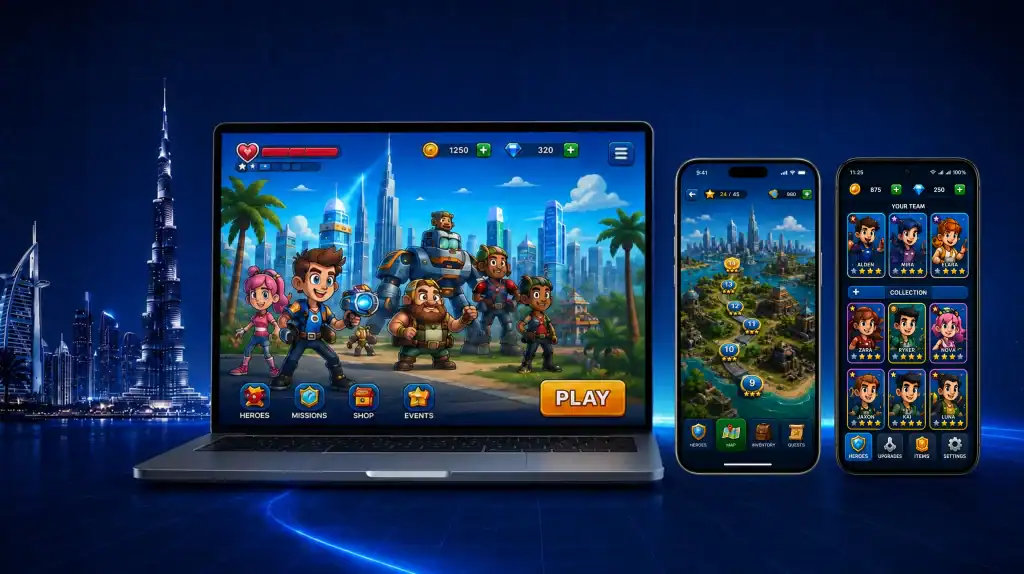
Okay, let’s slow down for a second. Cross-platform game development is when a single game, or at least a single game economy, works across multiple devices like phone, PC, console and players on different platforms can play together, or at minimum, carry their progress between them.
There are actually two different things people mean when they say “cross-platform,” and mixing them up causes confusion:
- Cross-platform play – players on different devices playing in the same match, live, together
- Cross-platform progression – your save file, purchases, and rank move with you between devices, even if you’re not playing with someone on a different platform at that exact moment
So what games are cross-platform right now, the ones people actually recognize? Fortnite is probably the most obvious example, it runs on basically everything and syncs progress everywhere. Call of Duty: Warzone and Call of Duty Mobile share an economy in some regions. Genshin Impact runs on mobile, PC, and console with full progression sync. Rocket League lets Xbox, PlayStation, PC, and Switch players compete in the same lobby. Minecraft has supported this for years across nearly every device that can run it.
What Are Some Cross Platform Games People Actually Play in the UAE?
Battle royale titles and competitive shooters lead here, mostly because they thrive on big player pools, and cross-platform play keeps queue times short. Sports simulation games are close behind, which tracks with the UAE’s competitive gaming culture and its growing esports scene.
What Games Are Xbox PC Cross Platform?
This one comes up a lot, and the honest answer is: it depends on the publisher, not really the platform. Xbox and PC (through the Microsoft ecosystem) share cross-play in titles like Halo Infinite, Sea of Thieves, Forza Horizon, and most first-party Xbox Game Studios titles by default. Third-party publishers decide case by case. Some enable it fully, some restrict it to invite-only matches, and some don’t bother at all.
If you’re building a game and asking “should we support Xbox-PC cross-play,” the better question is: does your matchmaking system justify it? Small player base, yes, absolutely add it. Massive player base already, you have more flexibility.
Building Cross Platform Mobile Games for a Phone Obsessed Market

Given everything above, it should be obvious by now that cross-platform mobile games are where most UAE studios need to start, not where they end up eventually. Android and iOS cross-platform game development isn’t an add-on feature anymore. It’s the foundation.
But building for both Android and iOS at once brings its own headaches. Performance varies wildly across Android devices in a way it doesn’t on iOS. Payment processing rules differ between app stores. And if you’re adding real-time multiplayer on top of that, you’re now syncing state across two operating systems and however many device tiers exist within each.
This is where cross-platform multiplayer games get genuinely difficult to build well. It’s not just “does the game run on both phones.” It’s server architecture, matchmaking logic, and real-time data sync, all of which need to hold up under concurrent load. A basic hyper-casual mobile game in Dubai might run anywhere from AED 110,000 to AED 220,000. But add multiplayer, real-time interactions, and cross-device sync, and costs jump to the AED 550,000-1,800,000 range, sometimes higher depending on scale. That’s a big gap, and it exists almost entirely because of backend complexity, not visuals.
The Multiplayer Backend Problem
Here’s the part people underestimate. Multiplayer isn’t a feature you bolt on at the end. It changes your entire architecture from day one. You need:
- Real-time data synchronization between devices with different processing speeds
- Server infrastructure that scales without crashing during peak hours (think evenings, weekends, Ramadan nights when UAE gaming activity spikes)
- Matchmaking systems that work across device types without giving one platform an unfair advantage
- Player data management that doesn’t lag or lose progress mid-session
None of this is cheap, and none of it should be rushed. If you want a full breakdown of what these costs actually look like stage by stage, game development cost in Dubai covers pricing by complexity level, which is worth reading before you set a budget.
There’s also the engine question, and it comes up more than people expect. Unity tends to be the go-to for mobile and cross-platform titles because it’s faster to develop in and cheaper overall, while Unreal Engine gets picked when the visual bar is higher, think 3D environments with cinematic lighting. Neither is objectively better. It really comes down to what your game needs to look and feel like, and how much of your budget you want going toward graphics versus gameplay systems.
One more thing worth mentioning here, testing across devices takes longer than most first-time studio founders expect. A game that runs perfectly on a flagship Samsung or iPhone can behave completely differently on a three-year-old budget Android device. So QA isn’t just “does it run,” it’s “does it run well enough that a player on cheaper hardware doesn’t quit in frustration.” Skipping this step to save time almost always costs more later, in bad reviews and churned players.
What is UAE’s Infrastructure Advantage? (Hint: Cloud Gaming)

So here’s a question that comes up constantly: how can we use cloud technology to build and run mobile games? The short answer is that cloud gaming removes the hardware bottleneck entirely. Instead of your phone rendering a graphically heavy game locally, the game runs on a remote server and streams the video feed to your device. Your phone just needs to display it and send your inputs back.
This matters enormously in the UAE because the infrastructure to support it already exists. Remember that 557+ Mbps median 5G speed and 99.3% fiber penetration we mentioned earlier? That’s exactly the kind of network cloud gaming needs to avoid lag. Platforms like GeForce NOW, Blacknut, and Etisalat’s own Arena Pro service, which bundles over 100 titles for subscribers, are already live and working in the region.
For developers, cloud gaming changes a few things. You’re no longer constrained by what a mid-range Android phone can render. You can push higher-fidelity graphics because the heavy lifting happens server-side. But you also introduce new dependencies, like your relationship with cloud infrastructure providers and how you handle latency for players slightly outside strong 5G coverage.
What Cloud-Native Architecture Actually Looks Like
In practice, building cloud-native means designing your game so the core logic and rendering can live on a server, not just the client device. This usually involves cloud services like AWS, Azure, or Google Cloud, running on usage-based pricing that scales with your player count. It’s a different mindset than traditional mobile development, and it ties closely into the broader wave of custom software investment happening across the UAE right now. If you want context on how other industries in the region are approaching this same infrastructure shift, top game development companies in Dubai investing in custom software in Dubai is a good read alongside this.
And honestly, this is where a lot of studios need outside help. Cloud architecture, scaling, DevOps for gaming specifically, it’s a different skill set than building gameplay. If your team is strong on game design but thin on infrastructure, that’s usually where custom software development services in Dubai come into the picture, filling the backend gap so your game doesn’t fall over the moment it gets popular.
There’s a cost trade-off too, worth being upfront about. Cloud gaming reduces the burden on the player’s device, but it shifts that cost onto you as the developer, since server time isn’t free and it scales with every concurrent player. For a small mobile title with modest graphics, this probably isn’t worth the complexity. But for anything visually ambitious, or anything you want playable on lower-end phones without sacrificing quality, cloud streaming starts to make a lot of sense. It’s less about whether cloud gaming is “better” and more about whether your specific game needs it.
Blockchain and Web3: Is This the Next Jump?

Now here’s where things get a little more experimental, but the momentum is real. Blockchain UAE game development has moved from “interesting side project” to something studios are actually shipping. The Web3 gaming market is projected to grow at over 20% CAGR globally, and the UAE, with its progressive regulatory stance through bodies like VARA, is positioning itself as a friendly place to build these systems.
So how does this connect to cross-platform strategy? Blockchain adds a layer of asset ownership that, ideally, follows the player across devices the same way progression does in a traditional cross-platform game. If you own an NFT based item in a game, that ownership record doesn’t care whether you’re playing on your phone or your PC. It lives on-chain, independent of the device.
One example worth knowing about: how The Game Company is upgrading MENA gaming with Web3. It’s part of a broader shift where studios are combining decentralized asset ownership with real-time multiplayer gameplay, essentially building games where players can trade, own, and earn digital assets while still getting the cross-platform experience they expect from any modern title. Cubix’s own WAGMI project is a similar case, a blockchain-powered multiplayer game with NFT-based assets and real-time PvP, built to run smoothly across devices while keeping the decentralized economy intact.
Why Web3 Needs Cross-Platform to Work
Here’s the thing though. A blockchain game that only runs on PC is missing most of its potential audience, especially in a market where 75%+ of players are on mobile. So if you’re building a Web3 game for the UAE, cross-platform isn’t optional, it’s basically required for the economics to make sense. You need enough active wallets and enough active players to sustain any kind of in-game marketplace, and that only happens if the game is accessible everywhere.
Cost-wise, this stuff isn’t cheap either. Blockchain game development in Dubai ranges from AED 110,000 for basic wallet integrations up to AED 2,000,000+ for full enterprise-grade blockchain ecosystems, and that’s before you factor in smart contract audits, which alone can run AED 20,000 to AED 200,000+. If you’re serious about this route, blockchain development cost in Dubai breaks down the full pricing structure, phase by phase, so you’re not blindsided halfway through.
Picking the Right Partner and Getting Your Game Built
By now you might be asking yourself: which is the best game development studio in UAE for this kind of project? Fair question, but honestly, there isn’t one universal answer. It depends on what you’re building. A studio great at hyper casual mobile games might not have the multiplayer backend experience you need. A studio strong in blockchain might be weaker on traditional mobile UX.
What you should actually be evaluating is capability across the specific things this blog just walked through:
| What to Evaluate | Why It Matters for Cross-Platform Projects |
| Multiplayer and real-time systems experience | Determines whether your game can actually sync across devices without lag or bugs |
| Mobile-first design experience | Since 75%+ of UAE players are on mobile, this can’t be an afterthought |
| Cloud infrastructure and DevOps capability | Needed if you’re building cloud-native or planning to scale fast |
| Blockchain and Web3 experience | Only relevant if you’re adding asset ownership, but critical if you are |
| Post-launch LiveOps support | Cross-platform games need constant balancing, updates, and monitoring after launch |
| Portfolio of live, shipped titles | Proof of execution beats a polished pitch deck every time |
This is basically the checklist that puts Cubix in a different category from most single-specialty studios in the region. Cubix has been building software and games out of Dubai since 2008, with a team of 350+ across mobile, multiplayer, AR/VR, and blockchain, and a portfolio of 600+ delivered projects. That range matters here specifically, because cross-platform work isn’t one skill, it’s four or five skills that all have to work together without one of them becoming the bottleneck.
Why Businesses Choose Cubix for Cross-Platform Game Development in the UAE
Building a successful cross-platform game takes much more than choosing the right game engine. You need scalable backend systems, cloud infrastructure, multiplayer networking, and a team that understands how players interact across different devices. At Cubix, we bring all of those pieces together.
With over 15 years of experience delivering mobile games, PC titles, multiplayer experiences, and enterprise gaming solutions, we help businesses build games that perform consistently across Android, iOS, PC, consoles, and cloud platforms.
Our team also focuses on Arabic localization, LiveOps, and performance optimization to ensure games are ready for the UAE and wider MENA market.
As a trusted game development company in the UAE, we build cross-platform experiences that are designed to grow with your players, not limit them.
A Few Quick Answers Before You Go
1. What games are cross-platform today?
Fortnite, Genshin Impact, Rocket League, Minecraft, and Call of Duty’s mobile-console economy are the clearest examples of cross-platform done well.
2. Is cross-platform mobile development harder than single-platform?
Yes, mainly because of device fragmentation on Android and the added complexity of syncing progress and multiplayer state across iOS and Android simultaneously.
3. Does cloud gaming replace the need for a powerful phone?
Largely, yes. The UAE’s 5G and fiber infrastructure make cloud streaming a genuinely viable alternative to local rendering, which is a big deal for accessibility.
4. Do I need blockchain to build a successful cross-platform game in the UAE?
No, not at all. It’s an option for specific game types, particularly ones built around asset ownership and player-driven economies, but plenty of successful cross-platform titles skip it entirely.