
Blog Summary
- Hiring dedicated software developers in Dubai requires the right strategy, not just fast recruitment.
- Businesses can choose between freelancers, agencies, and dedicated development teams.
- Developer costs vary based on experience, skills, and engagement model
- Structured hiring processes reduce risks and improve product success
- Partnering with full-cycle teams like Cubix helps scale faster and reduce hiring delays
Hiring the right tech talent in Dubai is both a challenge and a strategic opportunity for businesses aiming to scale. When you hire dedicated software developers in Dubai, you gain access to a diverse talent pool skilled in cutting-edge technologies and aligned with fast-evolving regional market demands. At the same time, Dubai continues to strengthen its position as a global technology hub, with the UAE’s technology export value reaching approximately $2.9 billion, reinforcing its role in the international digital economy.
Despite this growth, the hiring process is not always straightforward. On average, finding and onboarding qualified software developers in Dubai can take 3 to 6 weeks, depending on project requirements, technical complexity, and recruitment approach. This delay can slow product development, increase operational costs, and directly impact time-to-market for businesses trying to stay competitive.
This is where many organizations shift to a more efficient and scalable model by choosing Cubix and hire a software development company in Dubai. . Instead of spending weeks on sourcing, screening, and interviewing, businesses can quickly access experienced software engineers who are ready to integrate seamlessly into existing workflows.
In this guide, we’ll break down everything you need to know to make smarter hiring decisions in Dubai and show how partnering with the right development team can help you build a reliable, high-performing software engineering capability that drives measurable business growth.
[blog_cta]
What’s Really Driving the Developer Shortage in Dubai
Dubai is not facing a true shortage of software developers. The real challenge is a mismatch between demand, expectations, and hiring speed. As more industries go digital at the same time, competition for experienced developers has increased significantly.
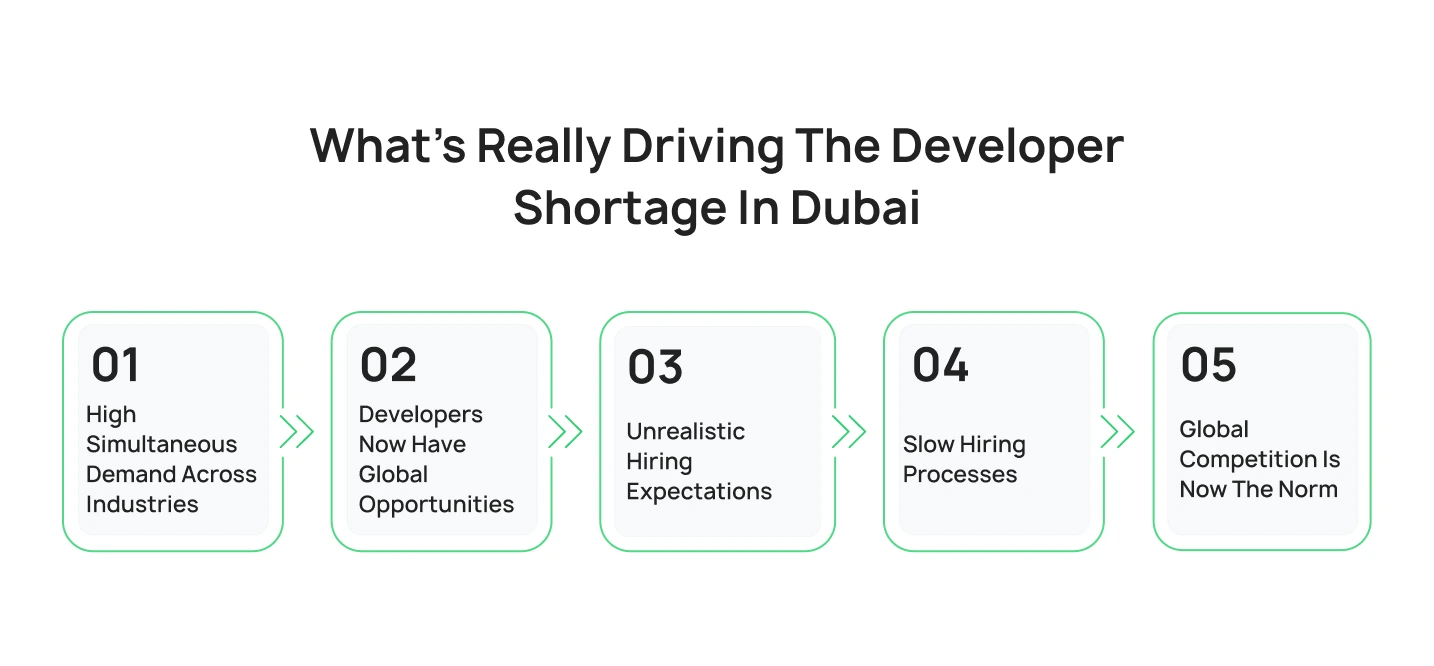
High Simultaneous Demand Across Industries
Multiple sectors are hiring developers at once, including banking, retail, logistics, startups, and government-backed digital initiatives. This has created strong competition for the same senior-level talent.
As a result:
- Companies compete for a limited pool of experienced developers
- Senior engineers receive multiple offers at the same time
- Hiring timelines are getting longer due to demand pressure
Developers Now Have Global Opportunities
Modern developers in Dubai are no longer limited to local job markets. They actively receive remote offers from international companies.
Typical market reality:
- Developers evaluate 3–5 job offers simultaneously
- Remote roles from the US and Europe are highly competitive
- Salary expectations are aligned with global benchmarks
- Flexible and hybrid work models are preferred
This reduces hiring predictability for local companies.
Unrealistic Hiring Expectations
Many hiring teams still search for unrealistic profiles instead of building balanced teams.
Common expectations include:
- Full-stack expertise across multiple frameworks
- Mobile + backend + cloud experience in one person
- Industry knowledge + product thinking + leadership skills
But in reality, developers usually fall into clear specializations:
- Frontend specialists
- Backend engineers
- Mobile app developers
- DevOps or cloud engineers
This mismatch leads to longer hiring cycles and repeated rejection of good candidates.
Slow Hiring Processes
Even in a competitive market, many companies still rely on slow, traditional hiring steps:
- Multiple interview rounds
- Delayed feedback loops
- Unclear technical requirements
- Long internal approvals
By the time a decision is made, top candidates are already gone.
Global Competition Is Now the Norm
Dubai companies are no longer competing locally only. They are competing globally.
Developers in Dubai can now easily:
- Work remotely for US startups
- Join European product teams
- Freelance for high-paying international clients
- Switch roles without relocating
This has permanently raised the bar for hiring speed and clarity.
Top Benefits of Hiring Software Developers in Dubai
Hiring dedicated software developers in Dubai is becoming a preferred strategy for businesses that want to build faster, scale efficiently, and reduce operational risks. Instead of managing fragmented freelancers or slow in-house hiring cycles, companies are now shifting toward focused development teams that deliver consistent output and long-term value.
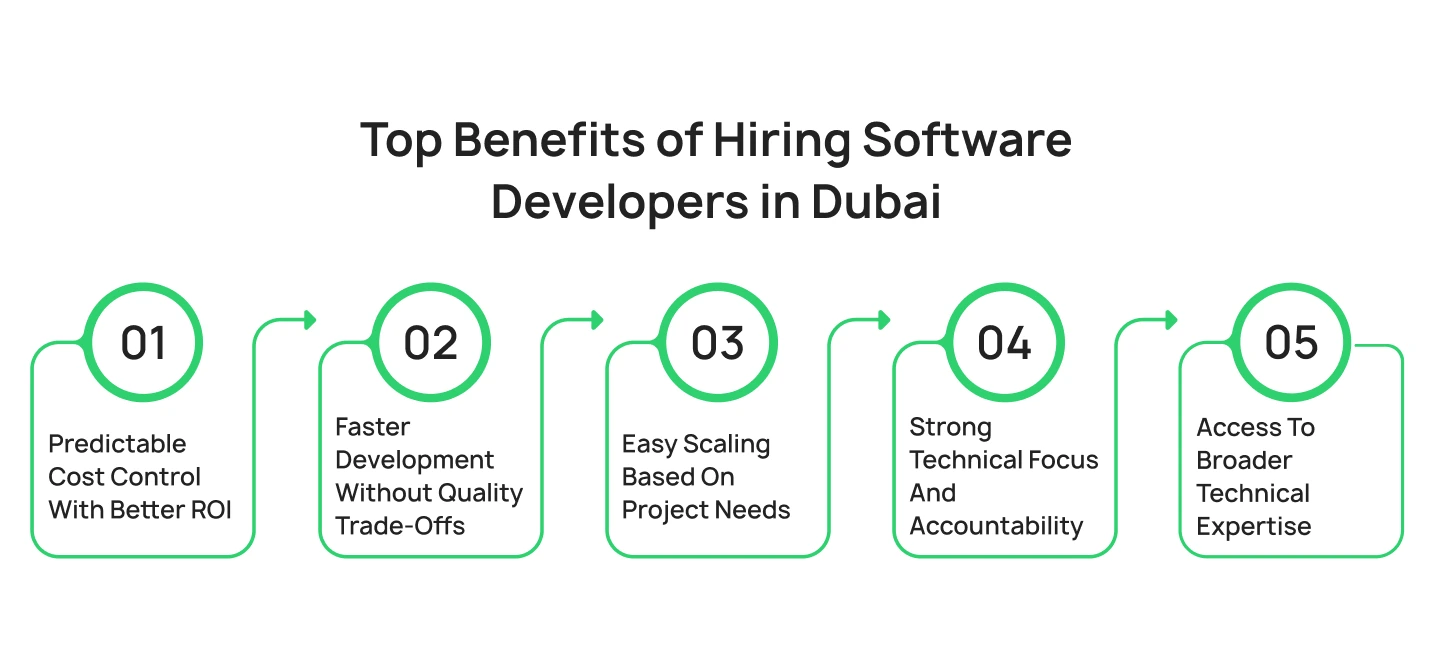
Here are the most important benefits that actually matter from a business and product perspective.
Predictable Cost Control with Better ROI
One of the biggest advantages of dedicated developers is financial clarity. Instead of dealing with fluctuating freelance rates or the heavy overhead of in-house hiring, businesses get a more structured and predictable cost model.
You avoid expenses like:
- Recruitment and onboarding costs
- Employee benefits and HR overhead
- Idle capacity during slow project phases
More importantly, you pay for focused productivity, not downtime. This makes dedicated teams especially valuable for startups and growing businesses that need to balance speed with budget control.
Faster Development Without Quality Trade-Offs
Dedicated developers work with one clear focus: your project. This eliminates distractions that often slow down internal teams or freelance setups.
The result is:
- Shorter development cycles
- Faster feature delivery
- More consistent sprint execution
- Reduced back-and-forth delays
Because the team is aligned with your product full-time, decisions are made faster, and execution becomes more streamlined, helping you launch and iterate quickly in competitive markets like Dubai.
Easy Scaling Based on Project Needs
Business requirements rarely stay fixed. Some months require rapid feature development, while others focus on optimization or maintenance.
Dedicated developers allow you to scale your team up or down without long hiring cycles. You can:
- Add developers during peak development phases
- Reduce team size during maintenance periods
- Bring in specialized skills when needed
This flexibility is especially useful for startups and SaaS companies that operate in fast-changing environments.
Strong Technical Focus and Accountability
Unlike fragmented hiring models, dedicated developers work with clear ownership. They are not switching between multiple clients or short-term gigs.
This leads to:
- Higher accountability for deliverables
- Better code consistency
- Stronger alignment with product goals
- Fewer communication gaps
Because they are fully integrated into your workflow, they become an extension of your internal team rather than external contributors.
Access to Broader Technical Expertise
Dubai attracts highly skilled developers with experience across global markets, from enterprise systems to modern SaaS platforms and mobile applications. This eliminates the need to hire multiple niche specialists internally at an early stage.
With dedicated teams, you gain access to expertise in:
- Scalable system architecture
- Cloud infrastructure (AWS, Azure, GCP)
- Mobile app development (iOS, Android, Flutter)
- API design and backend engineering
- Performance optimization and security
What Skills You Should Look for When Hiring Software Developers
Hiring the right developer is not about ticking boxes on a resume. It’s about finding someone who can translate business requirements into reliable, scalable software while working effectively within your team. Many hiring decisions fail because companies focus too much on tools and not enough on real-world execution.
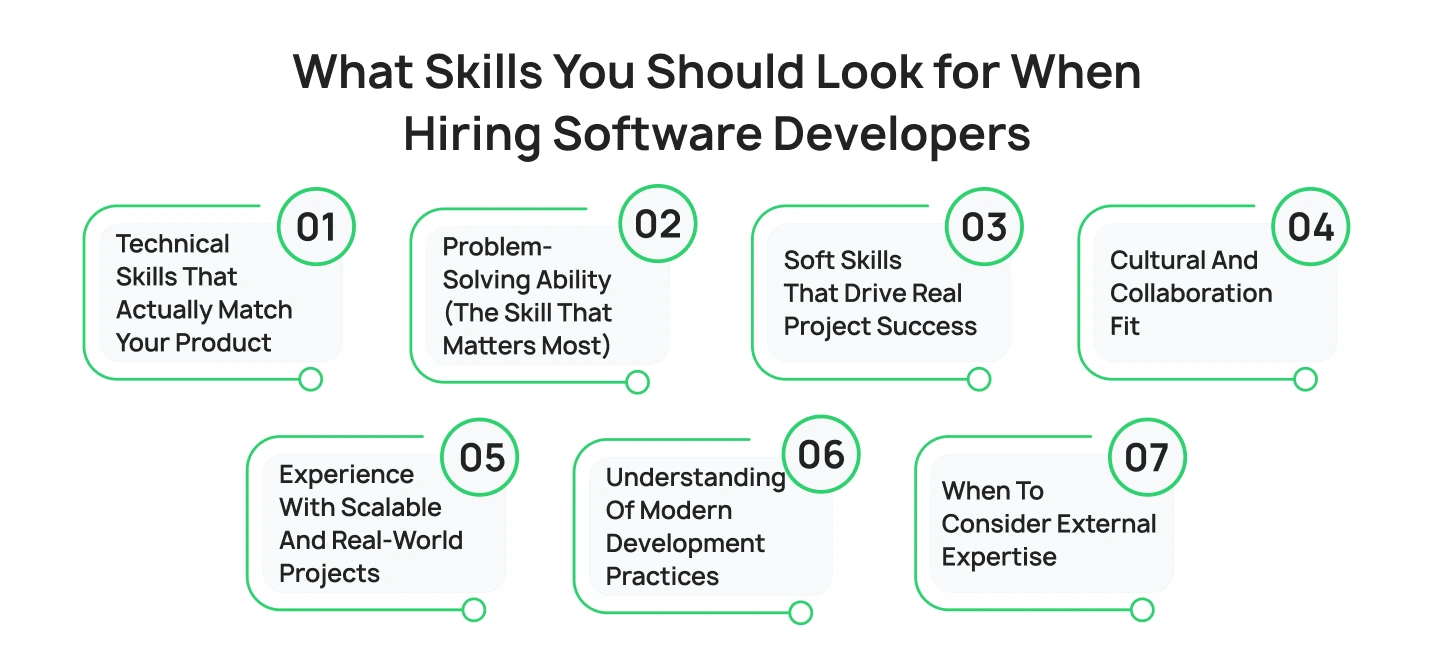
To make the right decision, you need to evaluate developers across three key dimensions: technical capability, problem-solving approach, and collaboration ability.
1: Technical Skills That Actually Match Your Product
The biggest mistake companies make is hiring based on trends instead of their actual product needs. A developer who is excellent in one stack may not be effective in another.
Start by aligning skills with your project:
Core Technology Areas to Evaluate
- Frontend Development: React, Angular, Vue (focus on performance and user experience)
- Backend Development: Node.js, Python, Java, PHP (focus on scalability and architecture)
- Mobile Development: Flutter, Swift, Kotlin (focus on cross-platform vs native needs)
- Cloud & DevOps: AWS, Azure, Google Cloud (deployment, scalability, security)
- Databases & APIs: MySQL, MongoDB, REST, GraphQL (data handling and integrations)
But listing technologies is not enough. What matters more is how developers have used them in real scenarios.
What to Look for Beyond Tools
- Have they built products similar to yours?
- Can they explain technical decisions clearly?
- Do they understand performance optimization and scalability?
- Have they worked on live, production-level applications?
Instead of relying on generic coding tests, ask candidates to walk you through real projects. This gives you far better insight into their thinking and execution.
2: Problem-Solving Ability (The Skill That Matters Most)
Strong developers are not just coders. They are problem solvers.
When evaluating candidates, focus on how they approach challenges:
- Do they break down complex problems into smaller steps?
- Can they suggest alternative solutions?
- Do they consider trade-offs like speed vs scalability?
- Are they proactive in identifying risks early?
A developer who can think critically will save you time, reduce rework, and improve product quality.
3: Soft Skills That Drive Real Project Success
Technical skills get the job done, but soft skills determine how smoothly the project runs.
The best developers consistently demonstrate:
- Clear communication: They explain ideas without confusion
- Ownership mindset: They take responsibility for outcomes, not just tasks
- Proactive updates: You don’t have to chase them for progress
- Collaboration: They work well with designers, product managers, and stakeholders
- User-focused thinking: They understand the end-user, not just the code
This becomes even more critical when working with remote or distributed teams.
4: Cultural and Collaboration Fit
Dubai-based businesses often operate across multiple regions, which means your developers must be comfortable working in diverse environments.
Look for developers who:
- Can collaborate across time zones
- Are responsive during overlapping UAE working hours
- Understand cross-cultural communication
- Adapt quickly to different team structures
A technically strong developer who cannot collaborate effectively can slow down your entire project.
5: Experience with Scalable and Real-World Projects
Not all experience is equal. A developer who has only worked on small internal tools may struggle with large-scale applications.
Prioritize candidates who have:
- Worked on high-traffic or production-level systems
- Experience handling performance issues
- Built scalable architectures
- Deployed applications in real environments
This is especially important if you are planning long-term growth or complex product development.
6: Understanding of Modern Development Practices
Strong developers stay up to date on how software is built today, not five years ago.
Look for familiarity with:
- Agile or Scrum methodologies
- CI/CD pipelines
- Version control systems like Git
- Code reviews and testing practices
- Security best practices
These practices ensure smoother development cycles and better product quality.
7: When to Consider External Expertise
If your internal team lacks specific skills or you need to move faster, many companies turn to software development outsourcing to access experienced developers without long hiring cycles. This approach allows you to bring in specialized expertise exactly when needed, without overcommitting to permanent hires.
Freelance vs Agency Software Developers: What Works Best?
Choosing the right hiring model is one of the most important decisions you’ll make when building a software product. Each option comes with its own advantages and trade-offs, depending on your timeline, budget, and project complexity.
| Factor | Freelance Developers | Agency Software Developers |
| Best For | Small tasks, MVPs, quick fixes | Scalable digital products, long-term development, end-to-end execution |
| Cost | Low upfront cost, budget-friendly | Flexible engagement based on project scope with stronger long-term ROI |
| Speed | Fast for simple tasks | Fast execution with dedicated teams aligned to your roadmap |
| Team Structure | Individual developer | Full-cycle dedicated team including developers, designers, QA, and DevOps |
| Scalability | Limited scalability | Highly scalable with teams that grow based on project needs |
| Management | Fully client-managed | Co-managed with Cubix as a dedicated development partner |
| Flexibility | High for short-term work | High flexibility with agile and adaptive development approach |
| Accountability | Low to medium | High ownership across the entire development lifecycle |
| Communication | Direct but inconsistent | Dedicated communication channels with consistent updates |
| Best Fit Scenario | Quick prototypes, short-term support | Startups and enterprises needing reliable, scalable product development with full-cycle companies like Cubix |
Cost to Hire Software Developers in Dubai
Understanding the cost of hiring software developers in Dubai goes beyond salaries alone. Businesses today are majorly investing in technical expertise, faster delivery, and long-term product stability. Software development jobs in Dubai now offer highly competitive, tax-free salaries and perks, making the market even more attractive to employers.
| Experience Level | Estimated Monthly Salary |
| Junior Developers | AED 3,000 – 12,000/month |
| Mid-Level Developers | AED 12,000 – 20,000/month |
| Senior Developers | AED 15,000 – 40,000+/month |
| AI, Blockchain & Cloud Specialists | Premium compensation based on expertise |
Software Developer Hourly Rate in Dubai (2026 Breakdown)
Hourly pricing in Dubai may depend on features, complexity, duration, technical specialization, and other factors. Below is a clear breakdown to help businesses estimate realistic development costs. Cost may depend on features, complexity, duration, and other factors.
| Developer Level | Hourly Rate (AED) | Skill Depth | Typical Responsibilities |
| Junior Developer | 80 – 150 AED/hour | Basic to intermediate | Bug fixing, UI updates, simple backend tasks, minor integrations |
| Mid-Level Developer | 150 – 300 AED/hour | Solid production experience | Feature development, API integration, full-stack tasks, product modules |
| Senior Developer | 300 – 550+ AED/hour | Advanced architecture & leadership | System design, scalability, security, performance optimization, and technical leadership |
| Specialized Engineers (AI / Cloud / Blockchain) | 400 – 900+ AED/hour | Expert/niche specialization | AI models, cloud architecture, DevOps automation, blockchain systems |
Step-by-Step Process to Hire Software Developers in Dubai
Hiring software developers in Dubai requires more than simply posting a job opening and reviewing resumes. The market is highly competitive, and businesses that approach hiring without a clear strategy often face delays, rising costs, and inconsistent results. A structured hiring process helps companies reduce risk, improve team quality, and build products that can rise in just a blink of an eye.
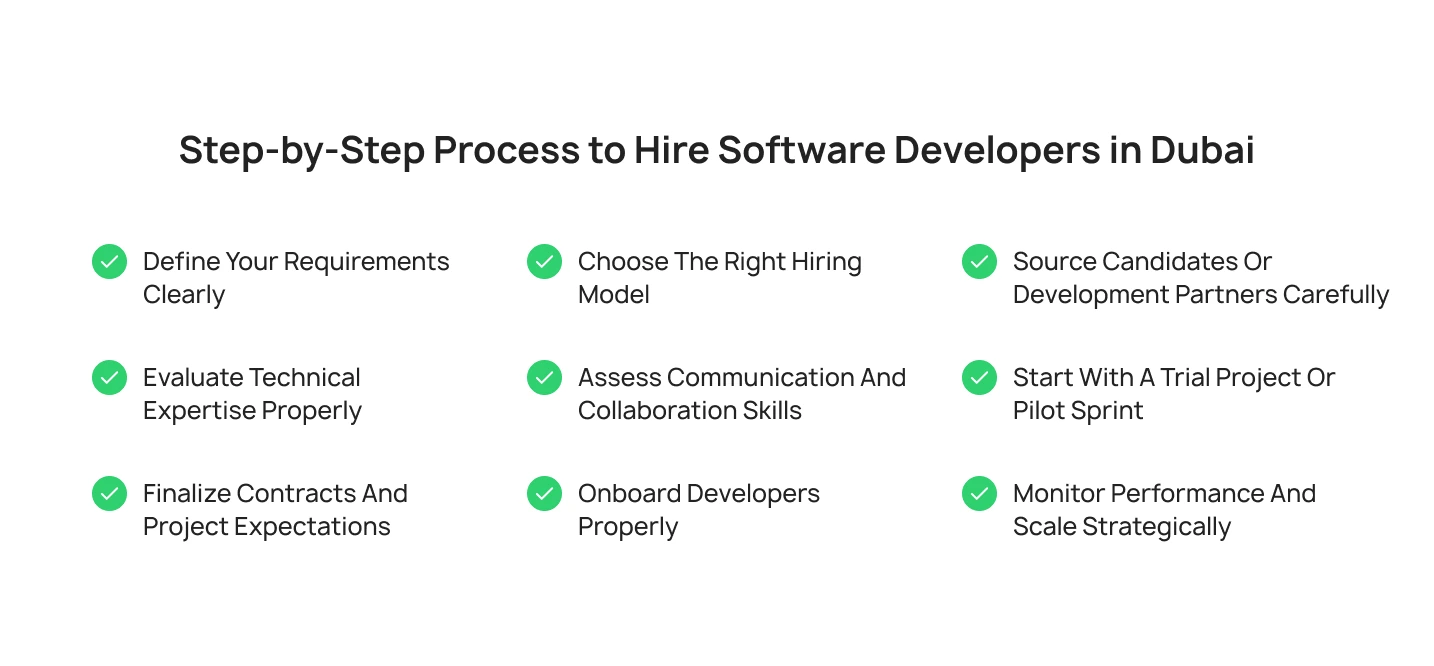
Step 1: Define Your Requirements Clearly
Before you start searching for developers, you need complete clarity about your project goals and technical needs. Many businesses rush into hiring without properly defining their product scope, resulting in communication gaps, unrealistic expectations, and budget overruns later.
Start by identifying:
- Your product objectives
- Core features and functionality
- Preferred technologies
- Delivery timeline
- Budget range
- Long-term scalability goals
You should also determine whether you need a mobile application, web platform, SaaS product, enterprise software, or a combination of multiple systems. The clearer your requirements are, the easier it becomes to find developers who actually fit your project.
Step 2: Choose the Right Hiring Model
One of the most important decisions is selecting the right hiring structure. Not every project requires full-time developers, and not every business benefits from building an in-house team immediately.
Freelancers are usually suitable for:
- Small projects
- Quick fixes
- MVP development
- Temporary technical support
In-house developers work best for:
- Long-term internal products
- Businesses needing full operational control
- Companies with established technical leadership
Dedicated development teams are ideal for:
- Scaling startups
- Ongoing product development
- Faster team expansion
- Long-term collaboration
Many businesses in Dubai now prefer working with full-cycle development companies like Cubix because they provide access to developers, designers, QA engineers, and project managers within a single delivery structure. This reduces hiring delays and simplifies project management significantly.
Step 3: Source Candidates or Development Partners Carefully
Finding strong developers is one of the biggest hiring challenges in Dubai. The issue is not the number of applicants, but filtering experienced professionals from unqualified candidates.
Businesses usually search through:
- UAE recruitment firms
- LinkedIn and professional networks
- Developer communities
- Global hiring platforms
- Referrals and recommendations
Another efficient option is to partner with experienced software development companies that already have pre-vetted engineering teams. This approach helps businesses skip lengthy recruitment cycles and access developers more quickly.
Step 4: Evaluate Technical Expertise Properly
Many companies make hiring mistakes because they rely only on resumes or outdated technical tests. A developer may perform well in generic coding assessments but still struggle with real-world product development.
Instead of focusing only on theory, evaluate:
- Real project experience
- Problem-solving ability
- Understanding of scalability
- API and database architecture
- Security awareness
- Performance optimization knowledge
Ask developers to explain products they have previously built, technical challenges they solved, and decisions they made during development. This gives much better insight into their practical capabilities.
Step 5: Assess Communication and Collaboration Skills
Technical ability alone does not guarantee project success. Strong communication is equally important, especially for remote or distributed teams.
Developers should be able to:
- Explain technical concepts clearly
- Collaborate with non-technical stakeholders
- Provide regular updates
- Handle feedback professionally
- Work effectively within teams
Poor communication often leads to misunderstandings, missed deadlines, and delivery issues, even when technical skills are strong.
Step 6: Start with a Trial Project or Pilot Sprint
One of the safest ways to reduce hiring risk is to start with a small trial project before committing long-term. This helps businesses evaluate:
- Code quality
- Delivery speed
- Communication style
- Reliability
- Team collaboration
A short pilot phase often reveals far more about a developer’s real capabilities than interviews alone.
Step 7: Finalize Contracts and Project Expectations
Before onboarding developers, businesses should clearly define:
- Scope of work
- Payment structure
- Milestones and deadlines
- Reporting process
- Intellectual property ownership
- NDA and security agreements
Clear contracts prevent future misunderstandings and create accountability from the beginning.
Step 8: Onboard Developers Properly
Even experienced developers need proper onboarding to perform effectively. Businesses should provide:
- Product documentation
- Technical workflows
- Access to tools and systems
- Communication guidelines
- Team introductions
A structured onboarding process improves productivity and helps developers integrate into projects faster.
Step 9: Monitor Performance and Scale Strategically
Hiring developers is not the final step. Ongoing management and performance tracking are equally important for long-term success.
Businesses should continuously evaluate:
- Delivery consistency
- Code quality
- Team collaboration
- Bug frequency
- Productivity and responsiveness
As products grow, development teams should scale strategically. Many businesses begin with a small development team and gradually expand by adding QA engineers, DevOps specialists, designers, and additional developers based on project needs.
Common Hiring Mistakes Businesses Should Avoid
Hiring software developers in Dubai can either push your product forward quickly or quietly hold it back for months if the wrong decisions are made early on. The reality is, most hiring problems are not caused by a shortage of talent in the market. They happen because businesses underestimate how complex the decision-making process really is.
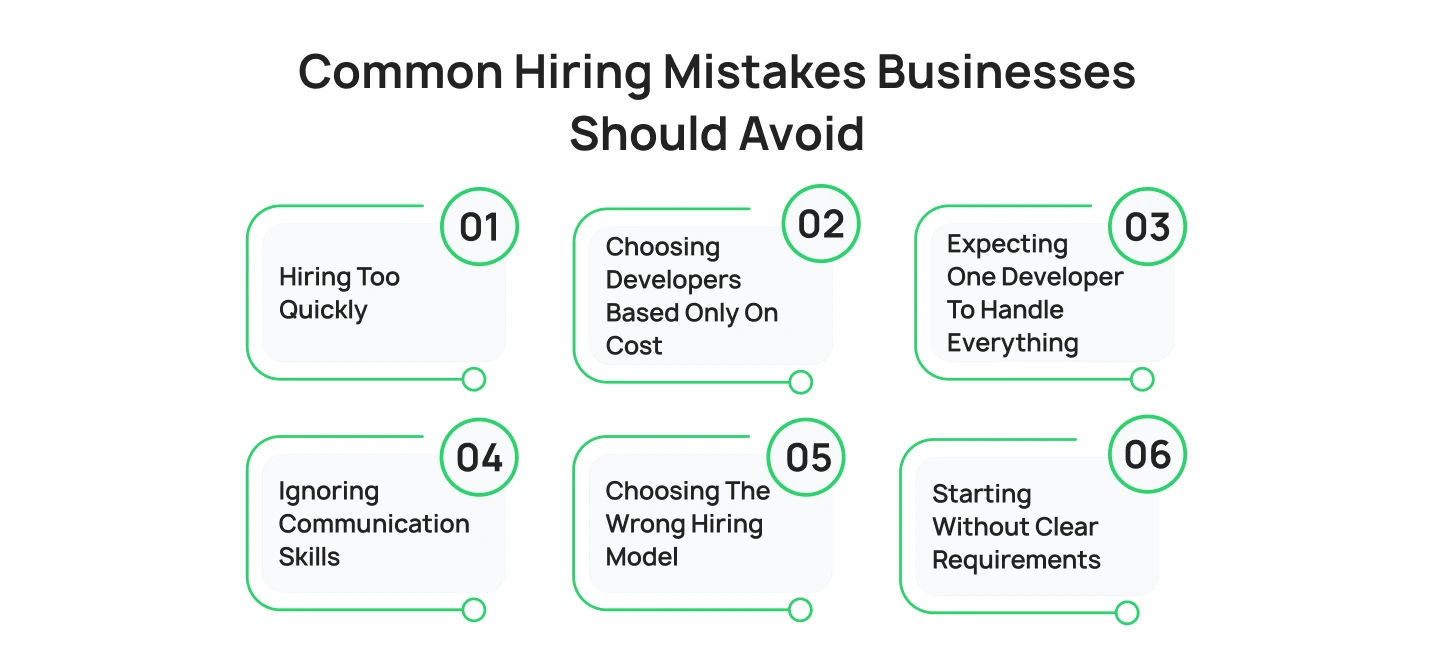
Here are the most common mistakes companies make when hiring software developers, and why each one ends up costing far more than expected.
Hiring Too Quickly
Many businesses rush hiring to start development faster, but poor evaluation often leads to weak technical execution and costly rework later. Always assess real project experience, not just resumes or coding tests.
Choosing Developers Based Only on Cost
Low-cost hiring may save money initially, but it often creates bigger problems:
- Poor code quality
- Scalability issues
- Delayed delivery
- Higher maintenance costs
The cheapest option rarely delivers the best long-term value.
Expecting One Developer to Handle Everything
Many companies look for developers who can manage frontend, backend, mobile, cloud, and DevOps together. Modern software projects require specialization, and unrealistic expectations usually slow projects down.
Ignoring Communication Skills
Technical skills alone are not enough. Developers must communicate clearly, provide updates, and collaborate effectively with teams. Poor communication often creates delays and misunderstandings during development.
Choosing the Wrong Hiring Model
Not every project needs a full in-house team, and not every product can succeed with freelancers. Businesses should choose hiring models based on project complexity, scalability, and long-term goals.
Starting Without Clear Requirements
Hiring developers without clearly defining product goals, features, timelines, and budgets creates confusion from the start. Clear project requirements help reduce delays, revisions, and unexpected costs.
Why Dubai Businesses Rely on Cubix for Full-Cycle Software Development

Dubai businesses rely on Cubix for full-cycle software development because it removes the complexity of managing fragmented teams and inconsistent delivery. With 15+ years of experience, we have delivered 1,300+ projects for 600+ clients across 20+ industries, supported by a global team of experts.
Businesses choose Cubix because they get:
- End-to-end product development under one roof
- Faster time-to-market with agile workflows
- Dedicated and scalable development teams
- Reduced hiring and management overhead
- Consistent quality across design, development, and testing
When businesses partner with a professional team, they get support across the entire product lifecycle, from strategy and development to deployment and ongoing maintenance. This reduces delays, improves communication, and ensures better control over project outcomes.
“Success in technology starts with the right development team. At Cubix, we make it easier for businesses in Dubai to hire software developers who deliver real impact, not just code.”
– Salman Lakhani, CEO at Cubix
Final Thoughts
Hiring the right development team is no longer just a technical decision; it is a growth strategy. Businesses in Dubai are increasingly turning to structured models instead of fragmented hiring approaches. Many now prefer working with offshore software developers to reduce costs, access global expertise, and speed up delivery without compromising quality. The key is choosing a partner that understands product vision, scalability, and strategic execution. With the right team in place, companies can focus on innovation while ensuring their software is built efficiently, securely, and ready for market growth.
[blog_cta_2]
Frequently Asked Questions
1: How do I hire software developers in Dubai?
You can hire software developers in Dubai by choosing between freelancers, agencies, or dedicated development teams based on your project scope, budget, and timeline.
2: What is the best hiring model for software development?
The best model depends on your needs. Freelancers work for small tasks, agencies are ideal for full projects, and dedicated teams are best for scalable, long-term development.
3: Why do companies choose Cubix for software development?
Companies choose Cubix because it provides custom software development services with full-cycle support, including developers, designers, QA, and DevOps teams. This helps businesses build tailored digital products, scale faster, and reduce the complexity of hiring and managing multiple resources.
4: How long does it take to hire software developers in Dubai?
On average, it takes 3 to 6 weeks to hire software developers in Dubai, depending on role complexity, sourcing method, and evaluation process.
5: Is outsourcing software development a good option for Dubai businesses?
Yes, outsourcing helps businesses access global talent, reduce hiring time, control costs, and speed up product development without compromising quality.