
Blog Summary
- The UAE is strengthening its position as a global digital economy leader through large-scale investments in AI, cloud computing, automation, and smart infrastructure.
- Digital transformation is redefining how businesses across the UAE operate, compete, engage customers, and drive long-term growth.
- Rising customer expectations, increasing market competition, and government-led innovation initiatives are accelerating digital adoption across industries.
- Technologies such as AI, predictive analytics, intelligent automation, and cloud platforms are helping organizations improve operational efficiency and decision-making.
- Industries including retail, healthcare, finance, logistics, hospitality, and real estate are leading the shift toward connected and data-driven business models.
- With expertise across AI, automation, cloud solutions, and enterprise technologies, Cubix helps Dubai businesses build advanced digital ecosystems designed for sustainable growth and innovation.
The UAE is moving quickly from being a technology adopter to a global digital leader, reshaping how modern economies grow and compete. Backed by a strong $509 billion economy, a population of over 11 million, and consistent investment in advanced technologies, the country has built one of the most mature digital ecosystems in the Middle East.
A major driver of this progress is the UAE’s Digital Economy Strategy, which aims to increase the digital economy’s share of GDP from 9.7% to more than 20% by 2031. This roadmap is not just policy; it is actively accelerating the use of AI, automation, cloud platforms, and data-driven systems across industries.
For modern businesses, this shift is changing everything from smart decision-making, daily operations, to customer engagement and sustainable business growth. As a leading technology and digital transformation company in Dubai, UAE, Cubix has seen firsthand how businesses are shifting from traditional operational models towards a smarter, more connected digital ecosystem that builds trust, scalability, and innovation.
This article explores the key digital transformation trends for businesses in the UAE in 2026, the technologies driving change, the industries leading adoption, and the future opportunities shaping the next generation of digital business in the Emirates.
[blog_cta]
What Digital Transformation Means for UAE Businesses
Digital transformation is changing the way businesses across the UAE operate, deliver services, and compete in an increasingly connected economy. It is no longer just about adopting digital tools or upgrading existing systems. In 2026, transformation is about building smarter, more agile businesses that can adapt quickly to changing customer expectations and market demands.
For many organizations, the biggest shift is moving from traditional business models to digital-first operations. This means replacing disconnected processes with integrated technologies that improve efficiency, strengthen decision-making, and create better customer experiences.
So, what does digital transformation mean for UAE businesses today? It means using technology as a core business driver rather than simply a support function. Companies are now investing in digital ecosystems that connect operations, employees, customers, and data in real time.
Core Areas Driving Digital Transformation
Businesses across the UAE are increasingly adopting technologies such as:
- Artificial intelligence (AI)
- Intelligent automation
- Cloud computing
- Predictive analytics
- Cybersecurity solutions
- Smart customer engagement platforms
- Internet of Things (IoT) technologies
- Digital payment ecosystems
These technologies are helping organizations improve operational performance while creating faster and more personalized customer experiences.
Why Digital Transformation Has Become a Business Priority in 2026
Business in the UAE is moving fast, and the gap between digitally ready companies and everyone else is becoming harder to ignore. In 2026, digital transformation for businesses in the UAE is no longer something companies “consider.” It is something they actively depend on to stay competitive and relevant.
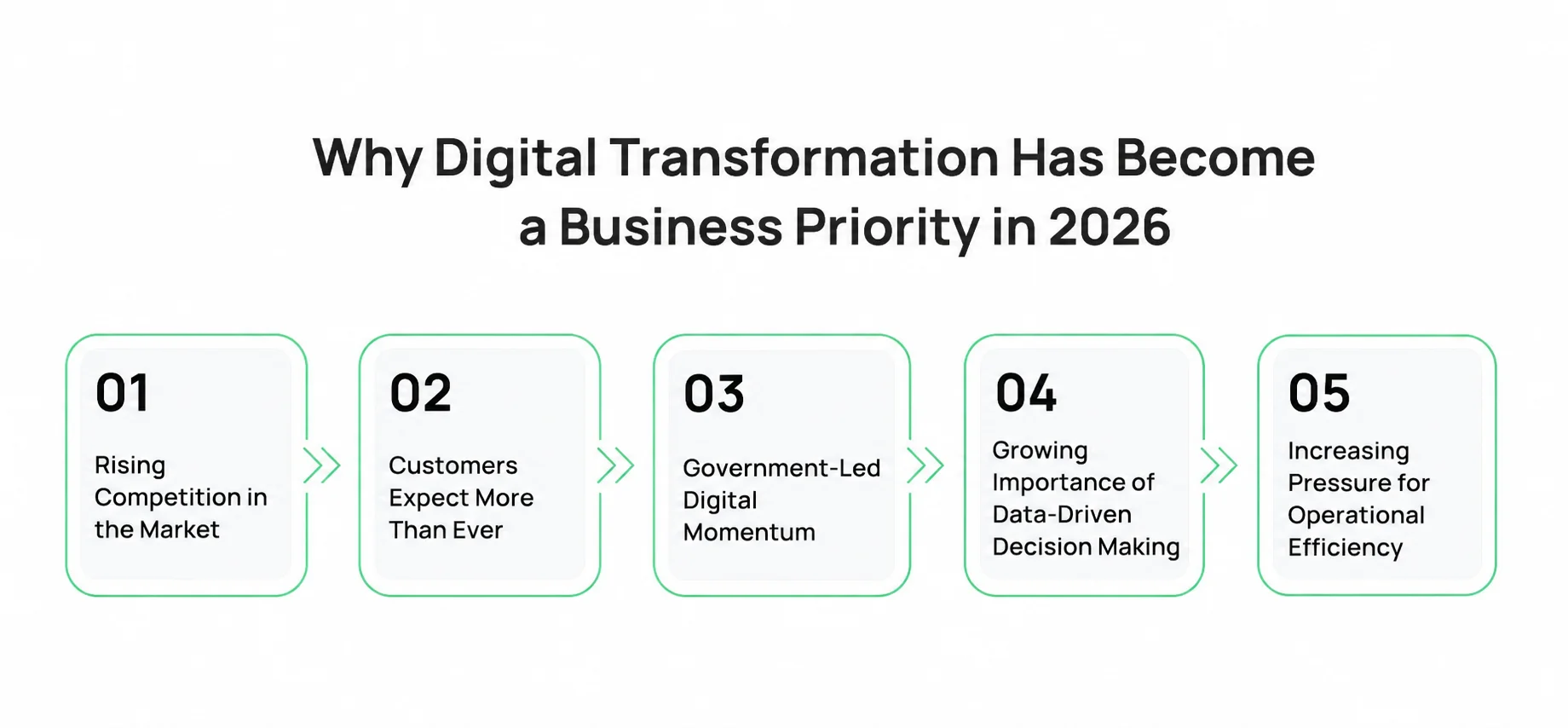
Below are a few clear forces shaping this shift.
Rising Competition in the Market
The UAE continues to attract global brands, regional leaders, and ambitious startups across every sector. That kind of environment naturally raises the bar. According to PwC’s 2023 report, 85% of UAE business leaders prioritize digital transformation to stay competitive in this challenging market.
Today, businesses are not only competing on price or product. They are being measured on how well they deliver:
- Fast and seamless services
- Smooth digital experiences
- Consistent customer support across channels
- Efficiency in operations
- Ability to innovate without delays
Customers Expect More Than Ever
Customer expectations in the UAE have changed in a very practical way. People don’t just prefer digital convenience anymore; they expect it.
In fact, according to Bayzat’s 2024 survey, 65% of UAE consumers now expect tailored digital experiences, especially in industries like hospitality, retail, and healthcare.
That expectation is shaping everyday business decisions. Businesses that fail to meet these expectations often lose attention quickly, even if their core offering is strong.
Customers now want:
- Services that feel personalized, not generic
- Quick access through mobile and digital platforms
- Smooth experiences across different touchpoints
- Round-the-clock availability
- Less effort, more convenience
Government-Led Digital Momentum
A major driver of digital transformation in the UAE is the strong national focus on innovation. Smart city initiatives, AI programs, and digital government services are creating an environment where modernization is becoming the norm rather than the exception.
This momentum is also accelerating business adoption. According to a 2024 Deloitte report, 70% of UAE firms using government digital programs have sped up their technology adoption timelines. This shows how closely public initiatives are influencing private-sector transformation.
As a result, digital adoption is no longer just a business choice. It is part of a wider national shift that is reshaping how companies operate, compete, and grow in the UAE.
Growing Importance of Data-Driven Decision Making
Modern organizations generate large volumes of data every day, but the real advantage lies in how effectively that data is used.
Businesses that embrace digital transformation are better positioned to:
- Identify market trends earlier
- Improve forecasting accuracy
- Understand customer behavior in real time
- Make faster operational decisions
- Reduce uncertainty in planning
Increasing Pressure for Operational Efficiency
Rising costs, complex operations, and fast-changing market conditions are pushing businesses to operate more efficiently. Traditional, manual processes are no longer sufficient to meet modern performance demands.
Through digital transformation, organizations can:
- Automate repetitive workflows
- Reduce operational delays
- Improve workforce productivity
- Streamline internal systems
- Lower long-term operational inefficiencies
Key Digital Transformation Trends in UAE Businesses for 2026
Digital transformation in the UAE is not only taking a big step, but it is also accelerating through clear, industry-wide shifts that are reshaping how businesses try to achieve their goals and deliver real value. In 2026, the focus is less on experimenting with technology and new strategies and more on embedding them deeply into core business models.
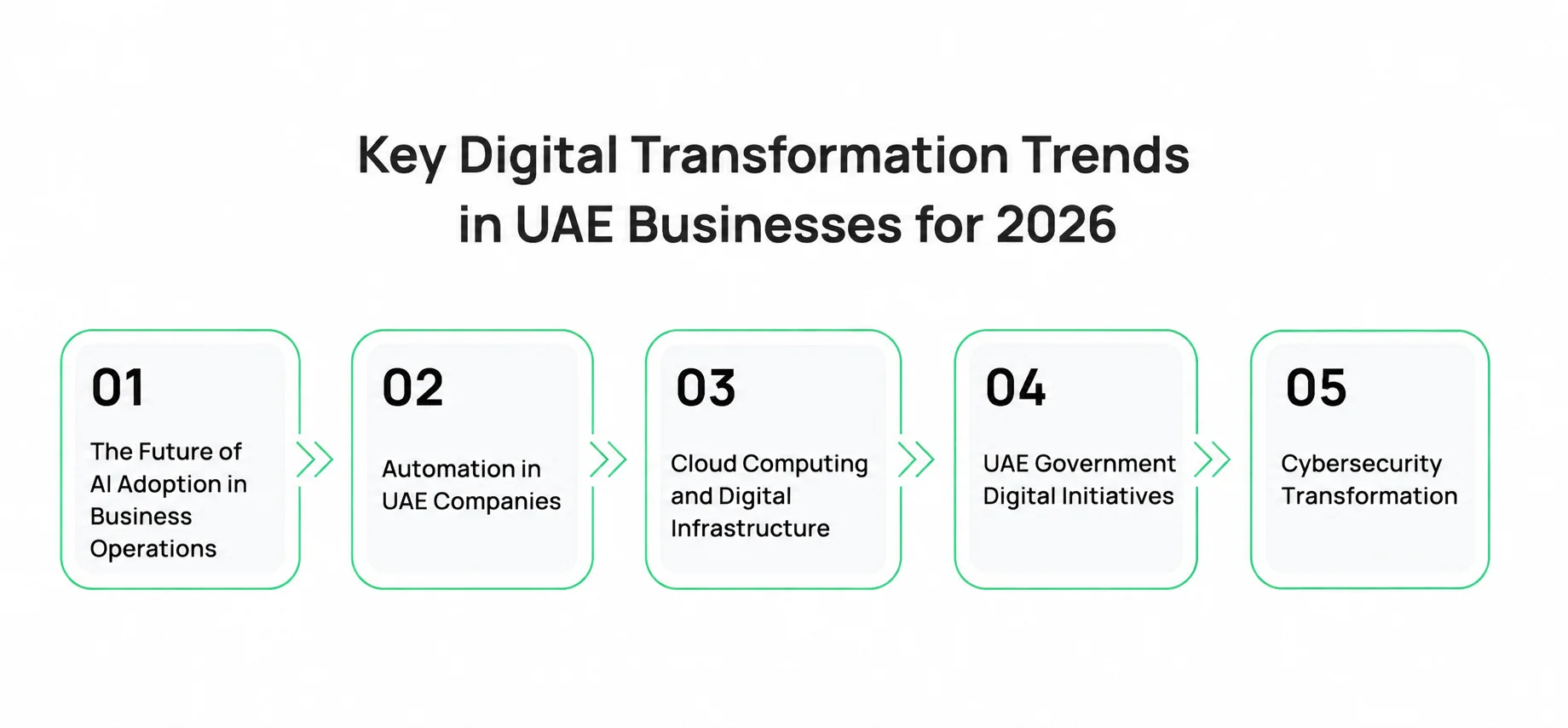
Here are the key digital transformation trends UAE businesses are actively embracing in 2026, with smart moves and key trends.
The Future of AI Adoption in Business Operations
Artificial intelligence is no longer just a futuristic concept. It is now actively reshaping how organizations operate, scale, and compete in 2026. AI is transforming industries across Dubai by automating daily operations, improving productivity, enhancing customer satisfaction, and strengthening business intelligence. According to PwC, in the UAE, AI contribution is expected to grow significantly, reaching $96.0 billion by 2030, accounting for 13.6% of GDP. This growing influence highlights how deeply AI is becoming integrated into business strategies across the country.
The main advantage of AI adoption in UAE businesses is predictive analytics. Businesses are now able to process vast amounts of customer and operational data to detect emerging trends in advance. Many UAE enterprises are partnering with experienced AI development companies to build predictive analytics systems, automation workflows, and intelligent business platforms.
Automation in UAE Companies
Automation is reshaping how businesses in the UAE run their day-to-day operations by moving beyond basic task handling to fully integrated workflow systems. Instead of relying on manual processes, companies are now using automation to improve coordination across departments and reduce operational delays. In HR, it simplifies hiring, onboarding, and payroll processes. In finance, it is making reporting, invoicing, and compliance more structured and reliable. In supply chain management, it improves tracking, inventory control, and procurement efficiency. Customer service is also evolving through chat-based support and self-service tools. Overall, automation is helping UAE businesses operate more efficiently, reduce operational strain, and improve overall business performance.
Cloud Computing and Digital Infrastructure
Cloud computing has become a key requirement for UAE businesses, offering the flexibility and speed needed to thrive in a fast-paced digital environment. Rather than depending on physical servers, organizations now rely on cloud platforms to store data, run applications, and manage operations more effectively. According to Gartner, around 90% of enterprises are expected to adopt a hybrid cloud approach by 2027. This shift enables teams to access information from anywhere, collaborate seamlessly across locations, and scale resources based on business demand.
Cloud technology also helps businesses improve system integration, support remote working models, strengthen data management practices, and overcome traditional infrastructure constraints. In addition, it accelerates the delivery of digital services and enhances decision-making by providing real-time access to data.
UAE Government Digital Initiatives
The UAE government is actively driving nationwide digital progress through smart governance, AI-led programs, and advanced digital public services. These initiatives are helping businesses modernize operations, improve efficiency, and adopt new technologies at a faster pace. By investing in digital infrastructure and innovation-focused policies, the government is creating a strong foundation for long-term economic growth. This supportive ecosystem is encouraging both public and private sectors to collaborate and build more connected, technology-driven business environments across the country.
Cybersecurity Transformation
When the businesses in the UAE expand at a rapid rate, their digital exposure also grows, making cybersecurity a critical part of overall operations. With increasing reliance on cloud platforms, AI systems, and connected technologies, protecting sensitive data becomes essential for maintaining stability and trust. Companies are now strengthening their security measures by embedding protection into every layer of their digital infrastructure. This includes real-time threat detection, stronger identity verification, and intelligent monitoring systems that can identify risks early.
In this environment, cybersecurity is no longer just a technical safeguard. It is a foundation for safe expansion, customer confidence, and long-term digital growth.
Why UAE Businesses Must Adapt To These Digital Transformation Trends

A few years ago, many businesses viewed digital transformation as a future investment. In 2026, it has become a business necessity. Companies across the UAE are operating in a market where customer expectations change quickly, competition moves faster, and operational efficiency directly impacts growth.
Let’s break down this information with the help of a real-world example: Consider a retail brand in Dubai managing thousands of daily customer interactions. Without AI-driven inventory tracking and real-time customer analytics, products run out of stock, delivery timelines slow down, and customer satisfaction drops. Meanwhile, competitors using automation and predictive systems can respond instantly to demand shifts, personalize shopping experiences, and retain customers more effectively. The difference is no longer just technology. It is business performance.
This is why adapting to digital transformation trends is becoming critical across industries. The UAE digital transformation strategy is further accelerating this shift by creating an environment where innovation, AI adoption, and digital infrastructure development are actively encouraged. As industries become more connected and data-driven, businesses that delay transformation risk falling behind competitors that are already operating with smarter and more adaptive systems.
Ultimately, digital transformation is not simply about adopting modern tools. It is about building businesses that are prepared for long-term growth, resilience, and leadership in an increasingly digital economy.
How to Implement These Trends in Your Business
Implementing digital transformation in UAE businesses requires a clear mix of strategy and the right technology stack. Instead of adopting tools randomly, companies should align solutions with specific business goals such as efficiency, customer experience, and scalability.
Key technologies businesses can use include:
- AI tools for predictive analytics and customer insights
- RPA (Robotic Process Automation) for workflow automation
- Cloud platforms like AWS, Azure, or Google Cloud for scalable infrastructure
- CRM systems for customer management and personalization
- AI chatbots for 24/7 customer support
- Cybersecurity tools for threat detection and data protection
This is where the right partner becomes important. At Cubix, we work closely with businesses to design and implement transformation strategies that are practical, scalable, and aligned with real operational goals, helping organizations move from digital planning to real execution with confidence.
Challenges Businesses Face During Digital Transformation
Digital transformation brings strong opportunities, but the journey is not without obstacles. Many UAE businesses struggle not because of technology itself, but because of how it is planned, adopted, and integrated into existing operations. Understanding these challenges helps organizations prepare better and avoid costly implementation gaps.
- Legacy systems that are difficult to integrate with modern cloud and AI-based platforms
- Resistance to change from employees who are used to traditional workflows
- Shortage of skilled talent in areas like AI, data analytics, and cloud engineering
- Cybersecurity risks are increasing as more business processes move online
- Difficulty in aligning digital investments with measurable business outcomes
- Complex system integration across multiple tools and departments
How Cubix Enables Scalable Digital Transformation For Dubai Enterprises

Cubix supports enterprises in building connected digital systems through custom software development services tailored for long-term growth. Digital transformation in Dubai is simply not just about adopting new technology. Enterprises in the UAE need advanced systems that can upgrade operational efficiency, enhance customer experiences, streamline operations, and drive sustainable growth in an increasingly digital business environment. This is where Cubix helps enterprises transition from traditional workflows to intelligent, connected business ecosystems built for innovation, agility, and measurable impact.
Our Proven Track Record:
- 1,300+ Successfully Completed Projects delivering scalable digital solutions across global markets
- 350+ Skilled Cubixians specializing in AI, cloud, automation, and enterprise technologies
- 600+ Satisfied Clients ranging from startups to large enterprises
- Trusted expertise across 20+ industries, including retail, healthcare, finance, logistics, hospitality, and real estate
- Proven experience in building AI-powered, cloud-driven, and automation-focused business ecosystems
- Strong focus on innovation, operational efficiency, and long-term digital growth for modern enterprises
“At Cubix, we focus on helping clients transform complex challenges into simple, next-generation digital solutions that improve performance and drive measurable business growth.”
– Salman Lakhani, CEO at Cubix
Conclusion
The United Arab Emirates is now becoming a major force in digital transformation, driving progress across business operations, government services, and advanced technologies. As the country continues investing in innovation and digital infrastructure, businesses are increasingly adopting technologies such as cloud computing, artificial intelligence, automation, and cybersecurity to improve performance and stay competitive. Companies that build strong digital strategies today will be better prepared to improve efficiency, meet changing customer expectations, and achieve sustainable growth. With the UAE continuing to expand its digital economy, organizations that embrace innovation and modern technology will be in a stronger position to succeed through 2026 and beyond.
[blog_cta_2]
Frequently Asked Questions
1: What does digital transformation mean for UAE businesses?
It means using digital technologies to improve how businesses operate, make decisions, and deliver value to customers. It goes beyond tools and focuses on building smarter, more connected business processes.
2: What are digital transformation services in the UAE?
Digital transformation services in the UAE include a wide range of advanced technology solutions such as AI development, cloud computing, automation, cybersecurity, and data analytics. These services enable businesses to improve operational efficiency, enhance customer experiences, and make more informed, data-driven decisions. With over 15 years of experience, Cubix helps enterprises design and implement tailored solutions that modernize operations and support long-term, sustainable growth in an increasingly fast-evolving business environment.
3: How are UAE companies using AI and automation?
UAE companies are using AI and automation for predictive analytics, customer support chatbots, fraud detection, workflow automation, inventory tracking, and improving operational performance across departments.
4: Is digital transformation necessary for businesses in the UAE?
Yes, it is essential due to rising competition, changing customer expectations, and the UAE’s rapidly growing digital economy. Businesses that fail to adapt risk losing competitiveness in the market.
5: How can Cubix help businesses with digital transformation in the UAE?
Cubix helps businesses implement strategies through AI development, cloud solutions, automation systems, enterprise software, and modern digital infrastructures. With over 15 years of experience across 20+ industries, we support organizations in improving operational efficiency, modernizing business processes, and building technology ecosystems designed for continuous improvement.