
Key Takeaways
- Software development outsourcing has become a growth strategy, not just a cost-saving tactic. Saudi and UAE enterprises are partnering with global tech companies to accelerate innovation and meet ambitious digital transformation goals.
- The demand for skilled software engineers continues to outpace local talent availability. Hiring challenges, rising salaries, and longer recruitment cycles are pushing businesses to explore global development partnerships.
- Global tech partners provide access to specialized expertise. From AI and cloud engineering to DevOps, cybersecurity, and enterprise software development, outsourcing helps businesses fill critical skill gaps faster.
- Successful outsourcing is about choosing the right partner. A proven development process, transparent communication, dedicated project management, and strong security practices are essential for long-term success.
- Outsourcing offers flexibility without sacrificing quality. Enterprises can scale development teams up or down based on project needs while maintaining speed, efficiency, and engineering excellence.
Saudi Arabia and the UAE are racing toward a digital-first future.
From smart cities and AI-powered government services to digital banking and Industry 4.0 initiatives, businesses across the Gulf are investing heavily in technology. Saudi Arabia’s Vision 2030 and the UAE’s Digital Government Strategy have accelerated demand for modern software, cloud platforms, artificial intelligence, and enterprise applications.
But here’s the challenge.
Building digital products is no longer the hardest part. Finding enough skilled software engineers to build them is.
That is one of the biggest reasons software development outsourcing has evolved from a cost-saving tactic into a strategic business decision.
And the numbers support this shift.
According to Deloitte’s Global Outsourcing Survey, organizations increasingly outsource to gain access to specialized talent, improve agility, and accelerate innovation. Meanwhile, industry reports from Korn Ferry estimate that the global technology sector could face a shortage of millions of skilled professionals by the end of the decade if current hiring trends continue.
That raises an important question.
If every company is competing for the same talent, how can enterprises continue delivering digital products on time?
Why Local Hiring Alone Can No Longer Meet Enterprise Demand
Ten years ago, hiring locally was often enough to support software projects.
Today, that’s no longer the case.
Across Saudi Arabia and the UAE, digital transformation has become a national priority. Enterprises are launching new digital products faster than ever, while governments continue investing billions of dollars into technology, AI, cloud computing, fintech, healthcare innovation, and smart infrastructure.
The result?
Almost every organization is competing for the same highly skilled software professionals.
GCC’s Digital Economy Is Growing Faster Than the Talent Pool
Saudi Arabia has committed hundreds of billions of dollars toward economic diversification through Vision 2030, with technology and innovation sitting at the center of that transformation. The Kingdom is rapidly expanding investments in artificial intelligence, cloud services, digital government platforms, and smart city initiatives like NEOM.
The UAE has taken a similar approach, becoming one of the world’s leading digital governments while encouraging innovation across finance, healthcare, logistics, retail, and public services.
This rapid growth has created enormous demand for experienced software engineers.
According to LinkedIn’s global workforce insights, software engineering, AI, cloud computing, and cybersecurity continue to rank among the fastest-growing technology skills worldwide. At the same time, Korn Ferry projects a significant shortage of skilled technology professionals over the coming years, making competition for experienced developers increasingly intense.
Digital Growth by the Numbers
| Statistic | Why It Matters |
| Saudi Arabia’s Vision 2030 continues to prioritize digital transformation and AI investment. | More enterprise software projects require skilled engineering teams. |
| The UAE consistently ranks among global leaders in digital government services. | Businesses are under pressure to modernize customer experiences. |
| Demand for AI, cloud, and cybersecurity professionals continues to outpace supply globally. | Hiring specialized talent locally becomes more competitive. |
| Global software developer shortages are expected to remain a major challenge throughout this decade. | Companies increasingly look beyond local hiring markets. |
The True Cost of Local Hiring
| Challenge | Business Impact |
| Long recruitment cycles | Delays product launches and digital initiatives. |
| Rising salary expectations | Increases overall development budgets. |
| Limited access to niche expertise | Makes AI, cloud, and enterprise projects harder to deliver. |
| Employee turnover | Causes knowledge loss and project disruption. |
| Scaling teams quickly | Often requires months of hiring and onboarding. |
Now imagine launching a new customer platform, ERP system, or AI-powered solution.
Would you rather spend four to six months assembling a team or start development with experienced engineers already working together?
That question is exactly why more organizations are exploring outsourcing custom software development through experienced global partners.
Instead of waiting for talent to become available, businesses can access dedicated teams with proven experience in software engineering, product development, cloud infrastructure, AI, cybersecurity, and enterprise applications.
And for many Saudi and UAE enterprises, that has become a faster, more scalable path to digital transformation.
Why Global Tech Partners Have Become the Smarter Growth Strategy

Not long ago, businesses outsourced software development mainly to reduce costs.
That has changed.
Today, speed, flexibility, and access to specialized expertise are just as important, if not more important than saving money.
Think about it.
An enterprise launching an AI-powered customer platform cannot afford to spend six months hiring data scientists. A bank rolling out a new mobile app cannot delay its launch because it’s still recruiting DevOps engineers.
In today’s market, waiting often costs more than hiring.
That’s why more organizations are turning to outsourcing software development services through trusted global technology partners.
Instead of recruiting every role internally, they gain immediate access to experienced engineers, architects, designers, QA specialists, and project managers who have already worked together on complex software projects.
The result?
Projects move faster, risks are reduced, and businesses can focus on innovation instead of recruitment.
The Shift from Cost Savings to Business Growth
One of the biggest misconceptions about software development outsourcing is that companies do it only because it’s cheaper.
While cost efficiency is certainly an advantage, it is rarely the only reason.
According to Deloitte’s Global Outsourcing Survey, organizations now outsource for several strategic reasons, including improving operational flexibility, accessing specialized talent, accelerating innovation, and enabling business transformation.
For enterprises in Saudi Arabia and the UAE, this approach aligns closely with ambitious digital transformation goals.
Instead of building every capability from scratch, businesses can partner with global experts who already have experience delivering enterprise software, AI solutions, cloud platforms, and large-scale digital products.
Why Enterprises Are Choosing Global Tech Partners
| Business Need | How a Global Partner Helps |
| Launch products faster | Provides ready-to-deploy development teams. |
| Access specialized expertise | Offers AI, cloud, cybersecurity, and enterprise specialists. |
| Scale projects quickly | Adds developers without lengthy recruitment cycles. |
| Reduce delivery risks | Uses proven development processes and experienced project managers. |
| Support long-term innovation | Brings knowledge from multiple industries and global projects. |
Notice something?
Only one of these reasons is directly related to cost.
The rest focus on helping businesses grow faster and deliver better software.
Local Hiring vs. Software Development Outsourcing
| Factor | Building an In-House Team | Working with a Global Tech Partner |
| Hiring timeline | Often takes several months | Teams can be onboarded within weeks. |
| Talent availability | Limited to local market | Access to global specialists. |
| Team scalability | Slower and recruitment-dependent | Scale up or down based on project needs. |
| Technology expertise | May require additional hiring or training | Ready access to niche technical skills. |
| Operational flexibility | Lower | Higher |
| Upfront investment | Higher recruitment and infrastructure costs | Lower initial overhead with flexible engagement models. |
For many organizations, the question is no longer whether to outsource.
It’s which work should stay in-house, and which projects are better handled by experienced global partners.
Access to Skills That Are Hard to Find Locally
- Artificial intelligence and machine learning
- Cloud architecture
- Kubernetes and containerization
- Cybersecurity
- Data engineering
- DevOps automation
- Enterprise integrations
- Low-code and no-code platforms
- Internet of Things (IoT)
- Business intelligence and analytics
High-Demand Technology Roles
| Role | Why Demand Is Growing |
| AI & Machine Learning Engineers | Organizations are integrating AI into products and operations. |
| Cloud Architects | Businesses continue migrating to cloud-native infrastructure. |
| DevOps Engineers | Faster deployments and continuous delivery require automation expertise. |
| Cybersecurity Specialists | Growing compliance and security requirements increase demand. |
| Data Engineers | Modern businesses rely on real-time analytics and business intelligence. |
This access to specialized talent is one of the biggest reasons enterprises are choosing outsourcing software development companies with proven experience across multiple technologies and industries.
Cost Efficiency Still Matters But It’s Only Part of the Picture
Instead of asking, “How much does a developer cost?“, they’re asking:
- How quickly can we launch?
- Can this partner scale with us?
- Will the software be reliable?
- Do they have experience with enterprise systems?
- Can they reduce project risks?
Looking Beyond Salary Costs
| In-House Expenses | Global Partner Benefits |
| Recruitment costs | Ready-to-start development teams |
| Employee benefits | Flexible engagement models |
| Office infrastructure | Remote-first collaboration |
| Ongoing training | Access to continuously upskilled experts |
| Recruitment delays | Faster project kickoff |
In other words, cost efficiency isn’t just about paying less.
Which Software Development Services Are Saudi & UAE Enterprises Outsourcing?

Here’s a common misconception.
Many people think outsourcing means hiring one or two developers to fill temporary gaps. That may have been true years ago.
Today, enterprises are outsourcing complete product teams, specialized engineering functions, and even long-term innovation initiatives.
Why? Because modern software projects are more complex than ever.
Let’s look at the services that are seeing the highest demand across Saudi Arabia and the UAE.
Enterprise Software Development
Enterprise software remains one of the largest areas of outsourcing custom software development.
Organizations are modernizing legacy systems while building entirely new digital platforms that improve efficiency, automate workflows, and support business growth.
These projects often include:
- Enterprise Resource Planning (ERP)
- Customer Relationship Management (CRM)
- HR and payroll systems
- Supply chain management platforms
- Internal workflow automation
- Business intelligence dashboards
Rather than assembling a large in-house team from scratch, enterprises often partner with experienced software engineering companies that have already delivered similar systems.
This reduces implementation risks while speeding up development.
AI and Data Engineering
Artificial intelligence has quickly moved from an experimental technology to a business necessity.
According to PwC, AI could contribute up to $15.7 trillion to the global economy by 2030, with the Middle East expected to capture a significant share of that value through investments in automation, analytics, and intelligent digital services.
That opportunity has created enormous demand for specialists who can build AI-powered products.
Many enterprises now outsource teams responsible for:
- Machine learning models
- Large Language Model (LLM) integration
- Predictive analytics
- Recommendation engines
- Computer vision solutions
- Natural language processing
- Data engineering pipelines
Instead of hiring an entirely new AI department, companies gain immediate access to experienced specialists who have already delivered similar projects.
Cloud, DevOps, and Infrastructure Engineering
Cloud adoption across the GCC continues to accelerate.
Businesses are moving away from traditional on-premises infrastructure toward scalable cloud platforms that support faster innovation and improved security.
This transition requires specialized expertise that many internal teams simply don’t have. As a result, organizations frequently outsource:
- Cloud migration
- AWS, Microsoft Azure, and Google Cloud implementation
- Kubernetes deployment
- Infrastructure automation
- CI/CD pipelines
- Disaster recovery planning
- Performance optimization
These engineers don’t just build infrastructure.
They create systems that allow development teams to release software faster, more securely, and with fewer production issues.
Mobile and Web Product Development
Customer expectations continue to rise.
Whether someone is ordering food, booking a medical appointment, applying for a loan, or shopping online, they expect fast, reliable digital experiences.
That expectation is driving investment across industries, including:
- Banking
- Healthcare
- Retail
- Logistics
- Education
- Government services
- Hospitality
Instead of hiring separate iOS, Android, frontend, backend, and QA teams, many businesses choose dedicated development partners that can manage the entire product lifecycle.
This allows internal stakeholders to focus on business strategy while external experts handle design, development, testing, deployment, and ongoing improvements.
QA, Testing, and Cybersecurity
Launching software is only half the job. Keeping it secure and reliable is equally important.
Cyber threats continue to evolve, while enterprise customers expect near-perfect performance.
That is why quality assurance and cybersecurity have become essential parts of modern software development outsourcing.
Companies frequently outsource:
- Manual testing
- Automated testing
- Performance testing
- Security testing
- Penetration testing
- Compliance assessments
- Application monitoring
- Vulnerability management
Partnering with global experts allows enterprises to strengthen software quality without delaying product releases. Instead of simply delivering code, the best outsourcing software development companies become an extension of the internal team.
Advantages and Disadvantages of Software Development Outsourcing
Let’s answer the question every business leader eventually asks.
Is outsourcing the right decision for every software project?
The honest answer is not always.
Like any business strategy, outsourcing software development services comes with both advantages and challenges. The difference often comes down to choosing the right partner and having a clear development process.
Let’s look at both sides.
Advantages vs. Challenges
| Advantage | Potential Challenge | How Leading Tech Partners Address It |
| Faster project delivery | Communication gaps | Dedicated project managers, Agile ceremonies, and shared collaboration tools |
| Access to specialized talent | Knowledge transfer | Comprehensive documentation and collaborative planning |
| Flexible scaling | Team integration | Engineers work as an extension of the client’s internal team |
| Cost efficiency | Quality concerns | Established QA processes, code reviews, and engineering best practices |
| Global expertise | Data security | NDAs, secure infrastructure, access controls, and clearly defined IP ownership |
How to Choose the Right Global Software Development Partner
By now, one thing is clear.
The success of your outsourcing strategy doesn’t depend on whether you outsource, it depends on who you outsource to.
The right technology partner becomes an extension of your business. The wrong one can create delays, communication issues, and technical debt that costs far more in the long run.
So, how do you separate one from the other? Start by asking the right questions.
Software Development Partner Checklist
| Evaluation Criteria | Why It Matters |
| Proven enterprise experience | Reduces delivery risks and improves project outcomes. |
| Expertise in modern technologies | Ensures your software is built using current best practices. |
| Transparent communication | Keeps projects on schedule and stakeholders informed. |
| Dedicated project manager | Provides a single point of contact throughout the engagement. |
| Agile development methodology | Allows faster iterations and continuous feedback. |
| Strong security practices | Protects your intellectual property and sensitive business data. |
| Flexible engagement models | Makes it easier to scale teams as business needs evolve. |
| Post-launch support | Ensures your software continues to improve after deployment. |
Don’t be afraid to ask for case studies, client references, or examples of similar enterprise projects.
A trustworthy partner will always be happy to share their experience.
Questions Every Enterprise Should Ask Before Signing a Contract
Choosing an outsourcing partner is a strategic decision.
Before moving forward, ask questions like:
- Have you delivered projects in our industry?
- Who owns the source code and intellectual property?
- How do you manage communication across teams?
- What happens if we need to scale the team midway through the project?
- How do you ensure software quality?
- What security standards do you follow?
- Do you provide long-term maintenance and support?
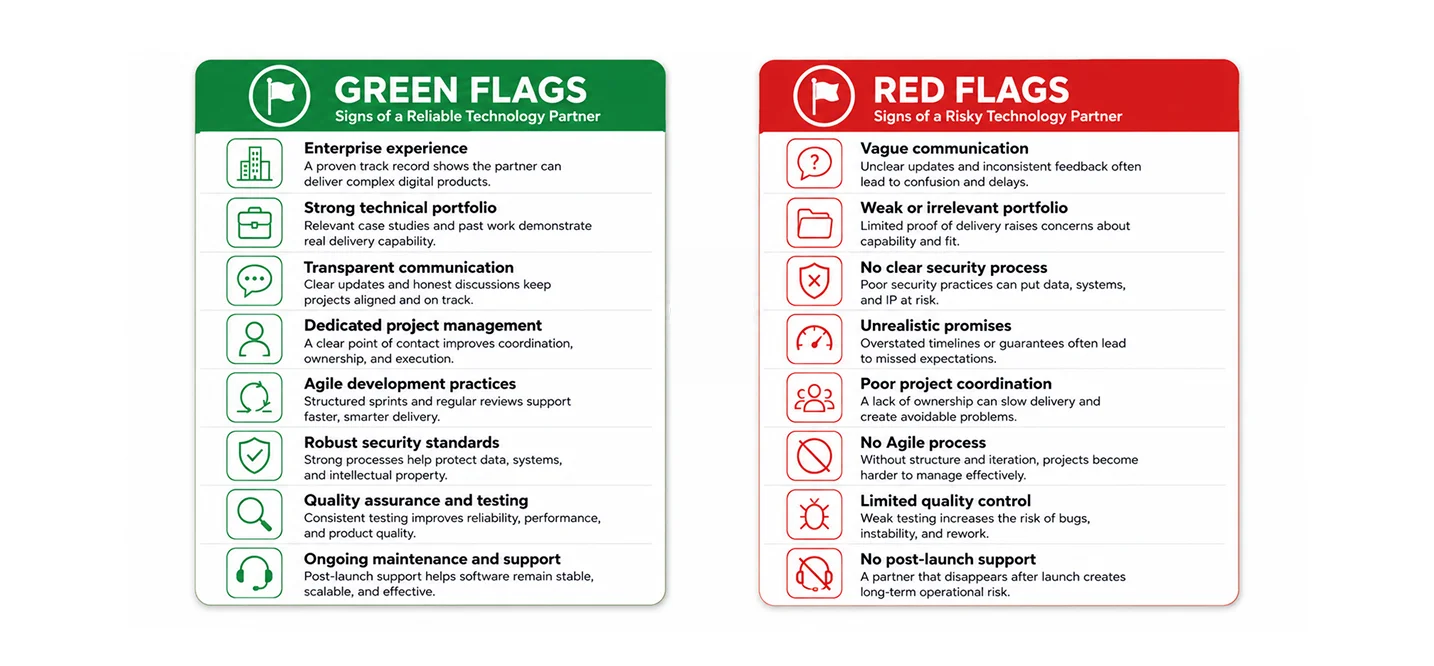
Choosing the Right Partner: Green Flags vs. Red Flags
Why Enterprises Across Saudi Arabia and the UAE Choose Cubix

Digital transformation isn’t slowing down.
If anything, it’s accelerating. At Cubix, we help enterprises turn ambitious ideas into scalable digital products.
Our teams combine technical expertise with industry knowledge to deliver software that is secure, scalable, and built for long-term growth.
Our capabilities include:
- Enterprise software development
- AI and machine learning solutions
- Mobile and web application development
- Cloud-native software engineering
- UI/UX design
- DevOps and infrastructure automation
- Quality assurance and testing
- Ongoing maintenance and product support
If you’re looking for Custom Software Development Services in Dubai, explore Cubix’s dedicated UAE services.
For businesses expanding digital initiatives in Saudi Arabia, our Custom Software Development Services in KSA are designed to support organizations across industries with scalable, enterprise-grade solutions.
Frequently Asked Questions
1. What is software development outsourcing?
Software development outsourcing is the process of hiring an external technology partner to handle some or all aspects of a software project. This can include planning, design, development, testing, deployment, and ongoing support. Many businesses use outsourcing to access specialized expertise, accelerate delivery, and scale development teams more efficiently.
2. Why are Saudi and UAE enterprises outsourcing software development?
Enterprises across Saudi Arabia and the UAE are outsourcing to overcome local talent shortages, accelerate digital transformation, and gain access to experienced specialists in AI, cloud computing, cybersecurity, and enterprise software development. It also provides greater flexibility for scaling projects while maintaining high-quality engineering standards.
3. What are the advantages and disadvantages of outsourcing software development?
The biggest advantages include faster hiring, access to global talent, improved scalability, and better cost efficiency. Challenges may include communication, project coordination, and data security, but these can be effectively managed by partnering with an experienced software development company that follows proven delivery processes and strong security practices.
4. How do I choose the right software development outsourcing company?
Look for a partner with enterprise experience, a strong technical portfolio, transparent communication, dedicated project management, Agile development practices, robust security standards, and a proven history of delivering successful software projects. Asking for client references and case studies is also recommended.