
Key Takeaways
- The GCGRA serves as the federal regulator for commercial gaming activities across the UAE.
- Not every game studio requires direct regulatory approval.
- Products involving wagering, betting, lotteries, or real-money gaming may fall under GCGRA oversight.
- Regulatory requirements are becoming increasingly important under evolving UAE gaming laws 2026.
- Founders should evaluate compliance obligations before launching products rather than after release.
- Understanding licensing requirements early can reduce legal risk and improve investor confidence.
The UAE’s gaming industry is moving fast.
A few years ago, most conversations around gaming in the region focused on esports events, mobile game adoption, and the growing number of startups entering the market. Today, there’s a new topic getting the attention of founders, investors, publishers, and legal teams alike: regulation.
The creation of the General Commercial Gaming Regulatory Authority (GCGRA) has changed how businesses think about gaming activities in the Emirates. As new licensing frameworks emerge, many studio founders are asking the same question:
Do I need a GCGRA license to launch my game in the UAE?
The answer isn’t as straightforward as many headlines make it seem.
In fact, one of the biggest misconceptions in the market today is that every game developer must obtain approval from gaming regulators before releasing a title. That’s not how the current framework works.
For traditional game studios developing mobile, PC, console, multiplayer, or educational games, licensing requirements may be very different from businesses operating real-money gaming products, lotteries, or wagering platforms.
Understanding that distinction can save months of confusion and potentially expensive compliance mistakes.
The UAE Gaming Industry Is Entering a New Regulatory Era

The UAE has spent the past decade positioning itself as one of the Middle East’s most attractive destinations for technology companies.
Dubai’s ambitious Gaming 2033 initiative aims to create thousands of new jobs and contribute billions of dirhams to the economy through gaming-related activities. International publishers are opening regional operations, investors are paying closer attention to gaming startups, and local development teams are producing increasingly sophisticated products.
According to industry estimates, global gaming revenue is expected to approach $200 billion in 2025, with mobile gaming continuing to account for roughly half of worldwide revenue. Meanwhile, the UAE’s broader digital economy continues expanding as government initiatives encourage technology investment across multiple sectors.
For founders involved in uae game development, this creates a unique opportunity. The market is growing, investment is available, and regional demand continues to increase.
Here’s an interesting question to consider:
If you’re launching a game in the UAE today, is your biggest challenge building the product, or understanding which regulations apply to your business?
For many founders, it’s becoming both. If you’re evaluating development expenses alongside operational planning, our guide on game development cost in Dubai provides a useful starting point.
“The gaming industry is evolving beyond entertainment into a serious business sector. As markets mature, regulation becomes part of the foundation that enables sustainable growth, investor confidence, and long-term innovation.”
– Salman Lakhani, CEO, Cubix
What Is the GCGRA and Its Role in the UAE Gaming Industry?

The GCGRA UAE was established as the federal authority responsible for regulating commercial gaming activities throughout the Emirates.
Its role extends beyond simply issuing permits.
The organization is responsible for developing regulatory frameworks, evaluating license applications, enforcing compliance standards, monitoring operators, and ensuring consumer protection across approved gaming activities.
Think of it this way.
Most industries that involve financial transactions, consumer participation, and operational risk eventually receive dedicated oversight. Banking has regulators. Telecommunications has regulators. Aviation has regulators.
Commercial gaming now has one as well.
The introduction of GCGRA licensing UAE created a centralized structure designed to oversee commercial gaming activities at a federal level rather than leaving oversight fragmented across different jurisdictions.
Several key objectives drive the authority’s work:
Consumer Protection
Regulators want licensed operators to maintain fair practices, transparent operations, and adequate safeguards for participants.
Financial Crime Prevention
Gaming activities can present risks related to money laundering and fraud if left unregulated. Regulatory oversight helps reduce those risks.
Industry Stability
Clear rules often encourage legitimate investment because businesses understand the operating environment before committing capital.
Responsible Market Development
The goal isn’t simply growth. It’s sustainable growth supported by clear governance structures.
This distinction matters because many developers hear the word “gaming” and immediately assume the regulator oversees every video game released in the country.
That’s not necessarily the case.
The authority primarily focuses on commercial gaming activities that fall within its regulatory scope rather than every digital game created by a development studio.
Is Commercial Gaming Legal in the UAE Now?

A few years ago, this question would have produced a very different answer.
Today, the conversation has changed significantly.
The UAE has introduced a regulated approach that allows certain commercial gaming activities to operate under approved licensing structures. Rather than existing in a legal gray area, these activities can now function within clearly defined regulatory frameworks.
This shift has created substantial interest among investors and international operators looking at opportunities in the region.
However, it’s important to understand what this means in practice.
- Legal does not mean unrestricted.
- Licensed does not mean automatic approval.
Businesses seeking a Commercial gaming license UAE must still satisfy regulatory requirements, undergo review processes, and maintain ongoing compliance obligations.
The framework is designed around controlled participation rather than open-market operation.
For game studios, this distinction is particularly important.
A company developing a mobile puzzle game is typically operating in a very different category from a company running a real-money gaming platform.
That’s why understanding UAE lottery and gaming laws has become increasingly relevant for founders evaluating new business models.
When a game includes wagering mechanics, prize pools tied to monetary participation, or other regulated gaming elements, the regulatory conversation changes considerably.
And that’s where many misunderstandings begin.
Do Video Game Studios Actually Need a GCGRA License?
This is probably the most important section in the entire discussion. Because for many studios, the answer may be no.
Let’s break it down.
Does Your Game Studio Need GCGRA Review?
| Game Type / Business Model | Typical GCGRA Review Needed? | Regulatory Risk Level |
| Mobile puzzle game | No | Low |
| Premium PC game | No | Low |
| Console game with DLC | No | Low |
| Educational game | No | Low |
| Multiplayer game with cosmetics | Usually No | Low |
| NFT-based ownership game | Depends on mechanics | Medium |
| Prize-based competition platform | Potentially | Medium |
| Sports wagering platform | Yes | High |
| Online casino-style game with real money | Yes | High |
| Lottery-based gaming platform | Yes | High |
Studios That Typically Do Not Need GCGRA Approval
Most traditional game development businesses operate outside regulated commercial gaming categories.
Examples include:
- Mobile games
- Console games
- PC games
- Educational games
- Story-driven experiences
- Multiplayer online games
- Casual and hyper-casual titles
- Enterprise gaming platforms
- Simulation products
If players purchase cosmetic items, season passes, downloadable content, or premium subscriptions, that alone doesn’t automatically place a studio under commercial gaming regulation.
- A battle pass isn’t a casino.
- A cosmetic skin marketplace isn’t necessarily wagering.
- A premium game purchase isn’t commercial gaming activity.
Many developers hear discussions around GCGRA regulations for game studios and assume every monetization model now requires licensing review.
That’s usually not the case.
Studios That May Trigger Regulatory Review
Things become more complicated when products begin incorporating mechanics that resemble regulated gaming activities.
Examples may include:
- Real-money gaming systems
- Sports wagering integrations
- Online betting functionality
- Prize-based gaming tied to monetary participation
- Lottery-style structures
- Casino-style products
- Certain tokenized wagering models
In these scenarios, game developer compliance UAE requirements become significantly more important.
The question regulators may ask is relatively simple:
Is this primarily a video game, or is it facilitating regulated gaming activity?
The answer determines which framework applies.
That’s why founders should evaluate business models early rather than waiting until launch.
Changing monetization systems after development is usually more expensive than designing compliance considerations into the product from the beginning.
“From a development perspective, compliance works best when it’s treated as a design consideration rather than a legal checklist. The earlier teams evaluate monetization models and player interactions, the easier it becomes to adapt to changing regulations without disrupting development.”
– Cubix Game Development Team
Where Blockchain Games Fit Into the Conversation

Few areas create more confusion than blockchain-based gaming. Part of the confusion comes from the technology itself. Blockchain game development isn’t automatically a gambling product.
A game that uses NFTs, digital ownership systems, token economies, or decentralized marketplaces doesn’t instantly become regulated commercial gaming.
Many blockchain games simply use distributed ledger technology to manage assets, ownership records, or in-game economies. That’s very different from wagering.
The regulatory conversation changes when players begin staking value, participating in betting activities, contributing to prize pools, or engaging in mechanisms tied directly to financial outcomes.
For example:
A player owning a digital sword represented by an NFT generally doesn’t raise the same regulatory concerns as a platform allowing users to wager cryptocurrency on match outcomes.
What Are the Different Types of Gaming Licenses Issued by GCGRA?
| License Type | Intended For | Examples |
| Lottery License | Authorized lottery operations | National or regional lottery programs |
| Internet Gaming License | Online commercial gaming activities | Regulated digital gaming platforms |
| Sports Wagering License | Sports betting operators | Sports prediction and wagering platforms |
| Land-Based Gaming Facility License | Physical gaming venues | Approved gaming resorts and facilities |
| Gaming-Related Vendor License | Service providers and technology vendors | Software providers, gaming infrastructure companies |
Not all licenses serve the same purpose.
The UAE’s regulatory framework recognizes multiple categories depending on the nature of the gaming activity being conducted.
Understanding these distinctions helps founders determine whether their products may fall within regulated areas.
Lottery Licenses
Lottery operators represent one category of regulated commercial gaming activity.
These licenses typically apply to organizations conducting approved lottery operations under regulatory supervision.
Internet Gaming Licenses
Digital gaming platforms involving regulated commercial gaming activities may fall under internet gaming licensing structures.
Requirements generally focus on operational controls, security measures, player protections, and compliance oversight.
Sports Wagering Licenses
Organizations facilitating sports-related wagering activities may require specialized licensing authorization.
These activities typically face extensive compliance obligations due to their financial nature.
Land-Based Gaming Facility Licenses
Physical gaming venues operate under separate regulatory requirements and licensing standards.
These requirements often include operational reviews, security assessments, and ongoing compliance monitoring.
Gaming-Related Vendor Licenses
Not every licensed participant operates gaming activities directly.
Some businesses provide technology, operational support, systems integration, or other services to licensed operators. These organizations may require authorization under specific vendor licensing categories.
Understanding the distinction between a gaming operator license and a broader gaming license in the UAE framework is important because different activities trigger different obligations.
What Is the Application Process for a GCGRA License for Game Studios?
If your business model falls within a regulated category, obtaining approval isn’t something that happens after filling out a short online form.
The licensing process is designed to evaluate not only the product itself but also the people behind it, the company’s financial structure, operational controls, technical systems, and long-term compliance capabilities.
That may sound extensive, but that’s fairly standard in regulated industries. Financial services, insurance, and telecommunications operate under similar principles. Regulators want to understand who they’re licensing before allowing businesses to enter the market.
While exact requirements can vary depending on license category, the process generally follows several stages.
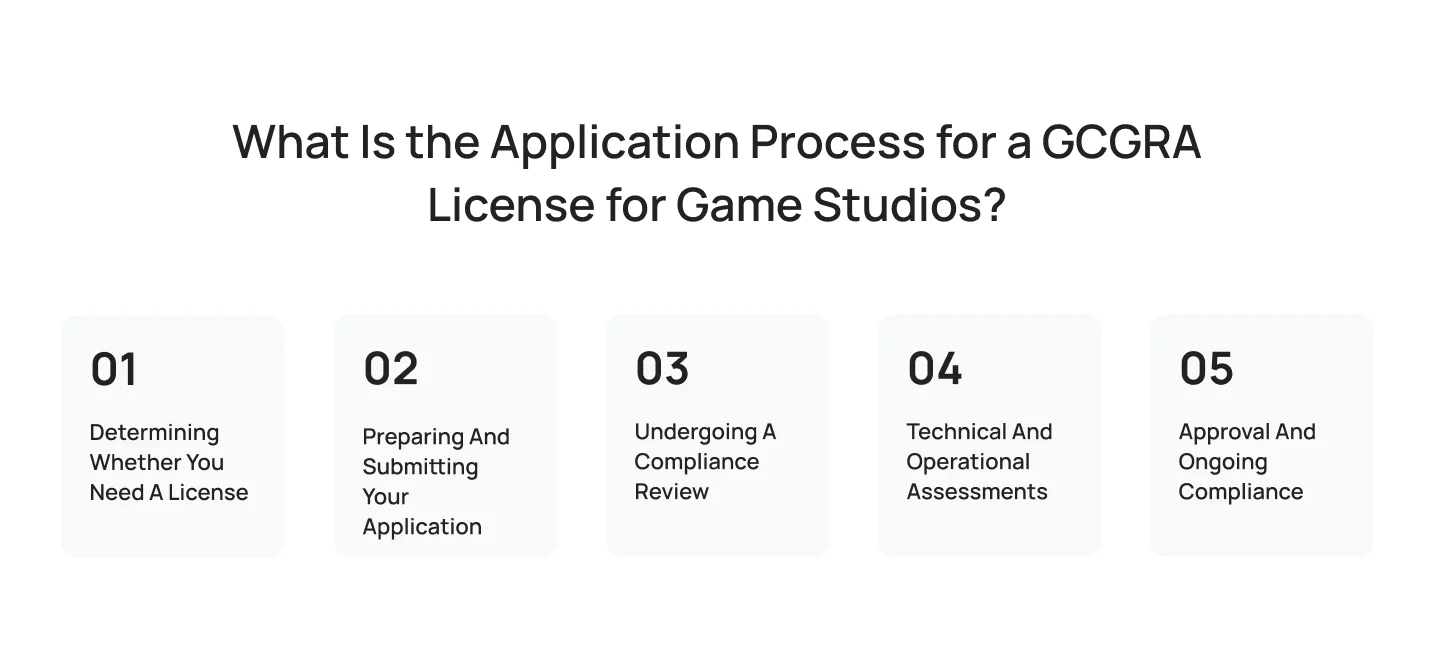
Step 1: Determining Whether You Need a License
This is where everything starts.
Before talking about paperwork or approvals, you first need to understand whether your product actually falls under regulated commercial gaming. Surprisingly, many businesses discover they don’t require the license they initially thought they did.
For example, a studio releasing a multiplayer mobile game with cosmetic purchases will likely face a very different regulatory situation than a company launching a real-money gaming platform.
Getting clarity at this stage can save months of unnecessary work later.
Step 2: Preparing and Submitting Your Application
Once it’s established that licensing is required, the documentation process begins.
Applicants are usually expected to provide information about company ownership, financial structures, business operations, technical systems, and long-term plans. Think of it as building a complete picture of how the business operates.
This is often where preparation pays off.
Companies that already have organized records, internal policies, and clear operational processes tend to move through the process more smoothly. Those trying to gather everything at the last minute often find themselves dealing with delays.
Step 3: Undergoing a Compliance Review
At this point, regulators begin evaluating whether the business can meet the required standards.
They’re not only looking at the product itself. They’re also assessing the systems that support it.
That includes financial controls, security procedures, risk management practices, and consumer protection measures. The goal is to determine whether the company can operate responsibly over the long term, not just whether it can launch successfully.
Step 4: Technical and Operational Assessments
For certain types of gaming activities, technical infrastructure becomes a major part of the review process.
Regulators may want to understand how systems are managed, how transactions are processed, and what safeguards are in place to protect users.
If a platform handles financial transactions or customer funds, reliability and security become especially important. A great product isn’t enough on its own. The supporting systems need to be just as dependable.
Step 5: Approval and Ongoing Compliance
One common misconception is that licensing ends once approval is granted.
In reality, that’s often when the long-term responsibilities begin.
Licensed operators are generally expected to maintain compliance, submit reports when required, and continue meeting regulatory standards throughout their operations. Compliance isn’t a one-time milestone. It’s an ongoing commitment.
This is one reason founders researching how to start a game studio in UAE should think about regulatory requirements early in the process. It’s far easier to build compliant systems from the beginning than to redesign them after launch.
If you’re researching the competitive landscape, our guide to top game development companies in Dubai offers useful insight into how the local ecosystem is evolving.
Understanding the Commercial Gaming Framework UAE Is Building
One of the more interesting aspects of the UAE’s approach is that it isn’t attempting to replicate every gaming market around the world.
Instead, regulators appear focused on creating a structured environment built around oversight, accountability, and long-term sustainability.
That’s an important distinction.
Some jurisdictions prioritize rapid expansion first and regulatory refinement later. The UAE appears to be taking the opposite route by establishing governance frameworks before the market reaches full scale.
The emerging Commercial gaming framework UAE is built around several core principles.
Consumer Protection
Participants need confidence that licensed operators are following approved standards and operating transparently.
Financial Integrity
Commercial gaming activities involve significant financial transactions. Strong oversight helps reduce opportunities for fraud, money laundering, and other financial risks.
Market Stability
Investors tend to prefer markets with clear rules.
According to PwC’s Global Entertainment & Media Outlook, gaming remains one of the fastest-growing segments within the broader entertainment economy. As investment increases, predictable regulatory environments become increasingly valuable.
Responsible Participation
This is where responsible gaming standards become particularly important.
Globally, regulated markets increasingly require operators to implement safeguards related to age verification, player protections, spending controls, and responsible participation policies.
These standards aren’t unique to the UAE. They’re becoming standard practice across mature gaming jurisdictions worldwide.
Common Compliance Mistakes Game Founders Make
Most compliance problems don’t happen because founders intentionally ignore regulations.
They happen because assumptions replace research.
Over the years, technology startups have developed a habit of moving quickly and figuring out regulations later. That approach can work in some sectors. In regulated industries, it often creates unnecessary risk.
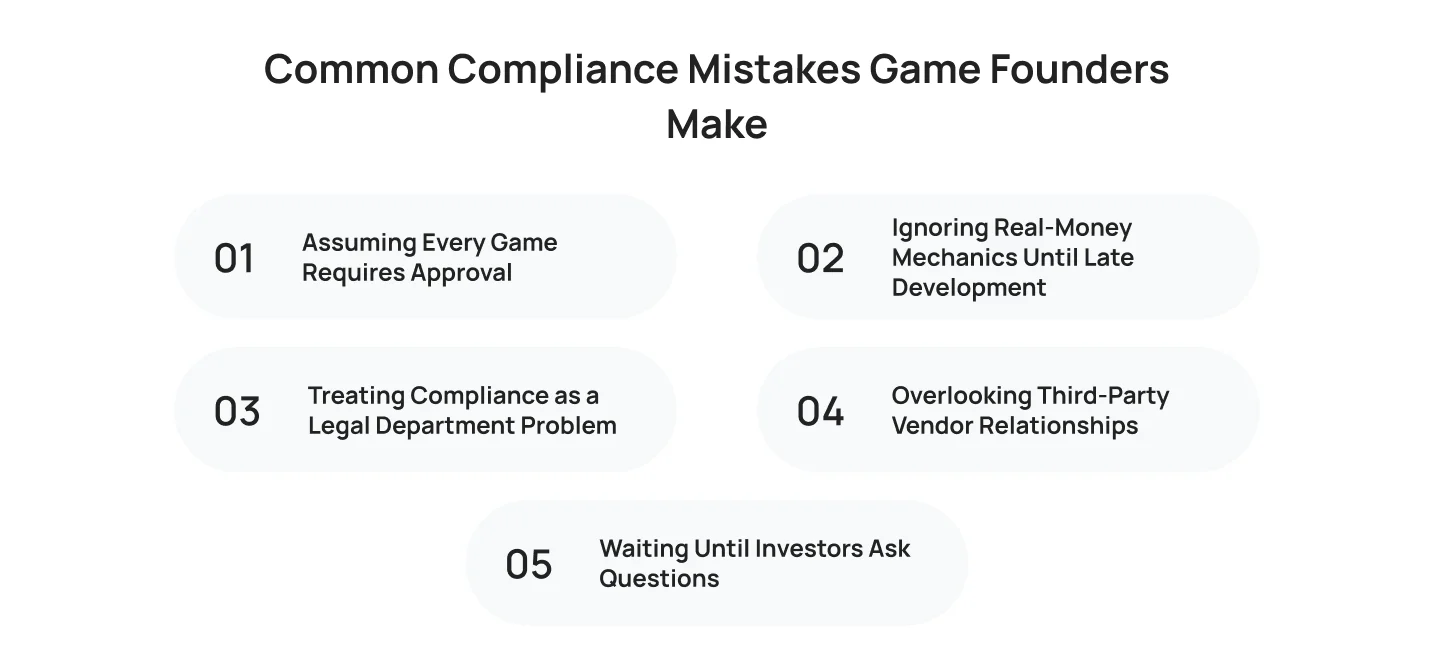
Here are several mistakes that appear repeatedly.
Assuming Every Game Requires Approval
Ironically, one of the most common mistakes is assuming regulation applies more broadly than it actually does.
Not every game falls under GCGRA regulations for game studios.
Founders sometimes spend weeks researching licenses they may never need because they haven’t first determined whether their business model falls within regulated commercial gaming activities.
Understanding where your product sits within the regulatory landscape should always come before filing applications.
Ignoring Real-Money Mechanics Until Late Development
The opposite mistake happens just as often.
Teams focus heavily on gameplay and monetization while postponing regulatory reviews until launch approaches.
At that stage, significant changes may be required.
A monetization system that seemed harmless during development may raise compliance questions once lawyers and regulators review it.
The earlier these discussions happen, the easier they are to address.
Treating Compliance as a Legal Department Problem
Compliance isn’t solely a legal function.
Product teams, finance teams, engineering teams, and leadership teams all contribute to compliance outcomes.
A technical feature can create regulatory implications just as easily as a contractual decision. Strong organizations recognize that compliance is cross-functional.
Overlooking Third-Party Vendor Relationships
Many gaming platforms rely on payment processors, analytics providers, cloud infrastructure partners, and technology vendors.
Those relationships can introduce additional obligations depending on the business model.
Companies pursuing game developer compliance UAE objectives should evaluate vendor relationships alongside internal operations rather than treating them as separate considerations.
Waiting Until Investors Ask Questions
This one happens more often than founders would like to admit.
A funding discussion begins, investors start due diligence, and suddenly regulatory questions become urgent.
The better approach is to have answers before the questions arrive.
Investors generally appreciate businesses that understand their operating environment and can articulate compliance strategies clearly.
How Much Does a GCGRA Gaming License Cost?
This is usually one of the first questions founders ask. Unfortunately, it’s also one of the hardest to answer with a single number.
Potential Costs Beyond Licensing Fees
| Cost Category | What It May Include |
| Application Costs | License submissions and regulatory processing |
| Legal Advisory Fees | Regulatory reviews and legal consultation |
| Compliance Programs | Internal policies and governance procedures |
| Technical Audits | Security and operational assessments |
| Reporting Infrastructure | Monitoring and compliance systems |
| Employee Training | Compliance and responsible gaming education |
| Ongoing Regulatory Obligations | Renewals, audits, and reporting requirements |
The reality is that licensing costs depend heavily on the type of activity being conducted, the complexity of the operation, and the specific compliance requirements associated with the license category.
Application fees are only one part of the equation.
Businesses pursuing a Commercial gaming license UAE should also account for legal advisory services, technical audits, compliance programs, security controls, reporting infrastructure, and ongoing operational requirements.
In many regulated industries, these supporting costs can exceed the application fee itself.
That doesn’t necessarily make licensing prohibitively expensive. It simply means founders should view licensing as part of a broader compliance investment rather than a standalone expense.
The same principle applies to technology planning.
For example, companies exploring blockchain-enabled gaming products often discover that compliance, security, infrastructure, and governance costs become just as important as development costs. If you’re evaluating that side of the equation, our breakdown of blockchain development cost in Dubai provides useful context.
Similarly, businesses assessing broader technology investment trends may find value in understanding how regulated industries approach software spending. Our analysis of top industries investing in custom software in Dubai explores that topic in greater detail.
For companies considering a gaming operator license, budgeting should account for both direct licensing expenses and the ongoing costs associated with maintaining compliance after approval.
What This Means for Game Studios Launching in 2026
The conversation around gaming regulation in the UAE is still evolving, but a few conclusions are becoming increasingly clear.
First, most game studios are not suddenly becoming regulated gaming operators.
A mobile strategy game, multiplayer shooter, educational platform, or indie PC title typically operates very differently from a commercial gaming business. The existence of the GCGRA UAE does not automatically place every developer under licensing requirements.
Second, founders can no longer afford to ignore regulatory awareness.
As the industry grows, investors, publishers, payment providers, and strategic partners will increasingly expect businesses to understand relevant compliance obligations.
Third, regulations will likely continue evolving.
The broader direction of UAE gaming laws 2026 suggests increasing clarity around commercial gaming activities, licensing structures, and compliance expectations.
“The most successful game studios don’t wait until launch to think about scalability, compliance, or monetization. They build those considerations into the product strategy from day one.”
– Salman Lakhani, CEO, Cubix
From Game Concept to Market Launch: Build Smarter with Cubix

Launching a game is challenging enough without having to untangle regulatory questions halfway through development.
At Cubix, we’ve worked with startups, enterprises, and gaming brands across the development lifecycle, from concept validation and game design to backend architecture, blockchain integration, live operations, and post-launch support. Our team helps businesses evaluate technical requirements, monetization strategies, and platform scalability before critical decisions become costly mistakes.
If you’re planning to launch a game studio or gaming product in the UAE, now is the right time to build with both growth and compliance in mind.
Talk to Cubix about your game development roadmap and create a launch strategy that’s built for long-term success.
[blog_cta]
FAQs
1. What is the GCGRA and its role in the UAE gaming industry?
The GCGRA serves as the federal regulator responsible for overseeing commercial gaming activities across the UAE. It establishes licensing frameworks, supervises operators, enforces compliance requirements, and helps ensure regulated gaming activities operate according to approved standards.
2. Is commercial gaming legal in the UAE now?
Yes. Certain commercial gaming activities can legally operate under approved regulatory frameworks and licensing structures. Businesses must obtain appropriate authorization and comply with applicable requirements before offering regulated gaming services.
3. What are the different types of gaming licenses issued by GCGRA?
Licensing categories may include lottery operations, internet gaming activities, sports wagering, land-based gaming facilities, and vendor-related authorizations. Specific requirements vary depending on the activity being conducted.
4. What is the application process for a GCGRA license for game studios?
The process generally involves an initial eligibility review, formal application submission, compliance assessments, operational evaluations, and ongoing monitoring after approval. Requirements differ based on the relevant license category.
5. How to start a game studio in UAE while remaining compliant?
Begin by determining whether your business model involves regulated commercial gaming activities. Most traditional game development studios won’t require commercial gaming licenses, but products involving wagering or similar mechanics should undergo legal and compliance review early in development.
6. How much does a GCGRA gaming license cost?
Costs vary depending on license type, operational complexity, compliance requirements, legal support, and technical review processes. Businesses should budget for ongoing compliance obligations in addition to application-related expenses.
7. What are the responsible gaming standards required by GCGRA?
Responsible gaming standards generally focus on consumer protection measures, fair operations, age verification processes, risk management controls, and safeguards designed to promote responsible participation.
8. Does a blockchain game require a Gaming license in UAE?
Not necessarily. Blockchain technology alone does not automatically trigger licensing requirements. However, if a blockchain-based product includes wagering, betting, lottery mechanics, or other regulated gaming activities, additional regulatory review may be necessary.