Key takeaways
- Cost range: Adding AI to an existing game runs from about $15K for smarter enemy behavior to $500K+ for voiced, memory-enabled NPCs.
- Generative AI has two bills: a one-time build cost and a monthly running cost. Scripted AI has almost no running cost.
- Prototype vs production: A proof of concept costs 25K. A full production build costs 350K, plus 15–25% of build cost per year for upkeep.
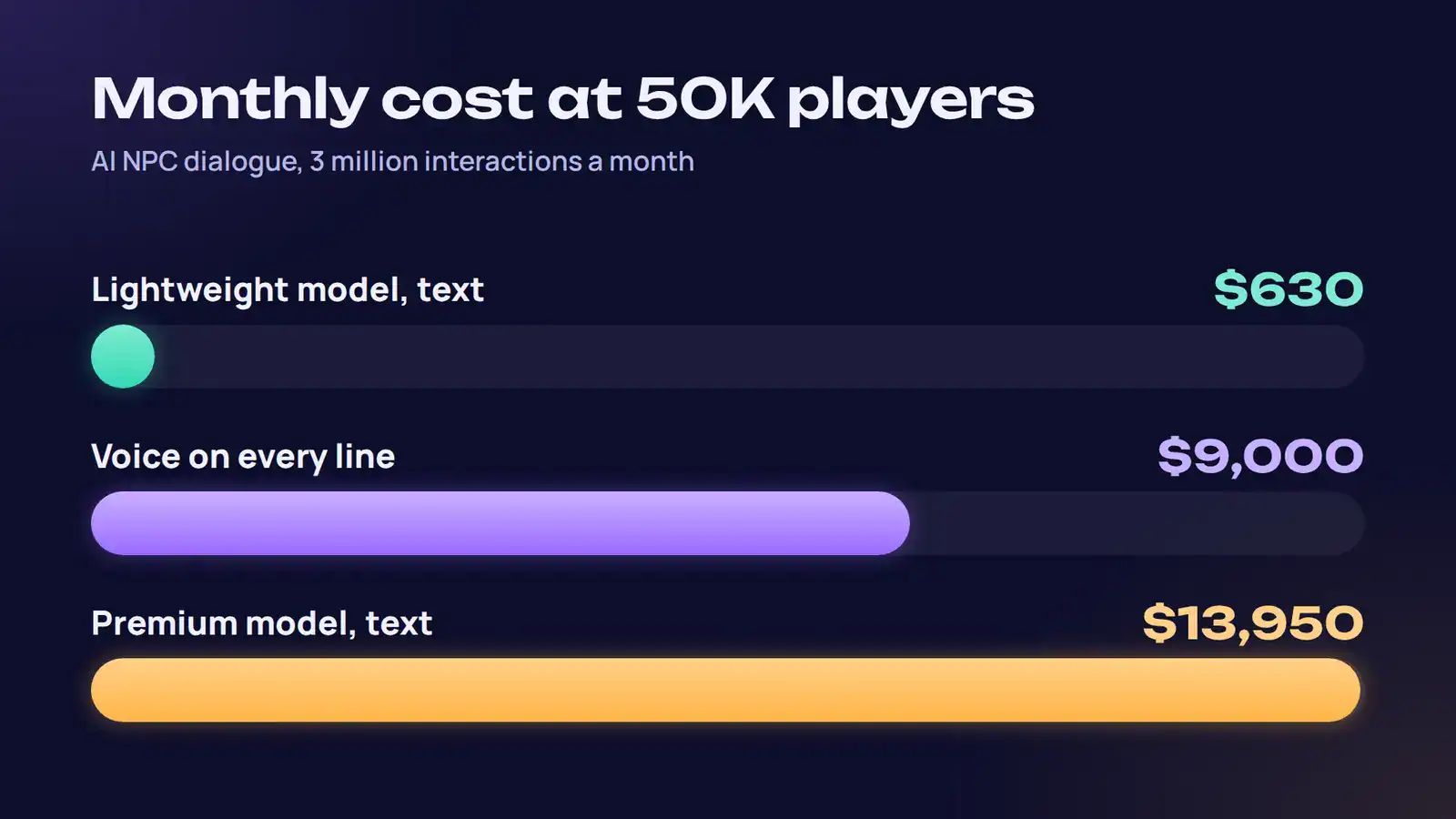
- Model choice swings spend 20x or more: At 50,000 monthly players, text dialogue costs about $630 a month on a budget model and about $13,950 on a premium one.
- Voice is often the biggest line item: The same 50,000 players add around $9,000 a month if every line is voiced.
- APIs usually win at small and mid scale: A single H100 GPU costs about $1,825 a month at $2.50 an hour. Self-hosting only competes at billions of tokens a month, with high GPU utilization.
- Hidden costs are significant: Moderation, prompt injection testing, fallback dialogue, evaluation and live tuning often add 30–50% on top of the core build.
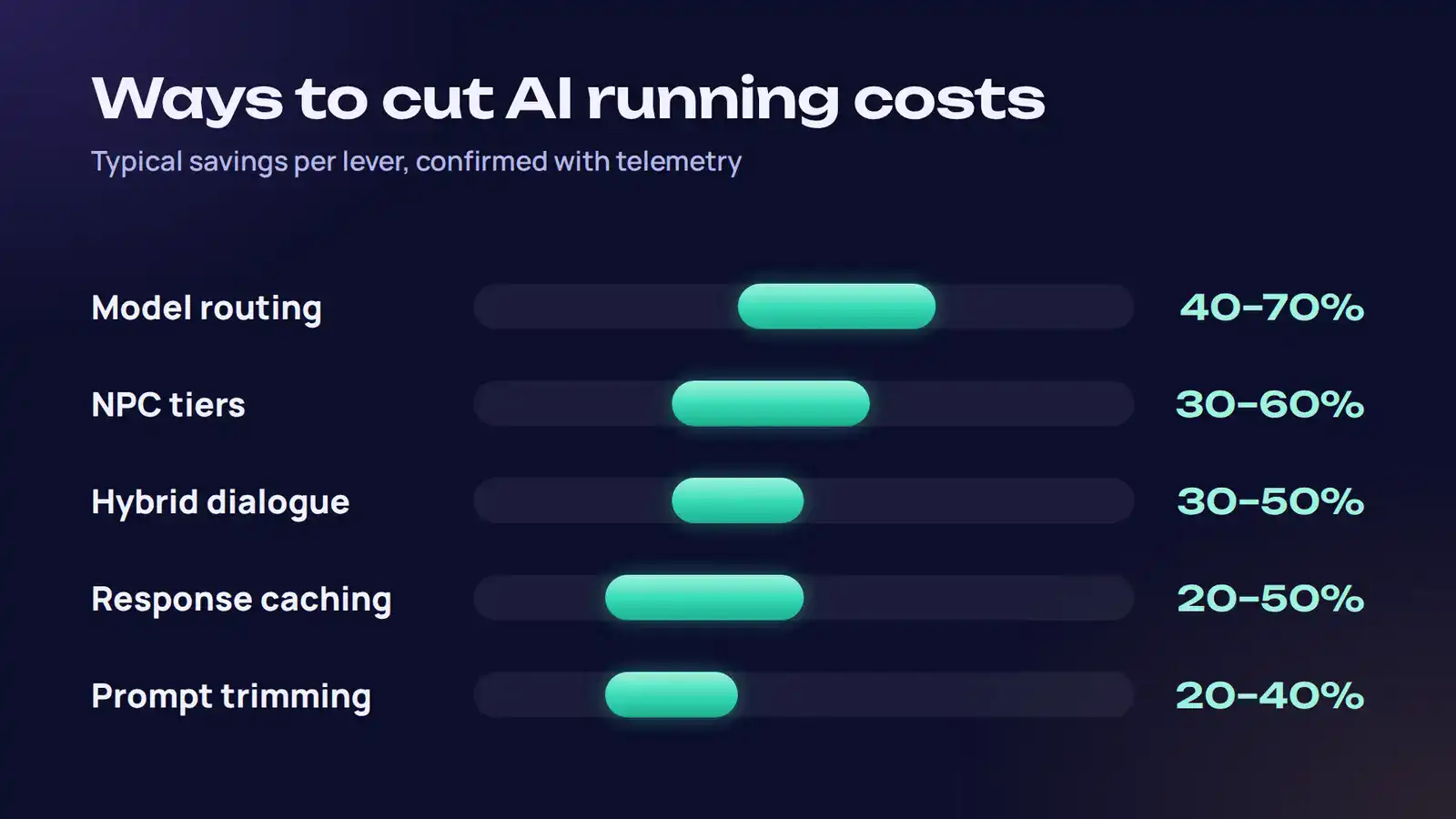
- Hybrid design saves the most: Routing, caching, NPC tiers and scripted story beats can cut spend by 30–70%.
- Start with one feature: Rank features by value, risk and measured performance, then expand once you know your cost per player.
Is your AI feature a $25K experiment or a $500K live service? The honest answer: it depends on three choices you make before writing any code. What kind of AI you add, where it runs, and how many players talk to it.
This guide breaks down AI game development costs into one-time build costs and monthly running costs, with real 2026 pricing, worked examples and a way to estimate your own number.
The Quick Answer: What Does It Cost to Add AI to a Game?
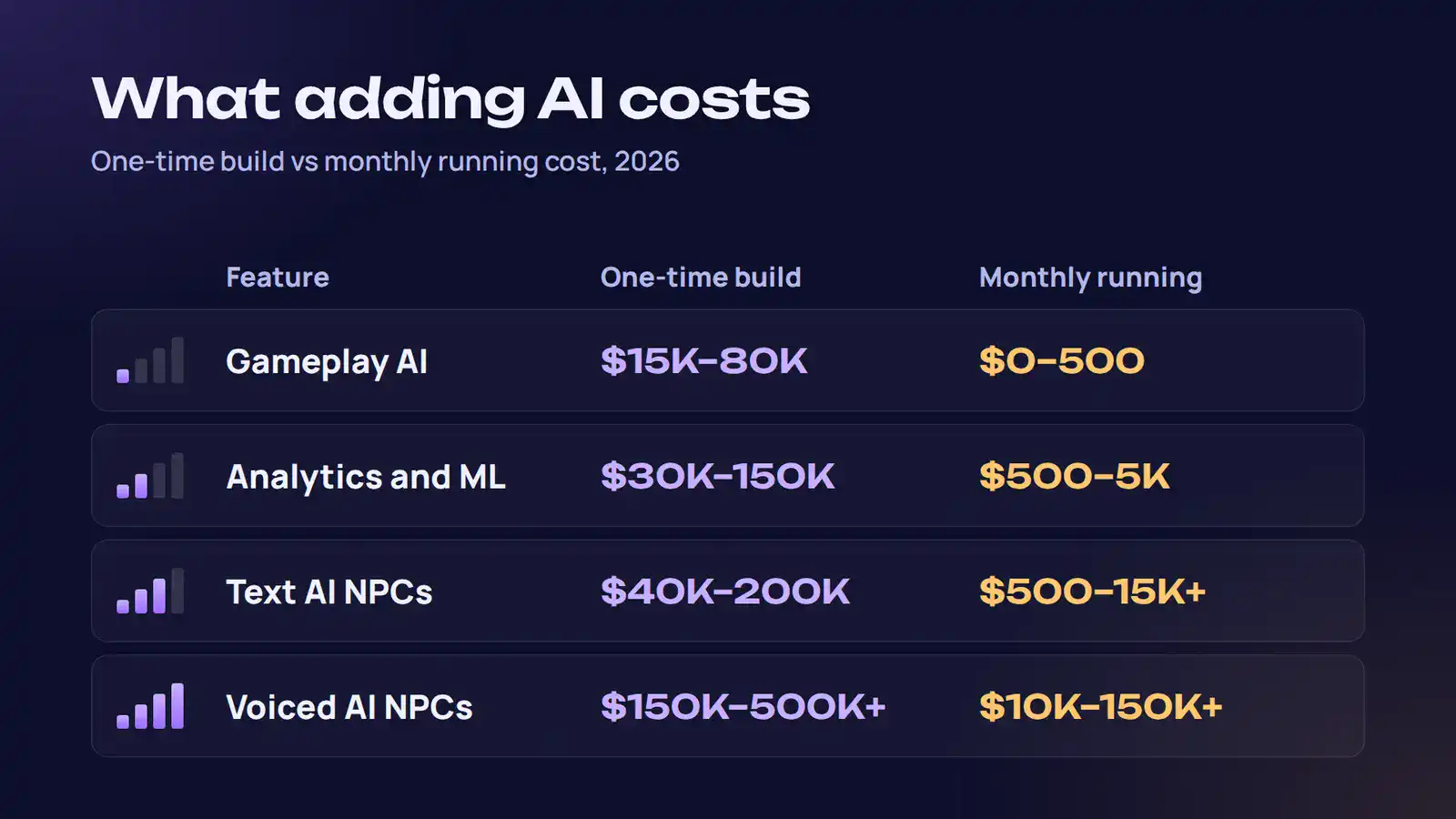
For an existing game, our typical planning ranges look like this:
| Feature type | One-time build cost | Monthly running cost | Time to ship |
|---|---|---|---|
| Conventional gameplay AI (behavior trees, utility AI, navmesh upgrades) | 80K | 500 | 1–3 months |
| Player analytics and ML (churn prediction, matchmaking, personalization) | 150K | 5K | 2–4 months |
| Text-only generative AI NPCs | 200K | 15K+ | 2–5 months |
| Voiced, memory-enabled NPCs at scale | 500K+ | 150K+ | 4–8 months |
The market context matters too. In the GDC 2026 State of the Game Industry survey of 2,300+ professionals, 36% said they use generative AI tools in their work, and 52% said their company uses it. But sentiment is cooling: 52% now say generative AI is having a negative impact on the industry, up from 30% last year and 18% the year before. A separate Omdia and Game Developer Collective survey found developer usage at 29% in early 2026, down from 36% a year earlier.
For your budget, that means one thing: scoped, well-tested features are a safer investment than “AI everywhere” plans.
What Affects the Cost of Adding AI to a Game?
Five factors drive almost every estimate we write:
| Cost driver | Why it matters | Impact |
|---|---|---|
| Feature scope | Scripted AI is a one-time build. Generative AI also costs money every time it runs. | High |
| Deployment model | Hosted API, self-hosted GPU and on-device inference have very different cost curves. | High |
| Player volume | Running cost scales with concurrent players and interactions per session. | High |
| Engine and codebase readiness | Legacy code, custom engines and multiplayer architecture add integration time. | Medium |
| Live operations | Moderation, tuning, monitoring and model updates continue after launch. | Medium |
The big shift to understand: a hand-written dialogue line is paid for once and shown to millions of players for free. A generated line costs money every time it is produced. That single difference is why generative AI budgets need a running-cost line, while classic NPC logic mostly does not.
Feature Scope: Three Types of Game AI and What Each Costs
1. Conventional gameplay AI
This is the AI most players never notice: behavior trees, finite state machines, utility AI and navigation mesh pathfinding. It runs on the player’s device, costs nothing per interaction, and behaves predictably. Typical work includes smarter enemy tactics, companion behavior, crowd movement and difficulty scaling.
Is traditional NPC AI cheaper than generative AI? Almost always, yes. Build cost is moderate, running cost is near zero, and QA is simpler because behavior is deterministic.
2. Player analytics and machine learning
This covers churn prediction, matchmaking, dynamic difficulty, offer personalization and fraud detection. It depends on clean telemetry data, so build cost is driven by data pipelines more than by models. If your event tracking is messy, budget to fix it first. Our machine learning services team starts with a data audit for exactly this reason.
3. Generative AI NPCs
This is the LLM NPC cost category: characters that hold open-ended conversations, remember players and sometimes speak aloud. It carries the highest build and running costs, plus extra safety work. For a deeper look at how we build these systems, see our generative AI development services.
| Feature | Typical use case | One-time cost | Monthly cost | Risk level |
|---|---|---|---|---|
| Behavior trees / utility AI | Enemy and companion behavior | 80K | ~$0 | Low |
| ML personalization | Offers, matchmaking, churn | 150K | 5K | Medium |
| Text NPC dialogue | Quest givers, shopkeepers | 200K | 15K+ | Medium |
| Voice + memory NPCs | Companions, story characters | 500K+ | 150K+ | High |
Not sure where AI fits in your pipeline? Our AI game development team can help you rank features before you commit a budget.
One-Time Costs: Proof of Concept vs Production
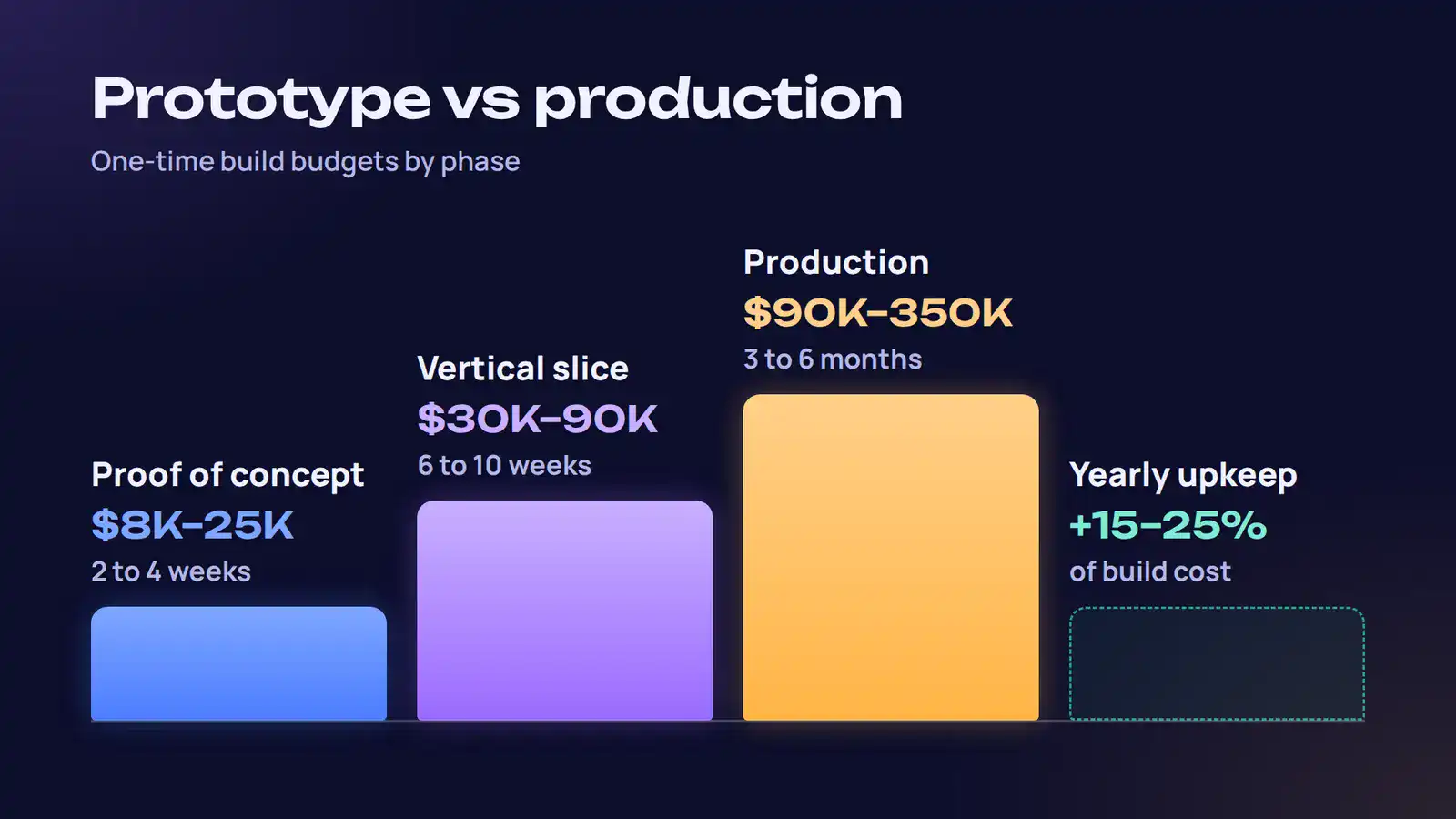
The most common budgeting mistake we see is pricing the prototype and assuming production costs the same. It does not.
| Phase | What you get | Duration | Budget | Team size |
|---|---|---|---|---|
| Proof of concept | One NPC, one scenario, rough prompts | 2–4 weeks | 25K | 2–3 |
| Vertical slice | One full area, basic safety filters, telemetry | 6–10 weeks | 90K | 4–6 |
| Production build | Multiple NPCs, moderation, fallback logic, QA | 3–6 months | 350K | 6–10 |
| Post-launch (yearly) | Tuning, monitoring, model updates | Ongoing | 15–25% of build cost | 1–3 |
A proof of concept proves the idea is fun. It does not prove the idea is safe, affordable at scale, or fast enough for real players.
Can AI be added to an existing Unity or Unreal game?
Yes. Both engines support AI integration through plugins, SDKs and custom services. In the GDC 2026 survey, 42% of respondents used Unreal Engine and 30% used Unity, with 19% on in-house engines and 5% on Godot, so most studios are on a well-supported path.
What increases Unity AI integration cost and Unreal Engine AI cost:
- Legacy code: tightly coupled dialogue or quest systems take longer to hook into.
- Multiplayer architecture: server-authoritative games need AI calls routed through the backend.
- Custom engines: no off-the-shelf plugins, so more custom work.
- Console certification: online AI features add platform compliance reviews.
- Animation and audio pipelines: voiced NPCs need lip-sync and audio streaming.
In our experience, expect a 15–30% higher estimate on heavily customized or multiplayer-first codebases compared with a clean single-player project.
Deployment Choice: Hosted API vs Self-Hosted vs On-Device
Where your model runs changes both your upfront and monthly costs.
| Model | Upfront cost | Running cost | Latency | Privacy and control | Best for |
|---|---|---|---|---|---|
| Hosted API | Low | Pay per token, scales with usage | Medium | Lower | PoC, small to mid player counts |
| Self-hosted GPU | High (setup, MLOps) | Fixed GPU rental plus engineering time | Low to medium | High | Large, steady traffic |
| On-device (edge inference) | Medium to high | Near zero per conversation | Lowest | Highest | PC and high-end hardware titles |
Is an AI API cheaper than running my own model?
At small and mid scale, usually yes. Self-hosting is a fixed cost: you pay for every hour of the month whether players are online or not. A hosted API costs nothing when idle.
Our planning figure for one dedicated GPU is roughly 2,000 per month. Against a mid-tier hosted model, break-even typically sits near 2 billion tokens a month, which is a big game, not a small one.
Two cautions we give every client:
- Utilization decides everything. A GPU running at around 25% utilization costs about three to four times more per token than one running at 80%.
- Engineering time is real. Maintenance, monitoring and troubleshooting commonly take 10–20 engineer hours a month, which is 3,000 in labor on top of the hardware.
Against lightweight hosted models, self-hosting rarely wins on cost alone. It wins on control, privacy and latency.
Cost levers on the model side
Model quantization shrinks a model so it runs on cheaper GPUs or even on a player’s device, trading a small amount of quality for large savings. Edge inference pushes the work to the player’s hardware, so the studio pays nothing per conversation. The trade-off: you must support a range of hardware, and console and mobile options are still limited.
Running Costs: How to Estimate Monthly LLM NPC Spend
AI running costs are calculated with a simple formula:
Monthly cost = monthly active players × interactions per player × cost per interaction
Cost per interaction depends on tokens used and the size of the model you choose. Here is how we plan it.
Worked example
Assume each NPC exchange uses 800 input tokens (character prompt, memory and the player’s message) and 150 output tokens (the reply). Using Cubix planning assumptions, that works out to:
| Model tier | Best for | Planning cost per interaction |
|---|---|---|
| Lightweight | Small talk, barks, shopkeepers | ~$0.0002 |
| Mid-size | Quest givers, recurring characters | ~$0.001 |
| Premium | Key story characters, complex reasoning | ~$0.005 |
The gap between tiers is more than 20x, which is why model choice is the biggest lever in your budget.
Voice is the second big lever. A 150-token reply is about 600 characters, and our planning assumption for generated speech is roughly $0.003 per line. That is more than the text itself on a lightweight model.
| Scenario | Monthly active players | Interactions per month | Lightweight (text) | Premium (text) | Voice add-on |
|---|---|---|---|---|---|
| Low | 5,000 | 200K | ~$42 | ~$930 | ~$600 |
| Base | 50,000 | 3M | ~$630 | ~$13,950 | ~$9,000 |
| Peak | 500,000 | 40M | ~$8,400 | ~$186,000 | ~$120,000 |
Assumes 40, 60 and 80 interactions per player per month in the low, base and peak scenarios.
Three takeaways:
- Model choice swings cost by 20x or more. Use premium models only where players will notice the quality.
- Voice is often the biggest line item. Voice key moments, not every line.
- Peak months hurt. Budget for events, sales and viral spikes, not just averages.
Latency matters for cost too
Inference latency is the delay between a player’s message and the reply. Slow replies break immersion, and the fixes (smaller models, streaming, caching) also reduce cost. A full voice pipeline chains speech recognition, the language model and speech generation, so every step adds delay. We target a first response in under about one second for conversational NPCs, and design a fallback line for when it takes longer.
Costs Commonly Missed in AI Game Budgets
The model bill is rarely the surprise. These are:
| Hidden cost | What it covers | Typical share of budget |
|---|---|---|
| Content moderation | Filtering unsafe or off-brand output | 5–10% |
| Prompt injection defense | Stopping players from hijacking NPC behavior | 3–8% |
| Fallback dialogue | Scripted lines for outages, timeouts and blocked output | 3–5% |
| Model evaluation | Test suites to check quality after each change | 5–10% |
| Telemetry | Logging, dashboards and cost tracking | 3–5% |
| Live ops retraining and tuning | Prompt updates, new content, drift fixes | 10–20% per year |
| Model and provider changes | Version updates, retired models, policy changes | 2–5% per year |
Two notes on this list. First, prompt injection is a real risk: players will try to make NPCs say things your brand never approved, so test for it before launch. Second, hosted models are updated and retired over time, so avoid designs that depend on one model’s quirks and budget time to switch.
This is where game testing services earn their keep. AI game testing cost is usually 10–20% of the build, because non-deterministic output cannot be checked with a simple pass or fail script.
How to Reduce AI Cost Without Cutting Quality
| Lever | How it works | Typical savings |
|---|---|---|
| Model routing | Send simple lines to lightweight models, hard ones to premium | 40–70% |
| Response caching | Reuse answers to common player questions | 20–50% |
| Prompt trimming | Shorter character prompts and memory summaries | 20–40% |
| NPC tiers | Full AI for main characters, scripted lines for background NPCs | 30–60% |
| Hybrid dialogue | Scripted story beats, generative small talk | 30–50% |
| Usage limits | Cap interactions per player per day | Predictable ceiling |
| Quantized or on-device models | Move work off paid servers | Up to 100% of per-chat cost |
Savings are indicative and depend on your game. Measure them with telemetry rather than assuming.
The cheapest design is usually a hybrid: handwrite the moments that matter, and let AI handle the variety around them.
Scope Control: How to Prioritize AI Features
Rank every candidate feature on three criteria:
| Criterion | Question to ask | Score 1–5 |
|---|---|---|
| Player value | Will players notice and enjoy it? | Higher is better |
| Risk | Could it produce harmful output, leak data or break balance? | Lower is better |
| Measured performance | Does a prototype hit quality, latency and cost targets? | Higher is better |
Start with the feature that scores highest on value and lowest on risk. For many studios, that is smarter conventional AI or analytics, not a talking NPC. Ship one feature, watch the telemetry for a month, then expand. Prove the cost per player before you scale it.
Build Smarter AI-Powered Games With a Clear, Scalable Budget
Contact UsFinal Thoughts
Adding AI to your game costs anywhere from $15K for smarter enemy behavior to $500K+ for voiced, remembering NPCs, and the monthly bill can outgrow the build cost if you do not plan for it. Start small, measure cost per player, choose the cheapest deployment model that meets your quality bar, and keep a hybrid design as your default.
Do you want a scoped estimate for your Unity or Unreal project? Talk to the team behind our AI game development services and get a feature-by-feature budget, from proof of concept to live operations.
Frequently Asked Questions
1. How much does it cost to add AI NPCs to an existing game?
Plan on 200K for text-based generative NPCs and 500K+ for voiced, memory-enabled characters. A proof of concept alone costs 25K.
2. What monthly costs should I budget for AI dialogue?
For 50,000 monthly players, expect roughly $600 on a lightweight text model, around $14,000 on a premium model, and about $9,000 more if every line is voiced. Add 10–20% for monitoring and moderation tooling.
3. Is an AI API cheaper than running my own model?
At low and mid volume, yes. Self-hosting starts to compete only at billions of tokens per month, with high GPU utilization and an engineer to maintain it.
4. Can I start with one AI feature and expand later?
Yes, and we recommend it. Build a shared foundation of telemetry, moderation and fallback logic, then add features one at a time as cost and quality data come in.
5. What costs are commonly missed in an AI game budget?
Content moderation, prompt injection testing, fallback dialogue, model evaluation, live ops tuning and model changes. Together they often add 30–50% on top of the core build.
6. How much does it cost to make a game with AI?
AI tools reduce some production tasks, but they do not remove the need for design, engineering and QA. In the GDC survey, 81% of developers using AI said their most common use is research and brainstorming, so most savings come from planning, not replacing the team. Budgets for building a whole game remain driven by scope and team size.