Healthcare software can pass every basic functional test and still fail in a way that disrupts patient care. A prescription may be attached to the wrong patient, a laboratory result may not reach the correct record, or an access-control flaw may expose protected health information. These failures often occur between features, systems, and user roles, which makes healthcare software testing more demanding than routine application QA.
The need for dependable testing grows as more patients and providers rely on digital health systems. According to the Office of the National Coordinator for Health Information Technology (ONC), 65% of people in the U.S. were offered and accessed their online medical records or patient portal in 2024. These systems must do more than display information. They need to preserve patient identity, protect clinical data, support accurate workflows, and exchange information reliably with other healthcare platforms.
Healthcare software testing combines functional QA, clinical scenario validation, security testing, interoperability checks, and performance engineering. A reliable strategy verifies that the system meets its technical requirements and works safely in the conditions where patients, clinicians, and healthcare organizations use it.
This guide explains how to plan healthcare QA, test clinical workflows and integrations, manage test data, document defects, and establish release-readiness criteria.
What Makes Healthcare Software Testing Different from Standard QA?
Healthcare software testing must account for clinical consequences, sensitive patient information, multiple user roles, and dependencies between healthcare systems. A defect that might be inconvenient in a general business application can affect a patient’s record, delay a diagnostic result, or interrupt a clinical workflow.
Four characteristics shape the QA strategy.
Clinical workflows have safety implications. An EHR system must associate every encounter, prescription, diagnosis, and test result with the correct patient. A medication workflow must handle dosage, route, frequency, allergies, and relevant clinical rules correctly. Testing only whether a form saves successfully does not establish that the workflow behaves safely.
Different users need different access. Physicians, nurses, pharmacists, patients, billing staff, and administrators interact with different parts of the same system. A nurse may need to document vital signs, while a billing specialist needs access to claims information. QA must verify both permitted actions and restricted access at the interface, API, and data layers.
Healthcare applications exchange structured data. An application may depend on an EHR, laboratory information system (LIS), radiology information system (RIS), pharmacy platform, or medical imaging archive. Each integration introduces possible failures involving data mapping, identifiers, terminology, message delivery, and synchronization.
Patient information requires strong protection. Systems that create, receive, maintain, or transmit electronic protected health information (ePHI) need appropriate safeguards. The HHS HIPAA Security Rule identifies technical safeguards such as access controls, audit controls, authentication, integrity protections, and transmission security.
These characteristics mean healthcare QA must evaluate the complete system, including its users, workflows, data exchanges, and operational dependencies.
Build a Risk-Based Healthcare Software Testing Strategy

A healthcare software testing strategy should begin with requirements and risk, not with a list of test types. The QA team needs to understand what the software is expected to do, which failures could cause the most harm, and what evidence will demonstrate that the system is ready.
1. Translate Software Requirements into Testable Conditions
Start by reviewing the Software Requirements Specification (SRS), user stories, acceptance criteria, architecture diagrams, interface specifications, and relevant regulatory requirements.
Convert each requirement into one or more testable conditions. A requirement such as “authorized clinicians can update patient medication records” is too broad to test on its own. It needs more specific conditions:
- An authenticated clinician with the correct permissions can create or update a medication record.
- A user without the required permission cannot modify the record.
- Required medication fields are validated before submission.
- The system records the change and its associated user and timestamp.
- The updated record remains consistent across connected components.
A Requirements Traceability Matrix (RTM) connects each requirement to its corresponding test cases, execution results, and defects. This makes it easier to identify requirements that have not been tested and assess the impact of changes.
A simplified RTM might look like this:
| Requirement ID | Requirement | Test Case | Expected Result |
| MED-01 | Authorized users can create medication orders | TC-MED-01 | Valid order is saved |
| MED-02 | Unauthorized users cannot modify orders | TC-MED-02 | Update request is rejected |
| PAT-01 | Patient records must use the correct identifier | TC-PAT-01 | Data is associated with the intended patient |
| AUD-01 | Changes to clinical records must be traceable | TC-AUD-01 | User and activity details are recorded |
The RTM should be maintained as requirements, workflows, and software versions change. A test case that no longer maps to the current requirement can create false confidence in test coverage.
2. Prioritize Tests Based on Clinical and Technical Risk
Risk-based testing directs QA effort toward failures with the greatest potential impact. A practical assessment considers:
- Severity: What could happen if the feature fails?
- Likelihood: How likely is the failure under expected operating conditions?
- Exposure: How many users, patients, records, or connected systems could be affected?
- Detectability: Would the failure be visible immediately, or could it remain unnoticed?
A risk matrix can help organize test priorities:
| Risk Level | Example | Testing Priority |
| Critical | Medication assigned to the wrong patient | Highest |
| High | Clinical results fail to reach the intended record | Very high |
| Medium | Appointment status does not synchronize promptly | Planned coverage |
| Low | Non-essential display element has a minor formatting issue | Lower |
The classification depends on the system’s intended use and operational context. For example, a delayed notification may be a low-impact issue in one application but a serious risk in a system supporting time-sensitive care.
High-risk workflows should receive deeper scenario coverage, negative testing, integration testing, and regression testing. Lower-risk functions still need validation, but they do not necessarily require the same testing depth.
3. Define Verification and Validation Criteria
Software verification and validation (V&V) answer two different questions:
- Verification: Does the software meet its documented specifications? This includes checking requirements, code behavior, interfaces, calculations, and system responses against expected results.
- Validation: Does the software satisfy its intended use in the actual or representative user environment? This includes evaluating whether clinicians, patients, and administrators can complete the workflows the system was designed to support.
For example, verification may confirm that an EHR correctly calculates a value from supplied inputs. Validation may assess whether the calculation appears in the right clinical context and supports the intended workflow.
Both are necessary. A system can conform to its technical specification and still fail to meet user or clinical needs.
For software that is part of a regulated medical device, additional requirements may apply based on its intended use and regulatory status. The FDA’s General Principles of Software Validation describe validation principles relevant to medical device software and software used in its design, development, or manufacture. It should not be treated as a universal regulatory checklist for every healthcare application.
What Should You Test in a Healthcare Software System?
Healthcare software quality testing needs coverage across clinical workflows, patient data, medication logic, security, performance, and system recovery. The exact test suite depends on the product. An EHR, telemedicine platform, hospital management system, and remote patient monitoring application do not share identical risks.
1. Functional and Clinical Workflow Testing
Functional testing checks whether features behave according to their requirements. Clinical workflow testing goes further by verifying that connected actions produce the correct result from beginning to end.
For an EHR, a workflow might begin with patient registration, continue through an appointment and clinical encounter, and finish with documentation, orders, and follow-up instructions.
Test the workflows relevant to the product, including:
- Patient registration, demographic updates, and appointment scheduling.
- Patient check-in, encounter creation, and clinical documentation.
- Diagnosis entry and medical history updates.
- Prescription creation, modification, and renewal.
- Laboratory and imaging orders, result retrieval, and clinician review.
- Billing, claims processing, and administrative approvals.
- Patient portal access to records, test results, and care instructions.
Include positive, negative, and interrupted scenarios. For example, test what happens when a clinician submits an order, but the connection fails before the application receives confirmation. The system should not silently create duplicate orders when the user retries.
Test the same workflow across relevant roles. A physician, nurse, and administrative user may interact with the same patient record but have different permissions and responsibilities.
2. Patient Identity and Data Integrity Testing
Patient identity matching is one of the most important areas of healthcare software testing. A system must associate clinical information with the correct individual, even when records contain similar names, incomplete demographics, or inconsistent identifiers.
Test scenarios should include:
- Two patients with similar names and dates of birth.
- Duplicate registration attempts.
- Missing or incorrect demographic information.
- Changes to patient identifiers or demographic details.
- Merging and correcting duplicate records, where supported.
- Accessing historical encounters after patient information changes.
- Synchronizing patient identifiers across connected systems.
Verify that the application does not associate an encounter, prescription, diagnostic result, or clinical document with the wrong patient.
The ONC’s SAFER Guides for Health IT include recommendations for patient identification, EHR system management, and other safety-related practices. These resources are useful when developing test scenarios around identity matching and system configuration.
Data integrity testing should also check whether records remain accurate throughout their lifecycle. Verify that:
- Required fields reject invalid or incomplete values.
- Units and measurement formats are handled consistently.
- Dates, timestamps, and time zones do not produce incorrect clinical sequences.
- Updates persist after logout, refresh, or service interruption.
- Concurrent updates do not silently overwrite valid changes.
- Data remains consistent between the user interface, APIs, and database.
Boundary Value Analysis is useful for testing inputs at and around defined limits. For example, if a field accepts values within a specified range, test the minimum, maximum, values just inside those limits, and values just outside them. The valid range must come from the actual requirement or clinically approved specification, not an arbitrary QA assumption.
3. Medication Safety and Clinical Decision Support Testing
Medication workflows need more than ordinary form validation. The application must handle medication information and relevant clinical rules according to the product’s intended functionality.
Test cases may cover:
- Medication name, strength, dosage form, route, and frequency.
- Required fields and invalid or incomplete prescription details.
- Dosage and quantity limits defined by approved requirements.
- Allergy and drug-interaction alerts, where supported.
- Duplicate medication warnings.
- Prescription changes, cancellations, and renewals.
- Medication history and reconciliation workflows.
- Correct display of medication instructions to authorized users.
Clinical Decision Support (CDS) testing should verify the logic behind alerts, reminders, recommendations, and order sets. A test should confirm not only that an alert appears, but also that it appears under the correct conditions and communicates the expected information.
Test the following:
- Trigger conditions: Does the rule activate when its defined clinical conditions are met?
- Non-trigger conditions: Does it remain inactive when those conditions are absent?
- Alert priority: Is the alert presented with the correct severity?
- Context: Does it refer to the correct patient, medication, result, or clinical event?
- Override behavior: If the workflow permits an override, is the action handled and recorded as specified?
- Rule updates: Does a changed rule produce the expected behavior without breaking existing workflows?
Clinical stakeholders should review expected outcomes for medication and CDS scenarios. QA engineers can validate the implementation, but they should not independently invent clinical rules or decide whether a dosage or recommendation is medically appropriate.
The AHRQ overview of clinical decision support explains how CDS tools deliver relevant information, reminders, and alerts to support care decisions. It is useful context when defining the behavior that test cases need to verify.
4. Security and Role-Based Authorization Testing
Healthcare software security testing should examine how the system authenticates users, authorizes actions, protects ePHI, and records activity.
Start with a role-permission matrix. List each user type and the actions it should be allowed to perform. Then test both permitted and prohibited actions.
Important test areas include:
- Authentication, password handling, and multi-factor authentication where implemented.
- Session expiration, logout, and session invalidation.
- Role-Based Access Control (RBAC).
- Access to patient records by user, organization, and assigned context.
- API-level authorization and object-level access restrictions.
- Privilege escalation and unauthorized administrative actions.
- Audit log creation, access, and integrity.
- Encryption in transit and at rest.
- Secure handling of errors, tokens, and sensitive data.
Do not test permissions only through visible interface controls. A button hidden from an unauthorized user does not prove that the corresponding API endpoint rejects an unauthorized request. Attempt direct requests using insufficient permissions and verify that the backend enforces the same access rules.
API security testing should also consider broken object-level authorization, broken authentication, excessive data exposure, and unrestricted resource consumption. The OWASP API Security Top 10 provides a useful set of API-specific risk categories for security test planning.
Passing a security test suite does not, by itself, establish HIPAA compliance. Compliance also involves organizational policies, risk analysis, workforce practices, physical safeguards, contracts, and other obligations that fall outside software QA.
5. Performance, Reliability, and Disaster Recovery Testing
Healthcare applications need predictable performance under normal and peak workloads. Performance testing should reflect realistic usage patterns rather than relying on a single response-time measurement.
Use several test approaches:
- Load testing: Evaluate the system under expected concurrent users and transaction volumes.
- Stress testing: Increase workload beyond expected capacity to identify breaking points and failure behavior.
- Endurance testing: Run sustained workloads to identify memory leaks, resource exhaustion, and gradual performance degradation.
- Spike testing: Introduce sudden increases in traffic or transactions to assess how the system responds.
- Fault injection testing: Deliberately interrupt dependencies or introduce controlled failures to evaluate error handling and recovery.
Test high-volume operations such as patient searches, appointment scheduling, clinical documentation, result retrieval, and API requests. Measure response times, throughput, error rates, CPU and memory utilization, database performance, and queue behavior.
Reliability testing should examine what happens when a service, network connection, database, or third-party integration becomes unavailable. Verify that the application handles timeouts, retries, partial failures, and recovery without losing or duplicating transactions.
Disaster recovery testing should validate the organization’s documented recovery procedures. This may include restoring backups, recovering databases, switching to redundant infrastructure, and verifying data consistency after restoration.
Where defined, test against the system’s:
- Recovery Time Objective (RTO): The target time for restoring a service after disruption.
- Recovery Point Objective (RPO): The maximum acceptable period of data loss measured in time.
A backup process is not proven reliable simply because it completes successfully. The team must demonstrate that the data can be restored and that the application can resume its required workflows.
How to Test Healthcare Integrations and Interoperability?
Healthcare integrations connect applications that may use different data models, terminology systems, APIs, and communication protocols. Integration testing must verify that information is transmitted, interpreted, stored, and retrieved correctly across system boundaries.
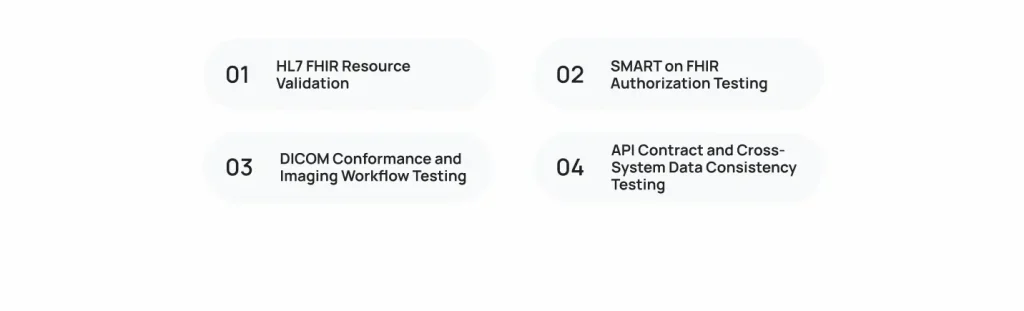
1. HL7 FHIR Resource Validation
Fast Healthcare Interoperability Resources (FHIR) is an HL7 standard for exchanging healthcare information through defined resources and interfaces. Healthcare applications may use resources such as:
- Patient for demographic and identity information.
- Practitioner for healthcare professionals.
- Encounter for a healthcare interaction.
- Observation for measurements and clinical findings.
- MedicationRequest for medication orders.
- DiagnosticReport for diagnostic results and reports.
FHIR Resource Validation should check more than whether an API returns valid JSON. Test the resource against the applicable FHIR version, implementation guide, and profile.
Validation should cover:
- Required elements and cardinality.
- Data types and permitted values.
- Code and terminology bindings.
- Resource references and relationships.
- Profile-specific constraints.
- Identifier consistency.
- Expected business rules and authorization behavior.
For example, a syntactically valid Observation resource may still contain an incorrect patient reference, an unsupported code, or a value that violates the receiving system’s profile.
The HL7 FHIR resource validation specification explains structural, cardinality, value-domain, terminology, invariant, and profile validation. Automated validators can identify many conformance issues, but they cannot establish that every clinical meaning or workflow is correct. Human review and end-to-end testing remain necessary.
2. SMART on FHIR Authorization Testing
SMART on FHIR uses OAuth 2.0-based patterns to authorize applications that connect to FHIR-enabled systems. Testing must verify both the authorization flow and the scope of data access granted to the application.
Test:
- Discovery of the authorization server’s supported capabilities.
- Application launch from an EHR or standalone context.
- Authorization requests and redirect handling.
- Access-token issuance and expiration.
- Refresh-token behavior, where supported.
- Requested and granted OAuth scopes.
- Patient and user launch context.
- Access attempts outside the granted permissions.
- Revoked or expired authorization.
For example, an application granted permission to read a patient’s encounters should not be able to modify medication records unless it has the required authorization. Test the server’s response to requests for resources or actions outside the token’s granted scope.
The SMART App Launch implementation guide defines authorization patterns, launch context, and scopes for FHIR-based applications. Use the version and implementation requirements supported by the systems being integrated.
3. DICOM Conformance and Imaging Workflow Testing
Applications that handle medical imaging need to exchange imaging data and related metadata with systems such as Picture Archiving and Communication Systems (PACS), Radiology Information Systems (RIS), and imaging modalities.
DICOM conformance testing should reflect the capabilities the integrated systems claim to support. Relevant test cases may cover:
- Supported DICOM Service-Object Pair (SOP) Classes.
- Image storage, retrieval, and transfer.
- Supported transfer syntaxes.
- Patient, study, series, and instance identifiers.
- Modality and study metadata.
- DICOM network communication and web services, where applicable.
- Error handling for unsupported objects or failed transfers.
Verify that images remain associated with the correct patient and study as they move between systems. A successful transfer does not prove that the receiving application has interpreted the metadata correctly or displayed the image in the right clinical context.
Compare the systems’ DICOM Conformance Statements to identify supported services and capabilities before integration testing. The DICOM PS3.2 Conformance specification explains the purpose of these statements and their role in assessing interoperability. A conformance statement describes supported capabilities; it is not a substitute for testing the actual integration.
4. API Contract and Cross-System Data Consistency Testing
API Contract Testing verifies that connected applications follow the agreed request, response, schema, and error-handling rules.
For each integration endpoint, test:
- Required and optional request fields.
- Data types, formats, and accepted values.
- Response structure and status codes.
- Authentication and authorization requirements.
- Invalid requests and validation errors.
- Timeout and retry behavior.
- Rate limits and throttling.
- Duplicate requests and idempotency where applicable.
- Backward compatibility after API changes.
Cross-system data consistency testing checks whether information remains accurate across connected platforms. For example, when a laboratory result is received, verify that the result, patient identifier, order reference, units, status, and timestamp are interpreted correctly by the receiving application.
Also test partial failures. An integration may accept a request but fail before the receiving system completes processing. The sending application should handle this state without assuming that the transaction succeeded or blindly creating a duplicate.
How Should Healthcare QA Teams Manage Test Data?

Healthcare software testing needs realistic test data to reproduce clinical workflows, boundary conditions, and integration behavior. However, using production patient records in development or QA environments can expose sensitive information and create avoidable privacy risks.
A test data strategy should balance realism, privacy, repeatability, and control.
1. Use Synthetic Patient Data for Clinical Scenarios
Synthetic patient data is artificially generated data designed to represent realistic records without directly reproducing actual individuals’ records. It can support testing of patient registration, encounters, medications, observations, diagnostic results, and other clinical workflows.
A useful synthetic dataset should include realistic relationships between records. For example, a medication order should reference the correct synthetic patient and encounter, while a diagnostic result should relate to the appropriate order.
Create test scenarios for:
- Patients with similar demographic details.
- Duplicate and incomplete records.
- Multiple encounters and medication histories.
- Different clinical conditions and workflow paths.
- Missing, invalid, and boundary-value fields.
- Conflicting updates from connected systems.
- Unusual but valid data combinations.
Synthetic data should be reviewed for both structural and clinical plausibility. Randomly generated values may produce records that look realistic but contain impossible dates, inconsistent relationships, or invalid combinations.
Synthetic data is not automatically safe or accurate simply because it is generated. If it is derived from real patient data or a model trained on sensitive records, its privacy properties need appropriate assessment.
The NIST guidance on de-identifying government datasets discusses test data, realistic test data, and fully synthetic datasets. Its principles help teams distinguish generated test records from data that has been modified or de-identified.
2. Apply Test Data Management Across Environments
Test Data Management (TDM) covers how datasets are created, approved, stored, accessed, refreshed, and retired across software environments.
A controlled TDM process should include:
- Environment separation: Keep development, QA, staging, and production environments logically separated.
- Data classification: Identify whether datasets are synthetic, de-identified, masked, or contain actual PHI.
- Access restrictions: Limit test data access to authorized team members.
- Data refresh controls: Define when datasets are updated and how changes are tracked.
- Consistency: Maintain stable datasets for repeatable functional, integration, and regression tests.
- Retention and disposal: Remove test records when they are no longer required, according to documented policies.
- Production protection: Prevent test transactions from reaching live patient records or operational systems.
If production-derived data is considered for testing, its use must be reviewed under the organization’s privacy, security, and legal requirements. Masking or de-identification does not automatically make every dataset suitable for unrestricted use.
How to Execute and Document Healthcare Software QA?
A healthcare QA process should produce more than a collection of passed test cases. It should create traceable evidence that requirements were tested, risks were addressed, defects were resolved, and the release meets predefined acceptance criteria.
A practical execution cycle includes eight stages.
- Review requirements and architecture. Examine the SRS, user stories, workflow diagrams, API specifications, data models, and integration dependencies. Identify clinical workflows and system components that require testing.
- Define the test plan. Document scope, test objectives, responsibilities, environments, test methods, risk priorities, entry criteria, and exit criteria. Identify which tests require clinical or security review.
- Design test cases. Create positive, negative, boundary, integration, regression, and clinical scenario tests. Link each test case to its requirement in the RTM.
- Prepare test environments and data. Configure representative environments, connected services, user roles, and controlled test datasets. Confirm that test records cannot affect production workflows.
- Execute tests and capture evidence. Run manual and automated tests. Record the build version, environment, test data, execution result, and relevant logs or screenshots. For failed integration tests, capture request and response details without exposing sensitive data.
- Log and classify defects. Record the affected requirement, reproduction steps, expected behavior, actual behavior, environment, and potential impact. Assign severity based on the risk and consequences of the failure.
- Retest fixes and run regression tests. Confirm that the defect is resolved, then test related workflows to identify unintended side effects. Regression coverage should prioritize critical clinical workflows and affected integrations.
- Maintain QA evidence. Keep the test plan, RTM, execution reports, defect records, validation results, and release approvals under appropriate version control and access restrictions.
Defect Severity Classification
Defect severity describes the impact of a failure. Teams should define classification rules before execution so that critical issues are not downgraded inconsistently.
| Severity | Meaning | Example |
| Critical | Creates an immediate patient safety, major data integrity, or serious security risk | Medication order is associated with the wrong patient |
| High | Breaks an essential clinical or operational workflow | Laboratory results fail to reach the intended patient record |
| Medium | Affects a non-critical function, with a reasonable workaround | Appointment status does not update correctly |
| Low | Causes a minor issue with limited operational impact | A non-essential interface element displays incorrectly |
Severity and priority are related but different. Severity describes the impact of the defect. Priority determines how urgently the team should address it, considering risk, exposure, release timing, and operational needs.
Healthcare Software Testing Checklist Before Release

Before deployment, QA leads, product owners, technical stakeholders, and relevant clinical reviewers should confirm that the system meets its release criteria. A high overall test pass rate is not enough if critical workflows remain untested or serious defects are unresolved.
Use this checklist as a release-readiness baseline and adapt it to the application’s intended use.
| Release Gate | What Must Be Verified |
| Requirements coverage | Critical requirements are mapped to test cases with recorded results |
| Clinical workflows | High-risk workflows pass normal, negative, and exceptional scenarios |
| Patient data integrity | Patient matching, record updates, and cross-system consistency are validated |
| Medication and CDS | Relevant medication rules and clinical alerts produce expected results |
| Access control | Authentication, authorization, and audit logging checks pass |
| Interoperability | Required FHIR, API, DICOM, and other integration tests pass |
| Performance | Defined workload, throughput, and response-time criteria are met |
| Recovery | Backup restoration and recovery procedures have been tested |
| Defect status | No unresolved release-blocking defects remain |
| Regression | Critical workflows pass after the latest code changes |
| Test evidence | Execution results, known issues, and validation records are available |
| Approval | Required technical, product, security, and clinical approvals are documented |
Release-readiness criteria should be agreed upon before the final test cycle. For example, an organization may require all critical and high-risk test cases to pass, no open release-blocking defects, and successful recovery testing. The exact thresholds should reflect the system’s risk profile and documented acceptance criteria.
If a known defect is accepted for release, record its impact, affected workflows, workaround, owner, and approval. Do not treat an undocumented exception as a passed test.
Common Healthcare Software Testing Failures That QA Teams Should Prevent
Even a structured test plan can miss important defects when teams focus on individual features instead of how the system behaves in real operating conditions.
Testing screens instead of end-to-end workflows. A registration form may work correctly while the patient identifier fails to propagate to the encounter or laboratory order. Test the full transaction across relevant components.
Treating a successful API response as proof of correct data exchange. An HTTP success response does not guarantee that the receiving system stored the right patient, code, unit, or reference. Validate the resulting data and downstream workflow.
Using unrealistic test data. Simple records rarely expose duplicate identities, incomplete histories, conflicting updates, or boundary conditions. Build datasets around realistic and exceptional scenarios.
Checking access restrictions only in the interface. Hiding a button does not prevent direct API access. Test authorization at the server and data-access layers.
Ignoring partial failures and retry behavior. A timeout can leave the sender uncertain whether a transaction was processed. Test idempotency, duplicate prevention, queue handling, and reconciliation.
Automating tests without validating expected clinical outcomes. Automation can repeat a test accurately while checking the wrong result. Have qualified stakeholders review clinical assumptions and expected outcomes.
Approving a release based only on the pass rate. A build can have a high pass rate and still contain an unresolved critical defect. Release decisions must consider risk, test coverage, defect severity, and acceptance criteria together.
Conclusion
Healthcare software testing must establish that an application does more than meet its functional specifications. It must preserve patient identity, handle clinical information accurately, enforce access restrictions, exchange data reliably, and recover predictably when services fail.
That requires a risk-based QA strategy, traceable requirements, realistic clinical scenarios, controlled test data, and release criteria tied to the system’s intended use. Testing should also continue as workflows, integrations, security requirements, and software dependencies change.
For healthcare organizations building or modernizing digital systems, QA needs to be part of the engineering process from the beginning, not a final check before deployment. Cubix helps healthcare organizations plan and build custom platforms with the architecture, integrations, security controls, and testing considerations their workflows require. Explore our healthcare software development services to discuss the technical requirements of your project.
Let's Catch the Failures Your Users Shouldn't Have to Find.
Contact Us
Frequently Asked Questions
1. What Is Healthcare Software Testing?
Healthcare software testing is the process of verifying and validating healthcare applications, platforms, and connected systems. It covers functional behavior, clinical workflows, patient data integrity, security, interoperability, performance, and reliability.
2. What Are the Main Types of Healthcare Software Testing?
The main categories include functional testing, clinical workflow testing, integration testing, interoperability testing, security testing, performance testing, usability testing, regression testing, and disaster recovery testing. The required coverage depends on the software’s features and intended use.
3. How Do You Test an EHR System?
Test patient registration, identity matching, encounters, clinical documentation, diagnoses, medication orders, laboratory results, permissions, audit trails, and integrations. Validate complete workflows across user roles and verify that patient information remains accurate throughout the system.
4. What Is the Difference Between Healthcare Software Verification and Validation?
Verification checks whether the software meets its documented requirements. Validation checks whether it supports its intended use and user needs in the relevant operating context. Both are necessary to establish confidence in the system.
5. How Is HIPAA Compliance Tested in Healthcare Software?
QA teams can test technical safeguards such as access control, authentication, audit logging, data integrity, and transmission security. However, software testing alone cannot establish HIPAA compliance. Organizations must also address applicable administrative, physical, contractual, and operational requirements.
6. Can Healthcare Software Testing Be Automated?
Yes. Automation is useful for repeatable regression tests, API validation, integration checks, permission tests, and performance testing. Manual testing and clinical review remain important for complex workflows, exploratory scenarios, usability, and expected clinical outcomes.