Key Takeaways
- AI-generated code can introduce security vulnerabilities, including SQL injection, hardcoded secrets, weak authentication, and unsafe dependencies.
- Every AI-generated code snippet needs human review, static analysis, dependency scanning, and security testing before deployment.
- Copyright ownership depends on meaningful human involvement, including original coding, substantial editing, and creative contributions.
- AI coding tools can reproduce open-source code, creating potential copyright infringement and licensing issues, especially with GPL and AGPL licenses.
- Businesses should track code provenance, review AI tool terms, enable code-matching filters, and automate license scanning to protect intellectual property.
- A clear AI usage policy, combined with human oversight and regular compliance audits, helps businesses reduce security, legal, and operational risks.
Quick gut check before we start. Think about the last pull request your team merged. How much of it came from an AI tool? A little? Half? You honestly don’t know?
That last answer is the one that worries me.
AI coding assistants went from “neat experiment” to “everyone’s using it” in about two years. Developers love them. Managers love the speed. But three questions keep nagging at anyone who has to sign off on what ships: Is this code secure? Do we actually own it? And could it get us sued?
Let’s walk through all three. Just what you need to know, and what to do about it.
Part 1: Is AI generated code safe to use?
Short answer: sometimes. Which isn’t comforting.
AI models learn from huge piles of public code. Public code includes brilliant work, and it also includes outdated tutorials, abandoned projects, and copy-pasted Stack Overflow answers with glaring holes. The model doesn’t know which is which. It predicts what looks right, not what is right.
So what are the common security risks associated with AI-generated code? Here are the ones I see most.
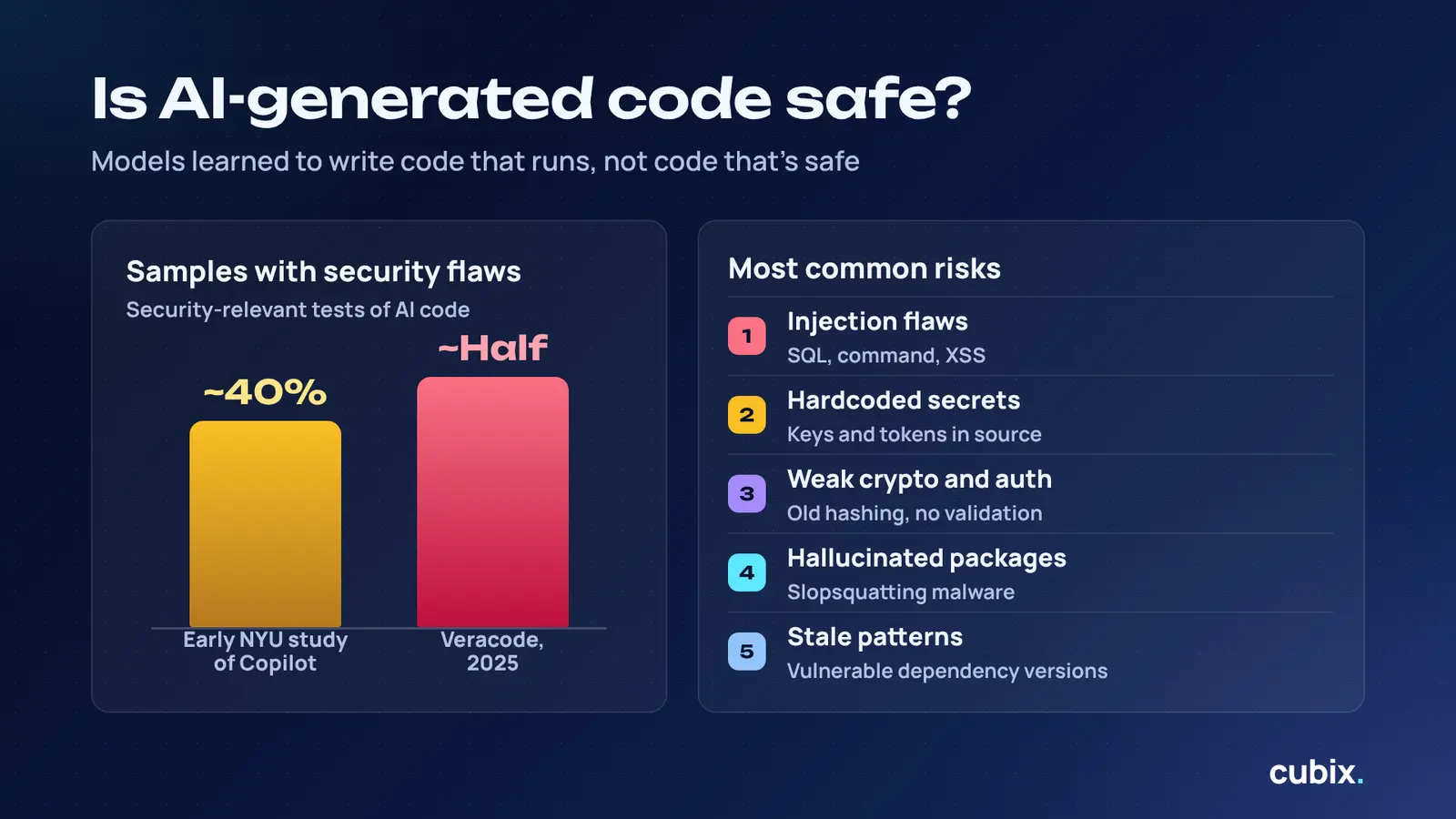
Injection flaws. The model happily builds a database query by gluing user input into a string. It works. It also invites SQL injection. Same story with command injection and cross-site scripting.
Hardcoded secrets. API keys, passwords, tokens sitting right in the source. The model has seen thousands of examples that do exactly this, so it does exactly this.
Weak crypto and auth. Old hashing algorithms. Skipped input validation. Session handling that falls over under a little pressure.
Hallucinated packages. This one is sneaky. The AI suggests a library that doesn’t exist. An attacker notices the made-up name, registers it, and loads it with malware. Now a developer who trusts the suggestion installs it. Security folks call this slopsquatting, and it’s a real thing.
Stale patterns. The model might recommend a dependency version with a known vulnerability, because that’s what the training data was full of.
Is this just a theory? Not really. Researchers have been testing assistants for years. An early NYU study of GitHub Copilot found roughly 40% of the generated programs in security-relevant scenarios contained vulnerabilities. More recent industry testing, including a widely discussed Veracode report in 2025, found close to half of AI-generated code samples carried security flaws. Models got better at writing code that runs. They didn’t get much better at writing code that’s safe.
Here’s the part that really matters, though. People trust AI output more than they should. Code that looks clean and comes with confident comments gets a lighter review. That’s the real risk. Not the tool, but the way we relax around it.
Quick quiz: spot the problem
Try this one. No peeking below.
A developer asks an AI for a login function. It returns code that:
- Hashes passwords with MD5
- Builds the SQL query with string concatenation
- Logs the full password on failed attempts
- Stores the admin API key in a constant at the top of the file
How many of those are problems?
Answer: all four. If you caught three or more, your review instincts are solid. If you caught one or two, you’re in good company, and that’s exactly why a second set of eyes (human or automated) matters.
Part 2: How to check AI generated code for security vulnerabilities
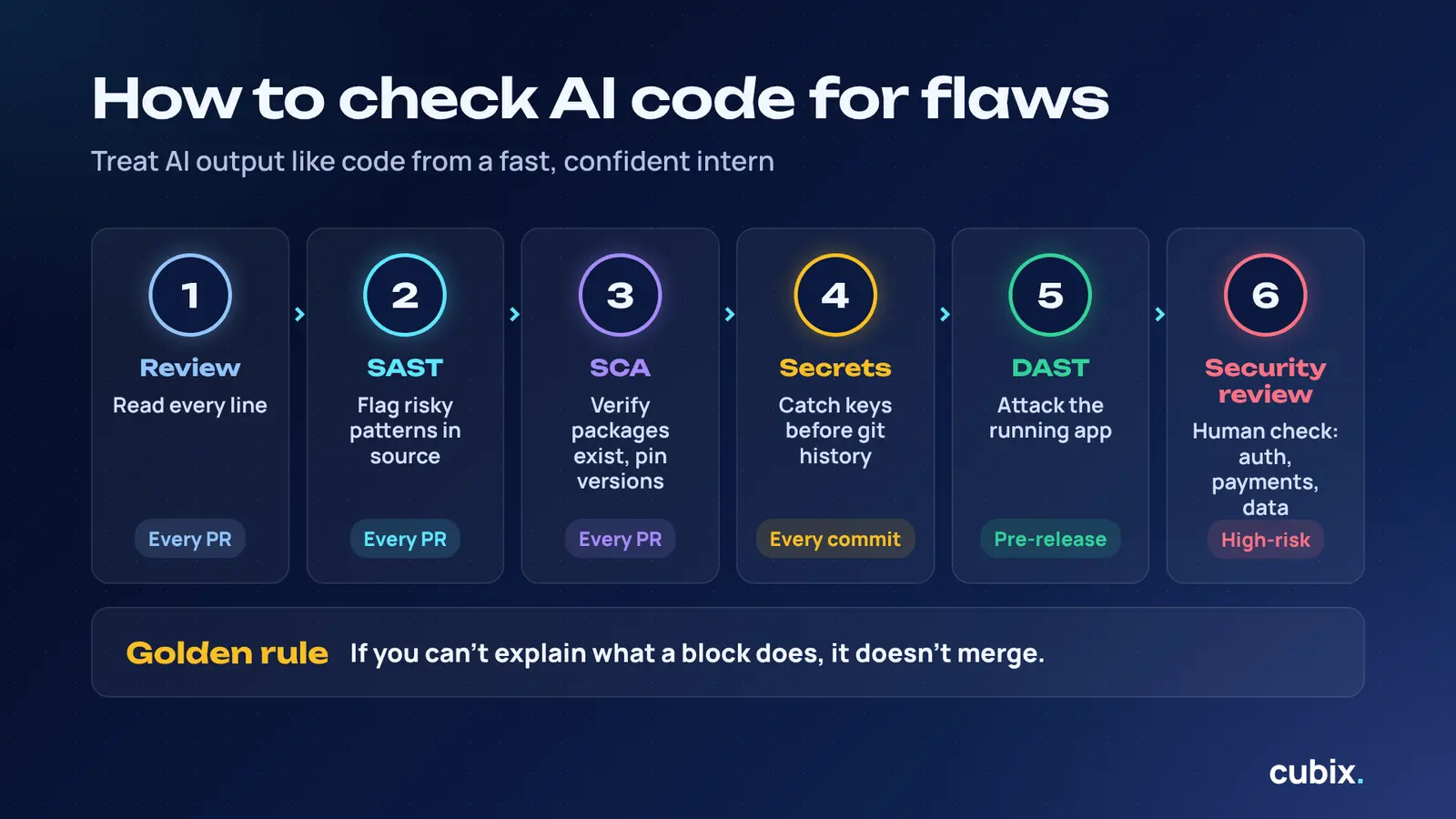
You don’t need to ban the tools. You need a process that treats AI output like code from a fast, confident intern. Useful, but never merged unreviewed.
Here’s a workflow that works.
1. Review it like you wrote nothing. Read every line. If you can’t explain what a block does, it doesn’t merge. Simple rule, painful to follow when you’re in a hurry.
2. Run static analysis (SAST). These tools read your source and flag risky patterns before anything runs. Run them on every pull request, not once a quarter.
3. Scan your dependencies (SCA). Check every package the AI pulled in. Does it exist? Is it maintained? Does it have known CVEs? Pin your versions.
4. Hunt for secrets. Secret-scanning tools catch keys and tokens before they reach your repo history. Once a secret is in git, you have to treat it as leaked.
5. Test it while it runs (DAST). Static tools miss problems that only show up in a live app. Dynamic testing pokes at your running system the way an attacker would.
6. Add human security review for sensitive code. Authentication, payments, anything touching personal data. Don’t let a machine be the only author and the only reviewer here.
If you want more on testing approaches, we put together a deeper look at AI generated code security and how automated testing fits in.
What to look for in a scanning tool
People ask me constantly about AI code security scanning tools, and which platforms offer real-time scanning. I won’t name winners here, because the market shifts every few months and your stack matters more than any ranking. But I can tell you what separates good from mediocre.
When you’re comparing platforms, ask whether they offer:
- Real-time feedback inside the IDE. Catching a flaw as the code appears beats catching it three days later in a pipeline.
- Coverage for your languages and frameworks. Sounds obvious. Gets overlooked.
- Low false-positive rates. If developers drown in noise, they’ll ignore the tool. Within a month.
- Dependency and package verification. Especially useful against hallucinated libraries.
- Secrets detection.
- Clear fix guidance. Not just “this is bad” but “here’s how to fix it.”
- CI/CD integration. It should slot into your pipeline without a rewrite.
- Audit trails and reporting. Your compliance team will want these. So will auditors.
And if you’re shopping for something broader, like AI code security posture management, ask for a trial before you commit. Run it on a real repository, not a demo project. See what it finds, and just as important, what it flags that doesn’t matter.
Poll time: which of these is your team missing right now? Be honest. Most teams I talk to have static analysis and nothing else. Secrets scanning and dependency checks are usually the easiest wins.
Part 3: Who owns AI generated code?
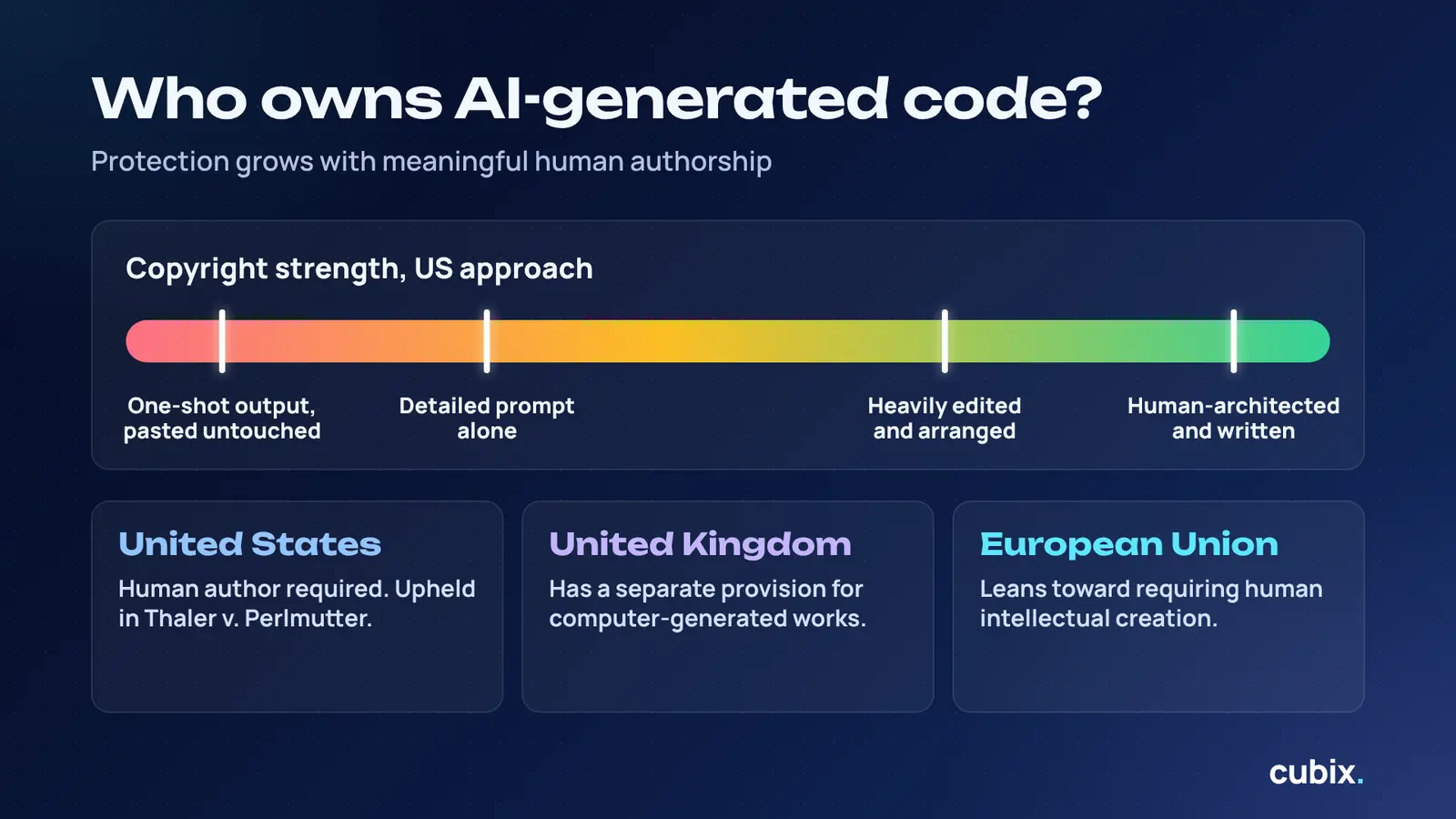
Okay. Different problems. Now let’s talk about ownership. You’d think this would be simple. You prompted it, you used it, it’s yours. Right? Not quite.
In the United States, copyright law is built around human authorship. The Copyright Office has said repeatedly that works made entirely by AI, without meaningful human creative input, can’t be registered. A federal appeals court backed this up in the Thaler v. Perlmutter case, where a researcher tried to register an image made autonomously by his AI system. The court said no. A human author is required.
So, can AI generated code be copyrighted? It depends on how much you did.
The Copyright Office’s guidance on AI works points in a consistent direction. Typing a prompt, even a detailed one, generally isn’t enough on its own to make you the author of what comes back. But the parts where a human contributed real creative work can be protected. That includes code you wrote yourself, code you substantially rewrote or arranged, and the way you selected and combined AI output into a larger design.
Think of it like this. A function the model spat out in one shot, which you pasted in untouched, sits on shaky ground. A system you architected, wrote large chunks of, and edited heavily with AI help? Much stronger.
And what about outside the US? Rules vary. The UK has a provision for computer-generated works that’s quite different from the US approach. The EU leans toward requiring human intellectual creation. If you operate globally, this gets messy fast.
What this means for you
If you’re building a product, source code copyright protection is part of what makes your company valuable. Investors ask about it. Acquirers ask about it. If big chunks of your codebase can’t be protected, a competitor might be able to copy them without consequence.
So keep records. Note which parts were human-written, which were AI-assisted, and what edits you made. It feels like paperwork until someone asks.
Part 4: AI generated code licensing risks
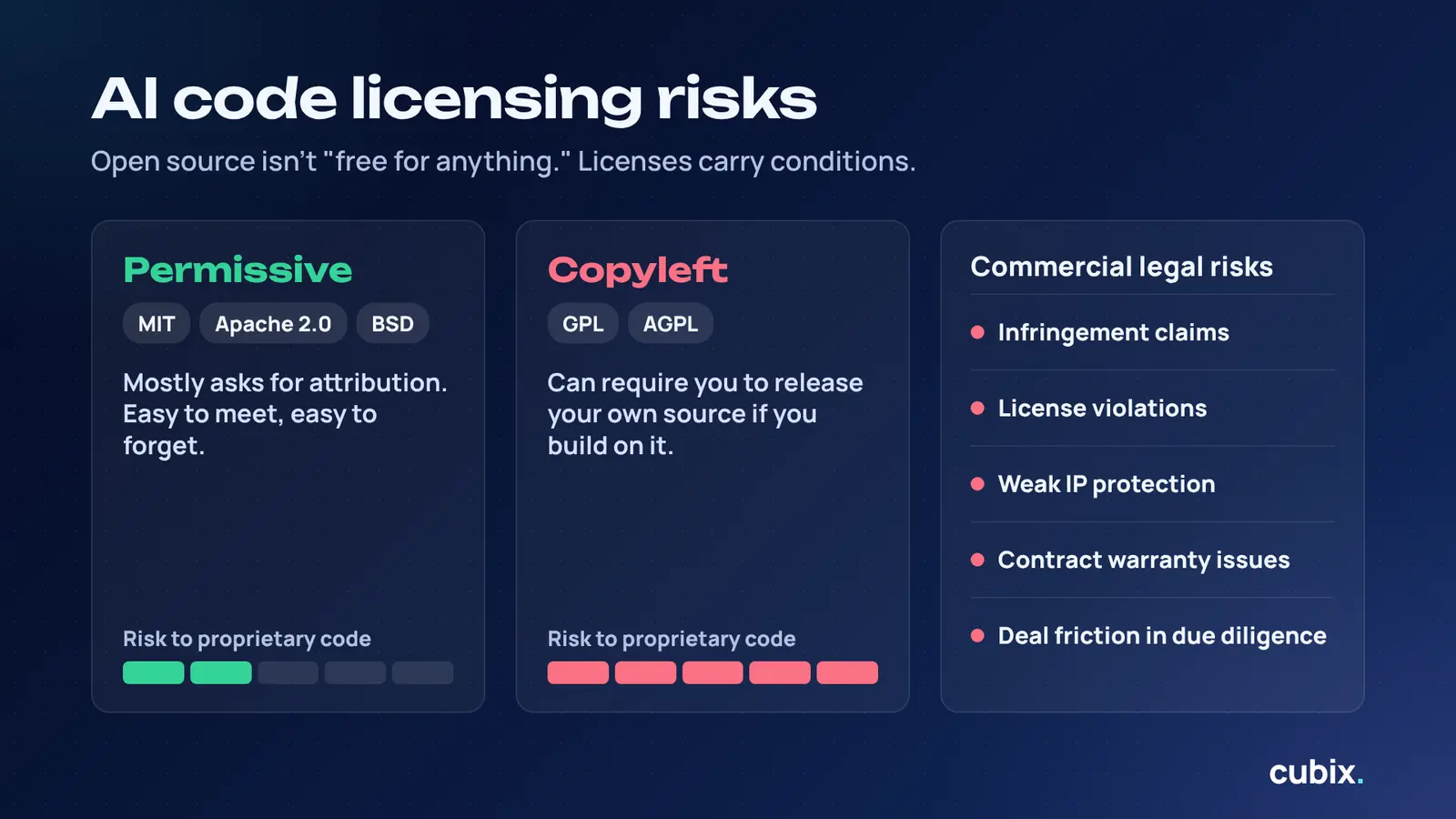
Here’s where it gets really interesting. Maybe ownership isn’t even your biggest problem. Maybe it’s what’s inside the code.
Can AI generated code violate open source licenses? Yes. It can.
Models trained on public repositories sometimes reproduce chunks of their training data. Usually it’s small and generic. Occasionally it’s long, distinctive, and lifted nearly word for word from a project with a specific license.
Why does that matter? Because open source isn’t “free for anything.” Licenses come with conditions.
- Permissive licenses (MIT, Apache 2.0, BSD) mostly ask for attribution. Easy to meet, easy to forget.
- Copyleft licenses (GPL, AGPL) can require you to release your own source code if you build on theirs. For a commercial product, that’s a very bad surprise.
Now picture this. Your AI assistant quietly drops a GPL-licensed routine into your proprietary app. Nobody notices. Two years later, during due diligence for an acquisition, a scan flags it. Suddenly there’s a delay, a rewrite, maybe a price cut.
That’s the scenario that keeps legal teams awake.
Courts haven’t settled all of this yet. The big lawsuit here, Doe v. GitHub, challenges how Copilot was trained and what it outputs. It has been working through the courts for years, with some claims narrowed or dismissed and others still in play. Meanwhile, the EU AI Act is adding transparency duties around training data. The ground keeps moving, so don’t build a compliance plan around one court decision.
Legal risks of using AI generated code in commercial software
Let’s pull the threads together. If you ship AI-assisted code in a commercial product, you may face:
- Infringement claims if output copies protected code.
- License violations if copyleft code sneaks in without the obligations being met.
- Weak IP protection if too much of your code lacks human authorship.
- Contract problems. Customers and partners often require you to warrant that you own, or have the right to use, what you deliver.
- Deal friction. Buyers and investors increasingly ask pointed questions about AI use in your codebase.
None of these are reasons to panic. They’re reasons to plan.
Part 5: How to protect intellectual property when using AI coding tools
Good news. Most of the protection comes from habits, not expensive software.
Read the tool’s terms. Look at who owns the output, what the vendor does with your prompts, and whether they offer IP indemnification. Some enterprise plans promise to cover you if output triggers an infringement claim. Free tiers usually don’t. That gap matters.
- Turn on filters. Several assistants have a setting that blocks suggestions matching public code. Use it.
- Don’t paste secrets or crown jewels into prompts. Proprietary algorithms, customer data, credentials. Check whether your vendor trains on your inputs, and opt out where you can.
- Track code provenance. Code provenance just means knowing where code came from: who or what wrote it, when, and under what terms. Tag AI-assisted commits. Keep a simple log. It’s cheap now and enormously valuable later.
- Run license scans. This is where AI code license compliance software earns its keep. Software composition analysis tools can detect open source components and snippets, flag the license types, and warn you about conflicts. Add them to your pipeline right next to your security scanners.
- Write an AI use policy. One page. Which tools are approved, what data can go in, what review is required. Your developers will thank you, because right now many of them are guessing.
- Keep humans in the loop. The more your engineers shape, restructure, and own the output, the stronger both your security and your IP position.
If you’re weighing whether to build your own tools or rely on vendors, our piece on licensed AI software covers the trade-offs, including who carries the risk.
The AI generated code license compliance checklist
Screenshot this. Or print it. Or stick it in your wiki and actually use it.
Before you adopt a tool
- Reviewed the vendor’s terms on output ownership
- Checked for IP indemnification
- Confirmed whether your prompts and code are used for training
- Enabled public-code matching filters
While your team codes
- AI-assisted commits are tagged
- Every AI suggestion is reviewed by a human
- New dependencies are verified to exist and be maintained
- No secrets or sensitive data go into prompts
In your pipeline
- Static analysis runs on every pull request
- Dependency and license scanning is automated
- Secret scanning is turned on
- High-risk code gets a human security review
Once a quarter
- Audit license reports for copyleft conflicts
- Update your AI use policy
- Re-check legal guidance, because it moves
How many boxes can you tick today? Under half? That’s normal. Pick two and do them this week.
Where this is heading
A few trends are worth watching. Scanning tools are getting built straight into AI assistants, so security checks happen as code is generated. Vendors are competing on indemnification and provenance features. And AI agents, which write, test, and deploy code with less supervision, are raising the stakes. An agent that can change your infrastructure needs tighter guardrails than a chat window that suggests snippets.
That’s a big reason we pay attention to how we build these systems at Cubix. If you’re curious about how we handle quality and risk in practice, here’s a look at our approach to secure software development.
So, should you use AI to write code?
Yes. Just not blindly.
AI generated code security isn’t a reason to avoid the tools. It’s a reason to pair them with scanning, review, and clear records. The same goes for ownership and licensing. The legal picture is unsettled, but the practical advice holds steady: keep humans meaningfully involved, know where your code came from, and scan for what you can’t see.
Our Generative AI Development Services cover custom solutions with security and compliance built in from day one, and if you’re exploring autonomous workflows, take a look at our AI Agent Development Services.
Teams that do this get the speed and sleep fine at night. Teams that don’t are building up risk they’ll meet during an audit, a lawsuit, or a breach. Usually at the worst possible time.
If you want help building AI into your products the safe way, our team at Cubix, an AI development company, works on this daily.
One last question, and I’d love an honest answer. If someone asked you today to prove where a random file in your codebase came from, could you?
If not, that’s your first task. Go start the log.
Protect Your Software IP. Talk To Cubix Experts
Contact UsFrequently Asked Questions
1. Can AI generated code be copyrighted?
AI generated code may qualify for copyright protection when a human makes meaningful creative contributions, such as writing, substantially editing, or creatively arranging the code. Copyright rules vary by country.
2. Can AI generated code contain security vulnerabilities?
Yes. AI generated code can contain SQL injection, hardcoded credentials, weak authentication, outdated dependencies, and other security vulnerabilities. Developers should review and test all generated code before deployment.
3. Can AI generated code violate open source licenses?
Yes. AI coding tools can reproduce code from open source repositories. If the reproduced code falls under licenses such as GPL or AGPL, using it without meeting the license requirements can create legal and compliance risks.
4. How can developers check AI generated code for copyright and licensing issues?
Developers can use code similarity detection, open source license scanning, dependency analysis, and code provenance tracking. Reviewing AI tool terms and documenting human contributions also helps reduce legal risks.
5. How can businesses protect intellectual property when using AI coding tools?
Businesses should review AI vendor terms, enable public code matching filters, avoid sharing confidential information, track AI assisted contributions, automate license scanning, and establish clear AI usage policies.