Key Takeaways
- Never trust the client. Keep currency, progression, match results and purchase entitlements on the server so a modified app can’t change the real game state.
- Cheating hurts revenue. 51% of studios report lower retention or revenue because of it, and mobile cheat revenue is estimated at about $286M per game.
- Layer your defences. Combine obfuscation, runtime integrity checks, certificate pinning, device-risk detection and server-side validation. 96% of organisations using multi-layered protection report fewer incidents.
- Validate purchases on the server. Check receipts with Google Play and the App Store, block duplicate transaction IDs, and grant items only from the backend.
- Treat root and jailbreak detection as a signal, not a verdict. Feed it into a server-side risk score instead of banning outright, which reduces false positives.
- Secure the backend as well. Use authentication on every endpoint, rate limiting, secrets management and secure cloud configuration.
- Test continuously. Run static and dynamic scans on every build and a penetration test at least annually or before major releases.
- Build security in from the start. Threat modelling in design is far cheaper than emergency patches after launch.
Mobile games are no longer casual side projects. They are live-service products that earn billions, run real economies and hold millions of player accounts. That makes them a high-value target. Every popular title eventually attracts modders, cheat developers, bot farmers and fraud rings, and the studios that treat security as a launch-week checklist item are usually the ones that pay for it later in churn, refunds and bad reviews.
This guide covers mobile game security from a developer’s perspective: the threats that matter in 2025 and 2026, the best practices that actually reduce risk, how to test your defences, and how to build protection into your pipeline from day one. Whether you are shipping a hyper-casual title or a competitive multiplayer game, the principles are the same: assume the client is hostile, protect the server, and layer your defences.
If you are building a game and want security designed in from the start, our game development company can help you plan it into the architecture rather than bolt it on at the end.
Secure Your Mobile Game with Cubix Today
Contact UsWhy Mobile Game Security Matters in 2026
The business case is simple: the more money a market makes, the more attackers it attracts.
According to Statista figures cited by Guardsquare, mobile games are expected to generate more than $134 billion in revenue in 2026, with the player base forecast to reach 2.5 billion by 2030. Games combine valuable intellectual property with repeatable ways to monetise, which is exactly what makes them attractive to attackers.
The underground economy has scaled to match. Research from game security firm Intorqa, reported by SecurityBrief in February 2026, estimates the global video game cheat economy at roughly $8.5 billion. For mobile specifically, the same research puts cheat-related revenue at an estimated $286 million per game, and notes that mobile attracts its own group of threat actors who rely on different distribution channels and device-level workarounds than PC and console cheaters.
The damage shows up in the studio’s numbers too. A September 2026 survey from Anybrain, covered by PocketGamer.biz, found that 51% of studios report measurable declines in player retention or revenue because of cheating, and 69% consider it a significant or very significant problem. The same report found that 55% of studios hit technical issues from their anti-cheat tooling and 31% deal with false positives, a reminder that protection has to be designed carefully, not just switched on.
Finally, there is the layered-defence argument. Guardsquare’s 2026 analysis reports that 96% of organisations using multi-layered mobile application protection see fewer security incidents. In other words, no single tool solves this; the winners combine several.
The takeaway: cheating is no longer just a gameplay problem. It is a security problem that begins with client-side compromise and often extends into backend abuse.
Top Mobile Game Security Threats (2025–2026)
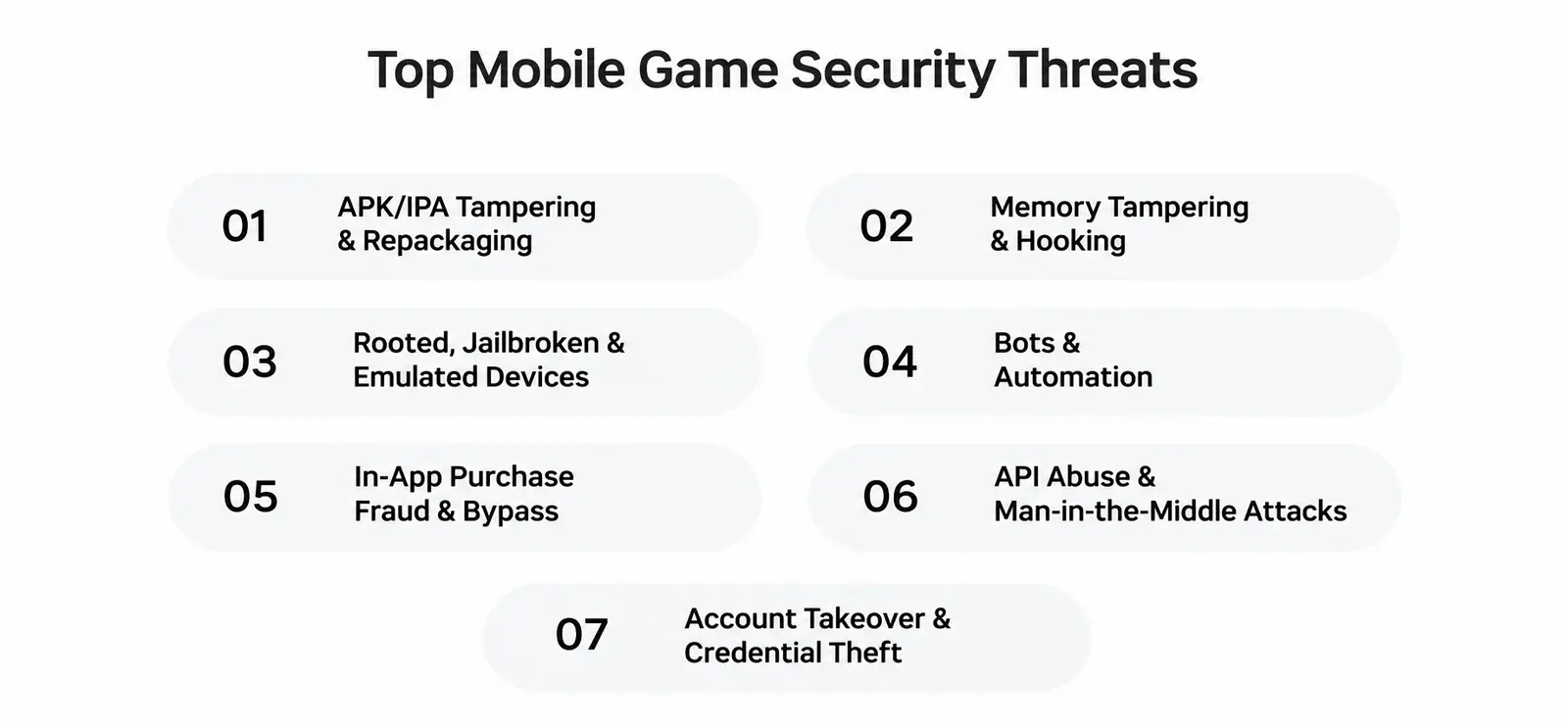
Understanding mobile game security threats is the first step to prioritising your defences. These are the attack categories we see most often.
1. APK/IPA Tampering and Repackaging
Attackers download your build, decompile it, inject cheats, remove ads or licence checks, then repackage and redistribute it through third-party stores or sideloaded links. The result is a cloned or modified copy of your game that bypasses your monetisation and sometimes carries malware that targets your players.
Repackaging is especially common on Android, where sideloading is easy, but iOS is not immune. Jailbroken devices and re-signed IPAs make modified iOS builds increasingly practical. Effective APK tampering protection means detecting that the binary has been altered at runtime and responding, not just hoping the store listing keeps attackers away.
2. Memory Tampering and Hooking
Tools such as memory scanners and runtime hooking frameworks let attackers change values like currency, health or cooldown timers while the game is running, or intercept and modify function calls. If your game trusts values stored on the device, a few minutes with a memory editor can break your economy.
This is the core of mobile game hacking: the attacker is not breaking your servers, just lying to them through a compromised client.
3. Rooted, Jailbroken and Emulated Environments
Rooted and jailbroken devices remove the operating system’s sandbox protections, giving attackers the privileges they need to inspect memory, inject code and bypass integrity checks. Emulators and multi-instancing tools add another layer: they let one person run dozens of game instances to farm resources, run bots or manipulate matchmaking.
Not every rooted device is malicious, so your response should be risk-based rather than an automatic ban. That is a theme we will return to below.
4. Bots and Automation
Automated scripts grind levels, collect rewards, snipe auctions and farm in-game currency around the clock. Cheat communities have also grown more sophisticated at disguising automation, imitating normal player behaviour to evade simple detection. Bots distort your economy, inflate your active-user numbers and frustrate legitimate players who cannot compete with a machine that never sleeps.
5. In-App Purchase Fraud and Bypass
If your purchase validation happens on the device, attackers can spoof receipts, patch the billing check or replay old transactions to unlock paid items for free. Fake receipts and cracked builds directly hit revenue, and they also trigger chargebacks and platform disputes when stolen payment methods are involved.
6. API Abuse and Man-in-the-Middle Attacks
Your game talks to a backend, and attackers will inspect that traffic. Without proper transport security, they can intercept requests, modify parameters, replay calls or reverse engineer your API and then script it directly, bypassing the game client altogether. Weak endpoints, missing rate limits and predictable identifiers make this trivially easy.
7. Account Takeover and Credential Theft
Players reuse passwords, fall for phishing messages, and trade accounts on grey markets. Intorqa’s research links cheating to fraud and account exploitation, particularly where paid boosting and account trading intersect with stolen credentials. Game account security is both a player-trust issue and a support-cost issue, since every compromised account becomes a ticket, a refund request or a lost customer.
Mobile Game Security Best Practices

The following mobile game security best practices work together. None is sufficient alone, but combined they raise the cost of attacking your game high enough that most attackers move on to easier targets.
Make the Server the Source of Truth
The single most important rule: never trust the client. Anything that affects fairness or revenue, such as currency balances, inventory, match results, purchase entitlements and progression, should be validated and stored server-side. The client can request an action; the server decides whether it is legal.
Practical steps include:
- Calculate rewards, damage and drops on the server, not the device.
- Validate every client request against game rules (is this action possible right now, at this speed, from this state?).
- Log anomalies such as impossible scores, inhuman reaction times and sudden currency spikes for review.
This server-authoritative design neutralises a huge share of memory-editing and speed-hack attacks because modifying a local value no longer changes the real state.
Follow Secure Coding Practices
Secure coding practices for mobile games are the foundation everything else sits on:
- Validate all input from the client, server and third-party SDKs.
- Never hardcode secrets such as API keys, signing keys or admin endpoints in the app binary. Assume anything shipped to the device will be found.
- Use the principle of least privilege, requesting only the permissions your game needs.
- Keep dependencies updated. Third-party SDKs for ads, analytics and social login are a common weak point, so audit them regularly.
- Strip debug code and logging from production builds.
The OWASP Mobile Application Security project identifies reverse engineering and app tampering as fundamental mobile risks across platforms, so it is worth using the OWASP mobile guidelines as a baseline for your own reviews. For a broader look at the risks that apply to every app, including games, see our guide to mobile app security for games and other apps.
Obfuscate and Harden Your Code
Obfuscation will not stop a determined attacker, but it slows them dramatically. Combine several techniques:
- Code obfuscation renames classes and methods and flattens control flow so decompiled output is hard to read.
- String and asset encryption hides logic, endpoints and resources.
- Native code for sensitive logic. In Unity games, consider IL2CPP rather than Mono, since managed assemblies are far easier to decompile.
- Anti-debugging and anti-hooking checks that detect debuggers and hooking frameworks at runtime.
The goal is to raise the time and skill needed to build a cheat, so that it is no longer worth the effort for casual attackers.
Add Runtime Integrity and Tamper Detection
This is where mobile game protection becomes active rather than passive. Your game should verify, at launch and periodically during play, that:
- The binary signature matches your official release.
- Code and resource files have not been modified.
- The platform’s attestation service reports a genuine device and app. On Android, that is the Play Integrity API; on iOS, App Attest.
Rather than crashing the game when a check fails, which tells the attacker exactly where to patch, send a signal to the server and let your backend decide the response: flag the account, limit rewards, isolate the player in a low-trust matchmaking pool, or ban after repeated violations.
Use Strong Encryption for Data and Traffic
Mobile game encryption covers both data at rest and data in transit:
- In transit: enforce TLS 1.2 or higher on all connections and add certificate pinning, so the app only trusts your server’s certificate, which prevents man-in-the-middle interception even on compromised networks.
- At rest: encrypt save files, cached tokens and local databases using platform keystores (Android Keystore, iOS Keychain), never plain-text files or PlayerPrefs.
- Request signing: sign sensitive API requests with short-lived tokens and nonces to defeat replay attacks.
Pinning needs a rotation plan. Pin to a public key or an intermediate certificate, ship a backup pin, and make sure you can update pins without forcing every player to reinstall.
Detect Rooted, Jailbroken and Emulated Devices
Combine multiple signals instead of relying on a single check: known root binaries and packages, writable system partitions, suspicious build properties, hooking-framework artefacts, and emulator fingerprints such as virtual hardware identifiers and sensor anomalies. Attackers routinely bypass any single check, so layering matters.
Handle results with nuance. Many legitimate players use customised devices, so a risk score that feeds your server-side decisions is safer than a hard block. You might restrict competitive modes and monetised events for high-risk devices while still letting people play casually.
Protect In-App Purchases
To stop in-app purchase fraud and bypass attempts:
- Validate receipts server-side directly with Google Play and the App Store. Never trust a receipt just because the client says it is valid.
- Prevent replay by recording transaction IDs and rejecting duplicates.
- Grant entitlements from the server after verification, never from a client-side flag.
- Monitor refund and chargeback patterns so fraud rings are caught early.
Build Layered Anti-Cheat Systems
For multiplayer titles, you need dedicated game cheat prevention. Effective systems combine client-side detection (memory scans, integrity checks, speed-hack detection), server-side behavioural analysis (statistical outliers, impossible movement, input patterns), player reporting, and a review pipeline. Machine-learning models are increasingly used to spot automation and abnormal play, but they work best alongside deterministic server validation rather than replacing it.
Be careful with false positives. As the Anybrain survey shows, a large share of studios struggle with them, and wrongly banning a paying player is costly. Use graduated responses and an appeals path. If you want to understand how these systems are structured, read our breakdown of how anti-cheat systems work in multiplayer games.
Defend Against Bots and Multi-Instancing
To prevent game hacking by automation, combine:
- Device and session fingerprinting to spot many accounts from one device.
- Rate limits on actions, trades and logins.
- Behavioural analysis: perfectly regular timing, no idle periods and identical routes are bot signals.
- Economy monitoring so that a sudden flood of a currency or item triggers investigation.
- Challenges (such as CAPTCHAs or in-game verification) only when risk is high, so legitimate players are not disrupted.
Strengthen Game Account Security
- Offer multi-factor authentication, or at least social login with strong providers.
- Use rate limiting and lockouts on login endpoints to blunt credential stuffing.
- Store passwords with modern hashing (Argon2 or bcrypt) and never in reversible form.
- Alert players about new-device logins and offer easy session revocation.
- Educate players about phishing, particularly via in-game chat and direct messages.
Game Server Security and Data Protection

Client hardening only delivers value if your backend is sound. Game server security is where most large-scale breaches and economy collapses actually happen, because one flaw can affect every player at once.
Focus on these areas:
- Authentication and authorisation on every endpoint. Do not rely on obscurity or client-supplied user IDs.
- Rate limiting and DDoS protection, especially for real-time and competitive games where downtime directly hurts retention.
- Secure cloud configuration. Misconfigured storage buckets and over-permissive access roles remain a leading cause of data exposure.
- Input validation and parameterised queries to prevent injection attacks.
- Logging and alerting to detect abnormal behaviour in real time, with enough retention to investigate incidents.
- Secrets management through a vault rather than environment files committed to repositories.
Mobile game data protection also carries legal weight. If you collect player data, including device identifiers, location, purchase history or chat, you are responsible under regulations such as GDPR and CCPA, and for games with younger audiences under rules like COPPA. Collect only what you need, encrypt it, set retention limits and have an incident response plan before you need one.
Mobile Game Security Testing and Vulnerability Assessment
You cannot protect what you have not tested. A structured mobile game vulnerability assessment shows you what attackers see before they exploit it. Treat testing as a recurring practice, not a pre-launch event, because every new feature, SDK and live-ops event changes your attack surface.
A solid mobile game security testing programme includes:
- Static analysis (SAST) to scan source code and binaries for insecure patterns, hardcoded secrets and vulnerable libraries.
- Dynamic analysis (DAST) to test the running game and its APIs for injection, broken authentication and logic flaws.
- Reverse-engineering attempts against your own build to see how easy it is to decompile, hook and modify.
- Penetration testing that simulates real attackers across client, network and server.
- Economy and abuse testing to find duplication exploits, reward loops and race conditions.
- Regression testing after each release so fixed vulnerabilities stay fixed.
Mobile Game Penetration Testing Checklist
- Can the APK or IPA be decompiled, modified, re-signed and installed?
- Are secrets, keys or endpoints visible in the binary or assets?
- Can memory values (currency, health, timers) be edited and persist to the server?
- Does the game detect rooted, jailbroken, emulated and hooked environments?
- Can API traffic be intercepted, replayed or modified (is certificate pinning enforced)?
- Can purchase receipts be spoofed or replayed?
- Are login, trade and reward endpoints rate limited?
- Can one account run many instances or scripted actions without detection?
- Are local save files and tokens encrypted?
Our mobile game security testing services combine automated scanning with manual exploit attempts, so you find the logic and economy flaws that tools miss. For a look at how security fits into everyday delivery, see how we approach QA and security inside our development process.
Mobile Game Security Checklist
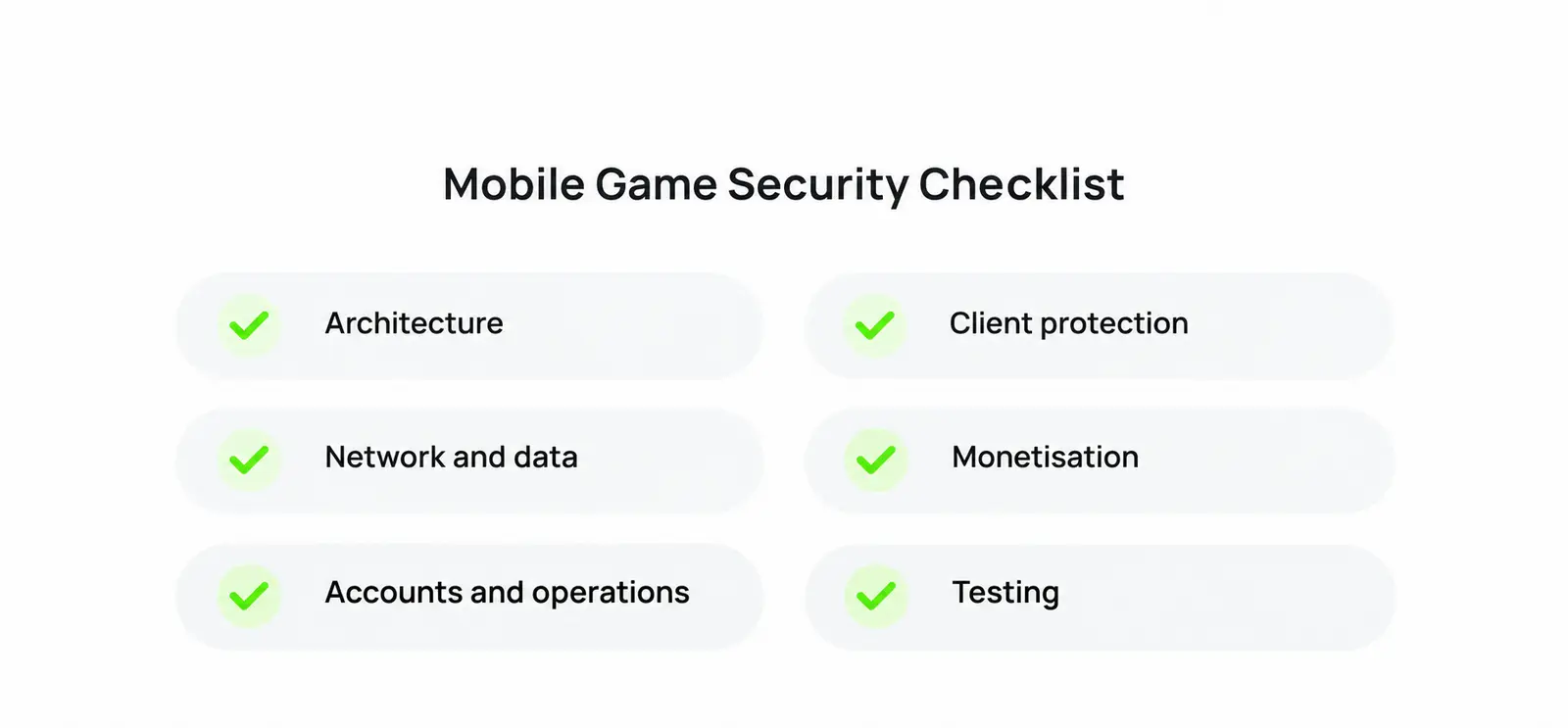
Use this mobile game security checklist as a quick audit before each major release:
Architecture
- Server-authoritative logic for economy, progression and purchases
- Threat model completed for new features
Client protection
- Code obfuscation and string encryption enabled
- Anti-tamper and integrity checks (Play Integrity / App Attest)
- Root, jailbreak, emulator and hooking detection feeding server risk scores
- No secrets or debug code in production builds
Network and data
- TLS enforced with certificate pinning and a rotation plan
- Request signing and replay protection on sensitive calls
- Local data encrypted with platform keystores
Monetisation
- Server-side receipt validation
- Duplicate transaction detection
- Refund and chargeback monitoring
Accounts and operations
- MFA or strong social login options
- Rate limits on login and in-game actions
- Real-time monitoring, alerting and an incident response plan
Testing
- Static and dynamic scans in CI/CD
- Annual (or per major release) penetration test
- Third-party SDK audit
Building Security Into Your Development Pipeline
The most expensive security fixes are the ones made after launch. Shifting security left, into design, development and QA, keeps costs down and prevents the emergency patches that disrupt live operations.
- Design: run threat modelling during architecture planning. Ask what an attacker would target and what happens if the client lies.
- Development: adopt secure coding standards, peer review security-sensitive code and automate dependency scanning.
- Testing: integrate security checks into CI/CD so every build is scanned before release.
- Release: sign builds properly, monitor store listings for clones and track tampering signals from day one.
- Live operations: monitor in real time, keep a response playbook for exploits, and ship fast patches with server-side kill switches for emergencies.
This lifecycle approach matters because live-service games ship updates constantly, and each update can open a new door. If you are starting a new project, our team offers secure mobile game development that builds these controls into the architecture, so protection is part of the product rather than an afterthought.
Conclusion
Mobile game security in 2026 is a moving target. The market is bigger, the cheat economy is more organised, and attackers use better tooling than ever. But the fundamentals remain stable: never trust the client, protect the server, layer your defences, test continuously and respond to threats with nuance instead of blunt bans.
Studios that invest early protect more than their code. They protect their revenue, their community and their reputation. If you are planning a new title or want to harden a live game, talk to the Cubix games team about building security into your next release.
Protect Your Game, Players, and Revenue with Cubix
Contact UsFrequently Asked Questions
1. What are the most common mobile game security threats in 2026?
The most common threats are app tampering and repackaging, memory editing and hooking, bots and automation, in-app purchase fraud, API and man-in-the-middle attacks, and account takeover. Emulators and rooted or jailbroken devices often sit underneath these attacks as the enabling environment.
2. How do I protect a mobile game from hackers?
Start with a server-authoritative design so the client cannot change the real game state. Then layer on code obfuscation, runtime integrity checks, certificate pinning, device-risk detection, server-side purchase validation and continuous monitoring. Regular penetration testing confirms the layers actually work.
3. How can I prevent cheating in mobile games?
Validate all gameplay actions on the server, detect tampering and memory manipulation on the client, analyse behaviour for statistical anomalies, and give players an easy way to report suspected cheaters. Use graduated penalties to limit the damage from false positives.
4. Does cheating really affect mobile game revenue?
Yes. The 2026 Anybrain survey found that more than half of studios report declines in retention or revenue from cheating. Fair players leave when they feel the game is rigged, and paying players are the least willing to tolerate it.
5. Is root and jailbreak detection enough?
No. Attackers can bypass any single check, so root and jailbreak detection should be one signal among many, combined with integrity attestation, hooking detection, behavioural analytics and server validation.
6. How often should I test my game’s security?
Run automated scans on every build, and commission a full penetration test at least annually and before any major release or monetisation change. Re-test after significant architecture changes or incidents.