Key Takeaways
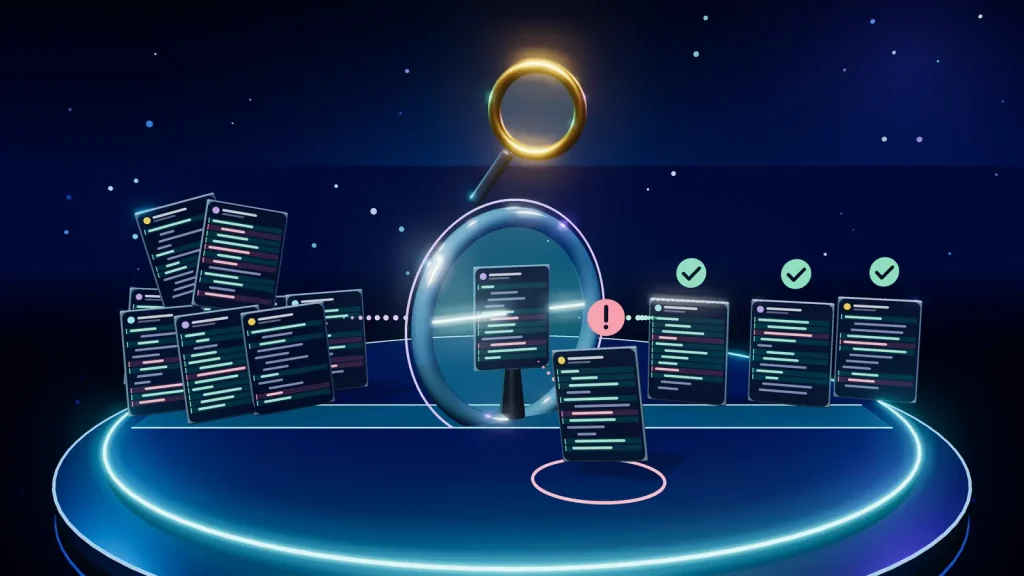
- AI code review is a fast first reader. It scans each pull request before a human does.
- The real bottleneck is human attention. AI writes code faster than people can read it. Reviews pile up.
- AI code is harder to review. It looks equally confident everywhere. Its tests often share its mistakes.
- AI misses what it cannot see. Business rules, architecture and product intent still need a human.
- What works is a simple system. AI goes first. Humans read the risky parts. Pull requests stay small.
- Measure fixes, not comments. Track whether flagged issues actually get resolved.
Lines added per pull request grew about 2.5 times in one year. That number comes from Cursor’s data on millions of coding sessions. Your review team did not grow 2.5 times. Same people. Same hours. Far more code to read.
Something has to give. Usually it is review quality. Tired reviewers skim. Skimmed code ships. Then the bugs show up in production.
This guide explains AI generated code review from start to finish. You will learn how it works, what it catches and what it misses. Then you will get a step-by-step checklist, a team workflow and a simple plan to roll it out.
Improve Code Quality with Smarter AI-Powered Reviews
Contact UsWhat Is the AI Code Review Bottleneck?
The AI code review bottleneck is a gap. Code gets written fast. It gets accepted slowly.
Writing code got much cheaper. Human attention did not. So the limit moved from the keyboard to the reviewer’s eyes. Every speed gain upstream just makes the line at the review door longer.
You can test this in ten minutes. Chart pull requests opened per week. Add median time to merge on the same chart. If both lines climb, you do not have a speed problem. You have a queue.
Three Signs You Are Stuck in It
- Pull requests wait overnight for a first look.
- Reviewers approve big diffs they only half read.
- Authors bundle more work into each pull request, because small ones sit anyway.
Why Did Merge Time Go Up When Teams Shipped More Code?
Review capacity is fixed. Queues do not grow in a straight line. Most teams learn this the hard way.
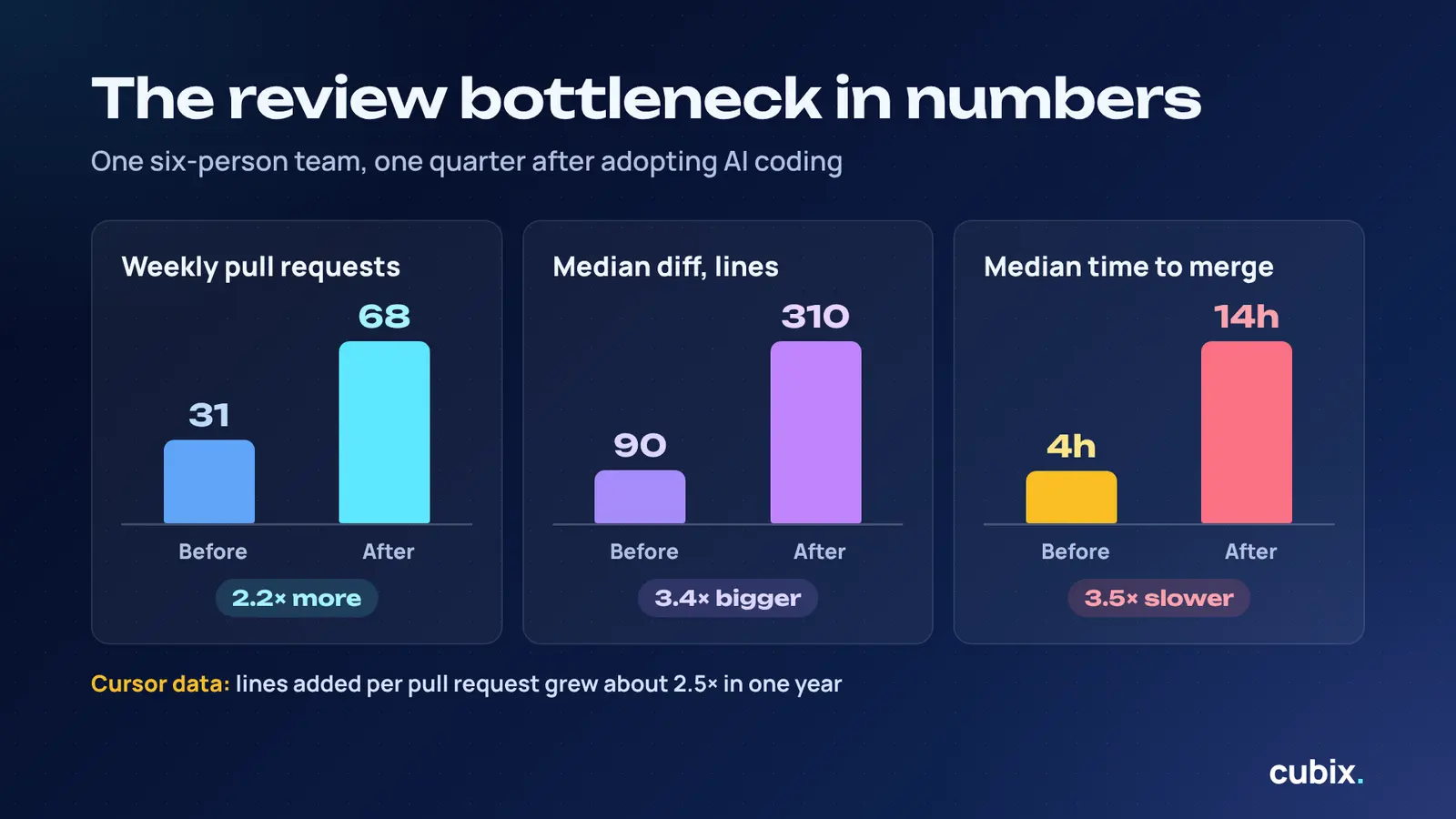
One six-person engineering team tracked its numbers for a quarter. Weekly pull requests grew from about 31 to 68. Median time to merge jumped from about 4 hours to 14 hours. More code did not mean faster shipping. It meant a longer line.
Three Forces Stacked Up
- More pull requests arrived. Same six people, twice the volume. As reviewers near full capacity, waiting time does not rise gently. It shoots up. Going from 60% busy to 90% busy is not a small slowdown. It is a multiple.
- Pull requests got bigger. The median diff grew from about 90 to 310 lines. A 300-line change is more than three times the work of a 100-line one. The reviewer must hold more in mind to spot how the parts interact.
- Reviewers started batching. With two pull requests waiting, you review them. With nine, you wait for a clear block of time. That block never comes. Pull requests sit overnight.
The Feedback Loop
Slow reviews push authors to bundle more work into each pull request. Bigger pull requests then review even slower. The loop feeds itself.
Why Is AI-Generated Code Harder to Review Than Human Code?
Volume is only half the story. AI diffs also cost more to read, line by line. Here are four reasons.
1. It Looks Equally Confident Everywhere
Human code leaves clues. A strange variable name shows doubt. A function much longer than its neighbors stands out. Experienced reviewers follow those clues.
AI code has no such tells. Line 12 and line 812 look equally careful. Your attention has nothing to grab. So you read evenly, and you read shallowly.
2. There Is No Intent to Question
The best review question is “why did you do it this way?” A human gives a good reason. Or you see a flinch. Both teach you something.
With AI code, you often get a shrug. Or you get the agent’s answer, which sounds agreeable. The reviewer becomes the only judge in the whole pipeline.
3. Volume Without Compression
An agent writes a version that works. It does not write the smallest one. You get extra layers, a helper used once and guards for cases that cannot happen.
None of it is wrong. All of it is more surface to read and maintain.
4. The Tests Agree With the Code
If the code misread the task, the tests usually copy the mistake. Green checks then show only that the code agrees with itself.
Weak tests quietly hurt AI generated code quality. Read them like code, not like proof.
What the Research Says
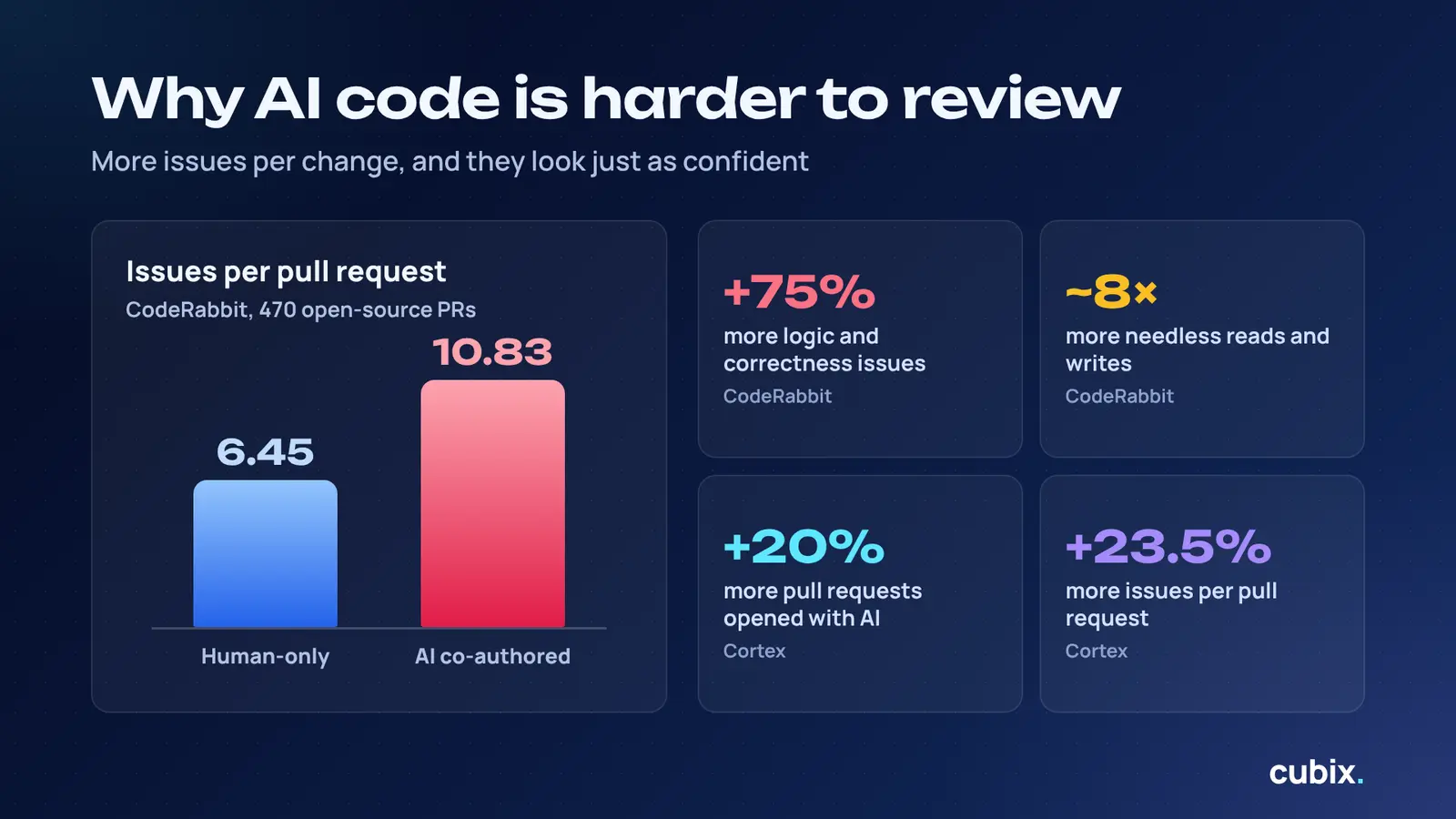
CodeRabbit studied 470 open source pull requests on GitHub. AI co-authored pull requests averaged 10.83 issues each. Human-only ones averaged 6.45. That is about 1.7 times more.
One caution. CodeRabbit sells AI review tools. It also counts readability and formatting as issues. So treat the gap as a strong signal, not a final verdict.
What Is AI Code Review?
AI code review is software that reads a code change and comments on it. It hunts for bugs, risky logic and security gaps. It runs before the code merges.
Think of it as a fast first reader. It does not get tiring. It does not skip the boring files.
How AI Code Review Works
Most tools follow the same loop:
- A developer opens a pull request.
- The tool reads the changed lines.
- Better tools also read related files, tests and team rules.
- The tool posts comments on problems it finds.
- The developer fixes each one or dismisses it.
Under the hood, these tools run on machine learning models trained on large code sets. Teams that want custom models often turn to machine learning development services for help.
AI Code Review vs Linting and CI
People mix these up. They do different jobs.
- Linters enforce style rules you already wrote.
- CI runs the checks you already automated.
- AI review hunts what is left. Think logic errors, race conditions and auth mistakes.
AI review adds to your CI. It does not replace it.
Why Context Matters
A reviewer that sees only the changed lines misses breaks in other files. A reviewer that sees the whole repo catches far more. Cursor’s guide makes the same point. Review works best when it shares the context of the tool that wrote the code.
Human Code Review vs AI Code Review
Neither one wins alone. Each is strong where the other is weak.
| Factor | AI review | Human review |
|---|---|---|
| Speed | Minutes | Hours to days |
| Fatigue | None | Grows with diff size |
| Team history | Only what it can read | Deep and personal |
| Business rules | Weak unless told | Strong |
| Consistency | Same checks every time | Varies by reviewer |
| Architecture calls | Limited | Strong |
| Cost per review | Low | High |
What AI Does Well
- It scans every line, every time.
- It catches missing null checks and error handling.
- It spots insecure patterns fast.
- It reviews in minutes, at any hour.
What Humans Do Better
- They know why the feature exists.
- They spot code that does not match how your team builds.
- They judge architecture and long-term cost.
- They understand business rules, like who can refund an order.
Do Both Give Useful Comments?
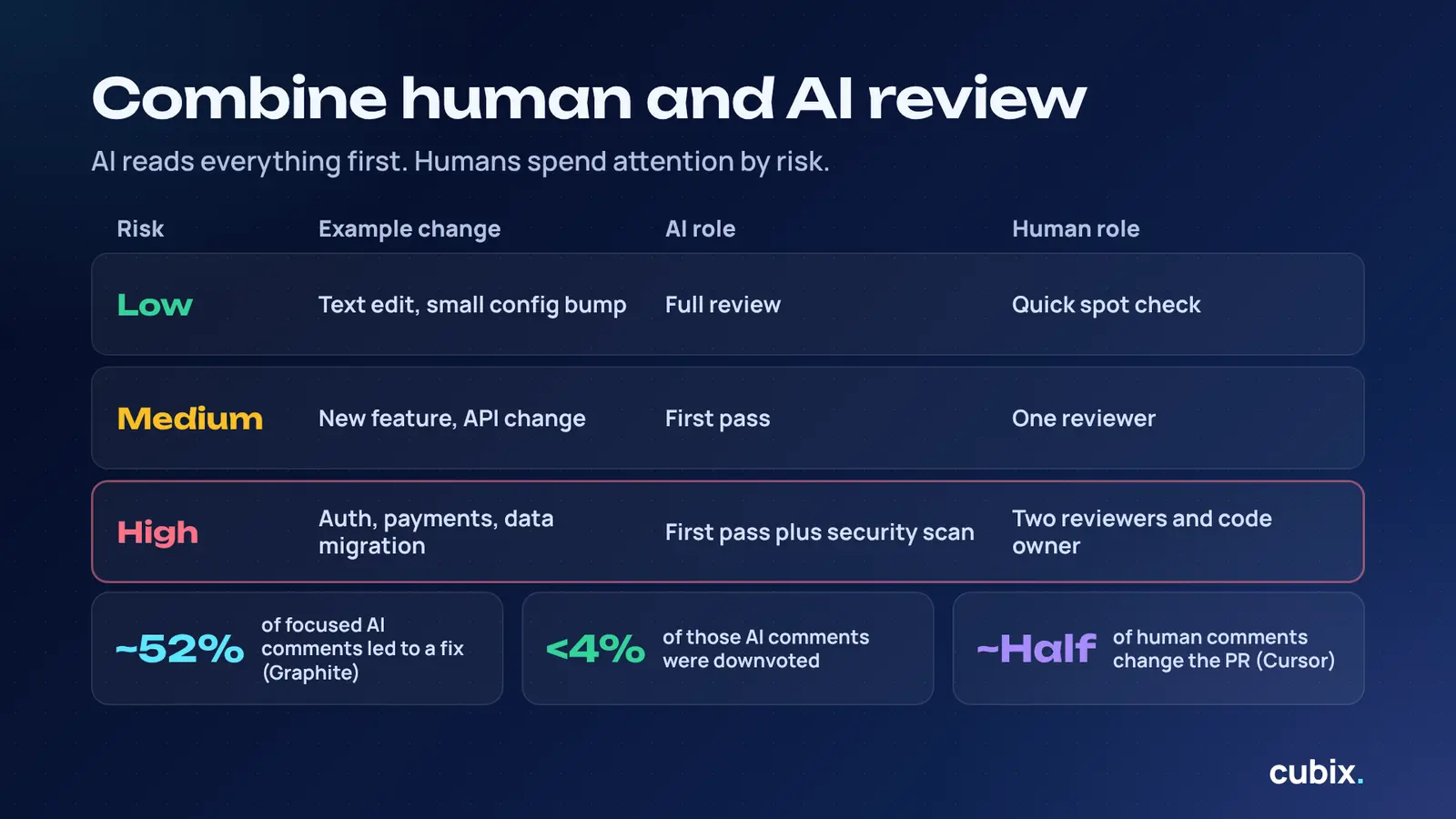
Cursor says only about half of human review comments lead to a change in the same pull request. Graphite narrowed its AI reviews to real bugs and security issues. About 52% of those comments led to a code change. That is close to human rates. Downvotes stayed under 4%.
At Cubix, our QA engineers use both layers on client projects. We explain the pairing in our guide to human AI code review.
What Does AI Code Review Catch and Miss?
CodeRabbit’s data shows where AI-written code breaks most. Logic and correctness issues were 75% more common. Needless reads and writes appeared nearly 8 times more often.
Bugs AI Review Catches Well
AI reviewers shine on repeatable mistakes:
- Missing null checks and weak error handling.
- Insecure patterns, like poor password handling.
- Slow code, like needless reads and writes.
- Messy naming and formatting.
What AI Code Review Misses
- Business logic. The tool does not know your refund rules.
- Architecture. It may add code that works but fits badly.
- Product intent. It cannot tell if you built the right thing.
- Team history. It does not know why you avoid a certain pattern.
Good bug detection in AI generated code needs both layers. The next section shows what the human layer looks like.
How Do You Review AI-Generated Code? A Step-by-Step Guide
Here is the checklist a human reviewer can follow. It works on any AI-written pull request. A Cortex study found AI helped developers open about 20% more pull requests. Issues per pull request rose 23.5% in the same period. So the checklist matters.
Step 1: Check the Scope First
A few minutes of triage shows where to spend your time.
- Read the request. Ask the author to paste the prompt or task into the pull request. Without it, you cannot judge scope.
- Read the file list. Compare it with the request. Flag anything outside it.
- Check the size. If you cannot hold it in your head, ask for a split. Unrequested refactors get their own pull request.
- Run it. Open a preview and try one failure case, like the wrong user.
Watch for changes to these files:
- Database migrations.
- Login and permission code.
- Middleware.
- CI workflows.
- Lockfiles.
- Security headers and CORS settings.
Step 2: Read the Risky Parts Line by Line
Skim the easy files. Slow down on the ones below.
| Area | What to look for | Quick check |
|---|---|---|
| Permissions | Checks done only on screen. Records fetched by ID with no owner check | For each new route, find the line that checks the user may act on the record |
| Input handling | User input going straight into database queries, file paths or commands | Search the change for built-up queries and eval or exec calls |
| Secrets | Keys placed where the browser can read them | Search added lines for public variable prefixes and service keys |
| Error handling | Empty catch blocks. Errors turned into success replies | Read every new catch. Does it log or rethrow? |
| Database rules | New tables with no row-level rules. Widened policies | Read every migration line, including grants |
| AI features | User text fed into prompts for models that can use tools | Trace each prompt input back to its source |
A clean search proves little. It cannot find a check that is missing. That is why a human must read the permission code.
Step 3: Review the Tests the AI Wrote
When one tool writes both code and tests, they share the same blind spots. Look for these problems:
- Assertions that can never fail.
- Snapshot tests that record the current output, bugs included.
- Mocks that replace the thing under test.
- Only the happy path. Ask for failure cases, like another user’s record.
- Tests removed, skipped or weakened.
Then try a quick trick. Break the code on purpose. Flip the ownership check, for example. If no test fails, the tests do not protect that behavior.
Step 4: Check Dependencies, Migrations and Config
- New packages. Confirm the exact name exists and is maintained. AI tools sometimes suggest names that do not exist. Attackers can register those names.
- Migrations. Ask for a rollback plan. Dropped columns and renamed tables are hard to undo.
- Config changes. Watch for open CORS rules, relaxed security policies and disabled lint rules.
- Agent rules files. Files that steer AI tools shape every future change. Review them like CI workflows.
What Actually Fixed the Review Bottleneck?
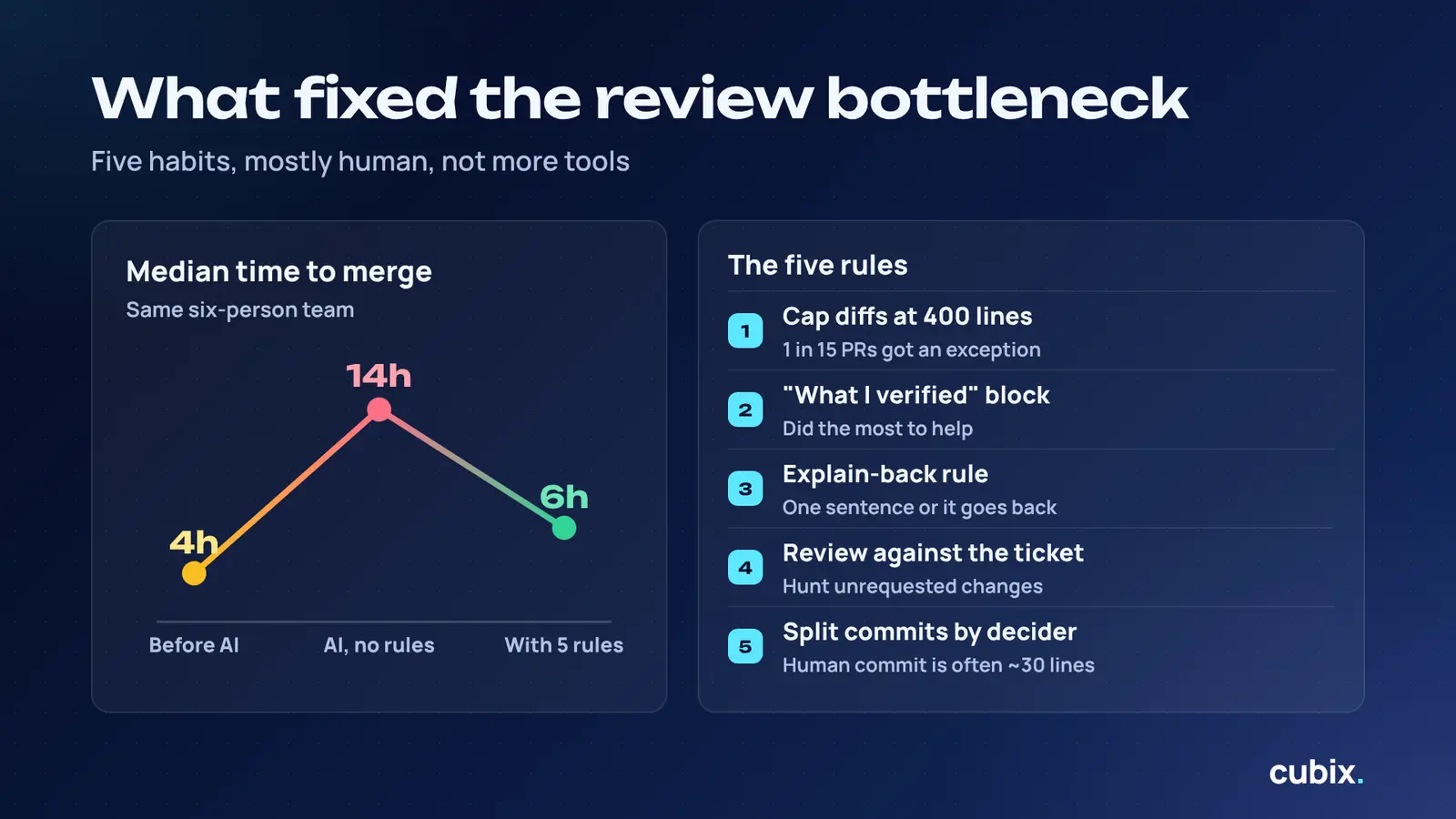
Nothing fancy. The six-person team we mentioned earlier made five changes. Four of them are about human habits, not tools.
Rule 1: Cap the Diff Size
Their CI flags any pull request over 400 lines. The flag blocks merging until the author writes one sentence on why it could not be split. About 1 in 15 pull requests got an exception. The rest were split. That was easy, because the agent that wrote them can split them too.
Rule 2: Add a “What I Verified” Block
The pull request template got three new lines. “Tests pass” is not allowed there. Authors must list what they personally did:
- Ran the endpoint with a bad input.
- Checked the migration on a copy of real data.
- Confirmed an old setting still works.
This one change did the most. It adds a speed bump between “the agent finished” and “I need your time.”
Rule 3: Use the Explain-Back Rule
A reviewer can point at any change and ask what it does. If the author cannot answer in one sentence, the pull request goes back. This is not a punishment. A review where nobody understands the code is just theater.
Rule 4: Review Against the Ticket
The best question became: what changed that we did not ask for? AI tools love an unrequested refactor. Scope creep stays invisible unless you hunt for it.
Rule 5: Split Commits by Who Decided What
Put the machine-made bulk in the first commit. Put the human judgment calls in the second. Reviewers read the second commit first. Most of the risk lives there, and it is often about 30 lines.
The Result
Median time to merge fell from about 14 hours to about 6. It did not return to 4. Six hours is the real price of a careful review.
What Did Not Work?
Some fixes sounded smart. They fell flat.
Adding an AI Reviewer Bot Alone
The team hoped it would help. It added a second stream of text to read. A pull request with eight resolved bot comments also feels reviewed, even when it is not. Their bot flagged naming and missing notes with great energy. It walked past a slow database pattern inside a loop. A human spotted it in seconds.
That is one team’s result. Tuned tools with full repo context did better, as the Graphite numbers above show. The lesson is simple. A bot is a first reader. It is not the whole review.
Adding More Reviewers
Review does not split across one diff. Two reviewers give you one careful read and one skim. Neither knows which one they are.
Trusting the Tests
We covered this above. The tests came from the same tool that misread the task.
More Mistakes to Avoid
- Approving because CI is green.
- Asking the same tool to review its own change.
- Reading only the files the description mentions.
- Fixing naming while a missing permission check goes unnoticed.
- Accepting a rewrite of working code inside a feature change.
- Approving without running the change once.
How to Combine Human and AI Code Review
Now put the pieces together. Four steps keep it simple.
Step 1: Let AI Do the First Pass
Run the AI review before a human sees the code. Do it in two places:
- Locally. After the coding agent finishes, before you push. The context is still fresh.
- On the pull request. This is the team gate. Shared rules, shared history.
Authors then fix the easy problems first. Humans see cleaner code.
Step 2: Humans Read the Risky Parts
Humans should spend time where mistakes cost most:
- Login and permission checks.
- Payments and money flows.
- Database migrations.
- Config and security settings.
Step 3: Set Risk Tiers
Not every change needs the same attention. Tiers save time.
| Risk level | Example change | AI role | Human role |
|---|---|---|---|
| Low | Text edit, small config bump | Full review | Quick spot check |
| Medium | New feature, API change | First pass | One reviewer |
| High | Auth, payments, data migration | First pass plus security scan | Two reviewers and the code owner |
Step 4: Lock the Merge Rules
Habits slip under deadlines. Let your repo enforce the rules:
- Require a set number of approvals.
- Dismiss old approvals when new commits land. Follow-up commits from an agent then cannot slip through.
- Route sensitive files to code owners.
- Require status checks to pass.
- Turn off admin bypass. By default, these rules do not apply to repo admins.
Also add a pull request template. Ask for the prompt used, the files changed on purpose and how the change was tested. Label AI-written code too. It tells the reviewer to look harder.
Cubix builds these review rules into client delivery through our Software Testing & Quality Assurance work.
Best AI Code Review Tools in 2026
The right tool depends on where your team already works. Look for these traits first:
- Full repo context, not just the diff.
- A narrow comment policy. Real bugs, not style nags.
- A way to track whether findings get fixed.
- Support for your Git host.
- A security pass, either built in or paired with a scanner.
| Tool | Best for | Where it runs | Watch for |
|---|---|---|---|
| CodeRabbit | Automated comments across many repos | Pull requests | Tune rules to cut noise |
| Graphite | Teams that want review inside their PR flow | Pull requests | Check fit with your Git host |
| GitHub Copilot | Teams already on GitHub | Pull requests and editor | Keep human sign-off rules |
| Claude Code | Reviewing local changes before you push | Terminal and editor | Give it clear rules and prompts |
| Cursor Bugbot | Teams that already use Cursor agents | GitHub, GitLab and Bitbucket PRs | Test it on your own repo first |
Scale is real here. Cursor says Bugbot reviews more than 2 million pull requests a month. Tools change fast, so check each vendor’s current features before you buy.
How to Measure AI Code Review
Comment count is a trap. Ten comments that nobody acts on mean nothing.
Metrics That Matter
- Resolution rate. At merge time, was the flagged issue actually fixed?
- False positive rate. How often does the team dismiss a comment as wrong?
- Time to merge. Is review getting faster or slower?
- Escaped defects. How many bugs reach production after review?
- Suggestion adoption rate. How often do developers accept the fix?
A Real Example
Cursor tracked this for Bugbot. Resolution rose from 52% to over 70% across 40 experiments. By May 2026, default resolution hit about 80%. Watch the trend. If resolution falls while comments rise, the bot is making noise.
Cubix sets up these metrics for clients from day one. Teams then see what works before they add more rules.
Your 30-Day Rollout Plan
You do not need to change everything at once. Try this order:
- Week 1. Pick one busy repo. Turn on one AI reviewer. Do not widen its comment rules yet.
- Week 2. Add a size limit and a “what I verified” note to your pull request template.
- Week 3. Add risk tiers. Set code owners for sensitive files.
- Week 4. Review your metrics. Keep the comment types that get fixed. Drop the rest.
So Why Did AI Make Code Review the Bottleneck?
AI removed the thing that hid the problem. When a feature took two days to write, review was a rounding error. Nobody measured it.
Now writing takes minutes. Review is the one step still running at human speed. It soaks up all the delay that used to spread across the whole cycle.
The teams that win are not the ones writing the most code. They make code cheap to read. They keep pull requests small. They ask authors to state what they checked. They refuse to merge what nobody can explain.
So here is a question. What does your merge time chart look like since your team started using AI? Pull it up today. The shape will tell you where to start.
How Cubix Helps With AI Code Review
Installing a bot is the easy part. The hard part is rules, tests and habits that stick. Cubix helps teams build all three.
- Workflow design. AI first pass, human sign-off and risk tiers.
- QA for AI-written code. Including checks on test quality.
- Pipeline rules. Code owners, merge protection and status checks.
- Metrics setup. Resolution rate, merge time and escaped defects.
- Team coaching. How to read and verify AI-written code.
We also build AI products from the ground up. Explore our AI software development services to see how.
Why Choose Cubix
- Hands-on AI experience. Our engineers build with AI and review it every day. [Add Cubix years in business and project count here.]
- QA-first mindset. We test early and test often.
- Plain reporting. You see what we found and what we fixed.
- Flexible engagement. Start small, then scale as results come in.
Ready to ship AI-written code with confidence? Talk to the Cubix team today.
Combine Human Expertise and AI for Better Code
Contact UsFrequently Asked Questions
1. Can AI replace human code reviewers?
No. AI handles the first pass well. It lacks your business rules and product context. Keep a human approval as a merge requirement.
2. Does AI-generated code have more defects than human code?
Studies point that way. CodeRabbit found about 1.7 times more issues per pull request. Results vary by tool, team and how you count issues.
3. What does AI code review miss?
It misses business logic, architecture fit and product intent. It also lacks your team’s history. Humans fill those gaps.
4. How accurate is AI code review?
It depends on context and rules. Track false positives and resolution rate. Narrow, well-tuned reviews perform far better than noisy ones.
5. Should AI-written code be labeled in pull requests?
Yes. A label tells the reviewer to apply the stricter checks. It also helps trace a defect back to its source.
6. How do I start with AI code review?
Follow the 30-day plan above. Start with one repo and one tool. Measure before you expand.