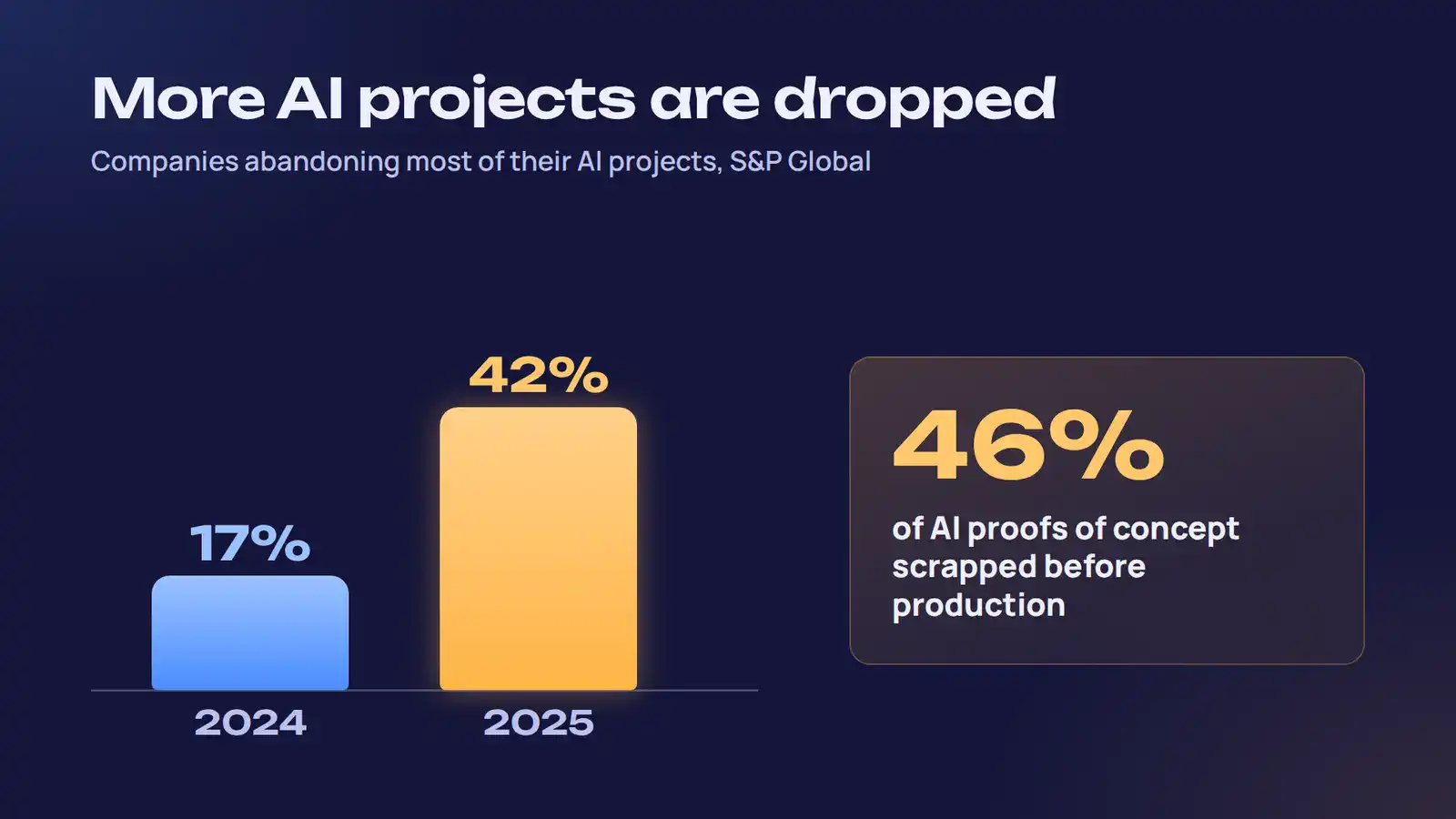
In 2025, 42% of companies dropped most of their AI projects, up from 17% in 2024, according to S&P Global Market Intelligence. Too often, founders start AI projects because of hype, not a proven business need. As a result, money goes into pilots that never reach real users or create value.
This guide covers the questions to ask before an AI project, so you can test feasibility, data readiness, cost, ROI, risk, and your choice of development partner before you spend.
In practice, AI success depends more on business fit, data quality, and execution than on a trendy model. Good AI development services start with these basics before anyone writes code.
Key Takeaways
- Start with one measurable business problem, not a general wish to use AI.
- Check data quality and access before you set a budget or timeline.
- Plan for ongoing costs like monitoring, retraining, and support.
- Judge success by business results, not model accuracy alone.
- Test the idea with a small proof of concept before a full build.
Why Founders Need a Checklist Before Investing in AI
An AI project is not just a software build. Instead, it changes how your team works, how people make decisions, and how your company uses data. So a weak start costs more than money. It also hurts trust in the next project.
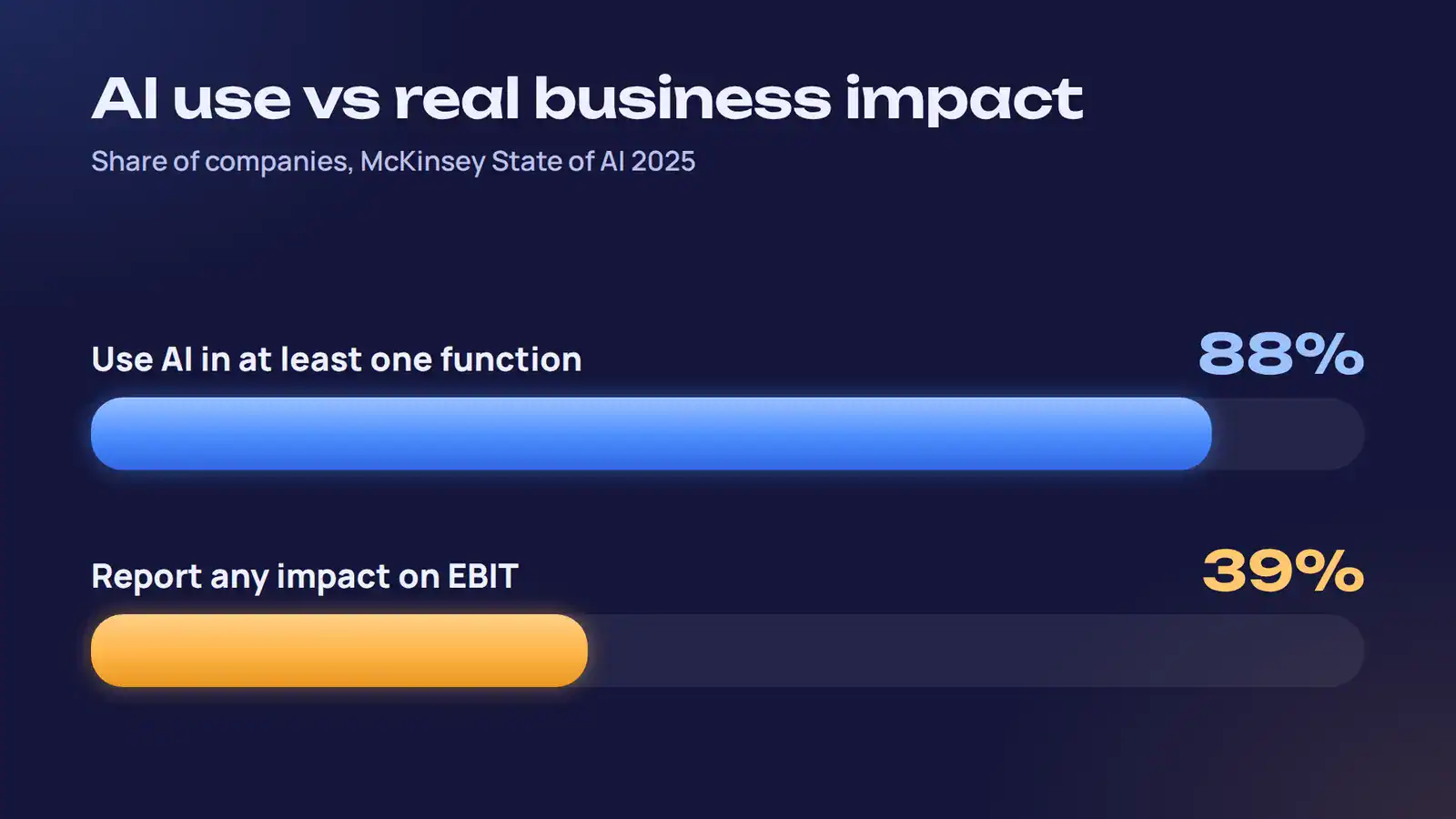
In fact, adoption is not the problem. McKinsey’s 2025 State of AI survey found that 88% of companies use AI in at least one business function. That is up from 78% a year earlier. However, only 39% report any impact on EBIT, and most of them say AI drives less than 5% of it.
Working through the questions to ask before an AI project helps close that gap. It keeps you away from costly pilots that look good in a demo but create no business value.
This checklist is for startup founders, SME owners, product leaders, and innovation teams planning an AI investment.
The Cost of Starting AI Without a Plan
Most AI projects don’t fail because of the model. Instead, they fail because of planning gaps. RAND interviewed 65 experienced data scientists and engineers. Above all, they found that the top root cause is a problem the business misunderstood or explained poorly.
Here are the failure patterns that show up most often:
- Unclear use case: nobody can say what problem AI should solve.
- Poor data: the data is missing, messy, or locked in separate systems.
- No owner: no one inside the business is accountable for results.
- Unrealistic ROI: leaders expect big returns from the very first pilot.
- Weak governance: there are no rules for privacy, security, or human review.
The cost shows up fast. S&P Global found that the average company scrapped 46% of its AI proofs of concept before they reached production. Companies also named cost, data privacy, and security risks as their top obstacles.
What Is an AI Project Checklist?
An AI project checklist is a set of questions that helps founders validate a use case, assess data readiness, estimate costs, identify risks, and choose the right AI development partner.
In simple terms, it is a test you run before you invest. It covers AI project planning, requirements, feasibility, the business case, and risk. Each answer either supports the project or exposes a gap you need to fix first.
In other words, think of it as a filter. Strong ideas pass through with a clear plan. Meanwhile, you stop weak ideas early, while they are still cheap to drop.
45 Questions to Ask Before an AI Project
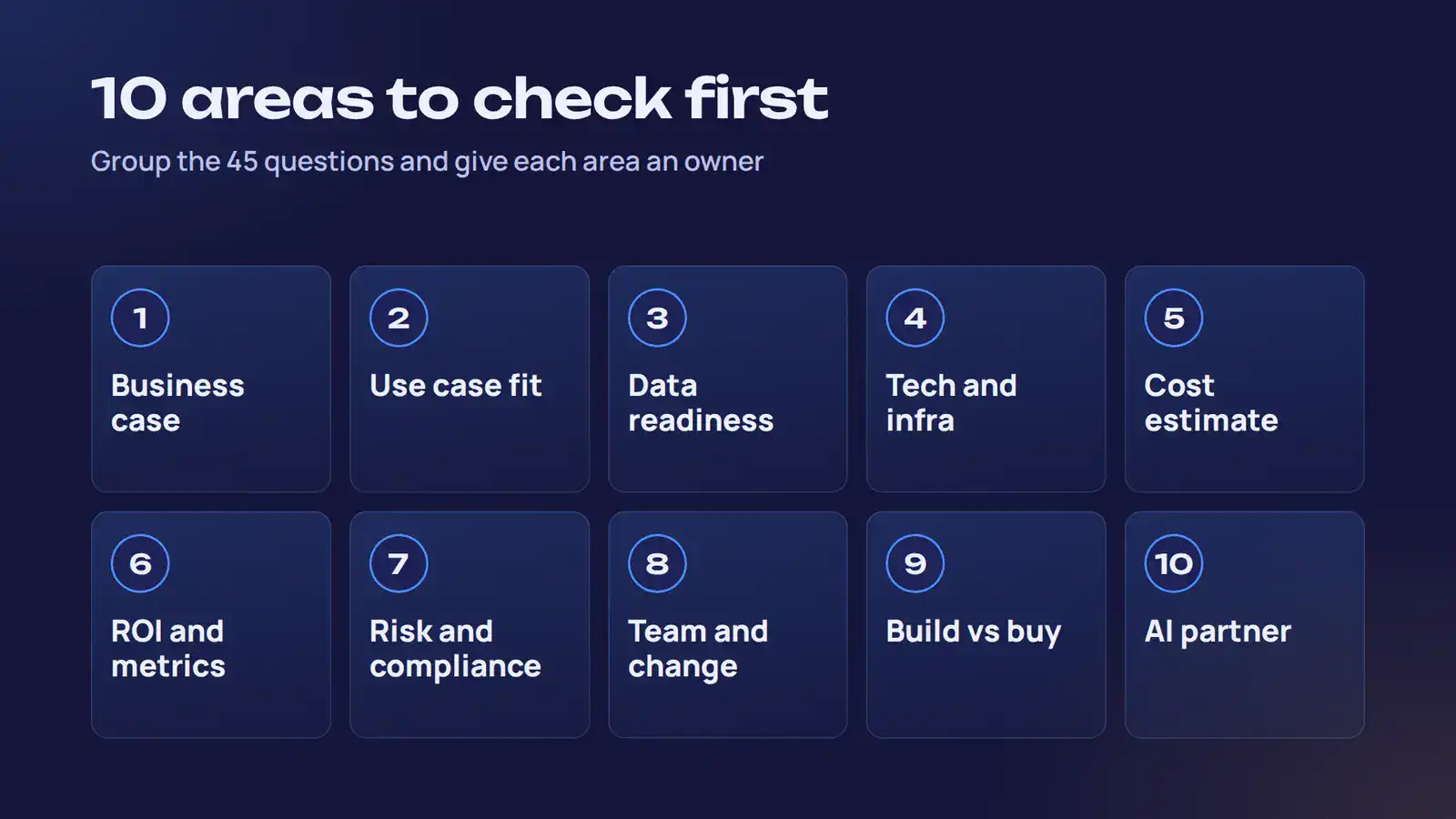
Use these questions as a practical AI readiness checklist before you commit budget or sign a development contract. We grouped them into 10 areas, so you can assign each area to an owner.
1. Business Case and Strategic Fit
Why does an AI project business case matter? Because it ties the project to money, time, or risk. Without one, you can’t judge whether the project worked. In fact, IBM’s 2025 CEO Study found that 65% of surveyed CEOs now choose where to use AI based on ROI.
- What specific business problem will AI solve?
- How does this align with our company goals?
- What happens if we do nothing?
- Is AI the best fix, or would automation, analytics, or workflow software work better?
- Who owns the project internally?
Founder tip: Start with one measurable problem, such as “cut invoice processing time by half.” Avoid vague goals like “we want AI.”
2. AI Use Case and Feasibility Assessment
First, a strong use case has three traits. It targets a task that repeats often, it has a clear success measure, and it runs on data you already have. So if one trait is missing, feasibility drops fast.
Next, match the problem to the right type of AI. For example, generative AI creates text, images, or code. Predictive AI forecasts outcomes such as demand or churn. Computer vision reads images and video. Natural language processing (NLP) works with text and speech.
- What decision, task, or workflow will AI improve?
- Can we measure success with a clear number?
- Is the task repeatable, and is it worth a lot to the business?
- Does the solution need generative AI, predictive AI, computer vision, or NLP?
- What is the smallest AI proof of concept that can prove value?
| Use Case Type | Example | Primary Success Metric |
|---|---|---|
| Customer support AI | FAQ chatbot | Deflection rate, CSAT |
| Sales AI | Lead scoring | Conversion rate |
| Operations AI | Demand forecasting | Forecast accuracy |
| Document AI | Invoice extraction | Processing time, error rate |
3. Data Readiness for AI
What data is needed for an AI project? You need past examples of the problem, the outcomes linked to those examples, and the legal right to use them. On top of that, the data must be accurate and easy to reach.
In fact, data is where many AI projects stall. Gartner predicts that through 2026, companies will abandon 60% of AI projects that lack data ready for AI. The same research also found that 63% of companies either lack the right data practices for AI or aren’t sure they have them. Similarly, Informatica’s CDO Insights 2025 survey of 600 data leaders found that 43% name data quality and readiness as a top obstacle.
- What data do we need to start?
- Where does the data live today?
- Is it accurate, complete, labeled, and accessible?
- Do we have enough historical data?
- Who owns the data?
- Can we connect the data through APIs?
Structured vs. Unstructured Data
Structured data sits in rows and columns, such as CRM records or sales tables. By contrast, unstructured data includes emails, PDFs, call recordings, and images. Most generative AI projects rely on unstructured data, so they need extra work to clean, split, and secure it.
Privacy and governance matter just as much. So you need clear rules on who can see the data, how long you keep it, and where it goes. Before you move on, confirm these five items:
- Data sources listed
- Quality checked for each source
- Access rights set
- Past examples on hand
- Privacy and storage rules checked
4. Technical Requirements and Infrastructure
Your AI project requirements should cover four areas: functional, technical, security, and operational needs. However, many founders list features and skip the rest. Then the project stalls at the security review or when it has to connect to other tools.
- What systems must the AI connect with?
- Do we have APIs, cloud infrastructure, and security controls in place?
- Should we use a custom model, a fine tuned model, or a vendor’s API?
- What are our needs for latency, uptime, scale, and performance?
- Who will maintain the solution after launch?
In general, a vendor API is the fastest way to start. A custom model gives you more control, but it costs more to build and maintain. Fine tuning sits in the middle, because it adapts an existing model to your data.
5. AI Project Cost Estimation
How much does an AI project cost? It depends on six things: scope, data preparation, integrations, model complexity, compliance, and ongoing upkeep. So two projects with the same goal can land at very different prices. For typical price ranges by project type, see this breakdown of artificial intelligence costs.
Most AI budgets cover seven stages:
- Discovery and scoping
- Data preparation
- Proof of concept (PoC)
- MVP development
- Integrations
- Testing and deployment
- Monitoring, retraining, and support
Costs also climb when teams skip planning. Gartner expected companies to abandon at least 30% of generative AI projects after proof of concept by the end of 2025. Rising costs were one of the main reasons, along with poor data, weak risk controls, and unclear value. Clear answers to the questions to ask before an AI project keep these costs in check.
- What is our total budget for year one, including operations after launch?
| Cost Driver | Lower Cost | Higher Cost |
|---|---|---|
| Data | Clean, accessible data | Scattered or unlabeled data |
| Scope | One workflow | Platform across several departments |
| Model | Pretrained API | Custom model training |
| Integration | One system | ERP, CRM, and legacy systems |
| Compliance | Internal data only | Regulated personal data |
Founder note: Budget for operations after launch, not just the first build. Models need monitoring, retraining, and support to stay accurate as your data changes.
6. ROI and Success Metrics
Here is how AI project ROI works in plain English. You compare the value AI creates with what it costs, then show the gain as a percentage.
ROI (%) = (Total Value Created − Total Project Cost) ÷ Total Project Cost × 100
For example, say a project costs $100,000 and saves $250,000 over two years. The ROI is 150%. Still, that number only means something if you measured the baseline first.
Yet many companies skip that step. The same IBM study found that only 25% of AI projects delivered their expected ROI, and just 16% scaled across the whole company.
- What metric will prove success?
- How much time, cost, or revenue impact do we expect?
- What is the payback period?
- Which baseline performance are we improving?
Good success metrics are concrete. For example:
- Shorter support handling time
- Higher lead conversion
- Fewer manual errors
- Faster document processing
7. Risk, Compliance, and Governance
An AI project risk assessment answers one question: what happens when the AI gets it wrong? Every model makes mistakes, so plan for them from day one. In McKinsey’s 2025 survey, over half of companies saw at least one bad outcome from AI in the past year. Inaccuracy was the most common one.
- What are the risks of wrong AI outputs?
- Could the model expose sensitive data?
- Are there bias, privacy, security, or legal risks?
- Who approves AI decisions?
- What human oversight do we need?
Also, cover data protection, confidentiality, model transparency, and vendor risk. Then keep it practical:
- Identify each risk and rate its impact.
- Assign an owner to every risk.
- Define a fallback process for when the AI fails.
8. Team, Skills, and Change Management
Getting people to use AI is often harder than building it. A model that works in testing still fails if your team doesn’t trust it or use it. McKinsey’s research backs this up, because redesigning workflows is one of the strongest drivers of real business impact from AI.
- Do we have internal AI, data, or product expertise?
- Who will use the AI solution every day?
- What training will they need?
- How will we manage resistance to change?
- Do we need AI consulting services or an internal team?
If you lack the skills inside, outsourcing AI development can fill the gap while your own team learns. Either way, involve daily users early, because they know where the workflow breaks.
9. Build vs. Buy an AI Solution
Should you build or buy an AI solution? Buy when your need is standard and many tools already solve it. Build when your workflow, data, or edge over competitors depends on it. Your answers to the earlier questions to ask before an AI project usually make the choice clear, especially on data and budget.
| Factor | Buy / Use Existing AI | Build Custom AI |
|---|---|---|
| Speed | Faster launch | Longer development cycle |
| Cost | Lower upfront cost | Higher upfront investment |
| Edge over rivals | Limited | Higher |
| Data control | Depends on vendor | Greater control |
| Best for | Standard workflows | Unique workflows or data |
Is this workflow unique enough to justify a custom build?
Either way, start with an AI proof of concept before you commit to a full custom build. A short test shows whether the idea works on your real data. Plus, it costs far less than a failed product.
10. How to Choose an AI Development Company
Look for proof, process, and clear terms. A good partner shows similar past work, explains its discovery process, and puts ownership and support in writing. Once you have a shortlist, test each firm with these questions:
- Have you built similar AI solutions?
- What is your discovery and feasibility process?
- How do you handle data security and confidentiality?
- What does your proof of concept include?
- How do you estimate timelines and costs?
- Who owns the code, models, prompts, and data?
- What support do you provide after launch?
- How do you measure success after deployment?
Vendor Evaluation Checklist
Compare every vendor against the same seven points. If you need a starting list, this roundup of top AI development companies shows how established firms compare.
- Relevant case studies
- Clear scope of services
- Clear rules for data handling
- Transparent pricing
- Defined IP ownership
- Maintenance and retraining plan
- Clear, regular updates
AI Project Planning Template for Founders
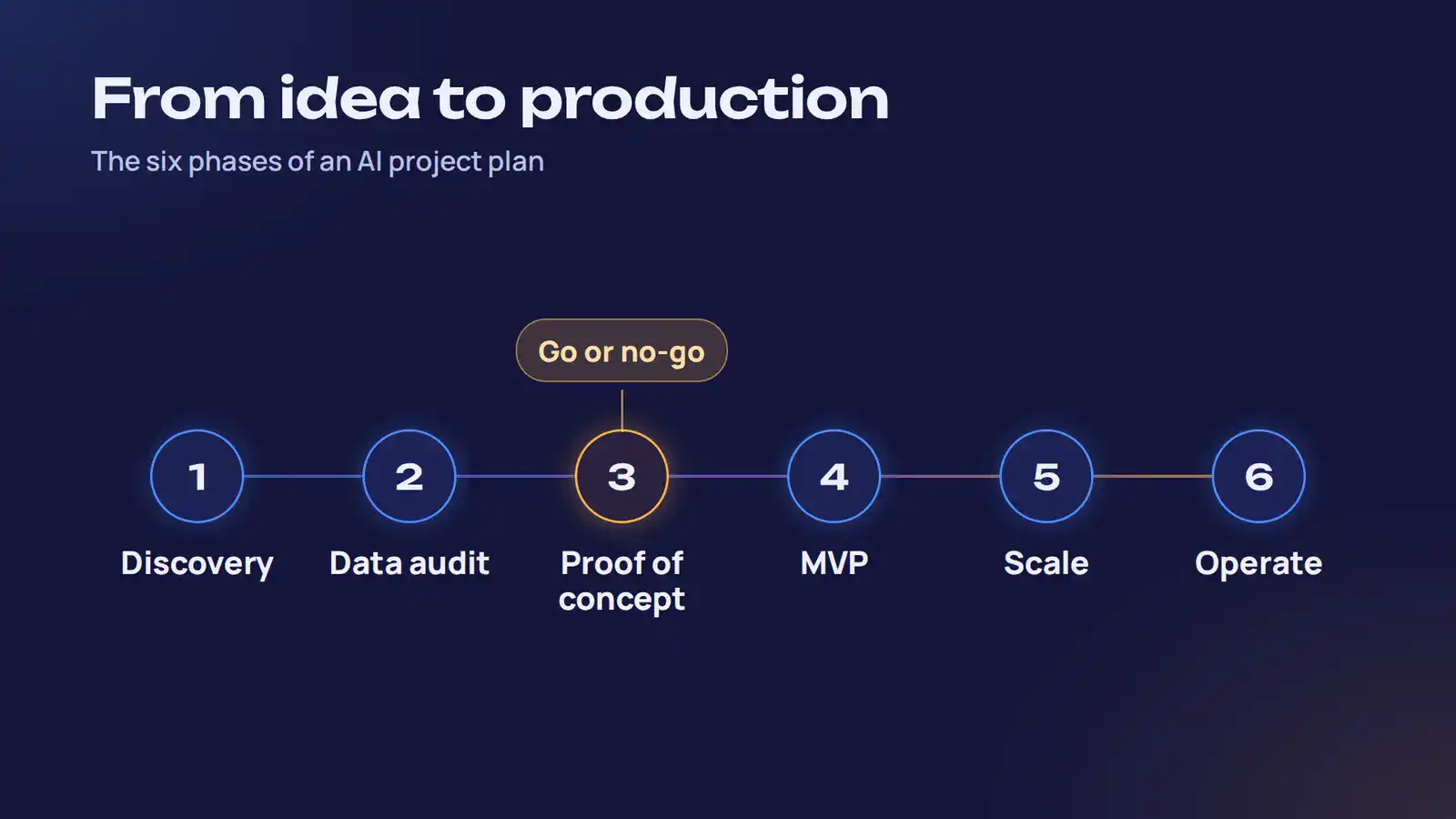
Use this simple template to turn your answers into a plan. Fill in each row before you talk to vendors, and update it after every phase.
| Phase | Key Question | Output |
|---|---|---|
| Discovery | What problem are we solving, for whom, and why now? | Problem statement and success metric |
| Data audit | What data exists, and can we use it? | Data readiness report |
| Proof of concept | Does the idea work on real data? | PoC results and a go or no go decision |
| MVP | Will users adopt it in a real workflow? | Working product for a pilot group |
| Scale | Can it run reliably at full volume? | Production rollout plan |
| Operate | Is it still accurate and useful? | Monitoring and retraining schedule |
Then bring this template to every vendor call. It turns your answers to the questions to ask before an AI project into a plan your whole team can follow. It also makes proposals easier to compare, because each vendor has to address the same phases.
Founder’s AI Readiness Checklist: Quick Summary
why-founders-need-a-checklist-before-investing-in-ai
Before you commit budget, make sure you can say yes to each point:
- You have one clear business problem with a named owner.
- The use case is measurable and repeats often.
- Your data is accurate, accessible, and legal to use.
- Your budget covers operations after launch, not just the build.
- Every major risk has an owner and a fallback process.
- Daily users are trained and ready for the change.
- You chose to build or buy based on real needs, not trends.
- Your partner puts IP, security, and support terms in writing.
In short, the questions to ask before an AI project are a cheap way to avoid an expensive mistake. Answer them honestly, fix the gaps you find, and only then start building.
Plan Your AI Project With Cubix
Cubix Ai helps founders and product teams answer these questions before anyone writes code. Our work starts with discovery, a data review, and a scoped proof of concept. As a result, you see real results and a clear cost estimate before you commit to a full build.
Our team builds AI assistants, fine-tuned models, AI integrations, and custom AI apps for web and mobile. In addition, every engagement starts with a measurable goal and a plan for support after launch. We also agree on code, model, and data ownership upfront, so you know exactly what you own.
With offices in Florida, Manchester, Dubai, and Karachi, our team works with clients across the US, the UK, and the Middle East.
Does your idea involve chat, content, or document generation? If so, our generative AI development services cover planning, model choice, integration, and support. Share your use case, and we will give you an honest view on whether AI is the right fit.
Validate your AI idea before investing. Talk to Cubix today
Contact UsFrequently Asked Questions
1. What questions should I ask an AI development company?
Ask about similar past work, their discovery process, data security, and who owns the IP. Also ask about proof of concept scope, pricing, integrations, support after launch, and how they measure success.
2. How do I know if my business is ready for AI?
Your business is ready when you have a specific problem, quality data, and clear success metrics. You also need a leader who owns the project and a realistic budget for both the build and ongoing upkeep.
3. How do you evaluate an AI use case?
Look at the business impact, the data you have, technical fit, user adoption, compliance risk, and expected ROI.
4. What data is needed to start an AI project?
Most AI projects need past examples of the problem, clean data that is easy to access, and labels or outcomes linked to each example. In addition, you need permission to use the data securely.
5. How much does an AI project cost?
Costs vary widely. They depend on scope, data work, integrations, model type, compliance needs, and upkeep. Start with a discovery phase and a short proof of concept to get a realistic estimate.
6. Should I build or buy an AI solution?
For standard needs, buy or use existing AI tools. Build a custom AI solution when your workflow, data, or competitive advantage requires it.
7. How do you measure AI project success?
Track business results such as money saved, hours saved, revenue growth, more conversions, fewer errors, happier customers, or faster processing. However, model accuracy alone is not enough.
8. What should founders consider before investing in AI?
Start with the business case, data readiness, cost, ROI, and compliance. Then check internal ownership, user adoption, technical feasibility, and the track record of your AI development partner.