Key Takeaways
- QA and security are built into every phase of Cubix’s development lifecycle, from discovery and architecture to deployment and post-launch monitoring.
- Cubix follows a secure software development lifecycle (SSDLC) that integrates threat modeling, code reviews, vulnerability scanning, and penetration testing as standard practice.
- Agile Testing at Cubix is continuous, with QA engineers embedded in sprint teams to catch defects early and reduce remediation costs.
- DevSecOps and Security Integration are embedded into Cubix’s CI/CD pipeline, automating security checks at every code commit.
- Software quality management at Cubix is measurable through defined quality benchmarks, test coverage targets, and security compliance standards
Software failures are expensive. Security breaches are catastrophic. As software systems become more complex, businesses can no longer afford to treat quality assurance and security as final checkpoints.
The Software testing market was valued at USD 54.44 billion in 2026 and is on track to reach USD 99.94 billion by 2031 at a 12.92% CAGR throughout the forecast period. That growth reflects a broader shift: organizations are investing earlier in software quality, application security, and resilient delivery practices.
At Cubix, quality and security are built into every stage of development through our secure software development lifecycle services, from requirements and architecture to deployment and post-launch monitoring. Our approach combines QA, DevSecOps, and structured testing to reduce risk, improve release confidence, and deliver enterprise-grade applications.
This is not just a development process. It is a practical DevSecOps implementation process designed to help teams ship faster without compromising security or reliability.
Why Most Software Teams Get QA and Security Wrong
Before diving into how our approach to software testing and security works, it’s worth being honest about where most development teams fall short because the patterns are predictable and the consequences are expensive.

The most common mistake is treating quality assurance as a final gate rather than a continuous discipline. In that model, QA testers receive a finished build, run through a checklist, file a pile of bugs, and hand the product back to developers who are already mentally moved on to the next feature. It’s reactive. It’s slow. And by the time defects surface, fixing them costs four to five times more than catching them during development.
Application security faces an even more fragmented approach at most organizations. Security reviews get scheduled as separate events, such as annual penetration tests and pre-launch audits, rather than integrated into the daily flow of development. The result is a dangerous gap between when vulnerabilities are introduced and when they’re discovered.
The software quality management discipline exists precisely to close these gaps. But doing it well requires structure, tooling, team culture, and a genuine organizational commitment to getting it right before shipping. That’s the environment Cubix has spent fifteen years building.
Cubix vs. Traditional QA Workflows
Understanding what separates Cubix’s approach from conventional software quality practices helps frame why the process is structured the way it is.
| Dimension | Traditional QA | Cubix QA Approach |
| When testing begins | After development is complete | At the requirements and architecture phase |
| QA team role | Separate function, end-of-cycle gate | Embedded in sprint teams, active from day one |
| Security reviews | Periodic audits, pre-launch only | Continuous — integrated into every sprint via DevSecOps |
| Test automation | Optional enhancement | Required baseline — gates advancement |
| Defect discovery timing | Late (often post-launch) | Early (sprint-level or requirements-level) |
| Compliance documentation | Produced at audit time | Maintained as living artifacts throughout |
| Security scanning | Manual and scheduled | Automated on every commit (SAST, DAST, dependency scanning) |
| Client visibility | Status updates | Documented test results, vulnerability reports, quality metrics |
The contrast isn’t theoretical. It translates directly into fewer production incidents, lower remediation costs, and software that holds up under real-world conditions.
The Cubix Quality Philosophy: Built In, Not Bolted On
The foundation of our approach to QA and security comes down to a single principle: quality is everyone’s responsibility, and security is every layer’s problem.
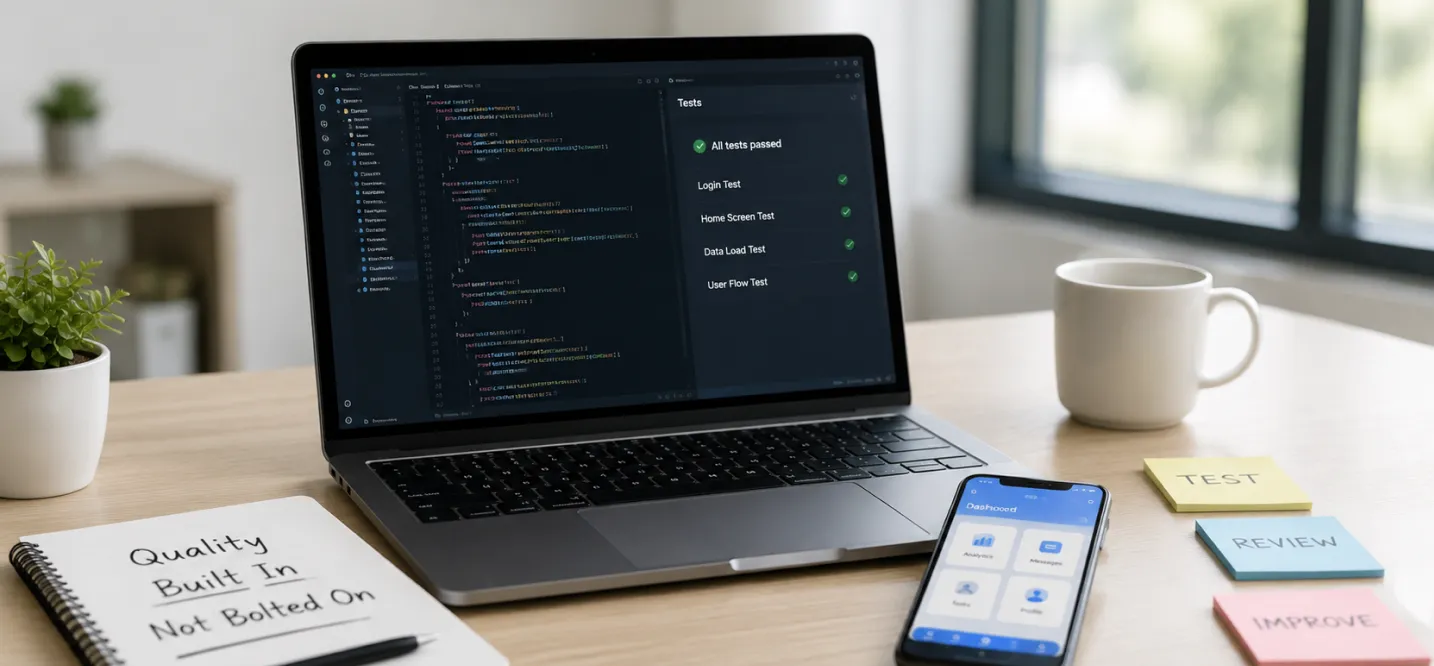
That philosophy has practical implications. Our QA engineers don’t sit on a separate team waiting for code to come to them. They participate in sprint planning. They review requirements documents before a single line of code is written. They ask uncomfortable questions like “What happens when a user submits empty form fields?” or “What’s the failure behavior if this third-party API goes down?” at the moment when answering those questions is cheapest.
Our security engineers follow the same model. Threat modeling happens during architecture review. Security requirements are documented alongside functional requirements. The secure software development lifecycle isn’t a document that lives in a compliance folder. It’s the actual process we follow every day.
We integrate QA and security across discovery, development, testing, deployment, and monitoring, not as overlapping phases but as a unified discipline applied continuously throughout the product lifecycle.
Our focus has never been on shipping faster at any cost. It has always been on building software that holds up when real users start pushing it. – Salman Lakhani, CEO at Cubix
How QA and Security Work Across the Development Lifecycle
Every phase includes defined quality and security activities, documented outputs, and measurable approval criteria. This structured delivery model reflects how Cubix’s 300-Person team builds software collaboratively across planning, engineering, testing, and release management, with progress driven by verified readiness rather than timelines alone.
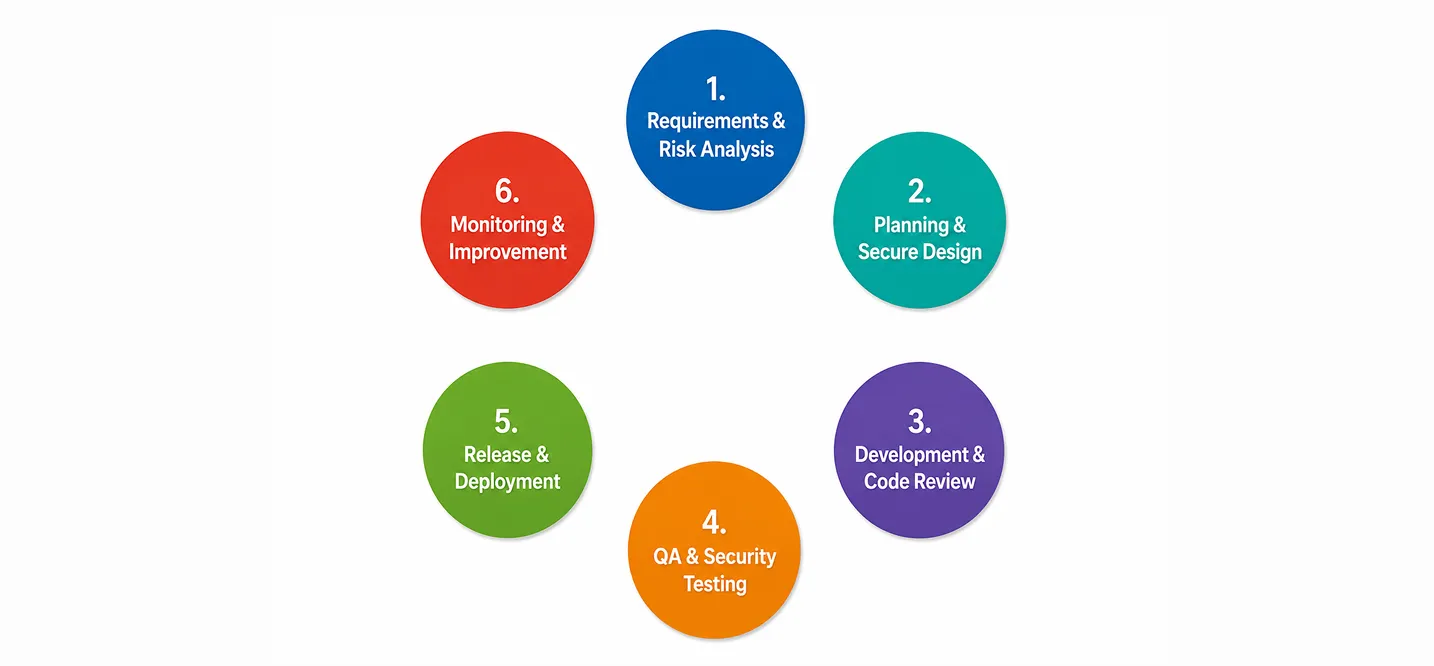
Below is an overview of our process:
Discovery & Requirements
↓
Architecture & Threat Modeling
↓
Development + Continuous QA
↓
Multi-Layer Testing (Functional, Performance, Security)
↓
DevSecOps CI/CD Pipeline Gates
↓
Pre-Launch Security Review & Compliance
↓
Deployment
↓
Post-Launch Monitoring & Vulnerability Management
Phase 1: Requirements and Architecture: Where Quality Actually Starts
Most clients are surprised to learn that our quality assurance process formally begins before any development work starts. The requirements and architecture phase is where the most consequential quality decisions get made and where fixing mistakes is essentially free compared to what comes later.
During requirements gathering, our team works with clients to identify not just what the software should do, but what it should never do, what it should do under stress, and what data it handles that requires special protection. These conversations surface requirements that often go undocumented in a purely feature-focused process: performance thresholds, error handling expectations, accessibility standards, and data classification that drives security controls. This early planning stage reflects how experienced custom software developers build resilient systems by addressing quality and security requirements before implementation begins.
Threat modeling happens at the architecture level. Before the team commits to a technology stack or a system design, security engineers review the proposed architecture against known threat patterns. What attack surfaces does this design expose? Where does sensitive data flow, and how is it protected in transit and at rest? Which third-party dependencies introduce risk?
This is what the secure software development lifecycle process actually looks like in practice. Not a compliance document, but a structured conversation that shapes design before code exists.
Phase 2: Development: Continuous Quality Assurance in Every Sprint
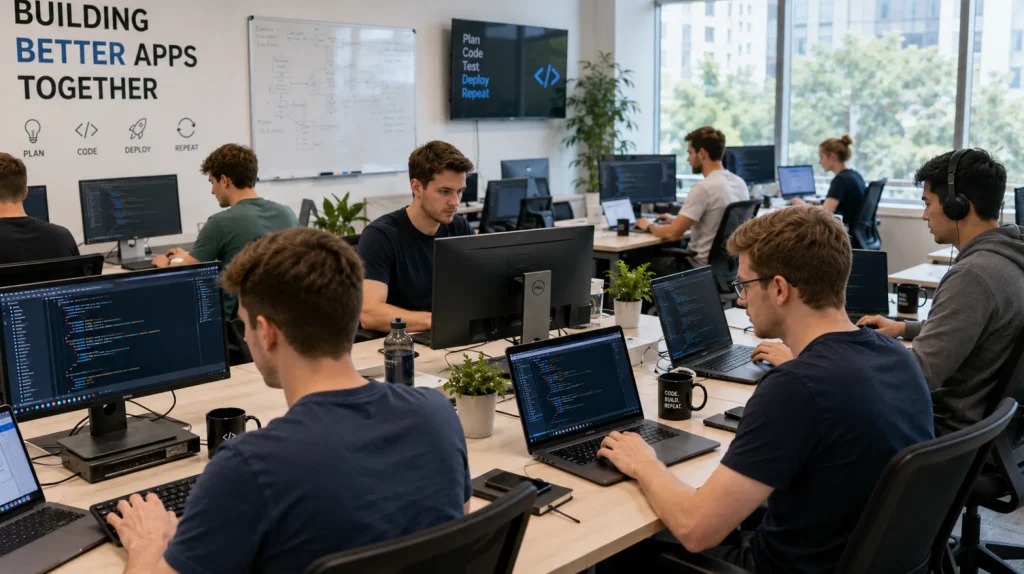
We operate in Agile development cycles, and our QA and Agile Testing integration goes deeper than most organizations achieve. Rather than treating QA as a separate phase that follows each sprint, testing runs continuously alongside development as part of our mobile development methodology and every other technology stack we build on.
That approach reflects how modern engineering teams operate today. Industry data shows that 86% of organizations report that testing teams influence release readiness decisions, signaling a shift toward embedding QA directly into Agile and DevOps workflows instead of treating testing as a final approval checkpoint.
Here’s what that looks like in practice:
Test case development starts with requirements: QA engineers write test cases during sprint planning, based on acceptance criteria defined before development begins. By the time a feature is coded, there is already a defined set of conditions it must satisfy to be considered complete.
Developers write unit tests as they go: Unit test coverage is a definition-of-done requirement, not a nice-to-have. Code without sufficient unit test coverage does not advance to integration testing.
Code reviews include a security lens: Every pull request goes through peer review that explicitly covers security concerns: Is user input properly validated? Is sensitive data being logged? Are authentication checks applied consistently? These questions get asked at the code level, not after the feature is deployed.
Static Application Security Testing (SAST) runs automatically: Our development pipeline includes automated static analysis tools that scan code for known vulnerability patterns, including SQL injection risks, hardcoded credentials, and insecure cryptographic implementations on every commit. Developers receive immediate feedback rather than discovering issues weeks later.
Phase 3: Testing: Comprehensive, Layered, and Risk-Based
Cubix’s formal testing phase is structured around layers, each designed to catch a different category of defect. Our end-to-end software testing services are not a single pass through a checklist; they’re a systematic elimination of every class of failure before software reaches production.
Functional Testing
Functional testing validates that the software does what it’s supposed to do. At Cubix, this includes manual exploratory testing by experienced QA engineers who understand real user behavior, combined with automated regression suites that ensure new changes don’t break existing functionality.
Automated testing uses tools appropriate to the technology stack: Selenium and Cypress for web applications, Appium and Detox for mobile, and custom frameworks where standard tooling doesn’t cover the use case. Test automation isn’t a replacement for human judgment; it’s a force multiplier that lets engineers focus attention on scenarios that require nuanced evaluation.
Performance Testing
Software that works correctly under light load but fails at scale is a production disaster waiting to happen. Our performance testing includes load tests that simulate expected peak traffic, stress tests that identify breaking points, and endurance tests that catch memory leaks and resource exhaustion issues that only surface after extended operation.
Performance testing results are measured against the thresholds established during requirements, not arbitrary benchmarks. If the client’s expectation is 500 concurrent users with sub-two-second response times, that’s the bar the software gets tested against.
Security Testing
This is where our software testing and security practices go deepest. The security testing layer includes:
Dynamic Application Security Testing (DAST): Automated scanners probe running applications for vulnerabilities that only appear at runtime, authentication bypasses, session management weaknesses, and injection vulnerabilities that static analysis can’t detect from source code alone.
API Security Testing: We test API endpoints for improper authorization, data exposure, rate limiting gaps, and input validation weaknesses, some of the most commonly exploited attack surfaces in production software.
Dependency Scanning: Third-party libraries are a major source of vulnerability in modern applications. We maintain automated scanning of all project dependencies against known vulnerability databases.
Penetration Testing: For applications handling sensitive data or operating in regulated industries, we coordinate professional penetration testing, structured attempts to compromise the application using the same techniques a real attacker would use. Findings feed directly into the development backlog as prioritized remediation work.
Compatibility and Accessibility Testing
Software quality management isn’t complete without ensuring the application works correctly across the environments real users bring to it. We test across target browsers, operating systems, and device types, and include accessibility testing against WCAG standards as a standard deliverable.
Phase 4: DevSecOps and Security Integration
One of the most significant advances in how Cubix delivers software is the full integration of DevSecOps and Security practices into the CI/CD pipeline. Our DevSecOps implementation approach treats security not as a checkpoint between development and deployment, but as a property of the pipeline itself.
At Cubix, every code commit triggers an automated sequence that includes:
- Linting and static analysis — catches code quality issues and potential vulnerabilities immediately
- Automated unit and integration test execution — verifies new changes don’t break existing behavior
- Dependency vulnerability scanning — flags newly introduced packages with known security issues
- Container image scanning — for projects deployed in containerized environments
- Infrastructure-as-code security scanning — catches misconfigured cloud resources before they reach production
This pipeline architecture means the feedback loop for both quality and security issues is measured in minutes rather than days. Developers learn immediately when a change introduces a problem, when the context is fresh, and the fix is cheap.
The CI/CD pipeline also enforces quality gates, defined thresholds that code must meet to advance toward production. A build with failing tests doesn’t advance. A build with critical-severity security findings doesn’t advance. These gates are automated into the system, which means they apply consistently regardless of release pressure or deadline urgency.
How We Integrate AI Into QA, Security, and Software Delivery
AI supports our teams throughout development, testing, and security workflows, but decisions remain guided by engineering standards and human review.
Industry adoption reflects this shift. Gartner projects that by 2028, 75% of enterprise software engineers will use AI code assistants, up from less than 10% in early 2023. Gartner also reports that 63% of organizations are already piloting, deploying, or actively using AI-assisted development workflows.
Here’s how AI supports our process:
- Accelerated development workflows to reduce repetitive implementation work and improve delivery efficiency.
- Smarter quality assurance through faster test planning, stronger regression coverage, and earlier defect detection.
- AI-assisted security analysis to identify vulnerability patterns and support secure coding practices.
- Code review support that helps teams surface inconsistencies and maintain engineering standards.
- Operational monitoring and insights to detect anomalies and improve post-launch responsiveness.
AI helps teams move faster, but quality validation, release decisions, and security approvals remain driven by experienced engineers and defined delivery standards.
Phase 5: Pre-Launch Security Review and Compliance Verification
Before any Cubix-built application goes live, it goes through a formal pre-launch review covering both quality and security. This review is structured, documented, and tracked.
The pre-launch review includes:
Final penetration test or security assessment: Sized to the risk profile of the application. Consumer apps handling payment data receive full penetration testing. Internal tools with limited data access may receive a focused security assessment. The approach is always risk-based.
Compliance verification: For applications operating in regulated industries. For our HIPAA-compliant healthcare platforms and clients in fintech, legal, and enterprise software, this phase includes documented verification of technical control implementation against the relevant regulatory framework, including HIPAA, PCI DSS, GDPR, or SOC 2 as applicable.
Launch readiness checklist completion: We maintain a standardized launch readiness checklist covering infrastructure configuration, monitoring setup, incident response preparation, backup verification, and rollback procedures.
Clients receive documentation of what was tested, what was found, how it was remediated, and what residual risk exists, giving genuine visibility into their product’s security posture rather than a verbal assurance that everything looks good.
Phase 6: Post-Launch Monitoring and Continuous Improvement
Shipping software is not the end of quality and security responsibility. Production environments surface behaviors that no test environment fully replicates, and the threat landscape continues to evolve after launch.
Post-launch engagement includes:
Application performance monitoring (APM) configured to alert on latency degradation, error rate spikes, and resource utilization anomalies. A sudden spike in 500 errors might be a bug, or it might be an attack in progress. Monitoring helps distinguish between the two quickly.
Security event monitoring for applications with ongoing support and maintenance. Suspicious authentication patterns, unusual data access volumes, and known attack signatures are monitored and triaged.
Dependency update management to ensure that newly disclosed vulnerabilities inthird-partyy libraries are assessed and remediated promptly. An application that was secure at launch is not automatically secure six months later.
Quarterly security reviews for long-term client engagements, covering new features developed since the previous review, changes in the threat landscape, and updates to compliance requirements.
How Cubix Success Is Measured
Quality without measurement is just intention. Success is tracked through concrete metrics that give both development teams and clients objective visibility into product health.
| Metric | What It Measures |
| Defect escape rate | Percentage of defects that reach production versus those caught in testing |
| Test coverage | Percentage of codebase covered by automated unit and integration tests |
| Deployment success rate | Percentage of deployments that complete without rollback or incident |
| Vulnerability remediation time | Average time from vulnerability discovery to verified remediation |
| Release frequency | Frequency of successful production releases, a proxy for pipeline health |
| Mean time to recovery (MTTR) | How quickly the team detects and resolves production incidents |
These metrics are tracked, reported, and used to drive continuous improvement rather than surfaced only at the end of a project. When defect escape rate rises, teams investigate whether test coverage has degraded or new complexity has exceeded existing testing capacity. When vulnerability remediation time increases, it signals a need to review pipeline automation or team capacity.
Why Teams Trust Cubix
Numbers tell part of the story. Cubix has:
- 1,300+ completed projects across web, mobile, enterprise, and embedded platforms
- 350+ specialists spanning engineering, QA, security, design, and product management
- 600+ clients ranging from funded startups to publicly traded enterprises
- 18+ years building digital products across fintech, healthcare, SaaS, e-commerce, and beyond
But the number that matters most to our clients isn’t a project count. It’s the defect escape rate on their last release. It’s the zero critical vulnerabilities in their pre-launch security report. It’s the compliance documentation that closed a six-figure enterprise deal because the buyer could verify security controls rather than just take their word for it.
That’s what eighteen years of building the right process delivers.
The Business Case for Getting QA and Security Right
The argument for investing in software quality assurance and application security is sometimes framed as risk mitigation, avoiding the cost of breaches, outages, and defects. That’s true, but it understates the case.
Companies that ship high-quality, secure software consistently have shorter development cycles, not longer ones. Defects caught early are cheap; defects caught in production are expensive in remediation costs, customer trust, and engineering time diverted from new development. Teams that invest in quality upfront have more capacity for feature work, not less, because they spend less time firefighting.
Application security, invested in properly through a genuine secure software development lifecycle, is increasingly a sales asset. Enterprise buyers perform security due diligence before purchasing software. Regulated industry clients require evidence of security practices as a contracting condition. Organizations that can demonstrate rigorous practices win deals their competitors lose.
Ready to implement secure software development lifecycle services for your product?
Let’s build QA and DevSecOps into your release process from day one.
Final Thoughts
The gap between software that works and software that scales, stays secure, and earns user trust is filled by QA and security practices that run through every phase of development, not bolted on at the end.
Our approach is not a differentiator in the sense of being exotic or unusual. It’s a differentiator because it’s applied consistently, rigorously, and with accountability to measurable outcomes. In an industry where shortcuts are common and “we’ll fix it in the next release” is a cultural norm, the organizations that treat software quality management and secure software delivery as core disciplines are the ones that build products worth being proud of.
Frequently Asked Questions
1: Does Cubix include QA and security testing in every project, or is it an add-on service?
QA and security are built into every project, not offered as optional add-ons. From requirements to post-launch monitoring, both run continuously across the entire development lifecycle. Testing is part of the delivery process from day one.
2: At what point does Cubix start QA?
QA starts before development begins. QA engineers join sprint planning, review requirements, and define test cases during the architecture phase. This ensures every feature has clear acceptance criteria before a single line of code is written.
3: How does Cubix ensure software is secure before launch?
Before launch, Cubix runs a structured security review that includes DAST, API security testing, dependency scanning, and penetration testing for sensitive applications. Clients receive a documented security report covering findings, fixes, and remaining risk before go-live.
4: Can Cubix handle compliance requirements like HIPAA or PCI-DSS?
Yes. Cubix builds applications aligned with standards like HIPAA, PCI-DSS, GDPR, and SOC 2. Compliance checks and documentation are integrated into development and pre-launch validation, with evidence delivered to clients as part of the project.
5: What happens if a vulnerability is found after launch?
Post-launch vulnerability management includes continuous dependency scanning, security monitoring, and scheduled reviews. Critical issues are prioritized immediately based on severity, not deferred to later release cycles.
6: How does Cubix measure QA effectiveness?
Quality is tracked using clear metrics: defect escape rate, test coverage, deployment success rate, vulnerability remediation time, and mean time to recovery. These metrics are shared with clients for full visibility into system health.
7: Will QA and security slow down delivery timelines?
No. Continuous QA and security reduce delays over time by preventing production issues, emergency fixes, and rework. Catching defects early significantly lowers overall delivery friction across the product lifecycle.
8: How does QA work in an Agile environment at Cubix?
QA is embedded directly into Agile sprints. Test cases are defined early, automation runs continuously, and code must pass quality gates within the same sprint. This ensures issues are resolved immediately, not after release.
9: What is the difference between SAST and DAST, and does Cubix use both?
SAST scans source code for vulnerabilities, while DAST tests running applications for real-world security issues. Cubix uses both together to ensure coverage across code-level and runtime vulnerabilities.
10: How is Cubix different from hiring an in-house QA team?
Cubix provides a full QA and security ecosystem, including QA engineers, automation specialists, and security experts supported by established tools and pipelines. This eliminates setup time and gives access to a mature testing and security framework from day one.