Key Takeaways
- The market is scaling fast. Mordor Intelligence puts warehouse automation at USD 29.98 billion in 2025 and USD 34.17 billion in 2026, heading to USD 65.74 billion by 2031 (13.98% CAGR).
- Three layers, one system. Vision sees, robots move, and software decides. Value comes from how well the three are integrated, not from any single machine.
- Know your acronyms. The WMS plans the work, the WES sequences it, and the WCS drives the equipment in real time.
- You can start small. Brownfield sites can automate in phases, usually beginning with vision-based visibility before adding AMRs and orchestration.
- Plan for failure. Confidence thresholds, human review and manual fallback keep orders moving when a camera or robot gets it wrong.
- Budget beyond hardware. Integration, change management and ongoing support often decide whether a project pays back.
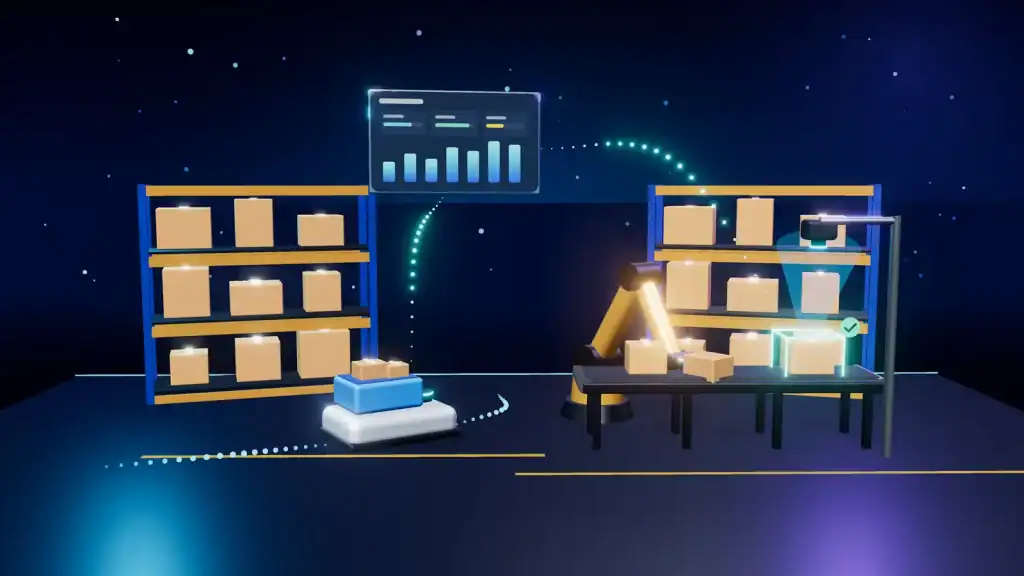
For years, warehouse automation meant fixed conveyors and big capital projects. That picture has changed. Today, AI warehouse automation combines robots, cameras and learning software so a facility can adapt to demand rather than just repeat a script.
The pressure is real. Zebra Technologies’ 2025 Warehouse Vision Study found that 84% of decision-makers see technology as essential to staying competitive. Yet 62% don’t know where to start. That gap between ambition and execution is exactly what this guide addresses.
Below, you’ll see how the pieces fit together, where each system’s job begins and ends, how to roll out in phases, and what to budget. If you want the wider context first, our overview of AI in Logistics and Supply Chain is a good companion read.
By the Numbers

| Metric | Figure | Source |
|---|---|---|
| Warehouse automation market, 2026 | USD 34.17 billion | Mordor Intelligence |
| Forecast, 2031 | USD 65.74 billion | Mordor Intelligence |
| Share of 2025 spend going to hardware | 55.12% | Mordor Intelligence |
| Software revenue CAGR, 2026-2031 | 14.87% | Mordor Intelligence |
| Leaders planning AI or AR within five years | 63% | Zebra, 2025 |
| Decision-makers unsure where to start | 62% | Zebra, 2025 |
| Growth in 2025 automation order intake vs. 2024 | +7% | Interact Analysis |
Notice the software line. Hardware still takes most of the money, but software is growing faster. That is the story of this decade in one row.
What Is AI-Powered Warehouse Automation?
AI-powered warehouse automation is the use of machine learning, computer vision and robotics, coordinated by warehouse software, to run receiving, storage, picking, packing and dispatch with less manual effort. Think of it as intelligent warehouse systems that perceive, decide and act.
Traditional automation follows fixed rules. A conveyor sorts to lane three because a barcode says so. If the label is torn, it stalls. AI changes that. A vision model can read a damaged label, estimate the item’s identity from its shape, and flag it for review instead of jamming the line.
The approach rests on three pillars:
- Robotics: autonomous mobile robots (AMRs), automated guided vehicles (AGVs), robotic picking arms and goods-to-person systems.
- Vision: machine vision, barcode recognition and OCR that turn camera feeds into data.
- Software: AI warehouse management software, execution layers and optimization engines that assign and sequence work.
What’s different from a decade ago? Learning. These systems improve as they see more products, more exceptions and more peak seasons. Short version: the warehouse gets smarter by operating.
How Robots, Vision, and Software Work Together (End-to-End Architecture)
A useful way to picture the stack is as five layers, each with a clear job. Data flows up, instructions flow down.
| Layer | What it does | Typical technologies |
|---|---|---|
| 1. Sensing | Captures images, barcodes and labels | Fixed cameras, 2D/3D sensors, scanners, OCR |
| 2. Edge inference | Runs AI models next to the sensor for sub-second answers | Edge GPUs, on-device models |
| 3. Robots | Moves, lifts and picks | AMRs, AGVs, robotic arms, SLAM navigation |
| 4. Orchestration | Allocates tasks and manages traffic | Fleet orchestration, task allocation engines |
| 5. Business systems | Plans and tracks inventory and orders | WMS, WES, WCS, ERP |
Here is the flow in practice. A camera reads a carton at receiving. Edge inference confirms the SKU in under a second. The WMS assigns a storage location. The orchestration layer picks the nearest available AMR, and SLAM (simultaneous localization and mapping) lets that robot navigate the aisle without fixed tracks. Once the robot confirms the putaway, the WMS updates inventory.
Why edge inference? Latency. A cloud round trip can be too slow for a moving conveyor or a robot arm. Edge processing keeps decisions fast and keeps working when connectivity dips.
Pro tip: Design the data contract first. Decide what each layer sends, how often, and what happens when a message is late. Most integration pain comes from skipping this step.
WMS vs WES vs WCS: What’s the Difference?

Short answer: the WMS decides what to do, the WES decides when and in what order, and the WCS decides how the machines do it.
| WMS | WES | WCS | |
|---|---|---|---|
| Scope | Whole warehouse, inventory and orders | Workflow across people and machines | Individual equipment |
| Decision horizon | Hours to days | Minutes to hours | Milliseconds to seconds |
| Typical functions | Receiving, slotting, order management, inventory | Wave and task release, labor and equipment balancing | Conveyor routing, sorter control, ASRS commands |
| Talks to | ERP, WES | WMS, WCS, robot fleets | PLCs, sensors, motors |
In smaller sites, a single WMS may cover all three roles. In larger, highly automated sites, the layers separate because real-time equipment control and long-range planning have very different speed needs.
Where does AI fit? Everywhere, but differently. In the WMS, it forecasts demand and improves slotting. In the WES, it balances workload across robots and people. In the WCS, it supports predictive maintenance and anomaly detection. Modern AI warehouse management software increasingly blends these functions, which is one reason software is the fastest-growing slice of spending.
How Warehouse Robots Integrate With WMS Software
Robotics WMS integration is where many projects succeed or stall. Locus Robotics notes that integration is often the most underestimated cost in warehouse automation, and a 2026 buyer’s guide from Layer3 Labs makes the same point: WMS integration, training and support shape the true cost and payback.
A typical flow looks like this:
- The WMS releases an order or task through an API, message queue or middleware.
- The fleet manager or WES translates it into robot-ready missions.
- Task allocation assigns the mission to the best available robot based on distance, battery and priority.
- The robot executes and streams status (position, load, errors) back.
- The human or system confirms the pick, drop or scan.
- The WMS updates inventory and closes the task.
Common pitfalls:
- Treating the WMS as the robot controller. It plans; it shouldn’t steer.
- Ignoring status feedback, so inventory drifts from reality.
- Hard-coding vendor-specific logic that breaks at the next upgrade.
- Skipping a test environment that mimics peak order volume.
A standards-based API layer and a clear fleet orchestration role protect you from vendor lock-in. This is also where custom machine learning services help, particularly when you need models that match your products and your data.
Computer Vision for Picking, Packing, and Inventory Checks

Computer vision warehouse automation replaces a lot of manual checking. Cameras never tire, and they can verify every item rather than a sample.
Zebra’s 2025 study shows where sentiment is heading. Among European decision-makers, 74% believe machine vision and fixed industrial scanning would save time and eliminate errors, and 65% plan to implement machine vision within one to five years.
| Use case | What vision does | Outcome to track |
|---|---|---|
| AI picking and sorting | Identifies items and grasp points; verifies the right SKU | Pick accuracy |
| Barcode and OCR reading | Reads damaged, skewed or low-contrast labels | First-pass read rate |
| Pack verification | Confirms contents match the order before sealing | Mis-ship rate |
| Damage detection | Flags crushed cartons or torn wrap at receiving | Claims and returns |
| Cycle counting | Counts pallets or shelves passively, even by drone or robot | Inventory accuracy |
| Safety | Detects hazards and unsafe proximity | Incident rate |
Results can be strong. Zebra’s Rebl robots, using a 2D and 3D perception stack, have reported picking accuracy above 99.7%. A DHL facility using vision picking with smart glasses reports 99.96% inventory accuracy. A peer-reviewed study from late 2024 also found a 45% cut in inventory counting time and a 9% accuracy gain from a vision platform.
The catch? Product variability. Shiny wrap, deformable bags and near-identical packaging all confuse models. Budget time for data capture and retraining as your catalog changes.
Automation Across the Warehouse: Receiving to Dispatch
You don’t have to automate everything. Pick the stage where errors or labor costs hurt most.
| Stage | AI and robotics use case | Typical KPI | Human role |
|---|---|---|---|
| Receiving | Vision-based label reading, dimensioning, damage checks | Dock-to-stock time | Resolves flagged exceptions |
| Putaway | AMRs and slotting optimization | Putaway accuracy | Handles oversized or odd items |
| Picking | AMR-assisted picking, robotic picking, goods-to-person | Lines per hour | Picks complex SKUs, supervises |
| Packing | Pack verification, cartonization, auto-labeling | Mis-ship rate | Final quality checks |
| Dispatch | Sortation, load verification, route-based staging | On-time shipment rate | Loads, handles carrier issues |
Picking remains the hardest. Interact Analysis has noted that robotic picking forecasts were revised down in the short term, although it sees vast long-term potential. Meanwhile, person-to-goods robots, which keep people in the loop, are forecast to grow around 30% annually. That tells you something: collaboration beats full autonomy for many sites today.
Can an Existing Warehouse Be Automated Gradually? (Brownfield Rollout)
Yes. In fact, most projects are brownfield, and a phased approach reduces risk. Mordor Intelligence’s projection that software will grow faster than hardware supports this logic: start with data and orchestration, then add machines.
| Phase | Focus | Typical activities | Exit criteria |
|---|---|---|---|
| 0. Audit | Data readiness and process mapping | Clean item master, map flows, baseline KPIs | Reliable baseline data |
| 1. Visibility | Vision and scanning | Fixed cameras, OCR, cycle count automation | Inventory accuracy improved |
| 2. AMR pilot | One zone, one process | AMRs for picking or transport, WMS integration | Pilot beats baseline |
| 3. Orchestration and scale | Multi-zone coordination | Fleet orchestration, WES layer, more robots | Stable at peak volume |
Is Your Warehouse Ready? A Quick Self-Check
- Is your item master data clean and complete?
- Do you have a WMS (or a plan to get one)?
- Are aisles wide enough and floors flat enough for AMRs?
- Is Wi-Fi coverage reliable across the floor?
- Can you name the one process causing the most errors?
If you answered “no” to more than two, start at Phase 0. Skipping it is the most common reason pilots disappoint.
What Happens When Vision or a Robot Fails? (Exception Handling)

Every system fails sometimes. What matters is how gracefully.
Well-designed AI warehouse automation uses layered safeguards:
- Confidence thresholds: the model acts only when it is sure enough; anything below goes to review.
- Human-in-the-loop review: a person sees the image and decides within seconds.
- Fallback to manual: if a station goes down, work reroutes to a manual lane.
- Controlled recovery: a stuck robot is isolated, its task reassigned, and the zone restarted without halting the floor.
- Audit trails: every override is logged so the model can learn from it.
Consider a scenario. A camera sees a carton and returns a 62% confidence match. The threshold is 90%. The system holds the item, shows an operator the image, and the operator confirms the SKU. The correction feeds retraining. Total delay: a few seconds. Without this design, a wrong item might ship.
Here’s the good news. Zebra found that 81% of leaders say automation improves morale, in part because people spend less time on repetitive checks and more on judgment calls.
What Drives Warehouse Automation Cost?
Warehouse automation cost depends on scope, scale and site conditions, so any single price tag should be treated with suspicion. A better approach is to separate the components.
| Cost component | What’s included | Notes |
|---|---|---|
| Equipment | AMRs, AGVs, arms, cameras, scanners, edge devices | Hardware held 55.12% of 2025 spend |
| Software | WMS/WES licenses, fleet manager, AI models | Fastest-growing segment (14.87% CAGR) |
| Integration | APIs, middleware, testing, data cleanup | Often underestimated |
| Infrastructure | Wi-Fi, charging, floor and layout changes | Site-specific |
| Change management | Training, process redesign | Drives adoption |
| Ongoing support | Maintenance, model retraining, updates | Recurring |
Robots-as-a-Service (RaaS) changes the equation by turning a capital purchase into a monthly fee that often includes maintenance. According to Layer3 Labs’ 2026 guide, this has made robots realistic for mid-size businesses. One caution: over several years, RaaS can cost more than buying, so compare NPV and IRR, not payback alone.
As a rule of thumb from industry ROI guides, modular or RaaS solutions are commonly evaluated on a two to three year payback, while fixed systems like AS/RS often run three to five years. Labor hours saved, error reduction and productivity per square foot drive the result.
How to Measure Warehouse Automation Performance
What gets measured gets managed. Set baselines in Phase 0 and compare every quarter.
| KPI | What it tells you |
|---|---|
| Throughput (lines or orders per hour) | Whether capacity actually increased |
| Pick accuracy | Quality of fulfillment |
| Inventory accuracy | Trust in system data |
| Order cycle time | Speed from order to dispatch |
| Robot utilization | Whether you’ve over- or under-bought |
| Exception rate | Model quality and process health |
| Cost per pick | True labor efficiency |
Watch the exception rate closely. A falling rate means your models and processes are maturing. A rising one is an early warning.
Start the Best Automation With Cubix
AI warehouse automation works when robots, vision and software act as one system. Cameras supply truth, robots supply movement, and the WMS, WES and WCS supply coordination. Skip any layer and the others underperform.
The practical path is clear: audit your data, add vision for visibility, pilot AMRs in one zone, and scale through orchestration. Budget for integration and support, design for exceptions, and track a short list of KPIs.
Are you ready to explore what this looks like for your operation? Read more about AI in Logistics and Supply Chain, or talk to us about machine learning development services tailored to your warehouse.
Optimize Warehouse Operations with AI-Powered Robotics and Automation
Contact UsFrequently Asked Questions
1. How do warehouse robots communicate with a WMS?
Usually through APIs or message queues, often via a fleet manager or WES in between. The WMS sends tasks, the robots return status and confirmations, and the WMS updates inventory.
2. What is the difference between WMS, WES and WCS?
The WMS manages inventory and orders, the WES coordinates workflows across people and machines, and the WCS controls individual equipment in real time.
3. Can AI automation be added to an existing warehouse?
Yes. Most deployments are brownfield. Start with data cleanup and vision-based visibility, then pilot AMRs in one zone before scaling.
4. What happens if computer vision misidentifies an item?
Low-confidence reads are routed to a human reviewer, and the item is held until confirmed. Corrections are logged and used to retrain the model.
5. What costs should a warehouse automation budget include?
Equipment, software licenses, integration, infrastructure upgrades, training and change management, and ongoing support including model retraining.