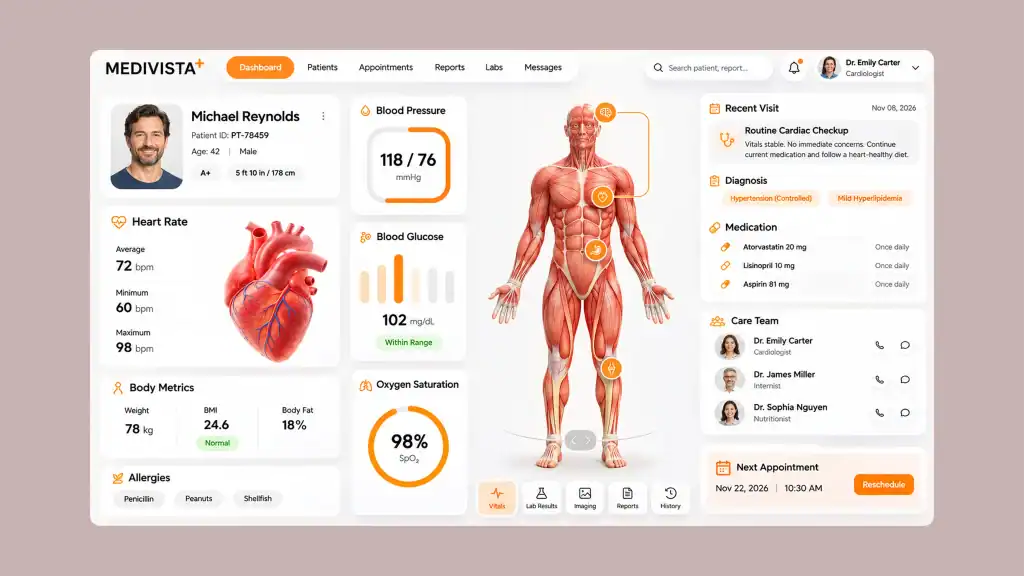
Telemedicine software development typically costs 40,000–80,000 for a basic MVP, 80,000–150,000 for a mid-level platform, and 150,000–300,000+ for an advanced telehealth solution. The final cost depends on the patient and provider features, video infrastructure, EHR integrations, security requirements, and expected consultation volume.
Demand for virtual care remains significant. According to the CDC’s National Center for Health Statistics, 80% of U.S. office-based physicians used telemedicine in 2024. For software buyers, that means a telemedicine product may need to support more than video calls. Scheduling, patient intake, clinical documentation, payments, and connections to existing healthcare systems can all affect the development budget.
This guide breaks down telemedicine app development costs, feature-level expenses, integrations, compliance, ongoing operating costs, and a sample project budget.
Key Takeaways
- A basic telemedicine MVP typically costs 40,000–80,000.
- A mid-level platform with messaging, payments, provider dashboards, and selected integrations costs around 80,000–150,000.
- Advanced platforms with extensive EHR interoperability and multi-facility workflows can exceed $300,000.
- EHR integration may add 10,000–30,000+, depending on vendor access and data exchange requirements.
- Video infrastructure, cloud hosting, third-party APIs, and maintenance create recurring expenses.
- Annual maintenance can be budgeted at approximately 15–25% of the initial development cost, excluding usage-based services and licensing.
How Much Does Telemedicine Software Development Cost?
The cost of telemedicine software development generally falls between $40,000 and $300,000+. The estimate depends on the product’s scope, number of user interfaces, consultation features, and integration requirements.
Telemedicine App Development Cost by Project Complexity
| Project scope | Estimated cost | Typical functionality |
| Basic MVP | 40,000–80,000 | Patient registration, provider profiles, appointment scheduling, video consultations, basic admin panel |
| Mid-level platform | 80,000–150,000 | Patient and provider dashboards, secure messaging, payments, notifications, selected EHR integration |
| Advanced platform | 150,000–300,000+ | Multiple facilities, advanced clinical workflows, bidirectional EHR integration, analytics, complex access controls |
These are indicative custom-development estimates, not fixed market prices. They assume a production-oriented product with backend services, user interfaces, testing, and deployment. A prototype with limited functionality may cost less. Enterprise requirements, data migration, and multiple vendor integrations can push the budget higher.
Telemedicine Platform Cost by Product Model
The product model also affects the budget. A platform for one clinic has different requirements from a marketplace connecting patients with providers across multiple organizations.
| Product Model | Estimated Cost | Main Cost Considerations |
| Direct-to-consumer telemedicine app | $40,000–$100,000 | Patient onboarding, provider discovery, scheduling, video visits, payments |
| Clinic-specific platform | $60,000–$150,000 | Clinic workflows, provider availability, patient records, billing, EHR connectivity |
| Multi-provider marketplace | $100,000–$200,000+ | Multiple provider accounts, search and matching, commissions, payments, scheduling |
| Enterprise telehealth platform | $150,000–$300,000+ | Multi-facility access, complex integrations, centralized administration, reporting, scalability |
A clinic that only needs scheduled video consultations may not need marketplace features or complex provider matching. Define the business model before estimating the software scope.
Which Features Drive Telemedicine App Development Costs?
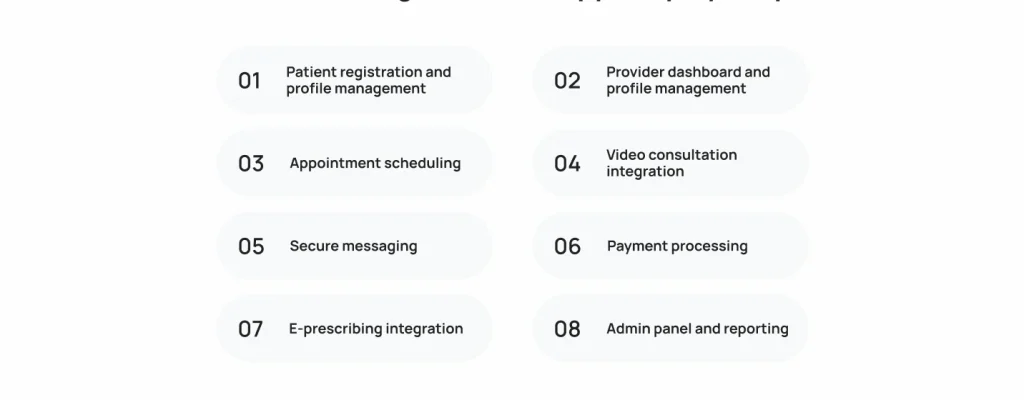
Features typically account for a large share of the development budget. A basic consultation product needs fewer components than a platform handling patient intake, clinical documentation, payments, and post-visit communication.
| Feature | Estimated Development Cost |
| Patient registration and profile management | $4,000–$8,000 |
| Provider dashboard and profile management | $6,000–$12,000 |
| Appointment scheduling | $5,000–$10,000 |
| Video consultation integration | $8,000–$18,000 |
| Secure messaging | $4,000–$8,000 |
| Payment processing | $3,000–$7,000 |
| E-prescribing integration | $5,000–$12,000 |
| Admin panel and reporting | $6,000–$15,000 |
These figures are planning estimates for individual feature work, not amounts that should simply be added together. Authentication, user management, APIs, and shared backend components support multiple features, so the final cost depends on how the product is designed.
For an MVP, prioritize:
- Patient registration and provider profiles.
- Appointment booking and availability management.
- Video consultations.
- Basic provider and admin dashboards.
- Notifications and essential account controls.
Add secure messaging, e-prescribing, insurance workflows, and advanced reporting when the first release has a clear need for them.
What Technical Factors Affect Telemedicine Software Development Costs?
The main technical cost drivers are platform coverage, video infrastructure, and the backend needed to coordinate patient and provider workflows.
1. Web and Mobile Application Development
A responsive web application can be less expensive than building separate native iOS and Android applications. However, the right choice depends on how patients and clinicians will use the product.
| Development Approach | Planning Estimate |
| Responsive web application | $15,000–$30,000 |
| One native mobile application | $25,000–$45,000 |
| Separate native iOS and Android apps | $45,000–$80,000 |
| Cross-platform mobile application | $30,000–$55,000 |
These estimates cover interface development for the relevant application scope, not the entire telemedicine platform. A shared backend, authentication, scheduling, and video services still need to be built.
Cross-platform frameworks such as React Native and Flutter can reduce duplicated development work. Native development may be more suitable when the product needs deeper platform-specific functionality or extensive device integration.
2. Video Consultation Infrastructure
Video functionality can be implemented using a third-party SDK or a custom WebRTC-based solution.
| Approach | Estimated Implementation Cost | Best Suited For |
| Third-party video SDK | $8,000–$18,000 | MVPs and standard one-to-one consultations |
| Customized video experience | $15,000–$30,000 | Products requiring custom call controls and workflows |
| Custom WebRTC implementation | $25,000–$50,000+ | Platforms needing greater control over media infrastructure |
A third-party SDK usually reduces initial engineering work, but usage charges continue after launch. A custom WebRTC implementation gives the engineering team more control, but it also requires additional work for signaling, connectivity, session management, monitoring, and network reliability.
For most first releases, using an established video SDK is the more practical starting point. Building a custom video stack is difficult to justify unless the product has specific technical or operational requirements.
3. Backend and Data Management
The backend manages appointments, user permissions, consultation sessions, notifications, and connections to external healthcare systems.
A basic backend may be included in the overall MVP budget. A more complex backend with multiple provider organizations, detailed clinical workflows, and advanced reporting can add 15,000–40,000+.
The architecture should account for:
- Separate patient, provider, and administrator permissions.
- Appointment and consultation session management.
- Secure handling of patient information.
- API connections to EHR, payment, and pharmacy systems.
- Monitoring and support for concurrent video consultations.
Avoid designing for hypothetical traffic at launch. Estimate expected users, simultaneous consultations, and data volume, then scale the infrastructure as demand grows.
How Much Do Telemedicine Software Integrations Cost?

Telemedicine integrations can add 3,000–30,000+ per integration, depending on the external system, data exchange requirements, and vendor access.
| Integration | Estimated Cost | What Affects the Price |
| EHR/EMR integration | $10,000–$30,000+ | Vendor APIs, patient matching, clinical data exchange, read/write access |
| HL7 or FHIR interfaces | $5,000–$15,000+ | Data mapping, authorization, validation, interface complexity |
| E-prescribing and pharmacy connectivity | $5,000–$15,000+ | Prescription workflows, medication history, external network requirements |
| Payment gateway | $2,000–$5,000 | Payment methods, refunds, billing workflows |
| SMS and email notifications | $1,500–$4,000 | Provider setup, templates, delivery tracking, consent management |
These are indicative implementation estimates. Vendor licensing, API access fees, certification requirements, and transaction charges may be billed separately.
1. EHR and EMR Integration
Connecting telemedicine software to systems such as Epic, Oracle Health, or athenahealth can involve more than retrieving patient records. The integration may need to exchange appointment details, clinical notes, diagnoses, medication information, and encounter data.
The scope changes significantly depending on whether the platform needs read-only access or bidirectional data exchange. Confirm the EHR vendor’s API availability, approval process, and fees before finalizing the development budget.
2. HL7 and FHIR Integration
HL7 v2 and FHIR support healthcare data exchange, but they are not interchangeable implementation shortcuts. HL7 v2 interfaces often require message mapping and interface-engine configuration. FHIR integrations require resource mapping, authorization, and validation against the receiving system’s implementation requirements.
The ONC’s hospital API research found that approximately 9 in 10 hospitals enabled patient access through APIs in 2024. However, hospitals still frequently used proprietary APIs and non-API methods for third-party data exchange. That makes early integration testing important.
3. E-Prescribing and Payment Integrations
E-prescribing may require connections to external prescribing networks and pharmacy workflows. The cost depends on the required services, authorization, and vendor arrangements.
Payment integration is usually more straightforward for self-pay consultations. Insurance eligibility checks, claims, and complex billing workflows require additional integrations and testing.
How Much Does HIPAA Compliance Add to Telemedicine Software Development Costs?
For planning purposes, a mid-level telemedicine project may need 10,000–25,000 in additional security and compliance engineering, depending on its existing architecture and the amount of electronic protected health information it handles.
A possible allocation is:
| Security Work | Estimated Cost |
| HIPAA Security Risk Analysis support | $3,000–$7,000 |
| Role-based access controls and MFA | $2,000–$5,000 |
| Encryption, audit logging, and monitoring | $3,000–$7,000 |
| Third-party vendor security review and BAA support | $2,000–$6,000 |
These estimates cover technical and implementation work, not legal advice, independent audits, or every organizational compliance activity.
Key requirements may include:
- Role-based access controls and least-privilege permissions.
- Encryption for data in transit and at rest.
- Multi-factor authentication for appropriate accounts.
- Audit logs for access to patient information.
- Secure consultation and messaging workflows.
- Backup, recovery, and incident-response procedures.
- Vendor reviews and Business Associate Agreements (BAAs), where applicable.
HIPAA compliance is not a fixed software surcharge or a certification that a developer can simply add at the end. The HHS guidance on cloud computing explains that cloud providers handling ePHI on behalf of regulated entities may be business associates and generally require an appropriate BAA. The organization must also conduct risk analysis and apply the relevant safeguards.
For more detail on application-level requirements, see Cubix’s guide to HIPAA compliance considerations for healthcare applications.
How Much Does Telemedicine Software Development Cost by Developer Location?
Development rates vary by region, seniority, and company structure. The following ranges are broad planning benchmarks for software development teams, not verified telemedicine-specific market averages.
| Development Region | Indicative Hourly Rate |
| United States | $75–$150 |
| Canada | $75–$150 |
| Western Europe | $70–$150 |
| Eastern Europe | $40–$90 |
| Latin America | $40–$90 |
| South Asia | $25–$60 |
| Southeast Asia | $25–$60 |
A lower hourly rate does not automatically mean a lower project cost. A team unfamiliar with healthcare integrations or security requirements may need more time to complete the same work.
When comparing development partners, assess:
- Experience with healthcare workflows and EHR integrations.
- Security engineering and HIPAA implementation experience.
- Availability of QA and technical project management.
- Ownership of source code and documentation.
- Post-launch support and maintenance arrangements.
For a healthcare product, domain experience can matter more than the lowest quoted rate.
What Are the Ongoing Costs of Running Telemedicine Software?
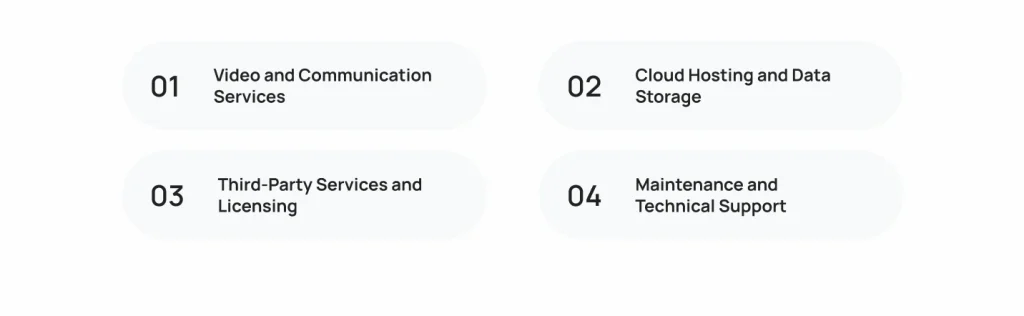
After launch, budget for cloud infrastructure, video usage, third-party services, maintenance, and technical support. These expenses vary with consultation volume and the services used.
1. Video and Communication Services
Video providers may charge per participant minute, with separate fees for recording, transcription, and storage.
For example, Twilio Video pricing lists a rate starting at $0.004 per participant per minute. A 20-minute consultation with two participants would cost approximately $0.16 for the video connection itself, excluding optional services and other infrastructure.
At 10,000 such consultations per month, that would amount to approximately $1,600 in video connection charges.
Actual costs depend on call duration, participant count, recordings, transcription, and the selected provider’s pricing.
2. Cloud Hosting and Data Storage
A small production deployment may start around 300–1,500 per month for basic application hosting, databases, backups, and monitoring. A larger platform with higher traffic, multiple environments, and more demanding availability requirements may cost 2,000–10,000+ per month.
These are planning allowances, not cloud-provider quotes. Estimate infrastructure using expected users, concurrent consultations, storage, network traffic, and backup retention.
3. Third-Party Services and Licensing
Other recurring expenses may include:
- EHR vendor API access.
- E-prescribing and pharmacy network services.
- SMS and email delivery.
- Payment processing fees.
- Identity verification services.
- Analytics and monitoring tools.
Ask each vendor for its pricing model before launch. Some charge monthly subscriptions, while others bill by transaction, API request, or usage volume.
4. Maintenance and Technical Support
Budget approximately 15–25% of the initial development cost annually for software maintenance. For a $120,000 platform, that equals roughly 18,000–30,000 per year.
Maintenance covers bug fixes, security updates, dependency upgrades, compatibility changes, monitoring, and integration support. It does not include all usage-based video, cloud, or licensing charges.
Custom Telemedicine Software vs. White-Label Solutions: Which Costs Less?
White-label telemedicine software usually costs less upfront, while custom development requires a larger initial investment but gives the organization more control over workflows and integrations.
| Consideration | White-Label Software | Custom Telemedicine Software |
| Initial cost | Often lower; may start around $5,000–$30,000 for setup and customization | Typically $40,000–$300,000+ |
| Launch time | Usually faster | Longer development and testing cycle |
| Custom workflows | Limited by vendor capabilities | Designed around specific requirements |
| EHR integration | Depends on available connectors and vendor support | Can be built for required systems |
| Technical control | Limited | Greater control over architecture and roadmap |
| Recurring expenses | Subscription and usage fees | Hosting, maintenance, and third-party service fees |
White-label pricing varies widely. Some providers charge monthly subscriptions, per-provider fees, or usage-based rates, so compare the total cost over several years rather than setup fees alone.
Choose white-label software when standard video visits and scheduling meet your needs. Custom development makes more sense when you need specialized clinical workflows, deeper EHR integration, ownership of the product roadmap, or a platform that supports multiple organizations.
How Can You Reduce Telemedicine App Development Costs?

You can reduce development costs by limiting the first release to essential virtual-care workflows and avoiding integrations or features that do not support an immediate business need.
Practical ways to control the budget include:
- Start with one use case. Build around a specific workflow, such as scheduled consultations for one clinic or specialty.
- Keep the MVP focused. Prioritize registration, scheduling, video visits, and basic provider administration.
- Use a video SDK. Avoid building custom WebRTC infrastructure unless you have a clear technical reason.
- Choose the right platform strategy. A responsive web application or cross-platform app may be sufficient for the first release.
- Limit initial integrations. Start with the EHR and payment connections required for launch.
- Confirm vendor access early. Check API availability, approval requirements, and fees before development begins.
- Plan recurring expenses. Estimate video minutes, cloud usage, storage, and support instead of focusing only on the initial build.
Do not cut costs by postponing essential security controls or testing. Fixing access-control, data-handling, or integration problems after launch can be more expensive.
How Do You Estimate the Cost of Your Telemedicine Software Project?
A practical estimate starts with the required workflows, integrations, and technical scope. Consider a mid-level platform with patient and provider interfaces, scheduling, video consultations, secure messaging, payments, and one EHR integration.
Sample Telemedicine Software Development Budget
| Development Activity | Estimated Cost |
| Discovery and requirements | $8,000 |
| UI/UX design | $10,000 |
| Frontend and backend development | $40,000 |
| Video consultation integration | $12,000 |
| EHR integration | $15,000 |
| Security implementation and QA | $20,000 |
| Deployment and launch support | $5,000 |
| Subtotal | $110,000 |
| Contingency reserve (approximately 10%) | $11,000 |
| Estimated project budget | $121,000 |
This is an illustrative budget, not a vendor quote. It assumes one EHR integration, standard video functionality, and a defined set of patient and provider workflows. Complex data migration, insurance claims, custom video infrastructure, or multiple EHR connections would increase the estimate.
Before approving a budget, confirm:
- Which patient and provider workflows are included?
- Are iOS, Android, and web applications all required?
- Does the product need read-only or bidirectional EHR integration?
- Which video, messaging, and payment providers will it use?
- What security, testing, and documentation work is included?
- Are vendor fees, hosting, and post-launch maintenance separate?
Keep recurring infrastructure, licensing, and maintenance outside the initial development budget. A 10–15% contingency reserve can also help account for scope changes and integration issues.
Conclusion
Telemedicine software development can cost $40,000 for a basic MVP to more than $300,000 for an advanced platform. The biggest budget decisions usually involve the consultation workflow, mobile and web coverage, video infrastructure, EHR integration, and security requirements. Recurring video, cloud, and maintenance expenses also need to be included in the financial plan.
Before development starts, define the care workflow and confirm which external systems the platform must connect with. Cubix’s healthcare software development services can help scope the architecture, integrations, and engineering effort around those requirements.
Need Help Estimating Your Telehealth Platform Costs?
Contact Us
Frequently Asked Questions
1. How much does it cost to build a telemedicine app?
A basic telemedicine app typically costs 40,000–80,000. A platform with provider dashboards, messaging, payments, and integrations may cost 80,000–150,000 or more.
2. How much does a basic telemedicine MVP cost?
A basic MVP generally costs 40,000–80,000. This can cover patient registration, provider profiles, appointment scheduling, video consultations, and basic administration.
3. How much does it cost to develop a telehealth platform for a clinic?
A clinic-specific telehealth platform may cost 60,000–150,000, depending on provider workflows, patient records, billing, and EHR integration requirements.
4. How much does EHR integration cost for a telemedicine app?
A standard EHR integration may cost 10,000–30,000+. Bidirectional data exchange, vendor-specific requirements, and data migration can increase the cost.
5. Does a telemedicine app need to be HIPAA-compliant?
If the app handles protected health information for a HIPAA-regulated covered entity or business associate, the applicable HIPAA requirements must be addressed. The exact obligations depend on the organization’s role and how the software handles that information.
6. How much does it cost to maintain telemedicine software?
Annual software maintenance can be estimated at 15–25% of the initial development cost. Cloud hosting, video usage, licensing, and transaction fees are additional expenses.
7. How long does it take to develop a telemedicine app?
A basic MVP may take around 3–5 months. A mid-level platform may take 5–8 months, while advanced platforms can require 8–12 months or longer. Integrations and compliance testing can affect the schedule.
8. Is custom telemedicine software more expensive than a white-label solution?
Custom development usually costs more upfront, often starting around $40,000. White-label solutions have lower initial setup costs but may involve recurring subscriptions, usage fees, and limitations on customization.