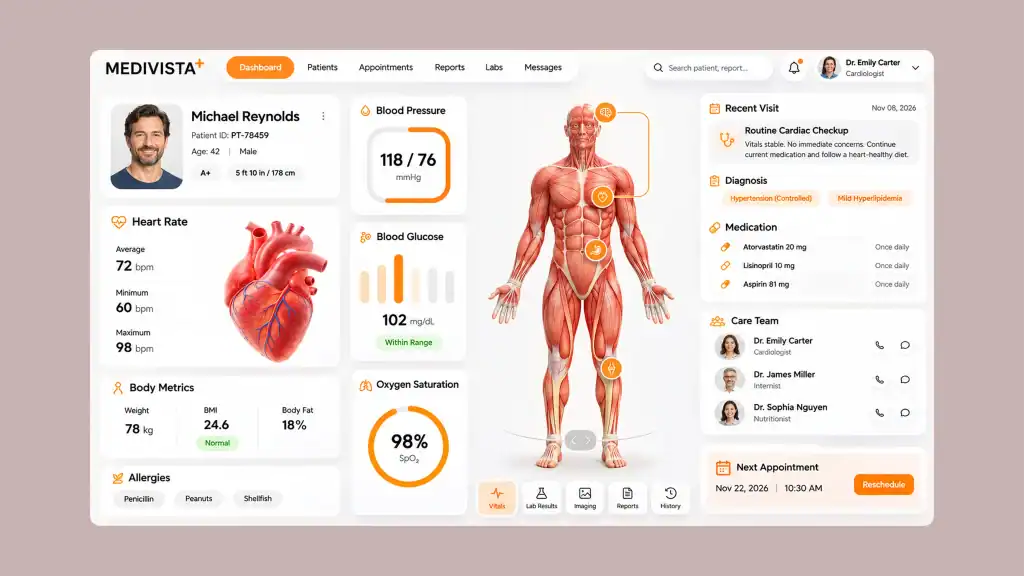
The cost to develop a custom EHR system typically ranges from $80,000 to $120,000 for a basic MVP, $120,000 to $200,000 for a specialty-specific platform, and $300,000 to over $500,000+ for larger multi-location and enterprise systems. The final price depends on clinical features, integrations, data migration, security requirements, and the number of facilities the system needs to support.
The investment is significant, particularly in a market where electronic records are already standard. According to the Office of the National Coordinator for Health Information Technology (ONC), 91% of office-based physicians and more than 99% of non-federal acute care hospitals had adopted certified EHRs in 2024. For organizations considering a custom platform, the challenge is deciding whether its workflows and capabilities justify the cost of building and maintaining another system.
The development estimates in this guide are indicative planning ranges, not fixed market prices or vendor quotes. They are intended to help healthcare organizations scope their budgets before requesting a detailed estimate.
Key Takeaways
- EHR software development cost: A basic EHR MVP may cost $80,000–$120,000, while complex enterprise systems can reach $300,000–$500,000+.
- Features shape the budget: Clinical documentation, e-prescribing, patient portals, reporting, and specialty-specific workflows all affect development costs.
- Integrations add complexity: Connecting laboratories, pharmacies, billing platforms, and external health systems requires additional development and testing.
- Compliance is part of the cost: HIPAA security controls, risk analysis, access management, and audit trails need to be considered from the start.
- Implementation involves more than coding: Data migration, staff training, infrastructure, and deployment can increase the initial investment.
- Maintenance requires ongoing funding: Plan for regular updates, security monitoring, support, and infrastructure expenses after launch.
- Start with essential workflows: An MVP focused on immediate clinical and administrative needs can keep the initial budget manageable while leaving room for future expansion.
How Much Does EHR Software Development Cost?
The cost of EHR software development varies with the size of the organization, the complexity of its clinical workflows, and the functionality required at launch.
| EHR Project Type | Estimated Development Cost | Typical Scope |
| Basic EHR MVP | $80,000–$120,000 | Patient profiles, clinical notes, appointments, basic user permissions |
| Specialty-specific EHR | $120,000–$200,000 | Specialty workflows, clinical templates, e-prescribing, selected integrations |
| Multi-location EHR | $200,000–$300,000 | Centralized records, multiple facilities, advanced permissions, reporting, integrations |
| Enterprise EHR | $300,000–$500,000+ | Complex clinical workflows, extensive interoperability, advanced security, high-volume data processing |
A basic MVP is suitable for a small practice that needs to digitize patient records and manage essential clinical workflows. It is not a complete hospital-grade system. A specialty-specific EHR costs more because it needs clinical templates, specialty workflows, terminology mapping, and potentially connections to external systems.
Multi-location platforms introduce another layer of complexity. Patient records must remain consistent across facilities, staff need different access permissions, and the system may need to connect with several laboratories, pharmacies, billing platforms, and health information exchanges.
A practical starting budget: If you’re developing a custom EHR for a specialty clinic, use $150,000–$350,000 as an initial planning range. If the platform needs to support several facilities or extensive integrations, expect a higher investment.
These figures cover indicative custom development costs. Hosting, third-party licensing, data migration, staff training, and ongoing maintenance should be budgeted separately.
What Features Affect Custom EHR Software Development Cost?

The number of modules matters, but their complexity matters more. Patient registration is relatively straightforward. Clinical documentation, medication management, and integrations require more specialized engineering and testing.
Here are some indicative costs for individual EHR modules:
- Patient Registration and Profiles: $8,000–$15,000. Covers patient demographics, contact information, medical history, and record management.
- Clinical Documentation: $15,000–$30,000. Includes clinical notes, diagnoses, treatment plans, and customizable documentation templates.
- Appointment Scheduling: $6,000–$12,000. Covers provider calendars, availability, appointment creation, and scheduling changes.
- E-Prescribing: $10,000–$25,000. Includes prescription workflows and connections to supported e-prescribing networks.
- Computerized Provider Order Entry (CPOE): 15,000–35,000. Supports electronic orders for medications, laboratory tests, and other clinical services.
- Patient Portal: $12,000–$25,000. Allows patients to access selected records, view appointments, and communicate with providers.
- Reporting and Analytics: $8,000–$20,000. Covers operational reports, patient activity, and clinical or administrative metrics.
- Lab and Pharmacy Integrations: $10,000–$30,000+. Connects the EHR with external laboratory and pharmacy systems.
These estimates represent individual module scopes, not a project quote. They should not be added together mechanically because modules share authentication, APIs, databases, and other infrastructure.
For example, a patient profile module that stores basic demographic information is less expensive than one that consolidates records from several facilities. Similarly, a read-only patient portal requires less development than one supporting appointment requests, secure messaging, document uploads, and payments.
For an MVP, prioritize patient registration, clinical documentation, appointment scheduling, and essential access controls. Add advanced reporting, patient-facing features, and nonessential integrations after the core workflows have been tested.
What Factors Increase EHR System Development Cost?
Beyond the visible features, several technical requirements can push the budget higher. These are worth estimating early because they can affect architecture, development time, and post-launch expenses.
1. Healthcare Integrations and Interoperability Requirements
An EHR rarely works in isolation. It may need to exchange information with laboratory systems, pharmacies, billing platforms, health information exchanges, and other clinical applications.
A rough integration budget might look like this:
- Basic HL7 v2 interface: $5,000–$12,000
- FHIR API integration: $8,000–$20,000
- Laboratory system integration: $8,000–$18,000
- Pharmacy or e-prescribing integration: $10,000–$25,000
- Billing or claims integration: $8,000–$20,000
These are indicative engineering estimates for individual integration scopes. Vendor onboarding, licensing, interface-engine costs, and complex testing can increase the total.
HL7 v2 is commonly used for healthcare messaging, while FHIR supports data exchange through standardized resources and APIs. However, choosing FHIR does not automatically make two systems compatible. Developers still need to map data fields, handle authentication, manage errors, and validate exchanged information. The HL7 FHIR overview explains the standard and its approach to healthcare data exchange.
For a new EHR, prioritize integrations that support essential clinical workflows. A specialty clinic may need laboratory connectivity and e-prescribing from the beginning, while connections to several external platforms can wait until there is a clear operational need.
2. Clinical Terminology Mapping and Data Standards
Clinical information needs consistent meanings across the EHR and connected systems. A diagnosis, laboratory result, or medication cannot always be treated as an arbitrary text value if the information must be exchanged or interpreted reliably.
The work may involve:
- SNOMED CT: Representing clinical concepts, conditions, and diagnoses.
- LOINC: Standardizing laboratory tests and clinical observations.
- USCDI: Structuring health data for applicable interoperability requirements.
- Terminology mapping: Matching codes and clinical concepts between legacy records and the new EHR.
A limited terminology-mapping scope may require $5,000–$20,000. Complex specialty workflows, large legacy datasets, and extensive normalization can push the cost higher.
This expense is particularly relevant when the EHR needs structured clinical data, reliable reporting, or interoperability with external healthcare platforms. Include it in the initial estimate if the project involves migrating records from an older system.
3. HIPAA Security and Regulatory Requirements
Security is not a feature that can be added at the end of development. An EHR handling electronic protected health information (ePHI) needs appropriate access controls, encryption, audit logging, secure authentication, backup procedures, and a documented security risk analysis.
For a moderately scoped custom EHR, a preliminary allocation of 15,000–30,000 for security engineering and validation may be reasonable. More complex systems with multiple facilities, strict availability requirements, and extensive integrations may require a larger budget.
Typical security work includes:
- Role-based access control for clinicians, administrators, and support staff.
- Encryption for data in transit and at rest.
- Audit logs for access to and changes in patient records.
- Secure authentication and session management.
- Backup and disaster recovery procedures.
- Security risk analysis and remediation.
- Business associate agreements with relevant service providers.
The HHS guidance on security risk analysis explains why organizations subject to the HIPAA Security Rule must assess risks to the confidentiality, integrity, and availability of ePHI.
HIPAA does not prescribe one universal software certification or fixed development checklist. Requirements depend on the organization’s role and the way it handles protected health information. The ONC Health IT Certification Program is also not a blanket requirement for every EHR product.
4. Data Migration and Validation
Moving patient records from an existing EHR is often more involved than exporting and importing files. Data may be stored in different formats, contain duplicate profiles, or use inconsistent terminology.
A moderately sized practice might spend $10,000–$40,000 on migration. Larger organizations with multiple legacy systems, extensive historical records, and complex data mapping can exceed this range.
The work typically includes reviewing the source database, mapping fields to the new EHR, cleaning duplicate records, migrating patient demographics and clinical history, and validating the transferred information.
Do not estimate migration costs based only on patient count. Record completeness, data quality, document volume, and the number of source systems can matter just as much. A smaller database with inconsistent records may require more cleanup than a larger, well-structured one.
5. Deployment Architecture and Scalability
A single-clinic EHR may work with a relatively straightforward cloud architecture. A multi-location platform needs more planning around availability, data access, backups, performance, and system isolation.
For preliminary budgeting, a basic cloud environment may cost $1,000–$3,000 per month, while a larger production environment may require $3,000–$10,000+ per month. These are planning estimates, not hosting quotes. Actual costs depend on database size, storage, traffic, backups, monitoring, redundancy, and cloud provider pricing.
A small practice does not need to pay for enterprise-level infrastructure before it has the usage to justify it. However, the architecture should support secure data storage, reliable backups, and future expansion without requiring a complete rebuild.
How Much Does Each EHR Development Phase Cost?
For a custom EHR project with a $250,000 development budget, the team could allocate the investment approximately as follows:
- Discovery and requirements: $20,000–$25,000. Covers workflow analysis, stakeholder interviews, scope definition, and the functional requirements specification (FRS).
- UX/UI design: $20,000–$25,000. Covers clinician dashboards, patient screens, navigation, and interactive prototypes.
- Architecture and core development: $87,500–$100,000. Covers the backend, frontend, databases, APIs, and core EHR modules.
- Integrations and interoperability: $37,500–$50,000. Covers HL7/FHIR interfaces, external connections, and data mapping.
- Security implementation: $20,000–$25,000. Covers access controls, encryption, audit logs, and security validation.
- QA and validation: $25,000–$30,000. Covers functional, integration, performance, and security testing.
- Deployment preparation: $10,000–$15,000. Covers production configuration, release preparation, and deployment support.
These are illustrative allocations, not fixed percentages or a universal project breakdown. The actual distribution depends on how much functionality is custom-built and how many external systems need to connect.
Core development generally takes the largest share because the team must build the data structures, workflows, APIs, and application logic. Integrations can also consume a meaningful portion of the budget, particularly when several vendors use different interfaces.
Do not cut discovery to save money. Unclear clinical workflows, user permissions, migration requirements, or integration dependencies can force expensive redesigns after development has started.
What Does EHR Implementation Cost Beyond Software Development?
A completed application is not necessarily ready for clinical use. Existing records need to be transferred, staff need to learn the new workflows, and the production environment must be validated before go-live.
For a moderately scoped project, plan for these additional expenses:
- Data migration: $10,000–$40,000. Depends on record volume, data quality, source systems, and validation requirements.
- Integration setup: $5,000–$25,000+ per integration. Covers vendor coordination, configuration, mapping, and testing. This may overlap with development estimates if integration work is already included in the project scope.
- Staff training and onboarding: $5,000–$20,000. Depends on user count, staff roles, training materials, and workflow complexity.
- Go-live support: $5,000–$15,000. Covers launch assistance, issue resolution, and initial production monitoring.
- Workflow configuration and validation: $5,000–$15,000. Covers final configuration and checks against actual clinical and administrative processes.
A clinic moving from spreadsheets may need relatively little migration work. A hospital replacing an established EHR may require extensive data mapping, validation, and training across several departments.
Include these expenses in the original project budget. Treating implementation as an optional post-launch activity can leave the organization short of the resources needed for a controlled rollout.
How Much Does It Cost to Maintain an EHR System?

An EHR needs ongoing maintenance to remain secure, available, and compatible with connected platforms. A common planning allowance is 15–20% of the initial development cost annually for software maintenance.
For a $250,000 EHR, that works out to approximately 37,500–50,000 per year. This is a budgeting guideline, not a fixed industry rate. It does not necessarily include major new modules or substantial feature development.
Other recurring expenses may include:
- Cloud hosting and infrastructure: $1,000–$5,000 per month. Depends on storage, traffic, backups, availability, and redundancy.
- Security monitoring and updates: $5,000–$15,000 per year. Covers vulnerability management, security patches, and periodic reviews.
- Integration maintenance: $3,000–$10,000 per year per moderately complex integration. Covers interface updates, compatibility fixes, and troubleshooting.
- Technical support: $2,000–$8,000 per month. Depends on support hours, response times, and service coverage.
- New feature development: Quoted separately based on the scope and complexity of requested changes.
Some of these expenses may already be included in a maintenance or managed-services agreement. Check the contract before adding separate line items.
Example: First-Year EHR Budget
Consider a specialty clinic developing a custom EHR with an initial development budget of $250,000.
| Expense | First-Year Estimate |
| Custom EHR development | $250,000 |
| Data migration | $20,000 |
| Integration setup | $25,000 |
| Training and go-live support | $15,000 |
| First-year hosting | $24,000 |
| First-year maintenance | $37,500 |
| Estimated first-year total | $371,500 |
This example assumes hosting costs of $2,000 per month and maintenance at 15% of the initial development cost. It excludes third-party licensing fees, taxes, major new features, and unexpected legacy-data issues.
The clinic therefore needs approximately $121,500 beyond the initial development quote to cover the listed first-year expenses. That difference is important when comparing custom development with an existing subscription-based EHR.
For a longer-term comparison, calculate the total cost of ownership (TCO):
TCO = Initial Development + Implementation + Recurring Operating Costs
Extend the calculation across three to five years. Include subscription fees, per-user charges, integrations, support, infrastructure, and expected enhancements when comparing custom and off-the-shelf systems.
How Can You Reduce Custom EHR Software Development Costs?
The easiest way to overspend on an EHR project is to build for every possible future requirement before solving the problems your team has today. A better approach is to control the first release, avoid unnecessary integrations, and catch expensive technical issues before development gets too far.
Here are six ways to keep the budget under control:
1. Build the Workflows Clinicians Use Every Day First.
Start with patient registration, clinical documentation, appointment scheduling, and essential access controls. If clinicians can complete their core tasks without switching between spreadsheets and disconnected tools, the MVP has served its purpose. Advanced analytics, AI features, and complex automation can wait.
2. Don’t Integrate Every System at Launch.
List the external platforms the EHR genuinely needs to communicate with. A clinic might need laboratory connectivity and e-prescribing immediately, but billing automation or connections to several external health systems may not be launch requirements. Each additional integration brings development, testing, vendor coordination, and maintenance costs.
3. Check Existing Patient Data Before Estimating Migration.
Request a sample export from the current system and assess its format, completeness, duplicates, and terminology. This gives the team a clearer picture of migration complexity before it commits to a price. Discovering inconsistent records after development starts can lead to unplanned data-cleaning work.
4. Use Established Healthcare Standards Instead of Custom Formats.
Where appropriate, use HL7 and FHIR for data exchange, along with recognized clinical terminologies such as SNOMED CT and LOINC. Building proprietary formats may seem quicker initially, but it can create additional mapping work whenever the EHR needs to connect with another healthcare platform.
5. Test Clinical Workflows Before Building the Full System.
Have clinicians review clickable prototypes and test common scenarios, such as documenting a consultation, updating medication records, and placing an order. Changing a prototype is considerably easier than rewriting a completed module because the workflow does not match how staff actually work.
6. Avoid Paying for Enterprise Infrastructure Before You Need It.
A single-clinic EHR does not necessarily need the same infrastructure as a platform serving multiple hospitals. Start with an architecture that meets current security, backup, and availability requirements, but can scale as usage grows. This avoids unnecessary infrastructure spending without creating a costly rebuild later.
The key is to distinguish between what the EHR must do at launch and what can be added once the system is in use. That decision has a greater effect on the initial budget than simply trying to reduce development hours.
Should You Build a Custom EHR or Use an Existing System?
Custom development is not automatically the cheaper option. Subscription-based EHR products can be more economical for practices with standard workflows. Custom development becomes worth considering when existing products cannot support specific clinical or operational requirements.
| Decision Factor | Existing EHR | Custom EHR |
| Initial cost | Usually lower; subscription or setup fees | Higher upfront development investment |
| Time to deployment | Usually faster | Requires discovery and development |
| Workflow flexibility | Limited to vendor features and configuration | Can be designed around specific workflows |
| Integrations | Depends on vendor-supported connections | Can support tailored integrations |
| Product control | Vendor controls the platform and roadmap | Greater control, subject to contract and IP rights |
| Ongoing expenses | Subscription, support, and add-on fees | Hosting, maintenance, support, and future development |
Choose an existing EHR if your organization can work within its available features and its integrations, support model, and pricing are acceptable. It is often the practical choice for a small practice that needs a working system quickly.
Consider custom development when you have requirements that existing products cannot reasonably support, such as specialized clinical workflows, multi-facility operations, unique integration needs, or control over the product roadmap.
Before deciding, compare the total cost over at least three years. Include subscription fees, per-user charges, implementation, migration, integrations, support, and expected customization. A low monthly price can become expensive as user counts and add-on requirements grow.
Organizations exploring custom clinical platforms can also review approaches to custom medical clinic management platforms before finalizing their requirements.
Planning an EHR system? Let's Map Out Your Development Costs.
Contact Us
Conclusion
Custom EHR development can cost anywhere from $80,000 for a basic MVP to more than $2 million for an enterprise platform. The final investment depends on clinical functionality, integrations, data migration, security, and deployment scale. Organizations should also budget for implementation and recurring expenses instead of treating the initial development quote as the full cost.
If you’re evaluating a custom EHR project, start by defining the clinical workflows, integrations, and data requirements that matter most. Cubix’s healthcare software development services cover the planning and engineering of custom healthcare platforms, giving teams a place to explore the technical scope and discuss a realistic development approach.
Frequently Asked Questions About EHR Software Development Cost
1. How much does it cost to develop a custom EHR system?
A custom EHR may cost $80,000–$120,000 for a basic MVP, $120,000–$200,000 for a specialty-specific platform, and $200,000–$300,000 or more for a multi-location system. Enterprise platforms can exceed $500,000+.
2. How much does a basic EHR MVP cost?
A basic EHR MVP typically requires $80,000–$120,000. This may cover patient profiles, clinical notes, appointment scheduling, and essential user permissions, depending on the project scope.
3. How long does it take to develop an EHR system?
A basic EHR MVP may take around 4–6 months. A specialty-specific platform may take 6–10 months, while multi-location and enterprise systems can require 10–18 months or longer. Integrations, migration, and validation can extend the timeline.
4. How much does EHR implementation cost?
Implementation may add $25,000–$95,000 or more to the development budget, depending on data migration, integration setup, staff training, workflow configuration, and go-live support. Large hospital deployments can cost substantially more.
5. Does HIPAA compliance increase EHR development costs?
Yes. Security engineering, access controls, encryption, audit logging, risk analysis, and validation add development and operational expenses. A moderately scoped project may allocate $15,000–$30,000 for security work, depending on its architecture and risk profile.
6. How much does it cost to maintain an EHR system?
A useful planning estimate is 15–20% of the initial development cost annually. For a $250,000 system, that equals approximately $37,500–$50,000 per year, excluding major feature additions and separately billed infrastructure or support.