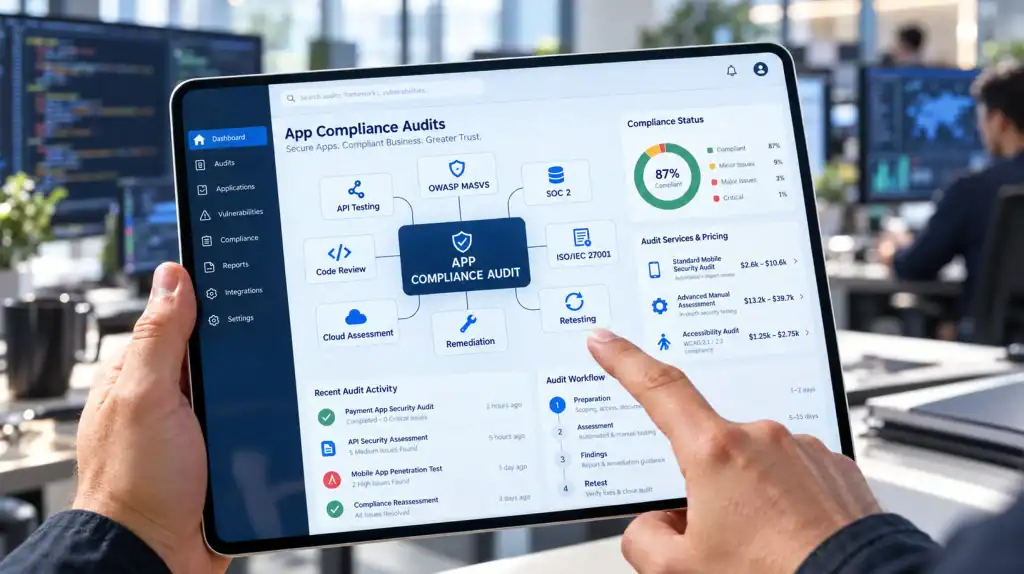
A standard mobile app security audit costs approximately $2,600 to $10,600 in one provider’s published guide. A deeper manual assessment ranges from approximately $13,200 to $39,700. Accessibility audits follow different pricing, while broader compliance services involve preparation, implementation, and ongoing support. Compare scope and deliverables before comparing fees.
Your budget starts with two questions: what must your app prove, and which systems need review?
The answers determine your assessment fee, preparation workload, and likely follow-up expenses. Application compliance requires more than purchasing a report. You also need resources to address findings and maintain the reviewed controls.
Need Help Preparing for App Audits? Talk to Cubix
Contact UsApp Compliance Audit Pricing
What Are You Paying For?
A compliance audit evaluates controls against defined requirements. Depending on scope, reviewers examine technical safeguards, policies, employee practices, and supporting records. A mobile security engagement might cover source code, APIs, cloud configuration, authentication, and data storage.
First, separate the assessment from readiness work. Compliance gap analysis identifies missing controls before a formal review. Readiness support helps your team prepare policies and evidence. External assessment evaluates the agreed controls. Implementation addresses the gaps.
Broader compliance packages often combine several activities. UnderDefense’s pricing page includes automation, consulting, policy development, remediation guidance, and audit support across its service offerings. Its published range therefore describes broader services rather than an audit-only fee.
Confirm the required outcome before requesting prices. A security findings report, accessibility assessment, SOC 2 report, and ISO/IEC 27001 certification serve different purposes. SOC 2 concerns service organization controls. ISO/IEC 27001 addresses an information security management system within a defined scope.
Audit Costs by Assessment Type
The following figures are provider-published examples, not universal market rates. Prices retain their original currencies.
| Assessment or service | Estimated cost in USD | Scope distinction |
| Automated security scan | $700 to $2,600 | Tool-led checks, rather than a complete compliance audit |
| Standard mobile security audit | $2,600 to $10,600 | Scanning, manual validation, and selected security tests |
| OWASP MASVS-based assessment | $6,600 to $19,800 | Assessment against mobile security verification criteria |
| Advanced manual assessment | $13,200 to $39,700 | Deeper specialist testing |
| Web app accessibility audit | $1,250 to $2,750 | Accessible.org’s published range for most clients |
| Broader compliance services | $70,000 to $150,000 | Wider services rather than an audit-only fee |
| Standalone privacy or regulatory review | Custom quote | Requirements, systems, specialist input, and deliverables determine scope |
Do not add every row together. These services overlap, and your application might need only selected assessments.
For privacy compliance or data protection compliance, request a scope-specific proposal. Technical testing alone does not establish whether disclosures, retention procedures, vendor arrangements, and user-rights workflows meet your applicable obligations.
Audit Pricing Tiers
Use tiers to organize scope, rather than treating every provider’s package as equivalent. The categories below are planning labels. The prices reflect the corresponding assessment categories in Suffescom’s guide.
| Planning tier | Estimated cost in USD | Assessment approach |
| Tier 1: Standard review | $2,600 to $10,600 | Selected security testing and manual validation |
| Tier 2: Standards-based mobile review | $6,600 to $19,800 | MASVS-based mobile security assessment |
| Tier 3: Advanced assessment | $13,200 to $39,700 | Detailed manual testing |
| Tier 4: Organization-wide compliance | Custom quote | Framework-specific readiness and external assessment |
A lower tier is suitable only when its coverage matches your needs. An inexpensive mobile-client review leaves unanswered questions when sensitive information moves through untested APIs.
Ask providers to explain their tier boundaries in writing. Package names reveal little about testing depth, exclusions, or reporting quality.
Costs Inside a Technical Assessment
A detailed quote should show where effort goes. Suffescom publishes these activity-level estimates. They describe components of security work, rather than guaranteed standalone prices.
| Activity | Published effort | Estimated cost in USD |
| Discovery workshop | 4 to 12 hours | $700 to $2,600 |
| Threat modelling | 8 to 20 hours | $1,300 to $4,000 |
| Secure code review | 20 to 80 hours | $2,600 to $13,200 |
| API testing | 15 to 50 hours | $2,000 to $10,600 |
| Mobile application testing | 20 to 60 hours | $2,600 to $10,600 |
| Cloud assessment | 10 to 40 hours | $2,000 to $9,900 |
| Reporting and retesting | 8 to 20 hours | $700 to $4,000 |
All figures in this breakdown come from the same provider guide. Confirm which activities overlap within your proposal before calculating a total.
An architecture assessment helps reviewers understand components, information flows, and trust boundaries. A secure code review examines implementation details. Neither replaces the policy and evidence work required for broader regulatory compliance.
What Raises the Audit Fee?
Screen count offers limited guidance. APIs, user roles, integrations, sensitive information, and cloud architecture also affect assessment effort.
| Cost driver | Question for your team | Quote detail to request |
| Platforms | Android, iOS, web, or several? | Coverage and effort by implementation |
| APIs | Which endpoints and workflows need testing? | Included services and test boundaries |
| User roles | Which permission combinations exist? | Authorization test coverage |
| Integrations | Which services receive sensitive information? | Included data-flow reviews |
| Evidence readiness | Are records complete and current? | Preparation support charges |
| Requirements | Which laws, standards, or contracts apply? | Control mapping and specialist work |
| Deadline | Is expedited delivery necessary? | Rush charges |
| Retesting | How many verification rounds are included? | Limits and additional fees |
Consider two appointment apps with similar interfaces. One displays public availability. The other handles patient records, staff permissions, and external integrations. Their assessment scopes differ despite similar screen counts.
Fixed Fees and Retainers
Request the pricing model alongside the estimate.
| Model | Budget advantage | Contract detail to check |
| Fixed fee | Defined expenditure for agreed scope | Assumptions and change charges |
| Hourly or daily billing | Flexibility during uncertain work | Rates, effort estimate, spending cap |
| Milestone pricing | Payments tied to deliverables | Acceptance criteria |
| Retainer | Planned recurring support | Included hours and services |
Your Complete Compliance Budget

Preparation Costs Before the Audit
Readiness work deserves its own budget. Assign resources for compliance gap analysis, policy review, architecture documentation, asset inventories, and evidence collection.
A governance framework should identify control owners, approval authority, and escalation routes. Internal controls need supporting records, not merely written statements.
Scrut’s compliance software guidance describes centralized evidence collection, control mapping, audit workflows, and shared records as ways to organize this work.
Estimate internal labor explicitly. For example, allocating 40 staff hours at an assumed internal rate of $75 produces a $3,000 preparation allowance. This is a planning illustration, not a market estimate.
Remediation Costs After the Audit
The assessment identifies problems. Your implementation budget pays for corrective work.
A missing permission check requires engineering changes. Outdated policies require review and approval. Incomplete access-review records require process improvements. Weak logging requires changes to the audit trail.
Security audit guidance identifies remediation, infrastructure adjustments, and retesting as expenses beyond the initial assessment.
Avoid assigning a universal price to “fixing a vulnerability.” Estimate each finding through its affected systems, engineering effort, testing requirements, and release work.
A Complete Project Budget
The following example uses hypothetical USD allocations. These numbers illustrate budgeting, rather than provider pricing.
| Budget component | Example allocation | What the allocation covers |
| Assessment | $8,000 | Agreed testing and report |
| Readiness consultant | $2,000 | Gap review and preparation support |
| Internal preparation | $3,000 | Staff time organizing records |
| Engineering remediation | $6,000 | Estimated corrective work |
| Retesting | $1,000 | Verification of completed fixes |
| Tools and specialist support | $2,000 | Defined supporting services |
| Contingency | $3,000 | Scope uncertainty and extra work |
| Total project budget | $25,000 | Combined project allocation |
The $8,000 assessment represents less than one-third of this example’s complete budget.
Replace every allocation with a quote or internal estimate before approval. Confirm whether readiness, reporting, tools, or retesting already appear inside another line item.
Accessibility Add-On Costs
Accessibility pricing offers a concrete example of separate charges.
There should be $1,250 to $2,750 for most web app audits, $350 for its WCAG-edition Accessibility Conformance Report service, and $195 per hour for technical support with a two-hour minimum.
| Service | Published charge |
| Web app accessibility audit | $1,250 to $2,750 |
| WCAG-edition report service | $350 |
| Minimum technical support purchase | $390 |
| Combined example | $1,990 to $3,490 |
The combined example adds the stated services. Development remediation remains a separate budgeting question.
First-Year and Recurring Costs
Separate setup from maintenance.
| First-year work | Recurring work |
| Initial gap analysis | Scheduled reassessments |
| Policy development | Policy maintenance |
| Evidence workflow setup | Evidence collection |
| Initial remediation | Vulnerability management |
| Monitoring configuration | Continuous compliance monitoring |
| First external engagement | Subsequent required engagements |
Reduce Duplicate Spending
Reuse evidence where requirements and review periods align. Maintain current diagrams, policies, and control records. Scrut describes shared control mapping and evidence reuse across frameworks.
Review engineering practices through Cubix’s Security Best Practices and infrastructure responsibilities through its Cloud Security Practices. Both address practices supporting preparation. Reduce repeat collection work. Preserve essential coverage.
When Your App Needs an Audit
Before Launching Sensitive Workflows
Schedule assessment before introducing sensitive records or privileged functionality. Leave time for remediation and retesting ahead of release. Pre-launch reviews appear among common security assessment triggers.
For healthcare products, establish which obligations apply before buying a generic package. Cubix’s guide to building software for healthcare hipaa compliance connects development with risk assessment, access controls, documentation, and logging.
The budget should follow those systems and responsibilities, rather than a healthcare label alone.
After Changes or Buyer Requests
Major releases and architectural changes also trigger reassessment.
| Trigger | Scope question |
| New identity provider | Which authentication flows changed? |
| Cloud migration | Which permissions and configurations changed? |
| New administrator role | Which access boundaries need testing? |
| New data integration | Where does sensitive information travel? |
| Customer assurance request | Which exact report does the buyer require? |
| Security incident | Which corrective controls need verification? |
A contained change deserves a focused scope discussion. Extensive changes require reconsidering earlier assessment boundaries.
Set a Review Schedule
Set review frequency according to applicable requirements, contracts, product changes, and regulatory risk.
Continuous compliance monitoring supports visibility between assessments through evidence checks and control monitoring. Staff still need to investigate exceptions and complete corrective actions.
Budget ongoing work separately from the next report.
Getting an Accurate Audit Quote

Define Scope Before Requesting Prices
Send every bidder the same scope document. Include platforms, APIs, environments, roles, integrations, requirements, deadlines, and reporting expectations.
State whether the engagement includes compliance documentation, control assessment, source review, cloud testing, and remediation verification.
Check Deliverables and Exclusions
Request finding severity, affected systems, supporting evidence, requirement mappings, and recommended actions. Security assessment deliverables commonly include prioritized findings, technical details, gap analysis, and remediation guidance.
Confirm the number of retests, support hours, and charges for scope changes. Establish written testing authorization and permitted environments.
Plan Engineering Support
Use Cubix’s Mobile App Security Best Practices to frame questions about development-stage security work. When choosing a custom mobile app development company, ask about documentation, code review, testing, and maintenance.
For Android-specific requirements, assess an android app development company against device coverage, integrations, and support needs. Cubix describes these capabilities within its development offerings. Keep implementation responsibilities separate from applicable auditor independence requirements.
Building a Compliant App? Let Cubix Help You
Contact UsFrequently Asked Questions
1. What is a compliance audit and what does it cover?
A compliance audit evaluates controls against selected requirements. Scope might include policies, technical safeguards, employee practices, evidence, and supporting infrastructure. An application engagement should specify whether mobile clients, APIs, cloud services, and administrative tools belong in the review. Coverage follows the agreement.
2. When should I conduct a compliance audit for my app?
Arrange a review before launching sensitive functionality, after significant releases or architectural changes, and when a customer requires assurance. Schedule enough time for preparation, fixes, and retesting. Confirm the required deliverable before booking, since different assessments answer different questions.
3. How much does a compliance audit typically cost?
Published provider estimates place standard mobile security audits at approximately $2,600 to $10,600 and advanced manual assessments at $13,200 to $39,700 after conversion to US dollars. Accessible.org lists $1,250 to $2,750 for most web app accessibility audits. Budget separately for preparation, internal labor, remediation, and additional retesting.ofx+2
4. What are the different types of compliance audits?
Relevant engagements include internal reviews, external control examinations, certification audits, security assessments, privacy reviews, and accessibility evaluations. Select the service matching your requirement. A penetration test, SOC 2 report, and ISO/IEC 27001 certification provide different forms of information and assurance.
5. What’s the difference between internal and external audits?
Internal reviews help your organization evaluate controls and prepare evidence. External engagements involve reviewers outside your organization and support the agreed assurance outcome. Qualification and independence requirements depend on the engagement. Compliance management software supports evidence requests and workflows across internal and external reviews.
6. How long does a compliance audit take?
Duration depends on scope, complexity, and readiness. Accessible.org publishes a standard two-week turnaround for its web app accessibility audits. SOC 2 Type II evaluates operating effectiveness across a defined period. Preparation, remediation, and report production require additional scheduling beyond hands-on testing.
7. What should I do to prepare for a compliance audit?
Agree on scope, assign control owners, and organize dated evidence against requirements. Review policies and resolve known gaps. Prepare diagrams, inventories, access records, and testing results. Centralized evidence collection helps teams manage requests and connect records with controls throughout the assessment.
8. What happens after the audit is complete?
Review findings, assign owners, and set corrective-action deadlines. Use remediation tracking to connect each finding with implementation and verification evidence. Retest technical fixes within the agreed scope. Update procedures where needed, then preserve the report and closure records for future reviews.
9. How often should I audit my app for compliance?
Base frequency on requirements, contracts, risk, and system changes. Add targeted assessments after material changes instead of waiting for the next scheduled review. Ongoing security checks and continuous compliance monitoring support oversight between formal engagements, without replacing the required external assessment.
10. What are the consequences of failing a compliance audit?
Consequences depend on the engagement and underlying issue. Findings require corrective work and affect the assurance available to customers. Certification outcomes follow the applicable process. Legal violations involve separate enforcement exposure. HHS describes corrective measures following investigations identifying HIPAA noncompliance. An audit finding alone does not establish a fine.