Key Takeaways
- Most companies use AI, but few scale it, so people decide the outcome.
- Employees resist what they do not understand, so explain why first.
- Pilot small, train by role, and redesign workflows before rollout.
- Measure business outcomes, not logins.
Only about one in three companies have scaled AI beyond pilots, even though 88% of firms already use it in at least one function, according to McKinsey’s State of AI 2025. AI change management closes that gap by preparing people, not just systems.
This guide shows how to get employee buy-in for AI with a clear process. You assess readiness, align stakeholders, pilot, train, redesign workflows, roll out, and measure. Each step answers a concern that employees raise, so the plan works in practice and not only on paper.
You will also see where outside support helps. For example, generative AI development teams build the tools your employees use, and change planning shapes how they use them. Both parts matter, because a great tool that nobody trusts delivers no value.
Talk to Cubix experts and plan your AI rollout today
Contact UsWhat Is AI Change Management?
AI change management is the structured process of preparing people, workflows, and policies for AI systems so employees adopt them and use them well.
It differs from a generic IT rollout in four ways:
- Judgment replaces fixed steps, because AI outputs vary and employees must evaluate results.
- Trust becomes central, since workers question accuracy, data use, and job impact.
- Work splits between humans and AI instead of moving to a new screen.
- Governance never ends, because models, data, and rules keep changing.
The table below puts the two side by side.
| Factor | Generic IT rollout | AI rollout |
|---|---|---|
| Output | Fixed and predictable | Variable and needs review |
| Training | Where to click | Judgment, limits, and prompts |
| Main risk | Downtime | Bias, privacy, and accuracy |
| Ownership | IT | Business, IT, and legal together |
| Lifecycle | Ends at go-live | Continues through iteration |
For example, a bank that adds an AI claims tool must also retrain adjusters, update approval rules, and explain how decisions get checked.
The stakes are high. RAND research finds that more than 80% of AI projects fail to deliver their intended value. That rate is about twice the failure rate of IT projects without AI.
At an enterprise scale, AI transformation change management ties each pilot to your AI transformation strategy. Pair it with enterprise digital transformation planning, so teams change together instead of tool by tool.
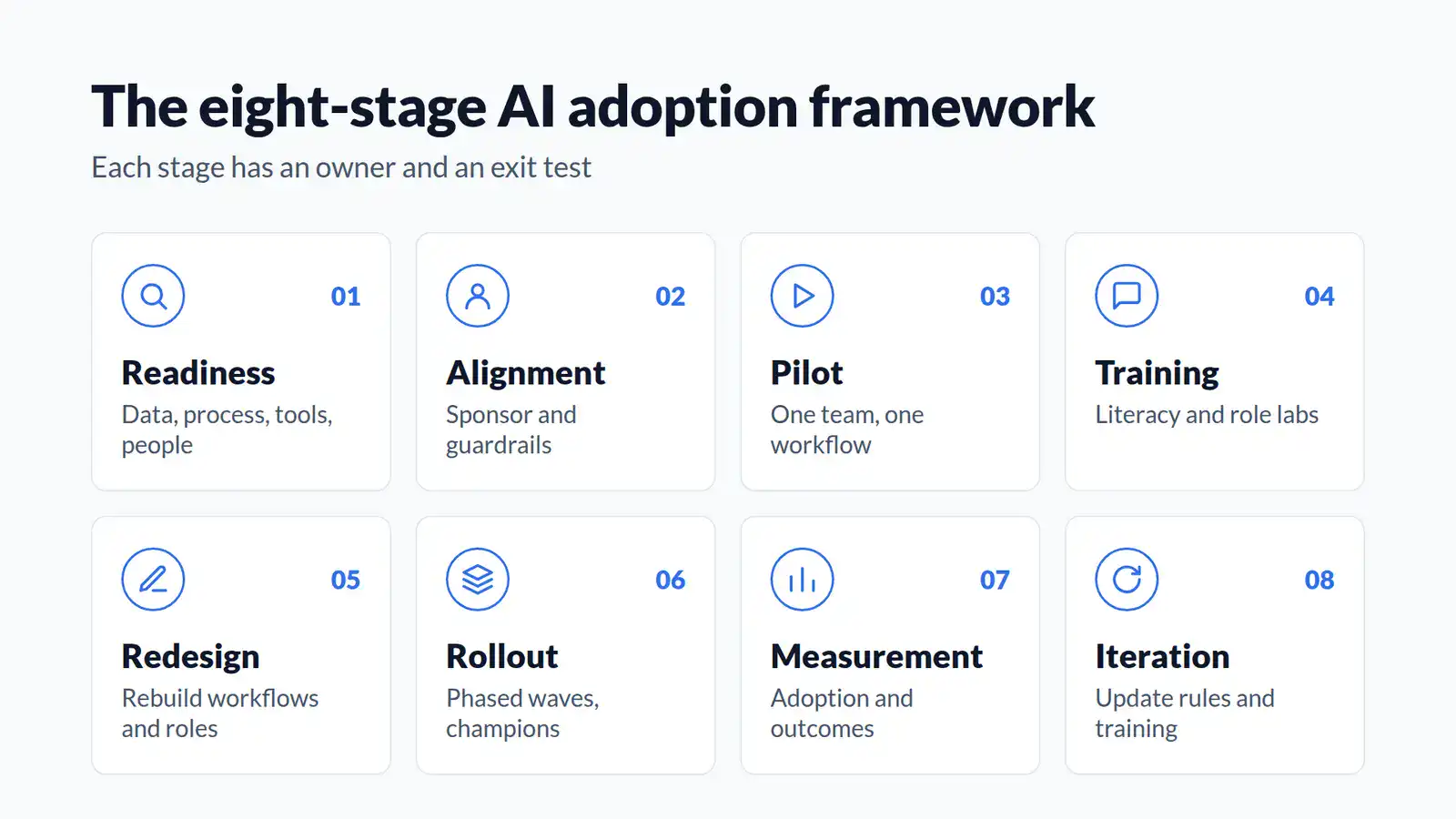
The AI change management framework in this guide has eight stages: readiness, stakeholder alignment, pilot, training, workflow redesign, rollout, measurement, and iteration.
How can AI be used in change management?
AI also supports the change process itself. Teams use it to:
- Draft announcements and FAQs
- Summarize survey feedback
- Group audiences by role and concern
- Flag groups that need extra support
However, humans still own every decision.
Why Employees Resist AI Systems (And How to Address It)
Resistance signals a clarity gap, not low interest. Gartner reports that 65% of employees feel excited to use AI at work. Yet Gallup’s fall 2025 workforce survey found that only 9% feel very comfortable using AI tools.
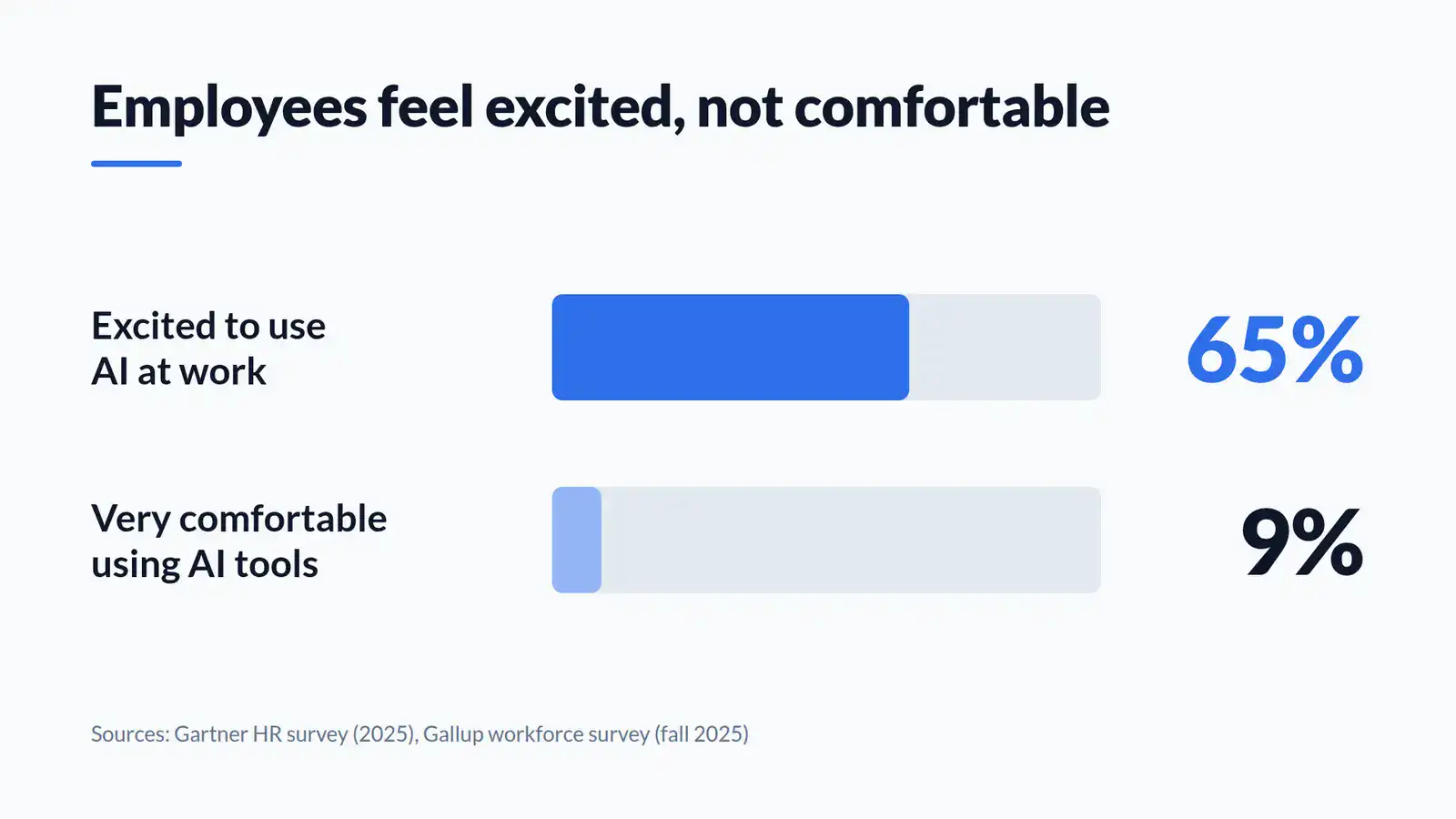
The same survey found that only about a quarter of employees say their employer has explained how to use AI in their work. Excitement is high, but guidance is thin. Gallup also found that employees who strongly agree their manager supports AI are more than twice as likely to use it often.
That gap shows how to manage resistance to AI at work. Replace uncertainty with structure, training, and clear rules.
Show Image
Job impact, workflow friction, and skills gaps
Employees raise real concerns. Take each one seriously, because each points to a design fix:
- Role redesign and task displacement
- Quality and accuracy risk in AI outputs
- Privacy and data use
- Unclear ownership when AI makes a mistake
- Skills gaps and extra workload during the switch
None of these concerns is irrational. Most come from missing facts, so share the facts early.
Low trust, unclear value, and governance uncertainty
Opaque tools and inconsistent rules fuel doubt. When employees cannot see how a model reaches an answer or who owns errors, they avoid it. A tool without a clear use case also gets ignored.
Leaders who start with managing the human side of AI remove most of this doubt early. They explain what changes, what stays the same, and who decides. Small group sessions also help, because people ask more questions there than in town halls.
Turning resistance into requirements
Convert each concern into a design constraint:
- Accuracy worry becomes a human review step before outputs reach customers.
- Job worry becomes a role map that shows which tasks change.
- Privacy worry becomes written data handling rules.
- Ownership worry becomes named owners and an escalation path.
As a result, resistance shapes the product instead of blocking it. Add each requirement to the project backlog with an owner and a due date, so it ships with the tool and not after it.
AI Change Management Framework: From Readiness to Iteration
Use this AI change management framework for enterprises as an eight-stage sequence. Each stage has an owner and an exit test. You move on only when the test passes. This keeps the plan honest, because no team skips ahead to rollout while training or policy work remains open.
1. Organizational AI readiness
Measure organizational AI readiness across data, process, tooling, and people. Check each area:
- Data: quality, access, and ownership
- Process: documented steps and clear owners
- Tooling: security, integration, and support
- People: skills, workload, and attitudes
Then pick high-impact use cases with manageable risk. A weak area becomes the first fix, not a reason to delay. This guide on how to prepare for AI integration lists the checks.
2. Stakeholder alignment and executive sponsorship
Map stakeholders and name a sponsor. Align on the why, the outcomes, and the guardrails before you announce anything. Visible executive sponsorship also keeps priorities steady when teams push back. Sponsors speak at kickoffs, remove blockers, and use the tool themselves.
3. Pilot program design and responsible AI guardrails
Run a bounded pilot program with success criteria, safety checks, and feedback loops. Limit it to one team and one workflow. As a result, you learn fast and contain risk. Write the success criteria before launch, so no one moves the goalposts later.
4. Role-based AI training for employees
Separate AI literacy (foundations, prompting, limits) from role-specific workflow training and manager coaching. AI training for employees works best when each group practices on its own tasks. A claims team, for example, trains on claims, not on generic demos.
5. Workflow redesign and job redesign
Start workflow redesign before rollout. Rebuild processes around human and AI collaboration, and remove legacy steps that block value. For example, drop a manual review that the AI check now covers. Then complete job redesign, so role descriptions match the new tasks.
6. Enterprise AI rollout best practices
Scale in phases. Use change champions, a steady communication cadence, and support channels such as office hours and playbooks. A later section covers each part in detail.
7. AI Adoption Measurement and Performance Tracking
Track AI usage, task completion rates, output quality, time saved, and employee satisfaction. Use these metrics to measure adoption, identify gaps, and evaluate overall performance.
8. Continuous Iteration and Improvement
Review AI adoption results monthly to identify gaps and gather feedback. Use these insights to refine governance, improve training, and adjust workflows. Each iteration helps make the next rollout phase smoother and more effective.
Stakeholder Alignment: Who Needs What to Say Yes to AI
Earning employee buy-in for AI means meeting each group’s needs. Each group needs different proof before it says yes.
Stakeholder table for AI adoption
| Stakeholder | Primary concerns | What they need to adopt | Success signals | Owner |
|---|---|---|---|---|
| Executives and sponsors | Return, risk, pace | Clear outcomes and guardrails | Funded roadmap, visible sponsorship | Business unit head |
| Managers | Team capacity, quality | Coaching scripts, workload clarity | Steady team use, fewer escalations | Department heads |
| End users | Job impact, accuracy | Training, safe tools, a voice | Weekly use, task completion | Team leads |
| IT and security | Data leakage, access | Approved tools and controls | No policy breaches | CIO or CISO |
| HR and legal | Fairness, compliance | Policies and role guidance | Updated policies and job descriptions | CHRO and counsel |
| AI and product teams | Adoption, feedback | Usage data and champions | Regular improvement releases | Product owner |
Treat this table as a working document. Review it with each group before the pilot starts, then update it after every wave.
Building Trust: Responsible AI Communication and Governance
AI change management earns trust through transparency, clear rules, and visible accountability. Strong responsible AI practice supports each one.
Show Image
Transparency, data use, and human oversight
Tell employees three things, and repeat them often:
- What data the system uses
- Where AI decides and where it only recommends
- How humans override results and escalate
Plain answers to these questions remove most “black box” fears. Employees accept limits they understand. For example, say that AI drafts the reply, but an agent approves it before it goes out.
AI governance and adoption policies
AI governance and adoption work as one system. Policies protect data, and guidance makes tools easy to use. Cover approved tools, data classification, retention, model risk, and incident response. Then review the guidance quarterly, so it stays current. Keep one owner for the policy set, and post it where employees already work, such as the intranet or team chat.
Escalation paths and accountability
Define who approves high-risk uses and how employees report issues. Then publish fixes, so people see that reports lead to action. Silence after a report destroys trust faster than the original error. Name an owner and a response time for every report.
AI Literacy Training: From Generic Demos to Role-Based Enablement
Here is how to improve employee adoption of AI tools: train by role, coach managers, and fix friction fast. Generic demos fade quickly, but hands-on practice on real tasks sticks. Short sessions also beat all-day workshops, because people apply what they learn right away.
1. AI foundations and prompting for change
Teach core concepts, limits, and bias. Then practice prompting on common change tasks:
- Drafting announcements and FAQs
- Summarizing survey comments
- Building rollout plans
- Preparing manager talking points
Every exercise should end with a check of the output. Employees learn to trust AI only as far as they can verify it.
2. Role-based labs and manager toolkits
Run hands-on labs by function. Sales, finance, support, and operations each use AI differently, so each lab uses that team’s real files and tasks.
Give managers scripts for 1:1s, team norms, and reinforcement, because employees look to their manager first.
3. Continuous learning and AI champions
Appoint peer advocates, hold office hours, and keep a resource library. Celebrate wins and share failures openly. When leaders admit what did not work, employees feel safe to try. A monthly show and tell, where teams demo one task they improved, keeps momentum high.
AI Change Champions: Building Peer Support
Selecting and enabling champions
Choose people with influence, credibility, and curiosity. Seniority matters less than trust among peers. Train them, and give them protected time to support their teams. Strong change champions translate rollout plans into local routines. Their duties are simple:
- Answer first questions from peers
- Collect issues and ideas
- Share quick wins in team meetings
- Escalate problems to the core team
Feedback loops and local workflow support
Set up a structured intake for issues and ideas. Triage fast, then publish what changed and why. These feedback loops show employees that their input shapes the rollout. A short weekly note with fixes and next steps is enough.
AI Adoption Metrics: Beyond Logins to Business Value
Report on enterprise AI adoption through outcomes, not activity alone. A high login count shows curiosity. It does not show value. Pair every usage number with one quality number and one business number.
Adoption KPIs that matter
Track employee AI adoption by team and role, because averages hide gaps:
- Active usage
- Task completion rate
- Time saved
- Quality and defect rates
- Satisfaction or NPS
- Support ticket volume
Together, these adoption metrics show whether employees trust and use the tool. Set a target for each KPI before launch, then review it at every wave.
Distinguishing adoption from ROI
Logins do not equal value. Strong AI change management ties adoption to outcomes such as cycle time, cost per case, revenue lift, and risk reduction.
For example, a support team that uses an AI drafting tool daily has high adoption. The business gains value only when time drops and quality holds.
Dashboards and usage analytics
Instrument workflows and review usage analytics on a fixed cadence. Then act on the signal: double down, redesign, or retire the use case. Share the dashboard with champions, so they see the same facts as leaders. Compare teams that use the tool often with teams that do not, then find out why.
How to Introduce Generative AI to Employees
Start with purpose, not features. AI workforce adoption grows when people see how a tool helps their own work. See how generative AI changes job roles before you set expectations.
1. The “why,” the “what,” and the “how”
Lead with the why and the human-centered outcome. Then show the what, a before and after view of one real workflow. Finish with the how: access, support, and limits.
Here is a simple before and after:
- Before: a support agent writes every reply from scratch.
- After: the agent reviews an AI draft, edits it, and sends it.
- Result: faster replies, and the agent still owns the final answer.
2. Safe experimentation and constraints
Publish approved tools, data boundaries, and do and don’t examples. For instance, employees review every AI draft, and they never paste customer data into public tools. Clear limits reduce anxiety and increase safe use. Add a short do and don’t list to each tool’s start page.
Offer a sandbox with sample data. People experiment more freely when mistakes cost nothing.
Enterprise AI Rollout Best Practices
Phased scaling and change waves
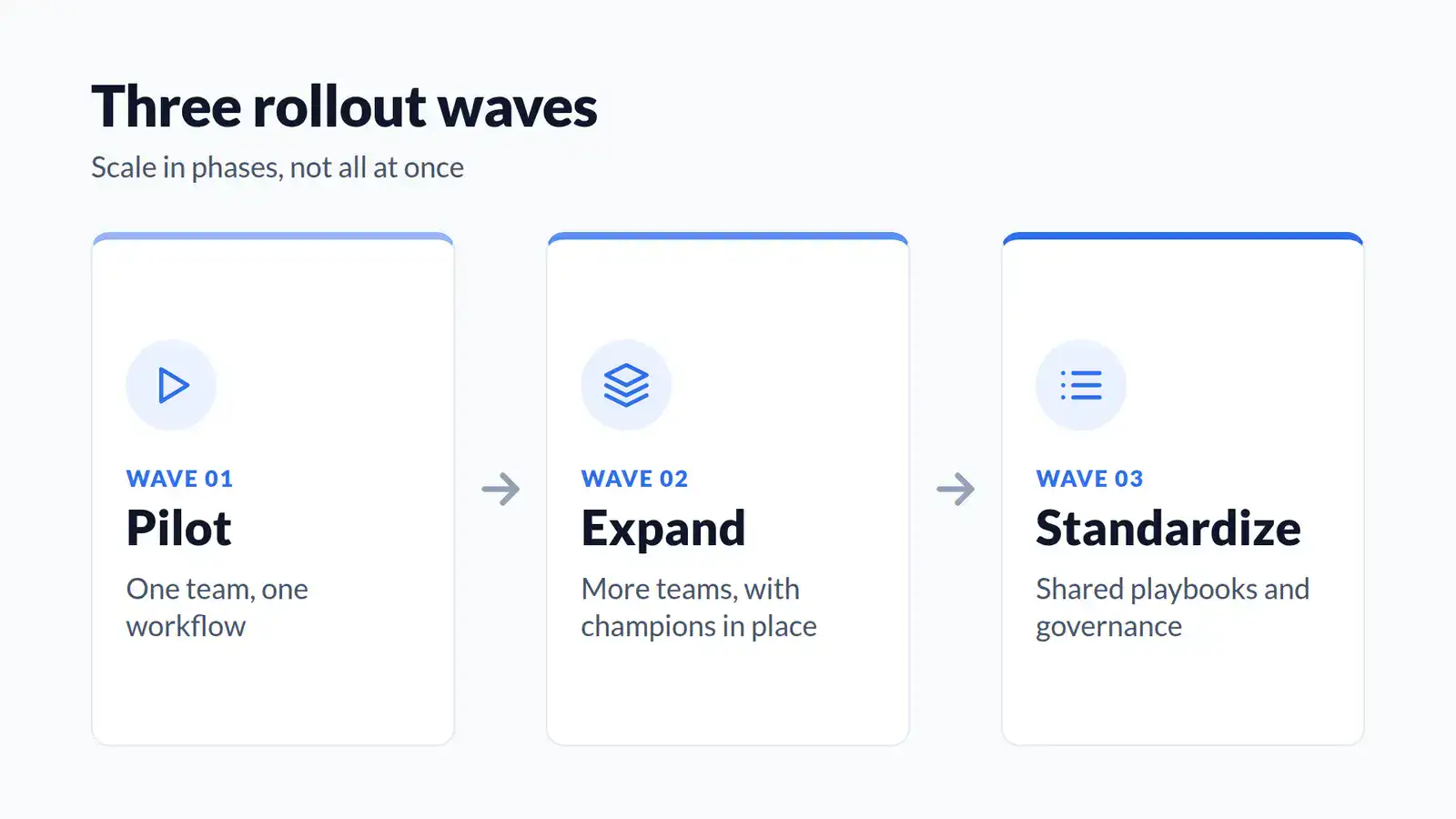
Move from pilot to expand to standardize. Align each wave with business calendars and team capacity. Plan each wave around three points:
- First wave: one team, one workflow, close support
- Next wave: more teams, with champions in place
- Final wave: shared playbooks, standard governance
Avoid launching during quarter close or peak season, because stretched teams skip training.
Communication plan and reinforcement
Build a communication plan with audience-specific messages, sponsor narratives, and manager talking points. Then reinforce a steady rhythm. One announcement does not change behavior, but repeated, consistent messages do. Use channels people already read, such as team meetings and email, instead of a new portal.
Center of Excellence and operating model
Set the center of excellence remit: standards, patterns, enablement, and governance. Then partner it with business units, so central teams support local needs. These strategies for scaling AI adoption explain the model.
Next Steps: Your AI Change Management Plan Template
Use this AI change management plan to write your AI implementation strategy on one page. Fill every line for your first pilot, then reuse it for each wave.
- Use cases: one to three with clear value and low risk
- Sponsor and owner: name both
- Guardrails: data rules, approved tools, escalation path
- Pilot: team, scope, duration, success criteria
- Training: literacy, role labs, manager coaching
- Workflow changes: steps removed and steps added
- Communication: audiences, messages, cadence
- Metrics: adoption and outcome measures with review dates
A written AI adoption strategy keeps every team on the same plan. It also gives new leaders a clear record of past decisions. Review the plan after each wave and record what changed.
CTA: Talk to Cubix experts and plan your AI rollout today.
How Cubix Accelerates AI Change Management and Employee Buy-In
Cubix builds AI systems and plans the change around them. As an AI agent development company, it designs agents with human review and escalation steps, so employees keep control.
The delivery approach covers:
- Discovery and readiness analysis of goals, processes, and data
- Custom model and agent builds
- Testing and validation before launch
- Integration, maintenance, and support after launch
Each stage gives employees something concrete to see. Early demos use real company data, so teams judge the tool on their own work. They learn how the tool works, who owns it, and where to get help. This visibility builds trust from the first demo. Teams also receive clear handoff notes, so your own staff can run and improve the system after launch.
Its machine learning development services cover model training, validation, and ongoing monitoring. Therefore, your pilot results stay reliable as data and usage grow.
Book a free consultation and turn AI pilots into results
Contact UsFrequently Asked Questions
1. How do you get employees to adopt AI?
Follow the full playbook: assess readiness, secure sponsors, run a pilot, train by role, redesign workflows, and track outcome metrics. Employees adopt tools that are safe, useful, and clearly explained. They drop tools that feel forced or confusing.
2. How should companies introduce AI to employees?
Lead with transparency, co-design workflows with users, and offer role-based enablement. Explain what the tool does, what data it uses, and where humans stay in charge. Then give people time to practice.
3. What should an AI adoption plan include?
Include use cases, governance, training, communication, metrics, and risk controls. Name an owner for each section and set review dates. Keep the plan to one page, so busy leaders actually read it.
4. How do you measure AI adoption?
Track adoption metrics such as active use and task completion, then link them to outcomes like cycle time and cost per case. Review both every month, and share the results with the teams that produce them.
5. How can leaders build trust in workplace AI?
Keep humans in charge of high-risk decisions, publish clear data rules, and follow through on reported issues. Consistency builds trust faster than promises. Leaders also earn trust when they use the tools in public.
6. How AI Is Transforming Change Management
AI now drafts messages, reads sentiment, tailors training, and flags which teams need support. Leaders still own decisions and keep employees informed.