Key takeaway
- The AstraZeneca and Oracle AI partnership is a non-binding term sheet announced on October 20, 2026. It sets a plan to explore AI use cases, not a finished product.
- The first focus areas are clinical trial recruitment, earlier diagnosis, drug-safety monitoring, and real-world evidence.
- The first program targets uncontrolled hypertension in Abu Dhabi with M42.
- The work uses de-identified data. AstraZeneca receives no patient-identifiable information.
AstraZeneca and Oracle Health and Life Sciences plan to explore whether AI and real-world data can address a long-standing problem in medicine: patients are often diagnosed late, and eligible patients may never learn about a clinical trial that fits their condition. The collaboration is exploratory, so its results will depend on successful pilots and clinical validation.
The agreement combines AstraZeneca’s scientific, clinical development, and regulatory expertise with Oracle’s real-world data, cloud infrastructure, and AI tools. It covers trial recruitment, earlier diagnosis, drug-safety monitoring, and care pathways. Programs will span the US, the Middle East, and Europe.
This guide explains what the companies announced, how the technology is meant to work, and what to watch next. Healthcare teams that want to build similar tools need clinical knowledge and engineering depth. A trusted AI Software Development Company can help you turn data and models into working clinical software.
What Is Confirmed vs. Still Unknown
Confirmed:
- AstraZeneca and Oracle Health and Life Sciences announced a non-binding agreement on October 20, 2026.
- The first program focuses on hypertension care and clinical research in Abu Dhabi with UAE-based healthcare company M42.
- The work uses de-identified real-world data. AstraZeneca will not receive patient-identifiable information.
Still unknown:
- Financial terms, pilot duration, launch dates, named AI models, and results have not been disclosed.
- The agreement is exploratory. It does not confirm that a product or platform will be launched.
Why Clinical Trial Recruitment Is a Major Bottleneck
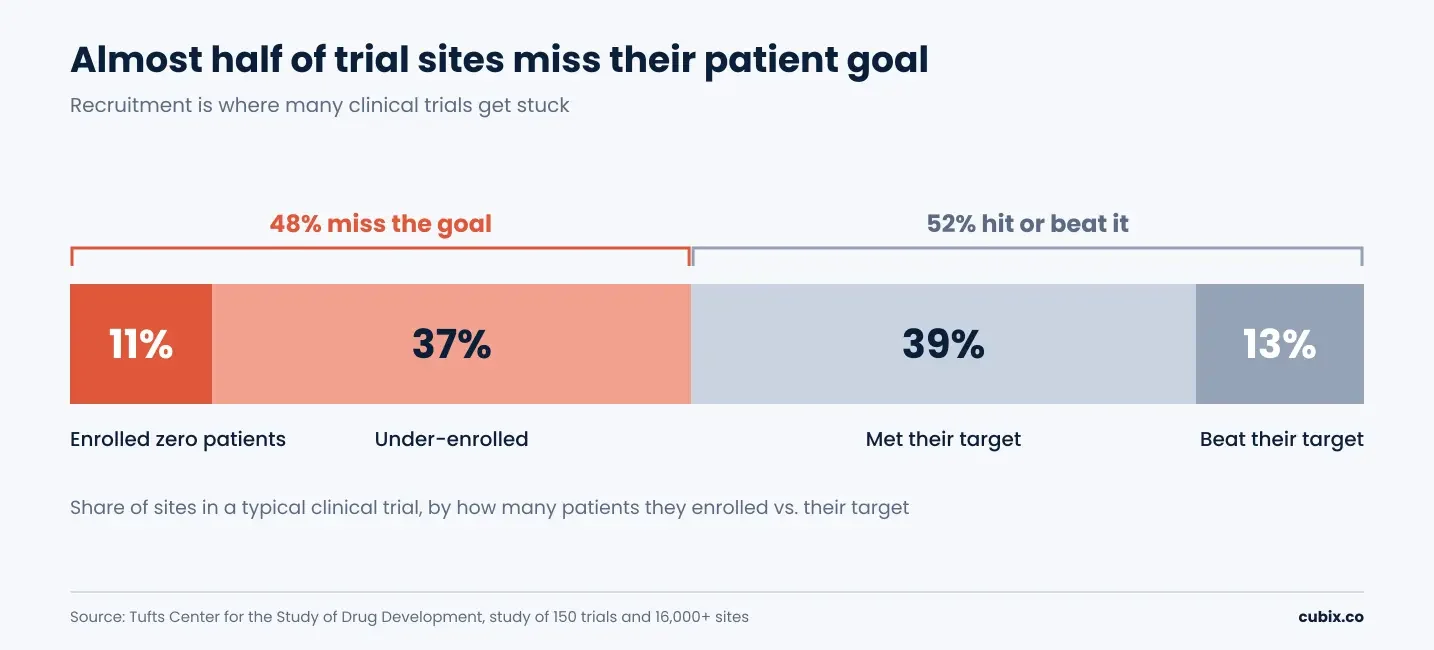
Finding the right patients is one of the hardest stages of clinical research. Oracle describes patient recruitment as one of the largest obstacles in clinical trials. Strict eligibility rules and scattered data create clinical trial recruitment challenges at every step.
Look at the chart above. Only 39% of sites hit their enrollment goal and 13% go beyond it. The rest fall short. And even when a trial does reach its goal, it can take far longer than planned. Tufts researchers found that reaching enrollment goals could mean doubling the original timeline.
Why Eligible Patients Are Often Missed
Several problems stack up. Each one hides patients who would qualify.
- Fragmented medical records: data sits in separate hospital, lab, and clinic systems.
- Complex eligibility rules: trials list many inclusion and exclusion criteria that are hard to check at scale.
- Late diagnosis: patients often reach specialists after the best window for a study has passed.
- Limited patient awareness: many patients do not know which trials exist for their condition.
- Manual screening: staff check records by hand, so many candidates never get reviewed.
How Manual Screening Slows Trials
Clinicians and research teams often read large volumes of records to decide if one patient qualifies. They check notes, lab values, diagnoses, and medication lists. This work takes hours, and it competes with patient care. As a result, screening becomes the slowest step in clinical trial patient recruitment.
The Impact on Patients and Research
Slow recruitment has real costs.
- Delayed studies: In one CenterWatch survey, hundreds of research sites said up to 90% of trials run past their original timeline.
- Higher costs: Every extra month adds to the cost of a study.
- Weaker results: A study of 2,542 surgical trials found that only 14.6% finished both on time and with full enrollment.
- Slower access: Patients wait longer for new treatments.
What the AstraZeneca and Oracle AI Partnership Covers
Start with the facts. The companies signed a non-binding term-sheet agreement to explore selected AI use cases. It is not a finished platform, and it does not guarantee a rollout. Neither company disclosed financial terms. The collaboration will span several international projects. Each one will work with local governments and within applicable regulations.
1. AstraZeneca’s Role in the Collaboration
AstraZeneca contributes three things.
- Scientific and therapeutic expertise across its major disease areas
- Clinical development knowledge
- Regulatory experience
2. Oracle’s Role in the Collaboration
Oracle Health and Life Sciences brings the technology and data side.
- Real-world data and health data
- Cloud infrastructure
- AI and analytics
- Clinical workflow tools
Data scale matters here. Pharma teams already know both the promise and the limits of large data sets, as this look at big data in the pharmaceutical industry shows.
3. Initial Areas of Exploration
- Clinical trial recruitment
- Earlier diagnosis
- Drug-safety monitoring
- Real-world evidence across a medicine’s lifecycle
- Guideline-directed care and improved care pathways
The AstraZeneca and Oracle AI partnership also plans shared governance, reusable technical components, and agreed outcome measures. These let both companies judge results and decide whether a successful approach can scale across disease areas and regions.
4. Disease Areas Included in Early Work
- Oncology
- Cardiovascular, renal, and metabolic diseases
- Respiratory and immunology
- Rare diseases
These areas match AstraZeneca’s core therapy areas.
How AI Could Improve Clinical Trial Recruitment
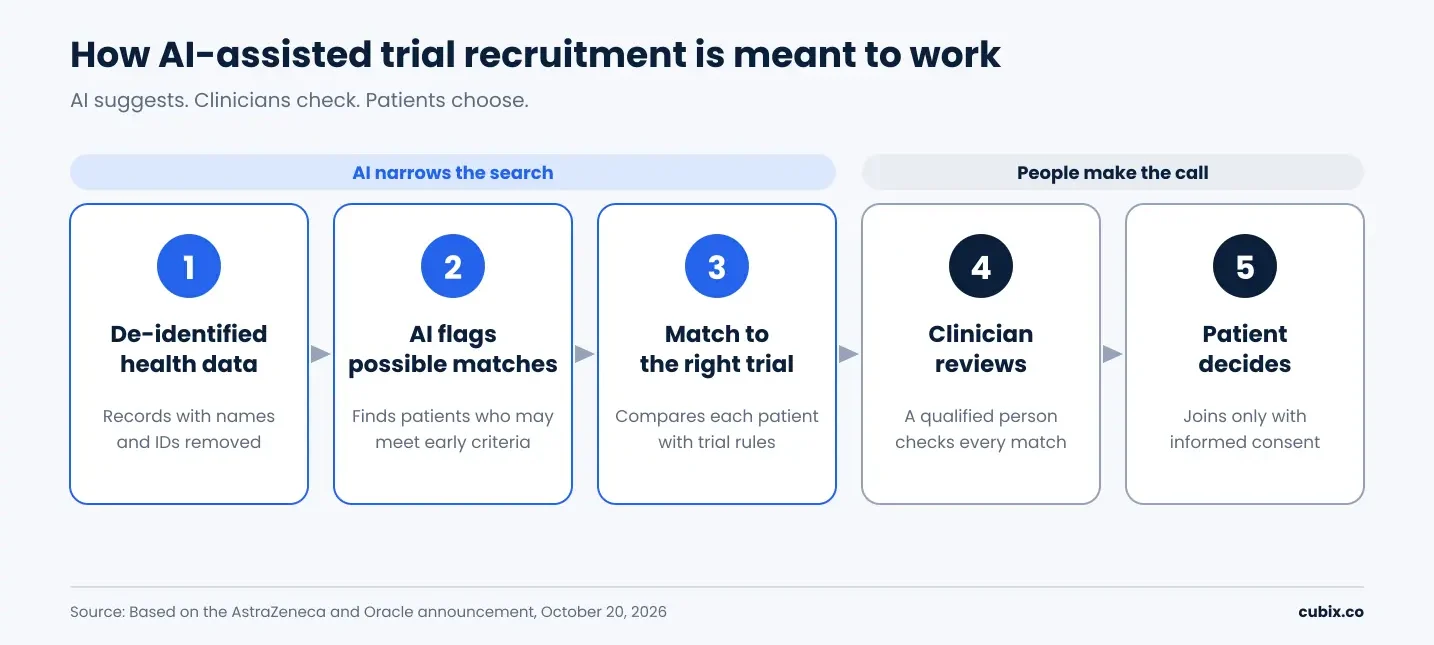
Oracle says the goal is to help care teams identify eligible patients earlier and with less effort. The companies call this an exploration, so treat the steps below as the intended workflow, not proven results. In practice, AI in clinical trial recruitment follows a clear sequence from data review to human decision.
1. Identifying Eligible Patients Earlier
AI models review de-identified records and flag patients who appear to meet preliminary eligibility criteria. Using real-world data in clinical trials lets teams find candidates in routine care instead of waiting for referrals. Earlier flags give patients more time to join a study.
2. Matching Patients to the Right Trials
AI patient matching compares a patient’s characteristics with each trial’s criteria. Then it surfaces the studies that fit. Inputs include diagnosis, lab results, medications, and clinical history. The care team gets a short list instead of a blank search.
3. Reducing Manual Chart Review
Automated pre-screening helps research teams decide where to spend their time. The system ranks likely candidates, and staff then confirm each one. Consequently, people review fewer irrelevant charts and focus on patients most likely to qualify.
4. Supporting Clinicians, Not Replacing Them
The AstraZeneca and Oracle AI partnership keeps people in charge of every decision. Qualified professionals review proposed matches. Patient contact and enrollment follow approved study procedures and documented informed consent. AI narrows the search, and clinicians make the call.
5. Improving Diversity and Access in Trials
Broader, data-driven matching can reach patients who do not know a relevant trial exists. Oracle says the work aims to broaden access to clinical trials. A search across many health system records reaches patients outside major research centers.
The First Program: Hypertension Care in Abu Dhabi
The first project runs in Abu Dhabi with M42, a UAE-based healthcare company. M42 was formed by G42 and Mubadala and combines technology, data, and care delivery. The program focuses on uncontrolled high blood pressure. It has three goals: find patients whose blood pressure isn’t under control, support guideline-based care, and improve trial recruitment.
1. Identifying Patients With Uncontrolled Hypertension
AI-enabled tools help clinical teams find patients whose blood pressure stays above target. Routine care data already holds the signals, such as repeated readings and medication history. The tools aim to bring those signals together in one view.
2. Supporting Guideline-Directed Care
Finding a patient is only the first step. The program also aims to help ensure patients receive care that matches clinical guidelines. A typical use is a prompt that asks a clinician to review treatment when readings stay high.
3. Connecting Care Teams With Research Teams
The same workflow helps authorized research teams assess potential participants for selected hypertension studies. Care and research then share one data foundation instead of running as separate processes.
4. Why Hypertension Is a Strong First Use Case
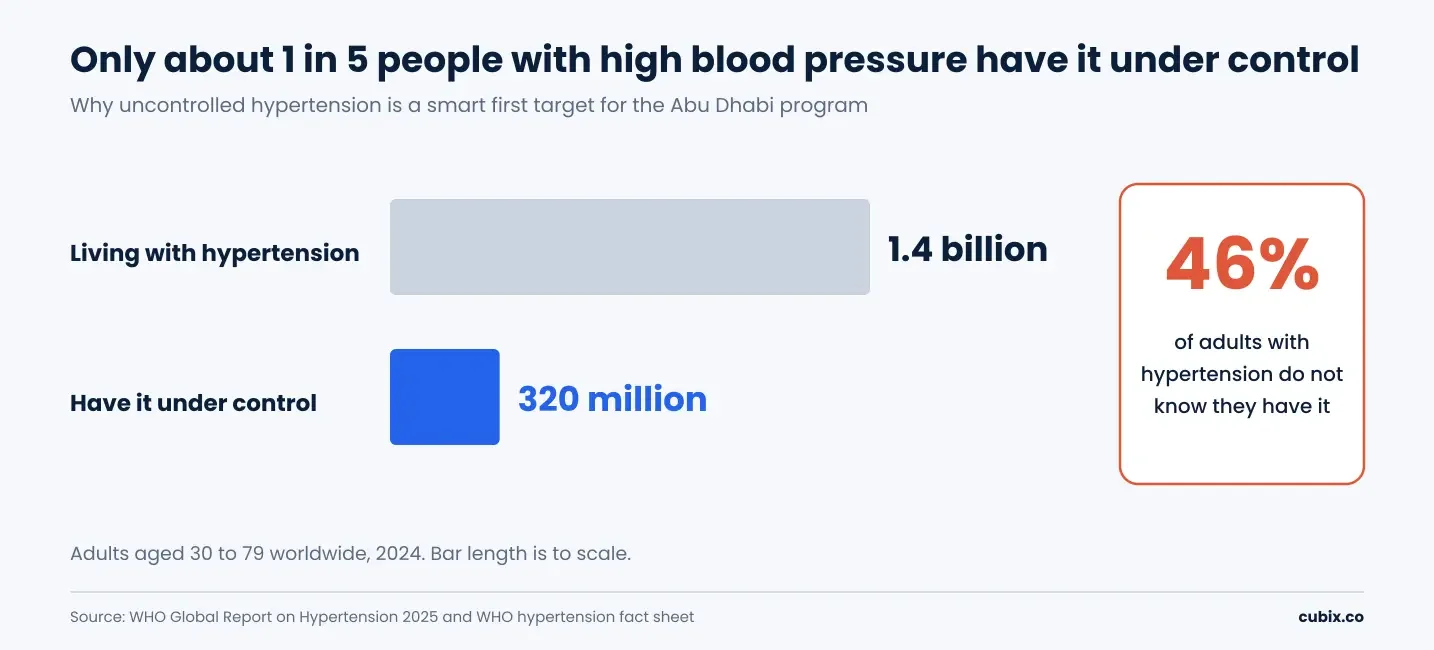
- It’s very common. The WHO reports that 1.4 billion people lived with hypertension in 2024, but only a little over one in five have it under control. That’s enough patients to measure real results.
- Many people don’t know they have it. WHO’s 2025 report puts the share of adults with hypertension who are unaware of it at 46%. Earlier detection could make a big difference.
- It’s easy to measure. Blood pressure is checked at normal visits. Connected devices add even more data, as these IoT applications in healthcare show.
- The guidelines are clear. Defined targets make it easy to see if care meets the standard.
- The payoff is huge. WHO’s Director-General said controlling hypertension in just half of affected people could prevent 76 million deaths by 2050.
What This Means for Patients
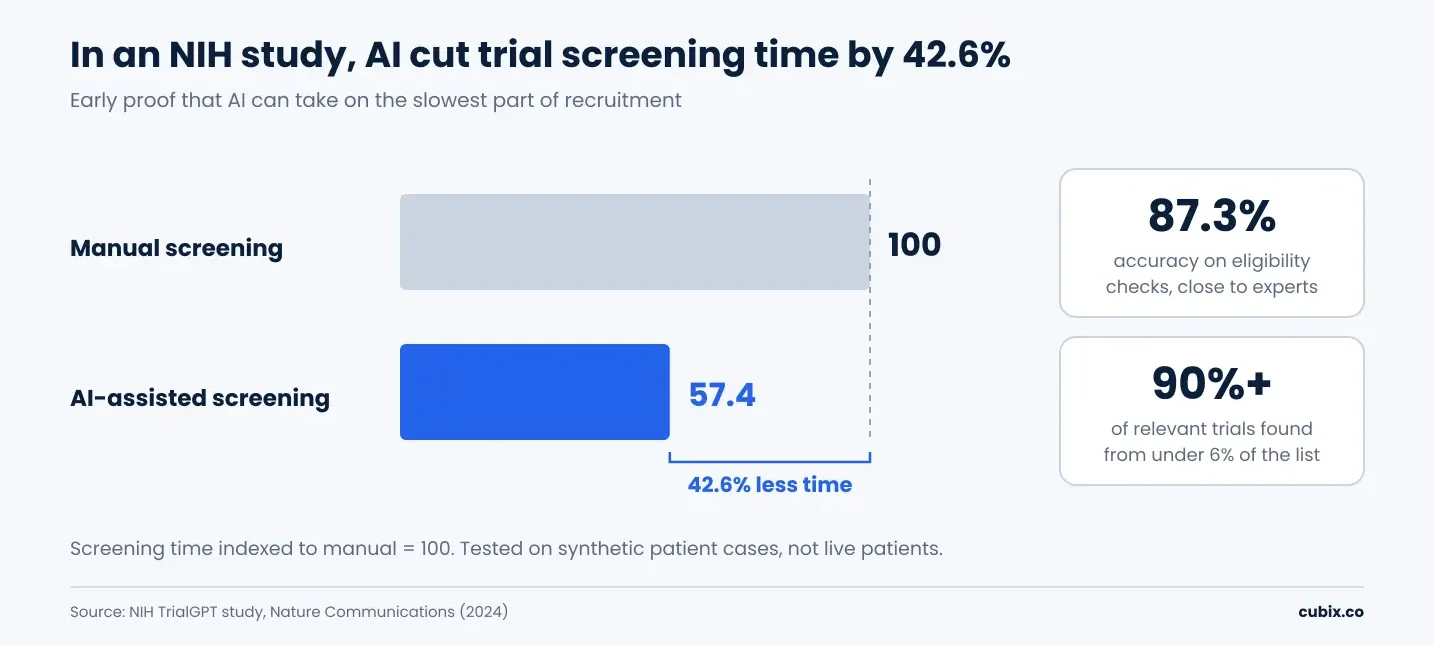
Is there any proof AI can actually speed up screening? Early signs say yes. In an NIH study, the TrialGPT tool cut screening time by 42.6%, reached 87.3% accuracy on eligibility checks, close to expert level, and found over 90% of relevant trials while searching less than 6% of the full list. One caveat: it was tested on synthetic patients, not live hospital data. It’s also a separate project, not part of this partnership. Still, it shows what’s possible. .
1. Earlier Diagnosis and Referral
The AstraZeneca and Oracle AI partnership responds to late diagnosis and long referral journeys. It brings research insights into care workflows, so clinicians see relevant signals during routine visits. Oracle’s CEO sees AI in healthcare as a major route for turning science into better outcomes.
2. Better Awareness of Relevant Clinical Trials
Improved matching helps more patients learn about trials that fit their condition. If you live with a condition that has active studies, you hear about them sooner. Your care team can then discuss your options.
3. More Personalized and Evidence-Based Care
Real-world evidence shows how treatments perform in everyday practice. Care teams can use that evidence to support treatment decisions and refine care pathways for patients like you.
4. Stronger Safety Monitoring After Treatment
Safety does not end at approval. The companies plan to apply AI and real-world data to track safety signals across a medicine’s lifecycle. Reliable AI drug safety monitoring helps teams spot patterns earlier and act on them.
What This Means for Clinicians and Health Systems
The operational value centers on three things: less manual work, better data use, and tighter links between care and research.
1. Research Insights Inside Clinical Workflows
The goal is to place evidence-driven insights inside the systems clinicians already use. That approach avoids extra logins and separate dashboards. It also fits the wider push toward digital transformation in healthcare.
2. Less Administrative Burden for Research Teams
AI-assisted pre-screening replaces repetitive record review. Coordinators spend less time searching and more time talking with patients. This is where clinical trial optimization delivers its most direct gain.
3. A Continuous Learning Model
The companies intend to explore a model where insights from research and routine care inform future study design, safety monitoring, and patient care. This loop links everyday practice to AI in pharmaceutical research. Each result feeds the next study.
4. Better Collaboration Between Care and Research
Shared workflows help hospitals connect routine care with research opportunities. Under the AstraZeneca and Oracle AI partnership, health systems keep governance over how their data is used. Oracle’s Seema Verma stressed that the work happens under the governance of the health systems delivering care.
Privacy, Governance, and Ethical Safeguards
Trust depends on how the companies handle data. The announcement sets firm limits.
1. Use of De-Identified Real-World Data
The collaboration uses de-identified real-world data within governance, privacy, and security arrangements. De-identification removes details that point to a specific person before analysts see the data. Health systems stay responsible for their records.
2. No Patient-Identifiable Data for AstraZeneca
AstraZeneca will not receive patient-identifiable information. In the US, related software must also meet privacy law. That is why guides on HIPAA-compliant healthcare software matter for teams building similar tools.
3. Project-Level Legal and Ethical Review
Each proposed project gets its own review. A project proceeds only after legal, privacy, regulatory, ethical, and institutional safeguards are in place. This case-by-case rule protects patients. It also lets the AstraZeneca and Oracle AI partnership adapt to local laws in each region.
4. Informed Consent and Patient Rights
Patient contact and enrollment follow approved study procedures and documented informed consent. No algorithm enrolls anyone. You decide whether to join a study.
Key Challenges to Watch
The announcement is an early step. Five issues will shape whether it works.
1. Data Quality and Interoperability
Records differ across hospitals in format, coding, and completeness. AI results are only as reliable as the data behind them. Teams need standard formats and clean data pipelines before matching tools produce dependable output.
2. Clinical Validation in Real Settings
A model that performs well in a test can fail in a busy hospital. The companies must measure accuracy on real patient populations. Their plan to agree on outcome measures addresses this directly.
3. Regulatory and Privacy Compliance
Rules differ across the US, the Middle East, and Europe. Each project must satisfy local law. Scaling therefore takes careful legal work in every region.
4. Clinician Trust and Workflow Adoption
Clinicians use a tool only if it saves time and earns trust. Alerts that interrupt work or produce false matches get ignored. Teams often need custom healthcare software development to fit tools into existing workflows.
5. Avoiding Bias in Patient Matching
If training data underrepresents some groups, matching tools miss those patients. Teams must test results across age, sex, ethnicity, and region. Then they must correct any gaps.
How Cubix Can Help Healthcare Teams Build AI-Powered Clinical Trial Solutions
Hospitals, research organizations, and life sciences companies can build tools similar to those in this announcement. The work needs strong data engineering, clinical validation, and privacy controls. Cubix supports teams in two areas.
- Cubix builds AI healthcare solutions such as eligibility pre-screening, patient matching models, and safety signal dashboards that connect to existing systems.
A typical build follows five steps.
- Map data sources and set de-identification rules.
- Build pre-screening and matching models.
- Add clinician review steps and audit logs.
- Validate results on real patient groups.
- Monitor performance and fix model drift after launch.
Patients and staff also need simple ways to use these systems. Cubix delivers healthcare mobile app development for trial discovery, consent tracking, and care team alerts.
Conclusion
The AstraZeneca and Oracle AI partnership is an early but concrete attempt to link research and routine care. Its first test, hypertension in Abu Dhabi, gives clear measures of success. The model keeps clinicians in charge, relies on de-identified data, and requires review for every project.
Watch three things next: pilot results, the agreed outcome measures, and expansion beyond the first region. If those results hold, trial recruitment speeds up and reaches more patients.
Build AI-powered healthcare solutions with Cubix’s expert development team
Contact UsFAQs
1. What is the AstraZeneca and Oracle AI partnership?
It is a non-binding agreement announced on October 20, 2026. The companies plan to explore AI and real-world data for trial recruitment, earlier diagnosis, safety monitoring, and better care. It is not a finished platform.
2. How could AstraZeneca and Oracle use AI to recruit clinical trial patients?
AI reviews de-identified real-world data, flags patients who appear to meet preliminary criteria, and matches them to relevant studies. Qualified professionals review the matches before any patient contact.
3. What is the first project under the AstraZeneca and Oracle collaboration?
The first program supports hypertension care and clinical research in Abu Dhabi with M42. It targets uncontrolled hypertension, guideline-directed care, and trial recruitment.
4. Which diseases will the AstraZeneca and Oracle AI collaboration focus on?
Early work spans oncology, cardiovascular, renal and metabolic diseases, respiratory and immunology, and rare diseases.
5. Will AstraZeneca receive patient-identifiable data through the partnership?
No. AstraZeneca will not receive patient-identifiable information. The work uses de-identified data under governance, privacy, and security arrangements.
6. Will AI decide who can join a clinical trial?
No. AI flags and ranks candidates. Qualified professionals review matches, and enrollment follows approved study procedures and documented informed consent.
7. How could patients benefit from AI-assisted clinical trial recruitment?
Patients can find relevant trials sooner. Care teams can also act on earlier diagnosis and safety signals. These benefits depend on successful pilots.