Key Takeaways
- Manual testers catch fun, feel, and odd bugs that scripts miss.
- Automation runs repeat checks fast. Start with smoke and regression tests.
- Exploratory testing still matters, even in studios with strong automation.
- Automate stable features. Test new and changing ones by hand.
- Start small. Audit your tests, pick a few, and run them each build.
In 2023, Sauce Labs asked 500 U.S. gamers about bugs. 74% said they avoid studios that shipped a buggy game before. One rough launch can follow a studio for years.
So teams argue about automated vs manual game testing. One side wants machines to check everything. The other side trusts human testers more. Both sides are half right. Most strong studios use a mix. That mix shifts over time.
This guide keeps things simple. You will learn what each method does best. You will see what to automate first. You will see what people should own. You will also learn how to track results. There are tables, charts, and a checklist at the end.
Balance manual and automated game testing with Cubix experts today
Contact UsWhat Is Manual Game Testing?
Manual game testing means real people play and hunt for problems. They follow test cases, but they also poke around. The same survey asked developers about release pressure. 79% said pressure to ship unfinished games rose over five years. QA feels that pressure first.
What manual testers do
- Play the game on real devices and consoles
- Follow written test cases step by step
- Log bugs with clear steps, screenshots, and video
- Retest fixes before a build moves on
- Share notes on what felt confusing or unfair
Where manual testing works best
- Fun factor: A script cannot tell you a level that feels boring.
- Usability: Humans notice unclear menus and awkward controls.
- Visuals and audio: Flickering textures and clipped sound need human eyes and ears.
- New features: Fresh code changes often, so people adapt faster than scripts.
Where it falls short
- It is slow when the same checks repeat every build.
- Tired testers miss things, especially late in a long cycle.
- It is hard to scale across dozens of devices.
- Costs grow in step with every new platform you add.
What Is Automated Game Testing?
Automated game testing uses scripts and bots to run checks. No person needs to click. It shines at repeat work. Still, many teams struggle to get it right. The World Quality Report 2024-25 surveyed 1,750 organizations. 57% named a missing automation strategy as a barrier.
What automated testing means
Think of it as a robot tester. You teach it a task once. It then repeats that task on every build, day or night. It never gets boring. It also never judges whether the game is fun.
What studios usually automate
- Build checks: Does the game even launch after each commit?
- Smoke tests: Can a player reach the main menu and start a match?
- Save and load: Does progress survive a restart?
- UI flows: Login, shop, settings, and tutorial screens
- Performance: Frame rate, load time, and memory over a set route
- Regression suites: Old bugs stay fixed after new code lands
Popular game testing tools
Tools fall into a few groups. Pick the group first. Pick a brand second.
Game testing tool types
| Tool type | What it does | Best use case | Example names |
|---|---|---|---|
| Engine test frameworks | Run code and play-mode checks inside the engine | Unit tests and gameplay logic | Unity Test Framework, Unreal Automation System |
| Mobile UI automation | Taps and swipes through menus on devices | Login, shop, and settings flows | Appium |
| CI servers | Build the game and run tests on every commit | Nightly builds and smoke tests | Jenkins, GitHub Actions |
| Bots and AI agents | Play the game on their own | Balance checks and crash hunting | Custom in-house bots |
| Device farms | Rent many real phones in the cloud | Device matrix coverage | Cloud device services |
| Bug trackers | Log, rank, and assign defects | Triage and reporting | Jira |
Automated vs Manual Testing Compared
Bad quality is expensive. CISQ estimated bad software cost the U.S. $2.41 trillion in 2022. The report also calls bug fixing the biggest single development expense. That number covers all software, not only games. Still, the lesson holds for studios.
Side-by-side comparison
Automated vs manual game testing
| Factor | Automated testing | Manual testing |
|---|---|---|
| Speed | Fast, can run overnight | Slower, limited by staff hours |
| Repeat accuracy | Same steps every time | Drops with fatigue |
| Upfront cost | Higher (tools and setup) | Lower |
| Ongoing cost | Script maintenance | Pay for each testing hour |
| Scalability | Easy to run on many builds and devices | Needs more people |
| Creativity | None | High |
| Finds “fun” problems | No | Yes |
| Finds surprise bugs | Rarely | Often |
| Best for | Regression, smoke, performance | Exploratory, usability, new features |
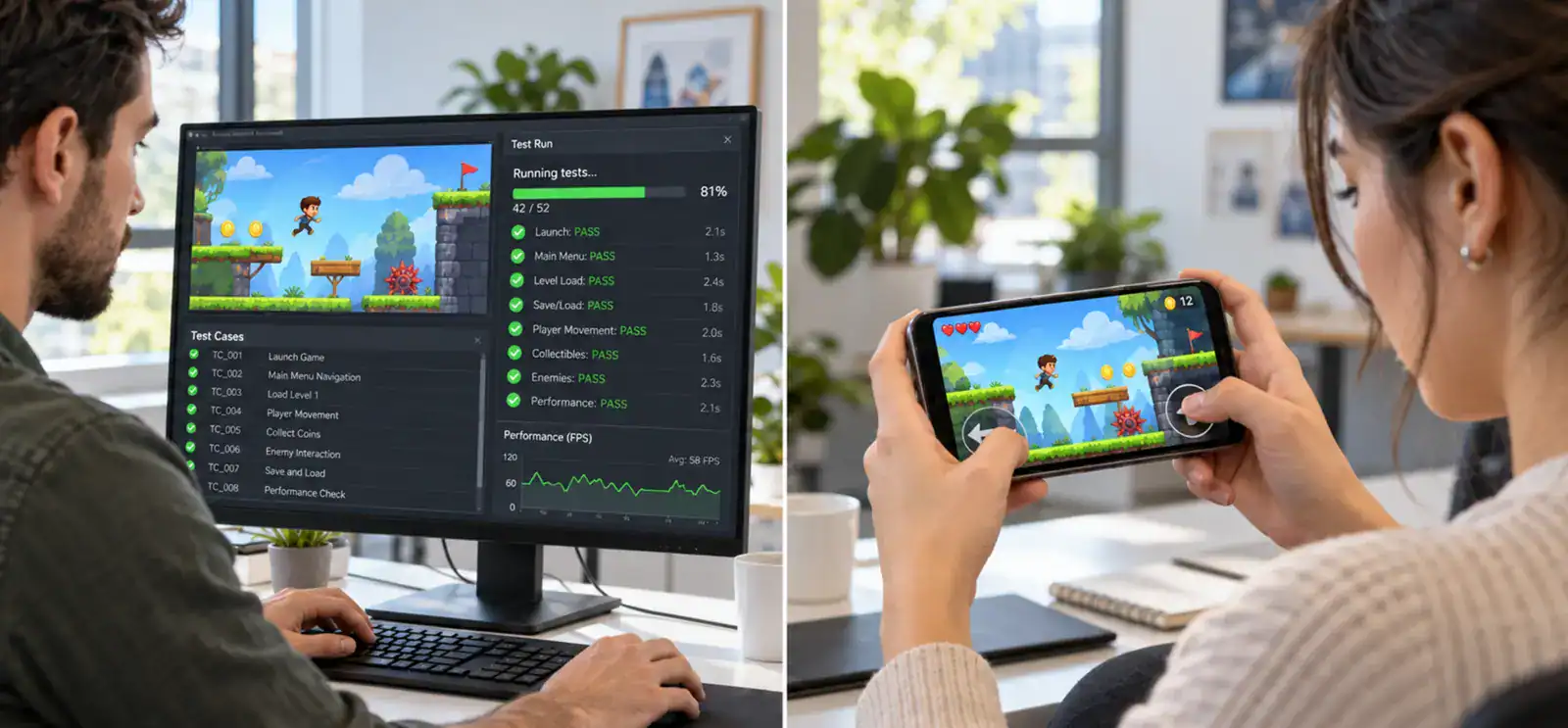
Many studios bring in a testing partner like Cubix. The partner runs both methods side by side. In-house teams stay focused on building.
Quick decision guide
Choose automation when:
- The same check runs on every build
- The feature is stable and rarely changes
- You need results across many devices
- A bug would be costly if it slipped through
Choose manual testing when:
- The feature is new or still changing
- You need to judge feel, difficulty, or pacing
- You want someone to try odd things on purpose
- The check will only run once or twice
What to Automate First
Start where machines beat people: repeat work. Google’s testing team suggests a rough 70/20/10 split. That covers unit, integration, and end-to-end tests. They also say it is not a strict rule. Use it as a starting point.
Regression testing
Regression testing checks that old features still work after new code. It is boring, repeat work. That makes it perfect for machines. A good suite spots a broken shop before players do.
The game testing pyramid
The pyramid has three layers:
- Unit tests (base): Small, fast checks on single pieces of code, like damage math.
- Integration tests (middle): Checks on how systems work together, like inventory plus shop.
- UI and gameplay tests (top): Full player flows. These are slow and break easily.
CI automation example
CI means continuous integration. Each code commit triggers an automatic check. Here is a simple flow:
Code commit → Build → Smoke test → Report → Fix
- A developer pushes code.
- The CI server builds the game.
- A smoke test launches it and walks to the main menu.
- The result lands in chat or a dashboard.
- The team fixes failures before anyone else pulls the build.
Unity documents running its test framework from the command line. That lets CI servers trigger it. Cubix lists Jenkins among the technologies it works with. Studios that want help can explore professional game testing services.
When to Test Manually
Machines follow orders. People get curious. Sauce Labs also asked about refunds. 33% of gamers had requested one for a broken game. Many problems come from odd player behavior. Humans find those first.
Exploratory testing
Exploratory testing means testing without a script. The tester learns the game while hunting for trouble.
- Find the unexpected, like walking through a wall
- Hit edge cases, like buying an item with exactly zero coins
- Play like a real player, including mistakes and impatience
- Follow hunches when something feels off
Usability and game feel
- Controls: Do they feel responsive on touch, pad, or keyboard?
- Difficulty: Is level three a fair jump from level two?
- Pacing: Does the first ten minutes hook a new player?
- Fun: Would a friend keep playing?
Early and changing builds
Automating an unstable feature wastes time. The script breaks every time a designer moves a button. Test new features by hand first. Automate once the design settles.
Why Automated Tests Become Flaky

A flaky test passes and fails on the same code. Nothing changed, yet the result did. It is one of the most annoying problems in automation. Google shared two telling numbers. About 1.5% of its test runs were flaky. Almost 16% of its tests showed some flakiness. Games add extra chaos, like physics, random drops, and live servers.
Common causes
- Timing issues: The test clicks before the screen finishes loading.
- Random events: Loot drops or enemy moves change each run.
- Server delays: A slow backend makes a good test fail.
- Device differences: One phone runs slower than another.
- Shared data: Tests step on each other’s saved progress.
How to reduce flaky tests
- Use fixed test data and fixed random seeds
- Wait for events, not for fixed timers
- Allow limited retries, but track every retry
- Quarantine failing tests so they stop blocking builds
- Give every quarantined test an owner and a fix date
Warning signs
- A test passes and fails on the same build
- Teams re-run builds “just in case”
- People ignore red results because “that one is always flaky”
- Test run time keeps creeping up
Device and Platform Testing
A game can pass on your phone yet crash on theirs. That is why the device matrix matters.
Why the device matrix matters
Android and iOS split the mobile world. StatCounter’s August 2026 data shows a clear split. Android held 67.61% of mobile use worldwide. iOS held 32.36%. Android is the bigger slice. It is also the messier one. A 2015 OpenSignal study counted 24,093 distinct Android devices. That figure is old. Treat it as a sign of scale, not a current count.
Studios building for phones need a smart device list. Good mobile game development starts with that list.
Sample device coverage plan
| Platform | What to test | Best method |
|---|---|---|
| Android phones (low, mid, high tier) | Install, crashes, memory, frame rate, screen sizes | Automated smoke on a device farm, manual on top devices |
| iPhone and iPad | OS updates, notches, safe areas, purchases | Mix of both |
| PC (low to high specs) | Graphics settings, drivers, controllers, load time | Automated for builds and performance, manual for visuals |
| Consoles | Platform rules, controller input, save data, suspend and resume | Mostly manual, with automated smoke tests |
| Web and browser | Browser versions, input, audio | Automated UI checks plus manual spot checks |
Cost and Team Size
Testing is a people business. The U.S. Bureau of Labor Statistics tracks software QA pay. Median pay was $104,300 in May 2025. That figure covers all software roles, not only games. Pay for game QA varies by country, studio, and seniority.
What drives cost
- Tools: Licenses, cloud runners, and device farm fees
- Setup time: Building the first test framework takes weeks
- Maintenance: Scripts break when the game changes
- Devices: Buying or renting phones, consoles, and PCs
- Salaries: QA testers, automation engineers, and leads
Example budget split
The table below is an illustrative example. These are assumptions for planning. They are not verified benchmarks.
Illustrative manual vs automation mix by studio size
| Studio size | Suggested manual / automation mix | Team roles | First move |
|---|---|---|---|
| Small indie (1 to 10 people) | 80 / 20 | 1 to 2 QA testers, developers write unit tests | Automate builds and one smoke test |
| Mid-size (10 to 50 people) | 60 / 40 | 3 to 6 QA testers, 1 automation engineer | Add a regression suite and device farm |
| Large (50+ people) | 40 / 60 | QA leads, several automation engineers, embedded QA | Automate pipelines, keep a manual exploratory team |
Most teams do not jump to a high automation share overnight. Effort shifts slowly as the game stabilizes.
Staffing is a trade-off. Hiring gives you deep game knowledge. A partner gives you speed and flexibility. Cubix, for example, offers staff augmentation for game testing. Teams can add testers for a crunch and scale back later.
Is automation worth it?
There are no magic numbers here. Break-even depends on a few things:
- How often you build: More builds mean more value from each script.
- How long the game lives: Live games pay back automation faster.
- How stable the features are: Stable code means fewer script rewrites.
- How costly a miss is: A broken shop hurts more than a typo.
Ship once and walk away? Heavy automation may not pay off. Run a live game with weekly updates? It usually does.
How to Build the Right Mix
The right mix is not fixed. It grows with your game. The World Quality Report 2024-25 shows a shift in team design. 40% of organizations embed quality engineers in agile teams. Testers work best close to the builders.
Step-by-step workflow
- Audit what you test today. List every check and who runs it.
- Sort by repeat and risk. Repeat checks with high risk go first.
- Pick five tests to automate. Start with build, launch, menu, save, and load.
- Connect them to CI. Run them on every commit.
- Keep exploratory sessions. Schedule them before every release.
- Review flaky tests weekly. Fix or quarantine them fast.
- Expand slowly. Add a layer only when the last one is stable.
KPIs to track
- Defect escape rate: Bugs found by players, as a share of all bugs
- Test pass rate: Share of automated runs that pass
- Flaky rate: Share of runs that pass and fail on the same code
- Run time: How long the smoke suite takes
- Bug fix time: Days from report to verified fix
Common mistakes to avoid
- Automating everything on day one
- Ignoring script maintenance
- Skipping exploratory QA because “the suite is green”
- Chasing a coverage number instead of real risk
- Leaving flaky tests in the main pipeline
Building from scratch? Plan QA with your build team early. Strong game development services bring testing in from the first sprint.
Game Testing Checklist
Use this list as your next-step plan.
- List every test you run today, and who runs it
- Mark which ones repeat on every build
- Pick five stable checks to automate first
- Set up a CI job to build and smoke test
- Build a device list from real player data
- Schedule exploratory sessions before each release
- Set a flaky test policy with owners and deadlines
- Pick three to five KPIs and review them monthly
- Decide what stays in-house and what a partner covers
- Revisit the mix every quarter
Why Choose Cubix for Game Testing?
Games need both machines and humans. Cubix offers game testing services. They cover manual QA, stress testing, and multiplayer checks.
What Cubix offers
- Manual QA for gameplay, controls, and usability
- Testing across genres, such as action, RPG, strategy, and simulation
- Performance, stress, and load testing
- Network stability and lag checks for multiplayer games
- AI and NPC behavior testing
How Cubix blends both methods
Cubix describes a five-step process:
- Test strategy and planning
- Stability testing on early builds
- AI and NPC behavior testing
- Stress testing
- Pre-launch testing
Teams can include QA engineers, designers, performance engineers, and AI specialists. Beta testers join too. See how Cubix game testing services fit your project.
Let’s Work Together
Not sure where your testing plan stands? Cubix can review it with you. You get a clear view of what to automate. You also see what stays manual and what to fix first.
Here is how to get started:
- Share your platforms, engine, and release schedule
- List your biggest quality worries
- Ask for a review of your current test coverage
- Agree on a simple first step
Building a new game or fixing a live one? Cubix’s game development services support you from the first sprint to launch. Reach out to talk through your plan.
Improve game quality with tailored testing solutions from Cubix
Contact UsFrequently Asked Questions
1. Which game tests can be automated?
Repeat, stable checks suit automation best. Think builds, smoke tests, save and load, UI flows, and performance. Regression suites are a strong first target.
2. When is manual testing necessary?
Use manual testing for fun, feel, and usability. It also fits new features and exploratory sessions. People spot problems no script was written to find.
3. How do studios balance automation and exploratory QA?
Most studios automate the repeat checks. They then give testers time to explore freely. A common habit is one exploratory session before every release.
4. What is the ROI of game test automation?
It depends on build frequency, game lifespan, and feature stability. Live games with frequent updates tend to see value sooner. Track defect escape rate and fix time to measure it.
5. Why is automation testing better than manual testing?
Automation testing is faster, more consistent, and ideal for repetitive tasks and regression testing. Manual testing remains useful for exploratory and usability testing.
6. What are the best automation testing tools?
Popular automation testing tools include Selenium, Playwright, Cypress, Appium, and Katalon, each suited to different testing needs.
7. Is manual testing still in demand?
Yes, manual testing remains important for usability checks, exploratory testing, and scenarios requiring human judgment.
8. How difficult is automation testing to learn?
Automation testing requires knowledge of testing concepts, tools, and sometimes programming. Beginners can start with basic test scripts and build their skills gradually.