Key takeaways
- AI player analytics turns gameplay data into useful retention signals.
- Churn models estimate risk. They never predict every player perfectly.
- Personalization can improve relevance across events, rewards, and content.
- Controlled testing separates useful interventions from assumptions.
- Privacy, consent, fairness, and human oversight must guide every system.
About 75% of mobile players churn by day 30 on Android platforms. Yet many studios still react after players leave. They watch dashboards, then scramble when retention drops.
Teams have rich telemetry. They see sessions, progression, and economy data. But they lack clear next actions. Descriptive reports show the past. They do not choose the next experience.
AI player analytics helps teams spot early changes. It also helps teams test better next steps. This guide explains how it works in plain English. Predictions require validation, not blind automation.
Predict player churn and personalize LiveOps with Cubix AI
Contact UsWhat Is AI Player Analytics?
AI player analytics explained
AI player analytics uses machine learning and player data. It finds patterns across gameplay, sessions, progression, and engagement. It can estimate churn risk or suggest relevant experiences. It supports people. It should not replace product judgment. It works best with reliable telemetry and clear product goals.
Median mobile games keep only about 22% of players past day 1. That makes early signals and smart LiveOps choices critical during AI game development.
Descriptive vs predictive analytics
Descriptive Analytics vs AI Player Analytics
| Question | Descriptive analytics | Predictive analytics | Personalized systems |
|---|---|---|---|
| Main purpose | Explains past behavior | Estimates likely future behavior | Chooses a relevant next experience |
| Example question | Where did players quit? | Who may stop playing soon? | Which event suits this player? |
| Typical output | Dashboard or report | Risk score or ranked list | Offer, event, challenge, or recommendation |
| Core method | Aggregation and reporting | Machine learning models | Models, rules, experiments, and controls |
| Main caution | Can hide player differences | Can confuse correlation with causation | Can become intrusive or manipulative |
Why this matters for live games
Players can leave after frustration, boredom, bugs, or weak progression. Broad campaigns often reach players who do not need them. Relevant interventions can help teams focus resources better.
Cubix describes AI-driven analytics and machine learning as tools for analyzing behavior and refining game experiences. That fits live-service studios that want practical, human-led implementation.
How AI Predicts Churn
What player churn means
Churn needs a studio-defined label. Churn may mean no return after a chosen period. The time window differs by game genre. A mobile puzzle game differs from a PC MMO. A player may pause, not permanently leave. Models estimate probability, not certainty.
More than half of costly acquired players stop being active on install day. That is why clear churn definitions matter from day one.
What data churn models use
Common Churn Signals in Game Player Analytics
| Signal area | Example telemetry data | What it may suggest | Why studios should be careful |
|---|---|---|---|
| Session decline | Fewer sessions or shorter playtime | Lower interest or reduced availability | Players may simply be busy |
| Progression stalls | Repeated failed levels or no progression | Difficulty, confusion, or content friction | Some players enjoy challenging content |
| Social inactivity | Fewer guild, friend, or team interactions | Weaker social connection | Not every game depends on social play |
| Economy friction | Repeated failed purchases or currency shortages | Value concerns or blocked progress | Avoid pressuring players to spend |
| Failed sessions | Crashes, lag, disconnects, or login failures | Technical frustration | Verify technical causes immediately |
| Event disengagement | Ignored invitations or lower participation | Event fatigue or poor relevance | Timing and messaging may be the real issue |
| Support signals | Repeated tickets or unresolved issues | Frustration or trust loss | Protect sensitive support data |
| Reward behavior | Unclaimed rewards or broken streaks | Lower engagement or unclear UX | Do not equate every missed reward with churn |
Churn signals vary by genre, platform, and player lifecycle stage. No universal signal set works for every game.
How a churn model works
- Define churn for the game and player lifecycle.
- Gather clean historical telemetry and identity data.
- Build feature windows from recent player behavior.
- Train a model using past examples.
- Score current players by estimated churn risk.
- Review model quality before taking action.
- Test interventions with control groups.
- Monitor results, bias, and model drift.
Labels describe past churn. Feature windows capture recent behavior. Feature engineering turns events into signals. Training data teaches the model patterns. Scoring cadence sets how often risk updates. Risk thresholds decide who gets attention. Intervention timing avoids spam. Model monitoring watches for drift.
Example: a useful churn-risk workflow
A player’s sessions drop for seven days. They also stall on the same level. They report a crash after a failed purchase. The model raises their risk score. The team first investigates the crash. It then tests a helpful recovery path. That could include support, guidance, or a fair reward.
This keeps the example player-friendly and avoids manipulative tactics.
The Player Data Pipeline
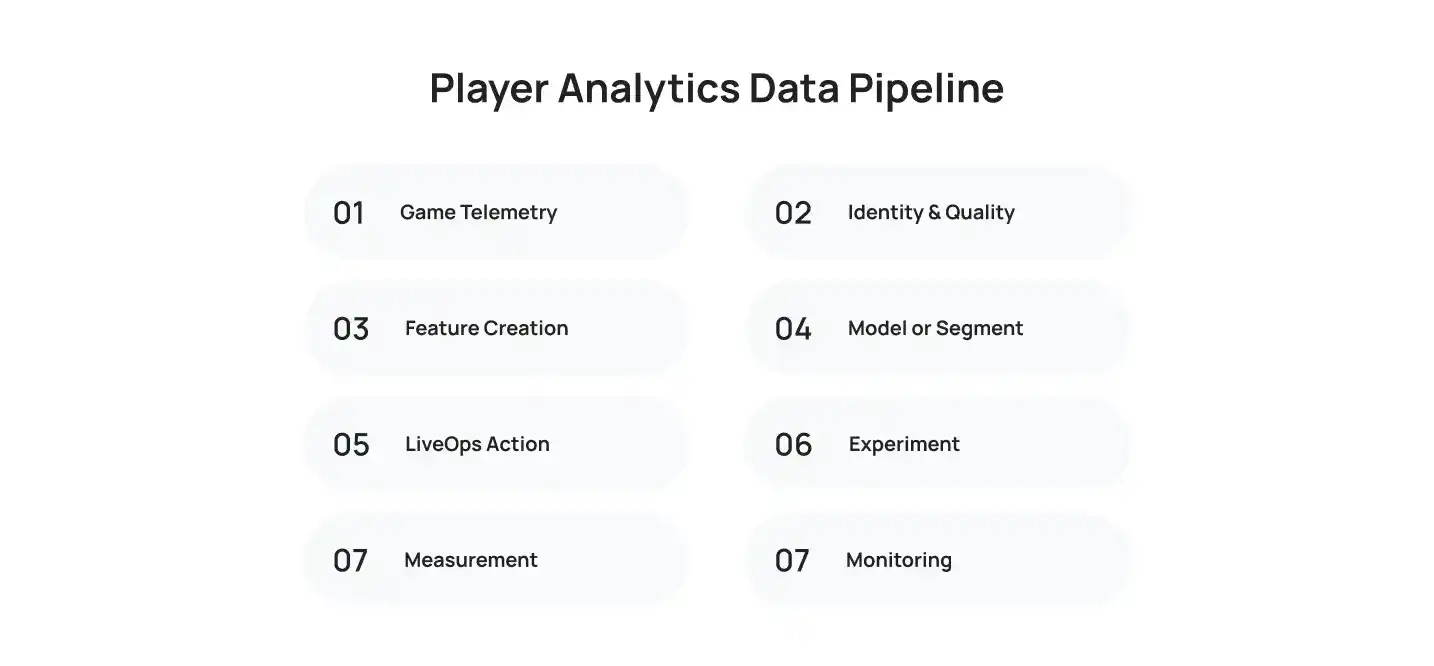
From telemetry to LiveOps action
Game teams need a clear path from events to actions. The pipeline should feel practical, not overly technical.
AI Player Analytics Data Pipeline
| Stage | What happens | Simple example | Main quality check |
|---|---|---|---|
| Game telemetry | Events record player actions | Level started, item crafted, match completed | Event names remain consistent |
| Identity and quality | Data is cleaned and connected | One player across mobile and web | Remove duplicates and broken events |
| Feature creation | Raw events become useful signals | Seven-day session trend | Avoid future data leakage |
| Model or segment | Players receive a score or group | High churn risk or explorers | Review model accuracy and bias |
| LiveOps action | Teams choose an experience | Tutorial tip or relevant event | Keep actions helpful and optional |
| Experiment | Test against a fair control group | Personalized reward versus standard reward | Randomize assignment |
| Measurement | Review player and business outcomes | D7 retention and incremental engagement | Measure causal uplift |
| Monitoring | Watch data and model changes | New patch changes player behavior | Retrain or adjust safely |
Events worth tracking
- Sessions, logins, and playtime
- Tutorial completion and onboarding friction
- Progression starts, failures, and completions
- Economy sources, sinks, and purchase attempts
- Match outcomes and matchmaking wait time
- Crashes, latency, and disconnects
- Guild, friend, and social interactions
- Event entries, exits, and reward claims
- Support tickets and resolution experience
- Messaging impressions, clicks, and opt-outs
Data quality comes first
Broken telemetry creates misleading models. Event definitions should be documented. Game updates can change player behavior. Player IDs need careful governance. Teams should check missing values and duplicates. Privacy settings must travel with the data.
Roughly one in four players who experience a crash will abandon a brand entirely. That is why technical signals deserve priority in the pipeline.
Personalize LiveOps
What good LiveOps personalization looks like
Good personalization makes the game more relevant. Bad personalization pushes players into choices they did not want.
Bain’s 2026 gaming report finds most gamers feel comfortable or neutral toward personalized offers based on in-game activity. That suggests room for helpful, transparent personalization when done responsibly.
Where AI can help
Personalized events
Surface cooperative events to social players. Recommend skill events to competitive players. Avoid repeating events players consistently skip. Keep discovery easy for everyone.
Adaptive difficulty
Detects repeated failure or sudden performance drops. Offer optional hints or practice routes. Avoid secretly making outcomes feel unfair. Let players keep meaningful challenge choices.
Content recommendations
Cover next quest suggestions. Cover mode recommendations. Cover character or build guidance. Cover content sequencing. Cover returning-player catch-up paths.
Rewards and offers
Recommend value based on gameplay needs. Do not exploit loss, urgency, or vulnerable behavior. Avoid targeting minors with pressure tactics. Keep prices and odds clear. Offer non-spending paths where appropriate.
Messaging and re-engagement
Use clear opt-ins and opt-outs. Limit message frequency. Send timely help, not guilt-based pressure. Test relevance, timing, and fatigue.
Support and technical recovery
Flag crash-heavy player cohorts. Surface help after a failed transaction. Prioritize recurring technical issues. Connect support themes to product fixes.
Helpshift also frames support delays, technical problems, weak content, and personalization as player-retention factors.
Segment Players
Rule-based cohorts vs ML segments
| Approach | How it works | Best use | Limitation |
|---|---|---|---|
| Rule-based cohorts | Teams set clear conditions | New players, spend tiers, event participants | Can miss hidden behavior patterns |
| RFM-style groups | Uses recency, frequency, and value | Lifecycle and engagement review | Can oversimplify gameplay motivation |
| Behavioral segments | Groups players by play patterns | Content and mode preferences | Needs quality data and interpretation |
| Churn-risk segments | Groups players by estimated risk | Retention experiment targeting | Risk does not prove cause |
| Value-based segments | Estimates player lifetime value | Resource planning and service priority | Must not create unfair treatment |
| Hybrid segmentation | Combines rules, models, and human review | Most LiveOps programs | Requires governance and testing |
Useful player segments
- New players needing onboarding help
- Returning players needing a catch-up path
- Social players seeking cooperative content
- Competitive players seeking ranked challenges
- Explorers engaging with broad content
- Players stalled in progression
- Players affected by bugs or performance issues
- Players with declining engagement
- Players opting out of marketing messages
How to avoid bad segments
Do not treat players as spending targets. Do not infer sensitive traits without a valid purpose. Do not use protected traits unfairly. Review segments after major game changes. Let product teams challenge model outputs.
About 52% of consumers now trust AI less than humans with their personal data. That makes careful segmentation and transparency even more important.
Measure What Worked
Measure the model
Explain these metrics in simple language. Precision shows how often high-risk flags were correct. Recall shows how many actual churners the model found. Ranking quality shows whether higher-risk players churned more often. Calibration shows whether predicted risk matches real outcomes. Stability shows whether performance holds over time.
Measure the player outcome
- D1 retention
- D7 retention
- D30 retention
- Session frequency
- Session length
- Progression completion
- Event participation
- Return rate
- Support resolution experience
- Player lifetime value, where appropriate
Median mobile games retain just under 4% of players by day 7. That is why small, measured gains matter.
Measure incremental impact
A model can identify risk. It cannot prove an intervention caused improvement. Use holdout groups when feasible. Compare outcomes against a fair baseline. Measure long-term impact, not only clicks. Watch for unwanted effects.
A/B testing enables data-driven decision-making by comparing different versions of game features with statistically significant player samples. That is the only reliable way to separate signal from noise.
Metrics that should never stand alone
- Revenue
- Click-through rate
- Purchase rate
- Daily active users
- Session time
- Offer acceptance
Each metric needs player-experience context. Higher short-term spending can still harm trust or long-term retention.
Build Responsibly
Privacy and consent
Collect only data needed for clear product purposes. Give players understandable privacy choices. Respect consent, opt-outs, and data rights. Set retention limits for player data. Apply extra protections for children and teens. Review relevant laws by jurisdiction.
Privacy and consent duties vary by country, state, audience, and platform. Studios should seek legal and privacy review before deployment.
About 71% of consumers find AI-driven personalization intrusive. Clear consent and controls help reduce that feeling.
Bias and fairness
Models can repeat historical bias. Check performance across relevant player groups. Avoid harmful targeting based on inferred vulnerability. Review recommendations before large-scale rollout. Give teams a clear escalation path.
Human oversight
Product leaders define acceptable actions. Data teams validate models. Designers protect gameplay quality. LiveOps teams approve campaigns. Support teams surface real player problems. Leadership reviews long-term player impact.
About 39% of Americans say AI should always have human oversight. That aligns well with responsible LiveOps programs.
Build a practical AI analytics foundation
Position Cubix as a development and implementation partner.
Cubix can help studios plan telemetry around product goals. It can design scalable game data systems. It can build machine learning models for churn and segmentation. It can connect predictions to LiveOps workflows. It can create player-facing features responsibly. It can test and monitor systems after launch. It can improve gameplay, content, and retention over time.
Explore Cubix’s AI video game development services for AI-driven gameplay, analytics, and adaptive player experiences.
Turn gameplay data into useful, player-first decisions. Build churn models, player segments, and personalized LiveOps carefully. Keep human judgment, privacy, and testing at the center.
Talk to a Cubix AI Game Expert
Start Your AI Analytics Plan
A simple first-step roadmap
- Define the retention problem worth solving.
- Audit telemetry, consent, and data quality.
- Choose a one player journey to improve.
- Build a simple baseline segment or model.
- Design a helpful and ethical intervention.
- Run a controlled experiment.
- Measure player impact and iterate.
Why partner with Cubix
Cubix brings experience across game design, development, testing, and post-launch support. It offers AI and machine learning capabilities for custom player analytics systems. It supports mobile, PC, console, and cross-platform game development. It provides flexible engagement models for product teams and live-service studios. It uses human-led implementation with clear product oversight.
Explore machine learning services for custom prediction and analytics systems. See Cubix’s broader game development services for full-cycle delivery. Visit Cubix AI to discuss a tailored AI implementation plan.
Cubix positions its machine learning services around custom models, scalable implementation, data insights, and cloud deployment. Its game-development offering also emphasizes post-launch improvement and AI-supported workflows with human creative direction.
Make Every LiveOps Decision More Informed
Your player data should support better experiences. Cubix can help build the pipeline, models, and workflows. Start with a focused use case. Measure results carefully. Then scale what genuinely helps players.
Turn player data into smarter retention strategies
Contact UsFrequently asked questions
1. How does AI predict player churn in games?
AI predicts churn by finding behavior patterns linked with past drop-off. It may review session frequency, playtime, progression, failed levels, event participation, social activity, support issues, and purchase behavior. The model then assigns a churn-risk score. It estimates likelihood, not certainty. Teams should test helpful interventions through control groups before scaling them.
2. What data is used for player churn prediction?
Studios usually use game telemetry first. Useful inputs include logins, session length, level completion, failed attempts, currency balances, item use, event participation, matchmaking outcomes, crashes, and support tickets. Some teams also use consented purchase, marketing, and social data. Data must be accurate, minimized, and handled under applicable privacy rules.
3. What is player behavior analytics in gaming?
Player behavior analytics is the practice of collecting and studying player actions. It helps teams understand how players move through onboarding, gameplay loops, events, progression, and purchases. For example, a studio may find that many players leave after a difficult tutorial step. That insight can guide a clearer tutorial or optional help feature.
4. How can AI personalize LiveOps?
AI can help teams recommend relevant events, optional challenges, content paths, rewards, messages, and difficulty support. A returning player may receive a catch-up path. A social player may see cooperative content. A player facing repeated crashes should receive support, not an offer. Personalization should remain transparent, optional, and free from pressure tactics.
5. Which metrics help identify players at risk of churning?
Start with D1, D7, and D30 retention. Then review session frequency, session duration, progression pace, funnel drop-off, event participation, crash rates, social engagement, and support issues. A single metric rarely explains churn. A steady session decline combined with stalled progression is usually more useful than either signal alone.
6. Can machine learning improve player retention?
Machine learning can help teams prioritize players and journeys needing attention. It can flag churn risk, identify behavior-based segments, and recommend possible actions. Still, it cannot prove why someone will leave. Studios should use experiments to measure incremental impact. The best systems combine model results with product judgment, player feedback, technical fixes, and ethical oversight.