
Imagine walking up to a village guard in an RPG and asking, “Why are the gates closed?”
Instead of choosing from three dialogue options, you ask a follow-up: “Is it because of the merchant I helped yesterday?”
The guard remembers the event. He explains that the merchant was attacked outside the walls and reacts differently because you helped him. You then ask what happened to the attackers, and the guard answers based on the game’s actual lore and current quest state.
That sounds like something from a futuristic RPG. But parts of this experience are already technically possible.
Conversational AI NPCs can use large language models (LLMs) to generate flexible dialogue, maintain short-term context, retrieve selected memories, respond to game events, and even communicate through voice. NVIDIA, for example, has demonstrated game-focused AI systems combining language models with speech recognition, text-to-speech, retrieval, memory, and character behavior.
But there is an important catch.
An LLM alone does not create a believable NPC.
A production-ready AI character also needs memory management, lore grounding, moderation, latency controls, cost management, and a reliable connection to the game’s actual state. Critical gameplay actions still need deterministic rules and validation.
So, what can AI NPCs really do today?
This guide breaks down how LLM-powered NPCs work, what developers can build now, where the technology still struggles, and what a practical implementation can look like.
What Are Conversational AI NPCs?
Conversational NPCs are non-playable characters that can interact with players using natural language rather than relying entirely on fixed dialogue trees.
Traditional NPCs typically follow dialogue written by designers. A player selects an option, the game checks a condition, and the NPC returns the corresponding line.
LLM-powered game characters work differently.
The player can enter an open-ended question, and the language model generates a response based on information supplied by the game. That information can include the NPC’s personality, relevant lore, current quest state, recent conversation history, and permitted actions.
This is where large language models in games become useful. Instead of writing every possible question and answer manually, developers can build a system that generates dialogue within defined boundaries.
However, the model should not be treated as the game’s source of truth. It is better understood as a dialogue-generation layer connected to authoritative game systems.
Traditional NPCs vs. LLM-Powered NPCs
| Traditional NPCs | LLM-powered NPCs |
|---|---|
| Use prewritten dialogue | Can generate varied responses |
| Follow predefined dialogue paths | Can respond to unexpected questions |
| Often rely on fixed triggers | Can use conversation context |
| Usually have limited dialogue variation | Can support more flexible role-play |
| Depend heavily on authored branching logic | Need additional controls for consistency |
This does not mean traditional NPC systems are outdated.
For important story moments, tutorials, quest instructions, comedy timing, and guaranteed gameplay outcomes, authored dialogue can still be the better choice.
In practice, the two approaches can work together. A game might use traditional dialogue for a critical cinematic while using an LLM for optional conversations around it.
Can NPCs Use ChatGPT or Other LLMs?
Yes. A game can connect an NPC to a hosted language model through an API or use a suitable model running locally or on the player’s hardware.
The architecture usually includes more than the model itself. The game engine captures player input, a backend or local orchestration layer prepares the relevant context, the model generates a response, and the game decides how that response should be displayed or spoken.
NVIDIA’s ACE architecture illustrates this modular approach by combining language models with speech recognition, text-to-speech, retrieval, memory, and other AI components.
That makes LLM-powered game characters less like a chatbot dropped into a game and more like a complete gameplay system with an LLM somewhere inside it.
How Do Conversational AI NPCs Work?
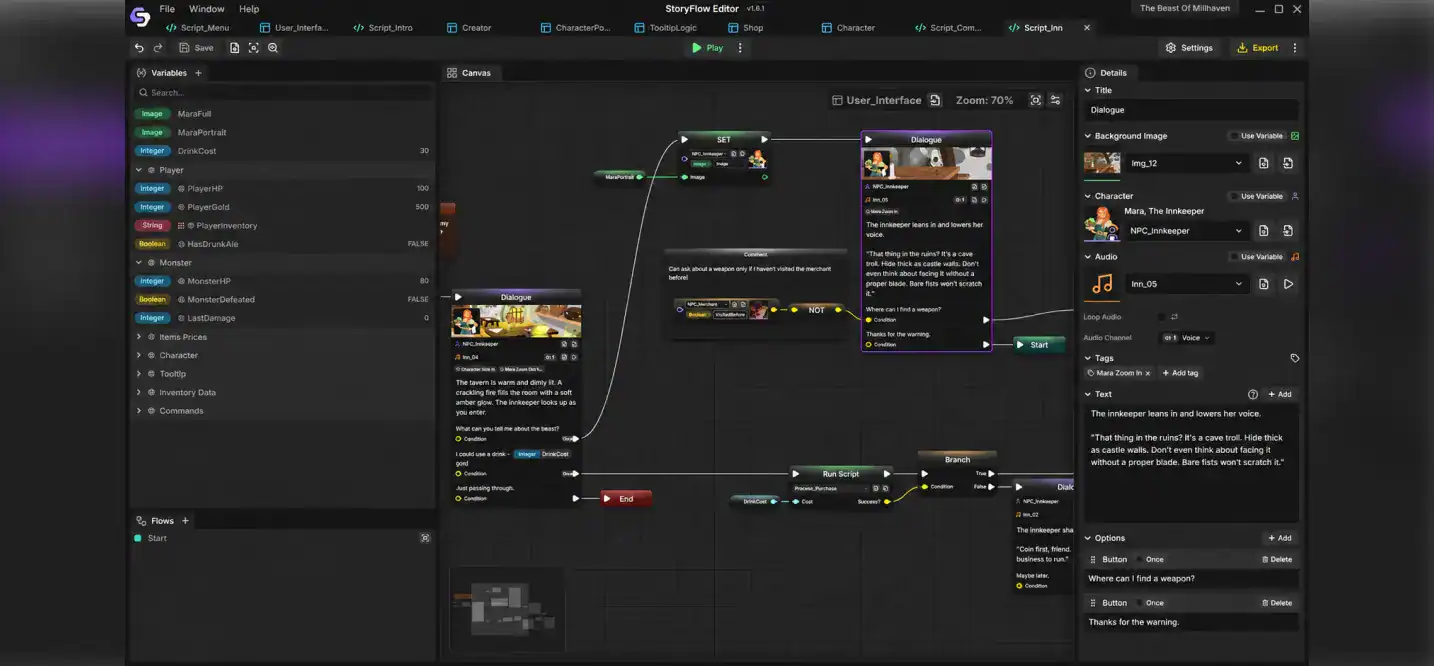
Consider a simple example.
A player approaches a shopkeeper and asks:
“You said the silver compass was stolen. Who took it?”
The NPC should not simply send that sentence to an LLM and accept whatever comes back.
A more reliable NPC conversation system follows several steps.
Step 1: Capture the Player’s Input
The game first receives the player’s question.
For text-based interaction, this could be typed directly into a dialogue interface. For voice interaction, the player’s speech must first be converted into text using automatic speech recognition.
The system can also identify basic information about the interaction, such as which NPC the player is speaking to and where the conversation is happening.
Step 2: Add Character, World, and Conversation Context
The system then prepares the information the model needs.
For the shopkeeper, this might include:
- Character: nervous but talkative merchant
- Knowledge: knows about the missing compass
- Current quest: “Recover the Silver Compass”
- Known suspect: Captain Vey
- Recent conversation: player previously asked about the shop
- World state: Captain Vey has not yet been confronted
Only relevant information needs to be supplied.
This matters because giving the model excessive context can increase latency and inference costs without necessarily improving the response.
Step 3: Generate a Context-Aware Response
The LLM receives the player’s question alongside the selected context and instructions.
It might generate:
“I didn’t see his face, but Captain Vey was near the shop that night. Ask me again after you’ve spoken to him.”
The exact wording can vary, while the underlying facts remain grounded in the game’s data.
This is where dynamic NPC dialogue becomes useful. The developer does not need to manually author every possible variation of the same response.
Step 4: Validate the Response Before Using It
The generated response should pass through application-level checks before reaching the player.
Depending on the game, these checks can include:
- Content moderation
- Lore validation
- Character rules
- Response length limits
- Allowed action checks
- Quest-state validation
- Structured output validation
This layer is especially important if the NPC can propose or trigger game actions.
Step 5: Deliver the Response Through Text or Voice
The approved response can appear as text, be converted into speech, or trigger an appropriate animation.
Voice-enabled systems can combine automatic speech recognition, an LLM, text-to-speech, and facial or character animation. NVIDIA’s ACE stack, for example, includes speech, language, retrieval, and animation components designed for digital characters.
A simplified real-time AI NPC conversation architecture looks like this:
Player input → Moderation and context → LLM orchestration → Lore-grounded response → Game-state validation → Text or voice output
The most important architectural rule is simple:
Let the LLM generate dialogue. Let the game engine control the game.
An LLM can suggest that the player should receive a reward. It should not independently decide to add 500 gold to the player’s inventory.
Critical quest progression, rewards, inventory changes, combat effects, and economy rules should remain under validated game logic.
Ready to Build Smarter AI NPCs?
Contact Us
What Can LLM NPCs Actually Do in Games Today?
The technology is already capable of much more than simply generating random NPC sentences. The important question is how reliably each capability can be implemented.
Generate Dynamic Dialogue
An LLM can respond to questions that were never written as individual dialogue options.
A player might ask a blacksmith why a sword is expensive, follow up by asking where its metal came from, and then ask whether the blacksmith knows the person who supplied it.
A traditional dialogue tree would require explicit branches for these interactions. An LLM can generate responses dynamically, provided it has the necessary information.
Stay Within a Defined Character Persona
Developers can give an NPC a defined personality, background, speaking style, motivations, and knowledge boundaries.
For example:
- A royal advisor speaks formally.
- A suspicious smuggler avoids direct answers.
- A young companion uses casual language.
- A scholar explains unfamiliar subjects in detail.
Character instructions, examples, retrieval, and output constraints can all help maintain that identity.
NVIDIA’s ACE documentation describes NPC configurations containing unique personalities and backstories, with runtime game context supplied to the character system.
Respond to Player Actions and World Events
An NPC can also receive updated information about what is happening in the game.
The player rescued a character? The NPC can acknowledge it.
A city was attacked? A resident can discuss the event.
The player has not unlocked a location? The NPC can avoid revealing information they should not know.
This creates a stronger connection between AI NPC dialogue and the actual game world.
Support More Natural Role-Playing
Open-ended dialogue allows players to ask follow-up questions instead of repeatedly selecting from fixed menus.
That can make companions, merchants, quest-givers, and background characters feel more interactive.
However, natural conversation does not automatically mean better gameplay. Developers still need to decide where free-form interaction adds value and where authored dialogue provides a better experience.
Support Multiple Languages
LLMs can generate dialogue in multiple languages, which can reduce some of the manual work involved in supporting multilingual interaction.
But translation quality is only one consideration.
Character voice, cultural references, humor, fantasy terminology, names, and world-specific terms all need testing. A technically correct translation can still sound wrong for the character.
Power Voice-Based NPC Conversations
Voice interaction adds another layer to the system.
A typical voice pipeline is:
Player speech → Speech recognition → LLM → Text-to-speech → Character animation
This is technically achievable today. NVIDIA’s game AI stack, for example, combines ASR, language models, TTS, retrieval, and animation in its AI character workflows.
The difficult part is making the complete interaction feel fast enough to be natural.
What Is Possible Today vs. What Is Still Difficult?
The difference between “technically possible” and “reliably production-ready” is critical.
| Capability | Possible today | What’s still difficult |
|---|---|---|
| Dynamic dialogue | Generate responses to open-ended questions | Keeping every response relevant and coherent |
| Character personality | Guide dialogue with character instructions | Maintaining perfect consistency across long conversations |
| Lore-based answers | Retrieve relevant world information | Preventing invented or contradictory details |
| Conversation memory | Store and retrieve selected facts | Managing long-term memory accurately |
| World reactions | Provide NPCs with updated game context | Keeping reactions synchronized with live game state |
| Voice conversations | Connect speech recognition, LLMs, and voice synthesis | Managing delays and interruptions |
| Multiple languages | Generate dialogue in different languages | Preserving tone, lore, and cultural nuance |
| Autonomous actions | Suggest or request supported actions | Safely validating actions and consequences |
Research is also exploring smaller models and modular memory systems specifically to address gaming constraints such as hardware requirements, latency, and knowledge boundaries. A 2025 study, for example, tested persona-focused small language models with modular memory on consumer-grade hardware.
Commercial systems are moving in a similar direction. NVIDIA’s current ACE for Games material describes applications ranging from on-device AI advisors to AI teammates, enemies, and autonomous characters.
So, the answer is not that LLM NPCs are either “ready” or “not ready.”
Their feasibility depends on the model, platform, game engine, architecture, player count, budget, and the level of reliability expected.
How Can AI NPCs Remember Past Conversations?
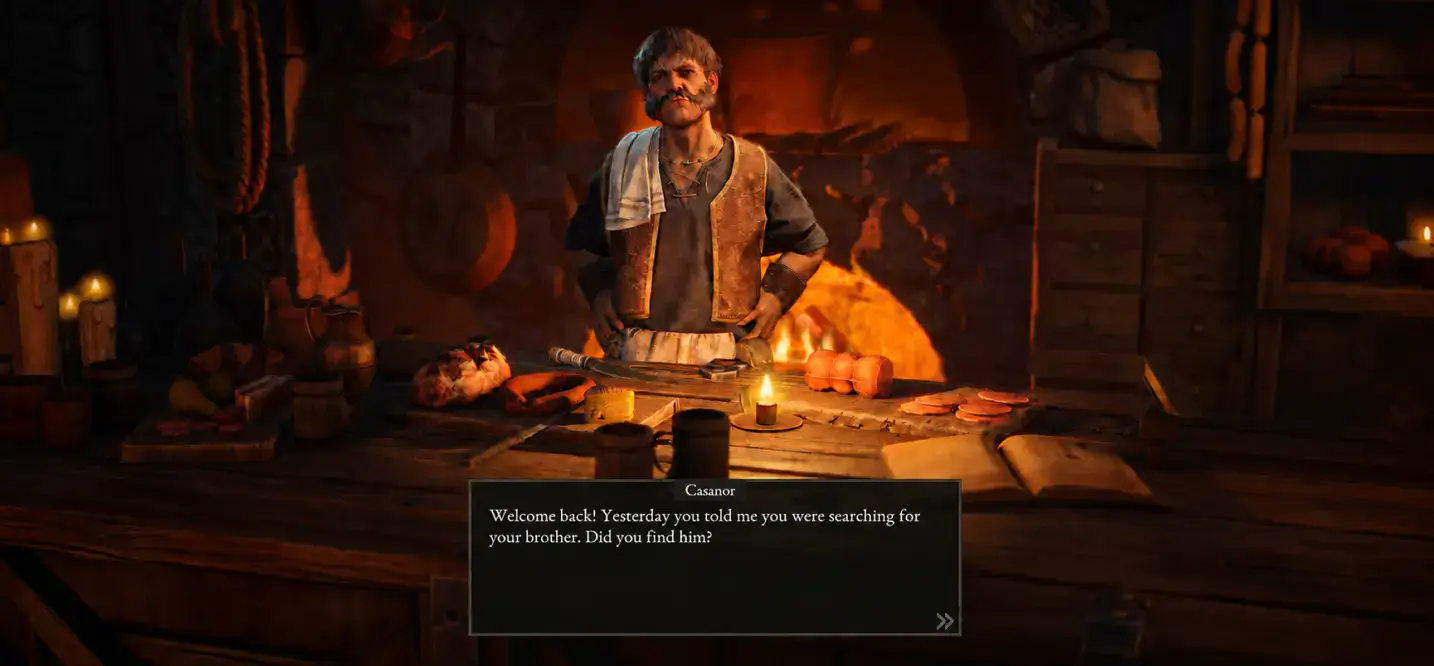
One of the biggest misconceptions about conversational AI NPCs is that the LLM automatically remembers everything a player has ever said.
It does not.
Memory needs to be designed as part of the application.
Short-Term Conversation Memory
During an active conversation, recent messages can be included in the model’s context.
This lets an NPC understand follow-up questions.
Player:
“Where did you find the map?”
NPC:
“In the old watchtower.”
Player:
“Who owned it?”
The NPC can understand that “it” refers to the map because the recent conversation is still available as context.
But context windows have practical limits, and sending every previous message indefinitely is inefficient. For broader AI-powered gaming solutions, see AI Video Game Development.
Persistent Memory Across Sessions
For longer-term memory, the game can store selected information outside the model.
For example:
Player spared Captain Vey → relationship event stored
When the player returns several hours later, the system can retrieve that event and tell the companion:
“You let Vey live last time. I haven’t forgotten that.”
The important detail is that the application remembers the event. The LLM simply uses the retrieved information when generating the next response.
Retrieval-Based Memory
A more scalable approach is to store many potential memories and retrieve only those relevant to the current interaction.
If the player asks about an earlier battle, the system searches the stored memory for relevant events rather than sending the NPC’s entire history to the model.
This approach can also be combined with lore retrieval and game-state data.
How to Keep NPC Memory Useful and Consistent
Not everything deserves to become a permanent memory.
A companion may need to remember that the player spared an enemy during an important mission. It probably does not need to remember every sentence spoken during that encounter.
Good memory design therefore involves:
- Selecting important events
- Assigning memory types or importance
- Removing or updating outdated information
- Resolving contradictory memories
- Retrieving only relevant facts
- Protecting sensitive player information
A 2025 research prototype demonstrated how modular memory can be separated from the language model, allowing character-specific conversational context and world knowledge to be swapped during gameplay.
How Do Developers Keep AI NPCs Consistent With Game Lore?
This is where a simple chatbot becomes a real game system.
Without grounding, an LLM may produce an answer that sounds convincing but is completely wrong for the game’s universe.
Ask an NPC about a fictional city, and the model might invent a district that was never created by the writers.
That is a problem if the player believes the answer.
Character Personas and Prompt Orchestration
The NPC’s instructions can define:
- Background
- Personality
- Speech style
- Motivations
- Relationships
- Knowledge boundaries
- Forbidden topics
- Current objectives
The orchestration layer can then combine these instructions with relevant game information for each request.
Retrieval-Augmented Generation (RAG) for Game NPCs
RAG for game NPCs allows the system to retrieve approved information before generating an answer.
A game might store:
- Lore documents
- Quest descriptions
- Character biographies
- Locations
- Factions
- Item descriptions
- Historical events
- Current world information
When the player asks a question, the system retrieves the relevant material and supplies it to the model.
This gives the model a smaller, more relevant knowledge set instead of expecting it to “remember” the entire game universe.
NVIDIA also identifies RAG, fine-tuning, and guardrails as mechanisms for improving the accuracy and consistency of AI-generated character interactions.
Connect NPC Dialogue to the Actual Game State
Lore alone is not enough.
The NPC also needs current information.
For example:
Quest status: Completed
Location: King’s Harbor
Player inventory: Silver Compass acquired
Captain Vey: Alive
Gate status: Open
The NPC can then respond based on what is actually happening.
Use Fallback Dialogue When the NPC Doesn’t Know
A good AI NPC does not need an answer to everything.
Sometimes the safest response is:
“I don’t know anything about the northern ruins.”
That is better than confidently inventing a secret passage that does not exist.
Fallback behavior is one of the simplest ways to protect lore accuracy.
What Are the Biggest Limitations of LLM-Powered NPCs?
The technology is powerful, but limitations of LLM-powered NPCs in games become much more visible when the system moves from a demo into a live game.
Hallucinations and Incorrect Information
LLMs can produce plausible statements that are factually incorrect.
For an NPC, that might mean inventing a character, changing the details of a quest, or giving the player incorrect directions.
Lore grounding, retrieval, validation, and fallback behavior can reduce this risk, but they do not make it disappear completely.
Latency and Conversation Flow
Players expect games to respond quickly.
A delayed NPC can make a conversation feel broken, especially when voice input, cloud inference, retrieval, moderation, and text-to-speech are all involved.
This is why model selection and system architecture matter. Research on game NPCs continues to identify latency and hardware requirements as important practical constraints.
Inconsistent Character Behavior
An NPC might be sarcastic in one response and unusually formal in another.
Long conversations make this harder because the system has more context and more opportunities for the character to drift.
Personas, examples, memory design, model selection, evaluation, and controlled prompts can reduce the problem.
Inference Costs at Scale
A prototype with 100 test conversations is very different from a multiplayer game generating millions of conversations.
Costs can depend on:
- Model selection
- Input tokens
- Output tokens
- Context size
- Number of interactions
- Memory retrieval
- Voice processing
- Hosting
- Moderation
- Concurrent players
Current API pricing varies substantially by model and processing mode. For example, Google’s Gemini API publishes separate rates for input, output, caching, and processing options, while OpenAI publishes model-specific input, cached-input, and output rates.
That is why there is no universal “LLM NPC cost.”
Safety, Moderation, and Prompt Injection
Players may intentionally try to make an NPC break its instructions.
They might ask it to reveal hidden prompts, produce inappropriate content, disclose restricted information, or perform actions outside its intended role.
Developers therefore need moderation and guardrails around both player input and model output.
Limited Control Over Generated Dialogue
With authored dialogue, the developer knows exactly what the character will say.
With an LLM, there is variation.
That can be a benefit for natural conversation, but it also creates uncertainty.
Production systems therefore need fallback dialogue, output constraints, testing, timeouts, validation, and clear separation between generated dialogue and authoritative game actions.
How to Build Conversational AI NPCs With LLMs
A practical implementation does not need to start with a massive autonomous game world.
Start with one character and one clearly defined interaction.
Define the NPC’s Role and Boundaries
Document the character’s:
- Personality
- Background
- Knowledge
- Motivations
- Speaking style
- Allowed topics
- Forbidden behavior
- Available actions
This gives the model a clear operating boundary.
Choose the Right Language Model
Hosted models can simplify deployment and provide access to capable models without maintaining inference infrastructure.
Local models can provide greater control over deployment, privacy, latency, and hardware use, but they introduce additional infrastructure and optimization requirements.
NVIDIA’s current ACE approach supports cloud and local deployment options, including AI models packaged for high-performance deployment on cloud infrastructure or NVIDIA RTX AI PCs.
The right choice depends on the game rather than simply selecting the largest available model.
Build the Context and Memory Layer
The system should determine what the model actually needs to know for each turn.
That could include:
Character persona + recent conversation + relevant lore + current quest state + selected memories
This is the foundation of a reliable NPC conversation system.
Connect the Model to Game Logic
LLMs should interact with game systems through controlled interfaces.
Instead of allowing the model to directly modify the game, the NPC might request:
Action: GiveQuest
Quest ID: silver_compass
The game validates whether that action is permitted and then executes it.
This separation makes the system easier to test and safer to operate.
Add Safety Controls and Fallbacks
Include:
- Input moderation
- Output moderation
- Prompt-injection defenses
- Response-length limits
- Timeouts
- Retry handling
- Fallback dialogue
- Action validation
These controls become increasingly important as the NPC gains access to more game functionality.
Test the NPC in Real Gameplay
A successful demo is not enough.
Test the character with:
- Normal questions
- Unexpected questions
- Repeated questions
- Long conversations
- Lore challenges
- Contradictory information
- Adversarial prompts
- Voice interruptions
- Network failures
- High player volume
The goal is not to prove that the NPC can generate impressive dialogue once.
The goal is to determine whether it behaves reliably across thousands of realistic interactions. Where model adaptation makes sense, LLM Fine-Tuning Services can support specialized model behavior.
How Much Does Real-Time LLM Dialogue Cost?
There is no single development or operating price for real-time AI NPC conversations.
The cost depends on the architecture and expected usage.
What Affects NPC Conversation Costs?
The biggest variables include:
- Model choice: More capable models can have higher inference costs.
- Conversation length: Longer prompts and responses generally consume more tokens.
- Player volume: A system used by 1,000 players has very different requirements from one used by 10 million.
- Memory retrieval: Persistent memory introduces storage and retrieval infrastructure.
- Voice: Speech recognition and voice synthesis add additional processing.
- Hosting: Cloud inference, databases, orchestration, and monitoring all contribute to operating costs.
Current provider pricing demonstrates why costs should be calculated from a specific model and usage pattern rather than a generic per-NPC estimate.
Hosted Models vs. Local Inference
Hosted APIs can make development faster because the developer does not need to operate the underlying model infrastructure.
Local inference can offer greater control and potentially reduce per-request dependency on external APIs, but it may require suitable hardware, optimization, model management, and ongoing maintenance.
For some games, a hybrid approach can make sense.
Ways to Control Latency and Costs
Developers can reduce unnecessary usage by:
- Using smaller models for simple interactions.
- Routing complex questions to more capable models.
- Caching suitable responses.
- Limiting unnecessary context.
- Using structured dialogue for predictable interactions.
- Setting response-length limits.
- Setting request and timeout limits.
- Retrieving only relevant memories.
A useful design principle is to avoid using an expensive generative model for interactions that do not actually need one.
If a shopkeeper always responds to “Show me your inventory” with a standard interface, there may be no reason to generate that response dynamically.
How to Evaluate Conversational AI NPCs Before Launch
A convincing demonstration does not prove that an NPC is ready for a commercial game.
Before launch, evaluate the system across several dimensions.
Character consistency
Does the NPC maintain its personality, role, knowledge boundaries, and speaking style?
Lore accuracy
Does the NPC provide information supported by verified game data?
Response relevance
Does the response actually address what the player asked?
Safety
Does the system handle inappropriate, adversarial, or prompt-injection attempts appropriately?
Latency
Does the conversation feel responsive enough for the game’s pace?
Cost
Can the architecture support the expected player and interaction volume?
Player experience
Most importantly, does the interaction make the game more enjoyable?
Developers should test normal conversations alongside unusual inputs, long interactions, repeated questions, and different player behaviors.
The goal is not to maximize how much an NPC can say.
It is to make sure the NPC says the right thing, in the right way, at the right time. On the AI side, Large Language Model Development can support LLM-based applications, while Generative AI Development Services can help with broader generative AI architectures.
How Cubix Can Help Build AI-Powered NPCs
Building an AI NPC is not simply an LLM integration task. It requires game logic, character design, AI orchestration, memory, game-state integration, testing, and performance planning to work together.
Cubix combines game development and AI capabilities to build these systems around the requirements of the actual game.
For NPC behavior and interaction systems, explore AI-Driven NPC Behavior Game Development.
The objective is not to put an AI model into a game and hope it feels intelligent.
It is to build an NPC system where dialogue, memory, lore, voice, and game logic work together reliably.
Turn Your AI NPC Idea Into a Game-Ready Experience
Contact Us
Frequently Asked Questions
1. Can NPCs Use ChatGPT or LLMs?
Yes. Games can integrate hosted language models through APIs or use suitable models locally. The LLM handles dialogue generation, while the game provides character context, lore, memory, and current state. Additional engineering is required for moderation, latency management, game integration, and safe handling of actions.
2. How Do Conversational AI NPCs Work?
The system captures player input, retrieves relevant character and game context, sends that information to an LLM, validates the generated response, and delivers it through text or voice. The game engine remains responsible for authoritative gameplay state, including quests, inventory, rewards, and other critical actions.
3. Can AI NPCs Remember Past Conversations?
Yes, but memory must be implemented by the game system. Recent conversation can be kept in the model’s context, while important events can be stored in an external memory system. The game can later retrieve relevant memories and provide them to the NPC during a new conversation.
4. What Are the Limitations of LLM NPCs?
Major limitations include hallucinations, latency, inference costs, inconsistent character behavior, safety risks, and limited control over generated responses. These issues can be reduced through lore grounding, memory design, guardrails, model selection, validation, fallback dialogue, and thorough testing.
5. How Do You Keep AI NPCs in Character?
Developers can combine character persona instructions, examples, lore grounding, response constraints, relevant memory, and evaluation tests. Fallback dialogue is also useful when the model lacks enough information. The strongest systems treat character consistency as an ongoing engineering and testing requirement rather than something a prompt can guarantee.
6. How Expensive Is Real-Time LLM Dialogue in Games?
There is no universal cost. It depends on the model, input and output length, number of conversations, player volume, memory retrieval, voice processing, hosting, and optimization. Developers should calculate costs using a specific model and expected interaction volume rather than relying on a generic per-NPC estimate.
7. Can LLM NPCs Safely Generate Dialogue for Players?
They can be designed to do so more safely, but generated dialogue should not be treated as automatically safe. Moderation, guardrails, prompt-injection defenses, output validation, testing, and fallback behavior are important. Access to critical game actions should also remain controlled by validated game logic.