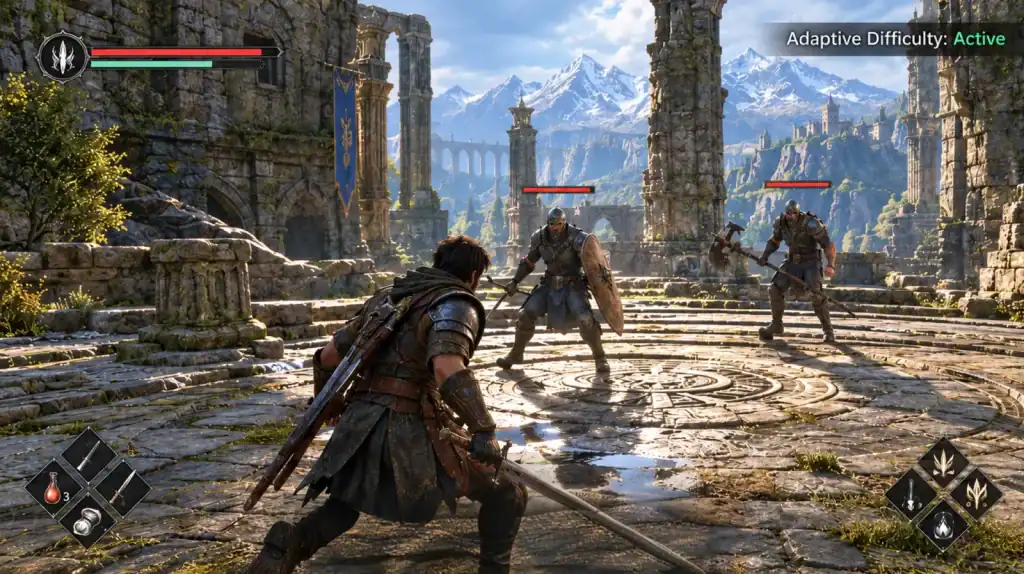
Key Takeaways
- DDA changes a game’s challenge while you play.
- Its goal is flow, not boredom and not stress.
- AI methods range from simple rules to reinforcement learning.
- Hidden changes can make players feel cheated.
- You can start small with a few safe variables.
Roughly 30% of players quit when a game feels impossible. That finding comes from a Quantic Foundry study, cited by Meegle. Think about that. Nearly one in three players walks away.
Now picture the other side. A game that is too easy bores people just as fast. Both problems share one root. Every player is different, but the game is not. Dynamic difficulty adjustment, or DDA, fixes that. The game watches how you play and adjusts the challenge.
This guide keeps it simple. You will learn what DDA is and how it works. We cover flow and the AI methods behind it. Real game examples and the risks come next. You will also get a clear plan to build it.
What Is Dynamic Difficulty Adjustment?
Dynamic difficulty adjustment is a game design method. It changes a game’s challenge in real time. The system watches how well you play. Then it makes the game easier or harder. The goal is simple. Keep you interested without making you quit.
Think of a good coach. They push you when you are ready. They ease off when you struggle. DDA does the same job inside a game.
Here is what a game can change:
- Enemy speed
- Enemy health
- How often enemies show up
- How often power-ups appear
- The player’s own power
The idea is not new. The 1975 arcade game Gun Fight helped whoever got shot. It dropped a cactus on their side so they could hide. That makes DDA more than 50 years old.
Static vs Dynamic Difficulty
A static setting is a fixed choice. You pick Easy, Normal, or Hard once. Dynamic difficulty keeps changing as you play. Smart game development starts with a solid build.
Static vs dynamic difficulty
| Feature | Static difficulty | Dynamic difficulty |
|---|---|---|
| Who controls it | The player, once at the start | The game, all the time |
| Flexibility | Fixed | Changes in real time |
| Player fit | One setting for many skill levels | Tailored to each player |
| Dev effort | Low | Higher, needs data and tuning |
| Main risk | Players feel bored or stuck | Players feel cheated |
Build Smarter Games With AI-Powered Difficulty Adjustment
Contact Us
How Does DDA Work?
DDA works in a loop. The game collects data about your play. It estimates your skill. Then it changes things like enemy health or hints. The loop repeats every few seconds or every level. You rarely notice it happening. Good DDA stays quiet.
The Simple Feedback Loop
The loop has four steps:
- Watch. Track what the player does.
- Measure. Estimate skill and mood.
- Adjust. Tune enemies, hints, or spawns.
- Repeat. Check the result and go again.
AI Video Game Development needs fast data and quick decisions. Resident Evil 4 shows this loop well. In 2005, it graded players on a 1 to 10 scale. In Normal, you start at grade 4. Do well and you can climb to grade 7. Struggle and you can fall to grade 2.
Does DDA Just Make Games Easier?
No. It works both ways. Adaptive difficulty in games can also push harder.
- It adds tougher enemies when you win easily.
- It adds hints and checkpoints when you fail.
- It holds steady when the balance feels right.
- It can change pacing, not just numbers.
DDA and Flow State
Flow is a state of deep focus. You feel fully absorbed and time slips by. It happens when challenge matches skill. DDA tries to keep that match alive. When you improve, the game pushes back. When you slip, it gives you room.
What Is Flow Theory?
Psychologist Mihaly Csikszentmihalyi defined flow back in the 1970s. He described a mind fully absorbed in what it is doing. Game designers have chased that state ever since. Flow state in games is the holy grail of balance.
Where Boredom Ends and Anxiety Begins
Skill and challenge must rise together.
- Too easy: skilled players get bored and drift away.
- Too hard: players feel anxious and frustrated.
- Just right: challenge and skill grow side by side.
Researchers need a target to aim at. One research team set a simple one. The AI should win about half its matches. They tested the idea with 31 players of mixed skill.
What Player Data Does DDA Track?
A DDA system tracks how you play. It looks at performance, like deaths and accuracy. It also watches behavior, like retries and pauses. Some systems add heart rate or chat mood. All of it feeds one question. Is this player bored, stuck, or just right?
Performance Signals
- Deaths per level
- Hit accuracy
- Time to finish a task
- Health left at the end of a fight
Behavior Signals
- Retries after a loss
- Pauses mid-level
- The point where players quit
- Which weapons or tools they pick
Emotion and Biometric Signals
These are optional and advanced. A 2026 study read Dota 2 chat to detect player emotions. The models reached over 97% accuracy. They spotted hope, frustration, anxiety, and boredom. Heart rate sensors are another option.
Player signals and what they unlock
| Signal | What it shows | What the game can adjust |
|---|---|---|
| Deaths per level | Struggle | Enemy damage, checkpoints |
| Accuracy | Skill with core mechanics | Enemy speed, aim assist |
| Completion time | Pace and confidence | Puzzle complexity, hints |
| Retries | Frustration or grit | Resource drops |
| Pauses and quits | Overload or boredom | Pacing, rest moments |
| Heart rate | Stress | Music, enemy count |
| Chat tone | Mood | Dialogue, challenge level |
Strong AI for Game Testing & Balancing turns signals into skill scores. Player adaptive difficulty depends on that score being right.
AI Techniques Behind DDA

Studios use three main approaches. Rule-based systems follow if-then logic. Machine learning learns patterns from player data. Reinforcement learning is learned by trial and reward. Many games also use behavior trees and utility AI. Monte Carlo Tree Search is another option. Most teams mix a few of these.
Rule-Based Systems
These are simple and cheap. A rule might say, “If the player dies three times, add a checkpoint.” They are easy to test. They are also easy to spot.
Machine Learning
Machine learning game balancing uses player data to predict skill or quit risk. It needs more data than rules. It adapts better to different players.
Reinforcement Learning
Reinforcement learning dynamic difficulty uses an agent that learns the best action. One battle game study used a learning agent called SARSA. Ten players tested it. Two setups landed between 2.2 and 2.5 on balance. In that study, 1.5 to 2.5 counted as balanced.
Other Tools
- Behavior trees: guide how enemies act.
- Utility AI: picks the best action by score.
- Monte Carlo Tree Search (MCTS): tests many possible moves.
One MCTS study tested three versions with 31 players. ATROSAS won 51% of games. ROSAS won 46%. CSAS won 41%. Players liked ROSAS most, even though it was not closest to 50%.
Rule-based vs machine learning vs reinforcement learning
| Factor | Rule-based | Machine learning | Reinforcement learning |
|---|---|---|---|
| Setup effort | Low | Medium | High |
| Data needed | Little | Lots of player data | Training runs or live play |
| Adaptability | Limited | Good | Very good |
| Cost | Low | Medium | High |
| Best use | Simple games, quick launches | Skill and churn prediction | Opponent AI that learns |
At Cubix, we pick the method per game. A casual puzzler may only need rules. A competitive title may need learning agents.
DDA Examples in Popular Games
Many famous games use DDA. Resident Evil 4 grades player skill. Left 4 Dead uses an AI Director to pace the action. Crash Bandicoot adds checkpoints after repeated deaths. Mario Kart hands out items based on race position. Some of these systems are decades old.
Classic Examples
- Zanac (1986): adapts to skill, fire rate, and ship defense.
- Crash Bandicoot: slows obstacles and adds hit points after deaths.
- Homeworld (1999): sets AI fleet size from your fleet power.
- Resident Evil 4 (2005): scores you from 1 to 10.
Zanac launched with adaptive AI in 1986. That was 40 years ago.
Modern Examples
- Left 4 Dead (2008): the AI Director paces zombies and boss fights.
- Fishdom: adds time to a level after you fail.
- Mario Kart: gives stronger items to racers in the back.
- Madden NFL 09: uses a knowledge test to set difficulty.
Game examples and what DDA changes
| Game | What DDA changes | Signal it reacts to |
|---|---|---|
| Zanac (1986) | Enemy behavior | Skill, fire rate, ship defense |
| Resident Evil 4 (2005) | Enemy attacks, damage, resistance | Deaths, critical hits |
| Left 4 Dead (2008) | Zombie counts, boss spots, pacing | Player and team performance |
| Mario Kart | Item quality, rival speed | Race position |
| Fishdom | Level time limit | Failed attempts |
Can DDA Improve Player Retention?
Yes, it can. Players stay longer when a game feels fair. DDA smooths out spikes that cause rage quits. It also helps new players catch up. One big study showed more play days and more rounds. That means better retention over time.
Engagement Benefits
- Smoother pacing across levels
- Fewer rage quits
- More reasons to replay
Retention and Churn
Columbia Business School ran a 12-week field test. It covered more than 300,000 players of a puzzle game. At-risk players got easier puzzles. Ad revenue rose 21%. Purchase revenue rose by as much as 79%.
Players also played one extra day and ten more rounds per month. They were likely to return after 1, 7, and 14 days. Strong game economy design also needs a healthy economy.
Accessibility Benefits
- New players get room to learn.
- Casual players avoid walls.
- Busy players can enjoy short sessions.
- Veterans still get a real challenge.
Risks of DDA
DDA has real risks. Players can feel cheated if changes feel fake. Some players learn to exploit the system. Hidden changes raise trust and ethics questions. Bad tuning can make wins feel empty. Done well, it stays fair and subtle.
When Players Feel Cheated
Racing games show the classic problem. Rival cars speed up when behind you. They slow down when ahead. Players call this rubber banding. Heavy use makes the race feel fake.
Players Gaming the System
Some players learn the rules. One game set difficulty from your past levels. Players then played badly on purpose before hard levels. Hide the logic and cap the changes.
Ethical Concerns
In 2020, a US class action accused EA of using DDA. The claim said it pushed players toward loot box purchases. It covered Madden NFL, FIFA, and NHL titles back to 2017. EA called the claims baseless. The plaintiffs dropped the suit in 2021.
The lesson is clear. Keep DDA away from spending decisions.
- Be open that the game adapts.
- Never tie difficulty to purchases.
- Offer an opt-out where you can.
How to Design DDA Without Frustrating Players
What AI Can Safely Adjust
- Enemy health and damage
- Spawn rates
- Hints and tutorials
- Checkpoints
- Resource drops
- Level timers
What AI Should Not Touch
- Core rules
- Win conditions
- Reward meaning
- Prices and offers
A good AI-driven game balancing plan protects these.
How to Measure Success
Track a few clear numbers:
- Session length
- Day 1 and Day 7 retention
- Level completion rate
- Churn
- Player feedback scores
Win rate alone can mislead. The MCTS version closest to 50% was not the favorite. A survey of about 150 players studied multiplayer DDA. Skilled players wanted little system help. Weaker players welcomed more of it. Both groups wanted the game to run it automatically.
Clear game UI/UX design helps players understand any visible assist. Cubix also tests balance with AI-driven playtesting before launch.
How to Build DDA in Unity or Unreal
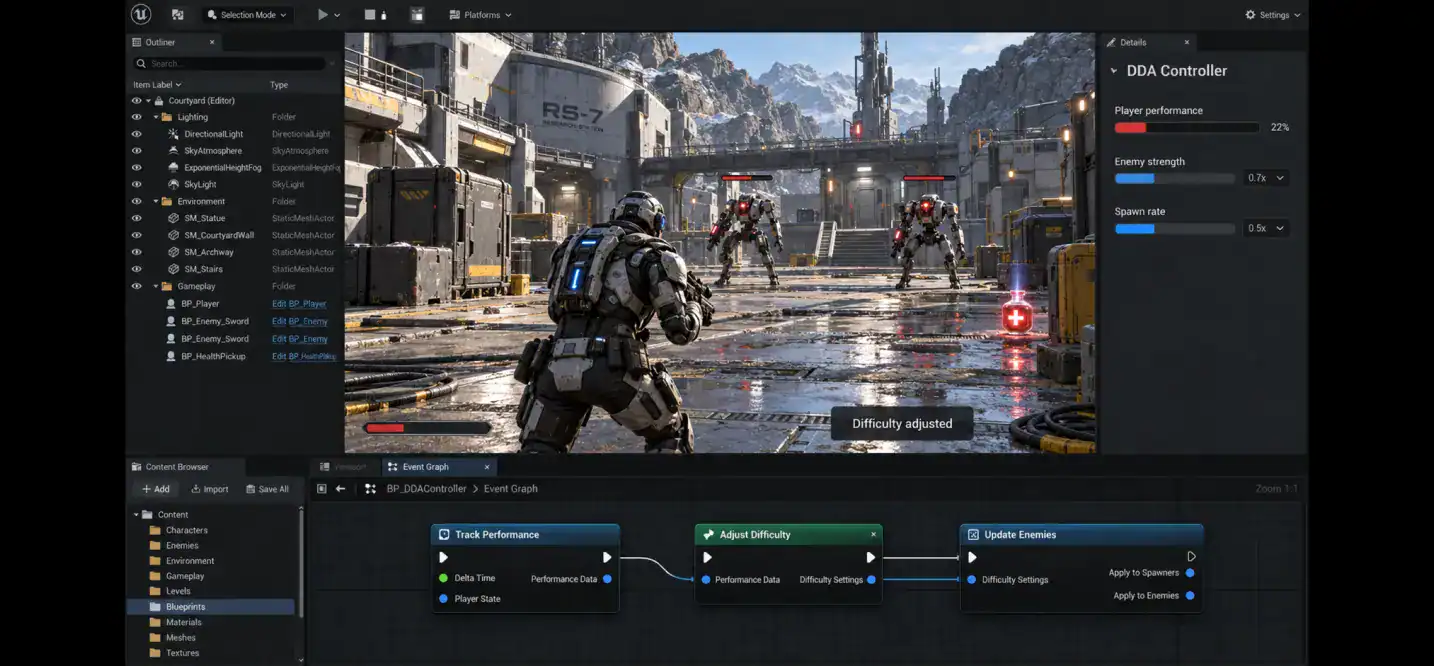
You can build DDA in four clear steps. First, define the experience you want. Next, collect player telemetry. Then estimate player skill. Finally, adjust and test the results. The same loop works in Unity and Unreal. Start small and grow it over time.
Step 1: Define Your Target Experience
Decide what the player should feel. Pick a target, such as a win rate. A smooth level pace works too. Write it down before you code.
Step 2: Collect Telemetry
Log the key events. Track deaths, accuracy, time, and retries. Both engines let you log custom events.
Step 3: Estimate Player Skill
Turn raw events into one skill score. Start with a moving average of recent results. Later, swap in a machine learning model.
Step 4: Adjust and Test
Change one variable at a time. Raise or lower enemy health in small steps. Playtest with real players. Compare retention and completion before and after.
Multiplayer note: Multiplayer needs extra care. Skilled players dislike obvious help. Keep adjustments automatic and subtle. Need hands-on help? Cubix engineers can build the telemetry and tuning layer for you.
Why Choose Cubix for AI Game Development?
You need a partner who understands both play and data. Cubix builds games that adapt to the people playing them.
What We Build
- AI-driven game balancing
- Game economy design
- Game UI/UX design
- Full Cycle game development from prototype to launch
Why Studios Trust Us
- One team covers design, engineering, and AI.
- We test balance with AI-driven playtesting.
- We follow a clear process from first prototype to launch.
- We tune for fun first, then for numbers.
Let’s Build Your Next Game With Cubix
DDA keeps players in flow. It cuts frustration and boredom. Done right, it also lifts retention. Ready to make your game adapt? Book a call with Cubix and let’s build it together.
Ready to Keep Players Hooked on Your Game?
Contact UsFrequently Asked Questions
1. What is dynamic difficulty adjustment (DDA) in gaming?
DDA changes a game’s challenge in real time. It reacts to how well you play. The goal is steady fun.
2. How does AI decide when to make a game easier or harder?
It compares your current performance to a target. If you fail a lot, it eases off. If you win easily, it pushes harder.
3. What is the connection between DDA and flow theory?
Flow happens when challenge matches skill. DDA adjusts challenge to protect that match. Without it, players drift into boredom or stress.
4. Which player behaviors can be used to adjust difficulty?
Deaths, accuracy, and completion time matter most. Retries, pauses, and quit points add context. Some systems also use heart rate or chat.
5. Can DDA work in multiplayer games?
Yes, but it needs care. Mario Kart does it with item drops. Skilled players dislike obvious help, so keep it subtle.
6. What is the difference between adaptive AI and dynamic difficulty adjustment?
Adaptive AI changes how enemies think and act. DDA changes the overall challenge level. Many games use both together.
7. Can players notice when a game is changing difficulty?
Sometimes they can. Racing games with rubber banding give it away. Some designers hide adaptation. Others tell players openly.
8. Is machine learning required to build a dynamic difficulty system?
No. Simple rules work well for many games. Start with rules, then add machine learning as data grows.