Key Takeaways
- Outsourced game QA means outsiders find bugs before players do.
- Cost depends on scope, platforms, devices, and how long you test.
- Pick a pricing model that matches how stable your scope is.
- Check device coverage, bug report quality, and security before you sign.
- Keep QA in-house if your design changes every single day.
- Track a few clear KPIs to see if the partner works.
Over half of mobile gamers have quit because of bugs. Mistplay surveyed over 3,000 North American players in 2023. Of them, 55.18% said bugs or errors made them leave. No angry review. No refund request. They just walked away.
That is the real cost of a missed bug. You lose the player. You lose their spending too. Many studios now give some testing to outside teams. Outsourcing can save time, but only if you choose well.
This guide explains how outsourcing game QA testing works. You will see what it costs and how pricing models differ. You will also learn how to compare vendors. You also get a scorecard, a worked example, and a checklist.
What Is Outsourced Game QA Testing?
Outsourced game QA means an outside team tests your game. They hunt for bugs, check performance, and report what they find. Your developers stay focused on building.
Think of it as a second pair of eyes. A fresh team plays without your team’s habits. They tap the wrong button. They skip the tutorial. They find the bugs you never would.
The size of the market shows why this matters. Newzoo says the games market will hit $201.6 billion in 2025. Mobile earned $113.3 billion of that, about 56%. Newzoo also counted 3 billion mobile players. That is 83% of all players. More players means more devices. It also means more places for bugs to hide.
Some studios want hands-on help. Dedicated game testing services can fill that gap. Cubix has tested 400+ games through its game testing services.
What a QA Vendor Delivers
A good vendor gives you more than a list of bugs. You should get a test plan. It shows what gets tested, where, and in what order. You should also get test cases. These are step-by-step checks anyone can repeat.
The daily work shows up as bug reports. Each one needs clear steps, screenshots or video, and logs. At the end, expect regression results and a device compatibility report. Performance notes and a release summary should follow. That summary shows what is still open before launch.
Regression Testing vs Exploratory Testing
These two terms come up on every vendor call. They are not the same thing.
- Regression testing checks that old features still work. A new update can quietly break something that worked last week. Testers repeat the same checks on each build. This work is steady and repeatable. That suits an outside team well.
- Exploratory testing has no script. Testers play freely and try odd things. They look for crashes, exploits, and confusing moments. This work needs curious people with a good eye for games.
You need both. Regression keeps the basics safe. Exploratory finds the surprises.
Why Studios Outsource Game QA
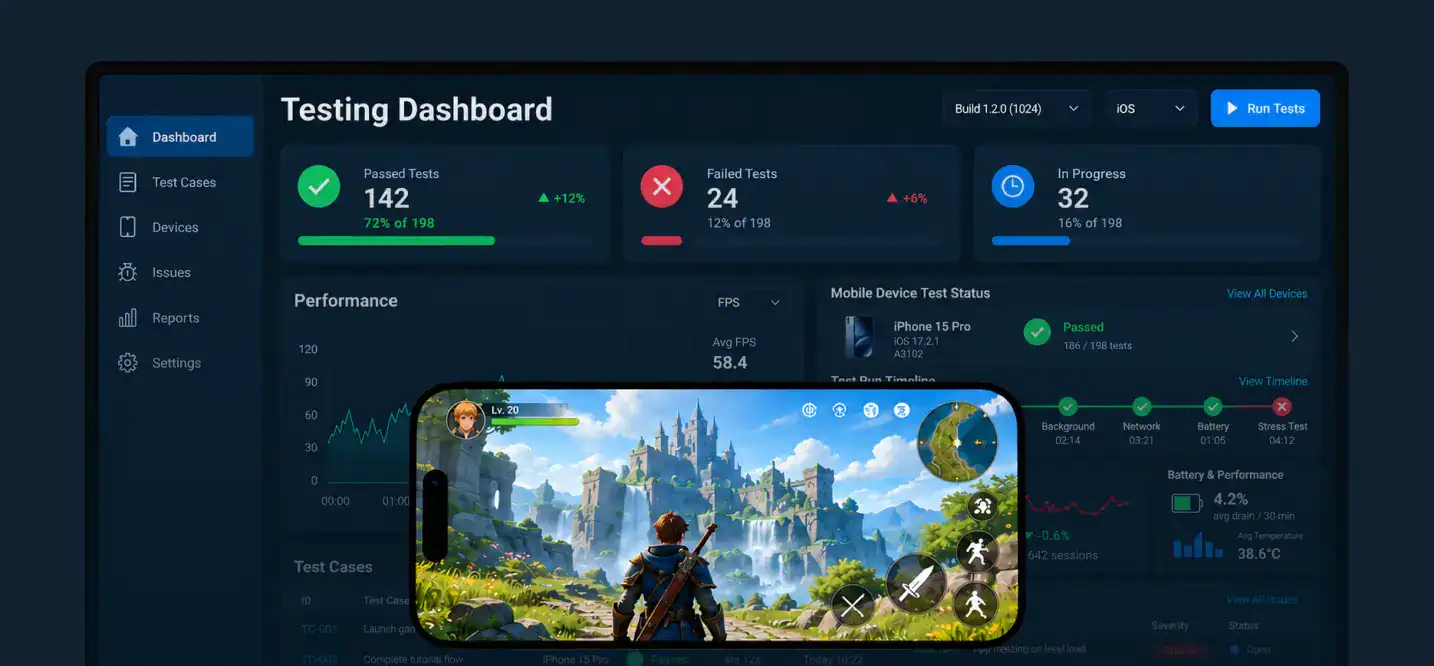
Studios outsource for speed, scale, and fresh eyes. Some need more testers right before launch. Others lack the devices. A few simply want an honest outside opinion.
The trend is growing. Epyllion’s 2026 report found outsourcing made up 35.5% of content investment. That was in 2025. In 2017 it was 30.6%. The freelance platform Mellow also saw studio contractor spending rise 55%. It says studios now work with about 10 contractors at once. That is platform data. Read it as a signal, not a law.
Tight budgets push this trend. GDC’s 2026 survey reached over 2,300 industry professionals. Two-thirds of those at AAA studios said their company had layoffs. One-third at indie studios said the same. Smaller teams cannot always keep a full QA department. Flexible outside help fills the gap.
Common Reasons Teams Outsource
The most common reason is the launch crunch. You may need ten testers for six weeks. Not for a whole year. A vendor lets you scale up, then scale back down.
Devices are the next reason. Buying every phone, tablet, and console is costly. A vendor often already owns them. Fresh eyes matter too. Outsiders spot problems your team no longer sees. Time zones help too. Testing can run while your team sleeps.
When QA Should Stay In-House
Outsourcing is not always the right call. Early prototypes change daily, so written test cases go stale fast. Balance and “fun” also need people who know the vision. Those are better judged by your own team.
Very secret builds are another case. The fewer people with access, the better. Many studios use a mix. Their own team runs quick daily smoke tests. A vendor handles the big test cycles.
In-House vs Outsourced QA
This table compares the two options on the factors that matter.
| Factor | In-House QA | Outsourced QA |
|---|---|---|
| Speed to start | Slow. Hiring takes weeks or months. | Fast. A vendor can often start in days. |
| Scaling up or down | Hard. You carry the cost year-round. | Easy. Add or remove testers per project. |
| Device coverage | Limited to the devices you buy. | Wider. Vendors often hold large device pools. |
| Game knowledge | Deep. Testers know your design. | Builds over time. Needs good onboarding. |
| Control and communication | High. Everyone sits on one team. | Medium. Depends on process and tools. |
| Fresh perspective | Low. Testers get used to the game. | High. New eyes find new bugs. |
| Security risk | Lower. Fewer people touch the build. | Higher. Needs NDAs and access control. |
| Best for | Daily checks and design-heavy testing | Launch peaks, device coverage, and regression |
How Much Does Outsourced Game QA Cost?
Game QA is billed by the hour or per tester each month. Rates move with skill level, test type, and region. The figures below are market estimates from published sources. They are not quotes. Your price depends on your scope.
Two sources shape the numbers. Game Dev Outsourcing, a studio directory, publishes game-specific rate bands. Botgauge, a software QA vendor, publishes regional rates and project ranges. Botgauge covers general software QA, not only games. Treat its numbers as a loose guide.
What Drives the Price
Platforms and devices come first. Testing one platform costs less than testing four. Each extra device adds hours. The size of your game matters too. A small puzzle game and an open-world RPG differ a lot.
Next comes the type of testing. Functional checks are the base. Compatibility, performance, localization, and multiplayer tests each add scope. Team size and seniority also change the quote. Senior testers cost more, but they often find tricky bugs faster.
Timeline and contract length matter as well. Rush work and weekend shifts usually cost extra. Long contracts often bring better rates than one-off tests. Reporting needs play a part too. Daily dashboards and custom tools take more effort.
Cost by Tester Level
Skill level moves the hourly rate the most. Game Dev Outsourcing lists these typical market bands.
| Tester Level | Typical Hourly Rate | Best For |
|---|---|---|
| Entry-level | $15 to $25 | Basic functional checks, smoke tests, repeat regression |
| Mid-level | $25 to $45 | Full test cycles, compatibility runs, bug triage |
| Senior or certification-focused | $45 to $80 | Test planning, platform certification, team leads |
It adds that region moves each band as much as seniority. Most studios mix levels. A senior lead plans and reviews the work. Mid-level testers handle the bulk of the hours.
Cost by Testing Type
Some tests cost more than others. Game Dev Outsourcing says localization and certification QA cost more. Those testers need native language skills or platform submission experience. The table below shows the relative level for each test type. These levels are a guide based on effort. They are not published prices.
| Testing Type | Relative Cost | Why |
|---|---|---|
| Functional testing | Lower to medium | Core checks with a steady workload |
| Regression testing | Lower to medium | Same checks repeated on each build |
| Exploratory testing | Medium | Needs curious, experienced testers |
| Compatibility testing | Medium to higher | More devices mean more hours |
| Performance and stress testing | Medium to higher | Needs tools and skilled testers |
| Multiplayer and network testing | Higher | Needs many testers online at once |
| Localization QA | Higher | Needs native language testers |
| Certification QA | Higher | Needs platform rules and submission experience |
Most of the spend lands in the final months. Game Dev Outsourcing advises budgeting QA around your certification date. Do not spread it evenly across the schedule.
Cost by Region
Where your testers sit changes the rate. Botgauge published these regional bands for general software QA. Game testing rates may differ.
| Region | Junior QA ($/hr) | Senior QA ($/hr) | Notes |
|---|---|---|---|
| Asia-Pacific | 20 to 30 | 35 to 50 | Strong cost efficiency |
| Eastern Europe | 25 to 40 | 45 to 60 | Strong automation skills |
| Latin America | 25 to 35 | 40 to 55 | Good time zone overlap with the Americas |
| North America | 60 to 80 | 100 to 120 | Highest rates |
A low rate does not always mean a low bill. Time zone gaps slow replies. Weak reports waste developer hours. Always compare the total cost, not just the hourly rate.
Cost by Pricing Model
Vendors usually offer four models. Each one fits a different kind of project. The ranges below come from Botgauge and cover general software QA.
| Pricing Model | How It Works | Typical Range | Best For | Watch Out For |
|---|---|---|---|---|
| Fixed price | One agreed price for a defined scope | $3,000 to $50,000 per project | Short projects with a clear scope | Extra charges when scope changes |
| Time and materials | You pay for hours or days worked | $15 to $150 per hour | Projects where scope may shift | Costs can grow without a cap |
| Dedicated team | A set group of testers works only on your game | $4,000 to $15,000 per month | Long projects and live games | You pay even in quiet weeks |
| Pay per bug | You pay for each valid bug found | No standard range | Rarely a good fit | Testers may chase easy, minor bugs |
Most studios start with a fixed price for a pilot. Botgauge says a pilot often costs $1,000 to $5,000. Studios move to a dedicated team once they trust the vendor. Be careful with pay per bug. It rewards volume, not value. A tester can log ten typos. They might skip the one crash that matters.
A Sample Budget
Here is a simple example using the Game Dev Outsourcing bands. It is an illustration, not a quote.
Say a studio needs a 6-week pre-launch test cycle. The vendor team has 3 mid-level testers and 1 senior lead. Everyone works 40 hours a week. That adds up to 960 hours.
| Role | Hours | Rate Band | Cost Range |
|---|---|---|---|
| 3 mid-level testers | 720 | $25 to $45 per hour | $18,000 to $32,400 |
| 1 senior lead | 240 | $45 to $80 per hour | $10,800 to $19,200 |
| Total | 960 | $28,800 to $51,600 |
This budget leaves out onboarding, management fees, and device costs. A different region or scope would change it. Use it to sanity-check quotes, not to replace them.
Hidden Costs to Watch
The quote is only part of the bill. Onboarding takes your team’s time. Game Dev Outsourcing says it takes two to four weeks. Contract early. Someone must upload builds, manage access, and refresh test accounts. Poor bug reports waste developer hours. Your team must chase details. Botgauge estimates unclear requirements add 15% to 25% in rework. Retest rounds may be billed separately. Switching vendors midway means paying to start over.
These costs sit on top of an already pricey business. Adjust says global cost per install rose 30% in 2025. It now sits at $0.56. Paid installs also grew 61% faster than organic ones. Every player you buy is expensive. A bug that drives them away wastes that spend.
Why Late Bugs Cost More
Fixing a bug late costs more than fixing it early. An IBM Systems Sciences Institute figure is widely cited. It says coding fixes cost about 6x more than design fixes. Testing fixes cost about 15x more. Production fixes can hit 100x.
Many experts question those exact numbers. The original study is hard to trace. The trend still holds: late bugs cost more. Developers must reopen old code. Support teams get tickets. Players leave reviews. Outsourced testing earns its keep by catching bugs before that point.
Platforms and Devices to Test
Players use a huge mix of phones, PCs, and consoles. Your QA partner must cover the ones your audience actually owns. Start with your analytics. Then build the device list from there.
Newzoo’s 2025 estimate shows the scale. Mobile had 3 billion players. PC had 936 million. Console had 645 million. Mobile is the biggest group by far. It is also the hardest to test. Devices vary so much.
StatCounter data for August 2026 is clear. Android held 67.45% of worldwide mobile usage. iOS held 32.52%. In the United States, the picture flips. iOS led with 58.35% in June 2026. Your target market decides which platform gets the most test time.
Mobile Game QA
Phones bring the most variety. Android runs across many brands, screen sizes, and chip types. Testers should check low-end phones with little memory. They should also check notches, aspect ratios, and battery drain. Overheating in long sessions is a common problem.
Real life also gets in the way of play. Calls and texts interrupt the game. Players switch from Wi-Fi to mobile data mid-session. In-app purchases, restores, and refunds must work every time. Install and update flows matter just as much as gameplay.
Stability has a hard number attached to it. Google Play’s bad behavior threshold is a 1.09% user-perceived crash rate. For ANR (app not responding) events, it is 0.47%. Cross those lines and Google may reduce your game’s visibility. On a single phone model, the limit is 8% for both. A partner with many test devices helps you stay under.
Plan your mobile game development schedule early. Build the test device list into it. That saves pain later.
PC and Console QA
PC testing is about hardware variety. Graphics cards, drivers, and resolutions change how a game runs. Frame rate drops are common. Keyboard, mouse, and gamepad input all need checks.
Console testing is about strict platform rules. Controllers, save data, and trophies must work as the platform expects. Certification checks can block a release. Both also need online service tests, cloud saves, and patch checks.
Platform Checklist
Use this table to plan your device list for each platform.
| Platform | Devices to Cover | OS or System Versions | Input Types | Key Risks |
|---|---|---|---|---|
| Android | Low, mid, and high-end phones plus tablets | Several recent Android versions | Touch, gamepad | Crashes on older chips, screen layout issues |
| iOS | Recent iPhones and iPads, including older models | Current and previous iOS versions | Touch, gamepad | Memory limits, store review rejections |
| PC | Budget, mid, and high-end builds | Current Windows version, plus Mac or Linux if supported | Mouse, keyboard, gamepad | Driver bugs, frame rate drops |
| Console | Each target console and model | Current system firmware | Controller | Certification failures, save data loss |
| Cross-platform | A mix of all the above | Varies | All | Progress sync errors, matchmaking issues |
How the Outsourcing Process Works
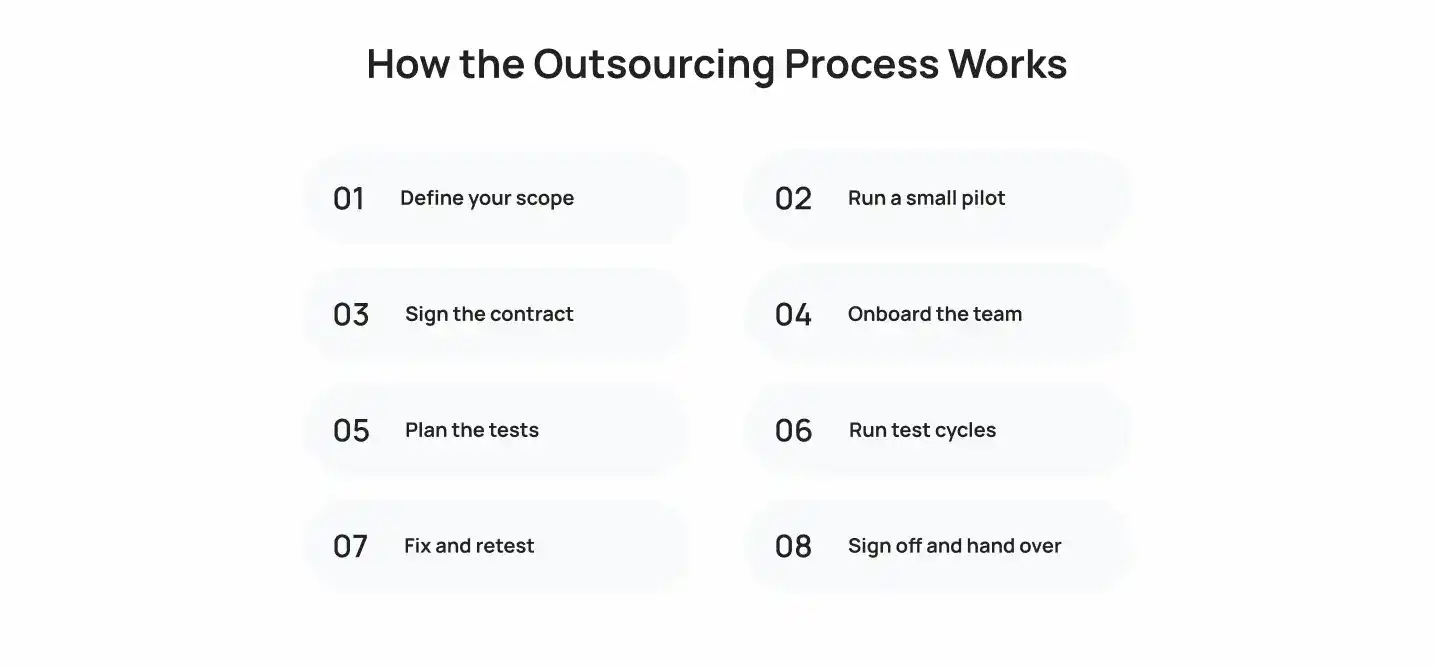
A good process looks the same at most vendors. Knowing the steps helps you spot a weak one. Here is the flow at a glance:
Step-by-Step Workflow
Start by defining your scope. List your platforms, devices, test types, and launch date. Then run a small pilot. Give two or three vendors the same build. Compare what they find. The pilot tells you more than any sales deck.
After that, the work follows eight steps:
- Define your scope. Platforms, devices, test types, and launch date.
- Run a small pilot. Same build, two or three vendors.
- Sign the contract. NDAs, SLAs, pricing, and IP ownership.
- Onboard the team. Design docs, builds, test accounts, and known issues.
- Plan the tests. Agree on a test plan and priority areas.
- Run test cycles. Bugs go into your tracker daily or weekly.
- Fix and retest. Developers fix. Testers confirm each fix.
- Sign off and hand over. Final reports and open issues.
Even hit games lean on outside teams. Epyllion’s report counted 97 internal and 93 external credits on Palworld. Of those, 80 were tied to one vendor, Keywords Studios. Outsourcing is normal at every level.
Who Does What
Clear roles keep a project calm. Your producer owns the schedule and priorities. The vendor’s QA lead plans tests and manages the testers. The testers run test cases and write bug reports. Your developers fix bugs and answer technical questions. A release manager makes the final ship call.
What to Prepare Before You Start
You can save days with a little prep. Set up a stable way to deliver builds. Write a short design document or game guide. Share a list of known bugs so testers skip them. Create test accounts and sandbox purchase setups. Pick a bug tracker such as Jira. Agree on what “critical,” “major,” and “minor” mean. Finally, name one person on your side to answer questions fast.
How to Choose a Game Testing Partner
Treat this like hiring a key team member. Test them first. Ask hard questions. Check the details. A cheap quote means little if the bug reports are vague.
What to Look For
Start with game experience. Have they tested your genre before? A team that knows match-three games may struggle with a shooter. Then check device access. Ask which phones, tablets, and consoles they own today.
Communication matters just as much. A good partner replies fast and asks smart questions. Strong bug reports are the proof. Ask to see two samples. Security habits and flexibility round out the list. Can they protect your build? Can they add testers on short notice?
First impressions matter in games too. Sauce Labs says up to 25% of players quit early. A poor first session drives it. A crash or freeze is enough. Ask every vendor how they test installs and tutorials.
Red Flags to Avoid
Some warning signs show up early. A vendor that refuses a paid pilot is hiding something. A vendor that quotes before asking questions has not listened. Vague sample reports are a bad sign. So is a team that cannot name its devices.
Watch for high tester turnover as well. If testers change every cycle, they never learn your game. Be wary of loose NDA terms. Distrust any vendor promising to find “every bug.” No one can.
Vendor Scorecard
Use this table to compare vendors side by side. Score each vendor from 1 to 5. Multiply by the weight. Higher totals win. The weights are a starting point, not an industry standard. Change them to fit your project.
| Criteria | What Good Looks Like | Weight (out of 10) |
|---|---|---|
| Bug report quality | Clear steps, video, logs, and device info every time | 10 |
| Security and NDA practices | Signed NDA, named testers, secure build handling | 10 |
| Game and genre experience | Shows past work on similar games | 9 |
| Device coverage | Owns or can access your full device list | 9 |
| Communication | Fast replies and overlap with your work hours | 8 |
| Pilot willingness | Happy to run a small paid trial | 8 |
| Pricing clarity | Plain quote with no surprise extras | 7 |
| Scalability | Can grow or shrink the team quickly | 7 |
| References | Past clients you can speak with | 7 |
| Tools and automation | Uses modern trackers and test tooling | 6 |
Questions to Ask on a Sales Call
Bring these to your next vendor call:
- Which games like mine have you tested?
- Who will test my game, and will they stay on it?
- Can you share two sample bug reports?
- How fast do you retest a fixed bug?
- What happens if a tester leaves mid-project?
- How do you charge for rework or extra cycles?
A vendor with a clear process is easier to trust. Cubix, for example, follows a five-step approach. It starts with planning and ends with pre-launch checks.
Security, IP and Contracts
Your unreleased build is valuable. A leak can hurt your launch and your marketing. Treat QA access like any other sensitive access.
Leaks cost real money. IBM’s 2025 report puts the global average breach at $4.44 million. Finding and containing one took 241 days on average. Insider attacks were the costliest type, at about $4.9 million. A game build is not customer data. The lesson still applies. Strong access rules cost less than a leak.
Protecting Your Build and Code
Sign an NDA before you share anything. Give each tester a named account, with no shared logins. Use private build links that expire. Limit who can see unreleased features. Remove access the day a tester leaves the project. Ask where the vendor stores builds and test data, too.
SLAs, Bug Reporting and Handoff
A service level agreement (SLA) puts promises in writing. Ask for a response time for questions. Ask for a turnaround time for logging bugs. Ask for a retest time for fixes. Agree on severity rules. “Critical” should mean the same to both sides.
Also lock in one report format, used every time. At the end, ask for a handoff package. It should include final reports, test cases, and open issue lists. These files stay useful long after launch.
IP and Ownership
Your contract should say you own all reports and test cases. The vendor should not reuse your content or screenshots. Subcontracting should need your written approval. Data should be deleted or returned when the project ends.
Some studios want QA and production under one roof. Full game development services can pair testers with the builders. That cuts handoff delays.
How to Measure QA Success
You cannot fix what you do not measure. Pick a few KPIs at the start. Review them every cycle. Do not wait for launch day.
Players give you little time. Mistplay found about 70% of players allow time for fixes. The window runs from days to two months. Only 25.64% say they will stay through a bad update. Fast, clean fixes protect that goodwill.
The stakes are high after launch. GameAnalytics studied 16,262 mobile titles. The median game kept under 4% of players by day 7. By day 30, the median game kept under 1%. A buggy first week makes these odds worse. Good KPIs show if your pipeline is healthy.
KPIs That Matter
| KPI | What It Tells You | Healthy Signal |
|---|---|---|
| Escaped defects | Bugs that reached players after launch | Drops release over release |
| Defect detection rate | Share of total bugs QA caught before launch | Rises as the partnership matures |
| Crash-free sessions | How stable the game feels in real play | Stays steady or climbs after each patch |
| Reproducibility | How often developers can repeat a reported bug | Most bugs repeat on the first try |
| Reopen rate | How often “fixed” bugs come back | Low and falling |
| Retest turnaround | Speed of confirming a fix | Meets your SLA every cycle |
| Test coverage | Share of planned test cases and devices completed | Close to the plan by each milestone |
Warning Signs a Partner Is Struggling
Late reports are the first sign. Duplicate bugs and thin detail follow. A rising reopen rate means fixes are not checked well. Testers who never ask questions may not understand the game.
Another sign is a pile-up of bugs in the final week. That means testing started late or skipped areas. Watch your developers too. If they clarify more than they fix, the reports are failing.
A healthy test cycle has a clear shape. New bugs rise early, peak, then fall as the build settles. The chart below shows a sample trend. The numbers are made up for illustration.
A Realistic Example
Read this first: This is an illustration, not a verified benchmark. All numbers are made up.
Meet a fictional studio. It has a small team and one casual puzzle game.
The Assumptions
The team has 12 people, including one in-house QA person. The game has in-app purchases and ships on Android and iOS. The device list has 12 Android phones, 6 iPhones, 2 iPads. Launch is 8 weeks away. The studio books a 6-week outsourced test cycle. The scope covers functional, compatibility, regression, payment flow, and performance testing.
How It Plays Out
In week 1, the vendor gets builds, docs, and test accounts. Testers run smoke tests and find 48 bugs. In week 2, full device testing starts. Compatibility issues push new bugs up to 61.
Week 3 brings heavy fixing. Regression testing catches 40 new issues. Some come from the fixes. By week 4 the build calms down. Testers find 24 new bugs. In week 5 they focus on exploratory play and payment flows. Only 12 new bugs appear. In week 6 the final regression run finds 5 more. Testers sign off, according to types of video game testing.
The result: 190 bugs found and 182 fixed. Eight minor bugs wait for a later patch. The in-house QA person handled daily smoke tests. The vendor handled devices and regression. Neither side was stretched too thin.
Common Mistakes to Avoid
- Hiring on price alone. A low quote often means thin reports. Score vendors with a scorecard instead.
- Skipping the pilot. You learn nothing until real testing starts. Run a small paid trial first.
- Weak onboarding. Testers cannot judge what they do not understand. Share design docs and a short walkthrough.
- Unclear bug priorities. When everything looks urgent, nothing gets fixed. Agree on severity levels in writing.
- No single point of contact. Questions get lost between teams. Name one owner on each side.
- Testing too late. Late bugs cost the most. Start testing at the first stable build.
- Ignoring the metrics. Problems stay hidden until players find them. Review your KPIs after every cycle.
Outsourcing Game QA Checklist
Use this list before you sign anything:
- List your platforms, devices, and test types.
- Set a launch date and a testing window.
- Decide what stays in-house.
- Shortlist three vendors.
- Score each one with the vendor scorecard.
- Run a small paid pilot with the same build.
- Compare bug report quality, not just bug counts.
- Sign an NDA and agree on access rules.
- Write SLAs for response, report, and retest times.
- Confirm that you own all reports and test cases.
- Pick 4 to 6 KPIs and a review schedule.
- Plan a handoff package for the end of the project.
Why Choose Cubix for Game QA?
Cubix is a game development company with a dedicated testing practice. The team has tested 400+ games. It has 18 years in the market. More than 350 game designers and developers work across the company.
The process is clear. It has five steps: planning, stability, AI and NPC behavior, stress, and pre-launch testing. The team covers action, adventure, RPG, simulation, and strategy games. It also checks multiplayer play. That includes network, lag, and server load tests.
The testing team is a mix of skills. It includes QA engineers, game designers, and performance engineers. AI specialists and beta testers join too. Work spans engines such as Unity and Unreal.
Talk to Cubix About Your Game
Not sure where to start? Share your build, your platforms, and your launch date. Cubix can review your scope. It can suggest a test plan that fits. There is no pressure to commit.
Bring your device list and your biggest worry. We will help you work out what to test first. Ready to protect your launch? Contact the Cubix team for a free consultation and project review.
Frequently Asked Questions
1. How much does outsourced game QA cost?
It depends on your scope. Platforms, devices, test types, and timeline all move the price. This guide avoids made-up rates on purpose. Ask two or three vendors to quote the same scope. Then compare the quotes side by side.
2. What does a QA vendor deliver?
A good vendor delivers a test plan and test cases. You also get detailed bug reports. You should also get regression results and a device compatibility report. A final release summary shows what is still open before launch.
3. How do I evaluate a game testing partner?
Run a small paid pilot with the same build. Compare bug report quality, not just bug counts. Then score each vendor with the scorecard in this guide. Check device coverage, communication, and security habits too.
4. When should QA stay in-house?
Keep QA in-house for early prototypes and fast-changing designs. Balance and “fun” checks also fit your own team better. Very secret builds are another case. Many studios keep daily smoke tests in-house. They outsource big test cycles.
5. What is the difference between regression and exploratory testing?
Regression testing repeats set checks to confirm old features still work. Exploratory testing has no script. Testers play freely and hunt for surprises. Most games need both.
6. Is it safe to outsource testing for an unreleased game?
It can be, with the right controls. Sign an NDA before sharing anything. Give each tester a named account. Use private, expiring build links. Remove access when a tester leaves. Confirm in the contract that you own all reports.
7. How long does an outsourced QA cycle take?
It depends on game size and test scope. Our worked example uses a 6-week cycle for a small mobile game. That is an illustration, not a benchmark. Ask vendors to share a timeline based on your own build.