Early Access vs Full Release comes down to one question: is your game ready to deliver a worthwhile experience, or does it need more development? Early Access lets studios release a playable game while development continues, whereas a full release delivers the intended finished experience.
Newzoo’s 2025 games market report found that games transitioning from Early Access to version 1.0 within roughly four to nine months generally attracted more new players after launch than titles with longer Early Access periods. This suggests that release timing matters, though the right timeline depends on the game.
The choice ultimately depends on gameplay readiness, funding, the value of player feedback, and your team’s capacity to complete and support the game.
Key Takeaways
- Early Access works best when the core gameplay is already engaging and worth paying for, even if development is ongoing.
- Player feedback is most valuable when studios can still make meaningful changes to gameplay, balance, and progression.
- A shorter, focused Early Access period can help maintain player interest and build momentum toward version 1.0.
- Early Access sales should support development, not serve as the only funding plan.
- Roadmaps should communicate development priorities without making promises the team cannot guarantee.
- Games built around complete narratives or controlled first-time experiences may be better suited to a full release.
- Studios should define clear version 1.0 criteria before launch rather than relying on timelines or sales momentum.
Ready to Launch Your Game? Let’s Plan the Right Strategy
Contact UsEarly Access vs Full Release: What’s the Difference?
Early Access gives players a playable version of a game while meaningful development remains. A full release presents the intended finished experience, although developers may continue releasing patches, balance changes, and additional content afterward.
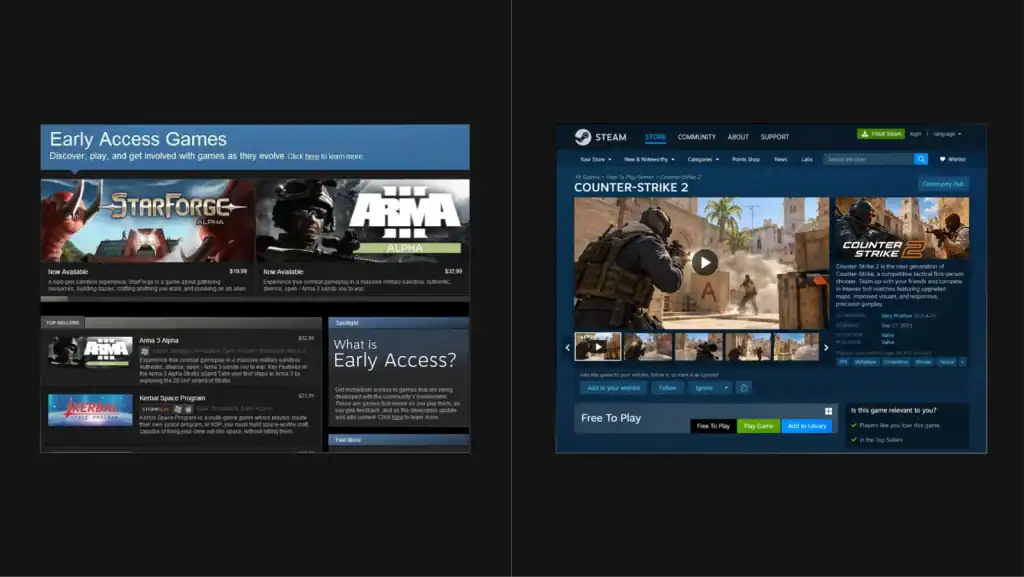
On Steam, Early Access is specifically a way to sell a game that is still being developed. Valve expects the current build to be playable and worth its asking price, rather than merely a promise of a future product. Its official Early Access documentation also makes clear that developers should not rely on Early Access simply to fund an unfinished project.
| Factor | Early Access | Full Release |
|---|---|---|
| Game readiness | Playable, with meaningful development remaining | The promised core experience is complete |
| Player feedback | Can influence features, balance, and priorities | Primarily informs fixes and future improvements |
| Revenue timing | Sales may begin before version 1.0 | Sales begin with the full launch |
| Development flexibility | More room to change systems, with community expectations to manage | Major changes can disrupt an established experience |
| Team workload | Development, updates, player support, and community communication | Launch support, fixes, and post-launch development |
| Main risk | Players lose confidence if progress or communication falls short | Players encounter an incomplete or poorly polished game |
The most important distinction is the commitment each model creates. Early Access is not permission to release a weak build. Players are paying for the experience available today, not just the game you intend to deliver later.
A studio should also distinguish Early Access from advance access. On Steam, Early Access means purchasing a playable game that remains in development. Advance access generally refers to a preorder benefit that lets eligible customers play before the standard launch. The terms and rules differ across storefronts, so verify the relevant platform’s requirements before planning a release.
Is Early Access the Same as a Beta, Demo, or Playtest?
No. Early Access is a release strategy, while a beta, demo, or playtest serves a different purpose.
1. Early Access
Players purchase a playable game that continues to receive substantial development. The studio must communicate the current state, known limitations, and plans for completion.
2. Beta Testing
Developers test a build to uncover bugs, evaluate balance, or validate systems. Access may be limited to selected participants, and the build may not be intended for general sale.
3. Demo
Players experience a limited portion of the game to evaluate its mechanics, presentation, and appeal. A demo can help test interest without committing the entire project to a public development cycle.
4. Steam Playtest
Steam’s dedicated testing feature allows developers to provide testing access separately from the main game’s purchase and release flow. See the Steam Playtest documentation for platform-specific details.
5. Paid Advance Access
Eligible customers receive access before the general launch, typically as part of a preorder or special edition. This does not automatically mean the game is an unfinished Early Access product.
Choose the format based on what you need to learn. If you are still testing whether a mechanic is fun, a focused playtest may provide better feedback with less public pressure. If the core experience already works and ongoing player input can shape the remaining development, Early Access may be appropriate.
How Do You Know If Your Game Is Ready for Early Access or Full Release?

A game is ready for Early Access when its core loop is playable, enjoyable, and stable enough to justify the purchase, even though substantial content or systems remain unfinished. A full release requires the team to meet the promises it makes about the complete experience.
Use the following assessment before choosing a launch date.
| Readiness Factor | Early Access Threshold | Full-Release Threshold |
|---|---|---|
| Core gameplay | The main loop works and offers meaningful repeat play | The intended gameplay experience is complete and polished |
| Stability | Critical defects do not routinely prevent play | Release-blocking defects are resolved and regression testing is complete |
| Content | Enough meaningful content exists to support the current price | Content meets the promised version 1.0 scope |
| Onboarding | Players can understand the basic mechanics and progression | Tutorials, progression, and usability are ready for the intended audience |
| Team capacity | The team can maintain development, support, and communication | The team can manage launch issues and ongoing support |
| Development plan | Remaining work, limitations, and priorities are clear | The game meets its release criteria and outstanding work does not undermine the promise |
When Should You Delay Either Release?
Some problems should stop a launch regardless of the release model.
- The core loop is not fun yet. Players cannot provide useful feedback on long-term balance if the basic activity is not engaging.
- Critical crashes remain unresolved. Frequent failures make it difficult to distinguish gameplay feedback from technical problems.
- The build is too thin to justify its price. A prototype or short technical demonstration is not automatically a worthwhile commercial product.
- The team cannot support the release. If every developer must abandon production to respond to bugs and player reports, the roadmap is unlikely to survive.
- The funding plan depends on optimistic sales. If the project stops without a specific revenue target, the team needs another funding or contingency plan.
For an early build, validate mechanics and gameplay flow before expanding content. Cubix’s Game Prototyping Services are relevant to this stage. Before release, use structured QA to assess stability and regression risk through Game Testing Services. Onboarding and interface problems also deserve attention; players should not need developer explanations to understand the basic experience.
What Are the Financial Trade-Offs of Early Access vs Full Release?
Early Access can bring in revenue while development continues, but sales are uncertain and may not cover the remaining production costs. A full release generally requires more of the intended experience to be completed before the main launch, which can increase the amount of funding needed upfront.
| Financial Consideration | Early Access | Full Release |
|---|---|---|
| Revenue timing | Potential sales before version 1.0 | Revenue from the full launch |
| Development funding | Sales may contribute to ongoing work, but are unpredictable | More production costs may need to be funded before release |
| Marketing workload | Requires ongoing communication about changes and progress | Often concentrates more heavily around launch |
| Support costs | Updates, bug fixes, and community management run alongside development | Launch fixes and post-launch support remain necessary |
| Financial exposure | Weak sales can leave the game unfinished or underfunded | A delayed launch or poor sales can put pressure on the upfront investment |
Example: A Studio With Six Months of Funding Remaining
Imagine a small studio has six months of runway, a playable core loop, and several major systems still in development. Launching Early Access might bring in sales and useful feedback, but it also introduces support costs and pressure to deliver updates.
Before committing, the studio should calculate:
- Monthly Operating Costs: Salaries, contractors, software, hosting, and other recurring expenses.
- Remaining Development Costs: The work required to deliver the promised version 1.0 experience.
- Early Access Support Costs: QA, crash fixes, community management, compatibility work, and update preparation.
- A Low-Sales Scenario: How the team will continue if revenue falls short of expectations.
- A Fallback Plan: Whether the studio can reduce scope responsibly, secure other funding, or extend its runway.
The team should not treat forecast sales as guaranteed cash. Store fees, taxes, refunds, discounts, and other costs also affect how much gross sales translate into usable development funding.
Decision Rule: If the project cannot continue without hitting an optimistic sales target, resolve the funding risk before launch. Early Access is a way to develop with players, not a reliable substitute for a financial plan.
How Should a Studio Plan an Early Access Release?

A successful Early Access plan defines what players can do today, what remains unfinished, how feedback will affect development, and what must happen before version 1.0. The work begins well before the store page goes live.
1. Define the First Paid Experience
Identify the features required for a satisfying session. A survival game might need resource gathering, crafting, exploration, and a meaningful progression loop. A roguelike might need reliable combat, enough build variety to encourage experimentation, and a repeatable run structure.
Not every planned feature must be present. The available build must still offer a coherent experience without relying on promises about future updates.
2. Test the Game With the Right Players
Use external playtests to uncover problems that internal developers may overlook. Observe where players become confused, abandon a run, exploit a system, or repeat an activity less often than expected.
Separate feedback into categories:
- Critical defects: Crashes, progression blockers, save corruption, and other issues that prevent play.
- Usability problems: Unclear controls, weak onboarding, confusing interfaces, or unexplained mechanics.
- Balance problems: Difficulty spikes, dominant strategies, or progression that feels unrewarding.
- Feature requests: New content and improvements that may or may not fit the roadmap.
This separation prevents the loudest feature request from taking priority over a defect that affects the entire player base.
3. Publish a Realistic Roadmap
Tell players what the current build includes, what remains unfinished, and which improvements the team is prioritizing. Distinguish confirmed commitments from ideas under consideration.
An effective roadmap describes outcomes, not just feature names. For example, “improve multiplayer stability and matchmaking reliability” gives players a clearer objective than “multiplayer update.”
Avoid promising exact delivery dates when the work is difficult to estimate. If a major system changes the scope or schedule, explain the reason rather than allowing outdated expectations to persist.
4. Budget For Ongoing Development and Support
Early Access adds work that a traditional production plan may underestimate. Developers must handle player reports, investigate bugs across different hardware configurations, communicate changes, and test updates without stopping feature development.
Assign responsibility for community feedback and triage, even if one person holds multiple roles. Set an update cadence the team can sustain, and protect time for regression testing before each release.
Studios that need production support can review Cubix’s online game development services when planning engineering capacity and ongoing development work.
5. Define the Conditions For Version 1.0
Do not decide that the game is finished simply because development has taken a long time or sales have slowed. Define release criteria before launch, then evaluate progress against them.
Useful criteria include:
- All promised core features are implemented.
- Critical and release-blocking defects are resolved.
- Performance and compatibility meet the project’s requirements.
- Progression, onboarding, and major game systems work as intended.
- Save data and player progression remain compatible where promised.
- The team has tested the final release candidate and prepared a support plan.
The exact criteria depend on the game. A competitive multiplayer title may require extensive server-load and matchmaking tests, while a narrative game may prioritize story completion, quest reliability, and save compatibility.
What Can Developers Learn From Games That Used Early Access?
Hades and Baldur’s Gate 3 show how Early Access can support iterative development when the studio has a clear reason to involve players before the final release. Their histories offer useful lessons, but neither example guarantees similar results for another game.
Hades: Design the Game Around Iteration
Supergiant Games launched Hades in Early Access in December 2018 and released version 1.0 on September 17, 2020. The studio said it designed the game for development in partnership with its community, with regular updates introducing new features, characters, weapons, environments, and other content. Its version 1.0 launch also added story content and improvements. These details are documented in the developer’s Early Access announcement and version 1.0 announcement.
The lesson is not that every game should remain in Early Access for a similar period. Hades had a structure that supported repeat play and incremental refinement. That made ongoing feedback relevant to combat, progression, and how the story unfolded over repeated runs.
What Studios Can Apply: Choose Early Access when the game can deliver a meaningful experience now and when player behavior can inform decisions the team still has time to change.
Baldur’s Gate 3: Feedback Needs to Influence Development
Larian Studios described Early Access as a way to iterate on Baldur’s Gate 3, hear player feedback, and improve the eventual version 1.0. In its official development update, the studio also discussed using gameplay data, including heat maps, to understand how players experienced the game.
That approach illustrates an important distinction: feedback is more useful when combined with evidence about actual player behavior. A forum request may explain what a player wants, while telemetry or structured testing may reveal where a mechanic causes confusion or difficulty.
What Studios Can Apply: Establish a process for comparing player comments with observed behavior. Use both to prioritize changes, rather than treating every request as a development requirement.
Both examples also highlight a limitation: Early Access works only when the team can respond to what it learns. Feedback collected too late, ignored by the team, or gathered from an unrepresentative player group may have little value.
What Are the Biggest Risks of Early Access?
The main risks are not limited to unfinished content. They include broken expectations, an expanding scope, technical debt, and a support workload that slows development.
- Scope creep: Player requests keep expanding the roadmap. Publish priorities and define what falls outside the planned release.
- Unrealistic promises: Missed update dates weaken trust. Communicate uncertainty and explain material changes to the plan.
- Negative first impressions: Players encounter a weak core loop or serious technical problems. Validate the current experience before selling access.
- Technical debt: Rapid changes create fragile systems that make future updates harder. Reserve time for refactoring, automated checks, and regression testing.
- Community management overload: Developers spend so much time responding that production stalls. Establish a reporting process and prioritize issues by severity and impact.
- Save incompatibility: Major changes may break existing saves or progression. Decide early how save migrations will work, test them, and communicate known limitations.
- A weak transition to version 1.0: Players do not understand what is complete or what has changed. Explain the final-release scope and verify it against the original promises.
Early Access may also be a poor fit for games whose appeal depends on a carefully controlled narrative reveal, experiences that cannot deliver meaningful play until most content is complete, or teams that lack the resources for continued public support. A private playtest or demo may answer development questions with less risk.
Which Release Strategy Should Your Studio Choose?
Choose Early Access when the current build is worth playing, player feedback can materially improve the game, and the team can sustain development without depending on optimistic sales. Choose a full release when the promised experience is ready, and a public development phase would add little value.
Use this checklist to make the decision:
Choose Early Access If:
- The core loop is stable, engaging, and repeatable.
- The current build offers enough content to justify its price.
- Player feedback can still influence important development decisions.
- The team can fund support and continued development if sales disappoint.
- The studio can communicate limitations and maintain a realistic roadmap.
Continue Development or Run a Private Playtest If:
- The core gameplay still needs validation.
- Critical technical problems make feedback unreliable.
- The current build does not provide enough value to players.
- The team cannot sustain updates or support.
- Major design decisions remain unresolved and need controlled testing first.
Prepare For Full Release If:
- The intended experience and promised content are complete.
- The game meets its performance, stability, and compatibility requirements.
- The remaining work is mostly polish, launch preparation, and manageable fixes.
- Additional public iteration is unlikely to change major development decisions.
The right release strategy is the one your team can execute without compromising the game or its relationship with players. Early Access can create a useful feedback loop, but only if the current build is worth playing and the studio has the resources to finish what it starts.
Final Thoughts
Choosing between Early Access and a full release depends on your game’s current state, your team’s capacity, and the value player feedback can bring to development. Early Access works when the game is already worth playing, and you have a realistic plan to improve it. If core mechanics, stability, or essential content still need work, continuing development before launch can protect both the player experience and your studio’s reputation.
If you’re unsure whether your game is ready for players, review its core gameplay, technical stability, and remaining development requirements before committing to a release date. A focused assessment can help you identify gaps early, prioritize the right improvements, and move toward launch with greater confidence.
Unsure if Your Game Is Ready to Launch? Let's Find Out
Contact UsFrequently Asked Questions
1. Is Early Access better than a full release?
Neither is inherently better. Early Access suits playable games that can improve through ongoing player feedback. Full release suits games whose intended experience is complete and ready for a wider audience.
2. Can Early Access sales fund the rest of game development?
They can contribute to development, but sales are unpredictable. Budget for a scenario in which revenue falls short, and avoid making the project’s completion dependent on a specific number of purchases.
3. What makes a game ready for Steam Early Access?
The game should be playable, worth its asking price in its current state, and supported by a credible plan for continued development. Players should understand what the current version includes, what remains unfinished, and what changes may occur.
4. When should a developer choose full release instead of Early Access?
Choose full release when the promised experience is complete, the build has passed the required testing, and additional public iteration offers limited benefit. This can be especially relevant when the game depends on a complete narrative or carefully controlled first-time experience.
5. How do you know when an Early Access game is ready for version 1.0?
Define measurable completion criteria before launch. Check promised content, critical defects, performance, progression, save compatibility, and release readiness against those criteria. Version 1.0 should represent the experience the studio committed to delivering, not simply the end of a planned development period.