Healthcare software development can cost anywhere from $25,000 for a basic patient or clinic application to $500,000 or more for a complex hospital management system. A custom EHR/EMR platform may require $300,000+, while telemedicine software can range from $$150,000. These are indicative planning estimates; the actual budget depends on features, system complexity, integrations, security requirements, and project scope.
Integration is one reason healthcare software costs can vary so widely. According to the Office of the National Coordinator for Health Information Technology (ONC), around 9 in 10 U.S. hospitals enabled patients to access their health information through APIs in 2024. However, much of the data exchanged between hospitals and third-party systems still relied on proprietary APIs or non-API methods, including HL7 interfaces. Connecting a new platform to existing healthcare systems can therefore involve more than building an API. It may require vendor-specific configuration, data mapping, testing, and ongoing integration support.
To estimate healthcare software development costs accurately, you need to look beyond the initial build. The following sections break down pricing by software type, development complexity, team location, project stage, integrations, compliance, and ongoing maintenance.
Key Takeaways
- Healthcare software development costs range from around $25,000 for a basic patient app to $500,000+ for complex hospital management systems.
- Software type, feature complexity, integrations, and security requirements have the biggest impact on development costs.
- EHR/EMR, telemedicine, and hospital management systems require different budgets based on their workflows and technical requirements.
- HIPAA compliance, data protection, and third-party integrations add development and testing costs.
- Budget for ongoing maintenance, infrastructure, security updates, and technical support, not just initial development.
- Prioritize essential features for the MVP, then expand based on user feedback and operational needs.
- Choosing between in-house development and outsourcing depends on your technical resources, budget, and long-term maintenance capacity.
Healthcare Software Development Cost Breakdown
Healthcare software development costs typically range from $25,000 to $500,000+, depending on the type of system, its complexity, and the workflows it needs to support. A basic patient application may fall near the lower end, while a custom EHR or hospital management platform can require a substantially larger investment.
The estimates below provide a starting point for budgeting.
Healthcare Software Development Cost by Complexity
| Project Complexity | Estimated Cost | Typical Scope |
|---|---|---|
| Basic | $75,000 | Essential features, limited user roles, and basic integrations |
| Mid-level | $$200,000 | Multiple workflows, custom modules, and third-party integrations |
| Enterprise | $500,000+ | Complex architecture, extensive integrations, and large-scale operations |
These are indicative planning estimates for custom development, not fixed quotes. Basic projects generally involve a limited feature set, while mid-level platforms support multiple workflows. Enterprise systems require broader functionality and more extensive engineering.
Healthcare Software Development Cost by Type
| Software Type | Estimated Cost | Typical Functionality |
|---|---|---|
| EHR/EMR software | $$300,000+ | Patient records, clinical documentation, diagnoses, and medication management |
| Hospital management software | $$500,000+ | Admissions, bed management, scheduling, billing, and department operations |
| Telemedicine platform | $150,000 | Video consultations, appointment scheduling, messaging, and patient profiles |
| Patient portals and healthcare apps | $75,000 | Patient registration, appointment requests, reminders, and health information access |
| Remote patient monitoring software | $200,000 | Device connectivity, vital tracking, alerts, and clinician dashboards |
| Practice management software | $150,000 | Scheduling, patient intake, staff management, and practice reporting |
| Healthcare billing and RCM software | $200,000 | Claims processing, payment tracking, denial management, and financial reporting |
These estimates represent custom development with a defined feature scope. They are not prices for complete enterprise platforms with every possible module. For example, an EHR MVP covering a limited set of clinical workflows will cost less than a system designed for multiple specialties, facilities, and external integrations.
What Factors Affect Healthcare Software Development Costs?
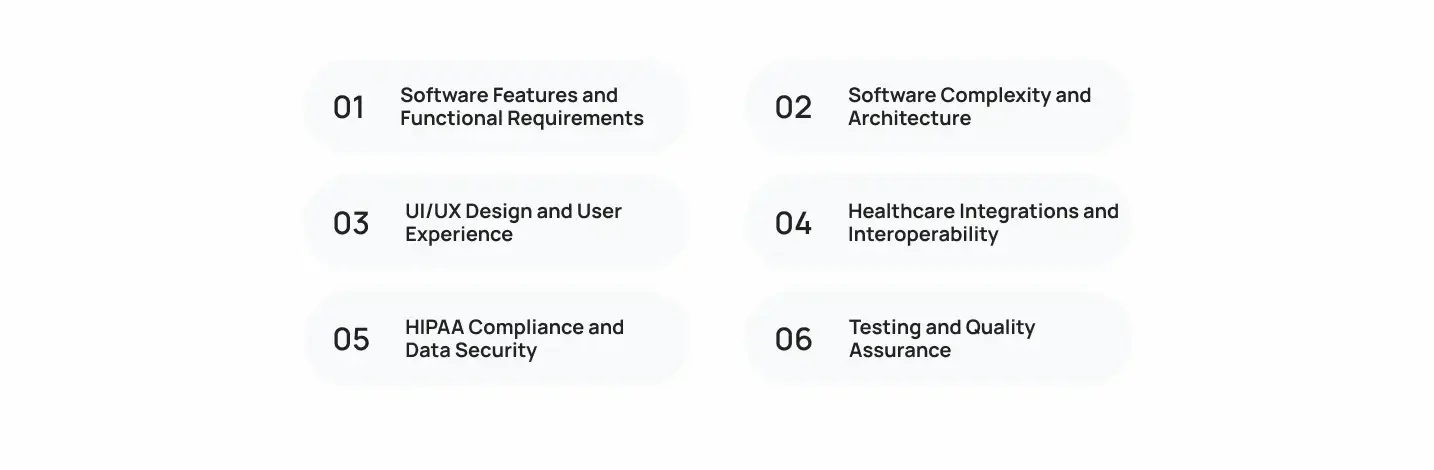
The final healthcare software development cost depends on the features, architecture, integrations, design, and level of testing a healthcare system requires. The main cost factors include:
1. Software Features and Functional Requirements
Every feature adds design, development, and testing work. A basic patient application may need registration and appointment scheduling, while a larger platform may include:
- Patient and provider management.
- Clinical documentation and medical records.
- Billing, claims, and reporting.
- Patient messaging and notifications.
- Role-based access for patients, clinicians, and administrators.
A Functional Requirements Specification (FRS) documents what each feature must do and how users interact with the system. A clear FRS helps define project scope and estimate development effort before coding begins.
2. Software Complexity and Architecture
A system with multiple modules and connected workflows generally costs more than a standalone application. Architecture decisions also affect the estimate, including:
- Single-tenant vs. multi-tenant architecture: Whether each organization gets a separate environment or shares an application with isolated data.
- Database design: How the system stores, retrieves, and processes clinical and administrative records.
- Scalability: Whether the platform must support growing patient volumes, facilities, and concurrent users.
- Performance and availability: Response-time requirements, uptime expectations, and recovery capabilities.
These requirements form part of the Non-Functional Requirements (NFRs). They define how well the system must operate, not just what it must do.
3. UI/UX Design and User Experience
Healthcare software often serves users with very different needs. Patients need simple navigation, clinicians need efficient clinical workflows, and administrators need clear operational dashboards.
Design costs depend on the number of interfaces, workflow complexity, accessibility requirements, and responsive layouts. Prototypes and usability testing also add effort, but help identify navigation and workflow problems before development progresses.
4. Healthcare Integrations and Interoperability
Connecting healthcare software to existing systems can add considerable development work. Common integration requirements include:
- HL7 and FHIR API integration.
- EHR/EMR connectivity.
- Laboratory, pharmacy, billing, and medical imaging systems.
- Data mapping and migration from legacy platforms.
- Interface engines and vendor-specific APIs.
The effort depends on the number of systems involved, API availability, data formats, and vendor restrictions. Some EHR vendors also charge separate API or connectivity fees.
5. HIPAA Compliance and Data Security
Software that handles Protected Health Information (PHI) needs appropriate safeguards. The scope of security work depends on the data involved, system access, integrations, and the organization’s HIPAA obligations.
Cost-related requirements may include:
- HIPAA Security Risk Analysis.
- Identity and access management, including role-based permissions and MFA.
- Encryption for stored and transmitted data.
- Audit trails and security monitoring.
- Third-party security reviews and Business Associate Agreements (BAAs), where applicable.
These requirements involve implementation, documentation, and ongoing review. HIPAA compliance is not a single add-on with a standard price.
6. Testing and Quality Assurance
Healthcare software needs more than basic feature testing. QA effort depends on the number of workflows, integrations, user roles, and risks associated with incorrect data or system behavior.
Typical testing activities include:
- Functional and regression testing.
- API and integration testing.
- Performance and security testing.
- Clinical workflow and data validation.
- Automated test coverage for critical workflows.
Systems with complex clinical processes or extensive integrations generally require more test scenarios and validation before release.
How Much Does Healthcare Software Development Cost by Developer Location?
The location of your development team affects its hourly rate and the overall project budget. The following ranges are indicative estimates for agency and contractor engagements, covering a mix of mid-level and senior developers.
| Development Region | Indicative Hourly Rate (USD) |
|---|---|
| United States | $150 |
| Canada | 150 |
| Western Europe | 150 |
| Eastern Europe | 90 |
| Latin America | 90 |
| South Asia | 60 |
| Southeast Asia | 60 |
Regional labor rates affect the overall development budget, but hourly pricing depends on more than location. Agency rates typically include project management, QA, and business overhead, while independent contractor rates generally cover individual services. Senior developers and specialists with healthcare experience also charge more.
A lower hourly rate does not always mean a cheaper project. Limited healthcare experience, weak communication, or poor security practices can lead to delays and rework. Compare providers based on their technical expertise, healthcare portfolio, security practices, and delivery process, not just their quoted rates.
How Much Does Each Stage of Healthcare Software Development Cost?
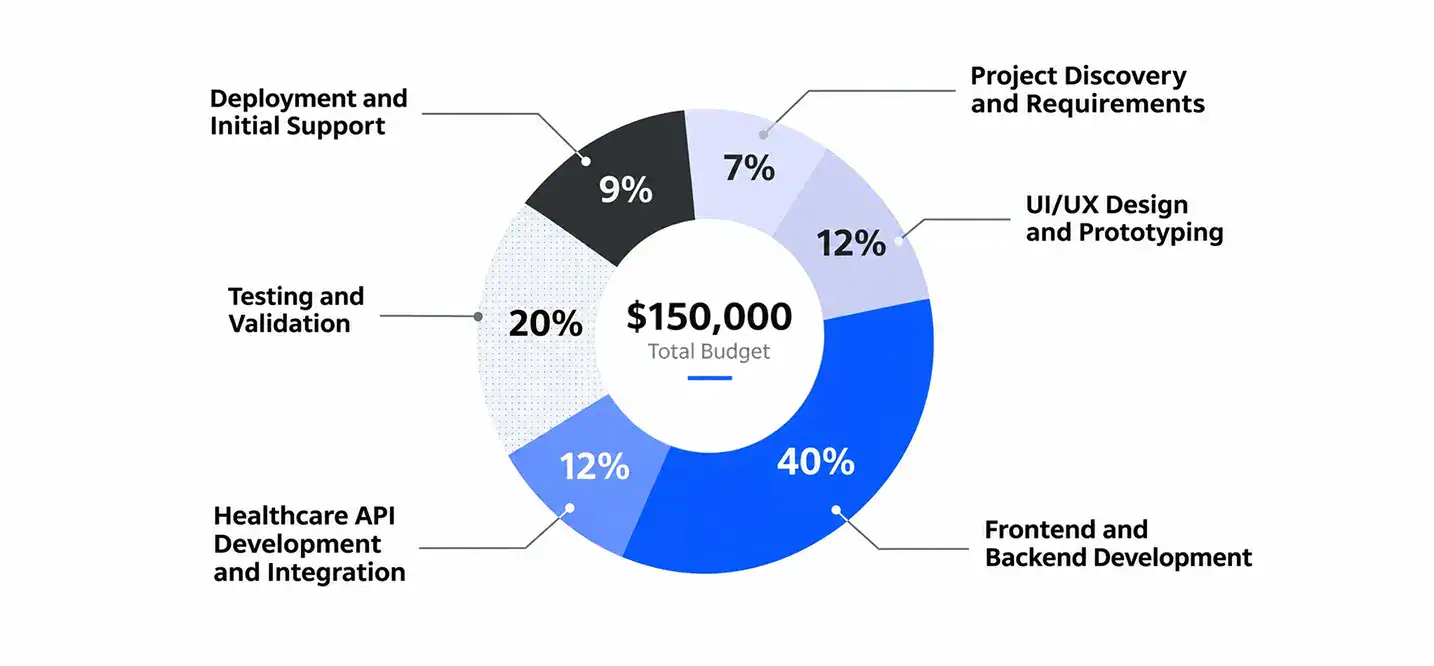
To make the budget breakdown more practical, consider a mid-level healthcare software project with a total development budget of $150,000. The following example shows how that amount could be distributed across the project lifecycle.
| Development Stage | Budget Allocation | Estimated Cost |
|---|---|---|
| Project discovery and requirements | 7% | $10,500 |
| UI/UX design and prototyping | 12% | $18,000 |
| Frontend and backend development | 40% | $60,000 |
| Healthcare API development and integration | 12% | $18,000 |
| Testing and validation | 20% | $30,000 |
| Deployment and initial support | 9% | $13,500 |
| Total | 100% | $150,000 |
1. Project Discovery and Requirements Gathering
Example Cost: $10,500
This stage covers stakeholder interviews, workflow analysis, technical feasibility, FRS and NFR documentation, and MVP definition.
2. UI/UX Design and Prototyping
Example Cost: $18,000
The design team creates user flows, wireframes, interface designs, and interactive prototypes for patient, clinician, and administrator experiences.
3. Frontend and Backend Development
Example Cost: $60,000
This is the largest allocation. It covers user interfaces, backend services, database development, APIs, and core modules such as patient management, scheduling, and clinical documentation.
4. Healthcare API Development and Integration
Example Cost: $18,000
This covers HL7/FHIR interfaces, EHR connections, third-party integrations, data mapping, and migration-related development.
5. Testing and Validation
Example Cost: $30,000
The QA team handles functional, regression, integration, performance, and security testing. Clinical workflow validation is included where the software requires it.
6. Deployment and Initial Support
Example Cost: $13,500
This covers cloud environment setup, production deployment, data configuration, user onboarding, and initial technical support.
How Much Do Healthcare Software Integrations Cost?
Healthcare integrations can take a separate share of the development budget because each connected system may use different data formats, APIs, authentication methods, and vendor requirements. A connection that looks simple on paper can involve custom development, data mapping, testing, and ongoing support.
For a mid-level project, integration work might account for 30,000 or more, depending on the number of systems and the complexity of data exchange. The following areas commonly contribute to this cost.
1. HL7 and FHIR API Integration Costs
Integration costs depend on the healthcare standard, data structure, and workflows involved.
- HL7 v2 interfaces: Require message configuration, routing, and transformation between systems.
- FHIR APIs: Involve resource mapping, API development, and authentication and authorization.
- Data validation: Ensures exchanged records are correctly structured and interpreted by the receiving system.
A basic interface may require limited configuration, while bidirectional exchange across multiple workflows needs more engineering and testing.
2. EHR Vendor API Fees
Connecting to an EHR system may involve costs beyond development. Some vendors charge for API access, subscriptions, or usage, while others impose approval and certification requirements.
Budget considerations include:
- API access and subscription fees, where applicable.
- Vendor-specific authentication and integration requirements.
- Usage limits and commercial agreements.
- Ongoing API support and maintenance.
These charges vary by vendor and contract, so they should be confirmed during project discovery.
3. Interface Engine Implementation Costs
An interface engine manages data exchange between healthcare applications, particularly when multiple systems use different formats or communication protocols.
Costs may include software licensing or subscriptions, message routing configuration, data transformation, monitoring, and maintenance. The number of interfaces and message volume can affect the overall expense.
4. Data Migration and Third-Party Integrations
Moving existing healthcare records and connecting external services can add substantial work. Typical requirements include:
- Extracting records from legacy systems.
- Cleaning and mapping data to the new platform.
- Matching patient identities across databases.
- Connecting laboratory, pharmacy, imaging, billing, and payment systems.
The effort depends on data quality, record volume, and the number of external systems. Poorly structured legacy records often require additional cleanup and validation before migration.
How Much Does HIPAA Compliance and Data Security Add to Development Costs?

HIPAA-related security work can add approximately 40,000 to a mid-level healthcare software project, depending on its architecture, PHI exposure, and existing security controls. This is an indicative planning range, not a fixed HIPAA surcharge. The main expenses usually involve risk assessment, access controls, data protection, and security testing.
1. HIPAA Security Risk Analysis
Estimated Cost: $10,000
A risk analysis identifies potential threats to electronic Protected Health Information (ePHI), evaluates security gaps, and establishes a remediation plan. Larger systems with multiple applications, vendors, and data environments may cost more to assess.
2. Identity and Access Management
Estimated Cost: $$10,000
Implementing secure access controls may involve role-based permissions, multi-factor authentication (MFA), least-privilege access, and user access reviews. The number of user roles and complexity of permissions influence the cost.
3. Encryption, Audit Trails, and Security Monitoring
Estimated Cost: $$15,000
This work covers encryption at rest and in transit, key management, patient record access logs, and security monitoring. More complex systems may require additional logging infrastructure and monitoring tools.
4. Business Associate Agreements and Third-Party Security
Estimated Cost: $5,000
This budget may cover vendor security assessments, reviewing third-party access to PHI, and coordinating Business Associate Agreements (BAAs) where required. Legal review and ongoing vendor oversight may create additional expenses.
Budget consideration: These estimates are not universal rates, and some security work may already be included in development or QA costs. For example, penetration testing may appear under testing and validation rather than as a separate HIPAA expense. Avoid counting the same work twice.
How Much Does SaMD Development and Clinical Validation Cost?
Unlike standard healthcare applications, Software as a Medical Device (SaMD) may require additional spending on regulatory assessment, quality management, software validation, and clinical evidence. For a product pursuing an FDA 510(k) pathway, regulatory preparation and testing can add approximately 250,000+. New clinical studies can increase that budget further.
These costs apply only when software meets the relevant medical device criteria. A patient portal, appointment app, or administrative platform does not automatically qualify as SaMD.
Software as a Medical Device Classification
Estimated Cost: $20,000
A regulatory assessment examines the software’s intended use, functionality, and potential medical risks to determine whether FDA regulation applies and which pathway may be appropriate. The assessment may include classification advice, regulatory gap analysis, and pathway planning.
Clinical Validation and Software Verification and Validation (V&V)
Estimated Cost: $100,000+ for testing; $500,000+ if a new clinical study is required.
V&V confirms that the software meets its specifications and intended use. Clinical validation evaluates whether its outputs are meaningful in the intended healthcare setting. Existing clinical evidence may sometimes be sufficient, but new studies can require substantial additional investment. <Cite refs={[“turn894184search17″,”turn894184search4”]}/>
Quality Management System and Documentation
Estimated Cost: $50,000+
This work may include establishing or improving a Quality Management System (QMS), documenting development processes, maintaining risk assessments, and creating requirements and design traceability records. The cost depends on the organization’s existing quality processes and the product’s regulatory requirements.
Automated Testing and Regulatory Considerations
Estimated Cost: 30,000+ for standard 510(k) submission consulting, excluding testing and FDA fees.
Automated and regression testing help maintain software quality throughout development and updates. Regulatory preparation may also require software lifecycle documentation, test evidence, and submission materials. More complex pathways, such as De Novo or PMA, can involve substantially higher consulting, testing, and evidence costs.
What Are the Ongoing Healthcare Software Maintenance Costs?
Healthcare software requires ongoing investment after launch. Cloud hosting, data storage, security updates, third-party subscriptions, and technical support all contribute to the cost of keeping the platform reliable.
As a planning estimate, annual maintenance typically accounts for 15–25% of the initial development cost. For a platform built for $150,000, that means budgeting approximately $$37,500 per year. The actual amount depends on infrastructure usage, data volume, support requirements, and system complexity.
1. Cloud Infrastructure and Hosting
Cloud expenses cover computing resources, networking, monitoring, and backups. Costs increase as the platform handles more users, transactions, and connected services. Scaling infrastructure to maintain performance during peak usage can also affect monthly spending.
2. Data Storage and Retention
Healthcare platforms store patient records, clinical documents, diagnostic files, and sometimes medical images. Storage costs depend on data volume, retention policies, backup requirements, and whether older records need to move to archival storage.
3. Software Licensing and Third-Party Subscriptions
Some platforms rely on paid external services. Recurring expenses may include:
- Interface engine licenses or subscriptions.
- EHR vendor API access fees.
- Messaging and video consultation services.
- Other third-party software licenses.
4. Security Updates and Technical Support
Maintenance teams handle vulnerability remediation, dependency updates, bug fixes, and performance monitoring. Healthcare systems also need regular security reviews to address risks involving patient data and connected services.
5. Backup and Disaster Recovery Planning
Disaster recovery expenses may include backup storage, redundant infrastructure, recovery testing, and arrangements for restoring services after an outage. The required investment depends on how quickly the system must recover and how much data loss the organization can tolerate.
How Do You Calculate a Healthcare Software Development Budget?
A healthcare software budget becomes easier to estimate when you break the project into specific deliverables instead of assigning one price to the entire application. Start with the features you need, estimate the work involved, and account for integration, security, testing, and post-launch expenses.
1. Define the Project Scope and Intended Users
Write down who will use the platform and what each user needs to accomplish. For example, a custom clinic management platform might serve three groups:
- Patients: Register, manage profiles, request appointments, and view medical information.
- Clinicians: Review patient records, document consultations, and manage appointments.
- Administrators: Manage users, schedules, billing, and operational reports.
This gives the development team a defined set of workflows to estimate.
2. Separate MVP Features from Future Functionality
Do not include every planned feature in the initial release. Separate essential functionality from enhancements.
| MVP Scope | Future Development |
|---|---|
| Patient registration and profiles | AI-powered patient assistance |
| Appointment scheduling | Advanced scheduling automation |
| Clinical documentation | Predictive clinical analytics |
| Basic billing | Advanced revenue cycle automation |
| Provider and admin dashboards | Multi-facility reporting |
This prevents the initial budget from absorbing features that are not necessary for launch.
3. Estimate Development Effort
Break the approved scope into work packages. Ask your development team to estimate the hours required for design, frontend, backend, integrations, and QA.
For example, if a feature requires 120 development hours and the blended team rate is $75 per hour, its estimated development cost is $9,000.
Apply the same calculation across the project, then add specialist work such as security assessments and integration configuration.
4. Add Integration, Security, and Testing Costs
List every external system the platform must connect to. For each integration, estimate API development, vendor access fees, data mapping, and testing separately.
Also account for security controls, HIPAA-related risk assessment, access management, encryption, and security testing. If the product qualifies as SaMD, include a separate regulatory and clinical validation budget.
5. Include Deployment and Post-Launch Expenses
Estimate cloud setup, production deployment, data migration, user onboarding, and initial support. Then calculate recurring expenses such as hosting, storage, API subscriptions, software licenses, and maintenance.
Finally, add a 10–15% contingency reserve to the estimated project cost. This provides room for unexpected integration issues, technical changes, or requirements discovered during development.
Sample Healthcare Software Development Budget
Consider a custom clinic management platform with patient and provider dashboards, appointment scheduling, clinical documentation, billing, and one EHR integration. Assume three user roles, a defined MVP scope, and no medical device functionality or clinical study.
A possible budget would look like this:
| Cost Component | Estimated Budget |
|---|---|
| Project discovery and requirements | $8,000 |
| UI/UX design | $12,000 |
| Frontend and backend development | $60,000 |
| EHR integration and data exchange | $22,000 |
| Security and compliance work | $12,000 |
| Testing and validation | $25,000 |
| Deployment and initial support | $6,000 |
| Initial third-party setup and licensing | $5,000 |
| Estimated development subtotal | $150,000 |
| Contingency reserve (10%) | $15,000 |
| Total initial project budget | $165,000 |
This example assumes a moderate integration scope and excludes recurring cloud, licensing, and maintenance expenses. For a project of this size, you should separately plan for approximately 37,500 in annual maintenance, based on the 15–25% planning guideline discussed earlier.
The final estimate should come from a feature-level breakdown and a technical assessment. Ask vendors to show their assumptions, estimated hours, integration costs, exclusions, and recurring fees so you can compare proposals on the same scope.
Should You Build Healthcare Software In-House or Outsource Development?
The choice between in-house and outsourced development affects both the initial budget and the cost of maintaining the software. An in-house team offers direct control but requires ongoing investment in hiring and retention. Outsourcing gives you access to an established development team without building every capability internally.
| Evaluation Factor | In-House Development | Outsourced Development |
|---|---|---|
| Initial hiring costs | Higher upfront costs for recruitment, salaries, benefits, and equipment | Lower initial staffing costs; pay for an agreed project scope or engagement |
| Healthcare expertise | Must recruit or train specialists in healthcare workflows, integrations, and security | Can access teams with existing EHR, HL7/FHIR, and healthcare software experience |
| Project control | Direct oversight of priorities, architecture, and daily work | Control through contracts, milestones, reporting, and communication |
| Team scalability | Hiring additional specialists takes time and increases payroll | Team size and expertise can be adjusted as project requirements change |
| Delivery management | Requires internal project managers, technical leads, and QA resources | Vendor typically manages development, QA, and delivery coordination |
| Long-term maintenance | Requires retaining engineers and support staff after launch | Can be covered through a maintenance agreement or ongoing engagement |
When Does In-House Development Make Sense?
In-house development is a good fit when healthcare software is central to your operations, and you expect continuous development over several years. It also makes sense when you need direct control over sensitive workflows, internal systems, and technical decisions.
However, account for the full cost of maintaining the team. Salaries are only part of it. Recruitment, benefits, training, management, infrastructure, and specialist security expertise all contribute to the budget.
When Should You Outsource Healthcare Software Development?
Outsourcing is worth considering when you need to launch a product without recruiting an entire engineering team. It can also help when your internal staff lack specific expertise in EHR integrations, healthcare interoperability, cloud security, or regulatory requirements.
Before selecting a development partner, evaluate:
- Healthcare project experience: Ask for examples involving similar software, clinical workflows, or healthcare integrations.
- Technical capabilities: Confirm experience with relevant technologies, HL7/FHIR, EHR APIs, and data migration.
- Security practices: Review how the team handles PHI, access controls, encryption, testing, and third-party vendors.
- Compliance responsibilities: Clarify which party handles security documentation, risk assessments, and applicable BAAs.
- Delivery process: Check how the vendor manages requirements, milestones, QA, change requests, and communication.
- Post-launch support: Confirm maintenance coverage, response times, ownership of source code, and handover arrangements.
The practical choice: Build in-house when you need a permanent engineering capability and can support its ongoing cost. Outsource when you need specialized expertise or a defined development team without taking on long-term hiring commitments. A hybrid model can also work: retain product ownership and internal technical leadership while outsourcing specialized engineering and integration work.
Conclusion
Healthcare software development costs can range from tens of thousands to several hundred thousand dollars, depending on the system, features, integrations, and security requirements. A realistic budget accounts for more than development alone. Discovery, testing, compliance, deployment, and ongoing maintenance all affect the total investment. Defining your requirements early and prioritizing essential features can help prevent unexpected expenses.
If you’re planning a healthcare platform, start by identifying the workflows you need to improve and the systems your software must connect with. Explore Cubix’s healthcare software development services to see how a custom solution can address your technical and operational requirements.
Need Help Estimating Your Healthcare Software Requirements?
Contact UsFrequently Asked Questions
1. How much does it cost to build a basic healthcare application?
A basic healthcare application typically costs 75,000. The final price depends on its features, user roles, design requirements, and integrations.
2. How much does custom hospital software development cost?
Custom hospital management software generally costs 500,000+. Systems with multiple departments, complex workflows, billing, and EHR integrations tend to require larger budgets.
3. How much does EHR software development cost?
Custom EHR/EMR software development can cost 300,000+. Costs vary based on clinical modules, data migration, interoperability, security, and integration requirements.
4. Does HIPAA compliance increase healthcare software development costs?
Yes. HIPAA-related security work can add approximately 40,000 to a mid-level project, depending on its architecture, PHI exposure, risk assessment, and existing security controls.
5. How much does healthcare software maintenance cost?
Annual maintenance typically accounts for 15–25% of the initial development cost. This covers ongoing support, security updates, infrastructure upkeep, and routine fixes.
6. Does the developer’s location affect healthcare software development costs?
Yes. Development rates vary by region. U.S. and Western European teams generally charge more per hour than teams in South Asia or Southeast Asia. However, healthcare expertise, communication, and delivery quality also affect the total project cost.