Key Takeaways
- A prototype is a cheap, throwaway test of one idea. Not a mini version of the whole game.
- Skipping this step usually costs more later. Fixing a bad mechanic gets expensive fast.
- Paper prototypes work for testing rules. Digital prototypes work for testing feel and controls.
- Real playtesting beats guessing every time. Watch people play before you trust your gut.
- Prototyping isn’t optional busywork. It’s the step that decides if the rest of production makes sense.
- Most studios treat it as stage two of development, right after the concept.
Game prototyping is how developers test ideas cheaply before spending real money. It answers one question: does this actually work? Below, we cover what prototyping means, how to do it, what it costs, and where it fits in the bigger production timeline.
Design and prototyping work alone can eat up roughly a quarter of a mobile game’s total development budget, once research, wireframes, and early builds are counted. That’s real money spent before a single line of “real” game code gets written. Most of it goes toward figuring out if the idea even works.
Here’s the thing. A game idea sounds great in your head. It sounds great in a pitch meeting too. But ideas fall apart the moment a real player touches them. Controls feel clunky. Rules confuse people. The “fun part” isn’t fun at all. Prototyping catches all of this early, while it’s still cheap to fix.
This guide walks through video game prototyping from the ground up. We’ll cover paper prototypes, digital prototypes, how to test what you’ve built, what it costs, and what happens after your prototype gets a thumbs up.
Have a Game Idea? Let’s Test It Before You Build It
Contact UsWhat Is Game Prototyping?
Game prototyping is building a rough, working version of one game idea. Not the whole game. Just one part of it.
Think of it like a sketch, not a painting. You’re not trying to make it pretty. You’re trying to find out if the core idea holds up. A prototype in game design might test a single mechanic, a control scheme, or a scoring system. Nothing more.
Why Prototyping Matters in Game Design
Every game rests on a handful of core decisions. Is combat fun? Does the puzzle logic make sense? Will players understand the goal in ten seconds? Prototyping answers these questions before you build art, sound, and levels around a broken idea.
- Prototypes should be fast to build and easy to throw away
- They test one specific thing, not the whole game
- They shouldn’t be polished or optimized
- They’re never meant to survive into the final product
- A good prototype forces the team to commit to a design decision on paper, not just in conversation
What a Prototype Is Not
People confuse prototypes with early builds all the time. They’re not the same thing.
- Not a demo you’d show a publisher
- Not something built with final art or audio
- Not a smaller version of the entire game
- Not something you spend weeks polishing
Getting this distinction right saves teams a lot of wasted effort. Cubix’s game development services team treats this separation as a first principle, because blurring the two is where most early-stage budgets go sideways.
Why Testing Your Idea Early Saves You Money
Every unresolved design question costs more the longer you wait to answer it. A confusing mechanic caught on paper takes an afternoon to fix. The same mechanic caught after three months of production can mean rebuilding entire systems.
The Real Cost of Skipping Prototypes
Look at how a typical game development budget actually breaks down by stage.
| Stage | Share of Total Budget | What Happens Here |
| Research & Discovery | 10 to 15 percent | Defining the idea, audience, and market fit |
| Design & Prototyping | 20 to 25 percent | Wireframes, mechanics testing, early builds |
| Full Development | 40 to 55 percent | Actual coding, art, and systems build |
| Testing & QA | 15 to 20 percent | Bug fixing, balancing, playtesting |
| Launch & Deployment | 5 to 10 percent | Store submission, release prep |
Notice something. Design and prototyping already claim a quarter of the budget on their own. Skip it, and that money doesn’t disappear. It just shows up later, in rework, delays, and confused engineers rebuilding features from scratch.
What Early Testing Actually Reveals
A working prototype exposes problems no design document ever will.
- Controls that feel awkward in someone else’s hands
- Rules with loopholes nobody on the team noticed
- A “fun” mechanic that turns out to be boring after five minutes
- Pacing issues that only show up when a stranger plays
Types of Game Prototypes
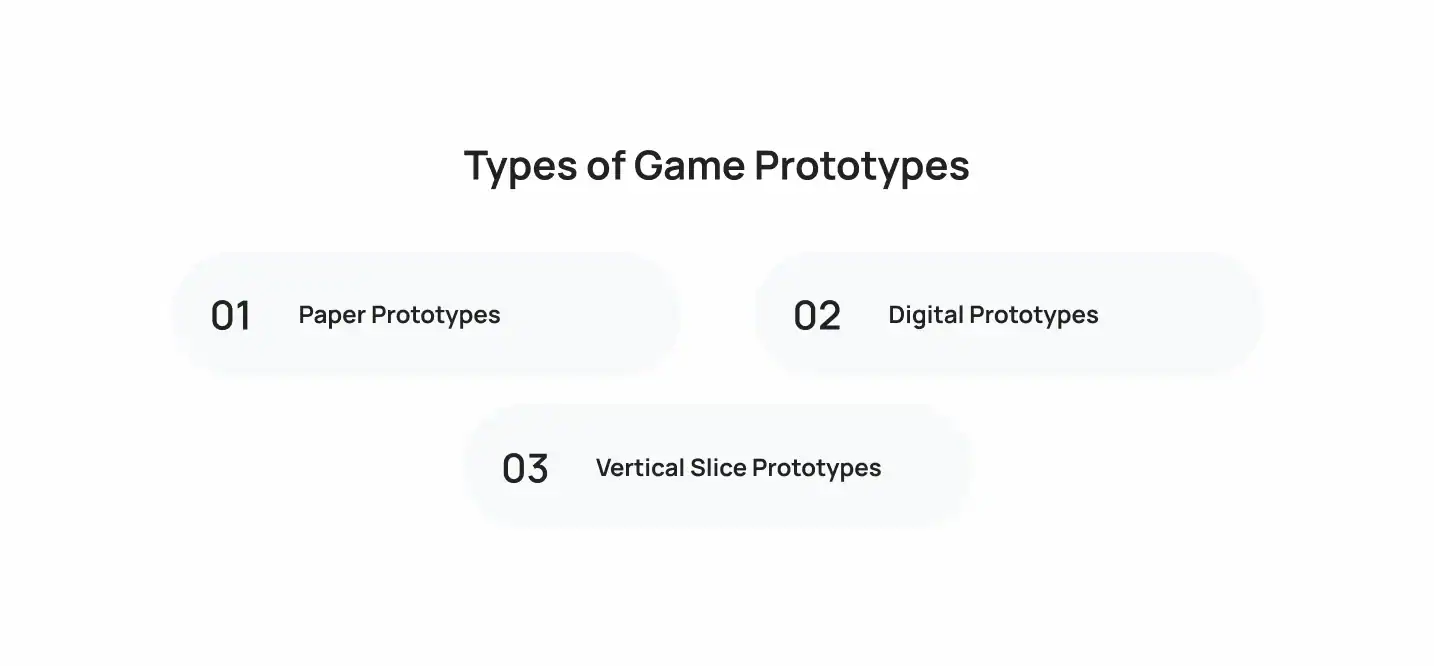
Not every prototype looks the same. The right type depends on what you’re testing.
Paper Prototypes
A video game paper prototype uses index cards, dice, or a simple board to test rules. No code required. This works best for turn-based logic, scoring systems, and core game loops.
- Cheapest and fastest option available
- Great for testing rules, not feel
- Lets non-technical team members join the design process
- Easy to change mid-session, just cross something out and try again
Digital Prototypes
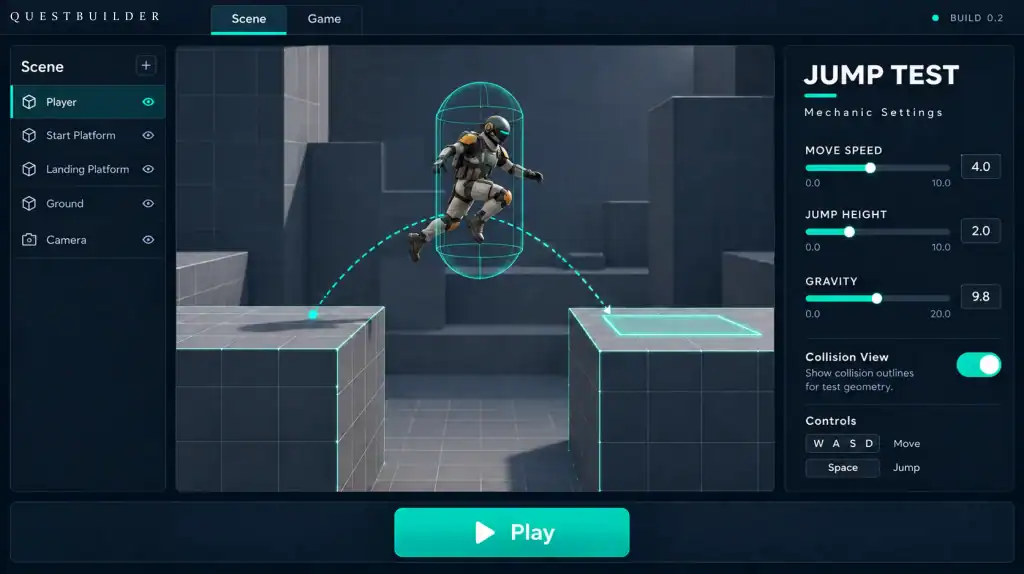
Once the rules feel solid, developers move to a digital build. This tests things paper can’t: timing, controls, camera feel, and real-time interactions.
- Built in engines like Unity or Godot, or even no-code tools
- Tests feel, not just logic
- Needed for anything action-based or real-time
- Still rough. Placeholder art and blocky shapes are normal here
Vertical Slice Prototypes
A vertical slice is a small, polished chunk of the final game. It’s used later, usually to pitch investors or publishers, showing what the finished product will actually look and feel like.
Common Prototype Types Used Early in Game Development
How to Make a Video Game Prototype
Here’s the actual process, step by step.
- Pick the one thing you’re testing. Not five things. One. Maybe it’s a jump mechanic. Maybe it’s a resource loop. Pick one and stay disciplined.
- Choose the right tool for the job. Paper for rules. A simple engine for feel. Don’t overbuild your toolkit before you need it.
- Build the smallest playable version. Strip out everything that isn’t the thing you’re testing. No menus. No art. Just the core loop.
- Get it in front of real players. Not your co-founder. Not your best friend who already agrees with you. Strangers, ideally.
- Write down what broke, then fix it. Repeat this loop until the idea either holds up or clearly doesn’t.
Tools by Prototype Type
| Prototype Type | Common Tools | Best For |
| Paper / Tabletop | Index cards, dice, printed boards | Turn-based rules, scoring, economy testing |
| No-Code Digital | Twine, Construct, Bitsy | Narrative flow, simple mechanics, quick iteration |
| Engine-Based | Unity, Unreal, Godot | Controls, camera feel, real-time systems |
| Interactive Wireframe | Figma, Adobe XD | UI flow and menu logic for mobile games |
Basic mobile game prototypes commonly run in the $25,000 to $60,000 range and take two to three months, depending on scope and platform. Bigger scope means bigger numbers, but the process stays roughly the same.
Paper Prototyping vs. Digital Prototyping
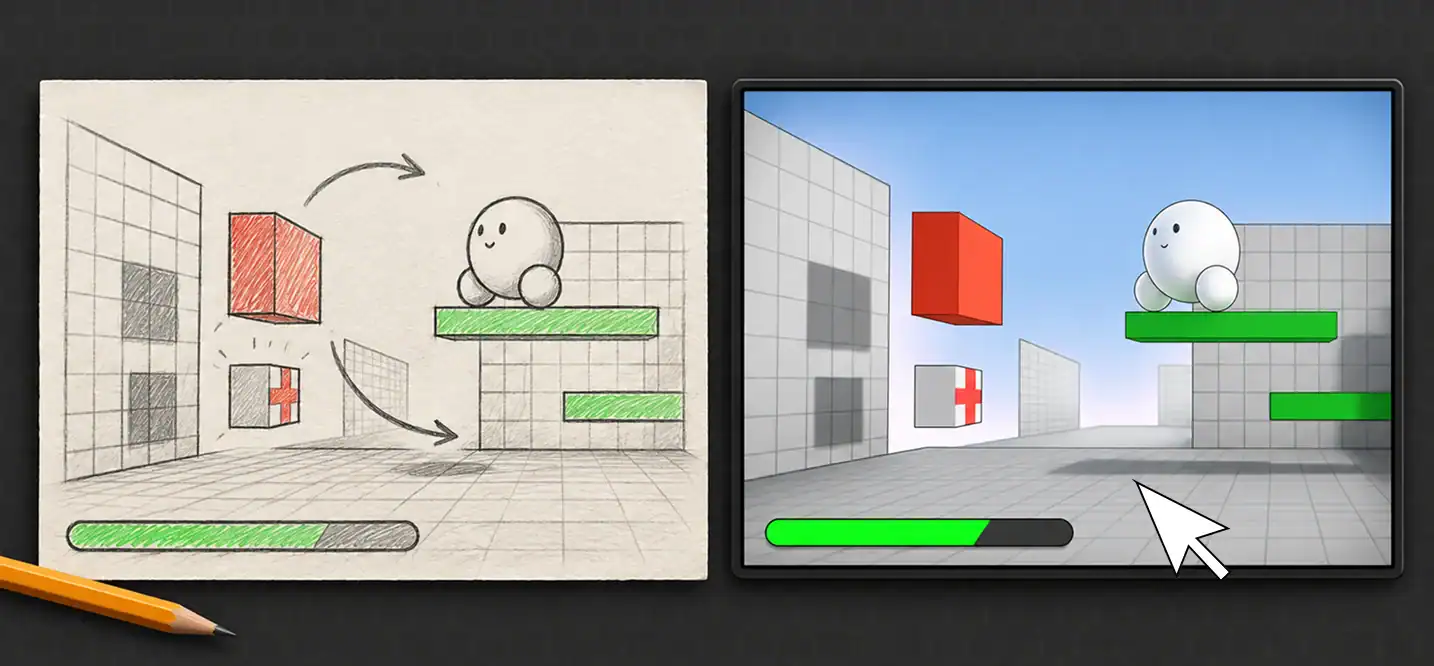
People often ask which one to start with. Usually, it’s both, just in sequence.
| Factor | Paper Prototyping | Digital Prototyping |
| Speed to build | Hours | Days to weeks |
| Cost | Nearly free | Requires dev time and tools |
| Best for | Rules, logic, scoring | Feel, controls, timing |
| Iteration speed | Instant, just redraw it | Slower, needs rebuild or code change |
| Limitation | Can’t test real-time action well | Costs more to throw away |
A tip worth stealing from veteran designers: start with cards, not boards. Boards slow games down and make movement complicated to test. Card-based systems escalate faster, which means faster answers.
Another one. Skip dice in your first version. Random outcomes make weak designs feel exciting by accident. Test the system without luck first. Add randomness once the core mechanic proves itself on its own.
How to Test Your Prototype
Building it is half the job. Testing it properly is the other half, and it’s the half most teams rush.
Who Should Playtest It
- Your internal team, early on, to catch obvious breaks
- People outside the project who have zero context
- Your actual target audience, once the prototype is stable enough
What to Ask Testers
- Was the goal clear within the first minute?
- Where did you get confused or stuck?
- What part felt satisfying? What part felt like a chore?
- Would you want to keep playing?
Common Playtesting Methods
- Think-aloud testing. Players narrate what they’re thinking as they play.
- Blind testing. No instructions given. You watch what confuses them.
- A/B mechanic testing. Two versions of one mechanic, tested against each other.
Roughly 78 percent of mobile device users in the US play games on their phones regularly, which means your testing pool is bigger than most teams assume. You don’t need a huge budget to find willing testers. You need the right questions.
How Testing Improves Your Prototype
Testing isn’t a formality. It’s where the actual improvement happens.
- It catches confusion before players ever see a finished screen
- It separates what’s genuinely fun from what only felt fun to the person who built it
- It surfaces loopholes in rules that the design team missed entirely
- It builds real evidence you can bring into a budget or investor conversation, instead of just an opinion
Games with strong monetization loops don’t happen by accident. In-app purchase revenue across mobile games topped $80 billion in a recent year, and that kind of return usually traces back to mechanics that got tested and refined early, not guessed at once and shipped.
What Does a Good Prototype Look Like?
Game designer Stone Librande’s classic do’s and don’ts still hold up. Here’s the short version.
| Do | Don’t |
| Focus on one key idea at a time | Try to duplicate the whole game |
| Abstract as much as possible | Simulate computer functions like physics or math |
| Accept that it won’t feel “fun” yet | Worry about polish or presentation |
| Keep it small enough to throw away | Build something you’ll feel bad deleting |
If your prototype passes this checklist, you’re testing the right thing. If it doesn’t, you’re probably overbuilding.
Fast, Rapid Prototyping Without Wasting Time
Speed matters here. The goal isn’t a perfect build. It’s a fast answer.
Tips for Speeding Up Without Cutting Corners
- Time-box each build. Give yourself a day or two, not a month.
- Reuse placeholder shapes and assets instead of custom art.
- Test one variable at a time, so you know exactly what changed the outcome.
- Kill ideas quickly if they’re clearly not working. Don’t fall in love with a bad prototype.
Teams that time-box their prototyping cycles typically move through two to three times more design iterations in the same stretch of weeks, simply because they’re not precious about early builds.
Common Mistakes to Avoid When Prototyping a Game
- Starting with a board instead of cards, which slows everything down
- Chasing “fun” too early, before the core system even works
- Trying to build too much in one prototype instead of isolating one idea
- Skipping real playtesters and only testing with people who already understand the vision
- Polishing art or sound before the mechanic itself is proven
How Much Does a Game Prototype Cost?
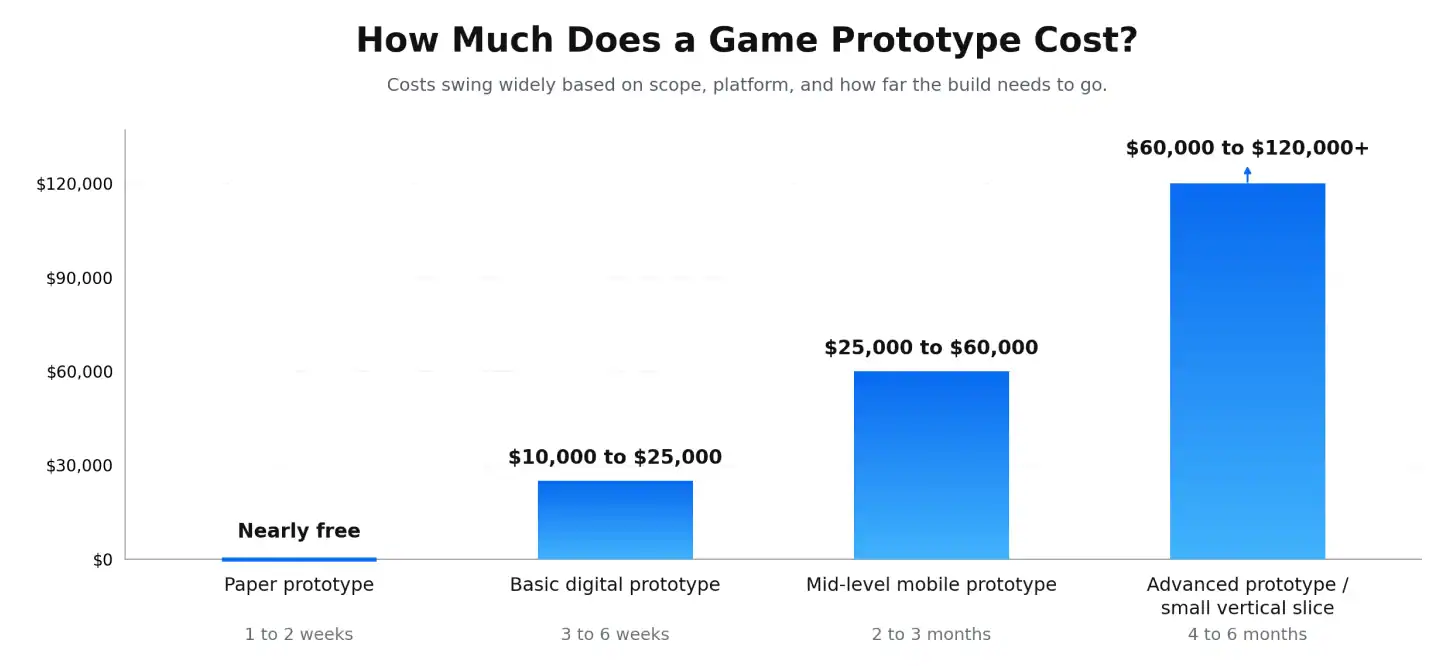
Costs swing widely based on scope, platform, and how far the build needs to go.
| Prototype Scope | Typical Timeline | Typical Cost |
| Paper prototype | 1 to 2 weeks | Nearly free |
| Basic digital prototype | 3 to 6 weeks | $10,000 to $25,000 |
| Mid-level mobile prototype | 2 to 3 months | $25,000 to $60,000 |
| Advanced prototype / small vertical slice | 4 to 6 months | $60,000 to $120,000+ |
For context, full mobile app builds usually run between $15,000 to $35,000 for a basic app, while enterprise apps can exceed $300,000. A prototype is meant to be a small fraction of that, not a scaled-down version of the full spend.
Studios working with hire android game developer teams often start with a smaller, focused prototype budget before committing to full production costs.
Where Prototyping Fits in the 7 Stages of Game Development
Prototyping doesn’t happen in isolation. It’s one stage in a longer pipeline.
- Concept – the raw idea takes shape
- Prototype – the idea gets tested cheaply
- Pre-production – planning, documentation, team structure
- Production – full-scale building begins
- Testing & QA – bug fixing and balancing
- Launch – the game goes live
- Post-launch – updates, patches, live operations
Notice where prototyping sits. Second, right after concept, before any serious money gets committed. That placement isn’t random. It’s there because everything after it gets more expensive to change.
What’s the Next Step After a Prototype?
Once your prototype proves the idea works, a few things typically happen next.
- A go or no-go decision, based on what testing actually showed
- Moving into pre-production, with clearer scope and fewer unknowns
- Pitching for budget or investment, backed by real test data instead of a pitch deck alone
- Full production planning, now that the core risk has been reduced
A quick note on process. Most modern studios don’t use strict waterfall planning anymore. They lean iterative, prototype first, adjust, then build. Waterfall assumes you know everything up front. Prototyping exists precisely because you don’t.
Why Work With a Prototyping Partner Instead of Going Solo
Building a prototype alone is possible. It’s also where a lot of first-time teams burn weeks on mistakes an experienced studio would catch in a day. A partner brings pattern recognition. They’ve seen which mechanics test well, which testing methods actually produce useful feedback, and which early decisions quietly turn into expensive problems later.
Cubix has worked through this exact process across dozens of game projects, which is part of why studios and founders bring their early-stage ideas here before committing to full builds.
How Cubix Helps You Prototype and Test Your Game Idea
If you’re sitting on a game idea and not sure if it holds up, that’s exactly the problem prototyping solves. Cubix’s team handles the full early-stage process: scoping the right type of prototype, building it fast, and running it through real playtesting before you spend a cent on full production.
Here’s what that typically includes:
- Rapid paper and digital prototyping tailored to your idea
- Structured playtesting through Cubix’s game testing company services
- Access to dedicated mobile developers if your prototype is ready to scale
- Honest feedback on whether an idea is ready to move forward, or needs another round
If you’re ready to test your idea before committing to a full build, reach out to Cubix and start with a prototype that actually tells you something.
Ready to Move Beyond the Prototype? Let’s Build Your Game
Contact UsFrequently Asked Questions
1. How do I test my prototype?
Get it in front of real players, not just your team. Watch how they play, ask what confused them, and take notes on where they got stuck.
2. What is the next step after a prototype?
A go or no-go decision, followed by pre-production planning if the idea holds up.
3. How much does a game prototype cost?
Anywhere from nearly free for a paper prototype to $120,000+ for an advanced digital build, depending on scope.
4. What are the 7 stages of game development?
Concept, prototype, pre-production, production, testing, launch, and post-launch.
5. Do developers use waterfall or prototyping?
Most modern studios use an iterative, prototype-first approach rather than strict waterfall planning.