Key Takeaways
- Git is not a website, a company, or a programming language, it’s free, open-source software that runs on your machine and tracks every change you make to your code.
- GitHub and GitLab are not the same product. Both are web-based platforms built on top of Git, but they’re owned by different companies, built on different philosophies, and priced differently.
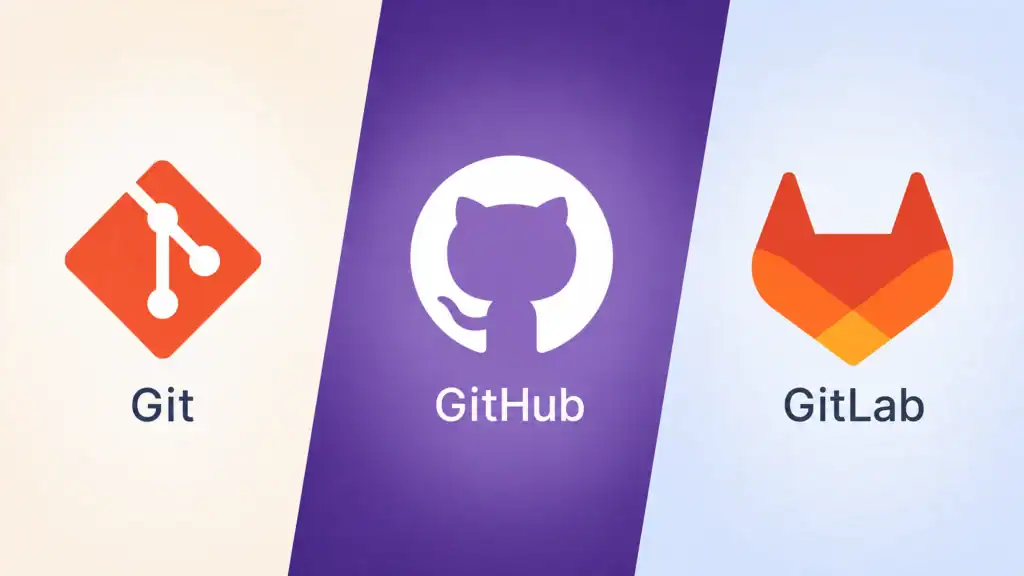
- The difference between git and github comes down to this: Git is the engine, GitHub is one of several garages you can park it in.
- In the gitlab vs github debate, GitHub wins on community size and open-source culture; GitLab wins on built-in CI/CD and enterprise-grade DevOps.
- Roughly 90%+ of professional developers use Git in some form, while GitHub alone hosts over 420 million repositories, these aren’t niche tools, they’re industry infrastructure.
- Teams shipping AI products, from custom deep learning solutions to production LLM apps, lean on these platforms even harder, since model versioning and CI/CD pipelines depend on the exact same Git foundation.
Confused about git vs gitlab, github and gitlab, or whether git and github are even the same thing? You’re not alone, and by the end of this guide, you won’t be.
Modification. Collaboration. Rollbacks. Merge conflicts at 2 a.m. If you’ve worked on any software project with more than one person touching the code, you’ve run into the tangle that version control was built to solve.
That’s where the confusion around git vs gitlab, github and gitlab, and plain old Git usually starts. The names sound related because they are related, but understanding exactly how is the difference between confidently choosing your team’s workflow and just going with whatever your last company used.
Want to discuss your project? Our experts are just a click away.
Contact Us
What Is Git? (Is Git a Programming Language? No)
One of the most-searched questions on this topic is genuinely “is git a programming language?”, and the answer is a firm no. Git is a distributed version control system (VCS), created by Linus Torvalds in 2005 to manage the Linux kernel’s source code. It’s software you install and run locally; it doesn’t compile or execute code the way Python or Java does.
What Git actually does is track every change to every file in your project as a “snapshot.” Need to go back to how your code looked three weeks ago? Git has it. Want to work on a new feature without touching the stable version? Create a branch, work in isolation, merge it back when it’s ready.
A few numbers that show why this matters:
- Git is used by an estimated 90%+ of professional software teams for version control, according to multiple developer surveys over the past several years.
- Because Git is distributed, every developer holds a full copy of the project’s history locally, there’s no single point of failure, unlike older centralized systems like SVN or CVS.
- Git was built for speed: it can handle repositories with hundreds of thousands of commits without meaningfully slowing down.
Git alone, though, has no web interface, no user accounts, and no “follow” button. That’s the gap GitHub and GitLab fill.
What Is GitHub?
GitHub launched in 2008 as a cloud-hosted home for Git repositories, adding a browser-based interface, issue tracking, and social features like following developers and starring projects. Microsoft acquired GitHub in 2018 for $7.5 billion, and it has since become the largest code hosting platform on the planet.
GitHub’s identity is built around community: open pull requests, public discussions, and a marketplace of third-party integrations rather than an all-in-one built-in toolchain.
What Is GitLab?
GitLab arrived in 2011, originally as an open-source alternative to GitHub, and has since evolved into a full DevOps platform. Where GitHub leans on integrations, GitLab builds CI/CD, security scanning, container registries, and project management directly into the core product, no plugins required.
GitLab also offers something GitHub doesn’t at the same scale: a genuinely open-source Community Edition alongside its paid Enterprise tiers, plus mature self-hosting options for organizations that need to keep code inside their own infrastructure.
Git vs. GitHub vs. GitLab, Quick Snapshot
| Git | GitHub | GitLab | |
| What it is | Version control software | Git hosting + collaboration platform | Git hosting + full DevOps platform |
| Released | 2005 | 2008 | 2011 |
| Owned by | Open-source community | Microsoft | GitLab Inc. (publicly traded) |
| Runs | Locally on your machine | In the cloud (or self-hosted) | Cloud or self-hosted |
| Built-in CI/CD | No | Via GitHub Actions | Yes, native |
| Cost | Always free | Free tier + paid plans | Free tier + paid plans |
GitHub vs. GitLab: The Real Philosophical Difference
This is the heart of the gitlab vs github question. Both platforms let you host repositories, review code, and manage issues, but they were built to solve different problems.
GitHub optimizes for community and momentum. It’s the default home for open-source projects, and its pull-request model plus massive third-party Actions marketplace make it the easiest on-ramp for individual developers and public projects.
GitLab optimizes for control and completeness. Its built-in CI/CD, security scanning, and self-hosting options mean an enterprise team can run its entire software delivery lifecycle, from first commit to production deploy, without stitching together five separate tools.
Neither approach is “better” in the abstract. It depends on what you’re optimizing for, which is exactly what the comparison table below is designed to help you figure out.
Full Feature Comparison
| Feature | GitHub | GitLab |
| Release year | 2008 | 2011 |
| Estimated community size | 100M+ registered developers | 30M+ registered users |
| Public repositories | Free, unlimited | Free, unlimited |
| Private repositories | Free (with collaborator limits on older free tiers) | Free |
| CI/CD | Requires GitHub Actions | Built-in, native pipelines |
| Open source | Platform itself is proprietary | Open-core (Community Edition is open source) |
| Self-hosting | Limited (GitHub Enterprise Server) | Robust, widely used |
| Security scanning | Via integrations/Advanced Security add-on | Built-in (SAST, DAST, dependency scanning) |
| Project management tools | Boards, wikis | Boards, milestones, epics |
| Time tracking | No native support | Yes, built in |
| Best known for | Open-source hosting, social coding | Enterprise DevOps, compliance-heavy teams |
Git vs. GitLab: Why This Comparison Trips People Up
Here’s something worth clearing up directly, since it’s one of the most common searches on this topic: the difference between git and gitlab isn’t really a “vs.” comparison at all, it’s closer to asking about the difference between an engine and a car built around it.
Git is the version control engine running on your laptop. GitLab is a web platform that hosts Git repositories and adds a UI, permissions, CI/CD pipelines, and collaboration tools on top. You can’t meaningfully choose “Git or GitLab”, GitLab requires Git to function. The real decision is which platform (GitLab, GitHub, or something else) you want managing your Git repositories remotely.
The same logic applies to the difference between git and github: Git is local and universal; GitHub is one specific commercial home for it.
Pros and Cons
| GitHub | GitLab | |
| Pros | Massive community and talent pool; easiest onboarding; huge Actions marketplace; strong for open-source visibility | Native CI/CD saves tool-sprawl; strong self-hosting/compliance story; open-core transparency; built-in security scanning |
| Cons | CI/CD requires extra setup via Actions; core platform is closed-source; advanced security features often gated behind paid tiers | Smaller community than GitHub; steeper learning curve for newcomers; upgrade paths can be complex for self-hosted instances |
Which Should You Choose? A Use-Case Breakdown
If you’re still asking is gitlab and github the same in terms of “does it matter which I pick”, it does, and the right answer depends heavily on your team’s shape and priorities.
Use-Case Matrix
| Your Situation | Better Fit | Why |
| Solo developer / open-source contributor | GitHub | Largest community, easiest discovery, huge integration ecosystem |
| Startup shipping fast with a small team | GitHub or GitLab | Both offer generous free tiers; choice often comes down to CI/CD preference |
| Enterprise with compliance/security requirements | GitLab | Native security scanning, mature self-hosting, granular permissions |
| Team wanting DevOps in one platform, no plugin-stitching | GitLab | Built-in CI/CD, container registry, monitoring |
| AI/ML team managing large datasets, models, and pipelines | GitLab or GitHub + MLOps tooling | Both integrate with model-versioning tools; GitLab’s native pipelines suit complex ML CI/CD |
The Numbers Behind the Decision
A few more data points worth knowing if you’re evaluating enterprise-grade source code collaboration tools for a serious migration or platform decision:
- GitHub reports hosting well over 420 million repositories, making it by far the largest code hosting service in existence.
- GitLab’s DevOps platform reports 30 million+ registered users, with a notably higher concentration of enterprise and government customers relying on self-managed instances.
- Surveys of engineering teams consistently show GitHub leading in raw adoption, while GitLab shows disproportionately strong adoption among regulated industries, finance, healthcare, government, where self-hosting and audit trails matter more than community size.
- Migration between the two is common enough that both platforms maintain dedicated import tooling, a signal of how frequently companies re-evaluate this decision as they scale.
How AI Development Teams Actually Use These Platforms

Version control stops being optional the moment your project involves more than a handful of files, and AI projects multiply that pressure fast. A single model iteration can touch training scripts, config files, dataset references, and evaluation notebooks all at once.
Teams building custom deep learning solutions typically run their entire experimentation cycle through Git-based branching: one branch per architecture variant, one per hyperparameter sweep, with pull/merge requests acting as a review gate before anything touches a shared training environment. This is exactly why platforms with native CI/CD, like GitLab, have found a strong foothold in ML-heavy organizations, automated pipelines can retrain, test, and validate models the same way they’d test application code.
The same pattern shows up in generative AI work. A large language models development company managing multiple fine-tuned model variants, prompt templates, and evaluation datasets needs the same branching discipline, except now “code” also includes prompt versions and retrieval configurations that need their own audit trail.
Choosing a Partner, Not Just a Platform
Here’s the part most comparison guides skip: picking between GitHub and GitLab only solves half the problem. The harder question is who’s actually building, training, and maintaining the AI systems living inside those repositories.
That’s where working with an established Custom AI development company changes the equation. Rather than assembling a stack of platforms, MLOps tooling, and in-house expertise from scratch, teams increasingly partner with specialists who already have the version-control discipline, CI/CD pipelines, and model-governance practices built in from day one.
This matters even more as AI systems get more autonomous. If you’re building anything resembling an intelligent workflow, not just a chatbot, but a system that plans, calls tools, and takes action, you need a custom ai agent development company that treats every agent behavior, tool call, and decision path as something to be versioned, tested, and rolled back if it misbehaves in production. That’s not a nice-to-have; agent logic that isn’t under proper version control is a production incident waiting to happen.
And whether the project is a recommendation engine, a computer vision pipeline, or a full LLM-powered product, the common thread is the same: it takes an AI Software Development Company with real engineering discipline, not just data science talent, to take a model from notebook to production without breaking things along the way. Cubix works across exactly this stack, pairing AI/ML engineering with the DevOps rigor that GitHub- and GitLab-based teams rely on every day.
Want to discuss your project? Our experts are just a click away.
Contact Us
Frequently Asked Questions
1. What is the difference between GitHub and GitLab?
GitHub is a Microsoft-owned platform focused on open-source collaboration and community, with CI/CD handled via GitHub Actions. GitLab is a self-contained DevOps platform with native CI/CD, stronger self-hosting support, and an open-core licensing model.
2. Is GitLab and GitHub the same?
No. They’re both web platforms for hosting Git repositories, but they’re separate companies with different ownership, pricing, feature sets, and target audiences. The confusion mostly comes from the similar naming, not any shared ownership.
3. Is Git, GitLab, and GitHub the same?
No, these are three distinct things at three different layers. Git is the underlying version control software. GitHub and GitLab are two separate commercial platforms that host Git repositories and add collaboration tools on top of it.
4. What is the difference between Git and GitHub?
Git is version control software that runs locally on your computer. GitHub is a cloud platform that hosts Git repositories remotely and adds a web interface, issue tracking, and collaboration features.
5. Why do people use GitLab instead of GitHub?
Mainly for GitLab’s native CI/CD, tighter security and compliance controls, and stronger self-hosting options, features that matter more to regulated industries and large enterprises than to individual developers or open-source maintainers.
6. Why are people moving away from GitHub?
Some organizations cite a preference for GitLab’s all-in-one DevOps toolchain, concerns about vendor lock-in with a Microsoft-owned platform, or a need for self-hosted infrastructure that GitLab supports more maturely. That said, GitHub still holds the larger overall market share.
6. Do most companies use GitLab or GitHub?
GitHub has the larger overall user base and repository count by a wide margin, largely driven by open-source projects and individual developers. GitLab holds a strong, often disproportionate share among enterprise, government, and regulated-industry customers who prioritize self-hosting and built-in compliance tooling.
7. Is Git a programming language?
No. Git is version control software, not a programming language. It doesn’t compile or execute code, it tracks changes to files over time.