Every mobile product decision eventually runs into the same wall: how should the app talk to the server? That single choice shapes load times, data costs for users on patchy networks, how fast your team ships new screens, and how much your backend bill looks like at scale. GraphQL vs REST for mobile app backends is no longer a theoretical debate, it’s a decision founders and CTOs make before a single screen gets designed, because reversing it later means rewriting the data layer of the entire app.
The numbers back up why this choice gets so much attention. Heading into 2026, REST is still used by 93% of developers, while 33% now use GraphQL alongside it, up from a much smaller share just a few years ago, according to Postman’s 2025 State of the API Report. Neither figure is shrinking. Teams are adopting both, often inside the same product, which is exactly why picking the right one for your mobile app backend matters more than picking a “winner.”
This piece breaks down the real architectural differences, current performance data, and a practical framework for picking the right approach for your mobile product.
Want to discuss your project? Our experts are just a click away.
Contact UsREST and GraphQL: A Quick Refresher
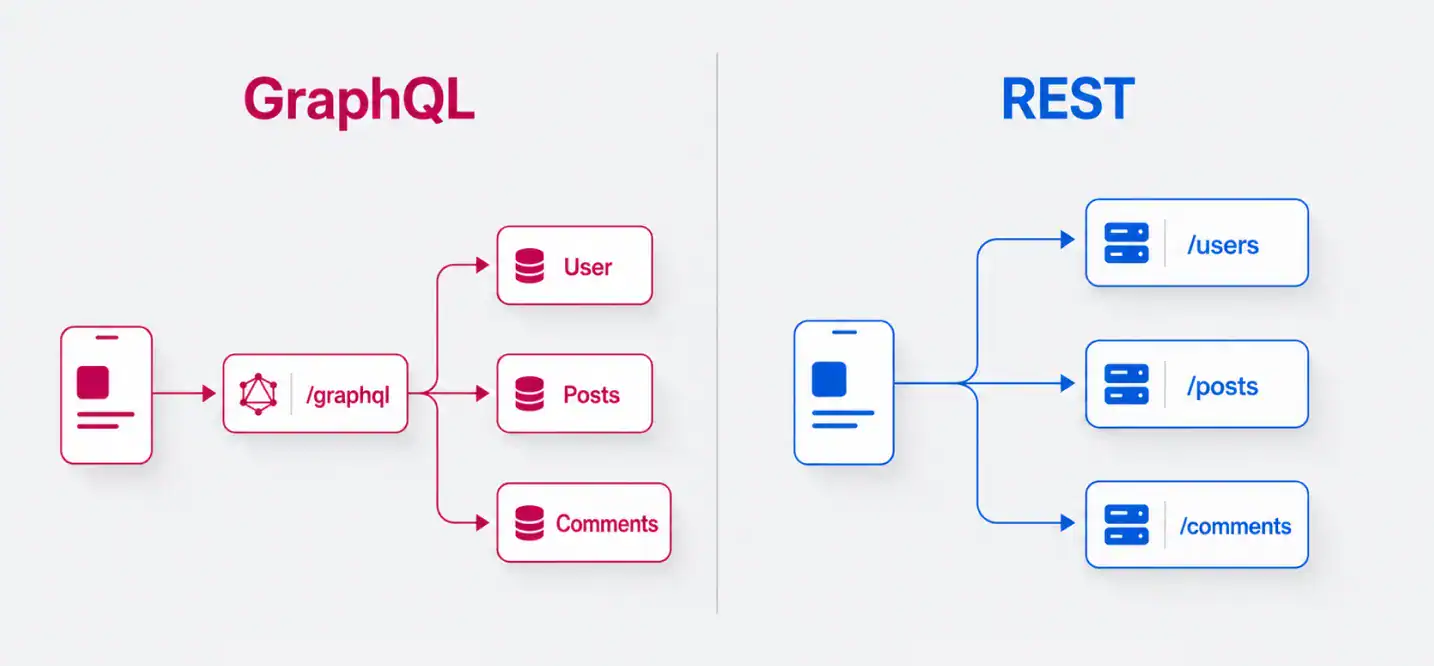
REST API (Representational State Transfer) has been the default for mobile app backend design since smartphones existed. It organizes data around resources (/users, /orders, /products) and uses standard HTTP methods (GET, POST, PUT, DELETE) to act on them. Each endpoint returns a fixed JSON payload, whether the client needs all of it or not.
GraphQL flips that model. It’s a query language for APIs, created by Meta to solve exactly the kind of data-fetching pain that mobile apps run into: multiple screens needing different slices of the same data. Instead of many endpoints, GraphQL exposes a single endpoint and lets the client specify precisely which fields it wants in one request.
Neither one is a fad. Both sit at the center of modern API development, and most serious engineering teams now have working knowledge of both before choosing an API architecture for a new product.
GraphQL Architecture vs REST Architecture: The Core Difference
| Factor | REST API | GraphQL |
| Endpoint structure | Multiple endpoints, one per resource | Single endpoint for all operations |
| Data fetching | Server decides response shape | Client decides response shape |
| Over-fetching / under-fetching | Common, fixed payloads often return too much or too little | Rare, client requests exact fields needed |
| Versioning | Usually via URL or header (/v1/, /v2/) | Schema evolves without version numbers |
| Caching | Native HTTP caching (CDNs, browsers, proxies) | Requires custom caching logic |
| Learning curve | Familiar to almost every backend developer | Steeper needs schema and resolver design |
| Real-time data | Needs separate WebSocket setup | Built-in subscriptions |
| Error handling | HTTP status codes | Always returns 200; errors nested in response body |
This is the essence of GraphQL architecture vs REST architecture: REST organizes around endpoints and lets HTTP infrastructure do the heavy lifting. GraphQL organizes around a schema and pushes flexibility to the client. Both are valid ways to structure an API architecture, the right one depends on what your app’s screens actually need.
GraphQL vs REST API: What the 2026 Data Actually Shows
The numbers below cut through a lot of the noise around this debate.
- REST and GraphQL are both widely used API approaches, and teams may choose one or combine both depending on their application requirements. REST is often preferred for straightforward, resource-based APIs, while GraphQL can offer more flexible data querying when applications need it.
- Mobile-first companies are the segment leaning hardest into GraphQL API development, largely because it cuts the number of round-trips a phone has to make over cellular networks before a screen is usable.
- Complex, nested data queries, the kind common in social feeds, marketplaces, and dashboard-style mobile apps, tend to resolve faster under GraphQL because the client gets everything it needs in one request instead of chaining several REST calls together.
- Simple, high-volume requests (a single product lookup, a status check, a health ping) still run faster and cheaper under REST, because there’s no query-parsing overhead and the response can be cached at the CDN layer.
None of this means one architecture has “won.” It means GraphQL vs REST API is now a per-use-case decision rather than a company-wide religion. Instagram and GitHub run GraphQL for client-facing data and REST or gRPC underneath it. Most banking and healthcare backends still lean on REST because of caching, auditability, and tooling maturity.
GraphQL vs RESTful API: Where Mobile Apps Feel the Difference First
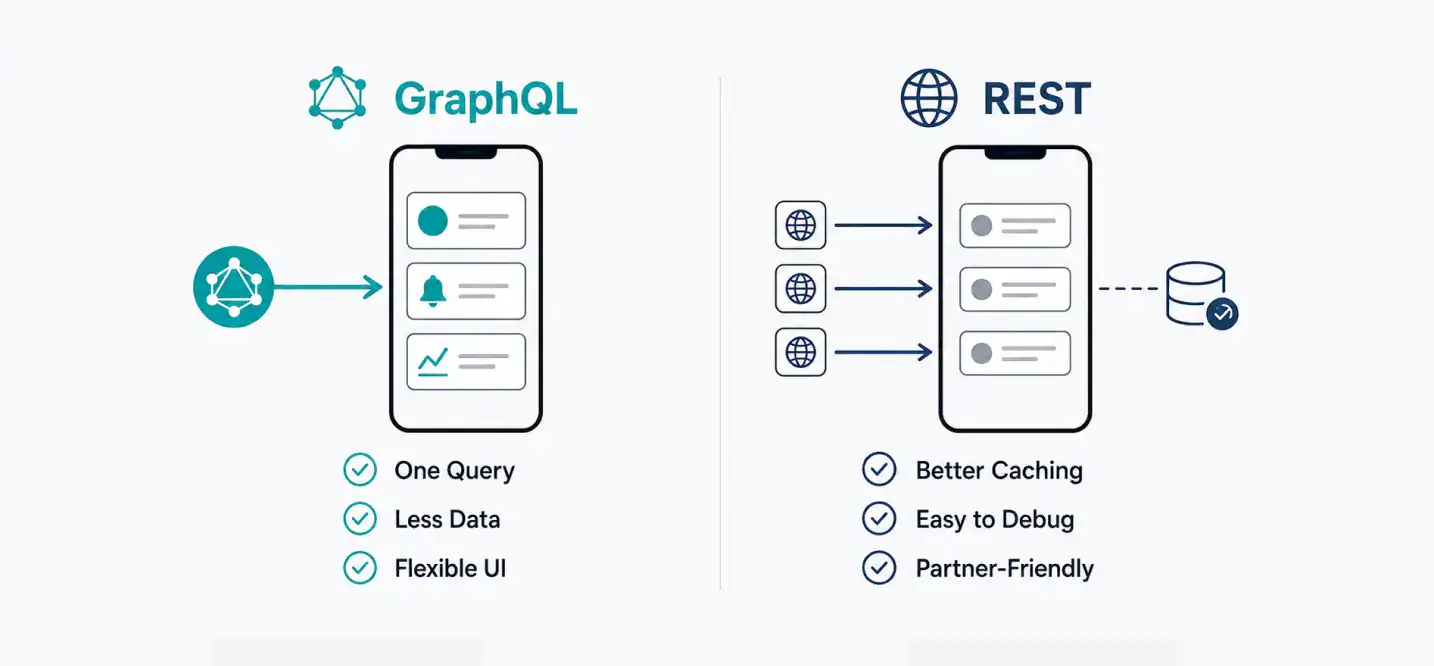
Mobile is where this comparison gets concrete, because phones live under constraints desktops rarely worry about, inconsistent networks, battery drain from repeated requests, and users who abandon an app after a few seconds of a spinning loader.
Where GraphQL API vs REST API matters most for mobile:
- Home feeds and dashboards: Screens that pull from five or six different data types (profile, notifications, recent activity, recommendations) benefit from GraphQL’s single-request model instead of five REST calls firing in parallel.
- Low-bandwidth regions: GraphQL’s field-level selection means a user on a weak connection downloads only what the screen renders, not an entire resource object.
- Rapid UI iteration: When product teams change what a screen displays every sprint, GraphQL lets frontend developers adjust the query without waiting for a new backend endpoint.
- Offline-first and cache-heavy apps: REST still tends to win here because HTTP caching, ETags, and CDN edge caching are native to it, while GraphQL caching requires extra tooling like normalized client-side caches.
- Public or partner-facing APIs: REST remains the safer choice, since it’s easier for third-party developers to understand, debug with tools like curl or Postman, and integrate without learning a new query syntax.
GraphQL Backend vs REST Backend: Development and Maintenance Reality

Choosing between a GraphQL backend vs. a REST backend isn’t only a technical question, it changes how your engineering team works day to day.
REST API Development
- Faster to start for teams already familiar with conventional backend frameworks
- Debugging is straightforward, every request maps to a clear URL and status code
- Documentation tools (OpenAPI/Swagger) are mature and widely adopted
- Adding new client needs (a smart watch app, a new dashboard) often means adding new endpoints or bloating existing ones
GraphQL API Development
- Requires more upfront schema design work before any endpoint exists
- Solves the “one backend, many clients” problem cleanly, mobile, web, and smart TV apps can each query exactly what they need from the same schema
- Needs careful handling of the N+1 query problem, where a single GraphQL request accidentally triggers hundreds of database calls if resolvers aren’t optimized
- Query complexity and depth need limits, or a single request can become expensive to run
For a growing mobile product, this decision also affects the timeline and the budget. Teams evaluating the cost of developing a mobile app should factor in that GraphQL typically adds backend design time upfront but can reduce frontend rework later, while REST is usually faster to ship in the first version but may need refactoring as more client types get added.
API Integration, Performance, and Security Considerations
| Factor | REST | GraphQL |
| Third-Party API Integration | REST is commonly used by external services such as payment gateways, mapping platforms, and analytics tools. | GraphQL can consume REST-based services and expose the required data through its own schema, rather than replacing those integrations. |
| API Performance | A well-designed REST endpoint can perform efficiently when it returns a small, predictable payload. | GraphQL can be more efficient when a mobile screen needs data from multiple resources because one query can retrieve the required data. |
| Data Fetching | Clients may need multiple API requests when information is distributed across several resources. | Clients can request related data through a single query, reducing the need for multiple sequential requests in some scenarios. |
| Security | Established approaches include endpoint-level rate limiting, OAuth, API gateways, authentication, and access controls. | Requires additional safeguards such as query-depth limits, query-cost analysis, and field-level authorization because a single query can access multiple resources. |
| Best Use Case | Suitable for predictable resource-based APIs and many third-party integrations. | Useful when applications need flexible data retrieval across multiple related resources. |
| Mobile App Security | Authentication, encrypted data in transit, and input validation remain essential. | The same security fundamentals apply, along with GraphQL-specific controls for query complexity and authorization. |
Key takeaway: Neither REST nor GraphQL is automatically faster or more secure. The right choice depends on your data structure, query patterns, integrations, and security requirements. Regardless of the API architecture, following proven mobile app security best practices remains essential.
Where This Fits Into the Bigger App Development Picture
The API layer is one piece of a larger build. Teams mapping out the stages of app development usually decide on API architecture during the technical planning phase, after defining data models and before UI development begins. Making major API changes later can affect multiple parts of the application and increase development effort.
The choice also connects to broader technology decisions. The programming language, framework, backend architecture, and available tooling can all influence whether REST or GraphQL is the better fit. Teams should evaluate these factors alongside their data requirements, integrations, performance expectations, and security needs before finalizing the API architecture.
Decision Framework: GraphQL vs REST for Mobile App Backends
| Choose REST if… | Choose GraphQL if… |
| Your app has simple, resource-based screens | Screens pull data from many sources at once |
| You need strong HTTP caching for performance | You need to minimize data usage on mobile networks |
| You’re building a public or partner-facing API | You’re serving multiple client types from one backend |
| Your team is new to API design | Your team can invest in schema and resolver design |
| Predictable, auditable request patterns matter (fintech, healthcare) | Frontend teams need to iterate on data needs quickly |
A meaningful number of mobile products don’t pick one exclusively. A common, practical pattern: REST for public-facing or partner integrations, GraphQL for the primary mobile client where screen complexity is highest.
Why This Decision Weighs More Heavily on Mobile Than on Web

Web applications often have more predictable access to network resources, while mobile apps must account for changing connections, limited bandwidth, and device constraints. A user switching between 4G, unstable Wi-Fi, and weak coverage during a commute can notice the difference between an over-fetched REST response and a precisely scoped GraphQL query within seconds of opening an app.
This is why GraphQL vs REST for mobile app backends receives so much attention. Larger payloads can increase transfer time, bandwidth usage, and battery consumption, particularly on slower or unstable mobile connections. Unnecessary requests can also add latency, affecting how quickly screens load and respond. A backend architecture decision that may have a limited impact on a desktop dashboard can have a much more noticeable effect on a mobile app’s user experience.
There is also a team-structure consideration that’s easy to overlook. Mobile teams often ship UI changes faster than backend teams can add new endpoints, such as a new onboarding flow, a redesigned profile screen, or an experimental feature. With REST, these changes may require additional endpoint work from the backend team. Once the required data is exposed through a GraphQL schema, mobile teams can often adjust their queries without requiring a new endpoint for every UI change. This flexibility is one reason some teams use GraphQL for mobile clients while continuing to use REST for other services.
The decision also depends on the technologies supporting your app. Your choice of programming language and framework can influence available API tooling, libraries, and integration patterns. Teams can review the mobile development languages when evaluating how their mobile stack will work with REST or GraphQL.
How Cubix Helps Businesses Choose the Right Mobile API Architecture
Choosing between REST and GraphQL is not simply a matter of picking the newer or more popular option. The right API architecture depends on how your mobile application handles data, the complexity of its workflows, third-party integrations, security requirements, and the capabilities of the existing technology stack.
Cubix approaches this decision as part of the broader mobile application architecture. Its custom mobile app development services cover strategy, UI/UX design, development, API development and integration, testing, deployment, and maintenance. The company also works across native, cross-platform, hybrid, and progressive web technologies, allowing the architecture to be selected around the product rather than forcing every project into the same framework.
For API architecture specifically, Cubix can evaluate factors such as:
- Data requirements: Determining whether the application needs predictable REST resources or flexible data querying through GraphQL.
- Third-party integrations: Assessing how payment gateways, maps, analytics platforms, enterprise systems, and other external services connect with the mobile backend.
- Performance: Reviewing payload sizes, request patterns, caching, and network conditions that can affect the mobile experience.
- Security: Planning authentication, authorization, encrypted communication, API protection, and appropriate controls for the selected architecture.
- Technology stack: Aligning the API approach with the application’s programming languages, frameworks, backend services, and cloud infrastructure.
- Future product changes: Considering how easily the API can support new screens, features, integrations, and evolving business requirements.
The company’s industry recognition provides additional context. In 2022, TopDevelopers included Cubix among its Finest 500 Mobile App Development Companies, citing the company’s track record and technology expertise. In 2024, GoodFirms recognized Cubix as one of the top mobile app development companies for Q2, highlighting its client-centric approach, diverse project portfolio, and development process.
Ultimately, REST and GraphQL can both be effective choices. The goal is to select the architecture that fits the application’s actual data flows, integrations, security model, and product roadmap. Cubix can help businesses make that decision as part of a broader mobile development strategy, rather than treating API architecture as an isolated technical choice.
Final Thoughts
There’s no universal winner in GraphQL vs REST for mobile app backends, there’s only a better fit for your app’s data shape, your team’s experience, and how many client types you’re serving. REST still runs the majority of the internet and remains the safer default for straightforward, cacheable APIs. GraphQL earns its complexity when your mobile screens are data-hungry and your team can support the schema design it demands.
Whichever direction you lean, treat REST vs. GraphQL for mobile apps as an early architectural decision, not an afterthought bolted on after the UI is finalized. The right move is to map your app’s actual screens and data needs before committing to either API architecture, rather than picking the trendier option first and retrofitting the backend around it.
Want to discuss your project? Our experts are just a click away.
Contact UsFrequently Asked Questions
1. Is REST or GraphQL better for mobile app development?
Neither is universally better. REST works well for predictable, resource-based APIs, while GraphQL is useful when mobile apps need flexible data fetching and fewer requests.
2. When should you choose GraphQL over REST for a mobile app?
GraphQL is a good fit when mobile screens require data from multiple resources or when frontend teams need more control over the data they request without creating new endpoints.
3. When is REST a better choice for a mobile app backend?
REST is often suitable for straightforward applications, public APIs, and systems where predictable requests, HTTP caching, and established security practices are important.
4. Can a mobile app use both REST and GraphQL?
Yes. A mobile application can use GraphQL for its primary client experience while using REST for third-party, partner, or public integrations where it makes more sense.
5. What should businesses consider when choosing REST or GraphQL?
Consider data requirements, performance, caching, security, integrations, development expertise, and future product needs. The API architecture should fit the application rather than follow a technology trend.