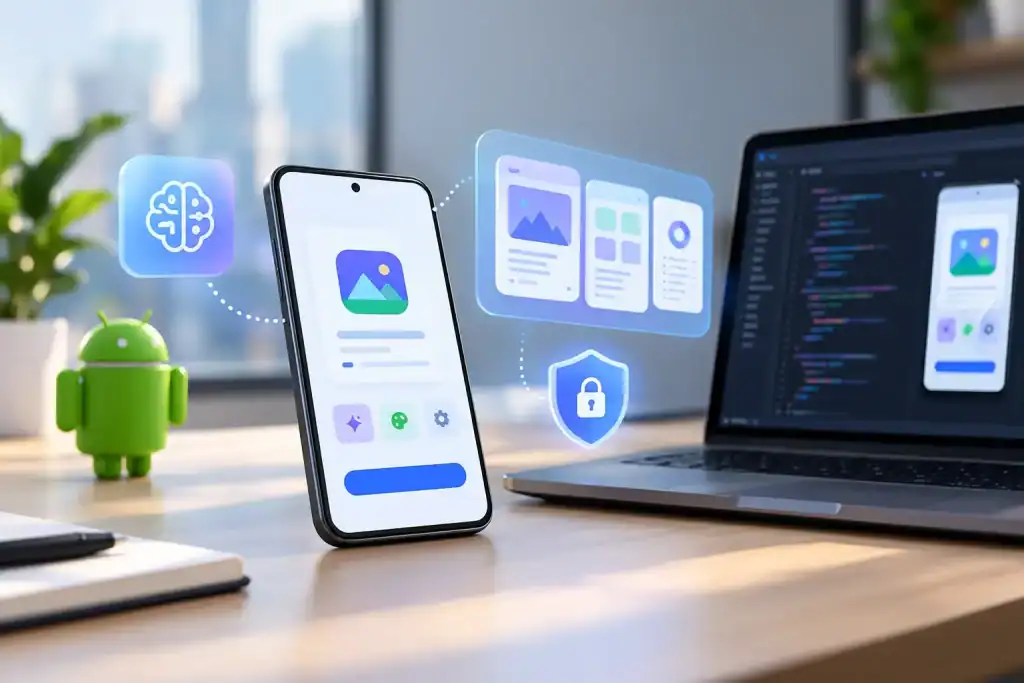
Google has removed one of the biggest obstacles between an idea and a working Android app. On October 13, the company announced that people in the United States can now build an app in Google AI Studio and run it privately on their own phone through Google Play, using nothing more than a standard Google account. There is no developer registration, no public listing and no audience of three billion strangers to worry about.
Two days later, Bluesky moved in the same direction. The company expanded its AI platform Attie so that anyone can create websites, games, quizzes and polls by describing what they want in plain language.
Together, the two announcements point to a shift that app businesses can no longer treat as a side story: building software is becoming something ordinary people do, not only something developers are hired to do. The useful question is not whether this will happen. It is what it changes, and what it leaves untouched.
What Google Actually Announced
The new feature lets users create a personal app with Google AI Studio and launch it on their own device through Google Play. A few details matter:
- Who gets it first. The rollout began October 13 for users aged 18 and over in the United States and select other markets.
- No developer account. A standard Google account is enough. A Play developer account normally costs $25, and new personal developer accounts must run a closed test with at least 12 testers for 14 days before going public. Personal apps skip all of that.
- Truly private. These apps do not appear in Play Store search results or listing pages, and only their creator can access them. They live in a new Personal Library section.
- Still bound by policy. Personal apps must comply with Google Play’s existing policies, though reporting from Tech-ish notes that Google describes them as personal-use apps that Play does not review.
- What comes next. In the coming months, Google plans to let creators share apps with a small circle of trusted friends and family. Apps that take off will be able to move to the public store after completing trust and safety reviews.
Why “Private” Is the Real Story
Google AI Studio has been able to generate native Android apps since May, and people could push them to a phone over a USB cable. That suits tinkerers, but it is not how most people install software. The easy route to an app on your own phone ran through publishing it on Google Play, which meant exposing an experiment to the store’s roughly three billion users. TechCrunch reported that this pushed many people to limit their vibe coding to web apps that run anywhere rather than building natively for Android.
Google has now removed that friction. The distance between “I described an app” and “it is on my phone” has shrunk to minutes, and the person doing it does not need to know what a signing key, a release bundle or a store listing is. That makes this more than a developer-tools update. It changes who gets to treat a native app as a casual thing to make.
Bluesky’s Attie: The Same Idea in a Different Lane
Attie began in March 2026 as an invite-only beta from Bluesky’s Jay Graber, originally for building custom feeds with AI. On October 15 it gained a site builder. Users describe a small social experience, such as a guestbook, an AMA, a quiz or a survey, and Attie builds it and publishes it at its own shareable address on the attie.site domain, with attribution to the creator.
Creations are tied to the builder’s identity on the AT Protocol, the open network underneath Bluesky, and users can bring their own AI model or choose open-weight options. CEO Toni Schneider calls the concept “social vibe coding,” meaning vibe coding for a community rather than a solo experience. COO Rose Wang pointed to Bluesky’s roughly 47 million registered users as a built-in audience. Early examples remain lightweight, and support for private data is still in alpha, with a full rollout planned by year-end.
The two launches sit at opposite ends of a spectrum. Google’s is private, native and personal. Attie’s is public, web-based and social. What they share is the premise that the cost of creating software is falling to the cost of writing a good description.
From “An App for That” to “An App for Me”
Google’s own framing is revealing. Sam Bright, who leads Google Play and its developer ecosystem, said the store is moving from “there’s an app for that” to “there’s an app for me.”
The examples Google gives show why. A custom habit tracker, a local sports league organizer, a personal finance tool, an app for a child’s T-ball league: none of these would ever justify hiring a development team. The audience is one person, or twenty. Personal software is a new category, not a replacement for commercial apps, and the demand is real. Lovable, one of the better-known vibe coding platforms, was reported this month to have reached a $600 million annual revenue run rate.
There is a second-order effect worth noticing. People who have built a tailored tool in an afternoon will expect more flexibility from the software they pay for, and they will be less patient with generic products.
The Catch: AI-Generated Is Not Production-Ready
Speed is the headline. Security is the footnote that matters. The research on AI-generated code is consistent enough to take seriously:
- Veracode’s 2025 report, which tested more than 100 AI models, found that 45% of generated code samples failed security tests based on the OWASP Top 10.
- Security firm Escape scanned about 5,600 publicly deployed vibe-coded apps and found over 2,000 high-impact vulnerabilities, more than 400 exposed secrets and 175 cases of exposed personal data, including medical records and bank details.
- Tenzai tested 15 apps built with five AI coding tools and found 69 vulnerabilities. None of the 15 had CSRF protection or security headers.
- A June 2026 academic study of 9,041 real vibe-coded applications found recurring problems such as placeholder logic, unfiltered input and exposed secrets. Better models and prompting reduced these issues but did not eliminate them.
- The Cloud Security Alliance highlighted a confidence gap: in one survey, over 75% of developers believed AI-generated code was more secure than human-written code, while 56% admitted it frequently introduces security issues.
To be fair, a private app used by one person on one phone has a small blast radius. The risk climbs quickly when an app touches financial or health data, connects to online accounts, or gets shared with other people, which Google plans to allow soon. Google says both AI Studio and Play have security policies to protect users, but those protections are not a substitute for engineering judgment.
Personal App vs. Real Product
The gap between the two is wider than it looks from a prototype on your own screen.
| Personal AI-built app | Production app | |
| Audience | One person or a small circle | Customers, from hundreds to millions |
| Security | Low stakes, limited exposure | Authentication, data protection, security testing |
| Reliability | Works on one phone | Monitoring, crash handling, device coverage |
| Compliance | Basic Play policies | Privacy law, payments, accessibility, store review |
| Maintenance | Rebuild when it breaks | Updates, OS changes, support, roadmap |
| Integrations | Simple or none | Payments, CRMs, APIs, back-end systems |
Google itself draws this line. Going public requires trust and safety reviews, and a path to a professional developer account. Developer verification is also tightening across Android: it became mandatory from September 30, 2026 in Brazil, Indonesia, Singapore and Thailand, with wider enforcement planned. Tech-ish noted that Google has not yet explained how unreviewed personal apps fit into that regime as it expands.
What This Means for Businesses and Founders
Prototyping gets cheaper. A founder can now turn a concept into a working Android app before spending anything on development. That is a faster way to test demand and sharpen requirements, and clearer requirements produce better products.
Simple internal tools become do-it-yourself, with limits. A team can build a one-off tracker or calculator without a formal project. The moment that tool handles customer data, credentials or sensitive records, it needs proper review. Unmanaged AI-built tools can quickly become a shadow IT problem.
Single-purpose utility apps face pressure. If an app does one narrow thing that a user can now prompt into existence, its value has to come from something harder to copy: proprietary data, integrations, network effects, brand trust or service quality.
Customer expectations rise. Personalization is becoming the baseline. Products that feel one-size-fits-all will look dated next to tools people shaped themselves.
The developer’s role moves up the stack. The work that remains is the work AI-generated output struggles with: architecture, security, scalability, integrations, compliance and long-term maintenance. Those are the areas where experienced engineering oversight decides whether an app survives contact with real users.
Ready to Build Beyond an AI-Generated Prototype?
Contact UsWhat to Watch Next
- The sharing rollout. How Google handles apps shared beyond one person will show how it balances openness with safety.
- Geographic expansion. Availability beyond the U.S., and how developer verification applies to personal apps.
- Attie’s private data support. It is due by year-end and will test whether community-built apps can handle sensitive information responsibly.
- AI-driven discovery. Google is also upgrading Ask Play with app comparisons and bringing Play into Gemini, so how people find apps is changing as fast as how they build them.
The Bottom Line
Google and Bluesky have made the same bet: the next wave of software will be built by far more people than before, and many of the results will be small, personal and short-lived. That is good news for experimentation and a clear signal about where the first draft of an app now comes from.
It does not remove the need for professional development. It moves it. The first version of an idea may come from a prompt, but a product that customers trust with their data, money and time still needs careful design, security and long-term support.
If you are weighing whether to prototype an idea with AI tools or build it properly from the start, the Cubix team can help you decide where the line sits for your project.