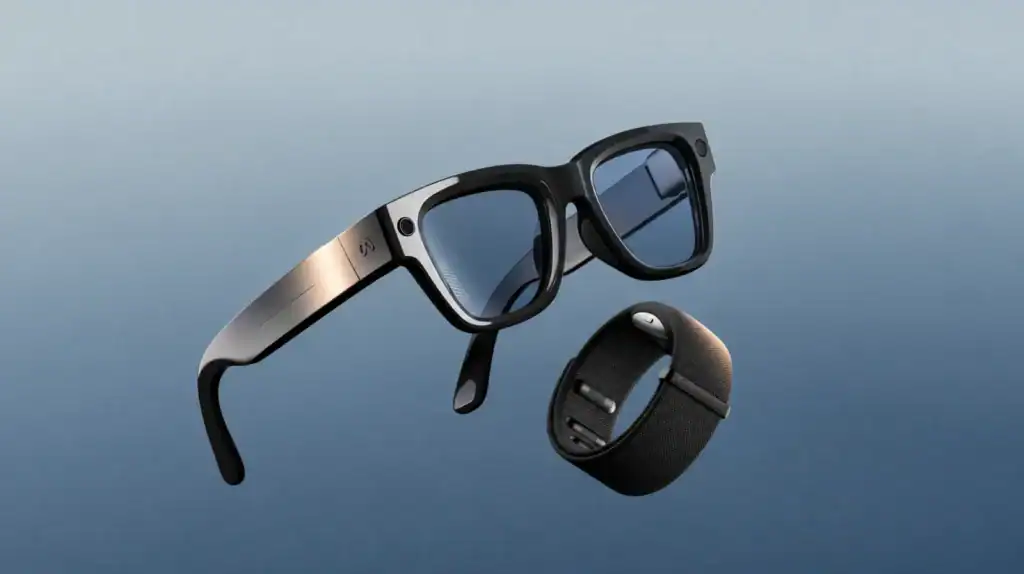
Key Takeaways
- Ray-Ban Meta Gen 3 launched at Meta Connect on September 23, 2026, starting at $449.
- Battery life rises to 9 hours, and the charging case extends total use to 50 hours.
- A new six-microphone array cuts over 90% of background noise on calls and voice commands.
- A customizable action button gives you one-press access to Meta AI or a shortcut of your choice.
- The camera stays at 12 MP with 3K Ultra HD video, plus new dynamic photos.
- Aviator and Zena join the Wayfarer, with 27 frame and lens combinations in total.
Smart glasses shipments grew 167% year over year in Q1 2026, reaching about 2.25 million units in a single quarter, according to IDC. Meta led that market with a 69.2% share, mainly because of the Ray-Ban Meta lineup. Now Meta has refreshed its best seller. The third-generation Ray-Ban Meta smart glasses went on sale on September 23, 2026, at Meta Connect.
This guide covers what Gen 3 does, what changed from Gen 2, and how Meta AI works on the glasses. You’ll also find full specs, pricing, lens options, and answers to common buyer questions.
Gen 3 also matters beyond consumers. Brands are now building companion apps, AI assistants, and hands-free workflows for glasses. As a result, demand for wearable app development services is growing alongside the hardware. Here’s what you need to know about the device first.
Ray-Ban Meta Gen 3: Key Features at a Glance
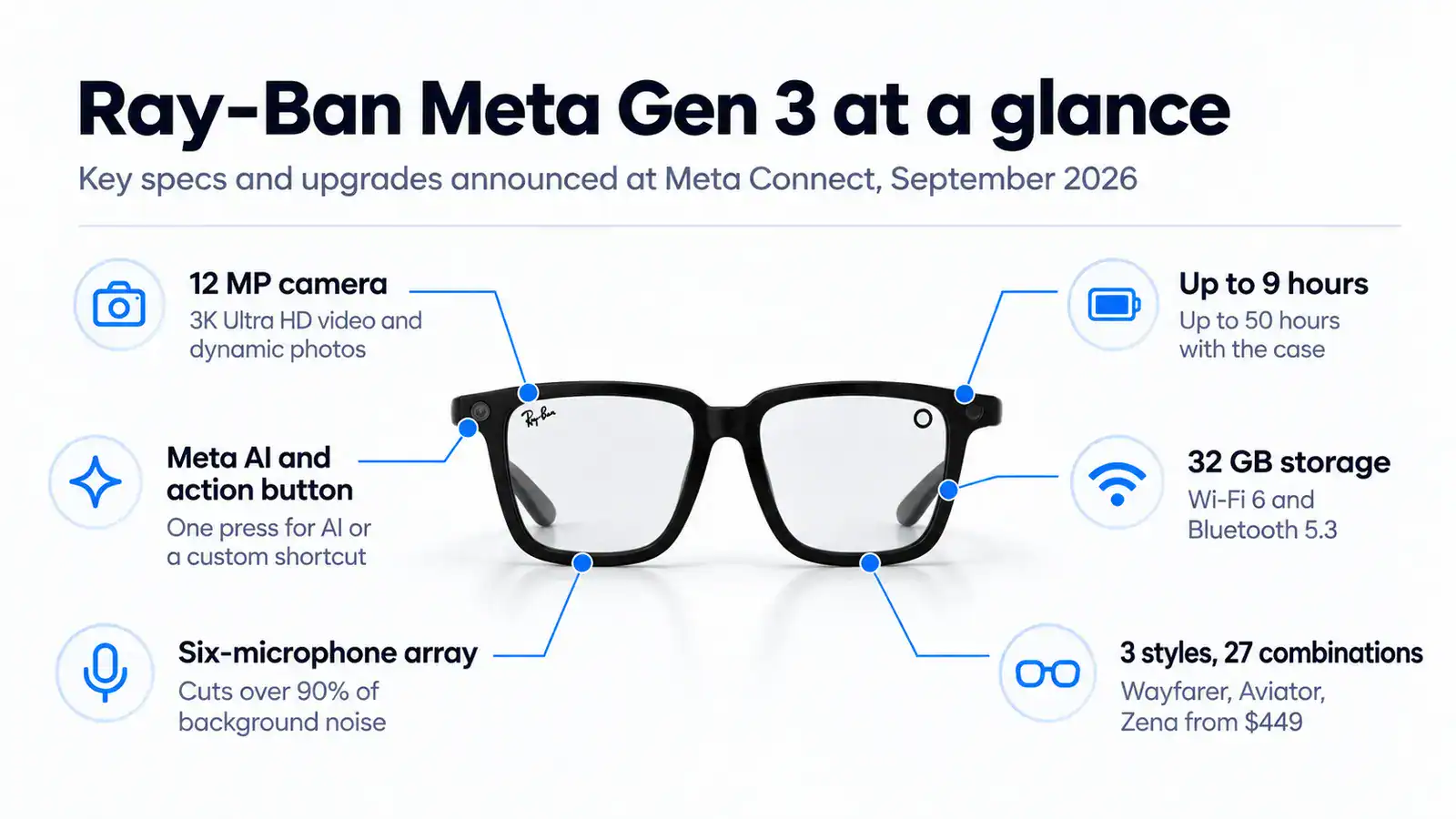
Gen 3 is an evolution, not a reinvention. The core Ray-Ban Meta Gen 3 features stay familiar, while comfort, battery, audio, and controls get practical upgrades.
1. 12 MP Camera and 3K Ultra HD Video
The Ray-Ban Meta Gen 3 camera keeps the same hardware as Gen 2. However, Meta added new ways to use it.
- 12 MP photos and 3K Ultra HD video recording, all captured hands-free
- Landscape or portrait photo orientation, plus new dynamic photos
- A built-in LED that signals to people nearby when you’re recording
In addition, Meta says its AI glasses will support video capture with Dolby Atmos and 360-degree spatial sound later this year.
2. Meta AI and Multimodal Assistance
Gen 3 is a showcase for Meta AI on wearables. The assistant uses the camera to see what you see, so you can ask questions about objects, signs, or products in front of you.
For example, you can look at a product in a store and ask Meta AI to compare prices, find deals, or pull up reviews. Meta is also adding its new agent. Muse, Meta’s personal AI agent, is coming to its AI glasses to help you manage tasks and goals hands-free. Meta has not given a date for that rollout.
3. Open-Ear Audio and Six-Microphone Array
Open-ear speakers sit in the temples. You hear music, calls, and AI responses while staying aware of your surroundings.
Audio pickup is the bigger change. The new six-mic array removes more than 90% of background noise, so calls and voice commands stay clear on windy or crowded streets. Also, a hearing enhancement feature for people with mild to moderate hearing loss is set to launch on Ray-Ban Meta glasses first.
4. Customizable Action Button
Gen 3 adds a second physical button next to the capture button. You can set it to summon Meta AI, act as a capture button, or trigger a shortcut to other features. Examples include texting a favorite contact or starting translation.
5. Up to 9 Hours of Battery Life
The Ray-Ban Meta Gen 3 battery life improves by one hour. Gen 3 runs up to 9 hours per charge and up to 50 hours with the charging case, compared with 8 and 48 hours on Gen 2. That covers most full days of mixed listening, capture, and AI use.
6. 32 GB Storage
Gen 3 includes 32 GB of flash storage, enough for over 1,000 photos or more than 100 30-second videos. You then offload media to your phone through the Meta AI app. For most owners of Ray-Ban Meta smart glasses, 32 GB lasts several days of casual shooting before a transfer.
7. Wi-Fi 6 and Bluetooth Connectivity
Gen 3 supports Wi-Fi 6 and Bluetooth 5.3. Bluetooth handles the constant phone link and audio. Wi-Fi 6 speeds up large photo and video transfers. The Meta AI app is required to set up and use the glasses.
Ready to Build an AI-Powered Wearable App?
Contact UsWhat’s New With Ray-Ban Meta Gen 3?
Early coverage describes Gen 3 as a refinement. Tom’s Guide calls the changes mostly cosmetic, with a new button and slightly longer battery life. Still, the upgrades target real complaints from daily users.
1. Slimmer and More Comfortable Design
Meta fits the same core tech into a slimmer, more comfortable frame. Weight ranges from about 51.5 g to 54.5 g depending on the frame. Introducing Ray-Ban Meta Audio and More AI Glasses Styles +2
2. New Aviator, Wayfarer, and Zena Styles
- Aviator: a new frame based on Ray-Ban’s classic Aviator shape
- Zena: a new cat-eye frame
- Wayfarer: carried over, now with a larger size option too
3. Improved Microphone Performance
Gen 3 moves to six microphones. As a result, voice commands work better outdoors and in noisy rooms.
4. Dynamic Photos
Dynamic photos let you pick the best frame from a capture, so you get a sharper final shot. fb
5. Longer Battery Life
The battery rises from 8 to 9 hours per charge, and the case adds two hours of total capacity.
6. Adjustable Temple Tips
Gen 3 adds professional-adjustable temple tips for a better fit. An optician can bend them to match your head shape.
Ray-Ban Meta Gen 3 Specifications
Here are the core Ray-Ban Meta Gen 3 specs in one place.
| Specification | Ray-Ban Meta Gen 3 |
|---|---|
| Camera | 12 MP |
| Video | 3K Ultra HD |
| Photo modes | Landscape, portrait, dynamic photos |
| Microphones | 6 (cuts over 90% of background noise) |
| Audio | Open-ear speakers |
| Battery | Up to 9 hours |
| Charging case | Up to 50 hours total |
| Storage | 32 GB flash |
| Connectivity | Wi-Fi 6, Bluetooth 5.3 |
| Controls | Capture button, action button, touchpad, voice |
| Weight | About 51.5 g to 54.5 g (varies by frame) |
| Styles | Wayfarer, Aviator, Zena (27 combinations) |
| Starting price | $449 |
| App | Meta AI app (iPhone and Android) |
What Can You Do With Ray-Ban Meta Gen 3?
The Ray-Ban Meta smart glasses replace several phone tasks with voice and a button press. Here’s what you can do day to day.
Capture Photos and Videos Hands-Free
Say “Hey Meta, take a photo” or press the capture button. You can also say “Hey Meta, start autocapture” at a concert or on a trip, and Meta AI records moments and builds highlight videos.
Ask Meta AI About What You See
Look at a menu, landmark, or plant and ask about it. The glasses capture an image, and Meta AI answers through the speakers.
Get Real-Time AI Assistance
Start a Live AI session for ongoing help. For instance, you can ask follow-up questions while cooking, shopping, or fixing something.
Translate Conversations
Gen 3 offers live translation in several languages, so you can follow a conversation without taking out your phone.
Listen to Music and Podcasts
You can connect Spotify, Apple Music, and Audible, then play content with a “Hey Meta” voice command.
Make Calls and Send Messages
Take calls, send texts, and reply to messages by voice. In addition, you can map the action button to message a favorite contact.
Set Reminders
Ask Meta AI to remind you about tasks, such as where you parked or what to buy later.
Get Information Without Using Your Phone
Check the weather, sports scores, or nearby restaurants by voice. Meta lists sports scores, restaurant picks, and live translation among common uses.
How Does Meta AI Work on Ray-Ban Gen 3?
The Ray-Ban Meta Gen 3 AI features run through the Meta AI app on your phone. The glasses handle input and output. Heavy processing happens in Meta’s cloud models. If you want background on the models behind tools like this, read our guide on what generative AI is and how it works.
Visual Questions and Multimodal AI
Multimodal AI combines what the camera sees with what you say. So when you ask “What is this building?” the assistant reads the image and your question together.
Live AI Assistance
Live AI keeps the session open. You don’t need to repeat the wake word for every question, so the conversation feels continuous.
Real-Time Translation
The glasses listen to the other speaker and play the translation in your ear. Meanwhile, the Meta AI app shows a transcript the other person can read.
AI-Powered Photo Features
Dynamic photos and autocapture use AI to choose and assemble the best moments. As a result, you spend less time sorting shots afterward.
Reminders and Everyday Tasks
Meta AI handles simple tasks like reminders, calls, and media control. Once Muse arrives, the glasses gain deeper planning and task support for owners of Ray-Ban Meta smart glasses.
Ray-Ban Meta Gen 3 vs Gen 2: What Has Changed?
Gen 3 keeps the camera and storage. It improves battery, audio, controls, fit, and style choice.
| Feature | Ray-Ban Meta Gen 2 | Ray-Ban Meta Gen 3 |
|---|---|---|
| Camera | 12 MP | 12 MP |
| Video | 3K Ultra HD | 3K Ultra HD |
| Battery | Up to 8 hours | Up to 9 hours |
| Case battery | Up to 48 hours | Up to 50 hours |
| Microphones | 5 | 6 |
| Controls | Capture button, touchpad | Capture button, action button, touchpad |
| Temple tips | Standard | Professional-adjustable |
| Styles | Wayfarer, Skyler, Headliner | Wayfarer, Aviator, Zena |
| Starting price | $379 | $449 |
- Camera and Video: No change in hardware. Gen 3 adds dynamic photos and orientation options through software.
- Battery Life: One extra hour per charge and two extra hours from the case.
- Microphones: The sixth microphone improves noise reduction on calls and commands.
- Design and Comfort: Gen 3 is slimmer and adds professional-adjustable temple tips.
- Controls: Gen 2 has a capture button that only controls camera features. Gen 3 adds the assignable action button.
- Styles and Lens Options: Wayfarer is the only frame shape that carries over from Gen 2.
- Price: Gen 3 starts at $449, which is $70 more than Gen 2. Gen 2 still sells at its $379 launch price.
Most early Ray-Ban Meta Gen 3 review coverage reaches the same verdict. Engadget notes that the higher price makes an upgrade from Gen 2 hard to justify. TechRadar, however, says Gen 3 is a much stronger buy for Gen 1 owners and first-time buyers.
Ray-Ban Meta Gen 3 Design and Lens Options
Gen 3 comes in 27 color and lens combinations across three styles.
Wayfarer
Ray-Ban’s best-known shape. It suits most face types and comes in standard and Large sizes.
Aviator
Meta is marking the Aviator’s 90th anniversary with a limited-edition Aviator in a vintage-inspired colorway. The thick frame comes in translucent and tortoiseshell colors.
Zena
A bold cat-eye frame and the most fashion-led option in the lineup.
Clear, Sun, and Transitions Lenses
You can choose clear, sun, polarized, or transition lenses. Pricing changes with the lens type. On Meta’s store, a Wayfarer starts at $449, a polarized pair costs $479, and Transitions lenses bring it to $529.
Prescription Lens Options
You can add prescription lenses through Ray-Ban and authorized opticians. For stronger prescriptions, Meta launched Ray-Ban Meta Blayzer and Scriber Optics earlier in 2026, starting at $499 and supporting nearly all prescriptions.
Adjustable Temple Tips
Professionally adjustable tips let an optician tune the fit. That matters because a stable fit keeps the open-ear speakers aligned with your ears.
Ray-Ban Meta vs Oakley Meta
The Ray-Ban Meta vs Oakley Meta choice mostly comes down to use case. Ray-Ban frames target everyday and fashion wear. Oakley Meta models, such as HSTN and Vanguard, target sport and outdoor use with performance-style frames.
Ray-Ban Meta Smart Glasses Price and Availability
Ray-Ban Meta smart glasses are priced from $224 to $799 USD, depending on the generation, lens options, and whether the model includes an in-lens display.
| Model | Starting price | Key difference |
|---|---|---|
| Ray-Ban Meta Gen 3 | $449 | Camera, 9-hour battery, action button |
| Ray-Ban Meta Gen 2 | $379 | Camera, 8-hour battery |
| Ray-Ban Meta Audio | $349 | No camera, up to 12 hours |
| Meta Ray-Ban Display | $799 | In-lens display, Neural Band |
You can buy Gen 3 from Ray-Ban stores and Ray-Ban.com, as well as Meta.com. Meta also plans to bring Ray-Ban Meta glasses to new markets later this year, including Turkey, Poland, Portugal, South Africa, Indonesia, and Thailand.
Market Context
Gen 3 enters a fast-growing category.
- IDC forecasts 13.6 million smart glasses shipments in 2026, up 41.4% year over year.
- IDC puts the average smart glasses selling price at about $376 in 2026, falling to about $229 by 2030.
- In Q2 2026, display-free audio glasses like Ray-Ban Meta made up 70.3% of XR shipments, and Meta held 68.7% of the market.
- EssilorLuxottica sold more than 7 million Ray-Ban and Oakley Meta glasses in 2025, over triple its 2024 total.
- Meta plans to offer more than 100 AI glasses options across Ray-Ban, Oakley, and Meta Glasses by the end of 2026.
Spatial computing is drawing similar business interest. Our breakdown of business opportunities around Apple Vision Pro covers how companies are preparing for that shift.
Build Innovative AI Solutions with Cubix
Gen 3 shows where consumer AI is heading. Assistants now live in hands-free devices that see and hear the world around you. The success of Ray-Ban Meta smart glasses also tells businesses something practical. Users want AI that works in the moment, without a screen in their hand.
That shift creates new product needs. Companies need voice-first assistants, visual recognition, and apps that sync data between glasses and phones. Cubix offers AI development services that cover generative AI, smart assistants, model fine-tuning, and AI integration into existing products.
Hardware is also moving toward displays. Meta Ray-Ban Display already puts visuals in the lens, and more brands are working on augmented reality eyewear. So your apps need interfaces designed for small fields of view, short glances, and gesture control.
Cubix has built immersive products for mobile and wearable platforms, including AR training and gaming apps. If you’re planning an experience for glasses or headsets, our AR/VR app development team handles strategy, design, development, and launch.
Bring Your AR/VR App Idea to Life
Contact UsFrequently Asked Questions
1. What cameras and recording features does Ray-Ban Meta Gen 3 have?
Gen 3 has a 12 MP camera that records 3K Ultra HD video. It supports landscape and portrait photos, dynamic photos, and autocapture highlight videos. An LED lights up whenever you record.
2. How long is the battery life on Ray-Ban Meta Gen 3?
Up to 9 hours per charge. With the charging case, you get up to 50 hours of total use.
3. What AI features does Meta AI on Ray-Ban glasses provide?
Meta AI answers questions about what you see, runs Live AI sessions, and translates conversations in real time. It also sets reminders, sends messages, plays media, and creates highlight videos. Muse agent support is coming later.
4. How much do Ray-Ban Meta glasses cost in 2026 and 2027?
Gen 3 starts at $449, Gen 2 at $379, Ray-Ban Meta Audio at $349, and Meta Ray-Ban Display at $799. Meta has not announced 2027 pricing. However, IDC expects average smart glasses prices to keep falling through 2030.
5. Can you use Ray-Ban Meta glasses for hands-free calls and messaging?
Yes. You can take calls, send texts, and reply to messages by voice. The six-mic array keeps your voice clear in noisy places.
6. Is there a display option for Ray-Ban Meta glasses?
Gen 3 has no display. For smart glasses with display, Meta sells the Meta Ray-Ban Display glasses at $799. They show a 600 × 600-pixel full-color display in the right lens and pair with the Meta Neural Band for gesture control. They’re now available to order online in the US and are expanding to the UK, Canada, France, Italy, and Germany. For a look at how headsets compare, see our take on how Apple Vision Pro changes the user experience. gsmarena9to5google
7. What privacy concerns exist with Ray-Ban Meta camera glasses?
Wearable camera privacy is the main concern. People nearby may not notice they’re being recorded. In a 2026 survey for France’s data regulator CNIL, 67% of respondents said smart glasses pose a privacy risk.
Data handling is a second issue. A February 2026 Swedish newspaper investigation reported that subcontractor workers reviewed clips from Meta AI glasses for AI training, and a lawsuit followed in March 2026. Meta relies on the recording LED as its main bystander signal. If you want no camera at all, Ray-Ban Meta Audio offers AI and open-ear audio without one, starting at $349.
8. Will Ray-Ban Meta smart glasses work with Android and iPhone?
Yes. You set them up through the Meta AI app, which runs on both iPhone and Android.