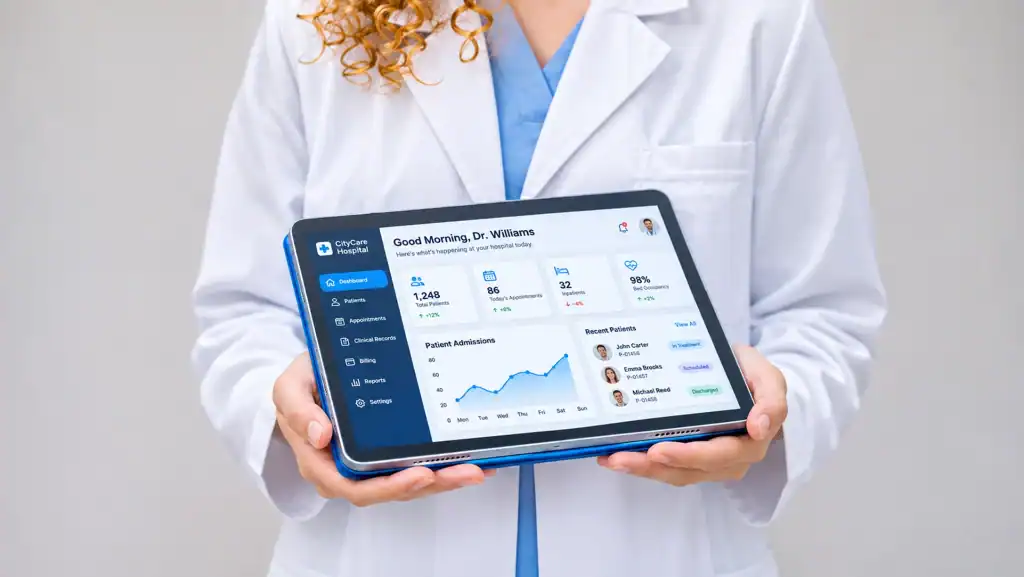
Custom hospital management system development typically costs $100,000–$500,000+. A basic system with essential hospital operations may cost 100,000–175,000, while a mid-sized platform can range from $175,000–$300,000. Enterprise systems with multiple facilities, complex integrations, and advanced workflows can exceed $500,000.
A hospital management system connects patient admissions, departments, billing, diagnostics, pharmacy, and administration. Building one involves more than developing separate modules. The system must keep data consistent across departments, integrate with existing healthcare platforms, and support the daily operations of the hospital.
The American Hospital Association’s hospital statistics show the scale of the U.S. hospital system. Since facilities differ in size, departments, and existing technologies, their software requirements and development budgets vary. This guide breaks down the costs of development, implementation, integrations, and ongoing maintenance.
Key Takeaways
- Hospital management system development costs $100,000–$500,000+, depending on system scope, features, and complexity.
- Core modules such as ADT, OPD/IPD, billing, diagnostics, pharmacy, and staff management determine the initial development scope.
- Integrations may add $5,000–$40,000+ per connection, while complex data migration can cost $20,000–$50,000+.
- HIPAA security, access controls, and deployment infrastructure should be included in the initial budget.
- Annual maintenance typically requires 15–25% of the initial development cost.
- Building in phases and integrating reliable existing systems can help control development expenses.
How Much Does Hospital Management System Development Cost?
Custom hospital management system development generally costs $100,000–$500,000+, depending on the number of modules, departments, integrations, and facilities.
| Hospital Management System Type | Estimated Cost | Typical Scope |
| Basic HMS | $100,000–$175,000 | Patient registration, appointments, admissions, billing, and basic reporting |
| Mid-sized HMS | $175,000–$300,000 | Multiple departments, EHR integration, laboratory workflows, pharmacy, and inventory |
| Enterprise HMS | $300,000–$500,000+ | Multi-facility operations, extensive integrations, advanced workflows, and enterprise reporting |
These are planning estimates for custom development, not fixed vendor prices or industry-wide averages.
Basic HMS ($100,000–$175,000): Covers essential administrative workflows, including patient registration, appointments, admissions, discharge, bed allocation, and billing. It typically serves a single hospital with limited integrations.
Mid-sized HMS ($175,000–$300,000): Adds departmental coordination, EHR connectivity, laboratory and radiology integrations, pharmacy, inventory, and more detailed reporting.
Enterprise HMS ($300,000–$500,000+): Supports multiple facilities, complex user permissions, centralized reporting, extensive interoperability, and high-volume operations. Legacy system integration and data migration can push the budget higher.
The number of modules alone does not determine the price. Five modules with complex integrations can cost more than ten relatively independent modules.
Which Modules Affect Hospital Management Software Development Cost?
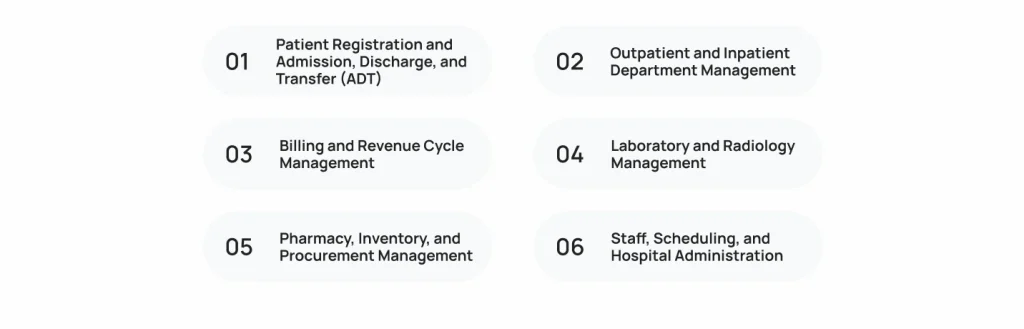
The modules included in a hospital management system determine its core development scope. A hospital may start with essential operational modules and add specialized functionality as its requirements grow.
1. Patient Registration and Admission, Discharge, and Transfer (ADT)
The registration and ADT module manages how patients enter, move through, and leave a hospital.
Typical features include:
- Patient registration and demographic records.
- Medical record number assignment.
- Admission and discharge processing.
- Bed and ward allocation.
- Patient transfer records.
A basic registration and admission workflow is relatively straightforward. Automated bed allocation, transfer rules, and complex discharge procedures require additional development.
2. Outpatient and Inpatient Department Management
OPD and IPD modules manage outpatient visits and inpatient stays.
OPD management typically includes appointment scheduling, doctor availability, patient queues, consultation records, and follow-up scheduling.
IPD management covers inpatient admissions, bed assignments, ward management, nursing records, and discharge preparation.
The cost depends on the number of workflows and how much automation the hospital needs. Specialty-specific scheduling, complex bed management, and detailed nursing workflows increase development effort.
3. Billing and Revenue Cycle Management
The billing and Revenue Cycle Management (RCM) module manages patient charges, invoices, payments, and revenue records.
Common features include:
- Service and procedure charge capture.
- Patient invoices and payment tracking.
- Insurance claim preparation.
- Denial and reimbursement tracking.
- Cost center accounting.
- Revenue and financial reports.
A basic billing module requires less development than a complete RCM system with automated charge capture, claim management, and detailed financial reporting.
4. Laboratory and Radiology Management
Diagnostic modules help hospitals manage test orders, imaging procedures, and results.
- Laboratory Information System (LIS): Manages laboratory test orders, specimen records, and test results.
- Radiology Information System (RIS): Handles imaging orders, scheduling, and radiology reports.
- Picture Archiving and Communication System (PACS): Stores, retrieves, and distributes medical images.
Hospitals can develop these capabilities as part of the HMS or retain their existing diagnostic applications. Building laboratory workflows, imaging management, and result handling from scratch adds considerably more scope than basic diagnostic order tracking.
5. Pharmacy, Inventory, and Procurement Management
These modules manage medication stocks, medical supplies, purchasing, and hospital assets.
Typical features include:
- Medication and supply inventory.
- Dispensing and stock records.
- Expiration date and low-stock alerts.
- Purchase requests and vendor records.
- Procurement approvals.
- Equipment and asset tracking.
A basic inventory module is less expensive than one supporting barcode scanning, multiple storage locations, automated replenishment, and detailed procurement workflows.
6. Staff, Scheduling, and Hospital Administration
Administrative modules support workforce planning and day-to-day resource management.
They may include staff profiles, shift scheduling, department assignments, credential records, leave management, and administrative reporting.
More advanced functionality, such as automated shift allocation, license expiration alerts, and credential renewal tracking, increases development scope.
Budgeting tip: Prioritize modules based on operational needs. If the hospital already uses reliable LIS, RIS, PACS, or HR software, retaining those systems may cost less than rebuilding their functionality inside the HMS.
What Factors Increase Hospital Management System Development Cost?
Beyond the selected modules, several system-wide requirements affect the total hospital management system development cost. These factors determine how well the software handles the hospital’s scale, existing technology, data, security, and infrastructure.
1. Hospital Size and System Scale
A system for one hospital with a few departments has different requirements from a platform serving a network of hospitals.
Additional facilities may require centralized patient lookup, facility-specific configurations, consolidated reporting, and separate operational settings. The number of concurrent users also affects performance, database capacity, and infrastructure planning.
For budgeting, define the number of facilities, departments, user roles, and expected concurrent users before development begins. These figures help establish the system’s architectural and infrastructure requirements.
2. Healthcare Integrations and Interoperability
Connecting the HMS with existing EHR platforms, laboratories, pharmacies, payer systems, and external healthcare services adds integration and testing costs.
Two common healthcare data exchange standards are:
- HL7 v2: Supports healthcare messages for workflows such as admissions, discharges, transfers, and laboratory results.
- HL7 FHIR: Defines standardized healthcare data resources and API-based exchange methods.
FHIR does not make every integration plug-and-play. Development teams still need to map data fields, configure authentication, handle vendor-specific implementations, and test how information moves between systems.
| Integration Complexity | Estimated Cost |
| Straightforward integration | $5,000–$15,000 |
| Complex integration with custom mapping and multiple workflows | $15,000–$40,000+ |
These are indicative planning estimates. Actual costs depend on vendor documentation, API availability, data formats, and testing requirements.
3. Data Migration From Legacy Hospital Systems
Moving records from existing hospital software into a new HMS requires more than transferring database files. Patient, admission, billing, and historical records must be assessed, cleaned, mapped, and validated.
| Migration complexity | Estimated Cost |
| Straightforward migration | $10,000–$20,000 |
| Complex migration across multiple databases | $20,000–$50,000+ |
Costs increase when records contain duplicates, missing fields, inconsistent formats, or mismatched patient identifiers.
Request sample data exports before finalizing the project budget. This helps identify migration problems early and reduces the risk of unexpected work during implementation.
4. HIPAA Security and Access Control Requirements
A hospital management system that handles electronic protected health information (ePHI) must account for applicable HIPAA requirements.
Security-related development work commonly includes:
- Role-Based Access Control (RBAC).
- Encryption in transit and at rest.
- Audit logs and access monitoring.
- Secure authentication and session management.
- Backup and disaster recovery controls.
- Security risk analysis.
The HHS HIPAA Security Rule guidance explains the need to assess risks and vulnerabilities affecting ePHI.
Hospitals should also review Business Associate Agreements (BAAs) with vendors that handle ePHI on their behalf. The cost depends on the system’s security requirements, existing infrastructure, and the work needed to address identified risks. These controls should be included in the initial development scope rather than treated as last-minute additions.
5. Cloud, On-Premises, and Hybrid Deployment
The deployment model affects infrastructure setup, hosting expenses, maintenance, and internal IT requirements.
| Deployment Model | Main Cost Considerations |
| Cloud | Hosting, database services, storage, backups, and availability requirements |
| On-premises | Servers, storage, networking, infrastructure setup, and IT administration |
| Hybrid | Cloud hosting alongside on-site infrastructure and legacy system connections |
Cloud deployment may reduce the need to purchase and manage physical servers, but recurring hosting and storage charges still apply. On-premises deployment requires greater investment in local infrastructure, while hybrid environments can introduce additional management complexity.
The right approach depends on existing hospital infrastructure, IT capabilities, application requirements, and security assessments.
How Much Does Each Hospital Management Software Development Phase Cost?
For a $250,000 HMS project, an illustrative development budget could look like this:
| Development Phase | Budget Allocation | Estimated Cost |
| Discovery and requirements | 10% | $25,000 |
| UI/UX and workflow design | 8% | $20,000 |
| Architecture and core development | 42% | $105,000 |
| Integrations and data migration | 15% | $37,500 |
| Testing and quality assurance | 15% | $37,500 |
| Deployment and launch | 10% | $25,000 |
| Total | 100% | $250,000 |
The allocation varies by project. A hospital replacing several legacy systems may spend more on integration and migration.
The phases cover:
- Discovery: Workflow analysis, technical requirements, integration assessment, and project scope.
- Design: Role-specific dashboards, forms, navigation, and workflow prototypes.
- Development: Frontend, backend, databases, permissions, and selected HMS modules.
- Integration and migration: API connections, data mapping, migration, and validation.
- Testing: Functional, integration, security, performance, and user acceptance testing.
- Deployment: Production configuration, staff onboarding, final migration, and go-live support.
Confirm whether vendor estimates include integration testing, migration, training, and post-launch support. These items are sometimes quoted separately.
What Does Hospital Management Software Implementation Cost?

Hospital management software implementation may add approximately $15,000–$60,000+ to the project, depending on data quality, integrations, infrastructure, and the number of departments involved.
Typical expenses include:
- Data migration: $10,000–$50,000+, depending on record volume and complexity.
- Infrastructure setup: Depends on cloud usage or on-premises hardware requirements.
- Integration configuration: Depends on the number of connected systems and vendor requirements.
- Workflow configuration: Department settings, user roles, approval rules, and reporting.
- Staff training: Role-specific training for clinical, administrative, and billing teams.
- Go-live support: Production monitoring, issue resolution, and rollout assistance.
The migration estimate may already be included in a broader implementation quote. Avoid adding it twice when calculating the total budget.
Ask vendors to separate development, implementation, third-party licensing, hosting, training, and support costs in their proposals.
How Much Does It Cost to Maintain a Hospital Management System?
Budget approximately 15–25% of the initial development cost annually for software maintenance as a planning guideline.
For a $200,000 HMS, that equals $30,000–$50,000 per year, excluding separately billed infrastructure and third-party services.
Recurring expenses include:
- Bug fixes and technical support.
- Security patches and vulnerability monitoring.
- Cloud hosting, storage, and backups.
- API and third-party integration updates.
- Compliance documentation and audit support.
- New modules and workflow enhancements.
Separate routine maintenance from new feature development in the support agreement. Adding a new department or integration is not the same as fixing a software defect.
How Can You Reduce Hospital Management System Development Costs?
Control the first release instead of trying to build every hospital workflow at once.
- Prioritize high-impact departments. Start with registration, ADT, billing, or whichever workflows cause the most operational problems.
- Integrate existing systems. Retain reliable LIS, RIS, PACS, and EHR platforms where replacing them would add unnecessary cost.
- Audit legacy data early. Review sample exports before committing to migration estimates.
- Use healthcare standards. Apply appropriate HL7 and FHIR patterns instead of creating proprietary formats for every connection.
- Validate prototypes with hospital staff. Test admission, transfer, billing, and discharge workflows before full development.
- Build for phased expansion. Use modular architecture so new departments and facilities can be added without rebuilding the core system.
- Define acceptance criteria. Document what each module must do and how the hospital will verify it.
The biggest savings often come from avoiding unnecessary scope and rework, not reducing testing or security work.
Should You Build Custom Hospital Management Software or Buy an Existing System?
Buying an existing HMS usually costs less upfront. Custom development requires a larger initial investment but offers greater control over workflows, integrations, and future changes.
| Consideration | Existing HMS | Custom HMS |
| Initial cost | Usually lower | Higher |
| Deployment | Often faster | Depends on project scope |
| Custom workflows | Limited by vendor | Built around hospital requirements |
| Integrations | Depends on available connectors | Designed for required systems |
| Licensing | Often recurring | No standard product license |
| Maintenance | Vendor support agreement | Internal team or external partner |
| Product roadmap | Vendor-controlled | Greater hospital control |
Choose an existing system when its modules and workflows already meet the hospital’s needs. Check licensing fees, integration charges, user limits, data export options, and support terms.
Choose custom development when existing products cannot handle important workflows, required integrations, or multi-facility operations without expensive customization.
Consider a hybrid approach when the hospital wants to retain established EHR, LIS, or PACS platforms but needs custom software to coordinate admissions, inventory, procurement, or reporting.
The decision should come down to the total cost of ownership, not just the initial software price. For smaller facilities, some requirements may overlap with custom medical clinic management platforms, although hospital-wide systems generally involve more departments and operational dependencies.
How Do You Calculate the Total Cost of Ownership of a Hospital Management System?

Total cost of ownership (TCO) includes development, implementation, infrastructure, integrations, maintenance, and future enhancements.
Consider a custom HMS with a $250,000 development budget:
| Expense | Three-Year Estimate |
| Initial development | $250,000 |
| Implementation | $45,000 |
| Maintenance (15–25% annually) | $112,500–$187,500 |
| Infrastructure and third-party services (20,000–40,000 annually) | $60,000–$120,000 |
| Estimated three-year TCO | $467,500–$602,500 |
This is an illustrative budget, not a standard hospital operating cost. It excludes major new modules, hardware replacement, and substantial expansion work.
When comparing proposals, request three-year and five-year projections. Include licensing, hosting, support, integrations, training, and future upgrades so that recurring expenses do not get overlooked.
Conclusion
A hospital management system should fit the way the facility operates, not force every department into a generic workflow. The right budget accounts for development, integrations, implementation, and ongoing maintenance. For most custom projects, that means planning around 100,000–500,000+, with the final investment determined by system scope and operational complexity.
If you’re planning a hospital platform, explore Cubix’s healthcare software development services to discuss the modules, integrations, and architecture your project requires.
Have a hospital software project in mind? Let's talk.
Contact Us
Frequently Asked Questions About Hospital Management System Cost
1. How much does a hospital management system cost?
A custom HMS typically costs 100,000–500,000+. Basic systems may cost 100,000–175,000, while enterprise platforms with multiple facilities and complex integrations can exceed $300,000.
2. What is the average cost of hospital management software in the USA?
There is no reliable universal average. A practical planning range for custom development is 100,000–500,000+, depending on modules, integrations, team rates, and implementation requirements.
3. How much does it cost to develop a Hospital Information System (HIS)?
A custom HIS may cost 100,000–500,000+. The price depends on whether it covers basic administration or connects clinical, diagnostic, financial, and operational departments.
4. How long does it take to develop a hospital management system?
A focused system may take 4–6 months, a multi-module platform around 6–12 months, and a large enterprise system 12–24 months or longer. Integrations and data migration can extend delivery.
5. Is custom hospital management software more expensive than off-the-shelf software?
Custom development costs more upfront, while off-the-shelf systems usually involve licensing and customization fees. Compare both options over three to five years.
6. What is included in hospital management software implementation costs?
Implementation typically covers configuration, data migration, integrations, infrastructure setup, staff training, deployment, and launch support. Some vendors charge separately for these services.