Key Takeaways
- Unity real-time servers are the backbone of every successful multiplayer experience, handling everything from matchmaking to gameplay synchronization.
- Photon is ideal for teams that want to build and launch multiplayer games quickly with managed cloud infrastructure.
- Nakama offers greater flexibility through its open-source architecture, making it well suited for live-service and content-rich multiplayer games.
- Custom backends provide complete control and scalability but require significantly more engineering expertise and ongoing maintenance.
A multiplayer game can have stunning graphics, smooth animations, and exciting gameplay. But if players experience lag, disconnects, or delayed actions, they definitely will not come back to play more.
That’s why choosing the right backend is one of the biggest technical decisions in modern game development.
Today, Unity real-time servers power everything from fast-paced shooters and racing games to MMORPGs and live-service mobile titles. They handle matchmaking, synchronize player actions, store game data, prevent cheating, and keep thousands or even millions of players connected at the same time. Check out our guide on Building for Scale: The Tech Behind Top-Grossing Mobile Games for more information.
But which backend should you choose?
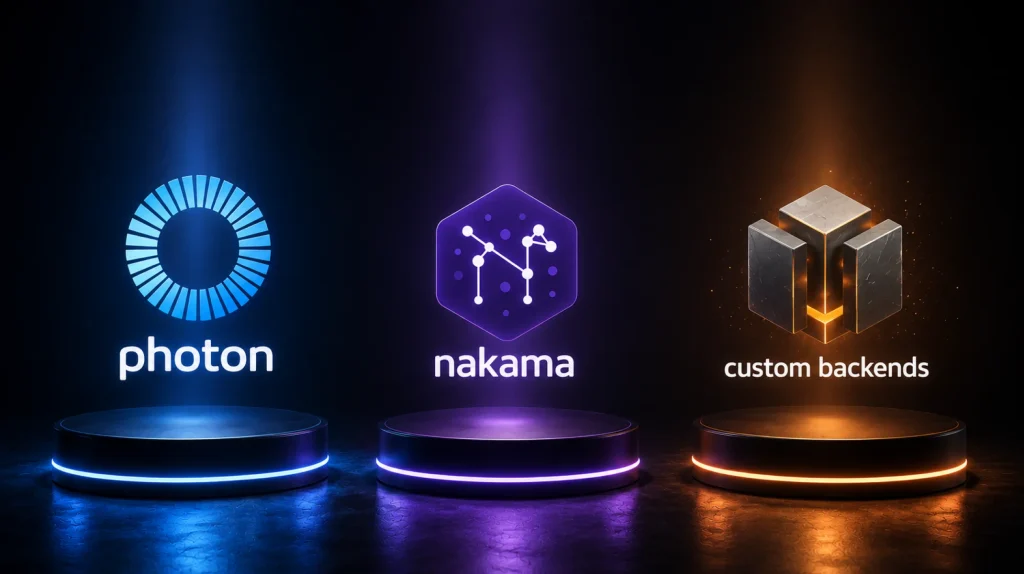
Should you use a Photon server, build on a Nakama server, or invest in a fully custom backend?
The answer depends on your game’s size, budget, scalability goals, and the level of control your team needs.
Why Unity Real-Time Servers Matter More Than Ever

The days of releasing a game with only single-player content are quickly disappearing.
Players now expect multiplayer by default. They expect every interaction to happen instantly. You can also read more multiplayer games on Key Market Insights on Multiplayer Games Development.
Behind every one of those moments is a real time server making sure every player sees the same game world at the same time.
Multiplayer Gaming Is Growing Faster Than Ever
The numbers tell an interesting story.
| Multiplayer Gaming Statistics | Latest Industry Data |
| Global gaming audience | Over 3.4 billion players worldwide |
| Global gaming market value | Expected to exceed $300 billion by 2028 |
| Mobile gaming share of total gaming revenue | Nearly 50% |
| Players who regularly play multiplayer games | More than 70% of gamers |
| Live-service games retain players longer than traditional premium games | Often 2–4× higher retention |
These trends explain why studios are investing heavily in scalable multiplayer infrastructure instead of treating networking as an afterthought.
Think about the games dominating player engagement today. Battle royales, survival games, co-op adventures, MOBAs, extraction shooters, and social sandbox games all depend on stable backend systems.
Without reliable networking, even the best gameplay ideas struggle to keep players engaged.
What Players Expect in 2026
Modern gamers have little patience for technical issues.
They expect:
- Matchmaking within seconds
- Low-latency gameplay
- Cross-platform multiplayer
- Persistent player progress
- Voice and text chat
- Live events
- Cloud saves
- Reliable reconnect systems
- Fair, cheat-resistant gameplay
Delivering all of that requires much more than simply connecting two devices over the internet.
It requires well-designed Unity real-time servers. For more insights, check out our article 50% of All Mobile Games Are Developed on Cross-Platform Engine Unity.
What Exactly Are Unity Real-Time Servers?
A real-time server constantly exchanges information between every connected player.
Imagine two players racing online.
When Player A turns left, Player B should see that movement almost instantly. If there’s too much delay, the race feels unfair and unresponsive.
The server acts as the central authority that receives every action, validates it, and sends updates to everyone else.
This process happens dozens of times every second.
Different Server Models
Not every multiplayer game uses the same networking approach.
| Server Model | How It Works | Best For |
| Authoritative Server | Server validates every action before updating players | Competitive multiplayer games |
| Dedicated Server | A standalone server hosts every match | Large-scale multiplayer titles |
| Relay Server | Routes player traffic without running game logic | Casual multiplayer games |
| Peer-to-Peer (P2P) | Players communicate directly with each other | Small private games with low infrastructure costs |
Competitive games usually rely on authoritative servers because they help reduce cheating and keep gameplay synchronized.
Casual multiplayer games, on the other hand, may prioritize faster deployment and lower operating costs.
The Backend Does Much More Than Networking
Many developers assume multiplayer servers only synchronize player positions.
In reality, today’s backend platforms handle much more. A typical multiplayer backend may include:
- Player authentication
- Matchmaking
- Friends systems
- Chat services
- Cloud save data
- Leaderboards
- Inventory management
- Live events
- Analytics
- Anti-cheat validation
- LiveOps support
Some platforms bundle these features together, while others let developers build them individually.
This is one of the biggest differences between a Photon server, a Nakama server, and a fully custom backend.
The Growing Networking Ecosystem
Unity developers now have more networking options than ever before.
Some of the most popular include:
- Photon Realtime Unity for cloud-hosted multiplayer sessions.
- Photon Fusion for fast-paced competitive games that require advanced prediction and rollback techniques.
- Photon PUN, which remains a popular choice for prototypes and smaller multiplayer projects.
- Colyseus, an open-source multiplayer framework designed for flexible server-side development.
- Netcode for GameObjects, Unity’s official networking solution for GameObjects.
- FishNet Unity, a community-driven networking framework known for strong performance and flexibility.
Want to understand the bigger picture behind multiplayer technology? Our guide, Technologies Powering Next-Generation Multiplayer Games, explores the networking, cloud infrastructure, AI systems, and server technologies that are shaping modern online games.
The good news?
There isn’t a single “best” backend for every project.
Some studios need to launch quickly with managed cloud services. Others prioritize complete ownership, customization, or long-term scalability.
Photon Server Explained
If you’ve searched for multiplayer solutions in Unity, you’ve almost certainly come across Photon.
It’s one of the most established networking platforms in the Unity ecosystem and has been used by thousands of studios, from indie developers to large game companies. Its biggest advantage? You can get a multiplayer prototype running in hours instead of weeks.
For teams that want to launch quickly without managing their own server infrastructure, Unity Photon remains one of the strongest options available.
How Does Photon Unity Work?
Unlike traditional dedicated servers that you host yourself, Photon offers managed cloud services that handle much of the networking for you.
When a player joins your game:
- The client connects to the Photon Cloud.
- Photon authenticates the player.
- Matchmaking places players into the correct room or session.
- The server synchronizes player actions in real time.
- Every connected player receives updates almost instantly.
This allows developers to focus on gameplay rather than maintaining physical servers.
Today, Photon offers several networking products designed for different types of multiplayer games.
| Photon Product | Best Used For |
| Photon Realtime Unity | Matchmaking, lobbies, chat, and session management |
| Photon Fusion | Competitive action games requiring prediction and low latency |
| Photon PUN (Photon Unity Networking) | Small to medium multiplayer projects and rapid prototyping |
| Photon Quantum | Deterministic multiplayer for highly competitive games |
While all four products belong to the Photon ecosystem, they solve different networking problems. For example, Photon Fusion introduces modern networking features such as client prediction and rollback, making it a better choice for fast-paced games than the older Photon PUN framework.
Why Developers Choose Photon
Photon has remained popular for years because it removes many of the hardest parts of multiplayer development.
Instead of building authentication systems, matchmaking servers, and room management from scratch, developers receive these features out of the box.
Some of its biggest strengths include:
- Fast Unity integration
- Managed cloud infrastructure
- Cross-platform support
- Reliable matchmaking
- Low-latency communication
- Built-in lobby management
- Extensive documentation
- Large developer community
- Support for Android, PC, WebGL, consoles, and iOS
For developers researching Unity real-time servers explained Photon iOS, the good news is that Photon fully supports iOS multiplayer deployments alongside other major platforms, making it a common choice for mobile game studios.
Another major advantage is speed.
Many indie developers can build a working multiplayer prototype within days because they don’t need to configure databases, authentication services, or dedicated hosting environments.
That shorter development cycle often translates into faster playtesting and quicker iterations.
Where Photon Works Best
Photon isn’t designed for every multiplayer game.
It performs especially well for:
- Casual multiplayer games
- Co-op adventures
- Party games
- Racing games
- Mobile multiplayer titles
- Card and board games
- Competitive arena games
- Small-to-medium online experiences
These projects benefit from Photon Cloud’s managed infrastructure without requiring extensive backend engineering.
If your team wants to validate an idea quickly or launch an MVP, Photon can significantly reduce development complexity.
The Limitations of Photon
No networking platform is perfect.
While Photon simplifies multiplayer development, it also introduces trade-offs that become more noticeable as projects grow.
| Advantages | Limitations |
| Quick setup | Less control over server infrastructure |
| Managed cloud hosting | Vendor dependency |
| Excellent Unity integration | Advanced customization can be limited |
| Strong documentation | Costs increase as concurrent users grow |
| Easy matchmaking | Complex backend logic may require additional services |
Nakama Server Explained
If Photon is known for helping developers launch multiplayer games quickly, Nakama is known for giving them more control.
Instead of being a fully managed cloud networking platform, Nakama server is an open-source game backend developed by Heroic Labs. It provides many of the services modern multiplayer games need while allowing developers to host and customize the entire backend themselves.
That flexibility has made Nakama increasingly popular among studios building long-term live-service games.
So, what is Nakama backend?
In simple terms, it’s a backend platform that combines multiplayer networking with player services such as authentication, matchmaking, chat, leaderboards, cloud storage, and social features, all in one system.
Rather than stitching together several third-party services, developers can build around a single, extensible backend.
What Comes Built Into Nakama?
One reason developers choose Nakama is that it offers much more than networking.
Out of the box, it supports:
- User authentication
- Matchmaking
- Multiplayer sessions
- Leaderboards
- Tournaments
- Friends and guild systems
- In-game chat
- Cloud save functionality
- Player inventories
- Server-side logic through RPCs
- Analytics integrations
Because these features are built into the platform, teams spend less time creating foundational systems and more time developing gameplay.
Unlike many managed services, developers also have complete access to the backend logic, making it easier to add custom rules or integrate external services.
Why More Studios Are Looking at Nakama
The gaming industry has changed dramatically over the past few years.
Many games are no longer launched and forgotten. They’re updated weekly, supported with seasonal events, and expected to stay online for years.
That shift has increased demand for backends that can evolve alongside the game.
Nakama fits that need because it’s:
- Open source
- Self-hosted or cloud-hosted
- Highly customizable
- Built for live-service games
- Designed to scale horizontally
It also works well with modern cloud technologies such as Docker and Kubernetes, making it easier for engineering teams to expand server capacity as player numbers grow.
Open Source Is Becoming a Bigger Advantage
Open-source software adoption continues to rise across the technology industry.
According to GitHub’s annual developer reports, millions of developers actively contribute to open-source projects every year, and game studios are increasingly embracing open infrastructure to avoid vendor lock-in and gain greater flexibility.
That’s one reason searches for Nakama GitHub continue to grow.
Developers often explore the source code before deciding whether the platform fits their project’s architecture.
Being able to inspect, modify, and extend the backend is a major advantage for studios building unique multiplayer experiences.
Where Nakama Shines
Nakama is especially strong when games require more than simple matchmaking.
For example, imagine an RPG where players:
- Own persistent inventories
- Join guilds
- Trade items
- Participate in seasonal events
- Earn leaderboard rewards
- Store years of progression
These systems all require backend logic that extends well beyond real-time networking.
Nakama allows developers to build these features directly into the backend instead of relying on multiple external services.
That makes it a strong choice for:
- MMORPGs
- Strategy games
- Survival games
- Live-service mobile titles
- Social multiplayer games
- Cross-platform online experiences
Advantages and Challenges of Nakama
Like any backend solution, Nakama comes with trade-offs.
| Advantages | Challenges |
| Open-source platform | Requires backend engineering expertise |
| No vendor lock-in | Longer initial setup |
| Highly customizable | Infrastructure must be managed by your team |
| Built-in player services | Smaller learning community than Photon |
| Excellent scalability | DevOps knowledge is recommended |
| Flexible deployment options | More responsibility for maintenance |
The biggest difference between Nakama and Photon isn’t performance.
It’s ownership. With Photon, much of the infrastructure is managed for you. With Nakama, your team owns the backend.
Photon or Nakama? It Depends on Your Team
Here’s a simple way to think about it.
If your priority is getting multiplayer online as quickly as possible, Photon usually has the advantage.
If your priority is building a backend that your team can fully customize and control over the next five or ten years, Nakama becomes much more attractive.
Neither approach is universally better.
The right choice depends on your game’s complexity, your engineering resources, and your long-term roadmap.
For projects with highly specialized networking requirements, however, some studios skip both platforms entirely and build a custom backend.
That’s where the comparison becomes even more interesting.
When Does a Custom Backend Become Worth It?
Studios often choose this route when building:
- Massive online worlds
- Games with millions of players
- Highly specialized gameplay mechanics
- Large-scale esports platforms
- Persistent simulations
- Custom anti-cheat systems
- Proprietary matchmaking algorithms
The downside?
Everything has to be designed, built, tested, monitored, secured, and maintained internally.
That requires experienced backend engineers, DevOps specialists, cloud architects, and networking experts.
While development costs are higher, the payoff is complete flexibility.
Photon vs Nakama vs Custom Backend: Which One Should You Choose?
By now, you’ve probably noticed that there’s no universal winner.
The best backend depends on what you’re building, how quickly you want to launch, and how much control you need over your infrastructure.
Let’s compare all three options side by side.
Feature Comparison
| Feature | Photon | Nakama | Custom Backend |
| Initial Setup | Fast | Moderate | Slow |
| Learning Curve | Low | Medium | High |
| Hosting | Managed by Photon Cloud | Self-hosted or cloud-hosted | Fully self-managed |
| Matchmaking | Built-in | Built-in | Must be developed |
| Authentication | Built-in | Built-in | Custom implementation |
| Leaderboards | Available | Built-in | Custom implementation |
| Server-Side Logic | Limited compared to custom solutions | Highly customizable | Unlimited |
| Scalability | Excellent with paid plans | Excellent with proper infrastructure | Depends on architecture |
| Vendor Lock-in | Yes | No | No |
| Long-Term Flexibility | Moderate | High | Very High |
| Best For | Indie, mobile, and casual multiplayer games | Live-service and growing multiplayer games | AAA-scale or highly customized projects |
A Simple Decision Guide
Still unsure? Ask yourself these questions.
| If your priority is… | Consider… |
| Launching a multiplayer MVP quickly | Photon |
| Minimizing infrastructure management | Photon |
| Building a long-term live-service game | Nakama |
| Avoiding vendor lock-in | Nakama |
| Creating highly customized backend systems | Custom Backend |
| Supporting unique gameplay mechanics | Custom Backend |
| Complete control over servers and data | Custom Backend |
Want to go deeper into the multiplayer architecture? You may also enjoy our guide Demystifying Tower Defense Game Architecture: A Practical Guide. Together, these resources explore the technical decisions that shape successful online games long after launch.
How Cubix Helps Studios Build Scalable Unity Multiplayer Games
Choosing between Photon, Nakama, and a custom backend is only one part of building a successful multiplayer game.
The bigger challenge is designing an architecture that supports your gameplay, business model, and future growth.
At Cubix Games, we help studios evaluate these trade-offs before development begins. Rather than recommending a one-size-fits-all solution, our engineers assess factors such as expected player count, game genre, platform support, monetization strategy, and long-term scalability.
Our Unity Game Development team builds multiplayer experiences with scalability in mind, combining networking frameworks with robust backend architecture, cloud infrastructure, and LiveOps planning.
You can also Hire Unity Developers with experience in multiplayer systems, server optimization, and real-time networking, or work with a 3D Game Artist for Hire to create immersive environments that complement your online gameplay.
Building a successful multiplayer game takes a lot more than just choosing the right backend. It requires a scalable architecture and an experienced team, of course. At Cubix Games, we help studios create reliable multiplayer experiences using Photon, Nakama, and custom backend solutions.
[blog_cta]
Frequently Asked Questions
1. What is the best backend for Unity?
There isn’t a single best backend for every Unity game. If you’re looking for a fast and reliable way to launch multiplayer features, Photon is an excellent choice because it offers managed cloud infrastructure and quick integration. If your game requires extensive customization, persistent player data, and full control over your infrastructure, Nakama or a custom backend may be a better fit.
2. What is the Nakama backend?
Nakama is an open-source game server and backend platform developed by Heroic Labs. It provides essential multiplayer features such as authentication, matchmaking, chat, leaderboards, cloud storage, multiplayer sessions, and server-side logic.
3. Is Unity still used in 2026?
Yes. Unity remains one of the world’s most widely used game engines in 2026. It continues to power thousands of indie, mobile, VR, AR, simulation, and multiplayer games. Its extensive asset ecosystem, cross-platform support, and mature development tools make it a popular choice for studios of all sizes.
4. How does Photon Unity work?
Photon connects Unity clients through managed cloud servers that synchronize gameplay in real time. It handles matchmaking, room management, player synchronization, and network communication, allowing developers to build multiplayer games without managing their own networking infrastructure. Depending on the project, developers can choose products such as Photon Realtime Unity, Photon Fusion, or Photon PUN.
5. Is Photon free for Unity developers?
Yes, Photon offers a free tier that is ideal for learning, prototyping, and small multiplayer projects. As your game grows, you’ll likely move to a paid plan based on your number of concurrent users (CCU). Before choosing a plan, it’s worth evaluating your expected player growth alongside overall photon server pricing to estimate long-term operating costs.