Key Takeaways
- LLM application testing checks prompts, model responses, retrieved context, tools, and application logic.
- Evaluate AI features for accuracy, relevance, groundedness, safety, latency, and cost.
- Use representative test datasets and combine automated evaluation with human review.
- Test RAG applications for retrieval quality, data access, and response grounding.
- Integrate LLM tests into CI/CD and production monitoring to catch regressions and quality drift.
AI features are moving from experimental demos into customer-facing products, internal tools, and business workflows. Stanford HAI reports that 78% of surveyed organizations use AI, making the reliability of AI-powered applications a practical software quality concern rather than a purely experimental one.
An LLM-powered application can return a fluent, well-written answer and still be wrong, unsafe, or poorly grounded in the information it was given. That makes testing an AI feature different from checking whether a traditional function returns the expected value.
LLM application testing evaluates the behavior of the complete AI feature, including prompts, retrieved context, model responses, business rules, safety controls, and application logic. Instead of relying only on exact output matching, QA teams need evaluation datasets, quality metrics, automated checks, adversarial prompts, and human review to determine whether responses meet defined thresholds.
The goal is not to prove that an LLM is always correct. It is to establish whether the application behaves reliably enough for its intended users, data, and risk level.
Want to discuss your project? Our experts are just a click away.
Contact UsWhat Is LLM Application Testing?
LLM application testing is the process of testing an application that uses a large language model to generate, classify, summarize, retrieve, or transform information.
The testing scope extends beyond the model itself. A production AI feature may combine:
- System and user prompts
- Model configuration
- Conversation history
- Retrieval-augmented generation (RAG)
- External APIs or tools
- Business rules
- Output parsers
- Safety and moderation controls
- User and permission data
That means a strong large language model testing strategy evaluates the application as a system rather than treating the underlying model as the only thing being tested.
This distinction matters because a model can perform well on general benchmarks while producing poor results inside a specific application. Application-centric testing needs to account for the prompts, context, workflows, domain constraints, and actual user inputs that shape the final response.
For organizations building these systems, Cubix AI provides a broader view of AI development capabilities and implementation.
Why Are LLM-Powered Applications Harder to Test?
Traditional software testing often works with deterministic expectations:
Input → Function → Expected output
LLM applications introduce another layer:
Input + context + prompt + model → probabilistic response → evaluation
The same prompt can produce responses with different wording or structure while still satisfying the application’s requirements. Exact string matching therefore becomes too restrictive for many AI features.
Other challenges include:
- Nondeterministic responses: Equivalent answers may differ in wording, structure, or length.
- Context sensitivity: Small changes in retrieved or conversational context can change the output.
- Hallucinations: A response can sound authoritative while containing unsupported claims.
- Model and prompt changes: Updating a model, system prompt, retrieval logic, or temperature can affect previously acceptable behavior.
- Security risks: Malicious inputs can manipulate model behavior or expose information.
- Evaluation complexity: Qualities such as relevance, tone, faithfulness, and helpfulness are difficult to reduce to simple pass/fail assertions.
For this reason, LLM testing combines traditional software tests with LLM evaluation, where outputs are scored against defined quality criteria rather than compared only with an exact expected string. This application-focused approach is also reflected in current LLM testing methodologies that distinguish application behavior from foundation-model benchmarks.
What Should You Test in an LLM Application?
A useful QA framework starts by defining what “good” means for the specific AI feature.
| Testing area | What to evaluate |
| Functional behavior | Does the feature perform the intended task? |
| Accuracy | Is the response factually correct? |
| Relevance | Does it address the user’s request? |
| Groundedness | Is the answer supported by the supplied context? |
| Consistency | Does the system maintain acceptable behavior across similar inputs? |
| Safety | Does it avoid harmful or prohibited responses? |
| Security | Can users manipulate the system or access protected information? |
| Performance | Does it meet latency and throughput requirements? |
| Cost | Does token and model usage remain within acceptable limits? |
These dimensions should not be treated as one universal score. A customer-support assistant, coding copilot, healthcare workflow, and internal knowledge bot have different failure conditions and therefore need different evaluation criteria.
For example, a support chatbot may prioritize answer relevance and policy compliance, while a RAG application may place greater weight on retrieval quality, groundedness, and data leakage.
For broader context on applying AI to software development workflows, see AI-powered development.
How to Build an LLM Evaluation Framework?
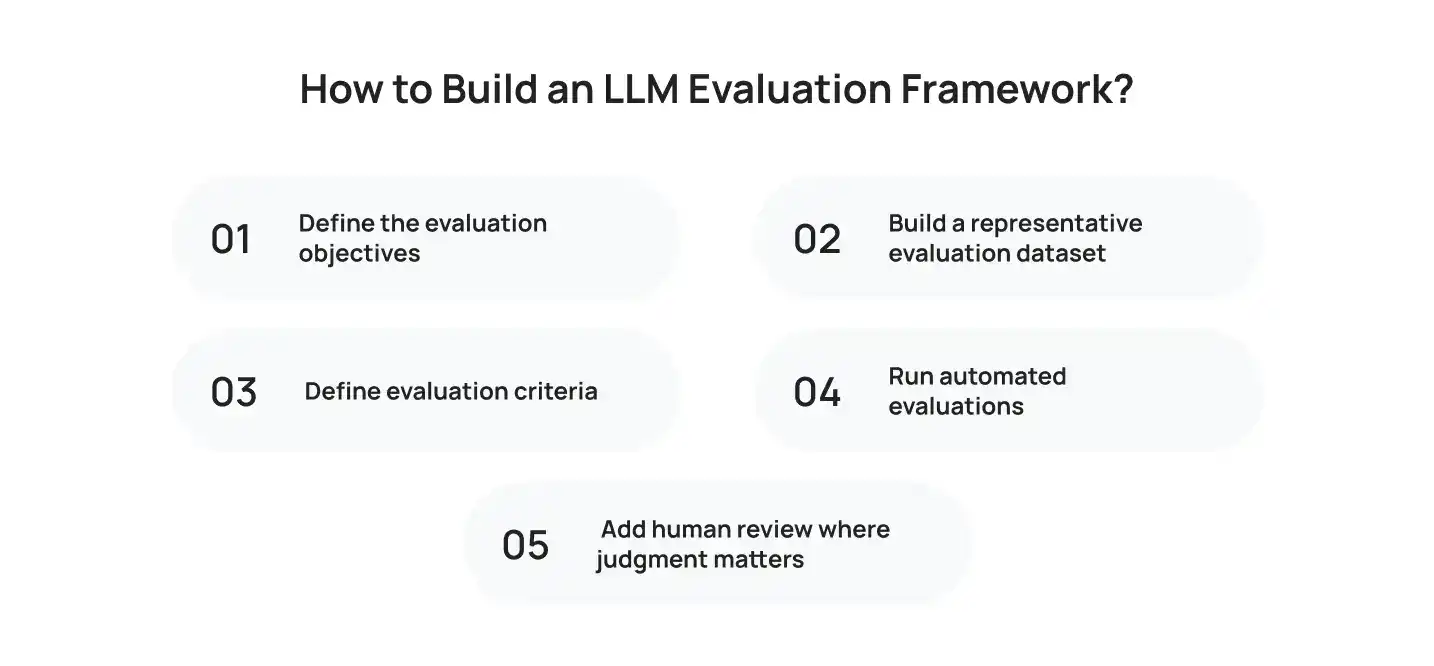
A practical LLM evaluation framework turns vague expectations such as “the chatbot should be helpful” into repeatable tests and measurable thresholds.
1. Define the evaluation objectives
Start with the behavior that matters to the business.
For a customer-support assistant, this could include:
- Correctly answering product questions
- Using approved policy information
- Avoiding unsupported claims
- Escalating uncertain cases
- Protecting customer information
2. Build a representative evaluation dataset
Create a test set that reflects real application behavior rather than relying only on ideal prompts.
Include:
- Common user queries
- Edge cases
- Ambiguous questions
- Long-context requests
- Negative examples
- Multilingual inputs where relevant
- Adversarial prompts
- Known historical failures
Real user queries can be combined with synthetic and manually authored cases, but the dataset should be reviewed for relevance and quality.
3. Define evaluation criteria
Each test case needs a clear definition of success.
For example:
Prompt: “What is the refund window for an annual subscription?”
Instead of requiring one exact sentence, evaluate whether the response:
- Gives the correct refund period
- Uses the approved policy
- Avoids unsupported exceptions
- Answers the question directly
4. Run automated evaluations
Automated evaluators can score outputs for criteria such as correctness, relevance, faithfulness, safety, and task completion. LLM-as-a-judge systems can help with semantic criteria, while deterministic assertions remain useful for structured outputs and hard requirements.
5. Add human review where judgment matters
Automated scoring should reduce repetitive review, not eliminate human oversight.
Human evaluators remain useful for:
- High-risk decisions
- Ambiguous responses
- Complex domain reasoning
- New failure modes
- Validating automated evaluator quality
NIST’s Generative AI Profile emphasizes evaluation and measurement as part of managing the risks and trustworthiness of generative AI systems.
Prompt Testing: How QA Teams Test LLM Instructions
Prompt testing should cover more than whether a model follows the ideal instruction.
QA teams can create prompt suites for:
- Normal user requests
- Ambiguous instructions
- Conflicting instructions
- Long inputs
- Repeated questions
- Unexpected formatting
- Multilingual prompts
- Boundary conditions
- Prompt injection attempts
- Jailbreak attempts
Version prompts like code. When a system prompt changes, rerun the relevant evaluation set rather than assuming the new version behaves like the previous one.
This makes prompt changes measurable and helps identify regressions before they reach production.
How to Test LLM Responses for Hallucinations
Hallucination detection is one of the most important parts of generative AI testing, particularly when users may rely on AI-generated information.
NIST uses the term confabulation for cases where generative AI produces and confidently presents erroneous or false content. The risk becomes particularly important when users may act on the response in consequential settings.
A response should therefore be checked against the information the application is allowed to use.
For RAG systems, QA teams can evaluate:
- Context relevance: Did retrieval return information related to the question?
- Context sufficiency: Does the retrieved information contain enough evidence?
- Faithfulness or groundedness: Does the answer remain supported by that evidence?
- Answer relevance: Does the response actually answer the user’s question?
A response that sounds convincing but introduces facts absent from the retrieved context should fail the relevant evaluation.
For high-risk workflows, combine automated hallucination checks with human review and source validation rather than relying on a single evaluator.
How to Test RAG Applications?
RAG application testing needs to evaluate both sides of the pipeline:
Retrieval → Context → Generation
Testing only the final answer can hide where the problem originated.
| RAG layer | Key tests |
| Query processing | Intent interpretation, query transformation |
| Retrieval | Relevance, recall, ranking, context sufficiency |
| Context | Correctness, freshness, duplication, access control |
| Generation | Groundedness, answer relevance, unsupported claims |
| Security | Prompt injection, sensitive data leakage |
| Regression | Changes in embeddings, chunks, indexes, prompts, or models |
RAG systems also need security testing because retrieved content can influence model behavior. OWASP’s LLM security guidance identifies prompt injection and sensitive information disclosure among the major risks affecting LLM-powered applications.
A useful RAG test case therefore does more than ask, “Was the answer correct?”
It asks:
Was the right information retrieved, was it authorized for the user, and did the model answer from that information without adding unsupported claims?
Teams building this type of system can also explore large language model development services for the engineering requirements behind LLM-powered applications.
How to Test AI Safety and Security?
AI safety testing should be part of the QA lifecycle rather than a final check before release.
Test for:
- Prompt injection
- Jailbreak attempts
- Sensitive information disclosure
- System prompt leakage
- Unsafe or inappropriate outputs
- Improper output handling
- Excessive model agency
- Unauthorized tool or API actions
- Data leakage across users or sessions
OWASP’s current LLM risk guidance covers areas including prompt injection, sensitive information disclosure, improper output handling, excessive agency, system prompt leakage, misinformation, and unbounded consumption.
For applications connected to tools, databases, or business systems, test the action boundary as carefully as the generated text. An acceptable response is not enough if an attacker can manipulate the model into performing an unauthorized operation.
For a broader look at QA and security across software development, see Cubix’s QA and security approach.
Automated vs. Human LLM Evaluation
Neither automated evaluation nor human review is sufficient for every scenario.
Automated evaluation works well for:
- Large test datasets
- Regression testing
- Repeated quality checks
- Format validation
- Basic safety screening
- Comparing prompt or model versions
Human evaluation is more valuable for:
- Subjective quality
- Complex reasoning
- High-risk decisions
- Ambiguous cases
- Evaluating whether an automated judge is itself reliable
LLM-as-a-judge evaluation can provide scalable semantic scoring by presenting a judge model with the input, application output, and a defined scoring rubric. However, judge models should themselves be validated against representative human-labeled examples.
For broader context on AI-assisted quality practices, see AI in software quality assurance.
How to Integrate LLM Testing Into CI/CD?
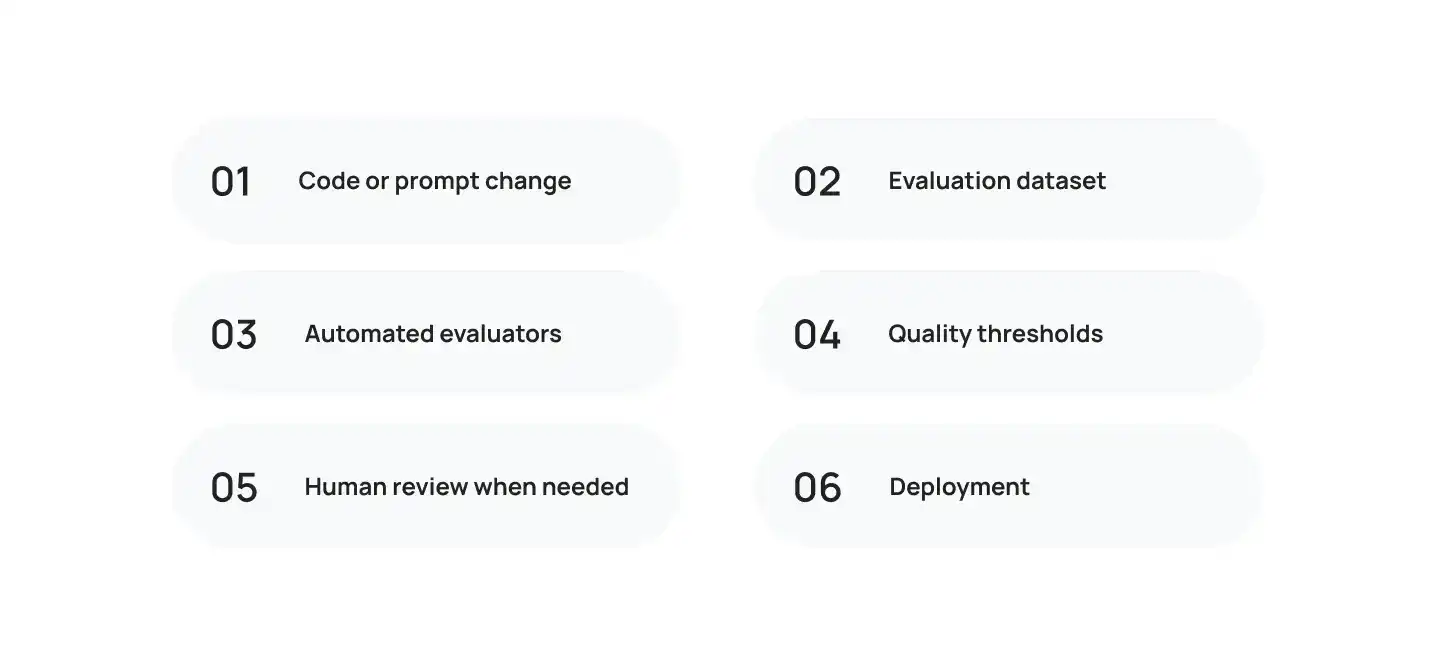
LLM testing becomes much more useful when it runs alongside application development instead of being performed manually after every release.
A typical workflow looks like this:
Code or prompt change → Evaluation dataset → Automated evaluators → Quality thresholds → Human review when needed → Deployment
A CI/CD pipeline can fail when critical thresholds are breached, such as:
- Accuracy falling below the approved threshold
- Hallucination rate increasing
- Safety violations appearing
- Structured output failing validation
- RAG groundedness declining
- Latency exceeding the service-level target
This turns automated regression testing for AI responses into a release control rather than a periodic QA exercise.
A practical starting point is to maintain a versioned dataset of representative inputs, execute the application against that dataset, score the results, and block releases when predefined quality thresholds are missed. This dataset-and-evaluator approach is also used in current LLM application testing workflows.
Which Metrics Should Businesses Use to Evaluate AI Feature Quality?
There is no single metric that works for every LLM application. Metrics should map to the feature’s actual failure modes.
| Metric | What it tells you |
| Accuracy / correctness | Whether the answer is correct |
| Answer relevance | Whether it addresses the user’s request |
| Faithfulness | Whether the output is supported by supplied context |
| Context relevance | Whether retrieved information is useful |
| Hallucination rate | How often unsupported claims occur |
| Task success rate | Whether the AI completes the intended task |
| Safety violation rate | How often unsafe behavior occurs |
| Latency | How quickly the application responds |
| Token usage | How much model capacity each request consumes |
| Cost per request | Financial efficiency of the AI feature |
For RAG applications, metrics such as context relevance, context sufficiency, answer relevance, and hallucination or faithfulness measures can be combined with use-case-specific criteria.
Track these metrics by dataset version, prompt version, model version, and application release where possible. That makes it easier to identify whether a regression came from the model, prompt, retrieval pipeline, or application code.
How Much Does LLM Application Testing Cost?
The cost of LLM application testing depends on the application’s complexity, evaluation volume, model usage, and amount of human review.
Key cost drivers include:
- Number and size of evaluation datasets
- Model/API usage
- Automated evaluator calls
- RAG and retrieval complexity
- Security testing
- CI/CD integration
- Human evaluation
- Production monitoring
A small AI feature can begin with a focused evaluation dataset and automated checks. Enterprise applications usually need broader datasets, multiple evaluation dimensions, security testing, regression tracking, and continuous monitoring.
The goal is to spend testing effort where an incorrect or unsafe AI response has the greatest business impact.
For a broader perspective on using AI to reduce repetitive work across software workflows, see integrating AI for optimized efficiency.
When Should Businesses Use LLM Application Testing Services?
Teams should consider AI application testing services when an AI feature has become too complex to validate through ad hoc manual testing.
This is especially relevant when an application:
- Uses RAG or external data
- Handles sensitive information
- Connects an LLM to business tools
- Serves a large user base
- Requires continuous model or prompt updates
- Needs repeatable CI/CD evaluation
- Has strict accuracy or compliance requirements
A testing partner should understand both conventional QA and the specific evaluation challenges introduced by LLMs, including nondeterministic outputs, hallucinations, retrieval quality, security, and production monitoring.
Final Takeaway
LLM application testing is not simply traditional QA with an AI model added to the stack. The test target is the complete AI feature: its prompts, context, retrieval pipeline, model behavior, outputs, safety controls, and integration with the surrounding application.
A practical QA framework combines representative evaluation datasets, automated metrics, prompt testing, hallucination and groundedness checks, RAG evaluation, adversarial security testing, human review, and CI/CD regression gates.
As the application changes, the evaluation suite should change with it. That is what turns LLM testing from a one-time quality check into an ongoing engineering practice.
Want to discuss your project? Our experts are just a click away.
Contact UsFrequently Asked Questions
1. How can QA teams detect hallucinations and unsupported AI responses?
Use reference data, retrieved context, source validation, factuality checks, and automated evaluators to identify unsupported claims. For high-risk use cases, add human review and test known failure scenarios.
2. What is the timeline for integrating LLM testing into an existing CI/CD pipeline?
A basic evaluation suite can start with a small representative dataset, automated scoring, and a few release thresholds. Larger systems take longer because they may require dataset versioning, RAG evaluation, security testing, human review, and production monitoring.
3. How should enterprises test RAG applications for accuracy and data leakage?
Test retrieval relevance and sufficiency before evaluating the generated response. Then check groundedness, sensitive-data exposure, authorization boundaries, prompt injection, and cross-user isolation. RAG evaluation should cover both quality and security.
4. What should businesses look for in an AI application testing partner?
Look for experience with LLM evaluation, prompt testing, RAG systems, automated regression testing, safety and security testing, CI/CD integration, and human-in-the-loop evaluation. The partner should also be able to define application-specific quality metrics rather than relying only on generic model benchmarks.
5. What are the best metrics for LLM application testing?
The right metrics depend on the use case. Common measures include correctness, relevance, faithfulness, groundedness, hallucination rate, task success, safety violations, latency, token usage, and cost per request.
6. Can LLM testing be fully automated?
Not reliably for every use case. Automated evaluation is effective for repeatable checks and large datasets, but human review remains valuable for ambiguous, subjective, or high-risk outputs. A layered approach generally provides stronger coverage than either method alone.