Key Takeaways
- Cross-play lets players on different platforms share one match. It depends on three systems: unified cross-platform accounts, cross-platform matchmaking, and a networking backend every platform can reach.
- Cross-play is not cross-progression. Cross-play decides who you can play with. Crossplay progression decides what you keep when you switch devices. Both rely on a shared account layer.
- Demand is well established. 87% of multiplayer gamers played cross-platform games in the past year (Unity/Harris Poll), and the global games market reached $201.6 billion in 2025 (Newzoo).
- Engagement upside is significant. Epic Games found Fortnite players who cross-played played about 570% more and generated 365% higher monthly revenue per user. This is correlation, not proof of causation.
- Dedicated, server-authoritative networking is the safest model. It keeps rules consistent across platforms and makes cheating harder.
- The difficulty comes from many overlapping factors. These include input and performance gaps, platform certification, anti-cheat, moderation and ongoing maintenance.
- Measure by platform, not just overall. Track matchmaking time, p95 latency, crash-free sessions, opt-out rate and retention for each platform pair.
- Decide early. Late architecture choices, short certification timelines and weak load testing are the most common causes of delay and rework.
Cross-play is the ability for players on different platforms, such as PC, console and mobile, to join the same multiplayer match. Cross-play game development is the engineering discipline that makes this possible: unified accounts, platform-neutral matchmaking, and multiplayer networking that performs consistently on very different hardware.
For studios, this is no longer a differentiator. In a Unity-commissioned Harris Poll study, 87% of multiplayer gamers reported playing cross-platform games within the previous year. This guide explains how cross-play works, how studios build it, what it costs, and how to measure whether it is working. If you are deciding whether to add cross-play to a new or live title, you are in the right place.
Build your cross-play game with Cubix. Let's make multiplayer seamless
Contact UsWhat Is Cross-Play?
Cross-play (also written cross-play or cross-platform play) lets players on different devices compete or cooperate in the same game session. A player on a PlayStation console can party with a friend on PC and a third on a phone, all in one lobby. Studios often use the terms cross-play games, multiplayer cross-play and cross-platform multiplayer interchangeably, and in everyday usage they mean the same thing.
The scope matters, because “cross-play” is not a single feature. A title may support cross-play between PC and one console family only, or across every major platform. Mobile is increasingly part of the picture. Mobile accounts for roughly 3 billion of the 3.58 billion players worldwide, and Unity’s research found that 44% of cross-platform gamers play on both mobile and console. Studios planning for that audience should treat mobile game development as a core cross-play platform rather than a later add-on.
Quick answer: Cross-play lets players on different platforms share one multiplayer match. It depends on three systems: a unified account layer, cross-platform matchmaking, and a networking backend that every supported platform can reach.
Is Cross-Play the Same as Cross-Progression?
No. They solve different problems, and confusing them leads to scope errors early in planning. Cross-play concerns who you can play with. Cross-play progression, or cross-progression, concerns what you keep when you change devices. Cross-save is the narrower mechanism that syncs save data.
| Feature | What it does | Typical requirement |
|---|---|---|
| Cross-play | Lets players on different platforms play in the same match | Shared matchmaking, networking and platform approval |
| Cross-progression | Carries levels, unlocks and currency between platforms | Cross-platform accounts and a central progression database |
| Cross-save | Syncs save files or game state between devices | Cloud save service tied to a unified account |
Both features depend on cross-platform accounts, meaning a studio-owned identity that links a player’s PlayStation, Xbox, Steam, Nintendo, Apple or Google IDs. Many studios launch cross-play first and add cross-progression later. Designing the account layer for both from day one avoids a costly migration.
Why Studios Invest in Cross-Play Game Development
The business case rests on a larger addressable audience and better engagement. The market context is substantial: Reports say that global games revenue reached $201.6 billion in 2025, up 9.1% year over year, with mobile at $113.3 billion, console at $44.7 billion and PC at $43.6 billion. Newzoo forecasts the market will reach $234.4 billion by 2028. A game that is locked to one platform addresses only a fraction of that spend.
The operational benefits are equally concrete:
- Larger player pools. More concurrent players means more potential opponents at every skill level.
- Shorter queue times. Psyonix’s co-studio head has said cross-play has a direct impact on matchmaking speed and quality, an effect that is most visible in niche modes and off-peak hours.
- Longer game lifespan. Players are less likely to abandon a game when every friend can join them, regardless of device.
Epic Games published some of the clearest engagement data available. Its analysis of Fortnite from March to June 2020 found that more than 60% of players partied up with someone on another platform. Those cross-players played about 570% more on average than non-cross-players, and their average monthly revenue per user was 365% higher. These figures describe correlation rather than proof of causation, because highly engaged players are more likely to have friends on other platforms. Even so, they show where the commercial upside sits.
Player sentiment has also shifted. In a 2017 GameTrack survey of gamers in the UK, France, Germany and Spain, 58% said they were indifferent to cross-platform play, and only 17% said it would persuade them to buy a game they otherwise would not. By 2021, Unity’s research showed that 43% of cross-platform gamers wanted more cross-platform options. The feature moved from novelty to expectation within a few years.
How Cross-Play Works: Core Architecture
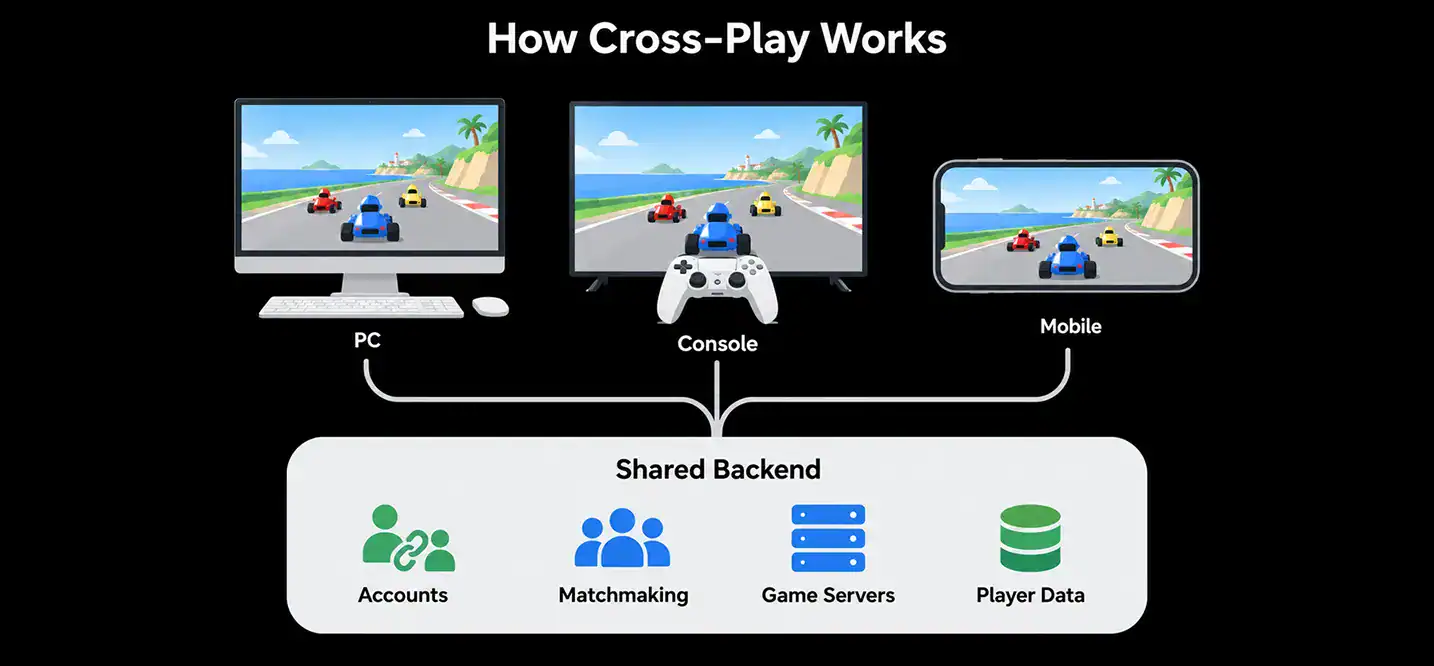
A sound crossplay architecture separates what is platform-specific from what is shared. The client on each platform handles rendering, input and platform services. A shared backend handles identity, matchmaking, game sessions, persistence and moderation. Between them sit authentication tokens, session relays and API gateways that translate platform requirements into a single common protocol.
The guiding principle is simple: every platform-specific dependency should sit behind an abstraction layer. Friend lists, entitlements, presence, chat and purchases all differ by platform. If gameplay code talks to them directly, each new platform multiplies the work. If it talks to your own interface, each new platform becomes an adapter.
Engine choice shapes this work. Teams building on Unreal Engine can use its online subsystem framework to abstract platform services, which is one reason studios often pair cross-play with specialist Unreal game development expertise.
Cross-Platform Accounts and Identity
The account layer is the foundation. A player signs in with a platform identity (for example, a PSN or Xbox account), and your backend links it to a single studio-owned player ID. That ID becomes the key for friends, parties, progression, purchases and bans.
Key design decisions include:
- Linking flow: Can a player link a second platform later, and how are duplicate accounts merged?
- Token validation: Each platform issues its own authentication tokens, and your backend must verify every one.
- Privacy and data: Linked accounts store personal data, so retention, consent and regional regulations (GDPR and COPPA among them) apply from day one.
Middleware can shorten this step. Epic Online Services, Microsoft PlayFab and Unity Gaming Services all offer identity and lobby building blocks, though each has trade-offs in cost, lock-in and platform coverage.
Multiplayer Networking Models
Multiplayer networking is where cross-play succeeds or fails in practice. Three models dominate:
| Model | How it works | Cross-play fit |
|---|---|---|
| Dedicated servers | An authoritative server runs the match; all clients connect to it | Strongest: consistent rules, easier anti-cheat, platform-neutral |
| Relay or hybrid | A relay forwards traffic between clients, sometimes with one client hosting | Good for smaller or co-op games where server cost matters |
| Peer-to-peer | Clients connect directly to each other | Weakest: NAT issues, host advantage, higher cheating risk |
Most competitive cross-play games use dedicated, server-authoritative architecture. It keeps game logic out of players’ hands, gives every platform the same simulation, and avoids the connectivity problems peer-to-peer creates between different console networks.
How Does Cross-Platform Matchmaking Work?
Cross-platform matchmaking groups players from different platforms into balanced sessions. The system typically follows five steps:
- Collect attributes. The matchmaker reads each player’s skill rating, region, latency to available servers, party size and chosen mode.
- Apply platform rules. Players may opt in or out of cross-play, and some games separate pools by input device.
- Search a pool. Tickets wait in a queue while the system widens skill and latency windows over time.
- Form a match. Once enough compatible players are found, the system allocates a game server.
- Distribute connection data. Each client receives the server address and a session token.
A common refinement is input-based matchmaking, which pairs controller players with controller players and keyboard-and-mouse players with the same, regardless of platform. It addresses fairness concerns, and it is worth evaluating early because it affects pool size.
Cross-Play Game Development Workflow: Step by Step
Successful crossplay implementation follows a staged workflow. Skipping stages is the most common source of schedule slips.
- Discovery and scoping. Define the target platforms, supported modes, input policies and whether cross-progression is in scope. Confirm platform-holder requirements before design is locked.
- Technical design. Choose the networking model, identity provider and matchmaking approach. Produce a crossplay architecture document and a risk assessment.
- Backend build. Implement the account service, matchmaker, session management, and the data stores for profiles and progression.
- Client integration. Integrate each platform’s SDK behind your abstraction layer, then connect clients to the shared services.
- Testing and hardening. Run functional, compatibility, soak and load tests across every platform combination.
- Certification and launch. Submit builds, resolve platform findings, then roll out in stages with monitoring in place.
- Live operations. Tune matchmaking, patch regularly and respond to cheating and abuse reports.
Roles involved: backend engineers, network engineers, client engineers per platform, QA specialists, a technical producer, a security or anti-cheat lead, and live-ops staff. Smaller studios often combine roles, but the responsibilities still need clear owners.
Prerequisites: a stable single-platform multiplayer build, server-authoritative gameplay logic, a version-compatible update process across platforms, and platform-holder developer access. Studios without in-house capacity often engage dedicated game development services to fill gaps in backend and platform integration.
Cross-Play Game Development Checklist
Use this checklist to confirm readiness before committing to build:
- Target platforms and supported cross-play combinations are defined
- Platform-holder agreements and developer access are in place
- A unified account and identity design is approved
- Server-authoritative networking is chosen and prototyped
- Matchmaking rules cover skill, latency, region and input type
- Player opt-out controls and privacy settings are designed
- Voice, text chat, blocking and reporting work across platforms
- Anti-cheat and fraud detection cover every supported platform
- Update processes keep all platforms on compatible versions
- Platform certification games requirements are mapped to the schedule
- Load, soak and latency tests are planned for each platform pair
- KPIs, dashboards and alert thresholds are defined before launch
- A live-ops plan covers incidents, moderation and maintenance
If more than a few of these are unchecked, the project is not yet at production readiness.
What Makes Cross-Play Difficult?

The challenge is rarely one hard problem. It is the combination of many moderate ones.
Input and balance disparities. A mouse offers precision that a controller cannot match, while aim assist can narrow that gap and create its own fairness debates. Touch input introduces another set of trade-offs. Studios address this with input-based matchmaking, tuned aim assist, or separate queues.
Hardware and performance gaps. A high-end PC and a handheld console or mid-range phone render at very different frame rates. Because frame rate affects reaction time, performance parity targets must be defined for each platform, and gameplay logic should not depend on frame rate.
Platform certification. Each platform holder sets its own rules. Sony, Microsoft and Nintendo run formal technical requirement checks before release, while Apple and Google enforce store review and policy requirements. Platform certification games must cover account handling, chat and privacy controls, error messaging and network behavior, and requirements change over time. Verify the current rules directly with each platform holder, because they are often shared under NDA.
Fragmented communities and communication. Voice chat, text chat, blocking and reporting each work differently by platform. Players expect a consistent moderation experience, and studios are expected to deliver it.
Anti-cheat and security. PC environments are more exposed to cheating tools than closed consoles, and that perception affects behavior. A report cited by industry statistics aggregators suggests a significant share of console shooter players disable cross-play for this reason, though the figure comes from secondary sources and should be validated against your own telemetry. Offering an opt-out and investing in server-side detection protects both trust and retention.
Multiplayer networking differences. Console network environments, mobile data connections and home Wi-Fi vary widely. Latency compensation and region-aware server placement must hold up across all of them.
Cross-Play Game Development Cost and Implementation Considerations
Cost varies sharply with scope, so studios should be skeptical of any single number. The main cost drivers are consistent:
- Backend infrastructure: dedicated servers, matchmaking services, databases and observability, which scale with concurrent users.
- Engineering effort: account services, platform SDK integration and network code.
- Quality assurance: every added platform multiplies the test matrix of devices, builds and platform pairs.
- Certification: submission cycles, rework and platform-specific fees or conditions.
- Live operations: moderation, anti-cheat, patch coordination and on-call support, which continue for the life of the game.
The central implementation decision is whether to build, buy or partner.
| Approach | Best when | Main trade-off |
|---|---|---|
| Build in-house | You have experienced backend and network engineers and need full control | Highest upfront cost and longest timeline |
| Use middleware | You want to launch quickly with standard features | Per-user pricing, vendor dependency, limited customization |
| Outsource or partner | You lack specialist capacity or need to scale a team fast | Needs strong governance and clear knowledge transfer |
In practice, most studios blend these: middleware for commodity services, custom code for differentiating features, and external partners for peak workload.
Scalability deserves early attention. Server fleets, matchmaker throughput and database capacity should be load-tested at a multiple of expected peak, because a successful launch is the scenario most likely to break an under-provisioned backend. Plan for long-term maintenance as well. Platform SDKs update on their own schedules, and each update can require client changes, retesting and resubmission.
How to Measure Cross-Play Success: KPIs and Validation
What you measure determines what you improve. The table below lists core metrics. The targets are illustrative starting points, not industry standards, and should be calibrated to your genre and audience.
| KPI | What it tells you | Illustrative starting target |
|---|---|---|
| Median matchmaking time | Whether cross-platform matchmaking is shortening queues | Under 30 seconds in core modes |
| Latency (p95) | How the worst-served players experience the game | Under 100 to 150 ms for fast-paced action |
| Crash-free session rate | Stability by platform | 99% or higher on every platform |
| Cross-play session share | Adoption of the feature | Track trend by mode and platform pair |
| Opt-out rate | Player trust and fairness concerns | Monitor for spikes after updates |
| Retention (D1, D7, D30) | Whether cross-play improves long-term engagement | Compare cross-players with single-platform players |
| Report and ban rates | Health of moderation and anti-cheat | Compare across platforms |
Validation methods include automated multi-platform regression suites, soak tests that run sessions for many hours, load tests that simulate launch-day concurrency, and closed betas that include every platform pair. Dedicated game testing services are valuable here, because quality assurance across a full device and platform matrix is demanding to staff internally.
Failure signals to watch for: queue times that rise as cross-play share grows, win-rate gaps between input types, platform-specific crash spikes, rising opt-out rates, and disconnect rates that differ sharply by platform. Any of these suggests a structural problem, not random noise.
Cross-Play Game Development Best Practices
These practices are consistent across successful projects:
- Decide early. Retrofitting cross-play onto a peer-to-peer, platform-coupled codebase is far more expensive than designing for it.
- Use server-authoritative logic. It reduces cheating and guarantees consistent rules on every platform.
- Abstract platform services. Keep platform SDK calls behind your own interfaces.
- Give players control. Offer cross-play opt-out, input-based matchmaking options and clear privacy settings.
- Align on governance. Assign owners for platform relationships, data protection, moderation policy and incident response.
- Protect player data. Encrypt tokens, minimize stored personal data and document retention periods.
- Test every platform pair. Do not assume that if A works with B and B works with C, then A works with C.
- Schedule certification early. Build submission time and rework into the plan.
- Instrument everything. Launch with dashboards and alerts, not after the first incident.
Common Cross-Play Mistakes to Avoid
Which of these could your team be heading toward?
- Making architecture decisions too late. Adding identity and matchmaking after content is complete forces rework across the codebase.
- Underestimating certification timelines. A failed submission can cost weeks. Plan for at least one resubmission cycle.
- Offering no opt-out controls. Players who feel disadvantaged, particularly on console, may leave rather than complain.
- Weak load testing. Cross-play expands your potential audience, so capacity assumptions based on a single platform will be wrong.
- Skipping risk assessment. Data protection, chat moderation, fraud and platform policy risks are cheaper to address in design than after launch.
- Ignoring maintenance. Platform SDK updates, new devices and policy changes require a funded, ongoing maintenance plan.
- Measuring only overall averages. An acceptable global metric can conceal a poor experience on one platform.
Why Choose Cubix for Cross-Play Game Development?
Cross-play combines architecture, platform certification, quality assurance and live operations into a single delivery challenge, and few studios have all of that expertise in-house. Cubix approaches cross-play game development as an end-to-end engineering effort, covering crossplay implementation from backend design and cross-platform accounts to matchmaking and multiplayer networking. Studios that need a delivery partner can explore Cubix’s game development services to see how these capabilities fit together.
Engine and platform depth matters just as much. Cubix supports teams working in Unreal game development and mobile game development, the two environments where cross-play architectures are most frequently built or extended. Because every added platform multiplies the test matrix, Cubix also pairs engineering with game testing services, helping studios validate quality assurance, compatibility and platform certification readiness before submission.
The delivery process mirrors the workflow described above: clear scoping, documented technical design, transparent communication and governance that keeps stakeholders informed at every stage, from discovery to production readiness. If you are planning a cross-play project or rescuing one that has stalled, talk to Cubix about your goals, platforms and timeline.
Turn your multiplayer vision into reality. Partner with Cubix today
Contact UsFrequently Asked Questions
1. What is cross-play?
Cross-play is a feature that lets players on different platforms, such as PC, console and mobile, join the same multiplayer match. It relies on unified accounts, cross-platform matchmaking and a networking backend that all supported platforms can reach.
2. Is cross-play the same as cross-progression?
No. Cross-play determines who you can play with across platforms, while cross-progression determines whether your levels, unlocks and purchases follow you between devices. Both depend on cross-platform accounts, but they are separate features with different technical and certification requirements.
3. How does cross-platform matchmaking work?
The matchmaker collects each player’s skill rating, region, latency, party size and cross-play preferences. It searches a shared pool, widens its criteria over time, forms a balanced match and assigns a game server. Many games also separate players by input type to keep matches fair.
4. What makes cross-play difficult?
The difficulty comes from many overlapping factors: input and performance differences, platform certification requirements, anti-cheat and moderation, varied network conditions, and the need to maintain all of it as platforms evolve. Early architectural planning and thorough testing reduce most of these risks.