Key Takeaways
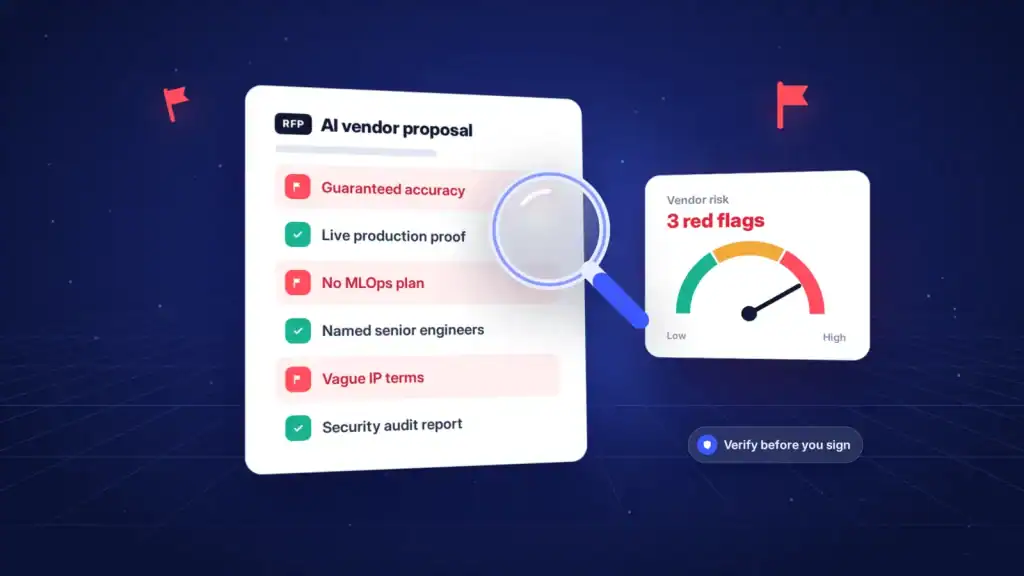
- Weak vendors promise accuracy before they see your data.
- Ask for live production proof, not demos or promo videos.
- Check the team, the security setup, and the contract terms.
- Score every proposal on the same weighted matrix.
Gartner predicts that 70% of enterprises will abandon agentic AI built through vendor forward deployed engineering by 2028. Costs rise, and internal teams still cannot evolve the systems alone. That risk makes hiring an AI development company a decision you cannot treat like a routine purchase.
However, most failures start before the contract. A vendor shows a polished demo, skips the data review, and glosses over the hard parts. As a result, you find the gaps only after you pay.
This guide covers 12 red flags, a four-step verification method, a question list, and a scoring matrix. If you want an outside view before you sign, Cubix offers software consulting services that help you scope and plan the build.
Why Choosing the Right AI Vendor Matters
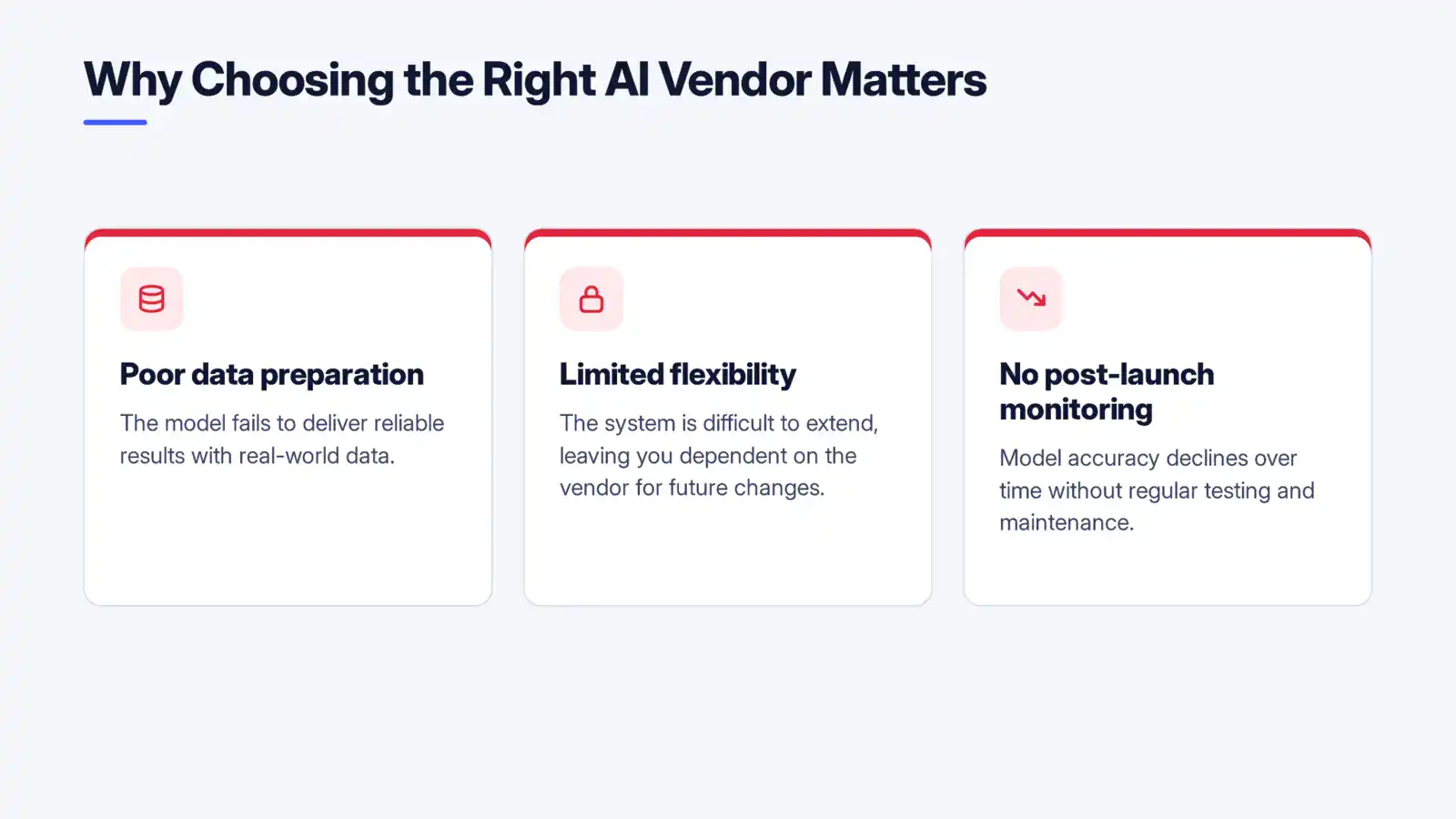
A weak vendor wastes more than your budget. Delays can set your project back by months, while poor technical decisions can leave you with a system your team cannot maintain or scale.
Three problems often arise when choosing the wrong vendor:
- Poor data preparation: The model fails to deliver reliable results with real-world data.
- Limited flexibility: The system is difficult to extend, leaving you dependent on the vendor for future changes.
- No post-launch monitoring: Model accuracy declines over time without regular testing and maintenance.
These AI development outsourcing risks increase when the vendor controls the code, data pipeline, and technical knowledge. Knowing how to choose an AI development partner helps you assess technical expertise, ownership, communication, and long-term support before requesting a quote.
Because AI systems depend on both code and data, hiring an AI development company requires careful evaluation beyond the initial price and delivery timeline.
12 Red Flags When Hiring an AI Development Vendor
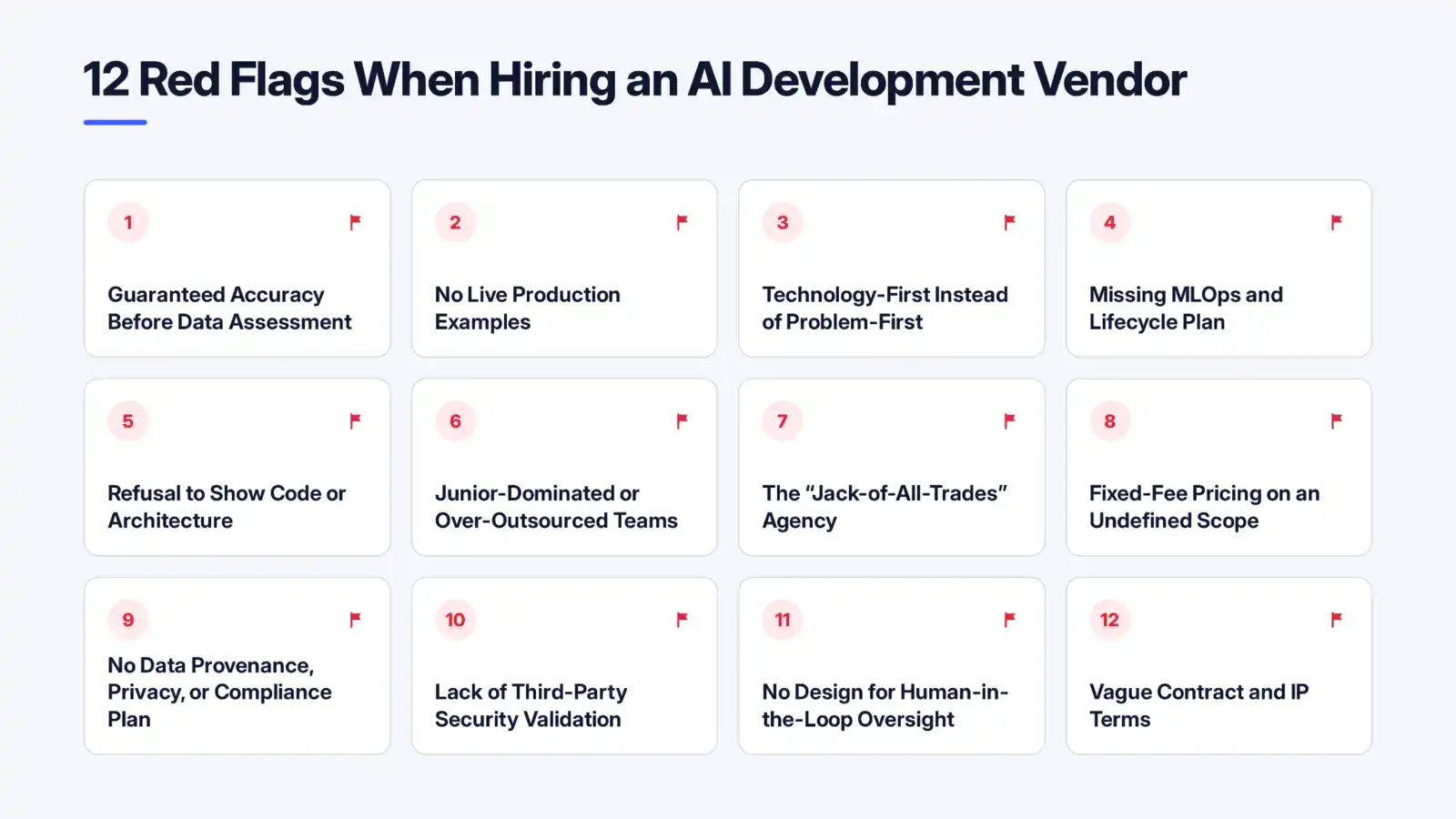
These AI development vendor red flags appear early in sales calls and proposals. Spot them before you sign, and you avoid the costliest mistakes. Each flag below lists what to check.
1. Guaranteed Accuracy Before Data Assessment
No vendor can promise a fixed accuracy figure before it sees your data. Instead, accuracy depends on data quality, label consistency, and how often rare cases appear. A vendor that quotes a number on the first call is guessing or selling.
Ask for these instead:
- A paid data assessment before any accuracy target.
- Accuracy ranges tied to a test set you approve.
- Clear metrics, such as precision, recall, and error rate by case type.
2. No Live Production Examples
A demo video proves editing skill, but a live product proves engineering skill. For a sense of what working systems look like, read this list of 20 AI agents already doing real work.
Ask the vendor for:
- Access to a live product or a supervised demo on your own sample data.
- The length of time the system has run in production.
- Uptime figures and incident history.
3. Technology-First Instead of Problem-First
If the pitch starts with a model name, stop. Strong vendors start with your business problem, your data, and the metric you want to move.
Look for these signs:
- Questions about which decision the AI supports.
- A success metric defined before any model choice.
- Simple rules based options when AI adds no value.
4. Missing MLOps and Lifecycle Plan
MLOps covers the practices that deploy, monitor, and retrain models. Without it, a model works at launch and then degrades as real world data changes.
Ask these three questions:
- Who monitors accuracy and drift?
- How often does the model retrain, and who approves each release?
- What is the rollback plan when a release fails?
5. Refusal to Show Code or Architecture
You do not need trade secrets, but you do need proof of sound engineering. A vendor that refuses every code sample, diagram, and technical walkthrough hides weak engineering or heavy reliance on third parties.
Request:
- Architecture diagram from a past project, with client details removed.
- Sample code review or pull request.
- Live walkthrough of design tradeoffs with the lead engineer.
6. Junior-Dominated or Over-Outsourced Teams
The people in the sales meeting rarely build your product, so find out who does.
- Ask for names, roles, and years of experience for every team member.
- Confirm who writes the code and who reviews it.
- Ask whether the vendor subcontracts any work, and to whom.
- Check the ratio of senior engineers to junior engineers on your project.
7. The “Jack-of-All-Trades” Agency
Agencies that claim expertise in every industry and every AI technique usually have depth in none. Therefore, to evaluate an AI development agency, compare its claims against its case studies.
- Look for repeat projects in your industry.
- Check that AI is core work, not a side service.
- Ask which projects the agency declines.
8. Fixed-Fee Pricing on an Undefined Scope
A firm price on an unclear scope hides risk. As a result, the vendor either pads the quote or recovers margin later through change requests. A full AI development cost breakdown shows which line items belong in a quote.
Better options include:
- A paid discovery phase that ends with a defined scope.
- Milestones with clear exit points.
- Separate lines for build costs and running costs.
9. No Data Provenance, Privacy, or Compliance Plan
Your model is only as safe as its data, so the vendor must explain where training data comes from. It must also say who can access yours and which regulations apply.
- Ask for a data processing agreement.
- Confirm which rules cover your data, such as GDPR or HIPAA.
- Ask how the vendor handles personal data in prompts and logs.
10. Lack of Third-Party Security Validation
Security claims mean little without outside proof. Ask for evidence from independent auditors.
- Request a SOC 2 Type II or ISO 27001 report.
- Ask for results from a recent penetration test.
- Check how the vendor tests for prompt injection and data leakage.
11. No Design for Human-in-the-Loop Oversight
Because AI makes mistakes, a safe system sends uncertain or high impact outputs to a person.
- Ask where humans review or approve outputs.
- Check which confidence thresholds trigger a review.
- Request audit logs of every automated decision.
12. Vague Contract and IP Terms
A contract decides who owns what when the project ends. Without clear terms, you end up renting your own system.
Use this AI development contract checklist before you sign:
- Ownership of code, trained models, prompts, and fine tuned weights.
- Rights to your data, plus a ban on training third party models with it.
- Acceptance criteria with measurable performance targets.
- Knowledge transfer, documentation, and exit terms.
- Support service levels after launch.
How To Verify an AI Vendor’s Technical Expertise?
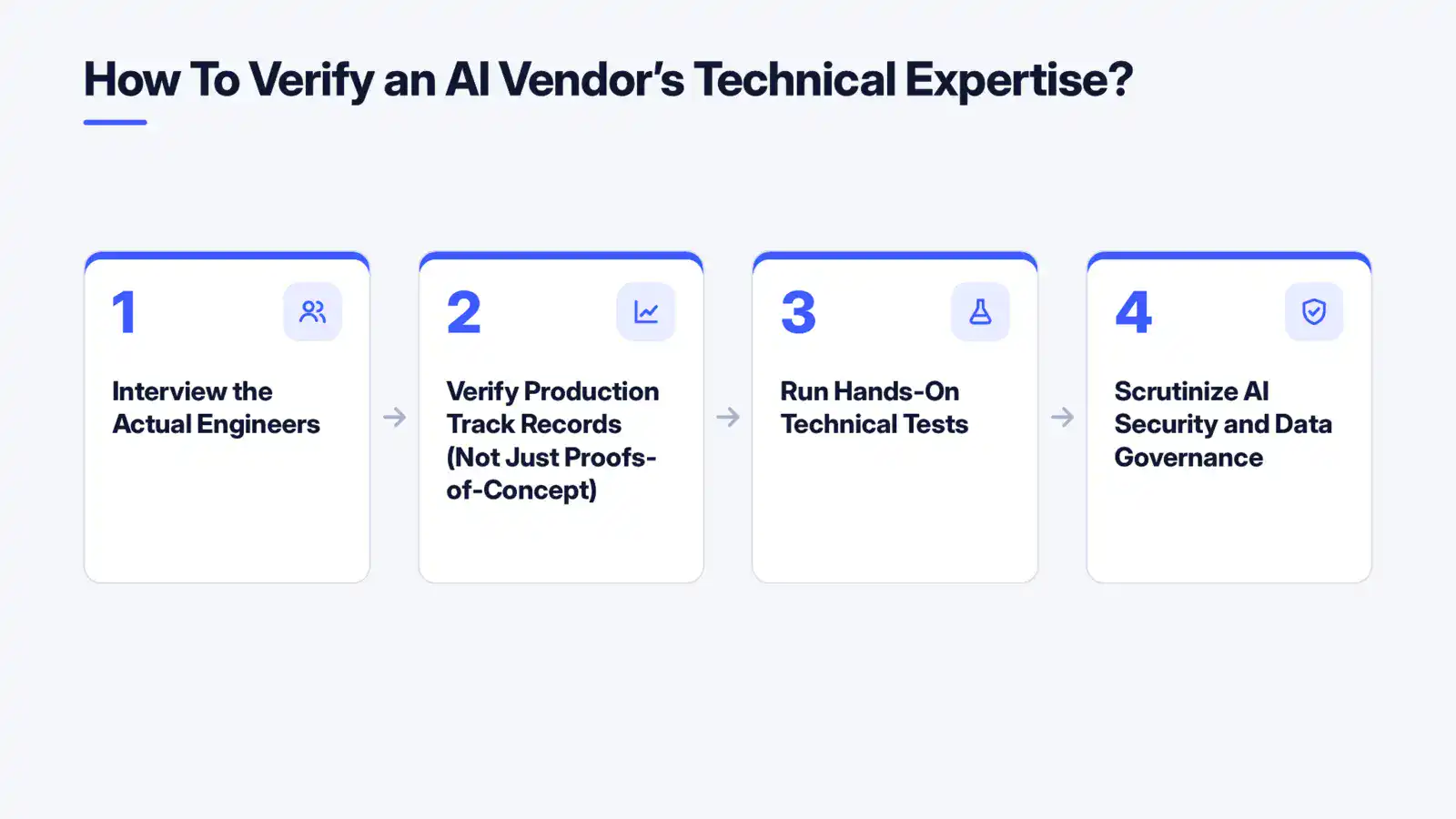
AI vendor due diligence takes a few focused sessions and prevents months of rework. Therefore, use these four steps as your AI vendor evaluation checklist.
1. Interview the Actual Engineers
Skip the account manager and ask to speak with the engineers who will build your system. Then give them a scenario from your business and listen to how they reason.
- Ask how they would handle your messiest data source.
- Listen for what they would test first.
- Note whether they raise risks on their own.
2. Verify Production Track Records (Not Just Proofs-of-Concept)
A proof of concept shows an idea works once. Production, however, shows it keeps working. Therefore, weigh live results over prototypes.
- Call two client references and ask about uptime, accuracy drift, and support response.
- Ask what broke in the first 90 days and how the vendor fixed it.
- Confirm the client still uses the system today.
3. Run Hands-On Technical Tests
Pay for a short trial and give the vendor a sample of your data and a defined task. Then score the output against a test set you held back.
- Measure accuracy, response time, and cost per request.
- Test failure cases on purpose, such as noisy inputs and rare edge cases.
- Compare results across vendors using the same data.
4. Scrutinize AI Security and Data Governance
Review how the vendor protects data from upload to deletion, including access controls, encryption, logging, and retention. In addition, GDPR duties apply to any product that handles personal data. This GDPR compliance guide for developers lists the main requirements.
- Confirm encryption in transit and at rest.
- Check role based access and separate environments for your data.
- Get the policy on model training with your data in writing.
- Ask for the incident response plan and breach notification times.
Questions to Ask Before Hiring an AI Development Company
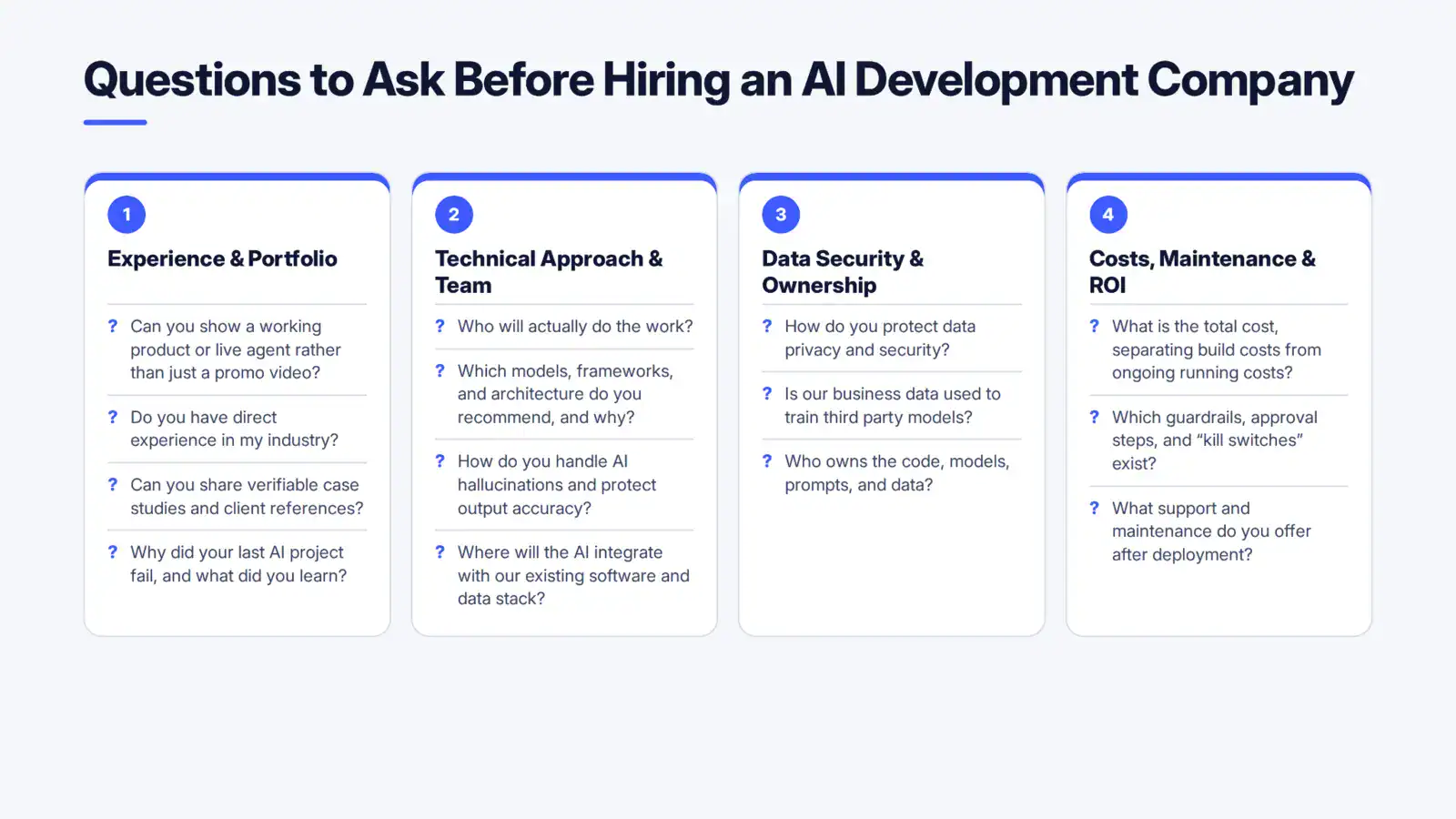
Use these questions to ask an AI development company during your first two calls. Vague answers, however, confirm a red flag.
1. Experience & Portfolio
- Can you show a working product or live agent rather than just a promo video?
- Do you have direct experience in my industry?
- Can you share verifiable case studies and client references?
- Why did your last AI project fail, and what did you learn?
A strong answer names specific projects, metrics, and people.
2. Technical Approach & Team
- Who will actually do the work?
- Which models, frameworks, and architecture do you recommend, and why?
- How do you handle AI hallucinations and protect output accuracy?
- Where will the AI integrate with our existing software and data stack?
A strong answer explains tradeoffs and names the engineers.
3. Data Security & Ownership
- How do you protect data privacy and security?
- Is our business data used to train third party models?
- Who owns the code, models, prompts, and data?
A strong answer puts ownership in writing.
4. Costs, Maintenance & ROI
- What is the total cost, separating build costs from ongoing running costs?
- Which guardrails, approval steps, and “kill switches” exist?
- What support and maintenance do you offer after deployment?
Outsourcing models also change what you pay for. This guide to how AI outsourcing works and what it costs explains the common structures.
How To Compare Proposals From AI Development Companies?
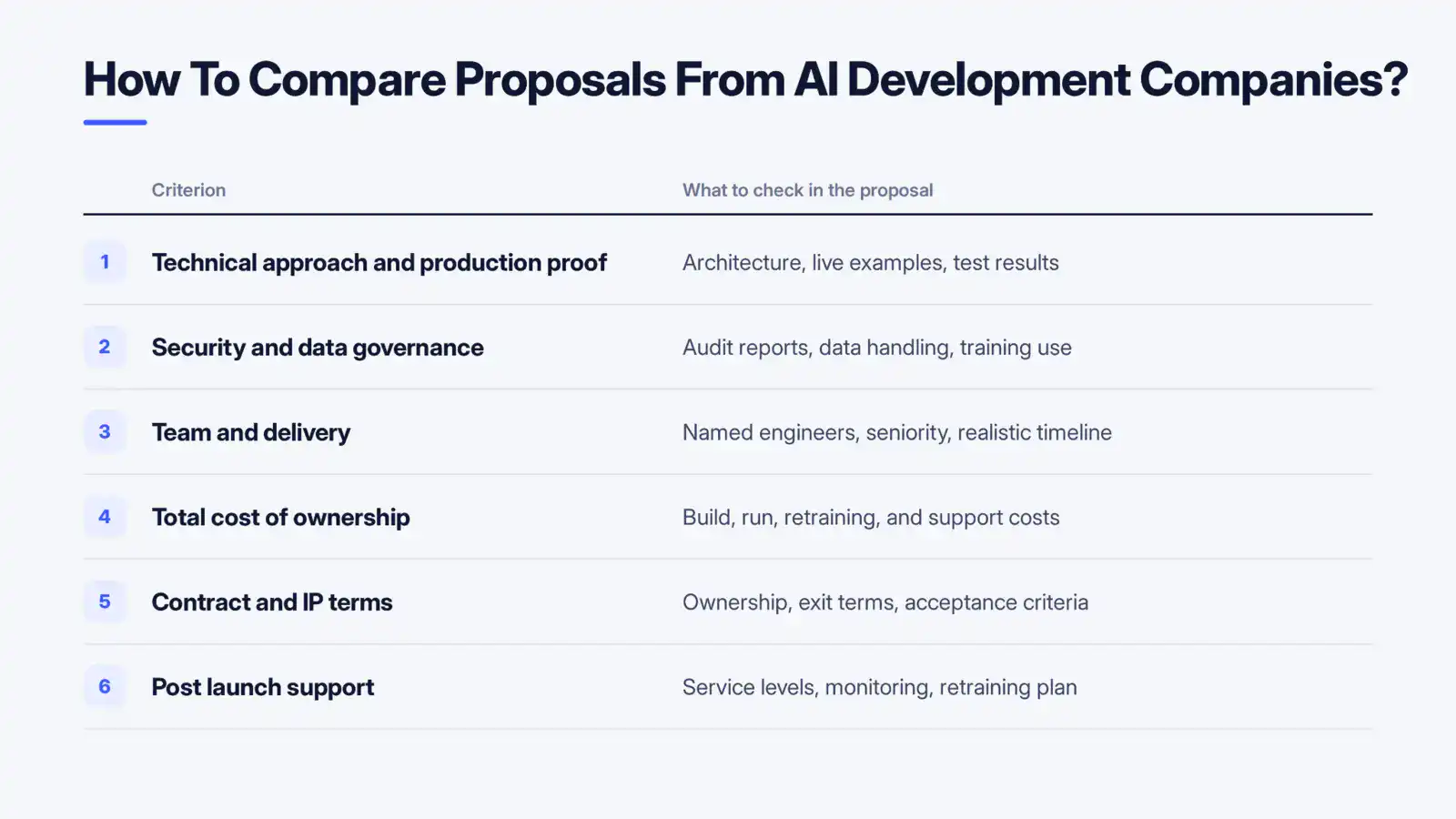
Proposals look alike on paper, but the differences sit in the details. AI development partner selection works best when you score every proposal on the same criteria.
1. Compare Scope and Success Metrics
The lowest quote often covers the narrowest scope. Check that each proposal defines deliverables, acceptance tests, and the metrics that mark success. Then compare prices on equal scope. Confirm whether data preparation, deployment, and post-launch support are included to avoid unexpected costs.
2. Evaluate Technical Approach and Third-Party Dependencies
List every model, API, and platform the proposal relies on. Third party dependencies add cost, risk, and lock in. Therefore, ask what happens if a provider changes pricing or retires a model. Check whether the vendor has alternative technologies and a plan to manage these dependencies.
3. Compare Delivery Timelines and Team Seniority
A short timeline paired with a junior team signals rework ahead. Therefore, match the timeline to the team’s seniority and the scope. Ask who will handle development, testing, and deployment, and whether their experience matches your project’s requirements.
4. Calculate Total Cost of Ownership
The true price of hiring an AI development company includes hosting, API usage, monitoring, retraining, and support. So add these running costs to the build quote and project them over three years.
5. Use a Weighted AI Vendor Scoring Matrix
Score each vendor from 1 to 5 on every criterion, multiply by the weight, and add the results. A red flag from this guide disqualifies a vendor regardless of score. Build your shortlist from a ranked comparison of AI development companies, then score each one.
| Criterion | What to check in the proposal |
|---|---|
| Technical approach and production proof | Architecture, live examples, test results |
| Security and data governance | Audit reports, data handling, training use |
| Team and delivery | Named engineers, seniority, realistic timeline |
| Total cost of ownership | Build, run, retraining, and support costs |
| Contract and IP terms | Ownership, exit terms, acceptance criteria |
| Post launch support | Service levels, monitoring, retraining plan |
Why Choose Cubix As Your AI Development Vendor?
Cubix is a software, mobile app, and game development company with offices in Florida, Manchester, Dubai, and Karachi. Its AI practice follows a six step implementation process and integrates AI into existing systems through APIs.
Here is how that connects to the checks in this guide:
- Review the AI services, pre built models, and implementation process on Cubix Ai.
- Request case studies that match your industry.
- Ask Cubix every question in the list above. Any good vendor welcomes them.
A paid discovery phase or a working prototype also lowers your risk before a full build. Start small, test with real data, and expand only after the results hold up. In addition, ask every vendor, including Cubix, to name the engineers on your project. Request the architecture in writing, and define the success metrics before work starts.
Score Cubix with the same matrix you use for every other vendor. Cubix delivers prototypes and MVPs through a five phase process that covers analysis, design, development, QA and delivery, and support. You can learn more about its professional MVP development services.
The effort you put into hiring an AI development company pays back through a system you own and can maintain. Use the red flags, the verification steps, and the scoring matrix as your standard. Hold every vendor to it, including Cubix.
Talk to Cubix engineers about your AI project this week
Contact UsFrequently Asked Questions
1. How can I tell whether an AI demo is production-ready?
A production-ready demo runs on your real data, handles bad inputs, and shows monitoring, logging, and error handling. Ask to see the system outside a scripted flow. If the vendor only shows a clean walkthrough with sample data, treat it as a prototype.
2. What should an AI vendor test before deployment?
Test accuracy on a held back data set, response time under load, and behavior on edge cases. Check bias across user groups and the strength of security controls. Then test failure paths, such as low confidence outputs. Require written results before you approve launch.
3. Can an AI development company guarantee accuracy?
No, because accuracy depends on your data quality, label consistency, and real world conditions. A vendor can commit to a defined test set, a target range, and a plan to improve results. However, a fixed guarantee before a data assessment is a red flag.
4. What hidden costs should an AI development quote include?
A complete quote lists data preparation, model hosting, API usage fees, monitoring, retraining, security testing, compliance work, and support. Ask the vendor to separate one time build costs from monthly running costs. If a line is missing, it usually shows up later as a change request.
5. Can an AI vendor use my company data to train models?
Only if your contract allows it. Write a clause that bans training third party or shared models on your data. Also ask where the vendor stores data, who can access it, and how it deletes data when the project ends.
6. How do I avoid AI vendor lock-in?
First, own the code, prompts, and model weights. Insist on documentation, knowledge transfer, and standard tools over proprietary platforms. Keep your data in formats you control, and write exit terms into the contract before work starts.
7. What should an AI development contract include?
Include ownership of code, models, prompts, and data. Add acceptance criteria, performance targets, security and privacy obligations, service levels, knowledge transfer, and exit terms. Also define who pays for changes in scope.
8. Should I request a paid discovery or proof of concept first?
Yes, for any project with unclear data or scope. A paid discovery phase tests your data, defines success metrics, and produces a fixed scope. Then a proof of concept confirms the approach before you fund the full build.
8. What post-launch support should an AI vendor provide?
Expect accuracy monitoring, drift alerts, scheduled retraining, bug fixes, security patches, and a defined response time for incidents. Also ask for a support agreement with named service levels and a rollback plan for failed releases.
9. How do I compare proposals from AI development companies?
Score every proposal on the same criteria: scope and metrics, technical approach, team seniority, total cost of ownership, contract terms, and support. Weight each criterion, then total the scores. Disqualify any vendor with an unresolved red flag.