Key Takeaways
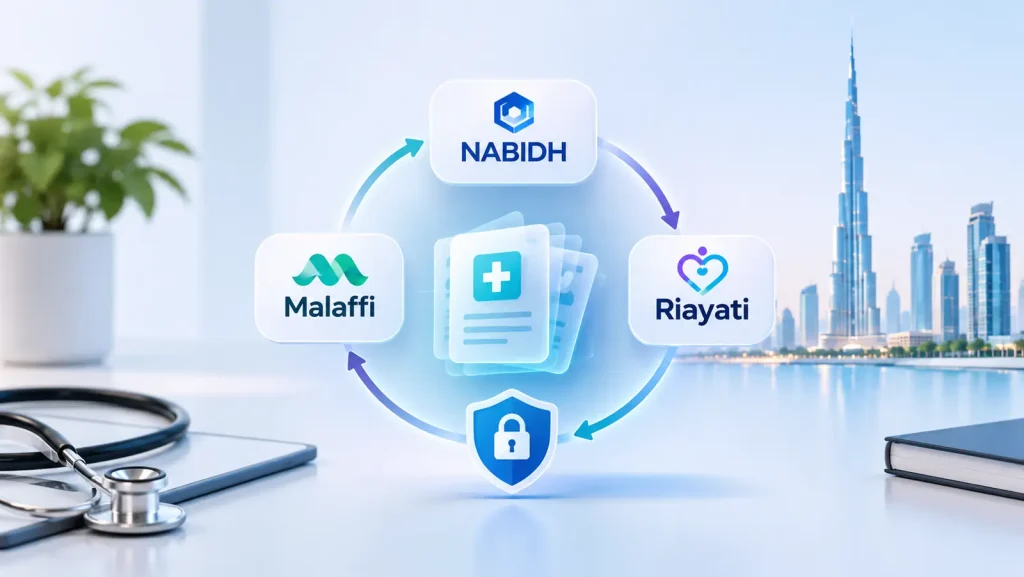
- NABIDH, Malaffi, and Riayati are the central platforms supporting healthcare data exchange and interoperability in the UAE.
- Integrating these systems creates unified patient records and secure care coordination across the country.
- UAE integration projects must strictly follow HL7 and FHIR standards for data compatibility and compliance.
- The UAE de-identified health data market is forecast to reach USD 163.2 million by 2033.
- Successful integration demands rigorous planning, technical expertise, and careful alignment with national requirements.
Healthcare data exchange is redefining patient care in the UAE, as NABIDH, Malaffi, and Riayati play a key role in linking digital health systems securely and efficiently. The UAE national health data platform connects both providers and authorities, enabling real-time access to health data across different emirates.
The UAE de-identified health data market is expected to reach USD 163.2 million by 2033. This shows how quickly digital health adoption and data exchange are accelerating. Yet integrating NABIDH, Malaffi, and Riayati poses challenges due to the technical standards and compliance rules that vary across regions.
This guide covers each platform’s role, outlines the integration process, spells out main requirements, highlights compliance, and explains how to navigate successful UAE healthcare data exchange projects.
Simplify UAE Healthcare Integration with Cubix Today
Contact UsUnderstanding NABIDH, Malaffi, and Riayati: Roles in UAE Healthcare
NABIDH, Malaffi, and Riayati form the foundation for healthcare interoperability in the UAE. Each platform serves its own region or function but all work towards better clinical data sharing and patient outcomes. To succeed with UAE electronic health records integration or to improve patient data interoperability, you need to understand how each system operates.
NABIDH: Dubai’s Healthcare Data Backbone
NABIDH is Dubai’s main healthcare data exchange platform, connecting all licensed healthcare providers throughout the emirate. Its central purpose is to collect and manage a full range of medical data, including patient histories, diagnostics, prescriptions, and imaging. By using NABIDH, hospitals, clinics, labs, and pharmacies can share data through a unified system. This ensures that Dubai care teams always have secure access to patient health records, which improves efficiency for both emergency and routine care. NABIDH is essential for any reliable healthcare information exchange system in the UAE.
Malaffi: Abu Dhabi’s Health Information Exchange
Malaffi acts as Abu Dhabi’s digital health hub, covering both public and private healthcare facilities. It consolidates patient records, medications, allergies, and clinical notes into a single digital profile. Providers benefit from secure access controls and advanced analytics tools. Malaffi promotes collaboration by connecting clinics and hospitals instantly, which supports continuity of care. Access to standardized health data through Malaffi reduces duplicate testing and helps guide evidence-based decisions throughout Abu Dhabi.
Riayati: The UAE’s Nationwide Health Information Exchange
Riayati is the UAE’s largest health information exchange, bringing together patient records from all emirates into one lifelong profile. Riayati ensures secure movement of medical information across regional lines, connecting NABIDH, Malaffi, and other local systems. This national network makes it easier to manage referrals, specialist consults, and emergency transfers, ensuring unified patient records are always current and available wherever care is delivered. Riayati’s approach scales health information exchange to the national level, making possible system-wide analytics, public health monitoring, and direct improvements in care.
Together, these UAE healthcare interoperability platforms enable secure patient data sharing and provide a foundation for transparent, efficient care throughout the country.
How UAE Healthcare Data Exchange Works
To see how healthcare data exchange operates in the UAE, it helps to break the process down into clear steps. Moving from patient registration to UAE-wide clinical data sharing involves coordinated work across systems and platforms.
1. Patient Onboarding and Registration
When patients arrive, their demographics, history, allergies, and treatment plans go into a local EMR or HIS.
2. Creation and Structuring of Health Records
Health professionals generate new records, such as lab reports, prescriptions, images, and notes, formatted to interoperability standards.
3. Submission to Exchange Platforms
The provider sends these structured records to NABIDH, Malaffi, or Riayati, depending on region and scope. Patient consent and privacy are carefully managed at this stage.
4. Assignment of Unique Patient Identifiers
A unique health ID links each patient’s records across providers, improving data interoperability.
5. Secure Data Sharing Across Providers
Authorized clinicians can retrieve and update records, so information stays current as patients move between facilities.
6. Enabling Unified Patient Records and Interoperability
Unified records prevent duplicate testing, support continuity of care, and enable rapid medical decisions.
By following these steps, UAE healthcare data integration turns fragmented information into a resource for clinical excellence and efficient care.
Key Integration Requirements for NABIDH, Malaffi, and Riayati
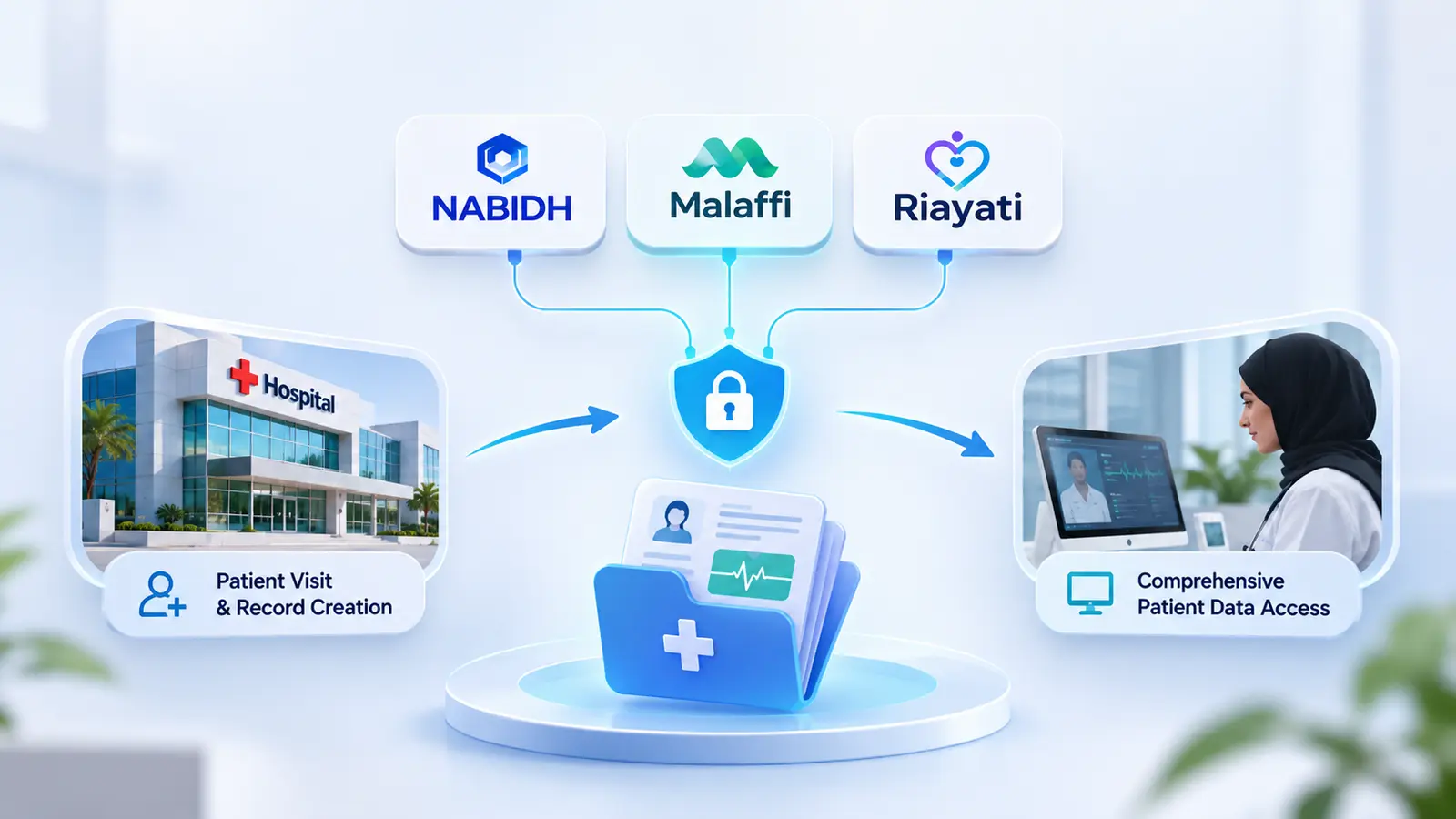
Implementing NABIDH, Malaffi, or Riayati integration means meeting regulated technical and organizational requirements. Any healthcare facility aiming for successful integration must address these essentials:
- Provider Registration and Certification:
Every hospital or clinic must register and show they are ready for certification before being allowed to connect.
- System Readiness and Pre-Integration Checks:
Assess EMRs or HISs to confirm they meet technical standards and can connect to UAE health platforms. Upgrades may be necessary for compatibility.
- Technical Connectivity:
Establish secure connections to NABIDH, Malaffi, or Riayati using approved VPNs or private networks. Redundant connections help avoid downtime and data loss.
- Data Privacy and Security Mandates:
Use strong encryption, two-factor authentication, and strict access controls to meet compliance standards. Data must remain within UAE borders unless allowed otherwise.
- Interoperability Standards and Data Formats:
All clinical data must follow HL7, FHIR, or UAE-approved standards, including structured text, images, and coded medical information.
- Documentation, Audit Trails, and Consent Management:
Track all data transfers, access, and patient consent as required by UAE authorities. Maintain complete audit trails for compliance.
- Continual Training and Compliance Audits:
Provide regular staff training and schedule audits to stay aligned with UAE healthcare data exchange requirements.
By fulfilling these requirements, organizations can enable secure data sharing across UAE electronic health records integration platforms.
Healthcare Interoperability Standards: HL7, FHIR, and UAE Regulations
Compliance with healthcare interoperability standards is essential for successful integration in the UAE. Using frameworks like HL7 and FHIR, and following UAE regulations, ensures secure and efficient data access for all approved users.
HL7 and FHIR Protocols
HL7 governs electronic medical information exchange. HL7 and FHIR are global standards that make hospital, lab, and imaging systems compatible. FHIR builds on HL7, using web-based APIs and modular data elements that allow systems to communicate easily.
In the UAE, these standards are tailored to fit local needs. Integrating HL7 and FHIR for UAE healthcare projects requires mapping global data formats to national data codes and vocabularies, often with translation tools built into middleware.
UAE Regulatory Requirements
UAE regulations set strict standards for every part of the data exchange process. The Ministry of Health and Prevention defines criteria for EHR and EMR integration. Data must stay within UAE borders unless special permission is granted, supporting both privacy and legal compliance.
Every integration must follow procedures for patient consent, role-based access, and breach notification. These steps protect patient rights and help providers stay in line with healthcare interoperability solutions across the UAE.
Integration Processes: Connecting Hospital Systems to National Platforms
Connecting hospital software to NABIDH, Malaffi, or Riayati involves a structured process to reduce risk and increase value. Knowing how to integrate NABIDH or other platforms with hospital systems helps organizations achieve secure, reliable, and compliant integration.
1. System Assessment and Requirements Mapping
Start by reviewing your HIS or EMR for national compatibility and map out any needed upgrades.
2. Gap Analysis and Solution Design
Identify and address gaps in standards or security, designing tailored workflows for your integration project.
3. API Setup and Secure Connection
Configure APIs and create secure channels, such as VPNs or private connections.
4. Data Mapping and Transformation
Convert patient data, lab results, and notes from proprietary formats into HL7 or FHIR, following UAE data schemas.
5. Testing, Validation, and User Training
Run detailed tests to ensure data accuracy. User acceptance testing involves both clinical and IT teams.
6. Go-Live and Production Rollout
Once validated, connect the system and roll out in phases, with backup plans to reduce disruptions.
7. Post-Integration Monitoring and Support
Keep monitoring performance, handle issues, and update software as standards change.
Staying in close communication, checking compliance, and involving staff throughout the process all help ensure long-term success with EHR integration across the UAE. For complex projects, partnering with an experienced enterprise application integration provider can streamline workflows and reduce risk.
Benefits of UAE Healthcare Data Integration
Bringing UAE health information exchange systems together provides a range of clear benefits for both providers and patients. Key strengths include:
- Improved Patient Safety:
Unified records lower the risk of errors and adverse interactions, supporting better clinical outcomes.
- Faster Diagnosis and Treatment:
Integration solutions allow providers to quickly access patient histories, test results, and medication information.
- Regulatory Compliance and Audit Readiness:
Working with a qualified healthcare integration company ensures compliance, simplifying audits and inspections.
- Operational Efficiency and Cost Reduction:
Streamlined workflows and fewer redundant procedures help reduce administrative work and costs.
- Enhanced Analytics for Population Health Management:
Interoperability supports real-time trend analysis and more effective community health planning. The use of big data in healthcare is a key enabler for these analytics capabilities.
- Access to Innovative Healthcare IT Solutions:
Modern API integration services offer a reliable foundation for future digital health growth.
These outcomes drive widespread adoption of healthcare data integration solutions across the UAE.
Technical Challenges and How to Overcome Them
Despite the benefits, integrating medical software in the UAE comes with challenges. Tackling these early improves project outcomes and helps future-proof technology investments.
Legacy Systems and Data Silos
Older systems may store data in incompatible formats. To address this, EMR integration specialists use migration tools that automate conversion to HL7 or FHIR. Transitional middleware links legacy systems to modern platforms, and thorough data cleansing cuts down on errors.
Security and Privacy Concerns
Protecting patient data is critical. Integration projects must apply strong encryption, strict access rules, and effective consent management. Regular audits and planning for security incidents are necessary to meet UAE compliance and protect trust. For healthcare projects, following best practices from HIPAA compliance can provide valuable guidance on privacy and security.
Scalability and Performance
As patient numbers and networks grow, performance can suffer. Using cloud-based platforms, elastic infrastructure, and ongoing monitoring helps manage scalability. Expert integration companies assist with capacity planning and fine-tuning to keep systems efficient as healthcare delivery advances.
Technology Stack for UAE Healthcare Integration
Choosing the right technology stack is crucial for effective healthcare system integration. Here’s how key options for healthcare API integration, FHIR, and HL7 compare in UAE settings:
| Technology | Supported Platforms | Typical Use Cases | Strengths | Considerations |
|---|---|---|---|---|
| HL7 (v2/v3) | EMR, HIS, LIS, RIS, NABIDH, Malaffi | Legacy integration, lab/radiology data | Mature, widely adopted | Requires translation layers |
| FHIR | Modern EMR, mobile apps, patient portals, Riayati | APIs, patient access, agile IT projects | Flexible, web-friendly API | Newer standard, training needs |
| Proprietary APIs | Custom hospital or payer systems | Specialized data sync, analytics | Rapid prototyping, tailored | Potential lock-in, support |
HL7 serves as the backbone for established hospital information systems. FHIR is better suited for new integrations and mobile or patient-facing features. Proprietary APIs fill specialized roles where custom features are required, though they limit broader interoperability. UAE healthcare IT providers often use a combination of these, balancing regulatory compliance, scalability, and required support.
Use Cases: Real-World Examples of NABIDH, Malaffi, and Riayati Integration
Practical use cases show the impact of Dubai healthcare data integration and Abu Dhabi healthcare data exchange on patient care and system performance.
- Multi-hospital Integration in Dubai with NABIDH:
A healthcare network adopts NABIDH to achieve full interoperability. Doctors can access records from other facilities, enabling coordinated care and quicker emergency responses.
- Abu Dhabi Clinics Connecting to Malaffi:
Private and public clinics join Malaffi, building a single record for each patient. Providers in Abu Dhabi gain visibility into medication lists, allergies, and key clinical details.
- National-Level Data Exchange via Riayati:
Riayati brings together data from NABIDH, Malaffi, and other emirate systems. Patients have unified records across emirates, ensuring up-to-date information for referrals and specialist care.
- Outcome Highlights:
These integration projects have led to fewer duplicate tests, faster data access, higher treatment accuracy, and better collaboration across providers.
This broad integration among UAE healthcare interoperability platforms produces lasting benefits for both patients and healthcare organizations.
How Cubix Supports UAE Healthcare Data Integration Projects
Cubix offers comprehensive integration services that help healthcare organizations meet compliance and efficiency goals across all major UAE health platforms. Their expertise spans NABIDH, Malaffi, and Riayati integration services, making them a leading healthcare integration company in the region.
Custom Integration Solutions
Cubix starts every project with an in-depth system assessment. Their team designs custom workflows, selects the best technology stack, and handles healthcare software integration from planning to deployment. This includes architectural planning, gap analysis, and workflow refinement.
Compliance and Security
Cubix ensures your integration meets every technical and legal requirement of NABIDH, Malaffi, and Riayati platforms. Their team sets up robust security controls, consent management systems, and thorough documentation so that your project is always audit-ready.
Ongoing Support and Optimization
After the initial rollout, Cubix provides continuous healthcare API integration services, managing system updates and supporting new regulations. Their regular training and support sessions help clients get the most from healthcare IT solutions and stay current as requirements evolve. Their expertise in enterprise application integration ensures seamless connectivity across complex healthcare environments.
With these end-to-end service capabilities, Cubix is a long-term partner for UAE healthcare data integration needs.
Connect Healthcare Systems for Better Patient Care
Contact UsFrequently Asked Questions
1. What are NABIDH, Malaffi, and Riayati, and how do they differ?
NABIDH forms Dubai’s healthcare data backbone, Malaffi manages Abu Dhabi’s clinical data, and Riayati connects all emirates into a single national exchange. Each serves a unique region or function within the UAE healthcare interoperability framework.
2. What is required for NABIDH integration with hospital systems?
Hospitals must register, secure technical certification, and ensure their systems comply with UAE data standards. Strong security protocols, patient consent processes, and adherence to NABIDH integration rules are essential.
3. How does Malaffi integration improve healthcare data sharing in Abu Dhabi?
Malaffi integration brings clinics, hospitals, and labs together on a single platform. This gives providers unified patient records, leading to better care and reduced duplicate testing.
4. What steps are involved in Riayati integration for nationwide data exchange?
Riayati integration includes system assessment, technical gap analysis, API setup, data mapping to HL7 or FHIR, and ongoing validation. The aim is seamless UAE-wide patient record exchange.
5. What are the main standards for healthcare interoperability in the UAE?
Primary standards are HL7 protocols and FHIR APIs. The UAE also requires data localization, structured consent, and role-based access to ensure compliant data exchange.
6. How does EHR integration work with UAE’s health information exchanges?
EHR integration uses standard data formats, unique patient IDs, and secure APIs. This lets hospitals contribute to and access clinical records through national UAE platforms.
7. What compliance requirements must be met for healthcare data integration in the UAE?
Compliance requires data to remain within the UAE, strong encryption, documented consent, and regular regulatory audits. Projects undergo periodic review to keep approval status.
8. How secure is patient data during UAE healthcare data exchange?
Patient data is secured with encryption, two-factor authentication, and thorough audit trails. Only authorized users can exchange or view sensitive information under regulatory frameworks.
9. What are the benefits of using HL7 and FHIR for UAE healthcare integration?
HL7 and FHIR improve data interoperability, boost compatibility, and enable rapid, accurate information sharing. These standards help minimize translation errors for UAE-wide data exchange.
10. How can a hospital start the process of integrating with NABIDH, Malaffi, or Riayati?
Start with a thorough IT system assessment, contact the relevant health authority, and work with an experienced healthcare integration company. Technical readiness and registration are key first steps.