Key Takeaways
- Enterprise application integration connects your CRM, ERP, HRM, and other tools into one working system.
- A strong enterprise application integration strategy removes data silos and speeds up decisions.
- Businesses use different types of business application integration, from point-to-point to API-led models.
- The right enterprise integration architecture reduces manual work and human error.
- Common enterprise application integration challenges include legacy systems, security gaps, and talent shortages.
- Cubix helps enterprises design, build, and manage integration systems that scale with growth.
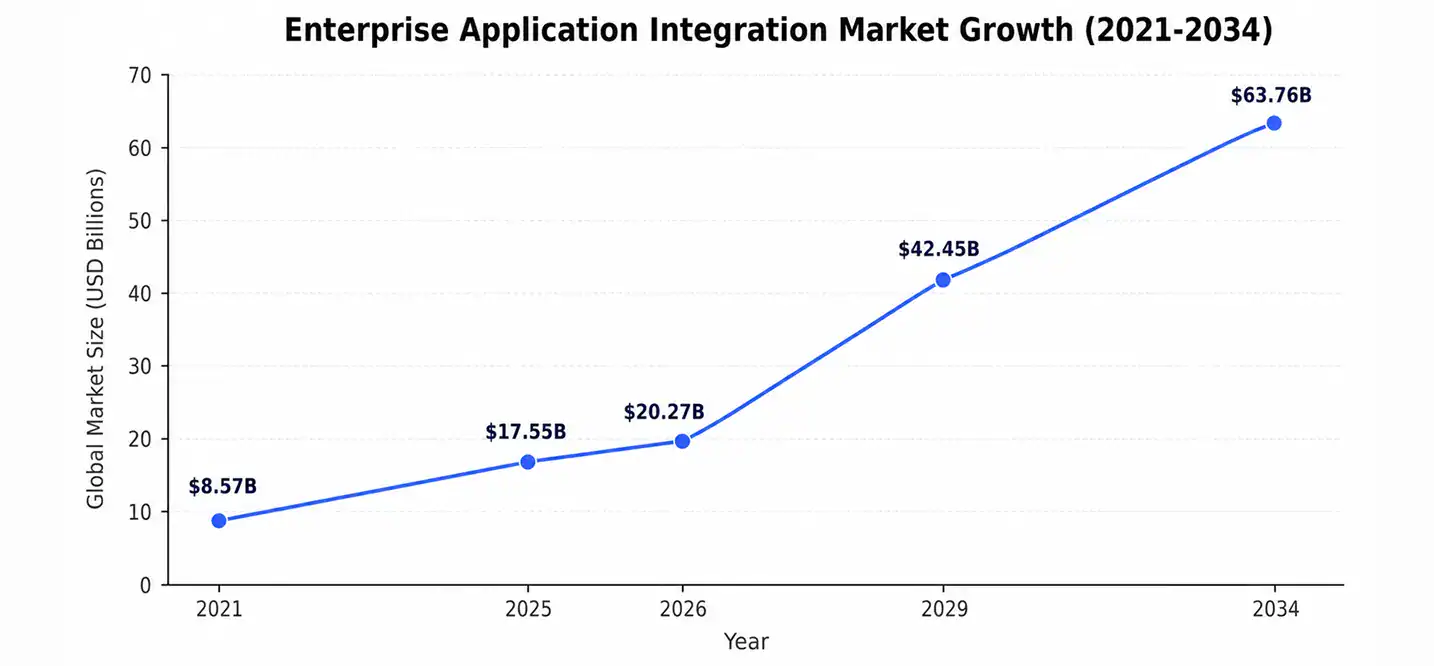
Here’s a number worth pausing on. The global enterprise application integration market is set to touch $20.27 billion in 2026 alone. That is not a small industry anymore. It is the backbone of how modern companies run. Every big business today juggles dozens of tools. Sales teams use one app. Finance uses another. HR runs on something else entirely. Without a way to connect them, these tools become isolated islands.
That is exactly the problem enterprise application integration solves. Think of it as a translator. It lets your CRM talk to your ERP. It lets your inventory system update your sales dashboard in real time. No more copying data by hand. No more waiting for one department to email another. Everything just flows. This is why so many companies are investing in enterprise integration solutions right now, not later.
In this guide, we will break down what enterprise application integration really means. We will look at how it works, why it matters, and which enterprise application integration tools can help. By the end, you will know exactly how to build an enterprise application integration strategy that fits your business. And if you are searching for a trusted partner to make it happen, Cubix has you covered.
Want to discuss your project? Our experts are just a click away.
Contact UsWhat Is Enterprise Application Integration?
Enterprise application integration, or EAI, is the process of connecting different software systems inside a company. These systems could be your CRM, your accounting software, your HR platform, or your inventory tool. On their own, each system does its job well. But they rarely talk to each other. That creates gaps.
EAI closes those gaps. It builds bridges between applications so data can move freely. A sale made in your CRM can instantly update your inventory. A new employee added in HR can automatically appear in payroll. This is the heart of enterprise systems integration. It turns scattered software into one connected machine.
Businesses that get this right save time. They also save money. They make fewer mistakes. And they make faster decisions, because everyone is looking at the same accurate data. This is why enterprise software integration has become a top priority for CTOs and CEOs across every industry.
How Does Enterprise Application Integration Work?
Enterprise application integration might sound complex. But it breaks down into a few simple parts. Each part plays its own role in making sure data flows smoothly between systems.
| Component | What It Does | Why It Matters |
| Data Integration | Pulls data from multiple systems into one format | Keeps information consistent everywhere |
| Middleware | Acts as a translator between applications | Removes communication barriers |
| APIs | Connect apps through defined rules | Enables secure, fast data sharing |
| Event-Driven Triggers | Starts actions automatically | Cuts down manual steps |
| Workflow Orchestration | Manages multi-step processes | Keeps every task in the right order |
Here is a fact that puts this in perspective. The average enterprise now runs on 897 different applications, yet 71% of them remain unintegrated. That is a huge amount of untapped potential sitting inside most companies today. Every one of those disconnected apps is a missed chance for automation. This is exactly why enterprise API integration has become such a hot topic among IT leaders. APIs are often the fastest, cleanest way to link two systems without rebuilding either one from scratch.
Good middleware also plays a quiet but powerful role. It does not just move data. It reshapes it so both systems understand each other. Without this layer, most enterprise data integration efforts would break down within weeks.
Enterprise Application Integration Benefits
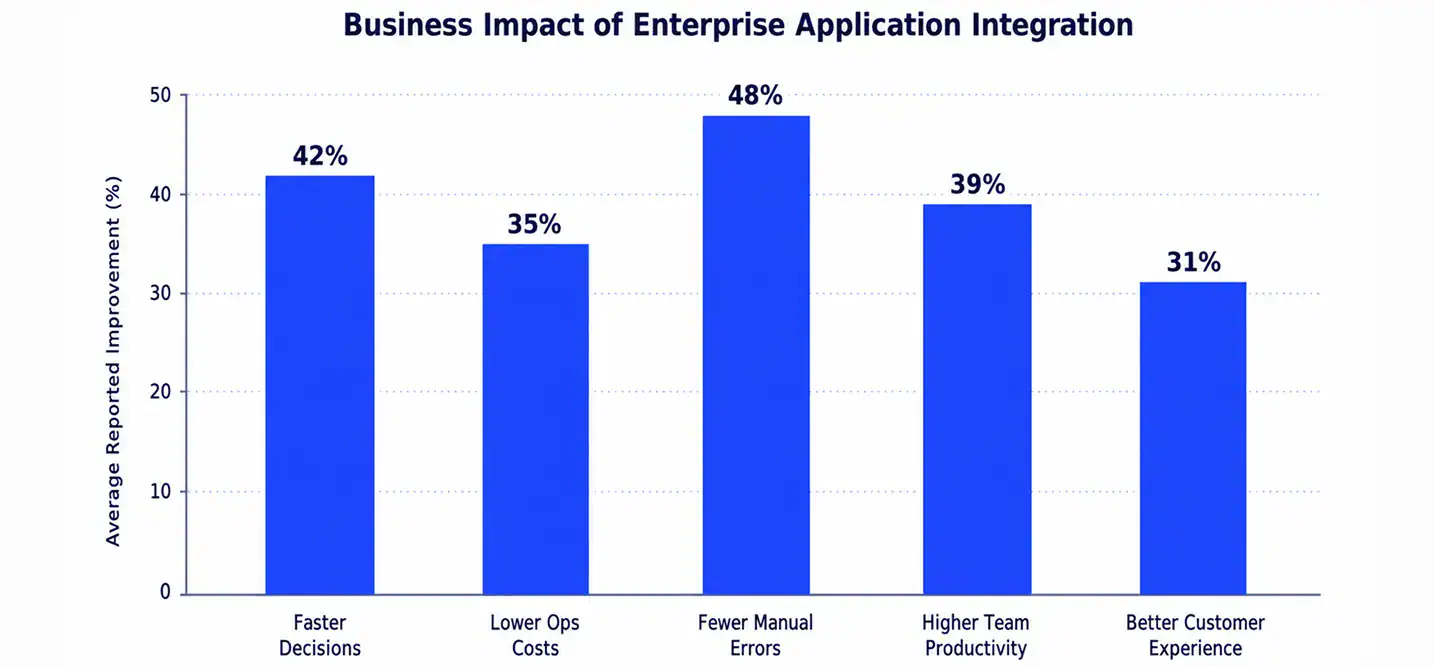
Let’s talk about the payoff. Why are companies pouring money into this? Because the enterprise application integration benefits are real, measurable, and fast to show up.
1. Faster, Smarter Decisions
When your data lives in one connected system, leaders do not have to guess. They see real numbers, updated in real time. This alone can improve decision speed by more than 40%, based on data shown above.
2. Lower Operational Costs
Manual processes cost money. Every hour spent copying data between tools is an hour not spent growing the business. Enterprise application integration benefits stack up quickly once automation takes over routine tasks.
3. Fewer Costly Errors
Human error drops sharply when systems sync automatically. No more duplicate entries. No more mismatched records between departments.
4. Room to Scale
As your company grows, so does your software stack. A strong application integration in enterprise settings means new tools slot in easily, without breaking what already works. This kind of flexibility often pairs well with a broader Business Benefits Of Mobile App Development strategy, especially for companies expanding their digital footprint.
5. Better Customer Experience
Support teams with full visibility solve problems faster. Sales teams with live inventory data close deals with confidence. That is the real value of connected systems.
Companies embracing this model report an average ROI of 345% over three years. That is not a small win. That is a business case that sells itself.
Real-World Use Cases of Enterprise Systems Integration
Numbers are great, but use cases make things click. Here is where enterprise application integration shows up in daily business operations.
| Use Case | Systems Connected | Business Outcome |
| Sales and Inventory Sync | CRM + ERP | Real-time stock visibility |
| Supply Chain Management | Inventory + Supplier Databases | Fewer stockouts, better forecasting |
| Payroll Automation | HRM + Payroll Systems | Accurate, on-time employee pay |
| Financial Reporting | Accounting + Billing Tools | Faster audits, cleaner compliance |
| Customer Support | CRM + Order Management | Quicker issue resolution |
Retailers connect their point-of-sale systems with inventory databases to avoid running out of stock. Banks link trading platforms with back-office systems to speed up regulatory reporting. Hospitals sync patient records across labs, billing, and scheduling tools for smoother care. In every case, the goal stays the same. Remove silos. Share data instantly. Let people focus on real work instead of manual reconciliation.
This is also where business application integration gets personal for smaller and mid-sized companies. You do not need to be a Fortune 500 giant to benefit. Even a 50-person company juggling five tools sees real gains from integration.
Types of Business Application Integration
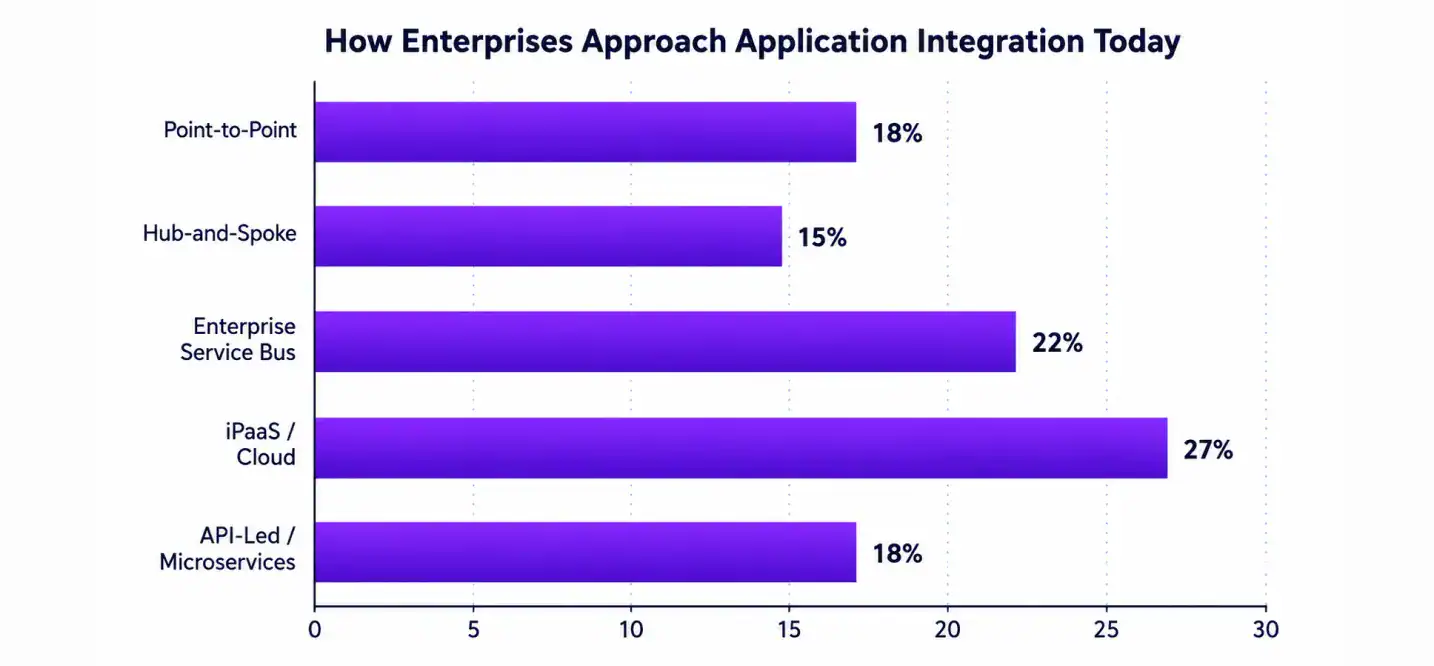
- Point-to-Point Integration connects two systems directly. It is simple and quick to set up. But it gets messy fast once you add more apps.
- Hub-and-Spoke Integration uses one central hub to manage all connections. This keeps things tidier than point-to-point, though the hub becomes a single point of failure.
- Enterprise Service Bus (ESB) is a more advanced version of hub-and-spoke. It uses shared standards so systems can plug in without needing a central controller for every task.
- Middleware Integration sits between applications and handles the messy translation work behind the scenes. This is popular in complex, older IT environments.
- API-Led and Microservices Integration is the modern favorite. It breaks big systems into small, independent services connected through APIs. It is flexible, scalable, and cloud-friendly.
According to industry data, API-led and cloud-based iPaaS models now make up nearly 45% combined of new enterprise integration solutions being adopted. That share keeps climbing every year. If you are building a fresh integration setup today, chances are you will lean toward this modern, API-first approach. An experienced Enterprise App Development Company can help you decide which model actually fits your existing tech stack, instead of guessing.
Enterprise Application Integration Tools
Choosing the right enterprise application integration tools makes or breaks your rollout. Here is a quick side-by-side comparison of the most common options.
| Tool Type | Best For | Deployment Style |
| APIs | Lightweight, direct connections | Cloud or on-premise |
| Enterprise Service Bus | Large, complex environments | On-premise or hybrid |
| iPaaS | Fast, scalable cloud setups | Cloud-native |
| Middleware | Legacy system compatibility | On-premise |
| Data Integration Tools | Data mapping and syncing | Cloud or on-premise |
| Message-Oriented Middleware | Asynchronous communication | Distributed systems |
The global iPaaS market alone is projected to reach $21.38 billion by 2035, growing at a striking 35.4% CAGR. That growth tells you where enterprise integration architecture is heading. Cloud-based, low-code, and self-service tools are winning because they let smaller IT teams do more without hiring a small army of developers.
For companies without deep in-house technical resources, working with mobile app developers who also understand backend integration can shortcut months of trial and error. It is often faster to bring in specialists than to build every connector from zero.
Common Enterprise Application Integration Challenges
No integration project is without bumps. Knowing the common enterprise application integration challenges ahead of time helps you plan around them instead of getting blindsided.
- Legacy System Compatibility tops the list. Older systems were not built with modern APIs in mind, which makes connecting them harder and slower.
- Security and Compliance Gaps come next. Every new connection point is a potential risk. Strong enterprise app security practices need to be baked into the integration plan from day one, not added afterward.
- Skilled Talent Shortage affects roughly 40% of integration projects, causing delays and pushing companies toward outside vendors for support.
- High Upfront Costs can scare off smaller teams, even though the long-term ROI usually justifies the spend.
- Data Format Inconsistency rounds out the list, since different systems often store the same information in totally different structures.
Building Your Enterprise Application Integration Strategy
A solid enterprise application integration strategy is not a one-time project. It is an ongoing process built in clear stages.
| Stage | What Happens | Why It Matters |
| Needs Assessment | Map current systems and data flows | Identifies real integration gaps |
| Roadmap Planning | Set priorities, timelines, milestones | Keeps the project focused |
| Architecture Design | Choose tools and connection models | Ensures scalability and security |
| Agile Rollout | Deploy in small, tested phases | Reduces downtime and risk |
| Ongoing Monitoring | Track performance and fix issues | Keeps systems running smoothly |
Start small. Fix your most painful data gap first, whether that is sales and inventory or HR and payroll. Prove value quickly, then expand. This step-by-step approach avoids the classic mistake of trying to integrate everything at once, which often causes projects to stall or blow past budget.
Businesses building mobile-first products should also think about integration early. If you are exploring Mobile App Development for customer-facing tools, connecting that app to your backend systems from day one saves a painful rebuild later.
Trends Shaping Enterprise Integration Architecture
The world of enterprise integration architecture keeps shifting. Staying current helps you avoid building something that feels outdated in two years.
The market has grown from $8.57 billion in 2021 to a projected $20.27 billion this year, and it is expected to hit $63.76 billion by 2034. That kind of growth does not happen without real business demand behind it.
- Cloud-First Integration keeps gaining ground, with 62% of enterprises now adopting cloud-based integration frameworks over on-premise setups.
- AI-Assisted Mapping is speeding up projects. Enterprises using AI-enabled integration platforms report timeline cuts of 40% to 60% on new deployments.
- Microservices and API-Led Models continue to expand, since they let teams update one small piece of a system without touching the rest.
- Real-Time Data Flows are replacing old batch processing habits, especially in finance and healthcare where delays can be costly.
Companies exploring Android-first strategies alongside these backend shifts often work with an experienced Android App Development Company to make sure mobile and backend systems grow together, not apart.
Why Choose Cubix for Enterprise Application Integration

Picking the right partner matters as much as picking the right tools. Cubix has spent years helping enterprises design integration systems that actually work in the real world, not just on paper. The team understands that every business has a different mix of legacy tools, cloud platforms, and custom software, and that a copy-paste integration plan rarely fits.
Cubix builds enterprise application integration platforms with three things in mind: security, scalability, and speed. That means your systems stay protected, your architecture grows with you, and your rollout does not take a year longer than it should. Whether you need a simple API bridge between two tools or a full enterprise service bus for a sprawling tech stack, Cubix tailors the approach to your actual business, not a generic template.
What sets Cubix apart is the way business goals lead the technical decisions, not the other way around. Before writing a single line of integration code, the team maps out your current systems, your pain points, and your growth plans. This upfront work is what separates a smooth rollout from a messy one that needs constant fixing later.
Want to discuss your project? Our experts are just a click away.
Contact UsFrequently Asked Questions
Q1. What is enterprise application integration (EAI)?
Enterprise application integration is the process of connecting different software systems within a company, such as CRM, ERP, and HR platforms, so they can share data automatically instead of relying on manual entry.
Q2. What are the key benefits of implementing EAI?
The main benefits include faster decision-making, lower operational costs, fewer manual errors, better scalability, and a smoother customer experience across connected departments.
Q3. What are the common implementation challenges with enterprise application integration?
Businesses often struggle with legacy system compatibility, security and compliance requirements, a shortage of skilled integration talent, high upfront costs, and inconsistent data formats across systems.
Q4. What are the main integration patterns used in EAI?
The most common patterns are point-to-point integration, hub-and-spoke, enterprise service bus (ESB), middleware integration, and modern API-led or microservices-based integration.
Q5. How do you choose the right EAI approach for your organization?
The right approach depends on your company size, technical resources, budget, and how complex your existing systems are. Smaller businesses often start with simple API connections, while larger enterprises may need an ESB or iPaaS platform. Working with an experienced partner like Cubix can help match the approach to your actual needs instead of guessing.