Key Takeaways
- Agritech app development helps farmers monitor crops, track field conditions, and make faster decisions.
- Core features include field mapping, crop health alerts, weather data, market prices, and offline access.
- AI, IoT, GPS, and satellite data power modern agritech app development solutions.
- Agritech apps can help reduce water waste, detect crop issues early, and improve farm productivity.
- Connectivity, data accuracy, and user adoption remain key challenges when building agritech apps.
- Start with one farming problem, then launch a focused MVP before expanding the app.
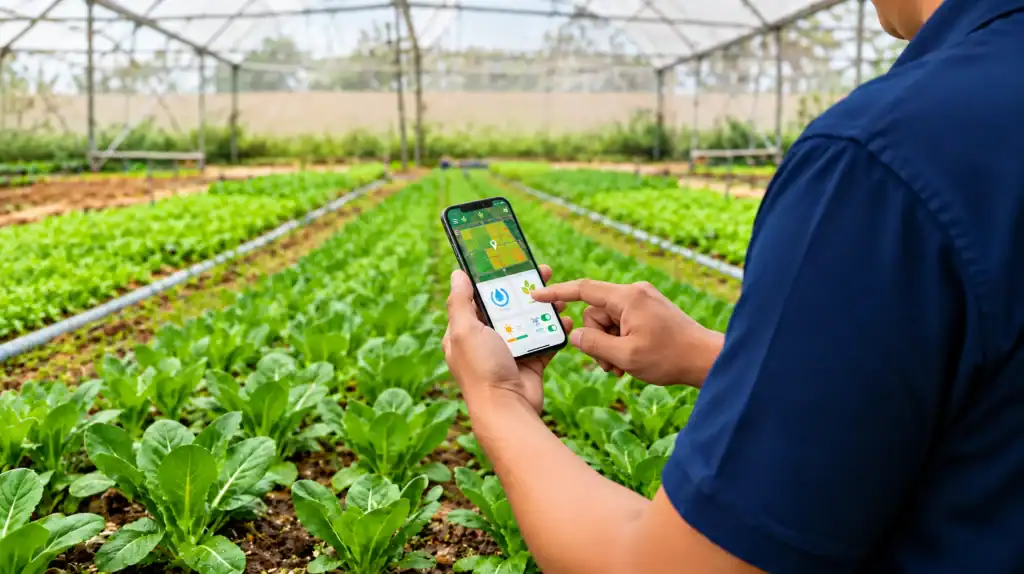
Agritech App Development puts crop data, weather alerts, and market prices on one phone screen. Farmers use these apps to decide faster and waste less. As a result, they protect yield and control costs.
The market reflects this shift. The global precision farming market reached $11.67 billion in 2024. It expects the market to hit $24.09 billion by 2030, a 13.1% CAGR. Yield monitoring holds the largest application share, at over 42%. In other words, farmers want tools that measure and improve output.
This guide covers app types, features, technologies, benefits, and challenges. It also outlines the steps to build one. However, a good app needs a good build partner. If you plan a project, work with a team that offers mobile app development services and understands field conditions.
Ready to Build a Smarter Farming App? Let’s Get Started Today
Contact UsWhat Is Agritech App Development?
It is the process of designing, building, and maintaining software that helps farmers manage crops, livestock, inputs, and sales. These apps run on phones, tablets, and web browsers. They pull data from sensors, satellites, weather services, and user input. Farmers then use the results to plan work, cut waste, and reach buyers.
How Agricultural Mobile Apps Work
Every farm app follows the same basic loop. Data goes in, insight comes out, and the farmer acts on it. The four steps below show how that loop works.
- Collect: Sensors, cameras, GPS, and manual entries capture field data.
- Process: Cloud servers clean the data and run farm data analytics.
- Deliver: The app shows maps, charts, and alerts in simple language.
- Act: The farmer adjusts irrigation, spraying, harvest timing, or sales.
The loop repeats every day. As a result, recommendations improve as more data arrives.
Types of Agritech App
Each app type solves a different farm problem. Some track crops, while others manage animals or sales. Most projects in agritech app development start with one type and add others later.
| App Type | Primary Purpose |
| Farm Management Apps | Manage daily farm operations |
| Crop Monitoring Apps | Track crop health and growth |
| Precision Agriculture Apps | Improve input and resource use |
| Livestock Management Apps | Monitor animal health and production |
| Agricultural Marketplace Apps | Connect farmers with buyers and suppliers |
| Agri-Advisory Apps | Provide farming recommendations |
| Supply Chain Apps | Track agricultural products |
Many teams begin with farm management software because it covers daily tasks. Then they add crop, irrigation, or marketplace modules as needs grow. This phased approach keeps early costs low and adoption high.
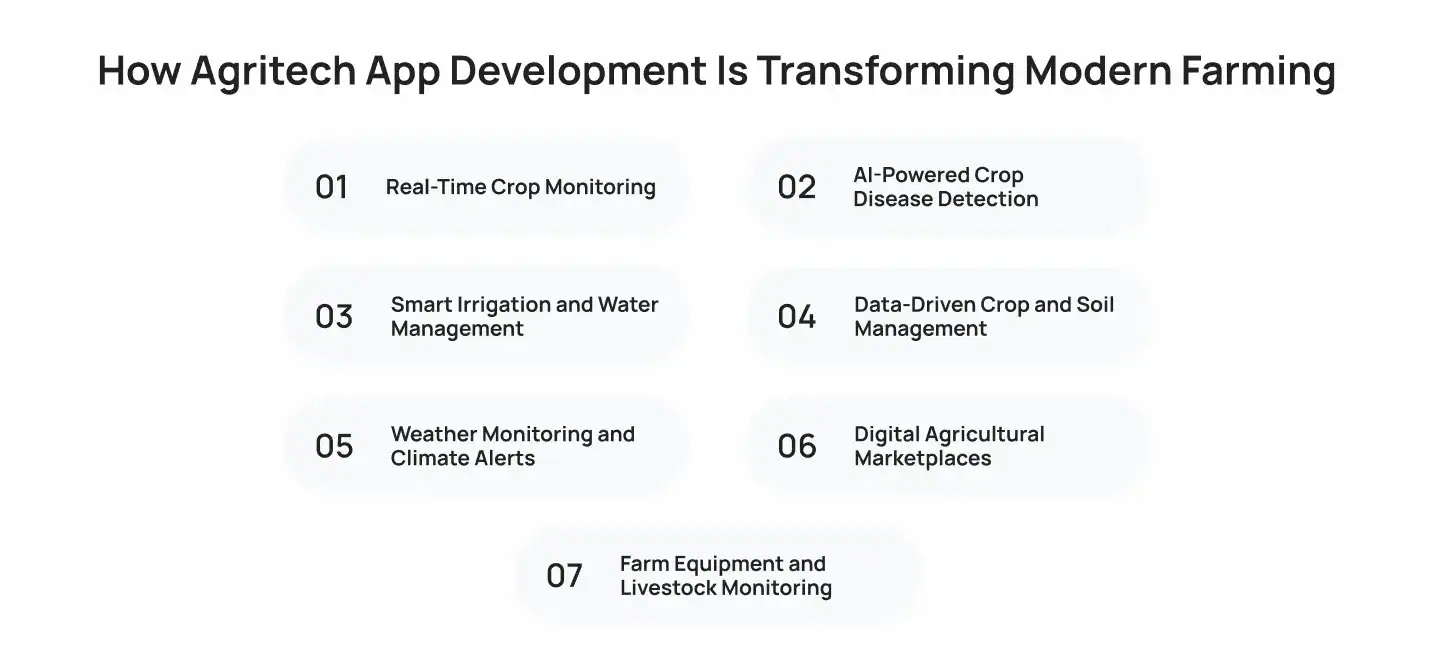
How Agritech App Development Is Transforming Modern Farming
Apps replace guesswork with measured data. This shift defines smart agriculture. The sections below show where the impact is strongest, from field monitoring to market access.
1. Real-Time Crop Monitoring
Apps combine satellite images, field sensors, and drone photos into one live view. Farmers see crop stress before it spreads across a field. As a result, they act within hours instead of days. Drone technology adds close range detail for large or uneven fields.
2. AI-Powered Crop Disease Detection
Farmers photograph a leaf, and the app compares it with trained image models. It then names the disease and suggests a treatment. This pest detection workflow replaces guesswork and slow lab checks. Farmers also save time because they diagnose problems in the field.
3. Smart Irrigation and Water Management
Sensors report soil moisture to the app in real time. Automated irrigation then opens or closes valves based on set thresholds. Farmers also review water use by field. Consequently, they avoid overwatering and cut pumping costs.
4. Data-Driven Crop and Soil Management
Regular soil monitoring records moisture, pH, and nutrient levels. The app then applies agricultural data analytics to compare fields across seasons. In addition, it recommends fertilizer rates for each zone. Farmers spend inputs where soil needs them most.
5. Weather Monitoring and Climate Alerts
Apps pull forecasts through weather APIs. They send alerts for frost, heavy rain, and heat waves. Farmers therefore time spraying, sowing, and harvesting with more accuracy. Timely warnings also protect crops and equipment from sudden damage.
6. Digital Agricultural Marketplaces
Marketplace apps connect farmers with buyers and input suppliers. Farmers compare prices and sell without extra middlemen. Some platforms add blockchain traceability so buyers verify a product’s origin. For background, read this guide on blockchain in agriculture.
7. Farm Equipment and Livestock Monitoring
GPS tracking shows where tractors and harvesters are working. Collar and ear tag sensors report animal movement and body temperature. Together, these feeds enable real-time farm monitoring from a single dashboard. Managers then spot idle machines and sick animals quickly.
What Features Should an Agritech App Have?
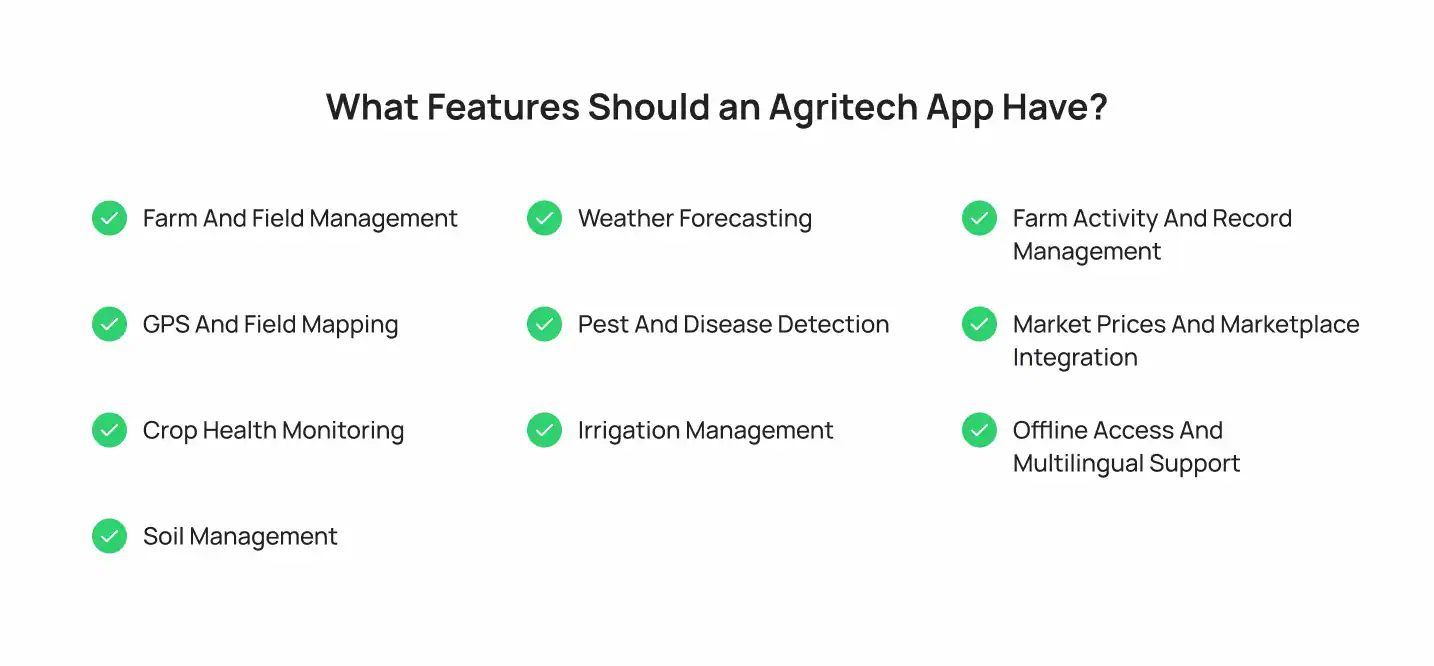
Feature choice decides whether farmers keep using an app. The best agricultural mobile apps share the core tools below. Each tool solves a daily task, so start with the ones your users need most.
1. Farm and Field Management
This module organizes daily work across every field. Owners assign tasks, set crop calendars, and track labor and costs. As a result, managers see progress without calling each worker.
2. GPS and Field Mapping
Farmers draw field boundaries on a map inside the app. They also track machinery paths and mark problem zones. Every note stays tied to an exact location, so teams find issues quickly.
3. Crop Health Monitoring
The app displays vegetation index maps and stress alerts for each field. Farmers link every alert to field notes and photos. This history shows what worked last season and what failed.
4. Soil Management
Soil tools store lab results, moisture readings, and nutrient data by field. The app then suggests lime or fertilizer rates. Farmers therefore stop guessing and start applying inputs by need.
5. Weather Forecasting
Hourly and weekly forecasts sit beside field tasks. The app warns about rain, frost, and heat. In addition, it suggests safe spray windows, which protects both crops and chemical budgets.
6. Pest and Disease Detection
Users upload a photo and receive a diagnosis in seconds. The app also warns nearby farmers about outbreaks. Treatment guides then explain the next step, so response time drops.
7. Irrigation Management
Farmers set watering schedules for each field and adjust them from their phones. Remote valve and pump control saves trips to the field. Water use reports then show where waste occurs.
8. Farm Activity and Record Management
Digital logs replace paper notebooks. They store spray records, harvest volumes, and expenses in one place. Moreover, users export reports for audits, certifications, and loan applications.
9. Market Prices and Marketplace Integration
Farmers view daily commodity prices and buyer listings inside the app. They also track orders and payments. With this information, they choose when and where to sell.
10. Offline Access and Multilingual Support
Rural signals drop often. Therefore, the app stores data on the phone and syncs later. Local language menus and voice prompts help users with limited literacy, which raises daily use.
Technologies Used in Agritech App Development
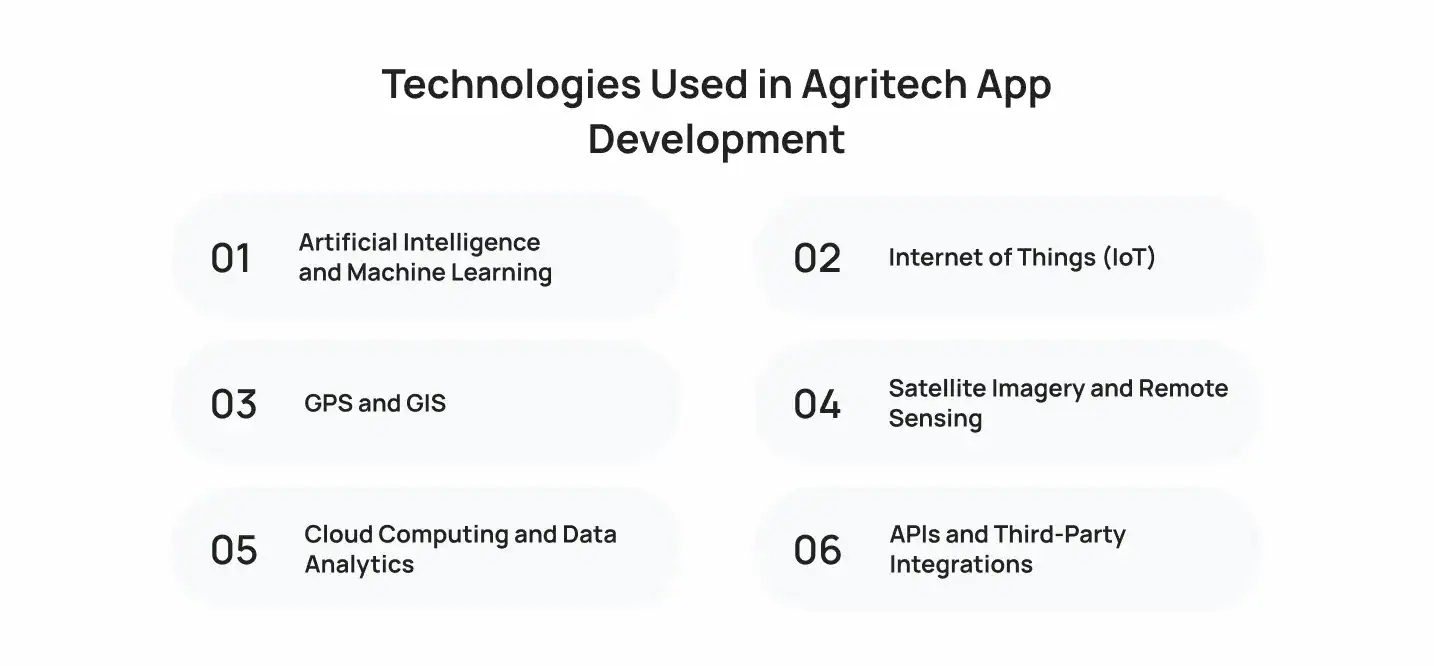
Each technology solves one part of the data pipeline. Some collect readings, while others store or interpret them. Together, they turn raw numbers into advice that farmers trust.
Artificial Intelligence and Machine Learning
AI in agriculture covers image recognition, yield models, and chat assistants. Machine learning models use predictive analytics to forecast disease risk and harvest volume. Adoption is growing fast. In McKinsey’s Global Farmer Insights 2026 survey of 5,500 farmers, 17% already use generative AI for farm tasks, and 4% pay for it.
Internet of Things (IoT)
IoT in agriculture links field devices to your app through low power networks. IoT sensors measure soil moisture, air temperature, humidity, leaf wetness, and water flow. The app then turns these readings into alerts and reports. Farmers receive facts instead of estimates.
GPS and GIS
GPS gives exact coordinates for machines, animals, and field points. GIS layers those points into maps of soil type, slope, and yield. Together, they support zone based decisions. As a result, farmers treat each part of a field differently.
Satellite Imagery and Remote Sensing
Satellites capture field images every few days. Vegetation index maps reveal weak growth zones from space. As a result, crop health monitoring works across thousands of acres without a site visit. Farmers then send scouts only to problem areas.
Cloud Computing and Data Analytics
Cloud servers store sensor, image, and weather data. They also run analytics and machine learning jobs behind the app. Because the cloud scales, one app serves a single farm or a full cooperative. Teams also avoid buying and maintaining their own servers.
APIs and Third-Party Integrations
APIs connect your app to outside data and services. Common examples include weather APIs, mapping tools, payment gateways, and equipment platforms. Good API design keeps the app flexible. You add new sources later without rebuilding the product.
Benefits of Agritech App Development
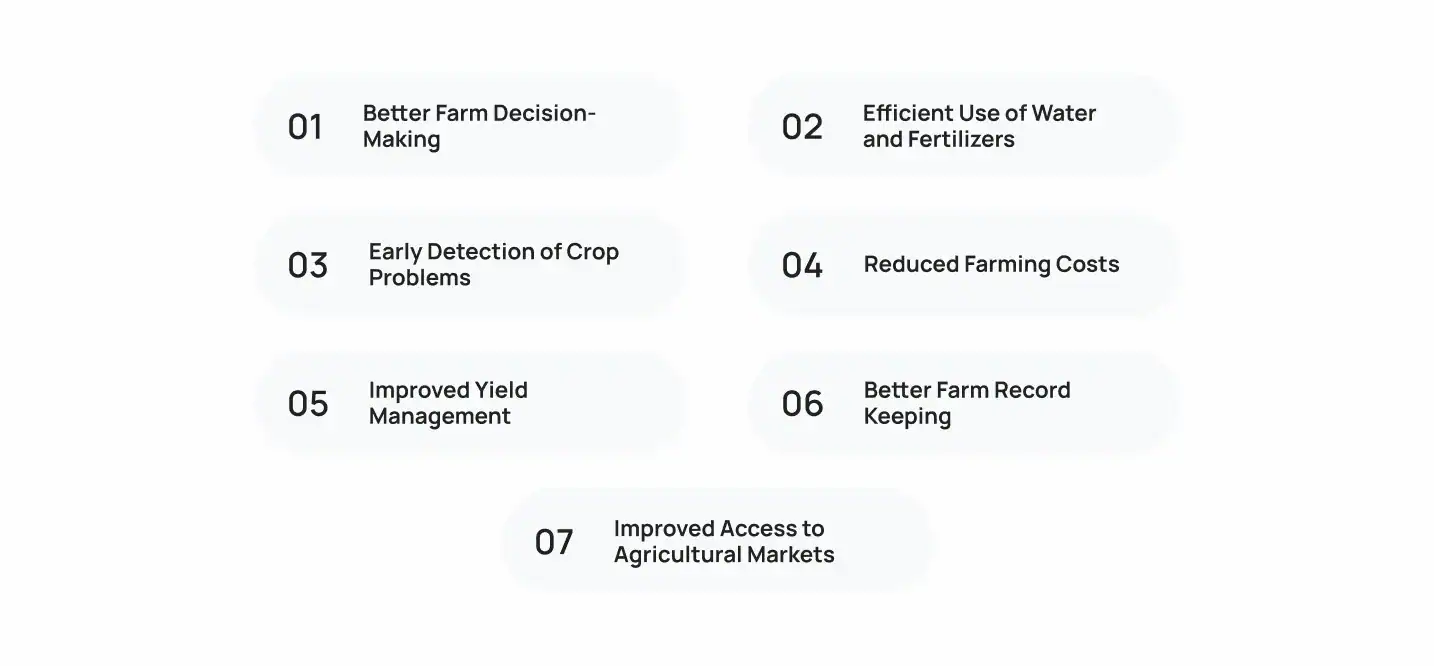
Apps deliver value on the farm and at the market. The gains come from better information, faster action, and cleaner records. The points below show where farmers see results first.
1. Better Farm Decision-Making
Live data replaces gut feeling. Farmers compare fields, seasons, and inputs before they commit money. Consequently, each decision rests on evidence from their own land.
2. Efficient Use of Water and Fertilizers
Precision farming methods apply inputs only where crops need them. This cuts runoff and saves money. It also protects soil and nearby water sources from excess chemicals.
3. Early Detection of Crop Problems
Alerts flag stress, pests, and disease within days. Early action limits crop loss and treatment cost. Farmers also stop small outbreaks before they spread to neighboring fields.
4. Reduced Farming Costs
Better input use lowers spending on water, fuel, seed, and chemicals. Fewer field visits also save labor. Over a season, these savings add up to a real margin gain.
5. Improved Yield Management
Field level records and forecasts support yield optimization. Farmers see which practices raise output, then repeat them. In addition, they drop methods that waste effort.
6. Better Farm Record Keeping
Digital logs simplify audits, certifications, and loan applications. They also preserve history when workers change. New managers therefore start with full field records instead of guesses.
7. Improved Access to Agricultural Markets
Farmers see live prices and reach more buyers. Better price knowledge improves their negotiating position. Direct sales also reduce the share lost to middlemen.
Challenges in Agritech App Development
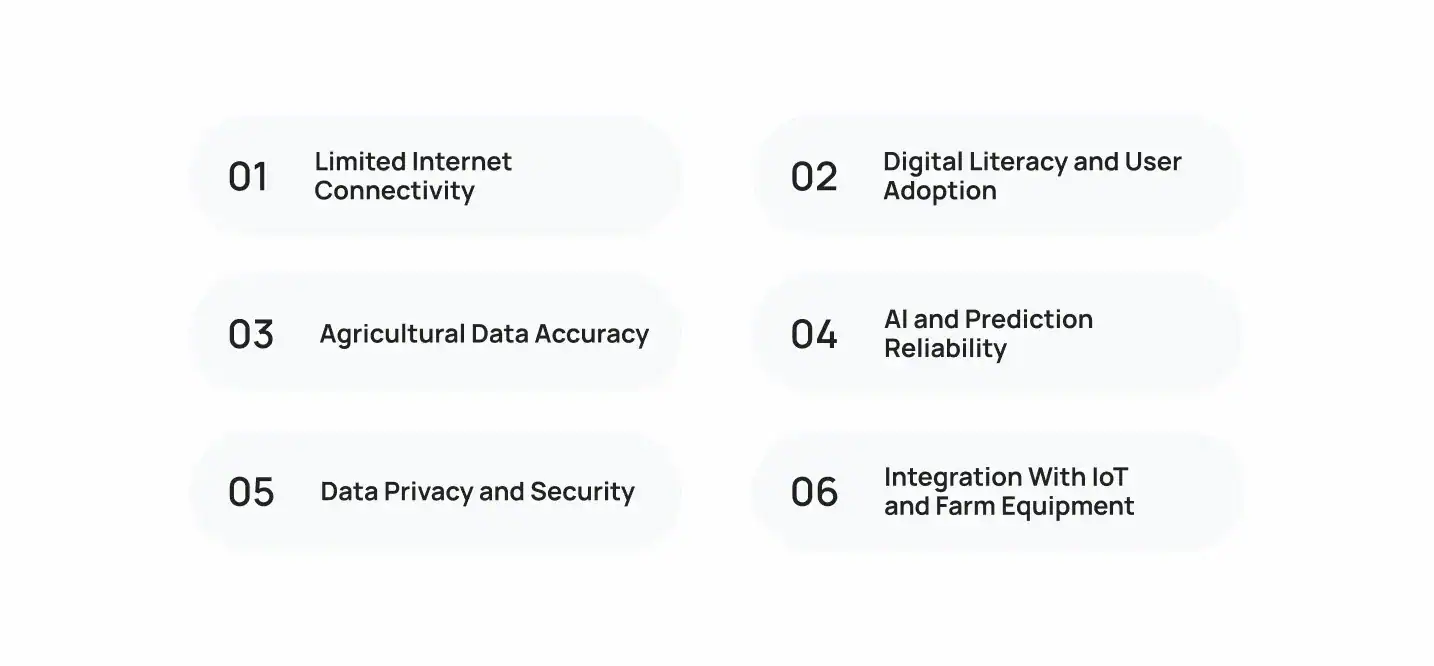
Farm apps face harder conditions than most consumer apps. Signals are weak, users vary widely, and data quality differs by field. Plan for each challenge below before you write code.
Limited Internet Connectivity
Many farms have weak or no signal. Apps that need constant internet fail in the field. Build offline modes that store data locally and sync later.
Digital Literacy and User Adoption
Some users have little app experience. Complex screens push them back to paper. Therefore, use simple layouts, icons, voice prompts, and local languages, and add in person training for first time users.
Agricultural Data Accuracy
Poor sensor calibration and manual entry errors corrupt insights. Bad data then leads to bad advice. Validate inputs, flag odd readings, and calibrate devices on a schedule.
AI and Prediction Reliability
Models trained on limited crops or regions misread new conditions. Wrong predictions damage farmer trust quickly. Train on local images, show confidence scores, and encourage agronomist review for major decisions.
Data Privacy and Security
Farm data has commercial value. Leaks expose yields, land details, and business plans. Encrypt data, set clear consent rules, and limit access by user role.
Integration With IoT and Farm Equipment
Devices use different brands and protocols. Poor integration causes missing data and sync errors. Choose open standards and test each device early in development.
How to Develop an Agritech App
Successful agritech application development follows a clear order. Each step reduces risk before the next one begins. Follow the sequence below to avoid costly rework.
Identify the Farming Problem
Pick one clear problem, such as late disease detection or wasted irrigation water. Interview farmers and agronomists to confirm it. A focused problem keeps the scope small and the value obvious.
Define the Target Users
Smallholders, commercial growers, agronomists, and cooperatives need different tools. Write user profiles that cover phone type, language, and connectivity. These details shape every design choice that follows.
Choose the Core Features
List every feature, then rank each by farmer value and build effort. Keep only the top three or four for launch. Extra features wait for later releases, once users prove demand.
Select the Technology Stack
Choose a native or cross platform framework, a cloud provider, and a database that handles map and sensor data. Match each choice to your users’ devices. In addition, confirm the stack supports offline storage.
Integrate Agricultural Data Sources
Connect satellite feeds, sensor gateways, and market price sources. Check data quality before you build screens on top of it. Clean inputs make every chart and alert more reliable.
Design and Develop the MVP
Design large buttons and clear maps for use in bright sunlight. Build the core workflow first. Scope drives mobile app development cost, so keep the MVP tight.
Test the Agritech App
Test in real fields, not only in offices. Check offline sync, battery use, GPS accuracy, and low bandwidth performance. Then run a pilot with a small farmer group and fix what they report.
Launch and Improve the App
Release in one region first. Track active users, task completion, and crash rates. After that, add features in phases based on farmer feedback.
Future of Agritech App Development
Apps will keep moving from simple record keepers to active farm advisers. Better models, cheaper sensors, and wider coverage drive that change. The trends below show where the field is heading.
AI-Powered Farming Assistants
Assistants now answer agronomy questions in local languages by text and voice. Farmers get advice without waiting for a field visit. Read more in this overview of AI farming solutions.
Predictive Crop and Yield Analytics
Models combine weather, soil, and satellite data to forecast yield weeks ahead. Farmers then plan storage, labor, and sales earlier. Accurate forecasts also improve contracts with buyers.
Connected and Automated Farms
Apps will control irrigation, sprayers, and autonomous machines from one screen. This reduces manual work and speeds up field tasks. However, rural connectivity gaps still slow rollout.
Smartphone-Based Precision Agriculture
Phone cameras, GPS, and sensors bring precision tools to small farms. As a result, growers skip costly hardware. This access widens the reach of data driven farming.
More Personalized Farming Recommendations
Apps adapt advice to each field’s soil, crop stage, and history. Advice becomes specific instead of general. Farmers therefore trust it more and act on it faster.
Agritech App Development Services for Modern Farming
Farm software needs more than clean screens. It needs offline logic, reliable data feeds, and strong device testing. Cubix builds mobile products with these needs in mind. Many farmers use Android phones, so an android app development company with wide device testing experience reduces adoption risk.
Cubix supports agritech application development from discovery to launch. A complete project includes:
- Farmer research and feature planning
- UI design for low literacy and low bandwidth users
- Sensor, satellite, and weather data integration
- Analytics dashboards and alerts
- Testing, launch, and post release support
You get one team that covers strategy, design, and engineering through its mobile app development services.
Have an Agritech Idea? Let’s Build an App That Transforms Farming
Contact UsFrequently Asked Questions
1. What is agritech and how does it transform farming?
Agritech combines technology with agriculture to improve farming operations and decision-making. It uses tools such as AI, IoT, GPS, sensors, and data analytics to improve productivity, resource use, and crop management.
2. How do precision farming apps reduce costs?
Precision farming apps use field, soil, weather, and crop data to guide the use of water, fertilizers, pesticides, and other inputs. This can reduce waste and help farmers allocate resources more efficiently.
3. What is the cost to develop an agritech solution?
Agritech development costs vary based on features, integrations, platforms, and complexity. A basic app costs less than a solution involving AI, IoT sensors, satellite data, or automated farm systems.
4. How do IoT sensors improve crop yields?
IoT sensors collect real-time data on soil moisture, temperature, humidity, and other field conditions. This information helps farmers adjust irrigation, fertilization, and crop care based on actual field conditions.
5. Can agritech apps predict weather?
Agritech apps can integrate weather APIs and forecasting services to provide localized weather predictions and alerts. These insights can help farmers plan irrigation, planting, spraying, and harvesting activities.
6. How does blockchain help in agriculture?
Blockchain can record and share agricultural transactions across a distributed ledger. It can improve traceability, support supply-chain transparency, and help verify information about products as they move from farms to consumers.
7. What role does AI play in modern farming?
AI can analyze agricultural data to identify crop diseases, predict yields, detect pests, and generate farming recommendations. It helps turn large volumes of farm data into actionable insights.
8. How do farmers benefit from mobile apps?
Mobile apps give farmers access to crop information, weather forecasts, field records, market prices, and farming recommendations from their smartphones. They can also help monitor farm activities remotely.
9. What’s the ROI for agritech investments?
Agritech ROI depends on the technology, farm size, implementation costs, and measurable outcomes. Savings in inputs, improved productivity, reduced losses, and better resource management can contribute to returns.