
Key Takeaways
- AI anti-cheat helps game studios identify suspicious gameplay, automated activity, collusion, and unusual account behavior.
- Machine learning works best alongside server-side validation, traditional security rules, and human review.
- Gameplay cheating, account abuse, payment fraud, and virtual economy manipulation require different detection methods.
- False positives can damage player trust, making explainability, appeals, and proportional enforcement essential.
- Secure telemetry, model monitoring, and regular testing help studios maintain reliable multiplayer game security.
Imagine spending 30 minutes fighting your way to the top of a multiplayer match. Your team communicates, your strategy works, and victory seems close. Then another player makes a series of actions that appear impossible under the game’s rules. Suddenly, the match feels pointless.
Now imagine this happening every day. Fair players become frustrated, competitive rankings lose their meaning, and some players may decide to leave the game entirely.
This is where AI anti-cheat can help.
As multiplayer games become more connected, game studios face several security challenges. Some players use unauthorized tools to gain an advantage, while others exploit bots, stolen accounts, suspicious transactions, or virtual economies. Traditional security rules can catch known violations, but identifying unfamiliar patterns often requires additional analysis.
AI offers another layer of protection by helping studios recognize unusual behavior across large volumes of gameplay and account data. However, it isn’t a magic solution. Reliable protection combines machine learning, server-side validation, established security rules, and human judgment.
So, how does AI actually detect cheating, and how can game studios use it without unfairly punishing legitimate players? Let’s break it down.
Why Multiplayer Games Need Better Fraud Detection
Cheating isn’t just a problem during a match. It can affect how players feel about a game, whether they spend money on it, and whether they return after a frustrating experience.
Consider a competitive shooter. If players believe opponents are cheating, they may stop trusting the ranking system. In a role-playing game, automated farming might flood the marketplace with resources. In a multiplayer sports game, account abuse or suspicious transactions can affect both players and the game’s economy.
Research published in 2025 offers a useful look at the scale of this problem. PlaySafe ID’s Gaming’s Cheating Crisis Report, based on a survey of 2,013 adult PC gamers in the United States and the United Kingdom, found that 80% had encountered cheating in online games. The report also found that 42% had considered quitting a game because of cheaters, while 55% said they had reduced or stopped spending on in-game purchases because of cheating. These are survey findings, not measurements of every gaming community, but they show why fair play matters beyond individual matches.
The developer perspective tells a similar story. In April 2025, Electronic Arts reported that its Javelin AntiCheat had blocked more than 33 million cheat attempts across 2.2 billion PC gaming sessions since its launch. The system was active across 14 EA titles at the time of that report. This illustrates the scale of ongoing anti-cheat operations, although blocked attempts should not be interpreted as the number of unique cheaters or matches affected.
So, where does AI fit into this picture?
AI can help studios analyze large amounts of gameplay data, connect suspicious events, and identify patterns that predefined rules might miss. Combined with other security measures, this can support more informed decisions about potential cheating and fraud.
What Is AI Anti-Cheat in Multiplayer Games?
AI anti-cheat uses machine learning, statistical analysis, and behavioral models to help identify activity that may violate a game’s rules or indicate abuse.
Think of it as a security analyst that can examine thousands of gameplay events much faster than a person could. It looks for patterns, compares behavior with relevant historical data, and helps prioritize cases that may need investigation.
For example, a system might identify an account whose gameplay behavior changes significantly over time. That change alone doesn’t prove cheating. However, when combined with verified rule violations or other independent evidence, it may justify further investigation.
Traditional anti-cheat systems often rely on known rules, software integrity checks, and predefined indicators of unauthorized activity. AI adds another layer by analyzing relationships between events and recognizing unusual patterns that may not have been explicitly programmed into a rule.
However, AI anti-cheat isn’t a replacement for established security controls. A machine learning model can make mistakes, and some forms of cheating are better prevented through secure game architecture than detected after they occur.
A reliable system combines three elements:
- Rules: Identify known violations and clearly defined suspicious events.
- Machine learning: Analyze behavioral patterns and help surface unfamiliar risks.
- Server-side validation: Verify game actions and protect critical game-state decisions.
Together, these approaches help studios protect fair play while keeping legitimate players’ experiences in mind.
Protect Your Multiplayer Game From Cheating and Fraud
Contact UsWhat Types of Cheating and Fraud Can AI Detect?
Not every suspicious activity has the same cause. A player using unauthorized software presents a different problem from someone taking over another player’s account or abusing a payment system.
Understanding these differences helps studios choose the right detection approach.
1. Unusual Gameplay and Impossible Actions
Some cheating involves actions that conflict with the game’s rules or the information available to a player.
AI systems can help identify unusual gameplay patterns, especially when they are considered alongside server-side checks and other evidence. For example, a system might flag repeated inconsistencies between recorded player actions and the game’s authoritative state.
However, a player performing exceptionally well isn’t automatically cheating. Experienced players, unusual strategies, accessibility tools, and ordinary variation can all produce behavior that looks different from the norm.
The goal is to investigate meaningful inconsistencies, not punish people for being skilled.
2. Bots and Automated Player Activity
Bots can perform repetitive tasks without the same limitations as a human player. Depending on the game, automated activity may affect matchmaking, resource collection, rankings, or virtual marketplaces.
Machine learning anti-cheat systems can analyze behavioral patterns over time to help identify accounts that may be operating through automation.
This is especially relevant in games with large player populations, repetitive progression systems, or valuable in-game resources.
Still, repeated behavior isn’t enough to establish that an account is a bot. Legitimate players may repeat actions while practicing, farming resources through permitted gameplay, or completing routine tasks.
3. Collusion and Coordinated Abuse
Collusion occurs when players secretly coordinate to gain an unfair advantage in a competitive environment.
For example, players in a ranked game might cooperate in ways that undermine the intended competition. In a trading-based game, multiple accounts might coordinate transactions that distort rankings or virtual asset values.
Collusion detection looks beyond individual accounts. It can consider relationships between players, repeated interactions, and patterns across multiple matches or transactions.
AI can help connect these events and highlight relationships that deserve review. The final decision should still consider the game’s rules, context, and available evidence.
4. Account Abuse and Account Takeover
Account abuse covers several behaviors, including unauthorized access, suspicious account activity, and the misuse of multiple accounts.
AI fraud detection for online multiplayer games can help identify unusual changes in account behavior or activity that differs from an established pattern.
For instance, an account might suddenly show activity inconsistent with its recent history. That could indicate unauthorized access, but it might also reflect a player changing devices or returning after a long break.
This is why account risk should be assessed using multiple signals rather than a single event.
5. Payment Fraud and Virtual Economy Abuse
Gaming fraud prevention also needs to cover activities that happen outside the actual match.
Payment fraud may involve unauthorized purchases, disputed transactions, or misuse of payment methods. Economy abuse can involve suspicious trading, manipulation of virtual currencies, or coordinated activity designed to distort an in-game marketplace.
These cases often require different data and controls from gameplay anti-cheat systems.
Payment records, transaction histories, account relationships, and marketplace activity may be relevant to fraud detection. Studios can use risk scoring to identify transactions that need additional checks or investigation.
The distinction matters: gameplay cheating, account abuse, payment fraud, and economy abuse are related security concerns, but they shouldn’t all be treated as the same offense.
How Does AI Anti-Cheat Work?
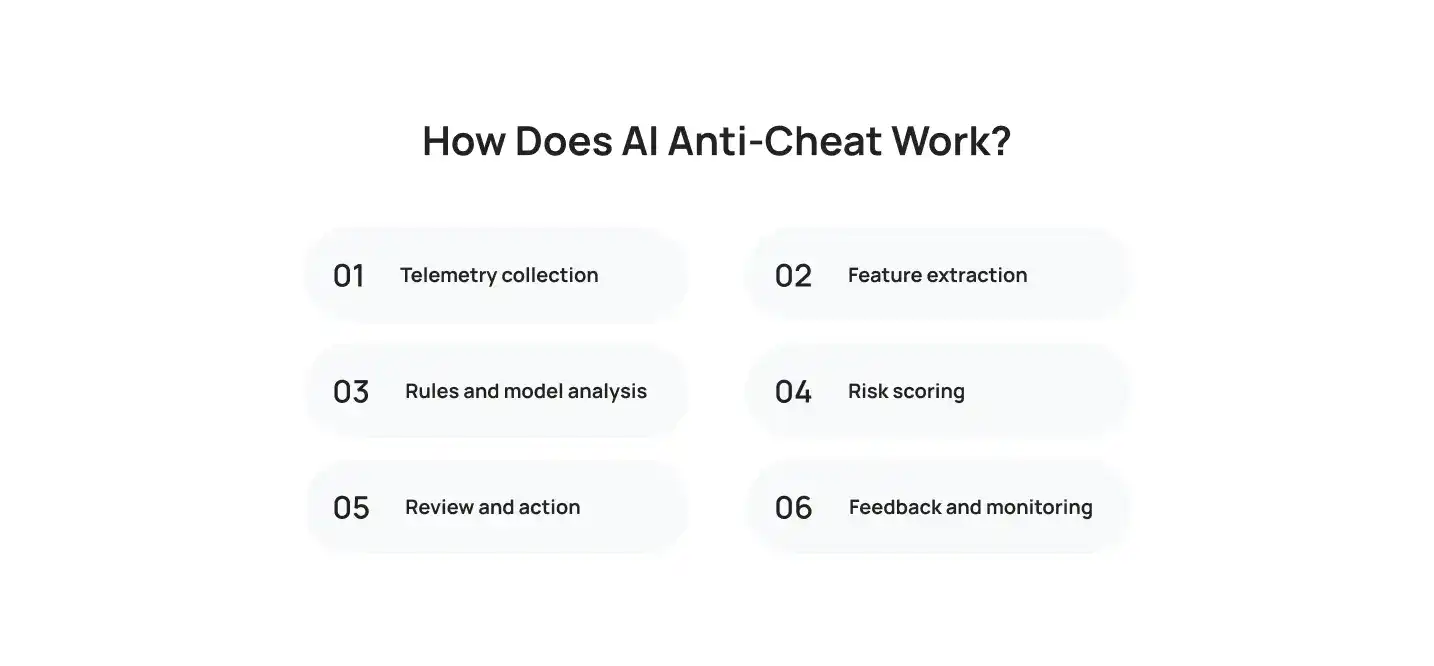
So, how does AI actually detect cheating in multiplayer games?
The simplest way to understand the process is to follow the information from the moment a game records an event to the point when a security team decides what to do about it.
1. Telemetry collection
Collect relevant gameplay events, account activity, and transaction records.
2. Feature extraction
Turn raw events into meaningful information for analysis.
3. Rules and model analysis
Apply known security rules and machine learning models.
4. Risk scoring
Estimate the level of concern based on the available evidence.
5. Review and action
Apply proportionate controls, investigate, or escalate the case.
6. Feedback and monitoring
Use confirmed outcomes to evaluate and improve the system.
Let’s look at what happens at each stage.
Step 1: Collect Gameplay Telemetry
Telemetry is the information a game records about events and activity.
Depending on the game and its privacy requirements, this might include match outcomes, player actions, game-state events, account activity, or relevant transaction records.
The important part is collecting information that serves a clear security purpose. Studios don’t need to gather every possible detail about a player. They need reliable, relevant data that helps them investigate specific risks.
Step 2: Extract Useful Features
Raw data isn’t always easy to analyze directly. Feature extraction turns it into information that models can use.
For example, a system might summarize gameplay consistency over time or organize transaction histories into broader behavioral patterns.
These features should provide useful context without exposing sensitive player information unnecessarily.
Step 3: Apply Rules and Machine Learning
Next, the system applies known rules and machine learning models.
Rules can identify established violations. Machine learning can analyze patterns across multiple events and help identify behavior that doesn’t fit expected gameplay or account activity.
Different models may serve different purposes. A system designed to identify automated gameplay won’t necessarily be suitable for detecting payment fraud or account takeover.
Step 4: Calculate a Risk Score
The system may assign a risk score to help prioritize cases for further investigation.
A risk score is not proof of wrongdoing. It represents the system’s assessment based on the available information and the model’s design.
Studios should combine model results with relevant rules, context, and corroborating evidence before taking serious enforcement action.
Step 5: Review and Take Action
Depending on the situation, the next step might involve collecting additional evidence, applying an extra account check, reviewing a transaction, restricting a suspicious activity, or escalating a case to a human investigator.
The response should reflect the seriousness of the risk and the strength of the evidence.
Step 6: Learn From Outcomes
Detection doesn’t end when a case is closed.
Security teams should examine confirmed cases, overturned decisions, player appeals, and new forms of abuse. This feedback helps them identify gaps in their detection process and determine whether models or rules need updating.
The result is an ongoing defensive process rather than a one-time AI implementation.
Rule-Based Detection vs. AI vs. Server-Side Validation
AI anti-cheat vs. traditional anti-cheat isn’t really a choice between two competing technologies. Each approach solves a different part of the security problem.
Consider the following comparison.
| Feature | Rule-Based Detection | ML and Anomaly Detection | Server-Authoritative Controls |
|---|---|---|---|
| Main purpose | Detect known violations | Identify unusual patterns | Enforce valid game actions |
| How it works | Applies predefined rules | Analyzes behavioral data | Verifies actions against trusted game state |
| Best suited for | Clear, established violations | Complex or changing behavior | Preventing invalid state changes |
| Explainability | Usually straightforward | Depends on the model | Often straightforward for defined rules |
| Main limitation | May miss unfamiliar patterns | Can produce false positives | Cannot identify every form of account or payment fraud |
| Ongoing needs | Rule updates | Data, monitoring, and retraining | Secure architecture and validation |
Why Server-Side Validation Matters
In a multiplayer game, the server should remain responsible for critical decisions about the game state.
For example, a server-authoritative system can verify whether an action is permitted according to the game’s rules instead of blindly accepting information supplied by a player’s device.
This helps prevent invalid actions from affecting the match in the first place.
Machine learning serves a different purpose. It can help identify suspicious patterns across gameplay events, accounts, and matches that may deserve investigation.
Rules provide another layer by checking for known violations.
The main takeaway: rules help identify known problems, server-side validation enforces game logic, and machine learning helps uncover suspicious patterns. Combining them creates a more complete approach to multiplayer game security.
Studios developing secure multiplayer experiences should consider these controls early in their game development services planning, rather than adding them only after abuse becomes widespread.
What Is Anomaly Detection in Multiplayer Games?
Anomaly detection is the process of identifying activity that differs significantly from expected patterns.
In gaming, this might involve unusual changes in gameplay behavior, account activity, transaction histories, or relationships between players.
Imagine a game where most players gradually develop their skills over time. One account suddenly displays a very different behavioral pattern. Should the system immediately ban that player?
No. A change in behavior is a reason to investigate, not automatic proof of cheating.
The player might have improved, changed their play style, or started using a different device. Context matters.
This is where player behavior anomaly detection becomes useful. Instead of relying on a single event, a model can help identify patterns across multiple events and highlight cases that warrant closer attention.
Studios may use several types of analysis:
- Behavioral analysis: Examines changes in gameplay and account activity.
- Statistical anomaly detection: Identifies observations that differ from an expected distribution.
- Relationship analysis: Helps investigate suspicious connections between accounts, matches, or transactions.
- Risk scoring: Combines relevant evidence to help prioritize cases for review.
These approaches can also support bot detection, collusion detection, and game fraud detection.
However, not every anomaly is malicious. New game updates, seasonal events, changes in matchmaking, and shifts in player populations can all affect normal behavior.
A reliable system must account for these changes and avoid treating unusual activity as automatic proof of wrongdoing.
How to Reduce False Positives in AI Anti-Cheat

Here’s a question every game studio should ask before deploying AI anti-cheat: what happens when the system flags an innocent player?
An incorrect ban can cost a player hours of progress, access to purchased content, competitive standing, or trust in the game. In some cases, the damage to a game’s reputation can extend beyond the individual account.
False positives are therefore a security concern, not merely a technical inconvenience.
A 2026 survey of 250 developers working on competitive multiplayer games in the United States and the United Kingdom, published by Anybrain, reported that 31% of respondents had experienced false positives from anti-cheat systems. The finding reflects surveyed developers’ experiences, rather than a measured error rate across all anti-cheat systems.
So, how can studios reduce the risk?
1. Combine Multiple Sources of Evidence
A single unusual event should rarely determine a serious enforcement decision. Combine relevant gameplay records, rule violations, model results, and other corroborating evidence.
2. Validate Models Before Deployment
Test detection models against representative data, including legitimate edge cases. Evaluate their performance across different skill levels, player populations, devices, and game modes.
3. Use Human Review for High-Impact Decisions
Automated detection can prioritize cases, but human reviewers should be able to examine important or uncertain decisions, especially permanent bans and complex fraud investigations.
4. Explain Decisions Where Possible
Security teams should maintain records explaining why a case was flagged and what evidence supported the final action. Player-facing explanations can communicate the relevant rule or policy without exposing sensitive detection details.
5. Provide a Clear Appeals Process
Players need a reasonable way to challenge incorrect decisions. Appeals should trigger a genuine review, not simply repeat the original automated judgment.
6. Apply Proportional Enforcement
Not every suspicious event requires a permanent ban. Depending on the evidence and the type of risk, appropriate responses may include additional verification, transaction review, temporary restrictions, or account suspension.
The goal is to protect fair play without punishing legitimate players for unusual behavior.
How Game Studios Can Build a Reliable AI Anti-Cheat System
Building machine learning anti-cheat isn’t just about choosing a model. Studios need a complete security process that works with their multiplayer backend, existing infrastructure, and player support operations.
Here are the main elements to consider.
Secure Gameplay Telemetry
Start by identifying the information needed to detect specific threats.
Gameplay telemetry, account events, and transaction records should be collected and handled through secure, access-controlled systems. Data should be protected in transit and at rest, with retention policies that reflect its purpose.
Privacy should be part of the design from the beginning. Studios should collect only relevant information, limit access, and explain applicable data practices clearly to players.
Integrate Server-Side Validation
Machine learning cannot reliably prevent every invalid game action on its own.
Critical decisions should be verified by trusted server-side logic. This reduces reliance on information supplied by the game client and helps ensure that game-state changes follow the intended rules.
The multiplayer backend should also have appropriate logging, access controls, and monitoring to support investigations.
Choose the Right Machine Learning Approach
Different security problems require different models.
A system analyzing gameplay behavior may need different inputs and evaluation methods from one designed to identify payment fraud or coordinated account abuse.
Studios should define the problem first, determine what reliable data is available, and select an approach that fits the use case.
Specialized machine learning development services can help teams evaluate suitable models, design data pipelines, and establish monitoring processes.
Monitor Model Drift, Latency, and Load
A model that performs well during testing may behave differently after launch.
Game updates, new content, changing player populations, and emerging abuse patterns can affect model performance. This is known as model drift.
Studios should monitor detection quality, false-positive rates, review volumes, and changes in incoming data. They should also test how the system behaves during peak player activity.
For real-time detection, latency matters. A model that takes too long to return a result may not be suitable for decisions that must happen during a live match. Other investigations, such as account or transaction reviews, may allow more time for analysis.
Not every decision needs to happen in real time. The architecture should match the security requirement.
Prepare an Incident Response Plan
Even a well-designed security system can miss suspicious activity or flag legitimate behavior incorrectly.
A documented incident response plan helps teams investigate issues, preserve relevant evidence, contain confirmed threats, communicate with affected players, and update security controls.
The plan should also explain who can approve enforcement decisions, how appeals are handled, and how detection models are reviewed after an incident.
For studios developing AI-enabled gaming experiences, AI video game development can involve security considerations alongside gameplay design, backend architecture, and ongoing maintenance.
Test the System Before and After Launch
Anti-cheat systems need ongoing testing, not just a final quality check.
Teams should test against known cases, legitimate edge cases, changes in game mechanics, and expected production workloads. Monitoring should continue after release so that unexpected changes can be investigated.
AI for game testing & balancing can support broader testing workflows, although gameplay balancing and security validation remain distinct tasks.
The important point is simple: AI anti-cheat needs reliable data, secure architecture, careful evaluation, and an operational team that can respond when something changes.
AI Anti-Cheat vs. Traditional Anti-Cheat: What Should Studios Consider?

Traditional anti-cheat methods remain useful because many violations can be identified through established rules, integrity checks, and server-side controls.
AI adds the ability to analyze behavior across large datasets and help identify patterns that are difficult to describe through individual rules.
However, machine learning introduces its own challenges. Models need reliable data, ongoing monitoring, and careful evaluation. Their decisions may also be harder to explain than a straightforward rule violation.
Here’s a practical way to think about the difference:
- Traditional anti-cheat: Useful for known threats and clearly defined violations.
- Machine learning anti-cheat: Useful for behavioral analysis and identifying patterns that warrant investigation.
- Server-side security: Essential for enforcing game rules and protecting critical game-state decisions.
- Human investigation: Important for complex cases, disputed decisions, and high-impact enforcement.
For many games, a combination of these approaches makes more sense than choosing just one. The exact balance depends on the game’s mechanics, player population, competitive requirements, and available resources.
Real-World Challenges and Limitations
AI anti-cheat can improve detection, but several challenges remain.
- Incomplete data: If telemetry is missing or unreliable, models may struggle to distinguish legitimate activity from suspicious behavior.
- Changing behavior: Game updates, new content, and evolving player strategies can affect previously established behavioral patterns.
- Privacy concerns: Collecting too much player data can create unnecessary privacy and security risks. Data collection should be limited to legitimate, clearly defined purposes.
- Performance requirements: Real-time detection needs to fit within the game’s latency and infrastructure constraints. More complex models aren’t always the right choice for time-sensitive decisions.
- Operational costs: Models require infrastructure, monitoring, testing, and staff who can investigate their findings.
- Changing threats: As cheating techniques and fraud patterns change, studios need to update their defenses without compromising legitimate players’ experiences.
The broader lesson is that AI anti-cheat is an ongoing security capability, not a feature that studios can implement once and forget. It should evolve alongside the game, its community, and its technical environment.
The Future of AI Security for Games
AI security for games is developing alongside changes in game architecture, player behavior, and the tools used to create both legitimate and unauthorized software.
Research and industry developments in 2025 and 2026 illustrate how much attention the problem continues to receive.
For example, Electronic Arts reported in April 2025 that its Javelin AntiCheat had blocked more than 33 million cheat attempts since launch. In September 2026, EA reported that the system had expanded to 20 titles and prevented 26.7 million cheat attempts over the preceding year. These are company-reported figures from different reporting periods, so they should not be treated as a direct measure of year-over-year changes in cheating.
Looking ahead, several developments may shape multiplayer security.
More Context-Aware Behavioral Analysis
Detection systems may increasingly combine gameplay events, account history, and match context to help distinguish suspicious patterns from legitimate differences in player behavior.
Better Detection of Coordinated Abuse
Relationship analysis can help security teams investigate possible collusion across accounts, matches, and virtual transactions.
Improved Real-Time Risk Assessment
Studios may use risk scoring to prioritize security checks while reserving more complex investigations for cases that require additional evidence.
Stronger Integration With Game Architecture
Security controls are likely to remain closely connected to server-side validation, backend monitoring, and development workflows.
These are areas of continued development, not guaranteed outcomes. Progress will depend on data quality, implementation choices, privacy requirements, and how well detection systems perform in actual production environments.
Protect Fair Play Without Losing Player Trust
Cheating and fraud can affect much more than the outcome of a single match. They can undermine competitive rankings, damage virtual economies, frustrate legitimate players, and create additional costs for game studios.
AI anti-cheat provides another way to identify suspicious activity, but it works best as part of a broader security strategy. Combining machine learning, traditional rules, server-side validation, secure telemetry, human review, and ongoing monitoring helps studios respond to threats while reducing the risk of unfair penalties.
The key is to build a system that can adapt as the game evolves without treating every unusual action as proof of wrongdoing.
At Cubix, AI development and game engineering can come together to support more secure, reliable multiplayer experiences. Explore our fraud detection solutions to learn how AI-based approaches can support broader fraud prevention and security efforts.
Make Fair Play a Priority in Your Game
Contact UsFrequently Asked Questions
1. How does AI anti-cheat work?
AI anti-cheat analyzes gameplay data, account activity, and other relevant signals to identify suspicious patterns. It combines machine learning with security rules and server-side validation to help detect potential cheating. Findings may trigger additional checks, human review, or enforcement, depending on the available evidence.
2. Can machine learning detect cheating in games?
Yes. Machine learning can help identify unusual gameplay, automated activity, possible collusion, and other suspicious patterns. However, it cannot detect every form of cheating or guarantee accurate decisions. It works best alongside established security rules, server-side controls, and human investigation.
3. What data is used to detect game fraud?
Depending on the threat, detection systems may analyze gameplay events, match outcomes, account activity, transaction records, and relationships between accounts. Studios should collect only the data needed for legitimate security purposes, protect it appropriately, and follow applicable privacy requirements.
4. How do anti-cheat systems reduce false positives?
Anti-cheat systems can reduce false positives by combining multiple sources of evidence, testing models against legitimate gameplay, monitoring detection quality, and using human review for high-impact decisions. Clear appeals processes and proportional enforcement also help protect innocent players from incorrect penalties.
5. What is anomaly detection in multiplayer games?
Anomaly detection identifies activity that differs from expected patterns. In multiplayer games, it can help flag unusual gameplay, account behavior, or transactions for further investigation. An anomaly does not automatically indicate cheating, so context and additional evidence are important.
6. Can AI detect bots and account abuse?
AI can help identify behavioral patterns associated with automated activity, suspicious account changes, and coordinated misuse. However, legitimate players can also exhibit unusual behavior. Detection systems should combine relevant signals with appropriate verification rather than automatically treating every unusual account as malicious.
7. How should game studios respond to suspected cheating?
Studios should investigate relevant evidence, validate suspicious activity against game rules, and determine the appropriate response. Depending on the circumstances, this may involve additional verification, transaction review, temporary restrictions, or account suspension. Serious enforcement decisions should have documented reasoning and a suitable appeals process.