Key takeaways
- A game backend is more than servers. It combines authentication, session management, matchmaking, authoritative game servers, databases, caches and observability.
- Decide where the truth lives. Any game with rankings, an economy or purchases should validate everything server-side. Trusting the client invites cheating.
- Dedicated servers aren’t always required. Competitive and economy-driven games need them. Casual co-op can use listen servers or relays, and turn-based games often need only a validated API.
- Matchmaking is a trade-off. Tighter skill windows give fairer matches but longer queues, so track both match quality and time-to-match.
- Use the right store for each job. Combine relational databases, key-value stores, a cache, object storage and an analytics warehouse, with encryption, least-privilege access and tested restores.
- Latency drives region choice. Put game servers near players, and keep platform services like auth in fewer regions with replicas.
- Security is a real cost. Games took 37% of DDoS attacks in Akamai’s 2022 report, and IBM’s 2025 data puts the average breach at $4.44M globally and $10.22M in the US.
- Managed, custom or hybrid depends on your team. Small teams usually favor managed services. Many mid-size studios land on a hybrid, with an exit path from any single vendor.
- Budget from real numbers. Our illustrative example (500,000 DAU, 25,000 peak concurrent users) comes to roughly $19,700 a month. Replace it with your own load-test results.
- Measure before launch. Track matchmaking time, p95 latency, crash-free sessions, disconnect rate and cost per peak concurrent user, and load test at 120% or more of forecast peak.
Short answer: Game backend architecture is the set of server-side systems behind a game client: authentication, session management, matchmaking, game servers that hold authoritative state, databases and caches for player data, and observability to keep it all running. In a multiplayer game backend, the key decision is where the truth lives. When the server decides what happened, you can secure, balance and scale the game. When the client decides, you inherit cheating and desync.
This guide helps you evaluate options rather than copy a diagram. It covers the building blocks, dedicated servers versus peer-to-peer, latency and regions, managed versus custom, an implementation roadmap, a costed worked example, KPIs, common mistakes and a checklist. The stakes are real: Cubix’s market insights article cites IMARC’s projection of US$130.4 billion for MMO games by 2032, and its 2026 market outlook estimates the wider multiplayer market at roughly $203.35 billion this year. These are third-party market estimates, not infrastructure benchmarks. Any figure below that is our own illustration is labeled as one.
What Is Game Backend Architecture?
A game backend is everything that runs outside the player’s device and makes a game persistent, shared and trustworthy. The client renders, collects input and predicts outcomes. The backend identifies the player, stores progress, forms matches, runs the rules and records what happened.
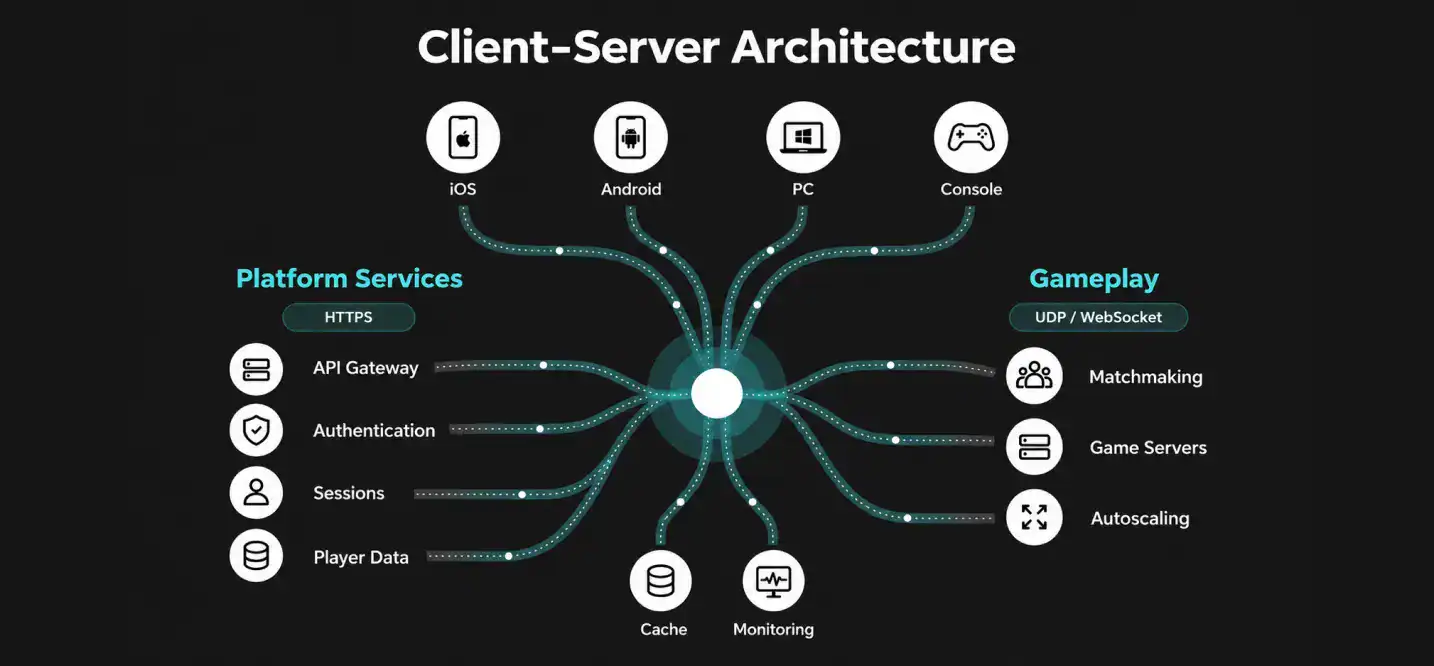
Most backends split into two planes:
- Platform services (request/response over HTTPS): login, profiles, inventory, store, leaderboards, friends, remote config.
- Real-time services (long-lived UDP or WebSocket connections): matchmaking tickets, game sessions, state synchronization.
One vendor overview describes a five-layer baseline for game backend infrastructure: an API server, a primary database, a cache, object storage for bundles and content, and background workers, plus separate production and staging environments (Supercraft, 2026). It is a useful minimum checklist, but it comes from a managed-backend vendor, so treat it as one perspective rather than a standard.
The Core Building Blocks
Game authentication
Game authentication proves who the player is and issues short-lived credentials. Best practice is to use platform identity (Apple, Google, Steam, console accounts) or a standard such as OAuth 2.0 and OpenID Connect, support guest-to-account linking so progress is never stranded, and issue signed tokens with short expiry plus refresh tokens. Game servers should receive a separate server-level credential and never share privileges with player tokens. Rate-limit login endpoints, because credential attacks are a constant threat (see the security section).
Session management
Session management tracks that a player is online, on which device, and in which match. A common pattern is a stateless API that validates tokens while a cache stores presence and the active session. Decide early whether one account may log in on two devices, how reconnection works (a rejoin grace window of 30 to 120 seconds is a common design choice, not a standard), and how a session ends cleanly so inventory writes are not lost.
Game matchmaking backend: how matchmaking works
Matchmaking converts a player’s request into a viable match:
- The client asks for a match and the backend creates a ticket containing skill rating, party size, mode and per-region latency.
- The ticket enters a queue. The matcher searches for compatible tickets, widening skill and latency windows the longer a player waits.
- When a group forms, allocation asks the fleet manager for a game server in the best region, ideally reusing a warm one.
- Players receive connection details and a one-time token.
- Backfill later fills empty slots in running sessions.
The core trade-off is match quality versus wait time. Tight skill windows produce fairer games but longer queues, which is why population size and region count matter. Elo or Glicko-style ratings are common, and you should track both fairness and time-to-match.
Authoritative game server versus client-trusted models
An authoritative game server runs the rules and owns the real game state. Clients send inputs and receive results; they may predict locally but are corrected by the server. The benefits are cheating resistance, consistent outcomes and central balancing. The costs are server compute and the need for latency-hiding techniques such as client prediction, interpolation and reconciliation. Client-trusted models are cheaper and acceptable for casual co-op play where nothing of value is at stake, but anything involving rankings, an economy or purchases should be validated server-side.
Player data storage
Player data storage usually combines stores by access pattern:
- Relational (PostgreSQL, MySQL) for accounts, purchases and entitlements where transactions matter.
- Document or key-value stores for profile blobs and high-write progress data.
- Cache (Redis) for sessions, leaderboards and hot profiles.
- Object storage for content bundles, replays and backups.
- Analytics warehouse for event data, kept off the live request path.
How is player data stored securely? Encrypt data in transit (TLS) and at rest, avoid storing passwords by using federated identity or modern password hashing, apply least-privilege database roles, separate environments, log access to personal data, define retention and deletion rules for privacy requests, and rehearse restores. Under GDPR, fines can reach up to EUR 20 million or 4% of worldwide annual turnover, whichever is higher; confirm your obligations with counsel.
Observability
Without logs, metrics and traces you cannot tell whether players are leaving because of design or because matchmaking is failing. Instrument structured logs with a correlation ID from login to match end, rate/error/duration metrics for every service, distributed tracing for the login-to-match path, and alerts on player-facing symptoms (queue time, disconnects) rather than CPU alone. Supercraft’s overview notes that many outages trace to an extra cache or queue nobody owns, so assign an owner to every component.
Do Multiplayer Games Need Dedicated Servers?
Not always. The answer depends on genre, cheating risk and budget.
Dedicated, listen-server and peer-to-peer compared
- Dedicated server: a server process in a data center, authoritative, with the best fairness and the highest cost.
- Listen server: one player’s device acts as the server. It is cheap but gives the host an advantage and struggles when the host leaves.
- Peer-to-peer (P2P): clients exchange data directly. It has the lowest server cost but exposes player IP addresses, is hardest to secure and scales poorly past small groups.
- Relay or hybrid: relays handle connectivity while authoritative logic stays on a server you control.
| Model | Best for | Cheating resistance | Latency fairness | Infrastructure cost |
|---|---|---|---|---|
| Dedicated authoritative | Competitive shooters, battle royale, ranked modes, games with an economy | High | High | High |
| Listen server | Casual co-op with friends | Low to medium | Host advantage | Low |
| Peer-to-peer | Small fighting or party games | Low | Varies by pair | Lowest |
| API-validated turn-based | Card, puzzle, async and turn-based games | High if moves are validated | Not sensitive | Low |
Decision rule: if players compete for ranking, items or money, use authoritative servers. Turn-based and asynchronous games often need only validated API calls and no game server fleet at all.
Latency, Regions, Resilience, and Security
Latency budgets and regions
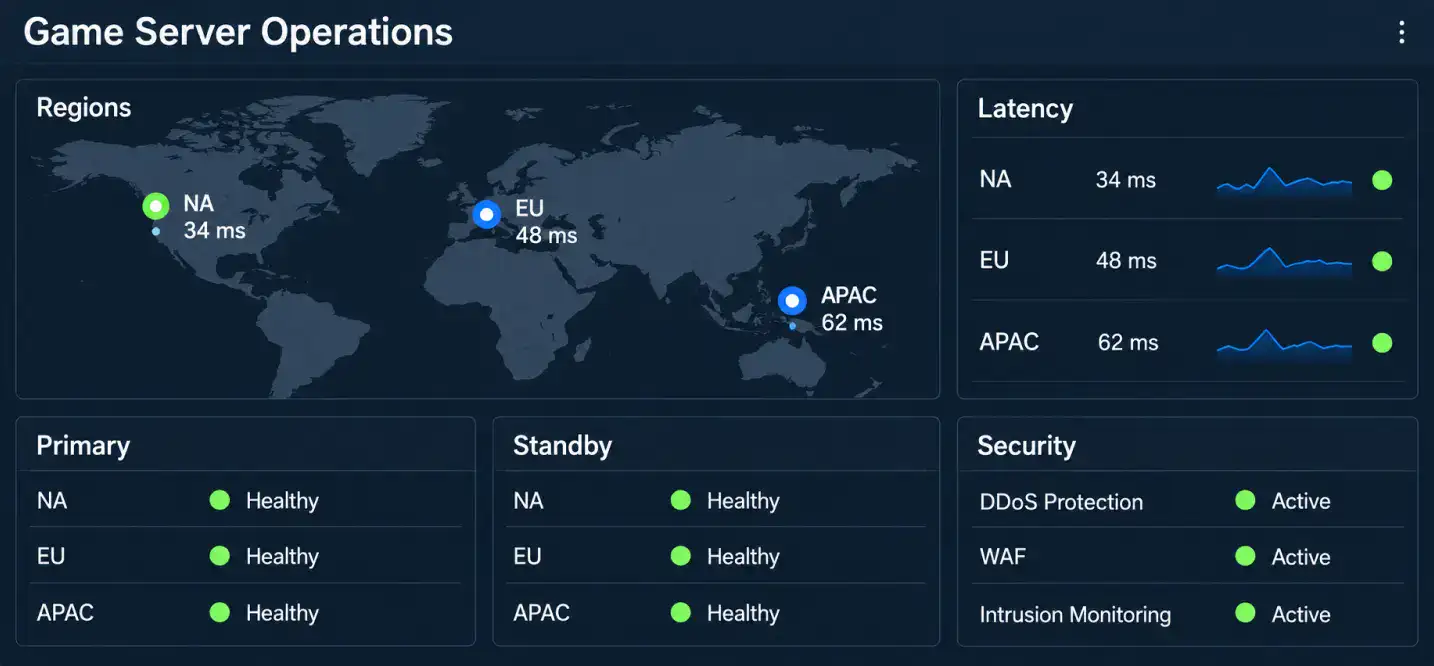
A latency budget is the sum of input sampling, network round-trip time, server tick and rendering. As a rule of thumb (not a benchmark), fast action games aim for round trips in the tens of milliseconds, while turn-based games tolerate hundreds. Deploy game servers near player clusters, measure client-to-region ping, and let the matchmaker prefer low-latency regions. Keep platform services such as auth and profiles in fewer regions with replicas, since they tolerate more delay. Tick rates commonly sit between 20 and 60 Hz, with competitive shooters going higher; every increase raises CPU cost per session.
Game backend scalability
Game backend scalability rests on stateless services, horizontally scaled game server fleets and capacity that follows demand. Fleet managers, such as the open-source Agones on Kubernetes or cloud-provider services, start and stop game server processes. Scale on active sessions rather than CPU, keep a warm buffer, and plan for launch spikes and weekend peaks. For databases, use read replicas, shard by player ID and cache hot data. Cubix’s guide to building scalable multiplayer game systems opens with the scenario of a game attracting 100,000 players in its first week, which is exactly the kind of load that exposes weaknesses invisible in testing.
Platform risk is real too: Unity’s built-in Multiplay Game Server Hosting reached end of support on March 31, 2026 (as reported by Supercraft), a reminder to keep an exit path from any proprietary host.
Resilience
- Failover: multi-zone databases, health-checked load balancers and region failover for platform APIs.
- Graceful degradation: if leaderboards fail, the game still plays; if the store fails, queue purchases for retry.
- Idempotent writes: make purchases and rewards safe to repeat.
- Backups: automated, point-in-time recovery, with scheduled restore drills.
- Ephemeral servers: game servers will crash, so save checkpoints or results so players are not penalized.
Security
Gaming is a heavily targeted sector. Akamai’s Gaming Respawned report found that games accounted for 37% of all DDoS attacks it tracked (financial services were next at 22%), and that web application attacks on gaming grew 167% from Q1 2021 to Q1 2022, led by local file inclusion (38%), SQL injection (34%) and cross-site scripting (24%). That is 2022 data, so read it for direction rather than precision.
Core controls include DDoS protection with game server IPs hidden behind relays, validation of every client message, server-side anti-cheat with telemetry anomaly detection, signed expiring tokens, a web application firewall with rate limiting, secrets management and dependency scanning. The cost of failure is substantial: IBM’s 2025 Cost of a Data Breach Report puts the global average at $4.44 million, the US average at $10.22 million, and the average time to identify and contain a breach at 241 days.
Managed vs Custom Backend: How to Decide
| Factor | Managed (BaaS or hosted services) | Custom build | Hybrid |
|---|---|---|---|
| Time to market | Weeks | Months | Weeks to months |
| Upfront cost | Low | High | Medium |
| Running cost at scale | Usage fees can climb | Lower unit cost if well run | Balanced |
| Control | Limited to vendor features | Full | High on core logic |
| Lock-in | Medium to high | Low | Low to medium |
| Team needed | 1 to 2 backend engineers | 4+ including DevOps/SRE | 2 to 4 |
| Best fit | Prototypes, indie and small studios | Large live-service games, unusual requirements | Most mid-size studios |
Score your project on five criteria: team size, real-time versus asynchronous gameplay, expected concurrent users, compliance needs and exit cost. Supercraft’s overview observes that studios without a dedicated platform engineer usually choose managed backends. That is a vendor view, but it matches common sense. A popular hybrid is managed auth, player data and analytics with custom matchmaking rules and game server logic.
Game cloud hosting and cost considerations
Game cloud hosting costs come from compute (usually the largest line), egress bandwidth, managed databases, cache, load balancers, observability, DDoS protection and support. The main levers are packing several sessions onto each instance, a committed baseline with on-demand burst capacity, regional price differences, compact state updates and log retention limits. Count engineering time as well: on-call rotations are a real operating cost.
Implementation Workflow: Stages and Prerequisites
- Requirements: genre, forecast concurrency, regions, compliance and cheating risk.
- Architecture decision: managed, custom or hybrid, with an exit plan.
- Vertical slice: login, matchmake, play, save. Prove the full loop early.
- Core build: services, CI/CD, separate environments and infrastructure as code.
- QA and load testing: bot simulations, soak tests and failure injection.
- Soft launch: one or two markets, with KPIs tuned on real telemetry.
- Global launch and live ops: on-call, patching, seasonal events and cost reviews.
Cubix’s write-up on building a multiplayer game in 16 weeks is one real example of a milestone-driven path from planning to launch, and its guide to multiplayer technologies covers networking and framework choices. Timelines always depend on scope.
Roles: backend engineers, network or gameplay engineers, DevOps/SRE, QA for load and security, a data analyst, a producer and a named security and compliance owner. If your team lacks some of these, external game development services or a decision to hire game developers for specific gaps are options to weigh against hiring in-house.
Worked Example: A Mid-Size Mobile Multiplayer Game

This is an illustrative estimate built on stated assumptions, not a verified benchmark. Imagine a 2v2 competitive title in the mobile game development space.
Assumptions
- 500,000 daily active users; peak concurrency of 25,000 (5% of DAU).
- 4 players per match, so 6,250 simultaneous sessions at peak.
- One 8-vCPU instance hosts 60 sessions, so about 105 instances at peak and about 58 on average (55% average load).
- Three regions, with traffic split roughly 45/35/20.
- Average 10 kbps per player: about 250 Mbps at peak and roughly 45 TB of egress per month.
- Assumed prices: $0.35 per instance-hour on demand, about 30% saved on the baseline through commitments, and $0.08 per GB egress.
| Component | Basis | Monthly estimate |
|---|---|---|
| Game server compute | 58 avg instances x 730 h x $0.35 = about $14,800 on demand, blended with commitments | ~$12,000 |
| Egress bandwidth | 45 TB x $0.08/GB | ~$3,600 |
| Managed PostgreSQL (primary + replica) | Assumed | ~$1,500 |
| Redis cache (high availability) | Assumed | ~$900 |
| Observability and logging | Assumed | ~$1,200 |
| Auth, load balancers, misc. | Assumed | ~$500 |
| Total | ~$19,700 |
That works out to roughly $0.04 per DAU and $0.79 per peak concurrent user per month. Real prices vary by provider and region (treat the figures as plus or minus 30%), and the total excludes staff, platform store fees, anti-cheat tooling and support. Use it to sanity-check a plan, then replace it with numbers from your own load tests.
Measuring Success: KPIs and Failure Signals
| KPI | Illustrative target | Failure signal |
|---|---|---|
| Median matchmaking time | Under 20 seconds | p95 above 60 seconds or trending up |
| p95 round-trip latency to game server | Under 80 ms (mobile real-time) | Regional p95 above 120 ms |
| Server tick stability | 99% of ticks on schedule | Rubber-banding, tick overruns |
| Crash-free sessions | 99.5% or higher | Drop after a release |
| Unexpected disconnect rate | Under 2% of sessions | Regional spikes |
| API p99 latency | Under 300 ms | Login timeouts |
| Availability SLO | 99.9% (about 43.8 minutes of error budget per month) | Budget consumed in week one |
| Cost per peak concurrent user | Track the trend | Rising without player growth |
These targets are our starting points, not industry standards. Calibrate them during soft launch.
Validation methods: load tests with bots up to 120 to 150% of forecast peak; 24 to 72 hour soak tests; chaos tests such as killing servers, forcing database failover and simulating a region loss; soft-launch telemetry review; restore drills; and an external penetration test before global launch.
Common Mistakes and Risks
- Trusting the client. Any value the client reports can be forged.
- Skipping load tests. Launch day becomes your test, in public.
- Single-region launch. Distant players churn quickly when latency is poor.
- No observability or owners. You find out from reviews, not dashboards.
- Over-engineering early. Microservices and a large cluster for a few hundred players add cost and risk without benefit.
- Underestimating live ops. Patches, events, on-call and content updates continue for years.
- Lock-in without an exit path. Provider shutdowns happen, as the Multiplay sunset showed.
Governance and maintenance: control access with least privilege, manage secrets centrally, define data retention, document runbooks, name an owner per service, and review cost and security quarterly. Plan for dependency upgrades, schema migrations and cloud service deprecations.
Game Backend Architecture Checklist and Next Steps
Production-readiness checklist
- Server-authoritative logic for every ranked, economy or purchase action
- Short-lived tokens, refresh flow and separate server credentials
- Matchmaking queue time, quality and backfill measured
- Game servers deployed in the regions where players actually are
- Autoscaling on session count with a warm buffer
- Database backups with a tested restore
- Encryption in transit and at rest; privacy deletion process defined
- DDoS protection, rate limiting and server IPs not exposed
- Logs, metrics, traces and alerts with named owners
- Load, soak and failure tests passed at 120%+ of forecast peak
- Runbooks, on-call rota and rollback plan
- Cost per peak concurrent user tracked monthly
Next steps
- Write a one-page requirements brief: genre, forecast concurrency, regions, compliance.
- Score managed, custom and hybrid against the decision table above.
- Build a vertical slice before committing to the full architecture.
- Load test before soft launch, and set KPI targets from the results.
- Assign an owner to every service and schedule the first quarterly review.
Ready to Power Your Multiplayer Game?
Contact UsFrequently Asked Questions
1. What is a game backend?
The server-side systems that handle identity, matchmaking, sessions, authoritative game logic, player data and monitoring so a game is persistent, fair and secure.
2. Do multiplayer games need dedicated servers?
Competitive or economy-driven games should use them. Casual co-op can use listen servers or relays, and turn-based games may only need a validated API.
3. How does matchmaking work?
Players enter a queue with a ticket, the matcher groups compatible tickets while relaxing limits over time, a server is allocated in a suitable region, and backfill fills open slots.
4. How is player data stored securely?
Through encryption in transit and at rest, least-privilege access, federated identity or strong hashing, audit logging, tested backups and clear retention and deletion rules.
5. What is the difference between a managed and custom game backend?
A managed backend uses existing services to handle features like authentication, player data, and hosting. A custom backend gives developers more control but requires more time and resources. A hybrid approach combines managed services with custom systems for features like matchmaking and game logic.
6. How much does game backend hosting cost?
Game backend hosting costs depend on player numbers, server capacity, bandwidth, databases, and monitoring tools. For example, an illustrative setup with 500,000 daily active users and 25,000 peak concurrent players could cost around $19,700 per month. Actual costs vary by provider, region, and game requirements.
7. How can I make a multiplayer game backend scalable?
Build stateless services, use autoscaling for game servers, and choose databases and caches based on your game’s data needs. Deploy servers close to player populations to reduce latency. Load testing, performance monitoring, and reliable backup systems also help your backend handle traffic spikes and maintain stable gameplay.
8. How do I prevent cheating in multiplayer games?
Use authoritative game servers to validate important player actions, rewards, purchases, and rankings. Avoid trusting the player’s device to determine game outcomes. Add secure authentication, rate limiting, server-side anti-cheat checks, and monitoring to identify suspicious activity and protect the game economy.