Key Takeaways
- Artificial intelligence in mobile apps is now a core product layer, not an optional feature.
- AI-driven mobile apps improve engagement through personalization, prediction, and automation.
- AI integration in mobile applications enhances security, performance, and user experience in real time.
- AI-powered systems enable apps to learn continuously from user behavior and adapt dynamically.
- Artificial intelligence applications are transforming industries like healthcare, finance, and e-commerce.
- Mobile app AI integration is becoming a standard expectation in modern digital products.
- AI agents and generative systems are shifting apps from reactive tools to adaptive digital experiences.
Artificial intelligence is no longer a future concept; it is actively reshaping how digital products are built and experienced today. Every interaction, from search results to smart recommendations, is increasingly powered by intelligent systems that learn and adapt in real time.
The global artificial intelligence market size was valued at USD 390.9 billion in 2025 and is projected to grow from USD 539.5 billion in 2026 to USD 3,497.3 billion by 2033, at a CAGR of 30.6% from 2026 to 2033. This rapid expansion reflects how deeply AI integration is influencing modern technology ecosystems, especially within mobile platforms and digital products.
At the same time, mobile applications continue to dominate how users interact with brands, services, and information. When AI and mobile come together, they create systems that are not only responsive but continuously evolving based on user behavior.
This convergence is redefining mobile app development, creating new opportunities for companies like Cubix, a recognized custom mobile application development partner focused on building AI-driven digital products for real-world business needs. At Cubix, we turn these advancements into practical solutions that help businesses deliver smarter, more adaptive digital experiences.
As we explore this topic further, we will break down how artificial intelligence in mobile app development is moving far beyond automation and chatbots, shaping a new generation of intelligent, user-aware applications.
“Our goal is to build technology that feels alive, apps that think, respond, and evolve alongside their users” – Salman Lakhani, CEO of Cubix.
Want to discuss your project? Our experts are just a click away.
Contact UsHow AI Is Transforming Mobile App Development
In simple words, AI in mobile app development is the process of integrating artificial intelligence into the mobile development process to make apps faster and more user-friendly. It’s all about improving how apps work and how people interact with them.
Artificial intelligence is no longer a fancy add-on; it’s becoming the backbone of modern mobile app development. From small startups to global enterprises, AI helps brands create applications that think, learn, and respond intelligently.
Here’s how AI is changing the game:
- Personalized Experiences: Apps can now learn user habits to deliver tailored content, smarter suggestions, and better engagement.
- Smarter Security: Predictive AI systems detect fraud, recognize unusual activity, and block potential threats before they cause harm, and keep user data safer than ever.
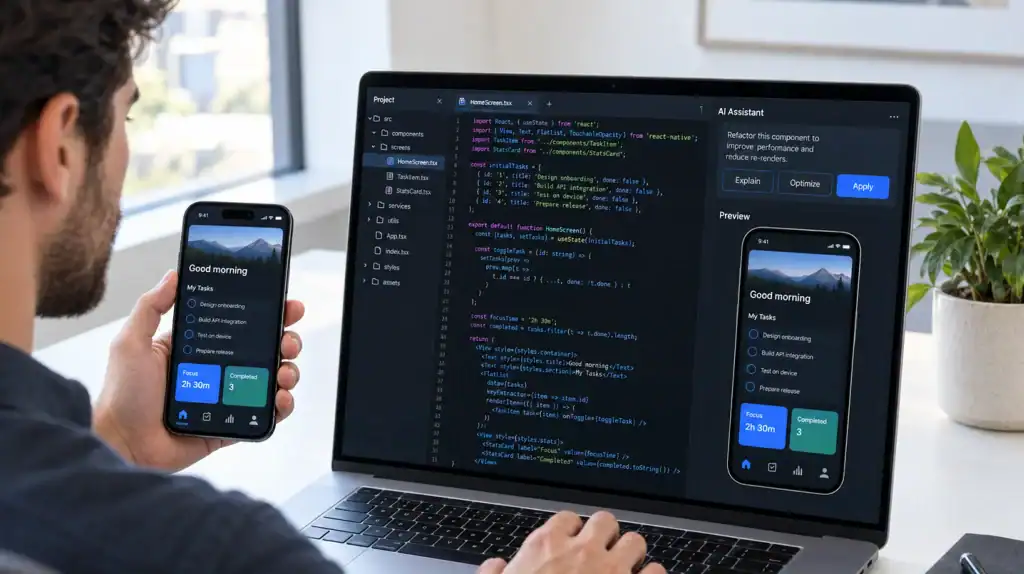
- Faster Development Cycles: AI-powered automation tools handle testing, debugging, and even code generation, reducing human error and accelerating time-to-market.
- Voice and Vision Integration: Features like speech recognition, natural language processing (NLP), and image detection make apps more interactive, accessible, and human-like in communication.
The impact of AI on mobile app development goes far beyond convenience; it’s about creating intelligent ecosystems that adapt to user needs in real-time, turning traditional apps into responsive, evolving digital companions.
Also Read: Create an App Using OpenAI
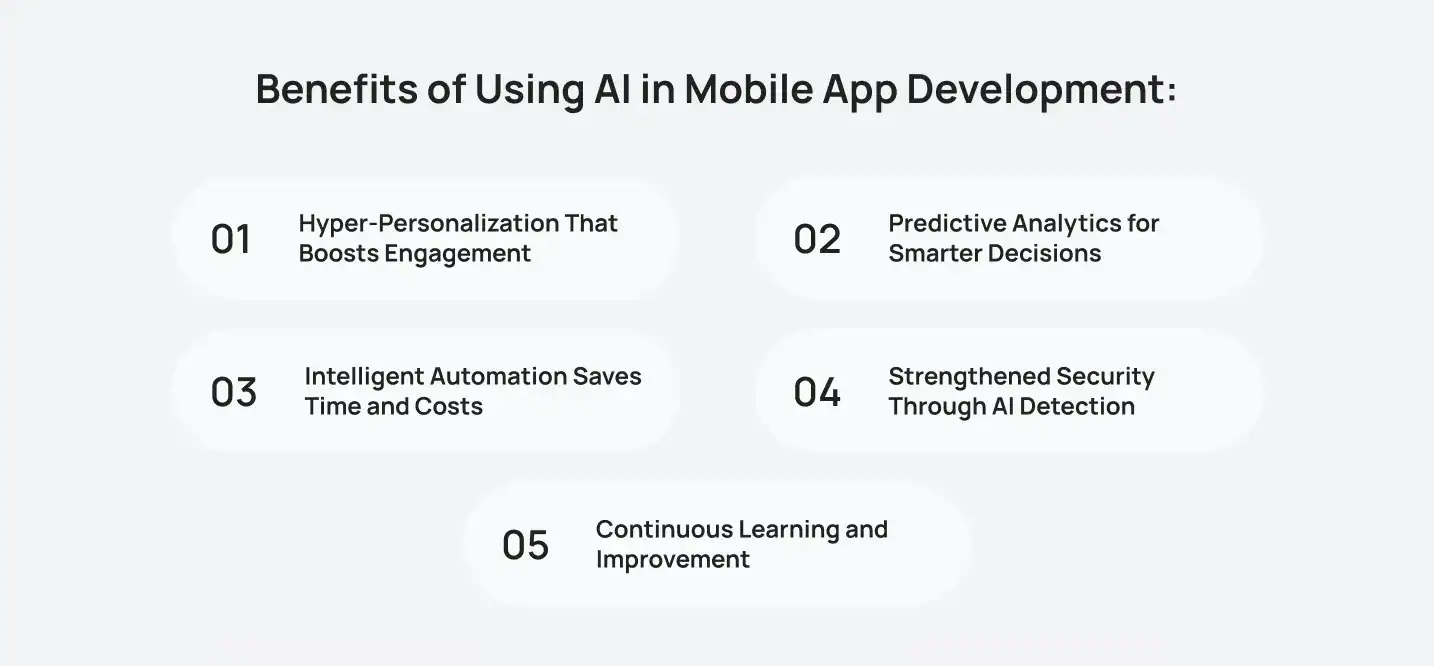
Benefits of Using AI in Mobile App Development
Artificial intelligence is rewriting the rules of how mobile apps are designed, built, and experienced. By infusing AI-driven app development, businesses are unlocking a level of intelligence and efficiency that was once unimaginable. From predictive analytics to hyper-personalized user journeys, AI empowers developers to deliver smarter apps that learn and evolve.
Let’s explore the most impactful benefits AI brings to the mobile app world.
Hyper-Personalization That Boosts Engagement:
AI helps apps understand users. By analyzing behavior patterns such as location, time spent, and in-app activity, AI-powered experiences deliver tailored interactions that feel relevant and intuitive.
For example: Netflix uses AI-driven recommendation engines that contribute significantly to viewer engagement. Personalization is no longer an added feature. It has become an expectation.
Predictive Analytics for Smarter Decisions:
AI algorithms process large datasets to predict future actions, from shopping behavior to health preferences. These artificial intelligence applications help businesses make data-informed decisions that improve retention and monetization.
Intelligent Automation Saves Time and Costs:
AI automates repetitive tasks, including testing, debugging, and optimization, allowing development teams to focus on innovation. Effective mobile app AI integration also improves release quality and shortens development cycles.
Strengthened Security Through AI Detection:
Security breaches cost companies billions annually. AI’s predictive monitoring systems can recognize irregular user activity, detect malware, and block suspicious access in real time.
For example, banking apps use AI-based fraud detection to identify anomalies within milliseconds, saving millions in potential losses.
By adding a cognitive layer of protection, AI ensures that trust remains at the heart of digital interactions.
Continuous Learning and Improvement:
Unlike traditional applications, AI-enabled apps continuously learn from user interactions. Each update and behavioral signal helps improve recommendations, responsiveness, and overall experience.
This adaptive intelligence allows applications to evolve alongside changing user expectations and emerging capabilities powered by modern AI agents.
Build Smarter Apps: The Best AI Tools for Developers in 2026
In 2026, the demand for smarter, more adaptive, and reliable mobile apps is skyrocketing, and AI tools are leading the charge. From automating code to personalizing user experiences. Around 89% of small businesses use AI tools for everyday tasks. AI-powered platforms are helping developers cut time, boost performance, and create more intelligent apps than ever before.
Here are 6 powerful AI tools shaping the future of app building in 2026:
|
AI Tool |
Key Highlights |
Best Use Cases |
| Tensor Flow | An open-source ML framework by Google that supports deep learning, predictive modeling, and neural networks. | Smart recommendations, predictive search, and real-time analytics. |
| IBM Watson | Cognitive AI that processes natural language and understands user emotions to enhance engagement. | Chatbots, emotion-aware UX, voice-enabled assistants. |
| Microsoft Azure AI | Cloud-based suite offering pre-built AI models and APIs for faster app scaling and integration. | Facial recognition, language translation, automation. |
| OpenAI API | Powered by GPT models, enabling generative and conversational AI for advanced text and dialogue features. | Chatbots, content creation, and personalization engines. |
| Amazon SageMaker | An end-to-end machine learning platform that simplifies model training, deployment, and management. | Predictive analytics, fraud detection, data insights. |
| Dialogflow | Google Cloud’s conversational AI platform for building voice and text-based assistants. | Voice commands, app navigation, customer support bots. |
Pro Tip: Choosing the right AI tool depends on your app’s core goals, whether that’s smarter automation, faster development, or a more human-like user experience. The right integration can elevate your app from functional to truly intelligent. However, selecting the right stack is only part of the process. Understanding how successful AI products move from strategy and development to launch can help teams make better implementation decisions and build stronger digital experiences.
Learn more about how to Build a Successful AI App.
How Generative AI is Revolutionizing Mobile App Development

Generative AI is rewriting the rules of mobile app development, turning what once took weeks of manual effort into hours of intelligent creation. In simple terms, it’s the technology that allows apps to think, design, and evolve on their own, also producing smarter layouts, tailored content, and dynamic interactions based on user behavior.
Instead of static interfaces, today’s AI-driven apps continuously adapt to how users engage. Developers can now leverage generative models to automatically generate app designs, craft personalized recommendations, and even write functional code, drastically reducing human effort while boosting innovation.
According to a recent Gartner report, by 2026, more than 80% of organizations will have adopted Generative AI-powered tools or integrated AI-driven APIs into their applications, a dramatic rise from just a fraction in 2023. This rapid expansion highlights how Generative AI is becoming a core driver of innovation, efficiency, and automation in modern app ecosystems.
From generating app copy in seconds to crafting intuitive UI elements, Generative AI in mobile app development isn’t just an upgrade; it’s a creative revolution shaping the next generation of intelligent, human-like digital experiences.
Smarter Experiences: How AI Redefines User Interaction with Real-World Magic
Let’s be honest, people don’t just use apps anymore; they connect with them. What used to be simple clicks and screens has evolved into meaningful, almost human-like interactions.
- Picture this: Spotify doesn’t simply queue songs; it senses your mood and builds a playlist that feels like your personal soundtrack. Netflix understands your late-night cravings and lines up shows you didn’t even know you wanted. And Duolingo adapts its tone and lessons just like a real teacher who knows when to push and when to encourage.
As these experiences become more intelligent, platform-level AI capabilities continue shaping how mobile interactions evolve. Understanding the differences between Apple Intelligence vs Android AI offers useful insight into how the next generation of personalized app experiences is being built.
In truth, artificial intelligence isn’t just enhancing how we use digital products; it’s rewriting the rules of engagement. Apps no longer just function; they feel. They listen, respond, and evolve, just like the people using them.
The Future of AI in Mobile App Development:
Artificial intelligence is no longer just shaping Apps; it’s defining their destiny. The coming years promise innovations that make mobile feel seamless, personal, and emotionally aware. Here’s what’s next.
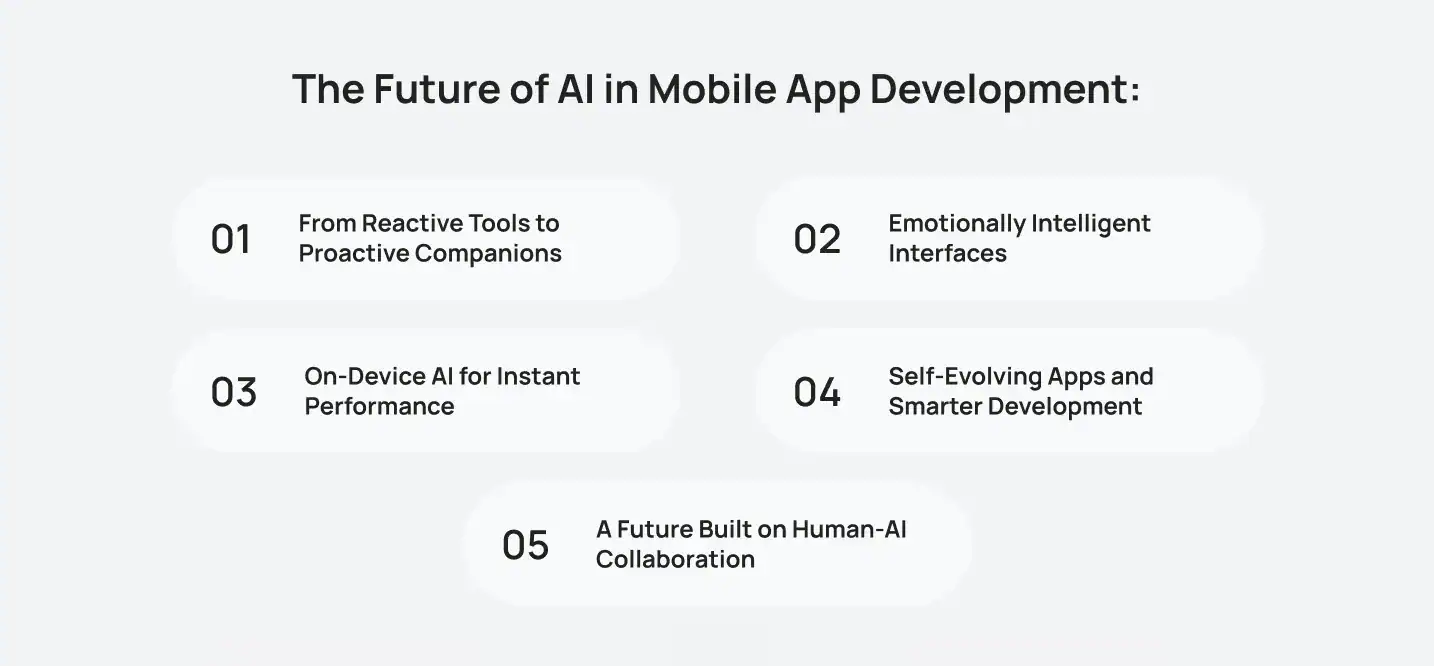
1: From Reactive Tools to Proactive Companions
Tomorrow’s apps won’t wait for input; they’ll anticipate it. AI will enable applications to predict user needs, automate responses, and assist proactively, creating fluid interactions that save time and feel intuitive.
2: Emotionally Intelligent Interfaces
Future apps may read facial cues, tone, and gestures to sense user emotions and adapt their responses accordingly. Imagine an app that detects frustration and simplifies its interface instantly, with empathy built into the design.
3: On-Device AI for Instant Performance
As edge computing advances, more AI functions will run directly on smartphones. This means faster processing, better privacy, and real-time personalization without constant internet connectivity.
4: Self-Evolving Apps and Smarter Development
With Generative AI and automated optimization, apps will soon update and redesign themselves based on user feedback by reducing human input while boosting creativity and speed.
5: A Future Built on Human-AI Collaboration
The next era isn’t about replacing developers but empowering them. AI will handle the repetitive tasks, while humans focus on creativity, strategy, storytelling, and crafting apps that truly understand people.
Cubix’s AI-Powered Approach to Next-Gen Mobile App Development
At Cubix, innovation is more than a goal; it’s the foundation of everything we create. By fusing human creativity with advanced intelligence, we craft digital products that adapt, grow, and respond like living systems. Our AI-first approach turns bold concepts into intuitive applications that go beyond performance; they connect, learn, and continuously improve with every user touchpoint.
Here’s how we craft smarter, future-ready solutions:
- We begin by aligning technology with strategy, ensuring every AI-driven feature solves a real business challenge.
- Our mobile app Developers harness machine learning to predict user needs and personalize experiences that feel effortless.
- Automation plays a vital role, from testing to deployment, helping us deliver faster, more reliable results.
- Advanced tools like voice, vision, and emotion recognition add a human touch to every interaction.
- Post-launch, our apps keep evolving through continuous learning, adapting to user behavior and emerging trends.
Ready to take your mobile app to the next level? Get in touch today and start building intelligent, adaptive, and engaging experiences that captivate your users.
Summing Up:
The world of mobile applications is entering a new era, where intelligence drives every interaction. Apps are no longer just tools; they’re becoming adaptive companions that learn, respond, and evolve with users. From hyper-personalized experiences to self-optimizing features, AI is transforming how people engage with technology.
This shift allows developers to craft solutions that feel intuitive, dynamic, and continuously improving, raising the bar for user satisfaction and innovation.
The future of mobile technology favors those who harness AI effectively. By integrating intelligent systems today, businesses can deliver experiences that feel alive, responsive, and unforgettable, shaping a smarter, more connected digital landscape.
Want to discuss your project? Our experts are just a click away.
Contact UsFrequently Asked Questions:
1. What is the role of AI in mobile app development?
AI enables apps to learn user behavior, deliver personalized experiences, and optimize performance automatically. It makes apps smarter, faster, and more engaging. Businesses can enhance retention and provide seamless interactions.
2. How does Generative AI impact mobile app creation?
Generative AI can design interfaces, create content, and even write functional code. It reduces development time while producing highly adaptive, user-focused experiences. Developers can innovate faster and smarter.
3. What are the main benefits of integrating AI into mobile apps?
AI improves personalization, boosts security, speeds up development, and adds interactive features like voice or image recognition. It keeps users engaged and ensures apps continuously evolve.
4. Which industries are using AI in mobile applications?
Healthcare, finance, e-commerce, entertainment, and education are leading the AI adoption. These sectors use AI to predict trends, personalize experiences, and enhance overall user satisfaction.
5. What challenges should developers consider when using AI in apps?
Key concerns include data privacy, algorithmic bias, ethical use, and transparency. Developers must carefully design AI systems to maintain trust and protect users.
6. How does Cubix leverage AI in mobile app development?
Cubix, a leading AI app development company, uses advanced AI technologies to create apps that learn, adapt, and evolve with users. Their solutions combine personalization, automation, and intelligent design to deliver smarter, future-ready mobile experiences.