Key Takeaways
- Define the business result first, because a model is not a goal on its own.
- Document your data, systems, and security rules before vendors ask for them.
- Share a realistic budget range and a phase-by-phase timeline with every vendor.
- Publish weighted scoring criteria inside the RFP so vendors know what matters.
- Require a proof of concept with clear exit criteria before full development starts.
- Ask for a three year total cost of ownership, not only the build price.
Most teams buy AI before they define what it must do. A clear AI project RFP fixes that problem before it starts. But the payoff often lags. PwC’s 2026 Global CEO Survey found that 56% of CEOs have seen no significant financial benefit from AI so far. Therefore, clear requirements at the buying stage matter.
First, this guide shows you what to put in the document. Then it explains how to score vendors and test a solution before you commit. You also get a 12-section structure, a weighted scoring table, and copy-ready template blocks.
Cubix is an AI software development company with over 18 years of experience. Because we sit on the vendor side of the table, we know what strong requests look like. As a result, this guide flags the gaps that slow proposals down.
Talk to Cubix experts and plan your AI project today
Contact UsWhat Is an AI Project RFP?
An AI request for proposal is a formal document that tells vendors what you need. It also shows how you will judge answers and how to respond. Because every vendor answers the same questions, you can compare scope, price, and risk side by side.
The need is clear. McKinsey’s 2026 State of AI survey found that nearly nine in ten respondents use AI regularly. Even so, only 37% report any profit impact. Spending keeps rising, too. Gartner forecasts worldwide AI spending of $2.52 trillion in 2026, a 44% increase over 2025.
However, large budgets with loose requirements create waste. A structured RFP prevents that waste in four ways:
- It sets a clear scope before vendors price the work.
- It forces an early talk about data and security.
- It makes pricing comparable across bids.
- It creates a record of how you chose your partner.
When should you send an AI RFP?
Send your AI project RFP when you know the problem but not the best partner. An AI development RFP fits that stage because it asks vendors to design and build the answer. Confirm these four points first:
- You can state the business problem in one sentence.
- You know which data the project needs and who owns it.
- Leadership has approved a budget range.
- A named owner can answer vendor questions within two days.
If you still explore options, send a request for information first. When you plan to hire outside help, read our guide to choosing an AI outsourcing partner before you shortlist.
RFI vs. RFP vs. RFQ
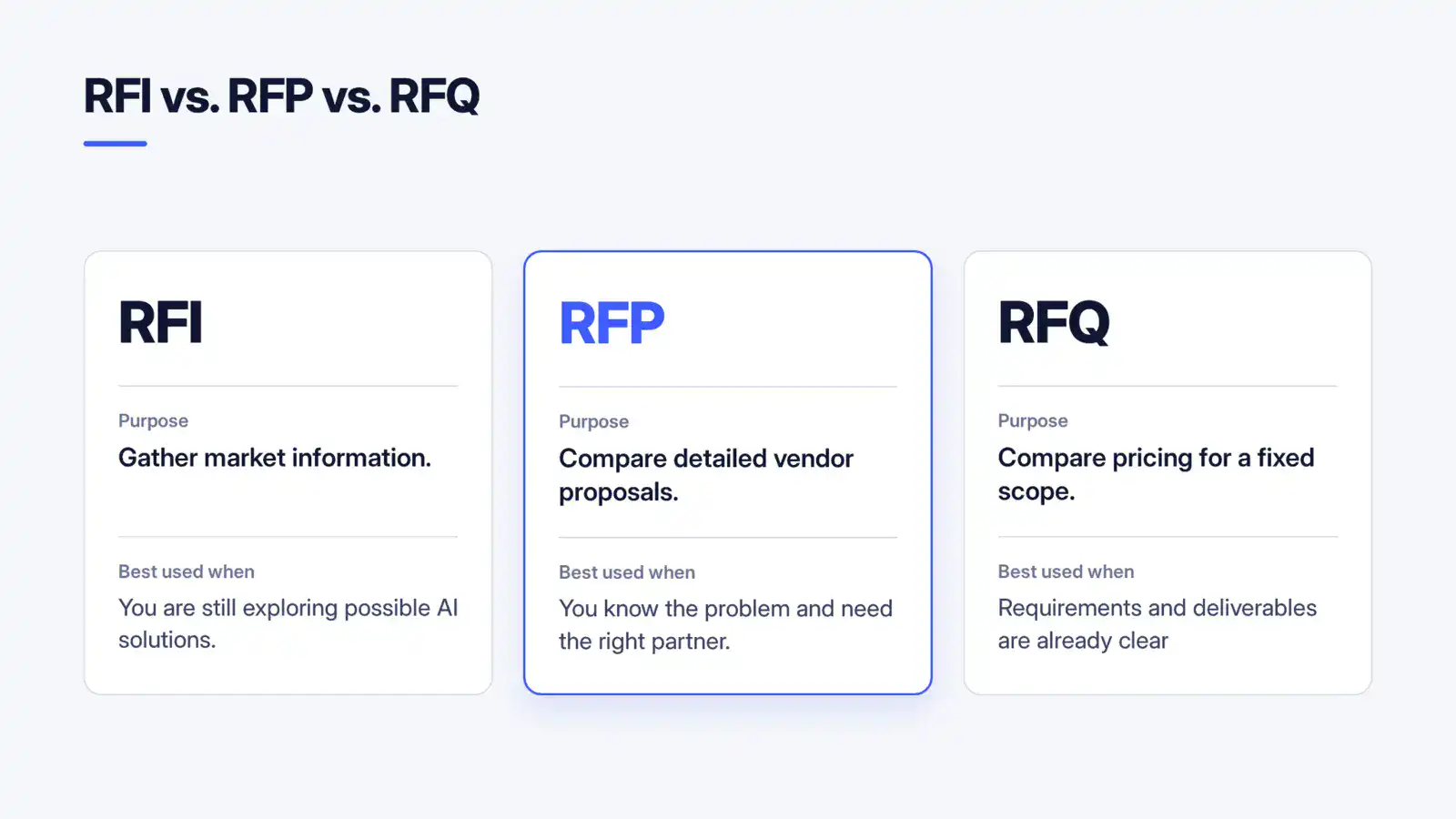
Teams often mix up these three documents, but each one serves a different stage.
| Document | Purpose | Best used when |
|---|---|---|
| RFI | Gather market information. | You are still exploring possible AI solutions. |
| RFP | Compare detailed vendor proposals. | You know the problem and need the right partner. |
| RFQ | Compare pricing for a fixed scope. | Requirements and deliverables are already clear |
What to Include in an AI RFP
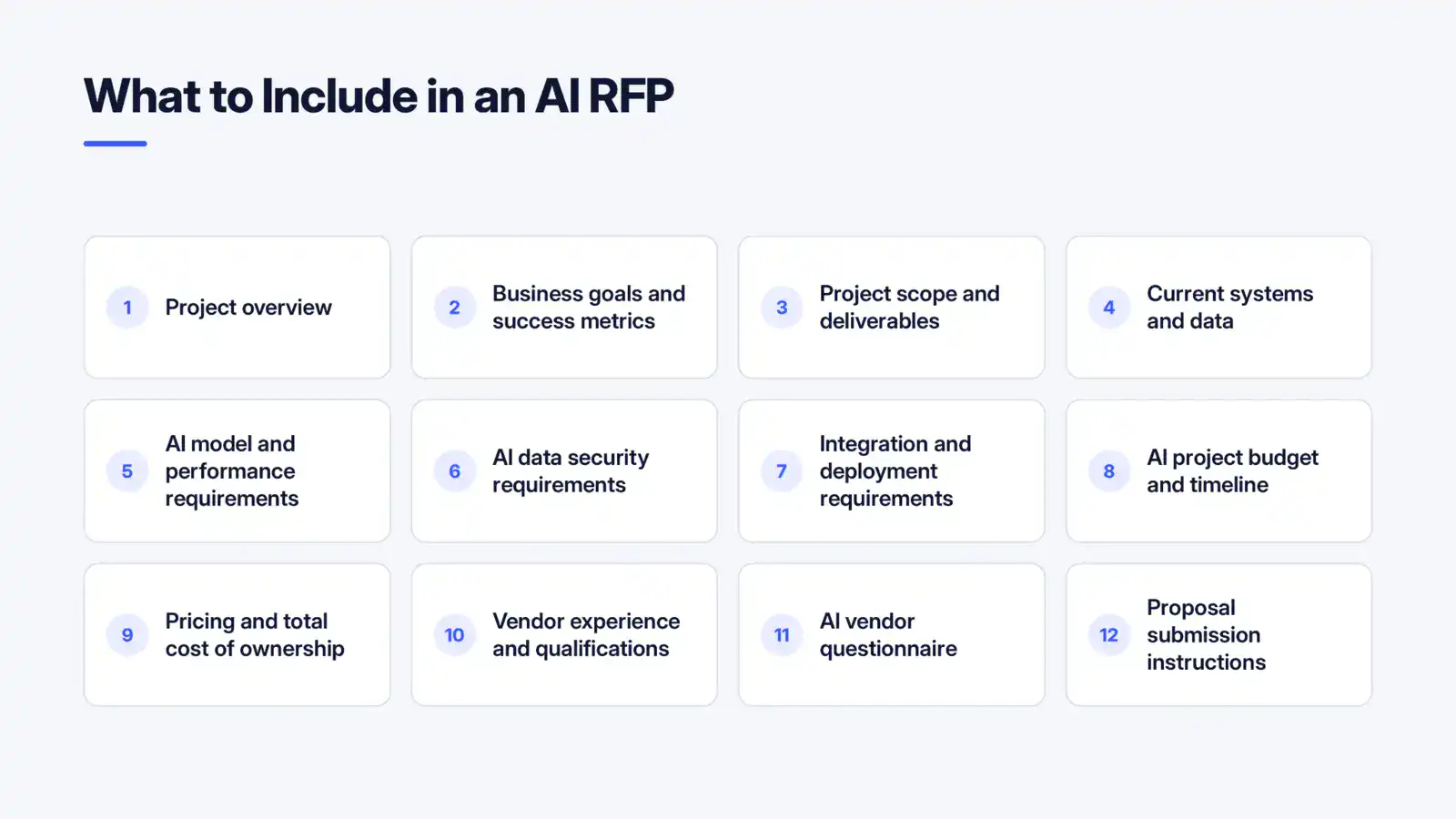
A strong AI RFP covers business context, scope, technical needs, data rules, security, pricing, vendor proof, and scoring. So here is how to write an AI project RFP in 12 sections. Treat them as your AI project scope template, because each section becomes a numbered block in your document.
1. Project overview
Open with context, because vendors need to understand your business before they price anything.
- Company background and industry
- The business problem and who feels it
- The current process and what it costs today
- Project owner and decision makers
- The reason you are sending the RFP now
First, describe the problem, not the tool. For example, write that manual claims review takes 10 minutes per case, not that you need a chatbot. Then keep this section to one page.
2. Business goals and success metrics
Do not define success as building an AI model. Instead, define the business result you want. Also, each goal needs a baseline, a target, and a deadline.
| Goal area | Example metric |
|---|---|
| Efficiency | Reduce processing time from 10 minutes to 2 minutes per case |
| Cost | Lower manual review costs by 30% |
| Accuracy | Achieve 95% extraction accuracy on approved document types |
| Customer experience | Reduce average response time from 24 hours to 2 hours |
| Adoption | 80% of target users active within 60 days |
Metrics matter because many AI programs stay shallow. For example, Deloitte’s 2026 State of AI in the Enterprise report found that 37% of companies use AI only at a surface level, with little or no change to existing processes. So tie every metric to a changed process.
3. Project scope and deliverables
A firm boundary matters, because vendors price only what they can see. So show them everything.
Next, list your AI project requirements as must have, should have, or nice to have. This split lets vendors price the core first.
- In scope: use cases, user groups, channels such as web, mobile, or API, and languages
- Deliverables: models, APIs, dashboards, documents, and user training
- Out of scope: work you handle yourself, such as data labeling or change management
4. Current systems and data
Data decides whether an AI project works, so describe yours honestly.
- Data sources, volumes, and formats
- Known quality issues
- Data owners and access rules
- Labeling status
- Systems the solution touches, such as CRM or ERP
- Privacy class of each dataset
Gartner predicts that companies will drop 60% of AI projects through 2026 when the data is not AI ready. Therefore, share a sample dataset under an NDA. Vendors can then test feasibility before they bid.
5. AI model and performance requirements
Write AI model performance requirements as numbers that vendors can test.
Core targets
- Accuracy or another task metric, measured on your own data
- Response time, such as under 3 seconds
- Throughput at peak load
- Uptime targets
- Bias and fairness tests
- Explainability needs
- A monitoring and retraining plan
If you use this document as a machine learning RFP template, also add training data lineage, a validation method, and drift limits.
Generative AI additions
Generative AI RFP requirements also need a few extra items:
- Hallucination limits and approved sources for answers
- Prompt injection tests
- Human review rules for risky outputs
- Model choice and switching rights
- Content filtering rules
Also, if the solution acts on its own, set tool access limits and approval steps. Our guide on how to build effective AI agents explains the moving parts if you plan to build one.
6. AI data security requirements
Security rules belong in the RFP, because they are hard to add after you pick a vendor. Then ask vendors to confirm each item in writing:
- Data residency and hosting regions
- Encryption at rest and in transit
- Role-based access and audit logs
- A ban on training models with your data unless you approve it
- Certifications such as SOC 2 Type II, ISO 27001, and ISO 42001
- Compliance with GDPR, HIPAA, or the EU AI Act where they apply
- Incident reporting within a set time
- A full list of subprocessors
7. Integration and deployment requirements
A model that cannot connect to your systems has no value, so list every connection point.
- APIs and protocols
- Single sign on
- Links to your CRM, ERP, and data warehouse
- Deployment model: cloud, on premises, or hybrid
- Separate test, staging, and live setups
- Monitoring and alerting
- Scale targets
- User training and handover guides
8. AI project budget and timeline
Sharing a realistic budget range helps vendors propose a suitable solution instead of guessing. Add the range to your AI project RFP, then ask vendors to split cost by phase.
| Phase | Example duration | Key output |
|---|---|---|
| Discovery | 2 to 4 weeks | Requirements, data assessment, success metrics |
| Prototype or POC | 2 to 6 weeks | Working proof of concept |
| Development | 6 to 16 weeks | AI solution and integrations |
| Testing | 2 to 4 weeks | Quality, security, and user acceptance results |
| Deployment | 1 to 3 weeks | Production launch |
| Support and optimization | Ongoing | Monitoring, retraining, and improvements |
First, use these durations as a starting point. Then adjust them to your data readiness and integration depth.
9. Pricing and total cost of ownership
The build price is only part of the cost, so ask vendors to show every line.
- Pricing model: fixed price, time and materials, or outcome based
- Cost per phase
- Licenses and cloud usage costs
- Data prep and system links
- Training and change management
- Support and monitoring fees
- Three year total cost of ownership
- Change request rates and exit costs
Also check typical ranges in our guide on how much artificial intelligence costs. That way, you can test each quote against the market.
10. Vendor experience and qualifications
Ask for proof, not promises, because claims are cheap.
- Three case studies with AI in production, ideally in your industry
- Named delivery team members with roles and experience
- Three references you can call
- Audit reports and security certificates
- The number of AI products shipped
- A monitoring and retraining approach from past projects
- A list of subcontractors
11. AI vendor questionnaire
Attach an AI software vendor questionnaire so every vendor answers the same technical questions. Here are six to start with:
- Which models and frameworks will you use, and why?
- How do you handle our data during training and use?
- How do you detect model drift and retrain?
- Who owns the models, prompts, and tuned weights?
- How do you test for bias and hallucination?
- What happens to our data when the contract ends?
Then require written answers with evidence, such as test reports or audit summaries.
12. Proposal submission instructions
Tell vendors exactly how to respond. First, state your AI implementation proposal requirements in one place:
- Required sections and page limit
- Submission deadline and file format
- Q and A window and contact person
- Review dates, including demo days
- Pricing format and how long prices hold
- NDA and conflict of interest rules
Clear rules also speed up scoring, because every response follows the same structure.
AI Vendor Evaluation Checklist
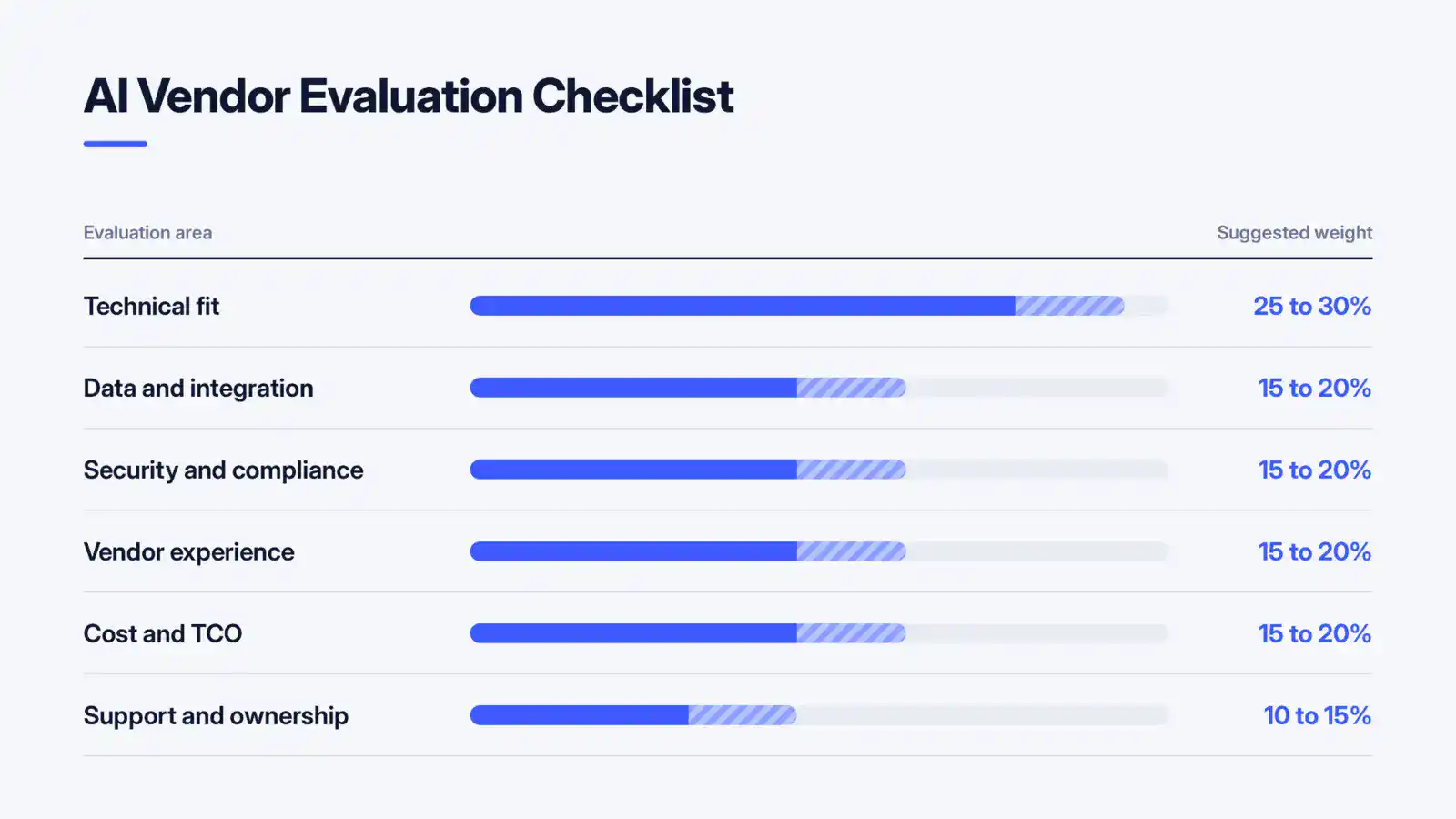
Score every proposal against the same standards, so the comparison stays fair. Then include your AI vendor selection criteria in the RFP, with weights, so vendors know what matters most.
| Evaluation area | What to assess | Suggested weight |
|---|---|---|
| Technical fit | Model approach, performance evidence, architecture, scalability | 25 to 30% |
| Data and integration | Data strategy, integrations, deployment plan, data readiness | 15 to 20% |
| Security and compliance | Data privacy, certifications, access controls, governance | 15 to 20% |
| Vendor experience | Relevant case studies, team expertise, references | 15 to 20% |
| Cost and TCO | Pricing transparency, hidden costs, three year cost estimate | 15 to 20% |
| Support and ownership | SLA, monitoring, training, documents, exit terms | 10 to 15% |
Weights shift with your risk profile. For example, regulated industries raise the security weight. Pick one value inside each range so the total equals 100%.
AI vendor evaluation criteria
Next, turn the table into a repeatable scoring method:
- Set pass or fail gates first, such as required certifications and data residency.
- Score each criterion from 1 to 5 using written definitions.
- Have each evaluator score alone before the group meets.
- Multiply each score by its weight, then add the totals.
- Review the top three vendors with demos and reference calls.
AI Procurement Checklist
Use this list to keep your AI project RFP process on track from first draft to signed contract.
Before you send
- Name an executive sponsor and a project owner.
- Approve the budget range.
- Make a list of all your data.
- Get legal approval for the NDA, MSA, and DPA.
- Build an evaluation panel from business, IT, security, and legal.
While vendors respond
- Log every vendor question and share each answer with all bidders.
- Give every vendor the same Q and A window.
- Keep all contact inside the agreed channel.
Before you sign
- Finish the security review first. A Gartner survey of 302 cybersecurity leaders found that 32% had faced an attack on AI applications that used the application prompt. Security cannot wait until after launch.
- Confirm IP ownership, SLA terms, and exit rights.
- Call at least three references.
- Review the role of AI in compliance for your industry.
Proof of Concept and Pilot Requirements
A proof of concept tests feasibility, while a pilot tests real operations. Require both, and put the terms in your AI project RFP so vendors price them upfront.
Here is why. IDC research with Lenovo found that 88% of observed AI proofs of concept never reached wide deployment. In fact, only four of every 33 launches moved to production. Data also predicts that more than 40% of agentic AI projects will end by 2027 because of rising costs, unclear value, or weak risk controls.
POC requirements
- One clear question the POC must answer
- Your data or a sample that represents it
- A fixed price and a fixed duration
- Success thresholds set before work starts
- Exit criteria, so you can stop without penalty
- A results report that includes failure analysis
- Clear IP terms
Pilot requirements
- A limited user group inside a real workflow
- A production like setup with live integrations
- Measurement against the success metrics in your RFP
- Ongoing support included
- A passed security review before launch
- Go or no go criteria set in advance
- A cost estimate to scale to full production
Common AI RFP Mistakes to Avoid
Each mistake below makes an AI project RFP harder to answer, and then harder to score.
- Vague goals. Loose AI RFP requirements give vendors nothing to price, so write metrics with baselines.
- Hidden data problems. Vendors find them after signing, and then change requests follow.
- No budget range. Vendors guess, so proposals land far apart.
- Too many bidders. Send the RFP to 5 to 8 qualified vendors instead.
- Unweighted scoring. Teams then pick on gut feel or presentation quality.
- Skipped governance. Deloitte found that only 21% of companies have a mature governance model for autonomous agents. Ask every vendor how they handle oversight, logging, and rollback.
- No exit terms. Without data return and handover help, you risk lock in.
How to Evaluate AI Vendors
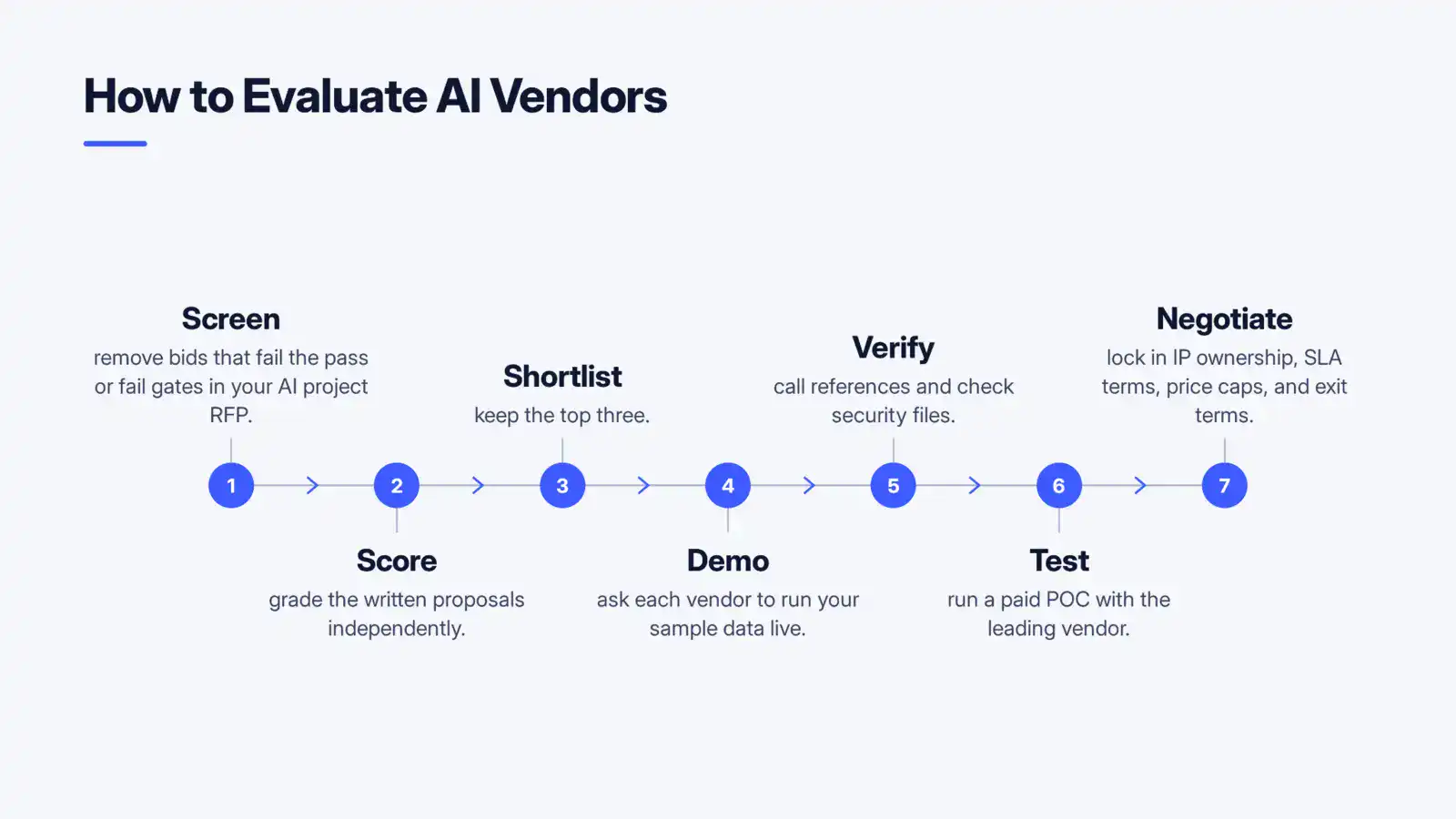
Follow this sequence to move from a pile of proposals to one signed partner:
- Screen: remove bids that fail the pass or fail gates in your AI project RFP.
- Score: grade the written proposals independently.
- Shortlist: keep the top three.
- Demo: ask each vendor to run your sample data live.
- Verify: call references and check security files.
- Test: run a paid POC with the leading vendor.
- Negotiate: lock in IP ownership, SLA terms, price caps, and exit terms.
Look beyond the model. For example, McKinsey found that nearly three quarters of AI high performers fundamentally redesigned workflows. Only one quarter of other respondents did. Therefore, ask each vendor how your workflow will change, not only which model they use. If you want a wider view, read our guide to AI vendor selection.
Build Your AI Project With Cubix
A strong AI project RFP is only the first step. The right AI software development company understands your business goals, data environment, security needs, and product roadmap.
Cubix builds custom AI systems, AI powered applications, generative AI solutions, machine learning models, and intelligent automation for startups and enterprises. With more than 18 years of experience and over 1,300 products shipped, Cubix helps businesses turn AI ideas into secure, scalable, production ready solutions.
Why Choose Cubix?
- Custom AI development: solutions built around your specific business challenge, data, and users
- Full cycle delivery: discovery, prototyping, development, deployment, and support
- Enterprise-ready engineering: AI systems designed for scale, security, and real world performance
- Broad AI expertise: generative AI, LLM integration, machine learning, computer vision, NLP, chatbots, and AI agents
- Product experience: mobile apps, enterprise platforms, and custom software built alongside our AI development services
Get a custom AI development quote from our engineers now
Contact UsFrequently Asked Questions
1. What should be included in an AI RFP?
Include the project background, business goals, and scope. Then add data needs, model targets, security rules, and budget. Finish with the timeline, vendor skills, scoring rules, and how to submit.
2. How do I write an AI project RFP?
Start with the business problem and define measurable outcomes. Then document your data and systems, set security and performance requirements, request clear pricing, and add a weighted scoring framework.
3. How long should an AI RFP be?
Aim for clear and structured, not long. A practical document runs 8 to 20 pages plus attachments. Also group requirements as must have, should have, and nice to have.
4. How many AI vendors should receive the RFP?
Send it to about 5 to 8 qualified vendors. That gives you enough comparison, so the review stays manageable.
5. Should I include a budget in an AI RFP?
Yes, because a realistic budget range helps vendors propose matching solutions. As a result, you receive fewer unsuitable proposals.
6. What AI vendor red flags should I watch for?
Watch for vague answers about data handling and no relevant production case studies. Also watch for unclear pricing, no named delivery team, and no model monitoring plan. Finally, watch for vendors who refuse to share references or security papers.
7. What are the 7 steps in an RFP?
- Define the need and goals.
- Draft the RFP.
- Send it to qualified vendors.
- Answer vendor questions.
- Evaluate proposals with a scorecard.
- Shortlist, demo, and negotiate.
- Award the contract and plan the kickoff.
8. What are 5 things all proposals should include?
Every proposal needs a summary and a proposed solution. It also needs a timeline with outputs, pricing, and the team’s relevant experience with references.
9. What are the 7 parts of a project proposal template?
A project proposal template has a summary and a problem statement. Next come goals and success metrics, scope and deliverables, a timeline, a budget, and the team with terms.
10. What is recommended when preparing requests for proposals for AI services?
Set clear targets and check that your data is ready. Then set security and performance requirements, require a proof of concept, and ask for a three year total cost of ownership. Finally, score vendors with published weights.