Key Takeaways
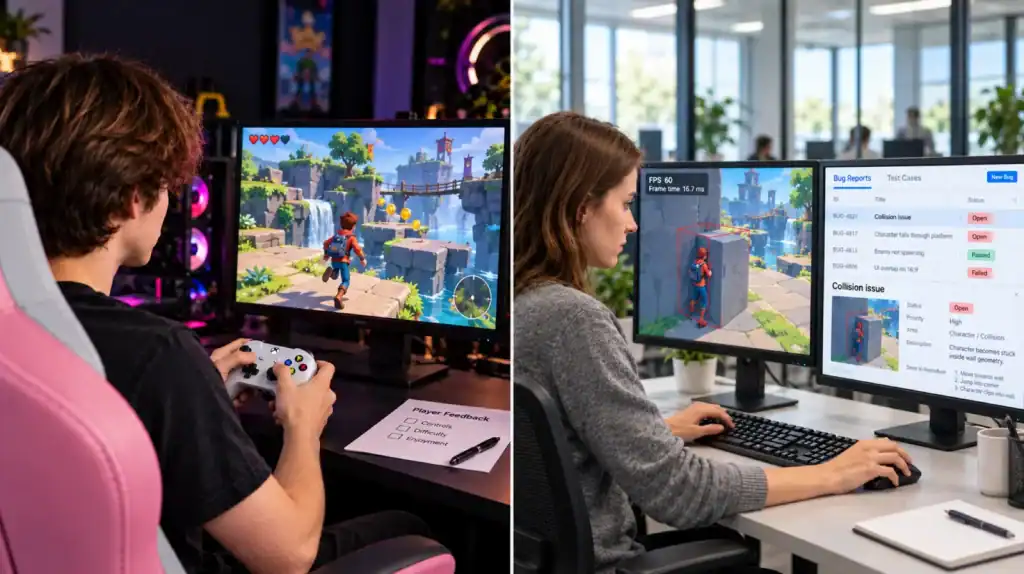
- Playtesting checks if your game is fun, clear and fair.
- QA testing checks if your game works the way you built it.
- Playtesting vs QA testing answers two different questions.
- Skip playtesting and you may ship a boring game.
- Skip QA and you may ship a broken one.
- Start both early. Keep both running until launch.
AppsFlyer found that 52% of players uninstall a game within 30 days. That data covers Android, from October 2023. Some players leave after a crash. Others leave because the game feels dull or confusing.
Many teams mix up these two problems. They hear “testing” and assume one process covers everything. It doesn’t. Playtesting vs QA testing are two separate jobs with different goals, people and results.
You’ll learn what each one does, when to run it, and how to measure it. We’ll also share a simple checklist. At Cubix, we’ve seen how much a clear testing plan helps a studio.
Ready to improve your game? Partner with Cubix testing experts today
Contact UsWhat Is Playtesting?
Playtesting means real players try your game and tell you how it feels. It checks for fun, clarity and challenge. Jakob Nielsen’s classic research says five users can spot about 85% of usability problems. That model comes from interface studies. Treat it as a rough guide.
Game playtesting is a player-first check. You watch people play. You see where they smile, stall or quit. It’s a core part of game user research. Nobody needs to read code to do it.
Here’s what playtest feedback often sounds like:
- “I didn’t know what to tap.”
- “Level 4 felt unfair.”
- “The reward was too small.”
- “I got bored after ten minutes.”
Who Participates in Playtesting?
Playtesters are players, not testers by trade. The best groups mix a few types:
- People who match your target audience
- Fresh players who have never seen the game
- A mix of casual and hardcore players
- Teammates, but only in the very early rounds
Moderated vs Unmoderated Tests
In a moderated test, a researcher watches and asks questions live. In an unmoderated test, players play alone and send data or short surveys. Both work. They solve different problems.
Moderated vs unmoderated playtests (typical patterns)
| Factor | Moderated | Unmoderated |
|---|---|---|
| Cost | Higher | Lower |
| Speed | Slower to set up | Faster to run |
| Depth | Deep. You can ask “why?” | Shallow. Mostly data and surveys |
| Typical group size | 5 to 10 players | 50 or more players |
| Best use | Prototypes, usability playtesting | Live builds, balance, retention |
What Is QA Testing?
QA testing checks that your game works as designed. It hunts for defects before players do. Quality assurance games also need clear rules, records and repeatable steps.
Bugs hurt sales. In a YouGov survey of US gamers, 41% said bugs affect their buying choice “a lot.” Another 34% said “a little.”
What Game QA Testing Covers
Game QA testing looks at how the game behaves, not how it feels. Testers check:
- Core features and menus
- Saves, loads and progress
- In-app purchases and ads
- Controls on touch, keyboard and pads
- Audio, visuals and animations
- New builds, to catch old bugs that return
Game Bug Testing Types
Game bug testing comes in a few common types:
- Functional testing: Does each feature do what it should?
- Compatibility testing: Does it run on different devices and OS versions?
- Performance testing: Does it hold frame rate, load fast and avoid overheating?
- Localization testing: Do translated text and formats fit the screen?
- Regression testing: Did a new fix break something old?
The stakes are real. A 2023 Sauce Labs survey found 33% of gamers have asked for a refund on a game they saw as broken.
Who Does QA?
- QA analysts run test cases and log bugs.
- QA leads plan the work and set priorities.
- Automation engineers build scripts for repeat checks.
Need extra hands? Dedicated game testing services can add skilled testers without a long hiring cycle.
Playtesting vs QA Testing
Is playtesting the same as QA? No. Playtesting asks, “Do players enjoy this?” QA asks, “Does this work?” A game can pass one and fail the other.
The trust cost is high. Sauce Labs found 74% of gamers avoid buying from a developer who released a buggy game before. That’s a long memory.
Playtesting vs QA Testing

| Factor | Playtesting | QA testing |
|---|---|---|
| Main goal | Check fun, clarity and challenge | Find and verify defects |
| Who tests | Target players | Trained QA testers |
| When it happens | Concept to beta | Prototype to post-launch |
| Main output | Playtest feedback and insights | Bug reports and test results |
| Question answered | “Is this enjoyable?” | “Does this work?” |
| Common tools | Surveys, recordings, interviews | Bug trackers, test cases, automation |
| Pass signal | Players finish and want more | No critical bugs, stable builds |
| Fail signal | Players quit or feel lost | Crashes, blockers, data loss |
What QA Covers That Playtesting Misses
- Rare crashes on older phones
- Broken purchase flows
- Save file corruption
- Memory leaks and slow loads
- Bugs that only appear after a patch
Players rarely test these on purpose. A trained QA tester does it every day.
What Playtesting Finds That QA Misses
- Tutorials that confuse new players
- Levels that feel too hard or too easy
- Rewards that feel pointless
- Menus that technically work but feel clumsy
- Core loops that get boring
A feature can work perfectly and still feel bad. Only players can tell you that.
When to Playtest a Game
Playtest early, then often. Don’t wait for a polished build. AppsFlyer data shows 43.54% of game uninstalls happen on the first day. Players decide fast. Your first-time experience needs testing before launch.
Game Testing Stages, From Concept to Launch
Game testing stages work best when each stage has a clear job. Here’s a simple view:
- Concept: Test the idea with paper sketches or short pitches.
- Prototype: Playtest the core loop. Keep it rough.
- Vertical slice: Run usability playtesting on onboarding and controls.
- Alpha: Start steady QA. Keep playtesting new features.
- Beta: Run a full game test plan. Add device coverage and balance tests.
- Soft launch: Watch real data in a small market.
- Post-launch: Track crashes, reviews and retention. Test every update.
Cubix’s own game testing process follows a similar path. It starts with strategy and planning, then moves through early stability checks, stress testing and pre-launch checks.
How to Recruit Playtesters
Recruit players who look like your real audience. Wrong testers give wrong answers. Right testers save you months.
Group size matters too. One study found groups of five discovered as few as 55% of problems in some runs. The average was still about 85%. Small groups vary a lot. Run several rounds.
Picking the Right Players
- Match age, device and play habits to your target market.
- Include both new and returning players.
- Ask about the games they already play.
- Screen out people who work in games, unless you need them.
- Pay or reward testers fairly.
How Bias Sneaks In
Bias is the quiet enemy of playtest feedback. Watch for these:
- Friends and family: They’re kind. They won’t tell you the truth.
- Hardcore fans only: They forgive things casual players won’t.
- Leading questions: “Wasn’t that fun?” gets a “yes” every time.
- Loud voices: One strong opinion can sway a whole group.
Simple Ways to Reduce Bias
- Ask open questions like “What were you thinking here?”
- Stay silent while players struggle.
- Test with strangers.
- Collect answers privately before group chat.
- Record sessions and review them later.
Menus and onboarding often show the most biased problems. Good game UI/UX design makes usability playtesting far easier to run.
How to Run a Playtest
Pick one goal per session. Then watch, listen and write things down. Sauce Labs found 55% of developers say feedback lacks the detail to act on. Clear session goals fix most of that.
Usability Playtesting Basics
Usability playtesting checks if players can use the game without help. Give them a task. Stay quiet. Note where they hesitate.
Good tasks sound like this:
- “Start a new game.”
- “Buy your first upgrade.”
- “Change the sound settings.”
Gameplay Validation Questions to Ask
Gameplay validation checks that the core loop works as intended. Try these questions:
- What do you think you should do next?
- What was the most fun moment?
- When did you feel stuck?
- What would you change first?
- Would you play again tomorrow?
Game User Research Methods
- Observation: Watch behavior. Actions beat opinions.
- Surveys: Quick ratings after a session.
- Interviews: Short chats to learn the “why.”
- Telemetry: Track taps, deaths and drop-off points.
Session Do’s and Don’ts
Do:
- Explain that you’re testing the game, not the player.
- Record the screen and voice, with permission.
- Take notes on exact moments.
Don’t:
- Help too soon.
- Defend your design.
- Ask more than one question at a time.
How to Run QA Testing
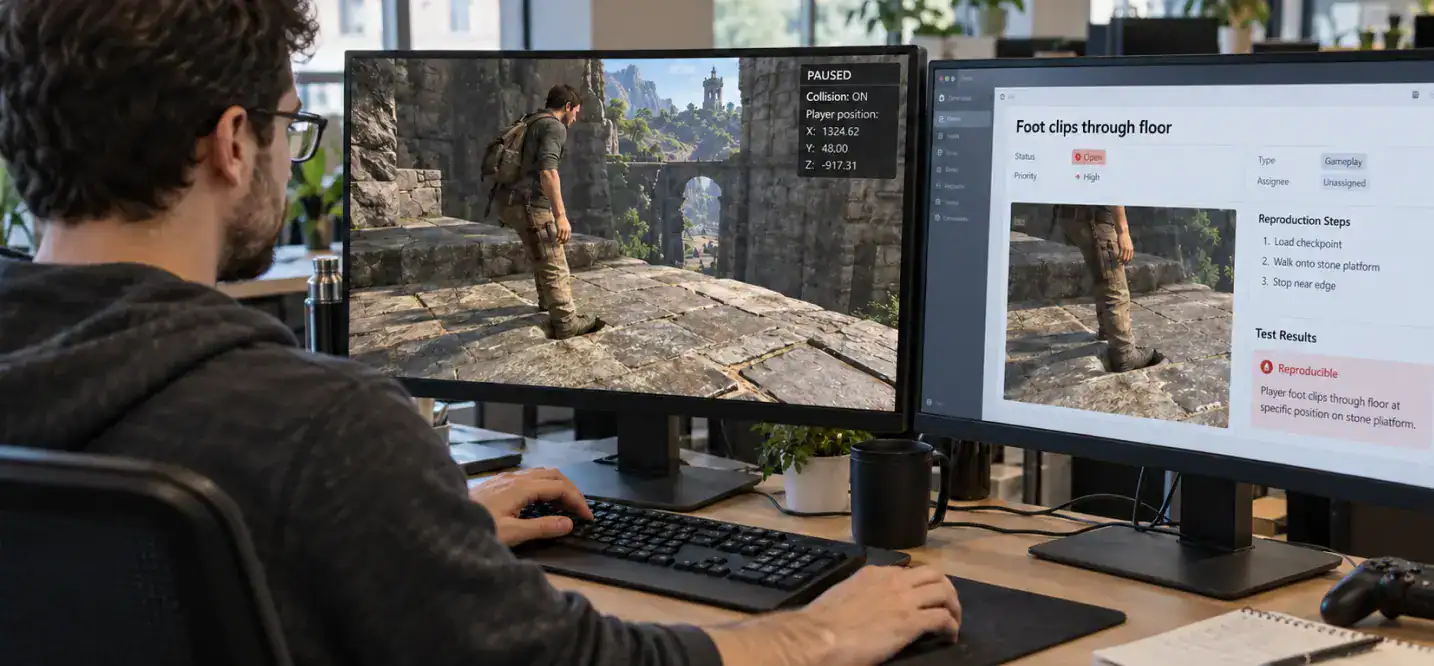
Start with a plan, then test against it. Pressure is common here. Sauce Labs found 61% of developers have released a game before it was fully debugged. A clear plan makes that harder to do.
Building a Game Test Plan
A solid game test plan covers these steps:
- Scope: What features, platforms and devices are in?
- Risk assessment: Which areas would hurt most if they broke?
- Test cases: Write steps and expected results.
- Environment: List devices, OS versions and tools.
- Entry and exit rules: Define when testing starts and when a build is ready.
- Governance: Decide who approves builds and who signs off on launch.
Issue Taxonomy and Severity Levels
An issue taxonomy is just a shared label system. It helps everyone talk about bugs the same way.
Bug severity guide
| Severity | What it means | Example | Fix priority |
|---|---|---|---|
| Critical | Game crashes or data is lost | Save file wipes progress | Fix now, block the release |
| Major | Key feature broken, no easy workaround | Purchase button does nothing | Fix before release |
| Minor | Small issue with a workaround | Sound cuts out after pausing | Fix if time allows |
| Cosmetic | Looks wrong, no effect on play | Text slightly misaligned | Fix in a later patch |
What a Good Bug Report Includes
- A clear, short title
- Steps to reproduce
- Expected result and actual result
- Device, OS and build number
- Screenshot or video
- Severity label
How to Measure Results
Pick a few numbers and track them every build. Too many metrics create noise. A few good performance metrics tell the story.
Google Play gives a useful reference. Its overall “bad behavior” threshold for user-perceived crash rate is 1.09%. Go above it and Play may reduce your game’s visibility.
Retention gives another view. Mistplay benchmarks, reported by Segwise, show puzzle games hold about 5.35% of players at day 30. Use numbers like this as context, not as a promise.
Playtest KPIs
- Completion rate: How many players finish the tutorial or level?
- Drop-off points: Where do players quit?
- Session length: Do sessions match your design goals?
- Difficulty rating: Do players call it too hard or too easy?
QA KPIs
- Defect density: Bugs per feature or per thousand lines of code
- Escape rate: Bugs found by players after release
- Fix rate: How fast the team resolves bugs
- Crash-free sessions: Share of sessions with no crash
KPIs, what they show, and failure signals
| KPI | What it shows | Failure signal |
|---|---|---|
| Tutorial completion rate | Is onboarding clear? | Many players quit in the first minutes |
| Drop-off point | Where fun or clarity breaks | A sharp drop at one level |
| Session length | Engagement | Sessions far shorter than planned |
| Defect density | Build quality | Rising bugs per build |
| Escape rate | Test coverage gaps | Players report bugs QA never saw |
| Fix rate | Team speed | Critical bugs open for days |
| Crash-free sessions | Stability | Falling trend across builds |
Cost and Risks
Late fixes cost far more than early ones. The widely cited IBM Systems Sciences Institute figures say a bug found in coding costs about 6 times more than one found in design. Testing-phase fixes run about 15 times more. After release, it can reach 100 times more. Some experts question the exact multiples. The direction is hard to argue with.
What Affects Cost
Cost considerations for any testing plan include:
- Game size and number of features
- Number of platforms and devices
- Team size and test hours
- Automation setup and upkeep
- Number of playtest rounds and tester rewards
- Tools, bug trackers and device labs
Scalability matters too. A plan that works for one level must also work for fifty.
Risks to Watch
- Data privacy: Playtesters may share personal data. Get consent and store it safely.
- Tester leaks: Unreleased builds can leak. Use NDAs and controlled access.
- Burnout: Repetitive QA wears people down. Rotate tasks.
- Ongoing maintenance: Automation scripts break when the game changes.
- Weak integration: Tests that don’t fit your build pipeline get skipped.
Planning your test work alongside your game development services partner keeps cost and quality in step.
Common Mistakes
- Testing too late. Start with prototypes. Fix the core loop first.
- Using friends as testers. Recruit strangers who match your audience.
- Treating playtests as QA. Don’t ask players to hunt for bugs. Use trained testers.
- Ignoring device coverage. Test the low-end phones your players actually own.
- Writing vague bug reports. Use a template with steps, device and severity.
- Collecting feedback with no action plan. Rank issues, assign owners and retest after each fix.
Playtesting vs QA Example
This is an example, not a real benchmark. The numbers are made up to show the workflow.
Assumptions:
- A mobile puzzle game with an 8-person team
- A 12-week test window before soft launch
- Budget for two playtest rounds and continuous QA
- Android and iOS, with 10 test devices
Walkthrough:
- Week 1 to 2, prototype playtest. Eight players try the core loop. Three get stuck on the first swipe. The team fixes the tutorial.
- Week 3 to 5, QA starts. Testers run the game test plan. They log crashes on two older phones.
- Week 6, usability playtesting. Players try menus and the store. The “buy” button hides below the fold. Design moves it.
- Week 7 to 9, regression and fixes. QA retests every fix. Crash-free sessions rise build by build.
- Week 10, second playtest. Twenty players test levels 1 to 30. Level 12 shows a sharp drop-off. The team lowers its difficulty.
- Week 11 to 12, production readiness check. QA signs off on critical bugs. Playtest scores meet the team’s targets. The game moves to soft launch.
Playtesting vs QA Checklist
Before Testing
- ✓ Define one goal per test round
- ✓ Write your game test plan
- ✓ Pick devices and platforms
- ✓ Recruit playtesters who match your audience
- ✓ Set up a bug tracker and severity labels
- ✓ Prepare consent forms and NDAs
During Testing
- ✓ Record sessions with permission
- ✓ Ask open questions only
- ✓ Log every bug with steps, device and build
- ✓ Track KPIs on every build
- ✓ Rotate QA tasks to avoid burnout
After Testing
- ✓ Sort issues by severity and impact
- ✓ Assign an owner to every issue
- ✓ Retest every fix
- ✓ Share a short summary with the whole team
- ✓ Update the test plan for the next round
Why Studios Choose Cubix
Cubix is a game development company with 15 years in the market. Its team includes 350 game designers and developers. Its testing page says it has tested 400+ games. Studios come to Cubix when they want testing to match their pace.
Testing Support Across the Full Game Lifecycle
Cubix supports teams from early builds to launch. Its process includes:
- Test strategy and planning
- Early stability checks
- AI and NPC behavior testing
- Stress testing
- Pre-launch checks
It also covers action, adventure, RPG, simulation and strategy games. That range helps studios that want one partner for game QA testing across genres.
Design and Development Under One Roof
Testing works best when it sits close to the people building the game. Cubix offers game design, development and UI/UX in one place. Fewer handoffs mean fewer misunderstandings. Findings move from testers to designers to developers faster.
Work With Cubix on Your Next Game
You don’t need a huge plan. You need a clear one. Start small, test early, and keep both playtesting and QA running to launch.
Your next steps:
- Write down one goal for your next test round.
- List your top five risks.
- Book a playtest for your current build.
- Set up a basic game test plan.
- Talk to a partner if you need more hands or a fresh view.
If you’d like help, Cubix can review your build and suggest a testing plan that fits your game and budget. Reach out through the Game Testing Services page whenever you’re ready.
Catch bugs early and build better games with Cubix
Contact UsFrequently Asked Questions
1. Is playtesting the same as QA?
No. Playtesting checks if players enjoy the game. QA testing checks if the game works. One looks at the feeling. The other looks at function.
2. Who participates in playtesting?
Real players take part. Pick people who match your target audience. Mix new and returning players. Teammates can help in very early rounds. After that, use strangers.
3. When should a game be playtested?
Start at the prototype stage. Test the core loop while it’s still rough. Then repeat at every major build. Keep going through beta, soft launch and post-launch updates.
4. What does QA cover that playtesting misses?
QA catches issues players rarely report. These include rare crashes, broken purchases, save file errors and slow loads. QA also checks different devices and OS versions.
5. What does playtesting find that QA misses?
Playtesting finds problems that aren’t bugs. Think confusing tutorials, unfair difficulty and weak rewards. A feature can work perfectly and still feel bad.
6. Do I need both playtesting and QA testing?
Yes. Playtesting vs QA testing is not an either-or choice. Without playtesting, you may launch a dull game. Without QA, you may launch a broken one. Most studios need both before launch.
7. How many playtesters do I need?
Five players per audience group is a common starting point. It spots many obvious usability problems. Subtle issues need more players. Run several rounds and fix problems between them.
8. What is the difference between moderated and unmoderated playtests?
A moderated test has a researcher watching live. You can ask “why” in the moment. An unmoderated test lets players play alone. It’s faster and cheaper, but shallower.
9. How much does game testing cost?
It depends on your game. Size, platforms, devices, team and test rounds all change the price. Early testing usually costs less than late fixes. Ask for a quote based on your scope.
10. What should a game test plan include?
A good game test plan covers scope, risks, test cases and devices. It also needs entry and exit rules. Add clear sign-off roles for governance.