Leasing teams can lose valuable time answering the same questions about rent, amenities, pet policies, application requirements, and apartment availability. When those inquiries arrive after office hours, prospects may have to wait for a response before they can decide whether to schedule a tour.
AI virtual leasing agents can handle many of these routine interactions, capture prospect details, schedule property tours, and route more complex questions to leasing staff. Their usefulness, however, depends on more than conversational AI. They need accurate property information, reliable system integrations, defined permissions, and a clear process for handing conversations to people.
The scale of the market makes these workflows worth examining. The U.S. Census Bureau’s 2023 American Community Survey estimated approximately 44.6 million renter-occupied housing units in the United States. That figure does not measure demand for leasing automation, but it illustrates the size of the rental housing market in which property operators manage inquiries, appointments, and tenant communication.
This guide explains how AI-powered virtual leasing agents work, which tasks they can automate, how to implement them, what affects their cost, and how property teams can evaluate their performance without sacrificing accuracy, privacy, or fair housing protections.
Key Takeaways
- AI virtual leasing agents automate repetitive leasing tasks, including answering property FAQs, capturing leads, scheduling apartment tours, and handling follow-ups.
- System integrations are essential. Connecting the agent with property management systems (PMS), CRMs, calendars, and approved knowledge bases enables it to retrieve information and complete authorized actions.
- Implementation should start with a focused use case. Automate one high-volume workflow, prepare accurate property data, define permissions, and expand after a successful pilot.
- Human oversight remains necessary. Sensitive complaints, accommodation requests, legal disputes, emergencies, and unverified information should trigger human escalation.
- Fair housing, privacy, and security must be built in. Use consistent property information, protect personal data, restrict system access, and disclose when prospects are interacting with AI.
- Measure operational performance. Track answer accuracy, lead capture, confirmed tour bookings, escalation quality, user experience, and integration reliability.
- Development costs depend on complexity. The number of properties, integrations, AI architecture, data preparation, security requirements, and ongoing maintenance all influence the investment.
Automate Leasing Inquiries, Schedule Tours, and Convert More Leads
Contact UsWhat Are AI Virtual Leasing Agents?
AI virtual leasing agents are conversational systems that help property management and leasing teams handle prospect inquiries and selected tenant interactions. They use natural language processing, language models, approved property information, and integrations with business systems to respond to questions and complete permitted tasks.
Depending on their configuration, an AI leasing assistant can explain property amenities, capture lead information, check tour availability, send appointment confirmations, and route tenant requests to the appropriate team.
The term AI virtual leasing agent can describe several types of systems. A rule-based chatbot follows predefined conversation paths. A generative AI assistant can interpret more varied questions and produce contextual responses. An AI agent may also use connected tools to retrieve records or perform actions, such as creating a CRM lead or booking an available tour.
These capabilities are not interchangeable. A conversational model does not automatically have access to live apartment availability or permission to modify a leasing record. Those functions require appropriate integrations, access controls, and validation.
Virtual Leasing Agents vs. Traditional Leasing Chatbots
| Capability | Rule-based chatbot | AI virtual leasing agent |
|---|---|---|
| Answering questions | Handles predefined questions and flows | Can interpret varied wording and answer from approved information |
| Conversation context | Usually limited to programmed paths | Can use context from the current conversation |
| Lead capture | Collects configured form fields | Can collect details conversationally and map them to CRM fields |
| Tour scheduling | May link to a booking form | Can check availability and book through an authorized integration |
| Complex requests | Follows predefined fallback rules | Can classify requests and route them according to defined policies |
| Operational control | Depends on configured rules | Requires explicit tool permissions, validation, and monitoring |
An advanced AI agent is not always the right choice. If a property only needs to display office hours and answer a small set of fixed questions, a conventional chatbot may be sufficient. More flexible AI becomes useful when questions vary significantly or when conversations need to trigger actions across multiple systems.
What Can AI Virtual Leasing Agents Automate?
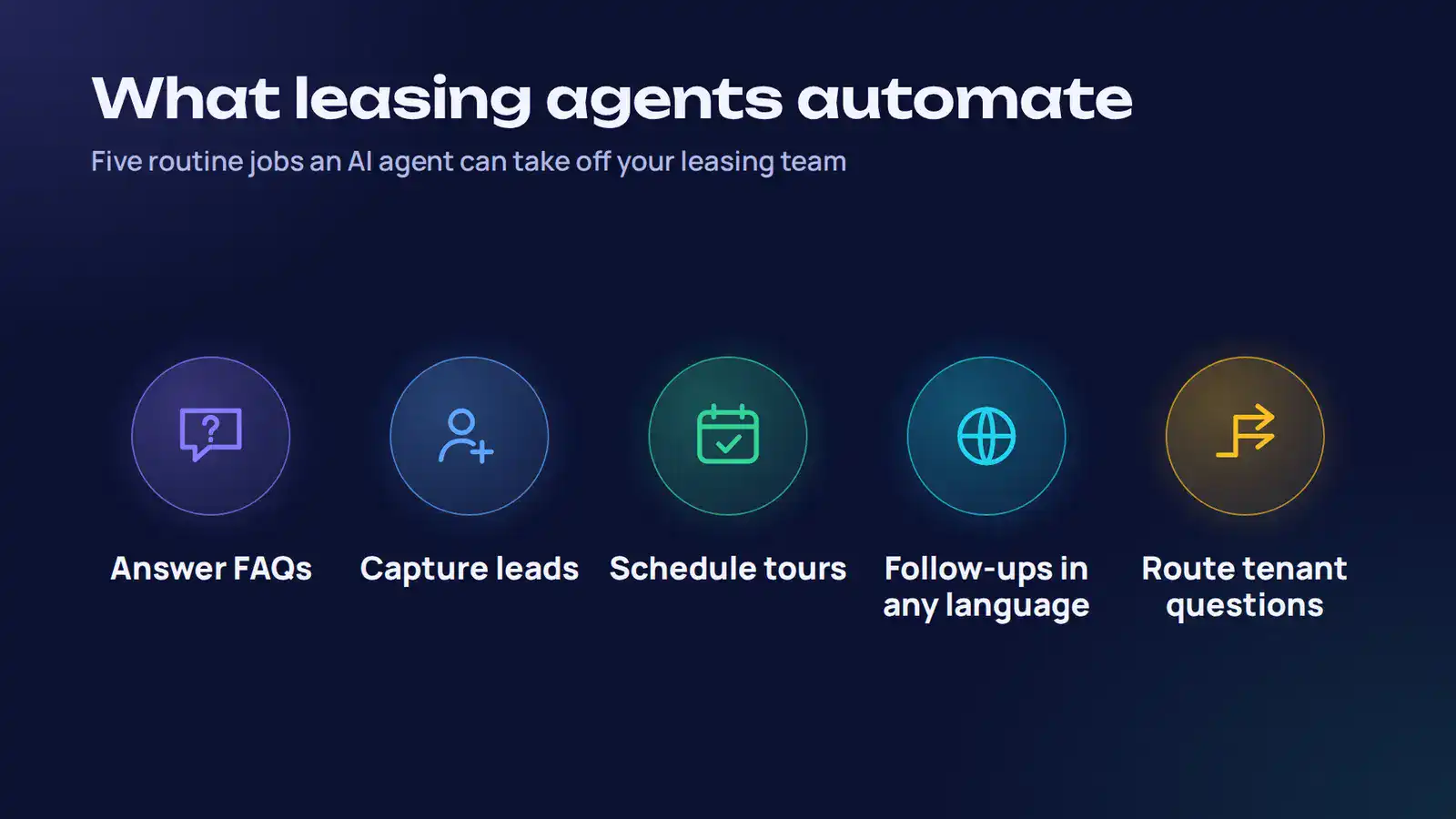
AI leasing agents can automate repetitive communication throughout the leasing journey, from the first property inquiry to tour confirmation and follow-up. The exact scope depends on the information available to the system and the actions it is authorized to perform.
1. Answer Property and Leasing FAQs
A virtual leasing agent can respond to common questions about:
- Rent ranges, advertised fees, deposits, and available lease terms.
- Pet policies, parking, amenities, utilities, and community facilities.
- Application steps, documentation requirements, and move-in procedures.
- Property location, office hours, floor plans, and tour options.
Answers should come from approved, current property information. If pricing has changed, two records conflict, or a requested detail is unavailable, the agent should acknowledge the limitation instead of inventing an answer.
For example, it may explain a property’s stated pet policy but should not promise an exception that only a leasing manager can approve.
2. Capture and Qualify Leasing Leads
An AI leasing assistant can collect basic contact information and details about a prospect’s inquiry, such as the property they are interested in, preferred unit type, approximate move-in plans, and preferred follow-up method.
With a suitable CRM integration, it can create a lead record, associate the conversation with the correct property, and notify the leasing team. It can also ask permitted follow-up questions to clarify what the prospect needs.
Lead capture should remain focused on legitimate leasing requirements. The agent should not infer sensitive personal characteristics, ask unnecessary questions, or make discriminatory assumptions about who is likely to qualify for housing.
3. Schedule Apartment Tours
AI apartment tour scheduling can reduce the back-and-forth involved in arranging property visits. When connected to an authorized calendar or leasing platform, the agent can:
- Ask the prospect which property or unit type they want to visit.
- Retrieve available appointment slots.
- Present options that match the configured scheduling rules.
- Book the selected slot and confirm the result.
- Send approved reminders or instructions.
- Handle supported cancellations and rescheduling requests.
The system must distinguish between suggesting a time and confirming a booking. It should only tell the prospect that an appointment is scheduled after the connected system verifies the reservation.
4. Automate Follow-Ups and Multilingual Communication
A leasing agent can send approved messages after an inquiry, provide tour reminders, and follow up with prospects who have requested additional information. It can also support communication in multiple languages when the selected model and workflow have been tested for those languages.
Multilingual support requires more than translating individual sentences. Property names, fees, lease terminology, dates, and policy details must retain their intended meaning. Teams should test language quality and offer human assistance when a conversation becomes unclear.
5. Route Tenant Questions to the Right Team
Virtual leasing agents can also support existing tenants by answering routine questions about office hours, maintenance procedures, community rules, and how to submit service requests.
They should distinguish these requests from prospective-tenant inquiries. A maintenance issue may need a ticket in the property management system, while an emergency, legal complaint, accommodation request, or sensitive dispute may require immediate human attention under the property’s established procedures.
How Does an AI Leasing Agent Work?
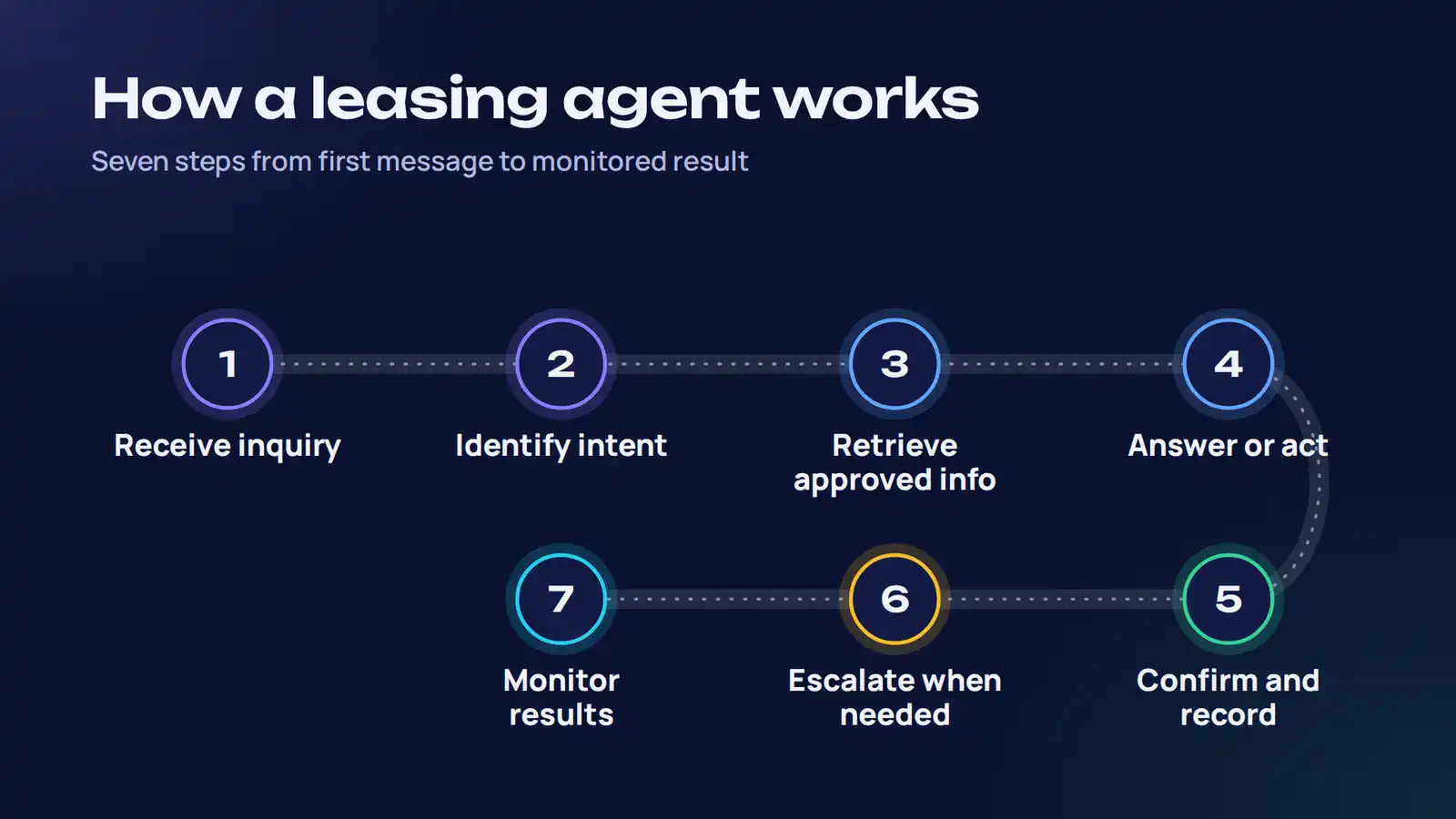
A production-ready AI leasing agent combines conversational AI with property data, business rules, and connected software. A typical workflow looks like this:
1. Receive inquiry → 2. Identify intent → 3. Retrieve approved information → 4. Answer or perform an authorized action → 5. Confirm and record the result → 6. Escalate when necessary → 7. Monitor performance
1. Receive the inquiry. A prospect contacts the agent through a property website, chat interface, or another supported channel.
2. Identify intent. The system determines whether the person needs property information, wants to schedule a tour, is following up on an inquiry, or needs assistance from staff.
3. Retrieve relevant information. It checks approved FAQs, property records, listing information, or connected systems. Live details, such as appointment availability, should come from an authoritative source rather than the model’s general knowledge.
4. Respond or take action. The agent generates an answer or calls an authorized tool to create a lead, retrieve a schedule, or submit a request.
5. Validate the result. The workflow checks whether the action succeeded. If the calendar rejects a booking or a CRM request fails, the agent should not report success.
6. Escalate when needed. The conversation moves to an appropriate team member when the agent reaches its limits or encounters a sensitive issue.
7. Monitor the interaction. The system records permitted operational events so the property team can review accuracy, failed actions, user feedback, and escalation quality.
The important distinction is that the language model handles interpretation and response generation, while the surrounding software controls data access, business rules, and task execution.
What Systems Should an AI Leasing Agent Integrate With?
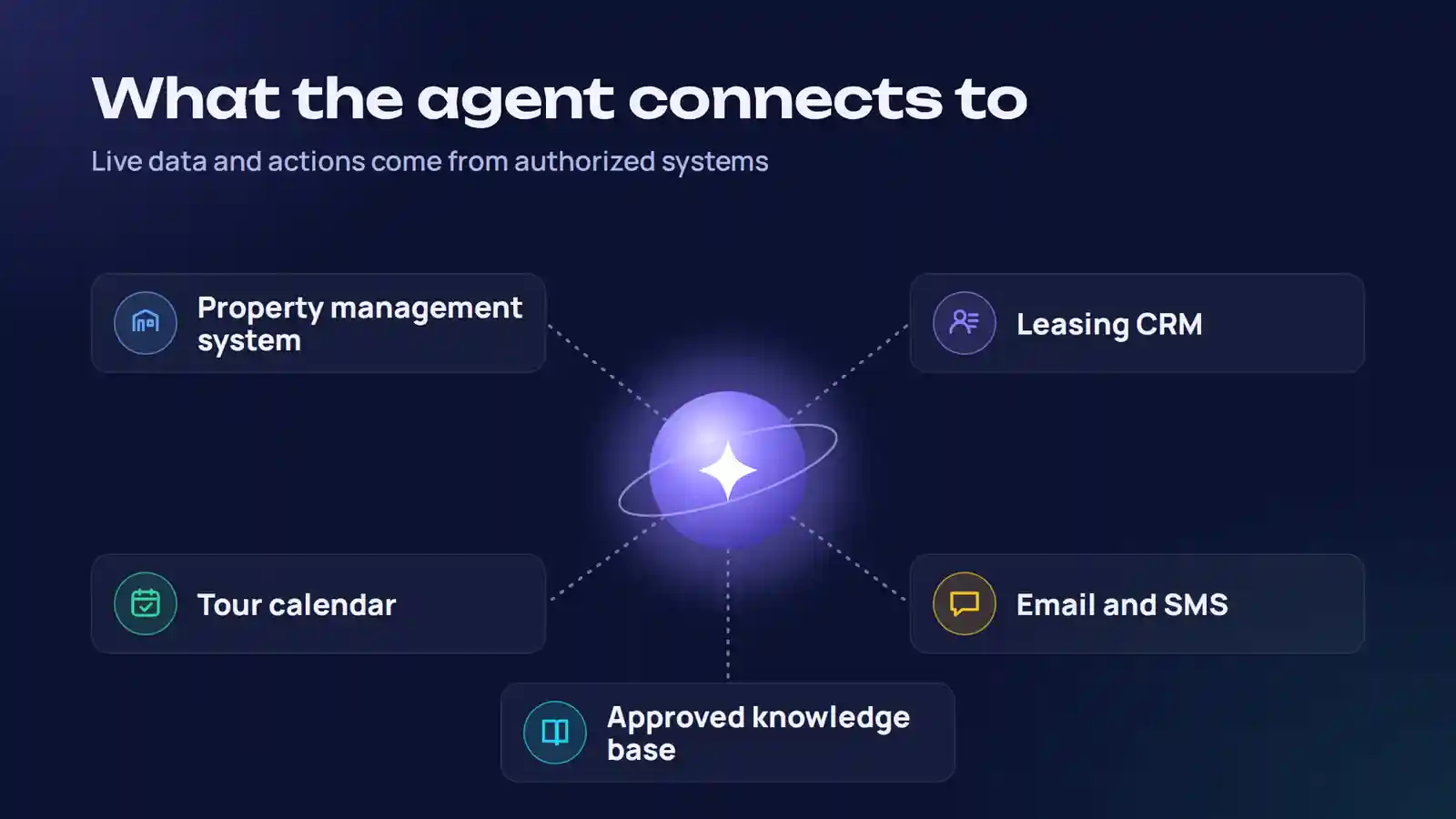
The value of leasing automation often depends on whether the agent can access the systems where property information and operational records actually live.
1. Property Management Systems and Leasing CRMs
A property management system (PMS) may contain unit records, occupancy information, lease details, and maintenance workflows. A customer relationship management (CRM) platform typically manages prospect records, inquiry history, follow-ups, and sales activity.
The precise division of responsibilities varies by product. Before development, teams should identify which system is authoritative for each type of information and determine which records the agent can read or update.
For example, the agent might retrieve approved listing details from a property system while sending a new prospect’s contact information to the CRM. It should not treat an old CRM note as the definitive source for current rent or unit availability.
For teams planning these connections, Cubix’s guide to chatbot integration with CRM provides additional context on field mapping, APIs, lead records, and integration testing.
2. Calendars, Messaging, and Contact Channels
Tour scheduling may require access to staff calendars, appointment rules, and property-specific availability. Email or SMS integrations can then deliver confirmations and reminders, subject to appropriate consent and communication preferences.
Teams should account for failed message delivery, time-zone differences, duplicate appointments, and delays between systems. If availability changes while a prospect is booking, the workflow must recheck the slot before confirming it.
3. Knowledge Bases and APIs
An AI agent may use a searchable knowledge base containing approved property descriptions, amenity details, FAQs, and leasing policies. Retrieval-augmented generation (RAG) can help a language model use relevant source material when forming an answer.
APIs connect the agent to live records and operational tools. These connections need authentication, permission checks, input validation, error handling, and appropriate logging. Integration feasibility depends on the systems involved, available API access, vendor restrictions, and data quality. Compatibility should be verified rather than assumed.
How to Implement an AI Virtual Leasing Agent?
A reliable implementation starts with a defined leasing problem, not with a decision to use the most advanced AI model available.
1. Select a Narrow, Measurable Use Case
Choose a workflow with a clear operational purpose. Examples include answering after-hours FAQs, capturing website inquiries, or scheduling apartment tours.
Document the current process before automating it. Measure inquiry volume, response time, common failure points, and the amount of staff effort involved. This baseline will help determine whether the pilot improves the process.
Avoid automating every leasing interaction at launch. A smaller scope is easier to test, monitor, and correct.
2. Prepare Property Data and Approved Answers
Collect the information needed for the selected use case, including property details, policies, unit information, scheduling rules, and approved responses.
Assign an owner to each important data source. Establish how frequently information changes and how updates reach the AI system. Remove outdated material, resolve conflicting records, and define which answers require approval.
Cubix’s resource on AI data readiness offers a broader framework for assessing data quality, ownership, governance, and infrastructure before building an AI solution.
3. Choose the Right AI Architecture
The architecture should reflect the work the agent needs to perform.
- Rule-based chatbot: Suitable for predictable questions and fixed workflows.
- LLM-powered assistant: Useful for interpreting varied questions and generating contextual answers from approved sources.
- Tool-enabled AI agent: Appropriate when conversations must trigger actions across connected systems, such as checking a calendar or creating a CRM record.
These approaches can be combined. A system may use a language model to understand a question while relying on deterministic rules for booking validation, permissions, and escalation.
Teams evaluating a custom solution can review Cubix’s AI Agent Development Company capabilities as part of their implementation research.
4. Integrate Systems and Define Permissions
Map the data flows between the agent, property management system, CRM, calendar, knowledge base, and messaging channels.
Define what the agent can read, create, update, or never access. Use the principle of least privilege, granting only the permissions needed for the selected workflow. Require confirmation or human approval for actions that carry higher risk.
Also establish what happens when an API is unavailable, a record cannot be matched, or two systems return conflicting information.
5. Test Before Launch
Testing should include normal requests and difficult edge cases. Check whether the agent can:
- Answer common questions using approved and current sources.
- Recognize when a question cannot be answered reliably.
- Retrieve available tour slots and handle booking conflicts.
- Create the correct lead record without duplicating it.
- Avoid disclosing information to unauthorized users.
- Handle supported languages and ambiguous wording.
- Escalate sensitive requests to the right team.
- Recover safely from failed API calls and messaging errors.
Review both the conversational answer and the action taken behind it. A convincing response can still hide a failed integration.
6. Launch Gradually and Improve
Begin with one property, channel, or workflow. Assign staff to review a sample of conversations, correct source information, and document recurring failures.
Expand only when the pilot meets predefined quality and reliability criteria. Changes to prompts, models, integrations, and property policies should be tested because they can affect performance after launch.
For more on architecture and deployment decisions, Cubix’s guide on how to build AI agents explores use-case selection, agent patterns, validation, and monitoring.
When Should an AI Leasing Agent Hand Off to a Human?
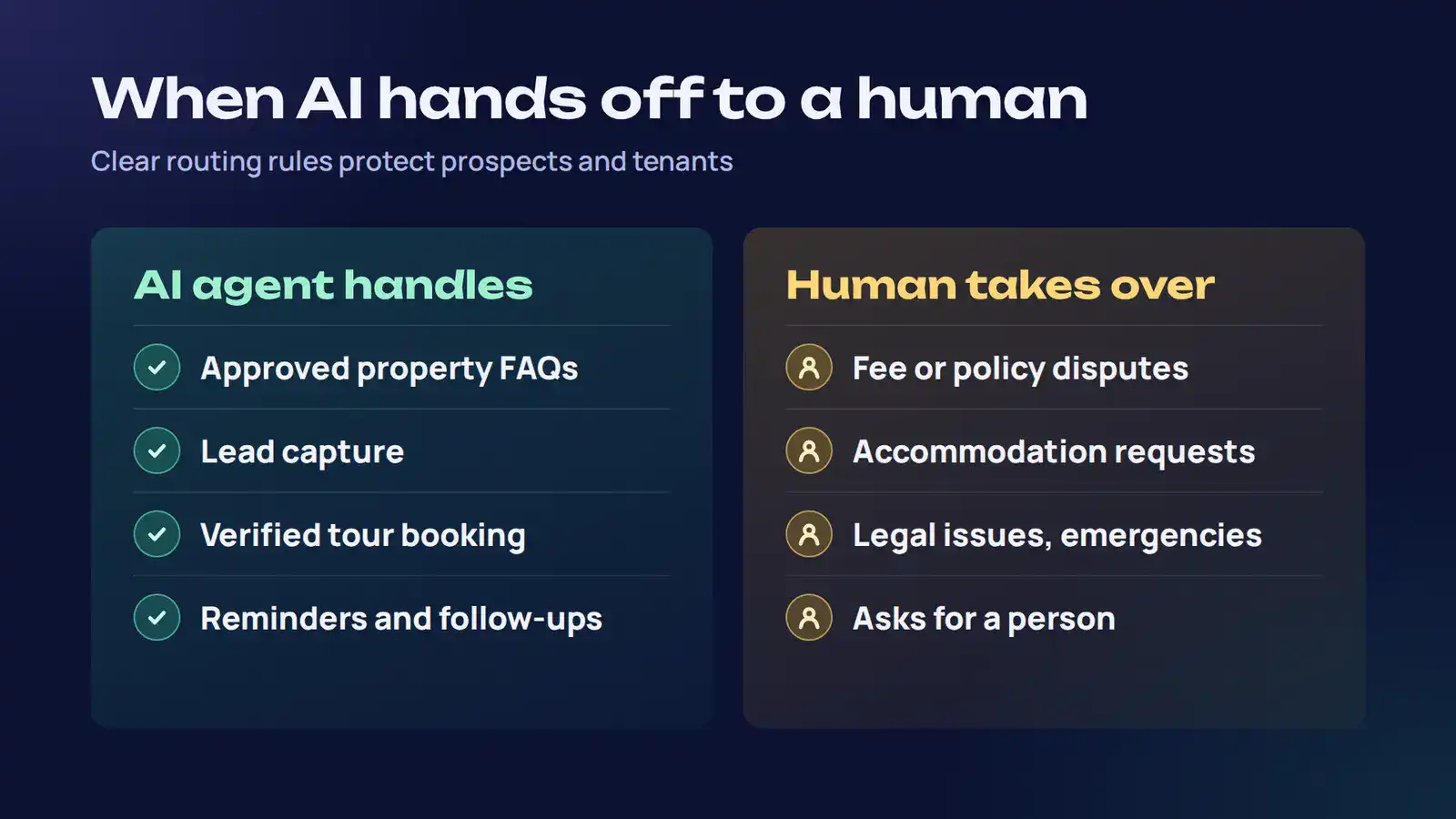
Human escalation is a core part of a leasing automation workflow. It protects prospects and tenants when a question requires judgment, an authorized decision, or information the agent cannot verify.
Escalation should occur when:
- The agent cannot find a reliable answer or encounters conflicting property information.
- A prospect disputes a fee, lease condition, or policy.
- Someone raises a discrimination concern or requests an accommodation.
- A conversation involves a legal dispute, sensitive complaint, or emergency.
- A booking or record update fails and cannot be safely resolved.
- The user explicitly asks to speak with a person.
The handoff should include the conversation history, the reason for escalation, and relevant details collected with appropriate permission. The user should know what happens next and whether a staff member has actually received the request.
Property teams should define escalation priorities and response expectations before launch. Urgent matters should follow the property’s established emergency and support procedures rather than relying on an AI assistant as the sole point of contact.
Fair Housing, Privacy, and Security Considerations
AI leasing automation operates in a sensitive context because conversations can affect access to housing and involve personal information. Compliance and risk controls should be part of the design, not a final review after the system has been built.
1. Reduce Fair Housing Risks
The U.S. Fair Housing Act applies to covered housing activities regardless of whether a decision or communication is handled by a person or an automated system. The U.S. Department of Housing and Urban Development has published guidance on the Fair Housing Act and advertising through digital platforms, including concerns involving algorithmic systems and AI in housing-related advertising.
For virtual leasing agents, practical safeguards include:
- Provide consistent, approved property information to different users.
- Avoid steering people toward or away from housing based on protected characteristics.
- Do not infer sensitive traits from names, language, location, or conversational behavior.
- Keep tenant eligibility and screening decisions outside the agent unless the workflow has been specifically authorized and reviewed.
- Test conversations for inconsistent answers, biased assumptions, and discriminatory patterns.
If the system is involved in screening applicants, the risk is greater. HUD’s guidance on screening applicants for rental housing explains that the Fair Housing Act continues to apply when technology is used in screening. Legal obligations depend on the specific activity and circumstances, so the proposed workflow should receive qualified legal review.
2. Protect Personal and Leasing Data
The agent may process names, email addresses, phone numbers, tour preferences, and conversation histories. Teams should collect only information necessary for the task and define retention, access, and deletion rules.
Security controls should include authentication, role-based access, encryption where appropriate, secure API credentials, audit logs, and restrictions on what information can be sent to an external model provider. Review vendor data-handling terms, including whether submitted content may be retained or used for model training.
Testing should cover prompt injection, attempts to retrieve another person’s records, unauthorized tool use, and accidental exposure of sensitive information.
3. Make AI Use Transparent
Tell prospects when they are interacting with an AI assistant. Do not present the agent as a real leasing employee or imply that it has made a human-approved decision when it has not.
The NIST AI Risk Management Framework provides a voluntary approach to identifying, assessing, and managing AI risks. It can help teams organize governance, evaluation, monitoring, and accountability, but it does not replace applicable housing, privacy, or consumer-protection laws.
How Do You Measure AI Leasing Agent Performance?
Measure whether the agent completes useful tasks accurately, not just how many conversations it handles. Establish a baseline before launch and define how each metric will be calculated.
| KPI | What to measure | Failure signal |
|---|---|---|
| First-response time | Time until the first useful response | Delays during high-volume periods |
| Lead capture completion | Eligible inquiries recorded correctly | Missing, inaccurate, or duplicate records |
| Tour booking completion | Confirmed bookings divided by eligible scheduling attempts | Calendar conflicts or failed confirmations |
| Answer accuracy | Share of reviewed answers supported by approved sources | Outdated, unsupported, or incorrect claims |
| Escalation quality | Whether cases reach the correct team at the right time | Sensitive requests missed or delayed |
| User experience | Feedback, abandonment, and repeat contacts | Confusion or repeated clarification |
| Integration reliability | Successful actions and frequency of system errors | Failed updates or stale information |
Use human-reviewed samples to assess answer quality, including cases where the agent confidently gives an incorrect response. Track metrics by property, channel, language, and task because an overall average can hide weaknesses in a particular workflow.
Define acceptable thresholds before the pilot begins. If bookings fail, source data becomes stale, or escalation quality declines, pause expansion and investigate the cause before increasing automation.
What Affects the Cost of an AI Virtual Leasing Agent?
There is no single reliable price for every AI leasing assistant. Cost depends on the scope of the workflow, the systems involved, expected usage, and the controls required for safe operation.
Key cost drivers include:
- Number of properties and channels: A single website assistant has a different scope from a portfolio-wide system supporting several communication channels.
- Integration complexity: Connecting to a CRM, PMS, calendar, and messaging provider depends on API access, vendor restrictions, and existing data structures.
- AI architecture: A fixed FAQ bot, a retrieval-based assistant, and a tool-enabled agent have different development and operating requirements.
- Data preparation: Property information may need to be consolidated, corrected, approved, and maintained.
- Security and quality assurance: Access controls, testing, audit logging, and risk review add implementation work.
- Ongoing operations: Model usage, monitoring, support, content updates, and integration maintenance continue after deployment.
- Language and escalation requirements: Additional languages, specialized routing, and staff handoff workflows increase complexity.
A sensible estimate starts with a defined use case, a list of required integrations, expected interaction volume, and clear acceptance criteria. Teams should compare total operating requirements, not just the initial development quote.
Example: Automating Leasing for a Multifamily Property
The following scenario is hypothetical and is not a verified client result or performance benchmark.
Suppose a property operator manages several apartment communities, receives frequent inquiries outside office hours, and uses a CRM alongside a separate tour calendar.
The operator introduces an AI virtual leasing agent to answer approved property FAQs, collect prospect contact details, and schedule tours. When a prospect asks about an available time, the agent checks the connected calendar and confirms the appointment only after the booking succeeds. It records the inquiry in the CRM so the leasing team can follow up.
If a prospect asks for an unapproved rent concession or raises a sensitive concern, the agent routes the conversation to staff instead of making a decision.
The operator evaluates the pilot using answer accuracy, completed bookings, lead-record quality, escalation handling, and staff review time. The team expands the workflow only after the results meet its predefined criteria.
AI Virtual Leasing Agent Implementation Checklist
Before launching, use this checklist to confirm the operational foundations are in place.
- Define the first leasing workflow and the problem it should solve.
- Establish baseline metrics and measurable acceptance criteria.
- Audit property information, FAQs, policies, and data owners.
- Confirm CRM, PMS, calendar, and messaging integration options.
- Define permitted actions, access controls, and escalation rules.
- Review fair housing, privacy, accessibility, and disclosure requirements.
- Test answer accuracy, security, booking conflicts, and integration failures.
- Establish monitoring, conversation review, and incident procedures.
- Launch a limited pilot and document issues before expanding.
Conclusion: Start With One Leasing Workflow
AI virtual leasing agents can help property teams manage repetitive inquiries, capture leads, coordinate apartment tours, and route tenant questions without requiring staff to handle every interaction manually. But successful leasing automation depends on accurate information, reliable integrations, transparent AI use, and human oversight where it matters.
Start with one high-volume workflow, establish clear performance criteria, and test it under real operating conditions. Once the system consistently answers accurately, completes authorized actions, and escalates sensitive requests appropriately, the property team can make an evidence-based decision about expanding its role.
For teams exploring a custom solution, Cubix AI is a starting point for reviewing AI development capabilities relevant to conversational systems and workflow automation.
Build an AI Agent That Knows When to Answer and When to Escalate
Contact UsFrequently Asked Questions
1. What can AI leasing agents automate?
AI leasing agents can answer approved property FAQs, capture prospect details, schedule tours through connected calendars, send permitted follow-ups, and route routine tenant requests. Their actual capabilities depend on the data and tools available to them.
2. Can AI schedule property tours?
Yes. An AI leasing agent can schedule apartment tours when it has authorized access to a current scheduling system and can create, validate, and confirm appointments. A booking should not be reported as complete until the connected system confirms it.
3. How do leasing bots handle tenant questions?
They interpret the question, retrieve relevant information from approved sources, and provide an answer within defined limits. Questions involving unverified facts, sensitive complaints, emergencies, or decisions requiring staff authority should be escalated.
4. When must a human take over?
A human should take over when the agent cannot verify an answer, the user requests assistance, an action fails, or a conversation involves a sensitive complaint, accommodation request, discrimination concern, legal dispute, or emergency. Property teams should establish specific routing rules for their operations.
5. Are AI virtual leasing agents suitable for enterprise property managers?
They can be suitable when the portfolio has repeatable leasing workflows, reliable property data, compatible systems, and teams able to monitor quality. Enterprise deployments also need clear permissions, consistent policies across properties, integration monitoring, and a defined human escalation process.