
Estimating a property’s value sounds straightforward until you need to do it for thousands of homes across different neighborhoods, price ranges, and market conditions. A valuation that works well for a recently sold suburban home may be less reliable for a rural property with few comparable sales.
Automated property valuation helps address this challenge by using property records, transaction histories, location data, and mathematical models to estimate market value at scale. The scale of the underlying data is significant: the Federal Housing Finance Agency’s House Price Index methodology and data draw on more than 100 million home sale and refinance transactions to measure U.S. house price movements. That index is not an automated valuation model, but it illustrates the volume of transaction data available for housing market analysis.
For real estate platforms, investors, lenders, and property technology companies, the important question is how an automated valuation model (AVM) turns that kind of information into a useful estimate, and how much confidence users should place in its output.
Ready to Build a Smarter Property Valuation Model? Partner with Cubix
Contact UsWhat Is an Automated Property Valuation Model (AVM)?
An automated property valuation model (AVM) is a system that estimates a property’s value using data and computational methods rather than relying entirely on a property-specific manual appraisal.
An AVM may analyze:
- Property characteristics, such as square footage, age, property type, and lot size.
- Recent sales of comparable properties.
- Historical transaction prices.
- Geographic and neighborhood characteristics.
- Local housing market trends.
The model identifies relationships between these inputs and observed property values, then applies those relationships to estimate the value of another property.
Some AVMs rely on statistical methods, while others use machine learning, ensemble techniques, or a combination of approaches. Automated property valuation and AI property valuation are related, but they are not interchangeable terms: not every AVM uses artificial intelligence or machine learning.
An AVM also does not establish a guaranteed selling price. Its estimate depends on the quality of the available data, the suitability of its modeling approach, and the conditions of the market being evaluated.
How Does Automated Property Valuation Work?
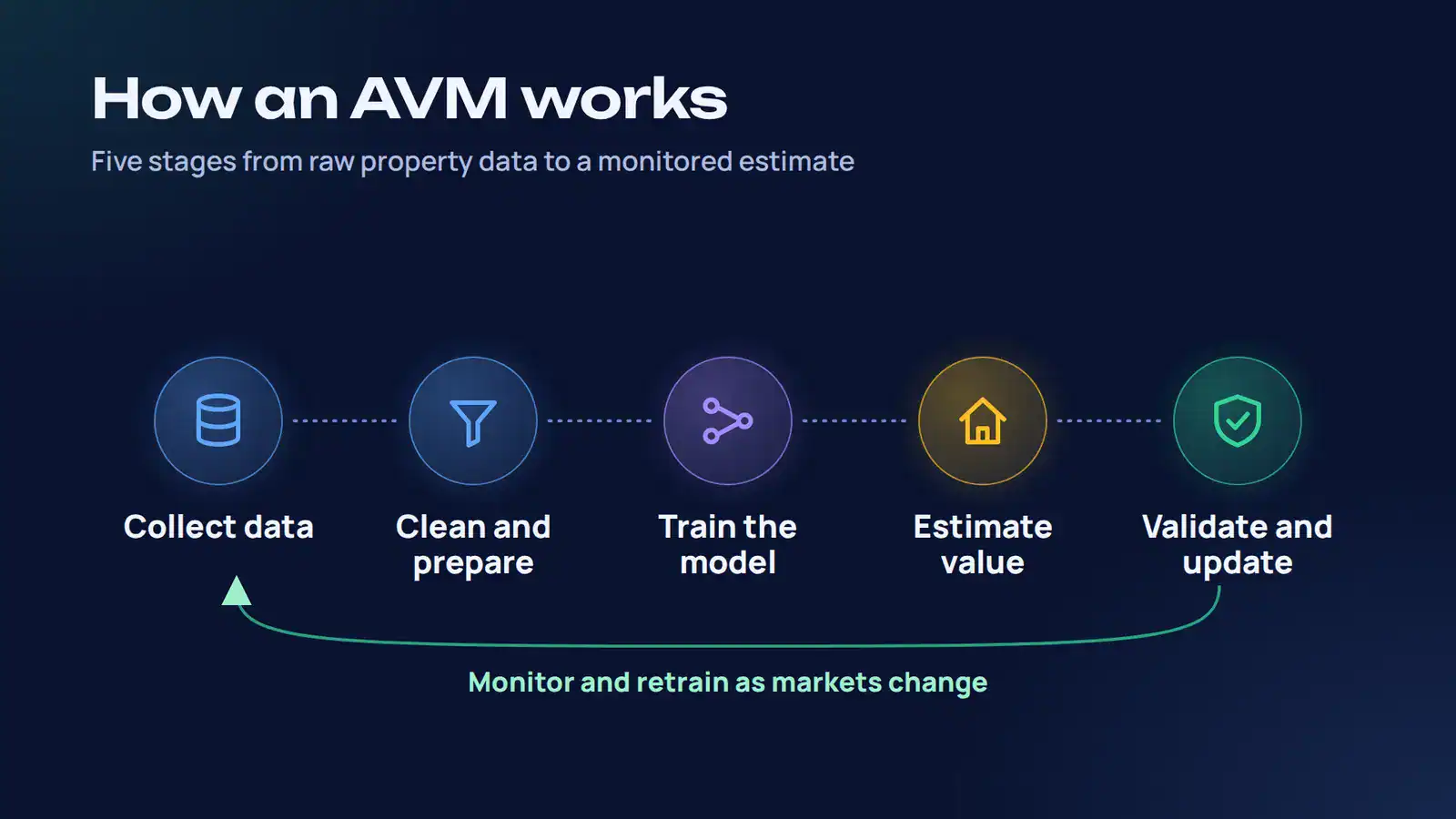
An automated valuation model moves through several stages, from gathering property data to producing and monitoring an estimate.
1. Collect Property and Market Data
The process begins with information about the property being valued and other properties that can help establish its likely market value.
Common inputs include:
- Property attributes: Living area, lot size, property type, age, bedrooms, bathrooms, and other available characteristics.
- Comparable sales: Recent transactions involving similar properties in relevant locations.
- Location data: Coordinates, neighborhood boundaries, geographic features, and proximity to relevant amenities.
- Transaction history: Previous sale prices and transaction dates.
- Market indicators: Local price movements and other relevant housing market information.
In the United States, useful sources may include county assessor records, property deed records, multiple listing service data where access is authorized, and licensed real estate data providers.
The model’s coverage depends on which sources are available and how consistently they describe properties. A system with extensive sales data but incomplete information about property condition may still struggle to value homes with substantial renovations or unusual features.
2. Clean and Prepare the Data
Raw property data often contains inconsistencies. A home may have different square footage recorded across sources, a transaction may be duplicated, or an old listing may no longer reflect the property’s condition.
Before model training or prediction, the data pipeline should address:
- Missing or inconsistent property attributes.
- Duplicate records and incorrect property matches.
- Implausible prices or transaction dates.
- Differences in how data providers define property characteristics.
- Outdated records and incomplete geographic coverage.
- Transactions that may not represent typical market conditions.
This stage matters because a model can produce a precise-looking number from unreliable inputs. Cleaning data does not remove every uncertainty, but it helps prevent avoidable errors from entering the valuation process.
For businesses planning a custom system, big data development services may be relevant when the project requires integrating large datasets, maintaining data pipelines, and processing information from multiple sources.
3. Select and Train the Valuation Model
Once the data is prepared, the development team selects a modeling approach that fits the property’s characteristics, the available data, and the intended use.
Possible approaches include regression-based models, comparable-sales methods, tree-based machine learning models, and ensemble techniques that combine multiple predictions.
During training, a model learns relationships between property features and observed transaction values. For example, it may learn how living area, location, property age, and recent local sales relate to prices in a particular market.
Machine learning can help capture nonlinear relationships and interactions among features, but it does not guarantee better predictions. Model complexity must be justified by validation results, not assumed to improve performance.
Teams evaluating machine learning development services should consider model selection, data preparation, testing, explainability, and ongoing maintenance as parts of the same project rather than separate afterthoughts.
4. Generate a Property Value Estimate
After training, the AVM applies the model to the property being evaluated.
The output may include an estimated value, relevant comparable properties, or an uncertainty indicator, depending on the system’s design. Some models also produce a range of plausible values instead of presenting a single number without context.
These outputs should be interpreted carefully. A confidence score, a prediction interval, and an estimate’s historical error rate measure different things. They should not be treated as interchangeable indicators of reliability.
5. Validate and Update the Model
An AVM should be tested against observed outcomes, including sale prices for properties that were not used to train the model.
Validation helps determine whether the model generalizes to new properties rather than simply fitting historical examples. Teams should also examine performance across geographic areas, property types, and price ranges.
The work continues after deployment. New transactions, changing market conditions, and updated property records can alter the relationships on which a model relies. Monitoring helps identify when performance deteriorates and whether recalibration, retraining, or additional data is necessary.
What Data Does an AVM Use to Value a Property?
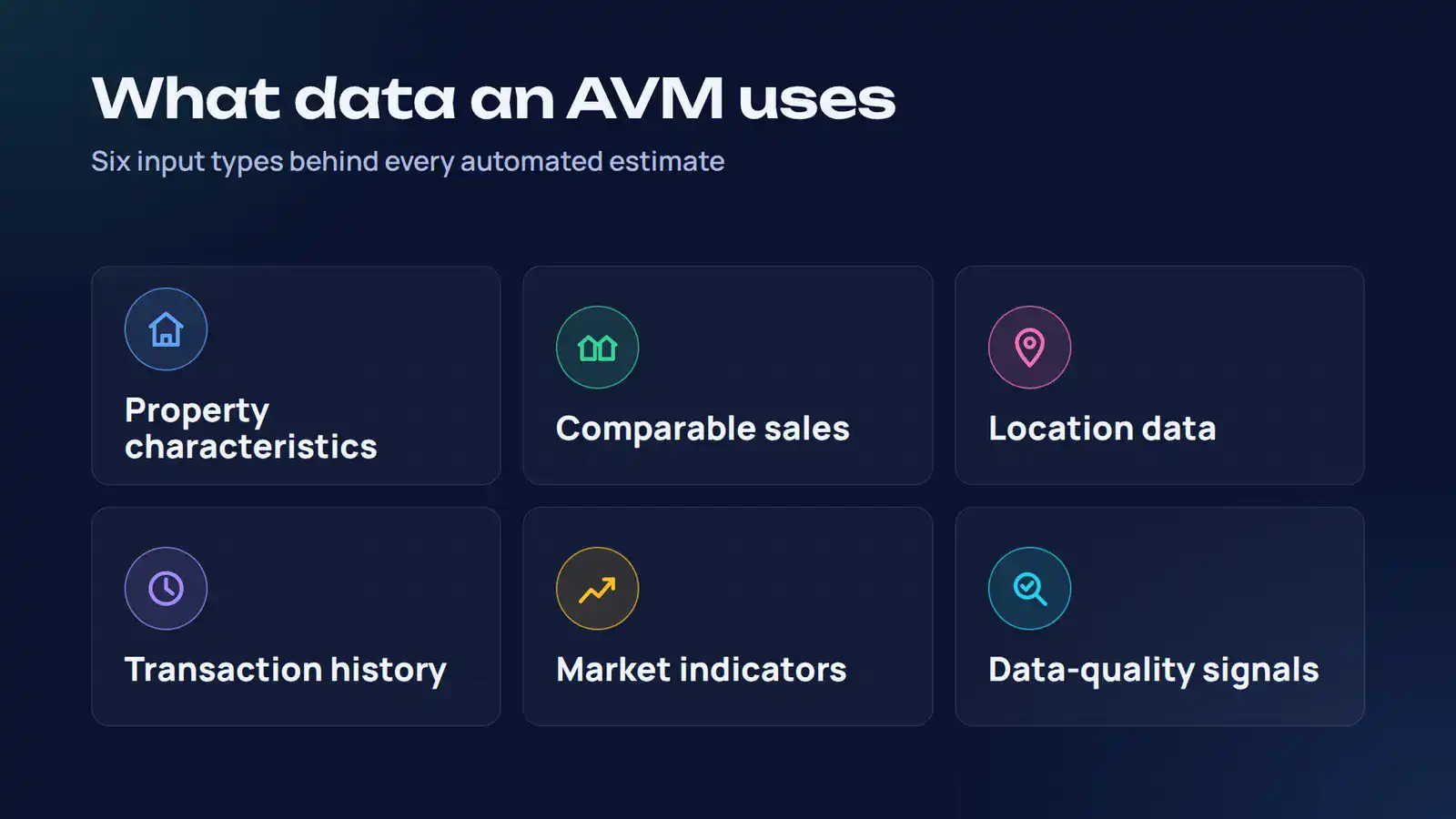
The usefulness of an automated property valuation model depends heavily on the relevance and reliability of its inputs.
| Data category | Examples | Role in valuation |
|---|---|---|
| Property characteristics | Living area, lot size, age, property type | Helps distinguish properties with different physical features |
| Comparable sales | Recent sales of similar homes | Provides evidence of prices paid for comparable properties |
| Location data | Coordinates, neighborhood, local boundaries | Captures geographic differences in property values |
| Transaction history | Previous prices and sale dates | Helps establish historical price patterns |
| Market indicators | Local price trends and transaction activity | Helps account for changing market conditions |
| Data-quality signals | Missing fields, stale records, unusual transactions | Helps identify inputs that may require review |
Why Property Data Quality Matters
A large dataset is not necessarily a good dataset. If it contains outdated sales, incorrect property matches, or incomplete information about the homes being compared, the resulting estimate may be misleading.
Coverage also matters. A model trained primarily on conventional homes in active urban markets may not perform as well on rural properties, custom-built houses, or locations with limited transaction activity.
Property data should therefore be assessed for accuracy, recency, completeness, licensing restrictions, and geographic representation before the model is developed. Cubix’s discussion of AI data readiness provides additional context on the preparation required before putting data-driven systems into production.
Which Methods and Algorithms Are Used in Property Valuation?
There is no single algorithm that works best for every property market. The appropriate approach depends on the available data, the complexity of the market, and the consequences of an inaccurate estimate.
1. Comparable-Sales and Statistical Models
Comparable-sales approaches estimate value using transactions involving properties with similar characteristics. Statistical models, including hedonic regression, can quantify relationships between property attributes and sale prices.
These methods can provide a useful baseline and may be easier to interpret than more complex models. Their effectiveness still depends on finding relevant comparables and accounting for meaningful differences between properties.
2. Machine Learning Models
Machine learning models can learn more complex relationships among location, property characteristics, transaction history, and other features.
Depending on the dataset, teams may evaluate tree-based methods, gradient boosting, or other supervised learning approaches. The model must still be tested on data that reflects the properties and markets it will encounter in production.
3. Hybrid and Ensemble Approaches
Some AVMs combine several models or use different methods for different property types or markets. An ensemble may improve predictions when its component models provide complementary information, but combining models does not automatically improve accuracy.
The right choice should be based on measured performance, reliability, interpretability, and the effort required to maintain the system.
How Accurate Are Automated Property Valuation Models?
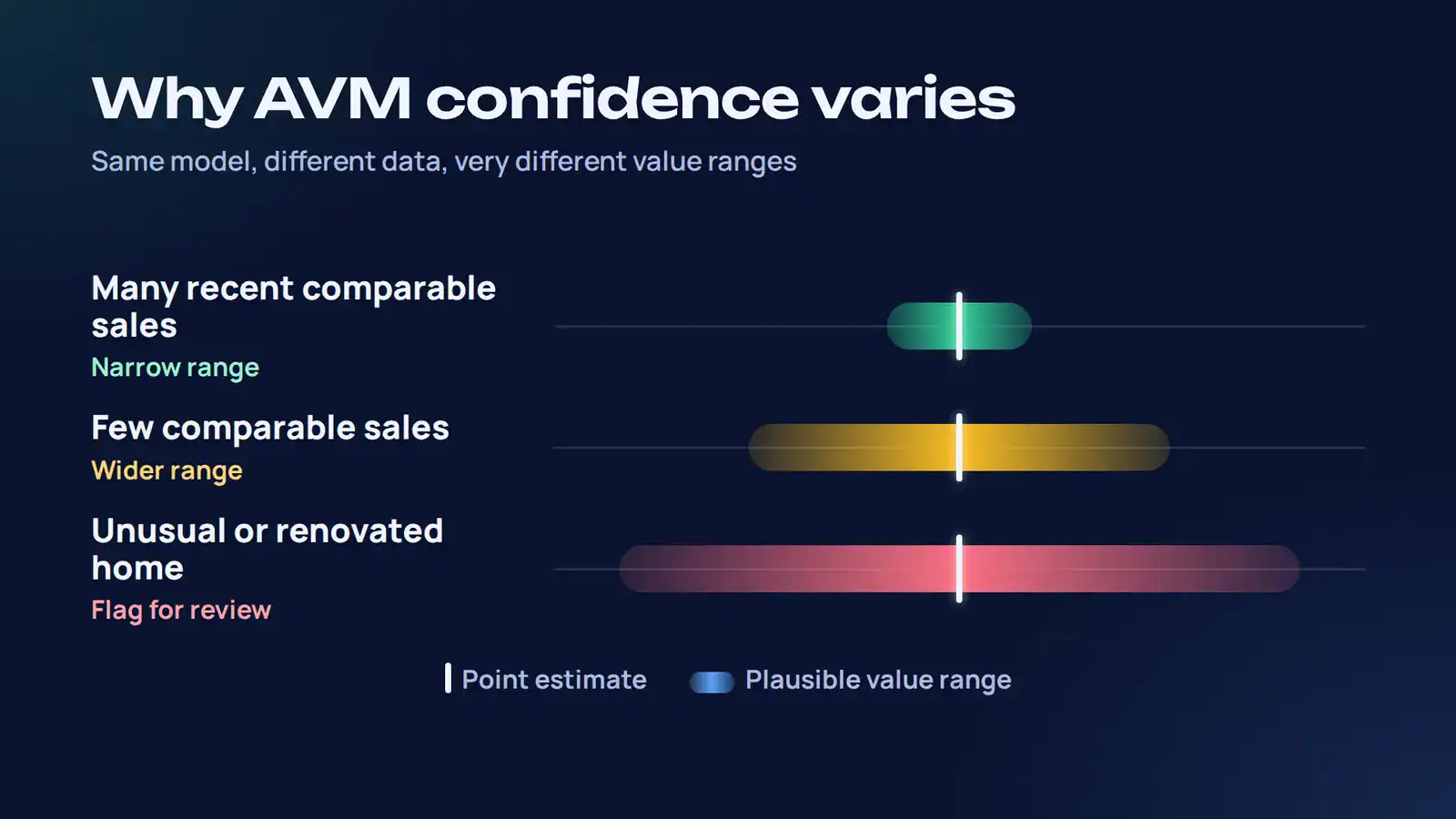
AVM accuracy varies by property, location, data quality, and market conditions. A model may perform well in a neighborhood with frequent sales and consistent property records but struggle in a market with few comparable transactions.
There is no universal accuracy percentage that applies to every AVM.
Metrics Used to Evaluate AVM Accuracy
Teams can use several measures to understand how closely estimates match observed sale prices.
| Metric | What it measures | Important consideration |
|---|---|---|
| Mean Absolute Error (MAE) | Average absolute difference between estimates and observed values | Easy to interpret in the same currency as the target value |
| Root Mean Squared Error (RMSE) | Error measure that gives greater weight to larger errors | Can highlight large valuation misses |
| Percentage-based error | Error relative to the observed property value | Useful for comparing errors across price levels, but sensitive to the metric’s definition and denominator |
| Error by market or property type | Differences in performance across groups | Helps uncover weaknesses hidden by an overall average |
A single overall metric can hide meaningful problems. A model may perform well on mid-priced homes but consistently overestimate properties in one area or underestimate homes at the upper end of the market.
Validation should therefore include representative holdout data, time-based testing where appropriate, and geographic or property-type analysis.
What Makes an AVM Estimate Less Reliable?
Several conditions can weaken an estimate:
- Sparse comparable sales: There may not be enough recent transactions involving similar properties.
- Unusual properties: Custom homes, unique architecture, or specialized features may not resemble the model’s training examples.
- Missing information: Property condition, renovations, or other important attributes may be absent from the dataset.
- Rapid market changes: Historical relationships may no longer describe current prices.
- Geographic bias: Data coverage or model performance may differ across neighborhoods and communities.
- Incorrect property matching: The system may associate the subject property with inaccurate or incomplete records.
Why Confidence Indicators Matter
An AVM should communicate uncertainty when possible. A valuation range or calibrated prediction interval can help users understand how uncertain an estimate may be, provided the method has been validated for that purpose.
The system should also have a way to flag cases where the data is insufficient or the property falls outside the model’s reliable coverage. In those situations, requesting further evidence or a professional review may be more appropriate than returning an unsupported number.
Automated Valuation Models vs. Traditional Property Appraisals
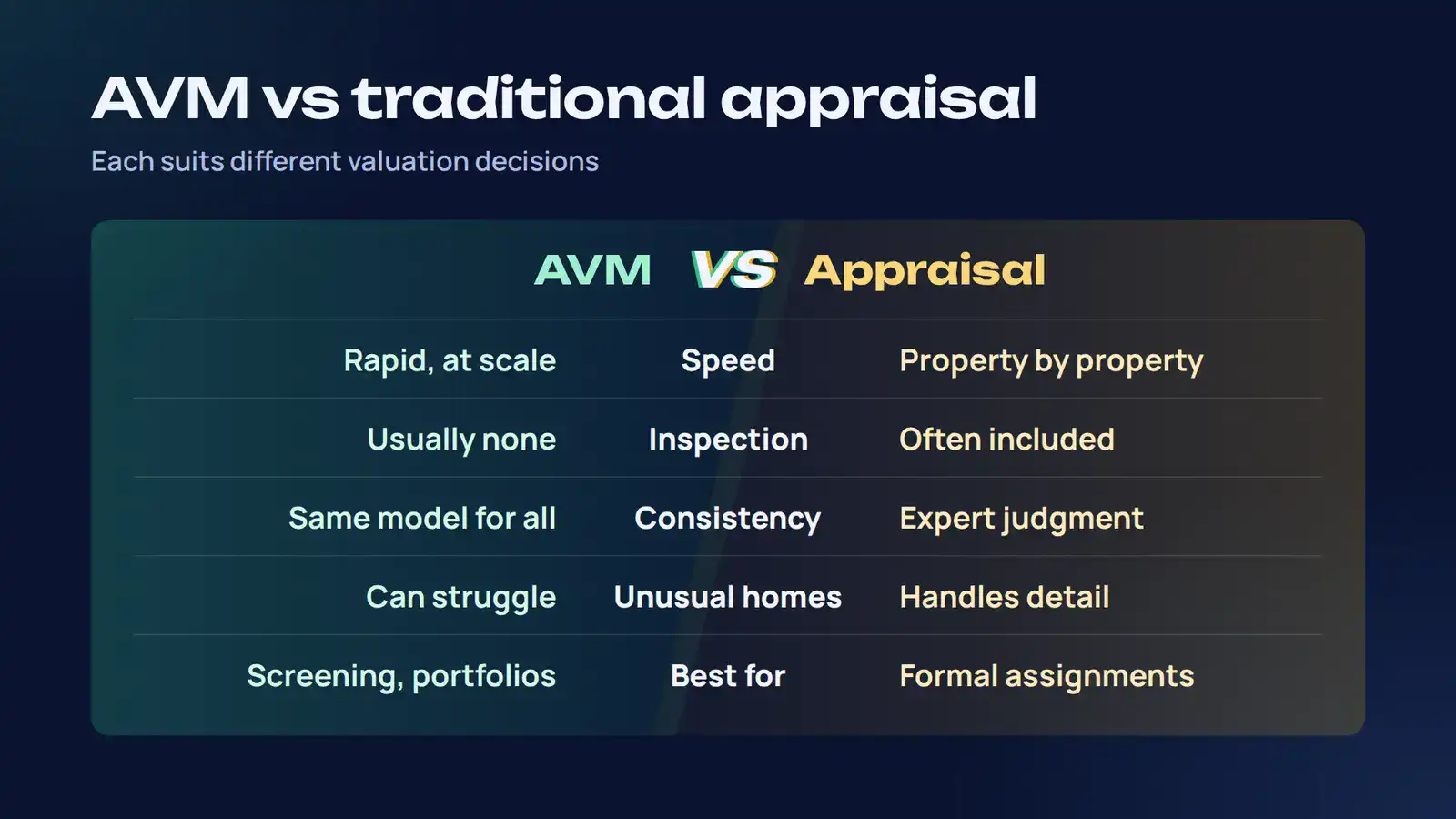
AVMs and professional appraisals can support property valuation, but they do not serve exactly the same purpose.
| Factor | Automated valuation model | Traditional property appraisal |
|---|---|---|
| Method | Applies a computational model to available data | Uses professional analysis and relevant valuation evidence |
| Speed | Can estimate many properties rapidly | Usually requires more time and property-specific work |
| Property inspection | Typically does not inspect every property physically | May include an inspection, depending on the assignment |
| Consistency | Applies a defined modeling process across many properties | Depends on the assignment, evidence, and professional judgment |
| Unusual properties | May struggle when comparable data is limited | Can account for property-specific evidence within the scope of the assignment |
| Common uses | Screening, portfolio monitoring, and supported valuation workflows | Assignments requiring a professional appraisal |
A professional appraisal is not automatically required for every property valuation task, and an AVM is not automatically sufficient for every decision. The appropriate method depends on the purpose, evidence available, and applicable requirements.
For mortgage-related use cases, the Consumer Financial Protection Bureau’s AVM quality control rule establishes requirements for covered mortgage originators and secondary-market issuers. Its scope should not be generalized to every commercial AVM application.
Where Are Automated Property Valuation Models Used?
Automated property valuation can support several real estate workflows when the model is appropriate for the decision.
1. Real Estate Platforms and Property Listings
Property platforms can use estimated values to provide additional context alongside listing information. Estimates may help users compare homes or explore local market patterns, but they should not be presented as guaranteed selling prices.
2. Real Estate Investment and Portfolio Analysis
Investors and portfolio managers may use AVMs to screen properties, monitor estimated portfolio values, or identify assets that warrant further analysis. The estimate is only one input into an investment decision and does not establish a property’s profitability.
3. Mortgage Lending and Collateral Assessment
Lenders may use AVMs within certain valuation workflows to support collateral assessment. Suitability depends on the transaction, the model’s reliability, and applicable requirements.
4. Market Research and Property Price Prediction
Real estate businesses can analyze estimates across neighborhoods or property segments to support market research. For broader housing market trends, official datasets such as the FHFA House Price Index can provide useful context, although a market index and an individual property’s AVM estimate answer different questions.
How to Implement an Automated Property Valuation Model?
Building an AVM involves more than training a model. The system needs a clear purpose, suitable data, reliable integrations, and a plan for monitoring performance after launch.
1. Define the Use Case
Specify the property types, geographic markets, intended users, and decisions the model will support. A tool for exploratory property search may have different requirements from a model used in a mortgage-related workflow.
Define acceptable uncertainty, required coverage, and circumstances that should trigger human review.
2. Assess Data Availability and Quality
Inventory internal records and potential external data sources. Review coverage, data rights, licensing terms, refresh frequency, and the consistency of property identifiers.
This assessment can reveal whether the project is feasible with available data or requires additional collection and integration work.
3. Select and Validate the Modeling Approach
Establish a baseline, compare suitable candidate models, and evaluate them against representative data. Test whether the model performs consistently across markets, property types, and price ranges.
Document the metrics and limitations before deployment rather than relying on a single favorable result.
4. Integrate the AVM Into Existing Systems
An AVM may need to connect with property databases, listing platforms, customer-facing applications, internal dashboards, or reporting systems.
The integration should address API reliability, access controls, data validation, error handling, model versioning, and what happens when the system cannot produce a reliable estimate. Businesses planning this work may explore AI software development when they need to integrate an AI capability into a broader product or operational system.
5. Test Before Deployment
Quality assurance should cover both the model and the surrounding application.
Before release, teams should verify data pipelines, prediction outputs, error handling, security controls, and performance across representative test cases. They should also document known limitations and establish a process for reviewing questionable estimates.
6. Monitor and Maintain the Model
After launch, track changes in prediction errors, data quality, market coverage, and system performance. Watch for model drift when new market conditions weaken the relationships learned during training.
Retraining should be based on evidence that the model needs updating, followed by validation before the revised version replaces the existing one.
What Affects the Cost of Building an AVM?
The cost of an automated property valuation system depends on its scope and operating requirements. A business licensing an existing valuation service has a different cost structure from one developing a custom model and maintaining its own data infrastructure.
| Cost Driver | What Influences TheCost |
|---|---|
| Property data | Licensing, collection, quality, and refresh frequency |
| Model development | Complexity, experimentation, and validation requirements |
| Geographic coverage | Number of markets and differences in local data |
| System integration | APIs, existing databases, and user-facing functionality |
| Infrastructure | Storage, processing, reliability, and monitoring |
| Quality assurance and governance | Bias testing, documentation, security, and human review |
| Ongoing maintenance | Data updates, drift monitoring, recalibration, and retraining |
The best way to estimate project cost is to define the use case, assess available data, establish performance requirements, and map the integrations before committing to a development scope. Without those details, a fixed price would be misleading.
What Risks and Governance Issues Should Businesses Consider?
An AVM can produce misleading results even when its software is functioning correctly. The risks often arise from data quality, model behavior, or the way people interpret the output.
Key considerations include:
- Data integrity: Protect against inaccurate, manipulated, or outdated records.
- Model bias: Test for systematic performance differences across relevant locations and property groups.
- Transparency: Document the model’s inputs, intended use, limitations, and evaluation results.
- Data rights and security: Confirm that data is used lawfully and protected through appropriate access controls.
- Model drift: Monitor changes in market conditions and prediction errors.
- Human oversight: Establish when an estimate should be reviewed or rejected rather than used automatically.
- Governance: Assign responsibility for validation, approvals, monitoring, and model updates.
For covered U.S. mortgage-related AVM uses, applicable quality control requirements include confidence in estimates, protection against data manipulation, safeguards against conflicts of interest, random sample testing and reviews, and compliance with applicable nondiscrimination laws. Businesses should confirm which requirements apply to their specific use case rather than assuming every AVM is governed identically.
Example: How an AVM Could Estimate a Property’s Value
Consider a hypothetical three-bedroom house in a suburban U.S. market. The AVM receives the property’s living area, lot size, age, location, and available transaction records.
The model then:
- Checks that the property records are consistent and correctly matched.
- Identifies relevant comparable sales and market features.
- Applies its learned relationships to estimate the property’s likely value.
- Produces an estimate and an uncertainty indicator if the model supports one.
- Flags the result for further review if comparable sales are limited or key property information is missing.
This example illustrates the workflow, not a verified valuation result. No specific dollar estimate can be justified without actual property data, a defined model, and appropriate validation.
Automated Property Valuation Implementation Checklist
Before building or integrating an AVM, confirm that your team has:
- Defined the property types, markets, and decisions the model will support.
- Identified suitable property data sources and confirmed access rights.
- Assessed data quality, coverage, and update frequency.
- Selected a modeling approach based on evidence rather than assumptions.
- Defined validation metrics and acceptable levels of uncertainty.
- Tested performance across locations, property types, and price ranges.
- Assessed bias, security, transparency, and governance requirements.
- Planned system integration, monitoring, and ongoing maintenance.
- Established clear criteria for human review.
- Documented model limitations and how estimates should be interpreted.
Conclusion
Automated property valuation gives real estate businesses a way to estimate values across large numbers of properties without relying on a manual valuation process for every case. But speed alone does not make an estimate reliable.
The quality of an AVM depends on the data behind it, the suitability of its modeling approach, how thoroughly it is validated, and whether its performance is monitored as markets change. Businesses evaluating a custom solution should start with the property data and decisions the system needs to support, then define the accuracy, integration, and governance requirements around that use case.
The goal is not simply to generate a property value. It’s to produce an estimate that users can interpret, evaluate, and apply appropriately.
Ready to Build a More Reliable Property Valuation Model?
Contact UsFrequently Asked Questions
1. What Is an Automated Valuation Model (AVM)?
An automated valuation model is a system that estimates a property’s value using property data, transaction records, and statistical or computational methods. Depending on its design, it may use machine learning, traditional statistical models, or a combination of approaches.
2. How Does AI Value Real Estate?
AI models can learn patterns linking property characteristics, location, transaction history, and market conditions to observed sale prices. They apply those patterns to estimate values for other properties. The quality of the result depends on the data, model design, and validation process.
3. What Data Does an AVM Use?
An AVM may use property characteristics, comparable sales, historical transactions, location data, and market indicators. The exact inputs depend on the provider, the property type, and the geographic market.
4. How Accurate Are Automated Property Valuation Models?
Accuracy varies by model, market, property type, and data quality. Teams should evaluate prediction errors on representative properties and examine results across different locations and price ranges rather than relying on one overall accuracy figure.
5. Can an AVM Replace a Property Appraisal?
Not automatically. An AVM may be suitable for certain screening or valuation workflows, but a formal appraisal may be necessary depending on the decision, assignment, and applicable requirements.
6. What Are the Main Limitations of AVMs?
AVMs can struggle with unusual properties, sparse comparable sales, missing property information, and rapidly changing markets. Their estimates can also be affected by data errors, geographic coverage gaps, and model drift.
7. How Much Does It Cost to Build an AVM?
The cost depends on data access, model complexity, geographic coverage, integration requirements, validation, and ongoing maintenance. Licensing an existing service and building a custom valuation system are different options with different cost structures.