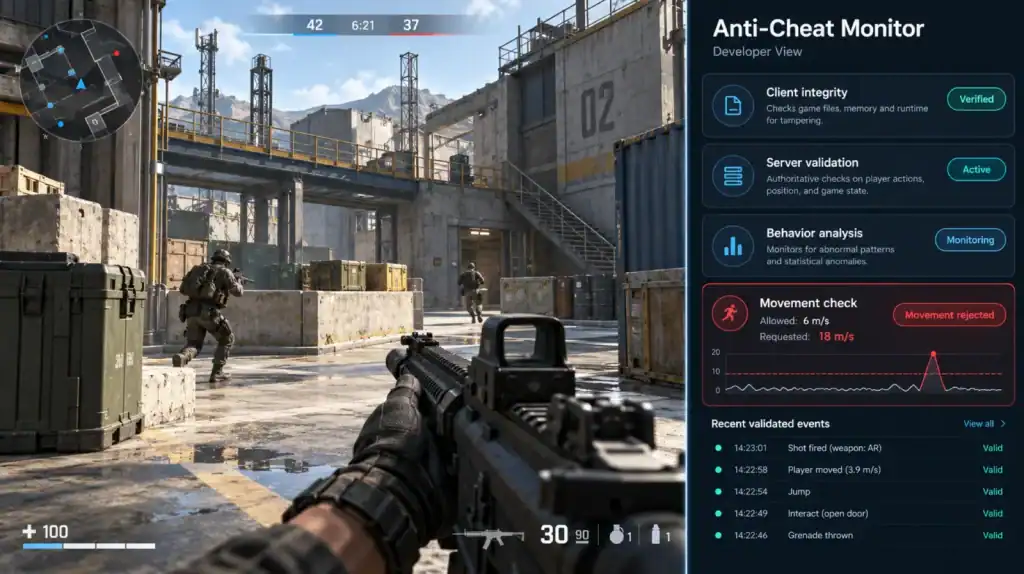
The short answer: anti-cheat systems in multiplayer games work in layers. Client integrity checks make tampering harder, server-authoritative validation decides what is actually allowed to happen, and behavioral analytics spot patterns that rules alone miss. All three are backed by risk scoring, fair enforcement and a working appeals process.
Why does this matter? Because one unchecked cheater can ruin dozens of matches. Honest players leave, reviews suffer, in-game economies get distorted, and in games with real-money or item trading, cheating turns into outright fraud.
Spot the layer (teaser): A player’s character crosses the map in two seconds, faster than any legitimate move allows. Which layer would catch it first: the client, the server or the behavior model? Keep your answer in mind. We’ll come back to it in the quiz at the end.
What Anti-Cheat Systems in Multiplayer Games Are (and Aren’t)
An anti-cheat system is a set of technical and operational controls that prevent, detect and respond to unfair play. Notice that this covers more than software. It includes data pipelines, review workflows, enforcement policy and communication with players.
Early anti-cheat was simple: a small program scanned the player’s machine for known tampering tools. That worked for a while, but as games moved online and competitive stakes rose, studios shifted toward verifying behavior on the server and analyzing patterns at scale. Today’s game anti-cheat systems blend all of these approaches.
Key idea: Anti-cheat is a risk-management system, not a one-time feature. You will never reach zero cheating. The goal is to make cheating costly, short-lived and low-impact while keeping honest players safe from wrongful punishment.
Partner with experts to develop secure, cheat-resistant multiplayer games
Contact UsThe Three Core Layers of Game Anti-Cheat Systems
Layer 1: Client Integrity
Client integrity checks try to confirm that the game running on a player’s device is the genuine, unmodified game. This is the layer most players associate with anti-cheat software.
What it’s good for: raising the effort required to tamper with the game, and removing low-effort cheats.
Its limit: the client runs on hardware the player controls, so it can never be fully trusted. Treat it as a speed bump and a signal source, not a wall.
Layer 2: Server-Side Anti-Cheat and Server-Authoritative Validation
What is server-authoritative validation? It means the server, not the player’s device, has the final say on what happens in the game. The client sends intentions (“I want to move forward,” “I fired”), and the server decides the outcome by checking them against the game’s rules.
Analogy: think of a referee at a sports match. Players can claim anything, but the referee’s ruling is what counts.
Server-side anti-cheat typically validates things like:
- Whether a movement is physically possible given speed and time
- Whether an action is allowed in the current game state (cooldowns, resources, line of sight)
- Whether inventory or currency changes match legitimate sources
Its limit: it catches rule violations, but not cheats that stay inside the rules, such as information advantages or assisted aiming that looks plausible.
Layer 3: Behavioral Cheat Detection and Gameplay Anomaly Detection
This layer asks a different question: does this player’s behavior look statistically unusual compared with others at the same skill level?
Studios collect gameplay telemetry (inputs, timings, outcomes, session patterns) and look for outliers. Behavioral cheat detection is also the main tool for bot detection in games, where automated accounts show unnaturally consistent timing or repetitive routes. The same approach supports multiplayer fraud prevention, such as detecting coordinated boosting or abnormal trading patterns.
Its limit: unusual is not the same as guilty. Highly skilled players can look like outliers, which is why this layer needs careful thresholds and human review.
Decision Table: Comparing the Three Layers
| Client Integrity | Server Validation | Behavior Analytics | |
|---|---|---|---|
| What it checks | Is the game software untampered? | Is this action allowed by the rules? | Does this pattern look abnormal? |
| Strengths | Deters casual tampering | Authoritative, hard to fool | Finds rule-compliant cheating and bots |
| Blind spots | Runs on untrusted hardware | Misses in-rule advantages | Can flag skilled players |
| Relative cost | Medium (ongoing updates) | Medium to high (design and compute) | High (data, models, review staff) |
| False-positive risk | Low to medium | Low | Medium to high |
| Best used for | First line of defense, signal source | Core game rules and economy | Bots, subtle assistance, fraud rings |
No single layer is enough. The strongest approach is defense in depth: each layer covers the others’ blind spots.
How a Modern Anti-Cheat Workflow Fits Together
Here is a simplified architecture showing how signals become decisions:
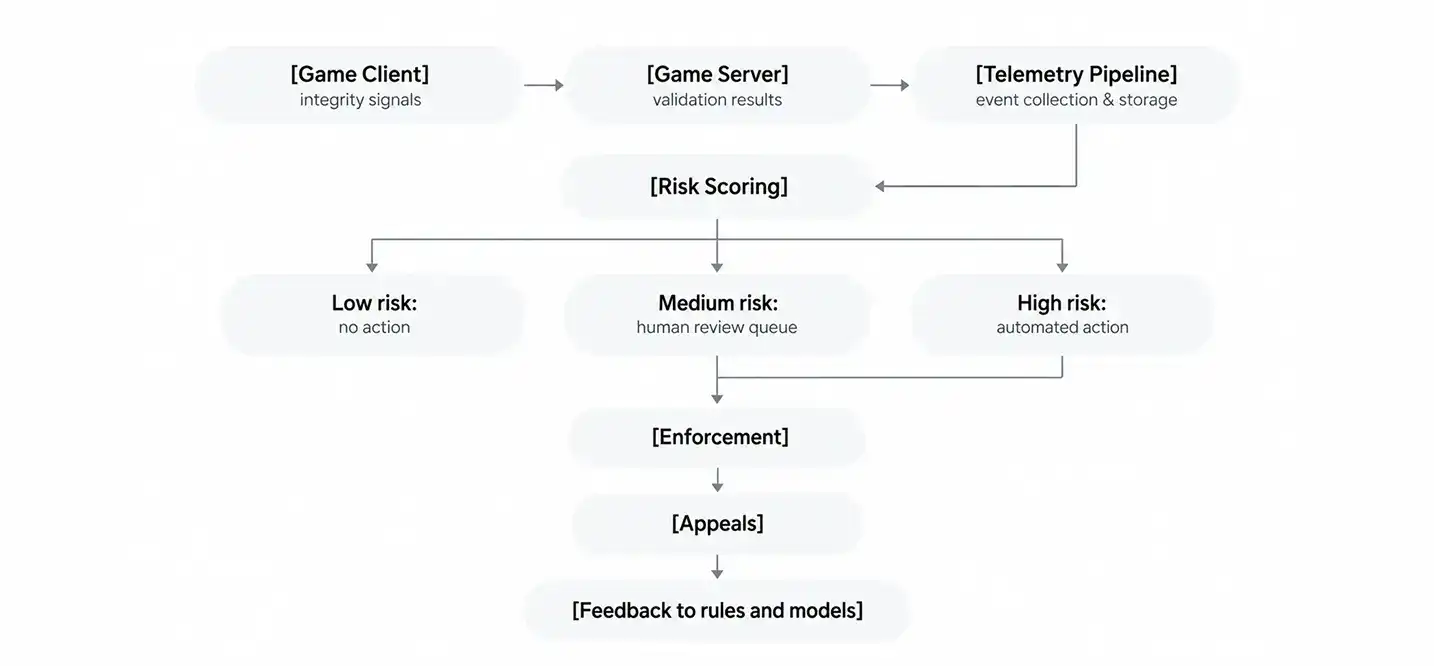
The loop at the bottom matters most. Appeal outcomes should feed back into your thresholds, so the system gets fairer over time instead of just stricter.
Telemetry and Risk Scoring
Telemetry is the raw material: player inputs, action timing, match outcomes, session patterns, and player reports. Collect what you need to answer specific questions, not everything you can capture.
Risk scoring combines these signals into one confidence-weighted score. A single odd signal, like a lucky streak, should barely move the score. Several independent signals pointing the same way, such as a server rule violation plus an unusual accuracy pattern plus repeated reports, should move it a lot. Combining signals is also what keeps false positives down.
Enforcement Tiers
Not every flag deserves a ban. Tiering the response lets you act early without risking wrongful punishment:
- Soft actions: quietly flagging an account, adding extra monitoring, or placing a suspected account in a separate matchmaking pool so it affects fewer honest players.
- Hard actions: temporary suspensions, feature restrictions, and permanent bans, reserved for high-confidence cases or human-confirmed ones.
A good rule: the harder the action, the higher the confidence and the more human review it needs.
Appeals, Privacy and Fair Enforcement
Players will trust enforcement only if they can challenge it. A fair program includes:
- Clear appeals: a simple process with a stated response time.
- Transparency: tell players what rule was broken, without revealing detection details.
- Data minimization: collect only the data your detection needs, keep it only as long as necessary, and disclose it in your privacy policy.
- Governance: document who can approve bans, who audits decisions, and how often thresholds are reviewed.
Can AI Detect Cheating?
Short answer: yes, for patterns and anomalies, but not as a standalone judge.
Machine learning is strong at spotting what rules can’t describe: subtle input regularities, coordinated account behavior, and bot-like consistency. It’s a natural fit for bot detection in games and multiplayer fraud prevention, where signals are spread across thousands of sessions. Teams building these systems often draw on machine learning development expertise and broader AI video game development practices.
It struggles in a few places. Models need good labeled data, they drift as player behavior and game updates change, and they can mistake elite players for cheaters. That’s why ML works best as a scoring input feeding human review, not as an automatic ban button.
Mini-interactive: AI or rule-based? Decide which approach fits each scenario, then check below.
- A player’s speed exceeds the game’s maximum movement speed.
- A group of new accounts trades items in a repeating, synchronized pattern.
- A player’s reaction times are consistently identical across hundreds of rounds.
Answers: (1) Rule-based. It’s a hard rule the server can check. (2) AI-assisted. The pattern only shows up across many accounts. (3) AI-assisted, with human review. It’s a statistical signal, not a rule break.
How Studios Handle False Positives
Anti-cheat false positives happen because unusual doesn’t mean guilty. Skilled players, unconventional playstyles, hardware quirks, and game updates can all look suspicious. Each wrongful action costs trust, and wronged players often tell others.
Practical safeguards studios use:
- Confidence thresholds: automate only the clearest cases.
- Human review queues: a person confirms borderline cases before hard action.
- Staged rollouts: test new detection on a small share of players first.
- Appeal SLAs: commit to a response time and track it.
- Reversal handling: restore accounts and rewards quickly when you’re wrong.
A Realistic Example with Explicit Assumptions
Imagine a mid-size studio running a 5v5 competitive shooter with about 100,000 monthly active players.
Assumptions:
- Matches are already hosted on game servers, but few actions are validated server-side.
- The team has one data engineer, one gameplay engineer, and a small moderation group.
- The studio wants to reduce cheating without increasing wrongful bans.
Rollout plan:
- Month 1: audit server validation, then close the biggest gaps (movement, cooldowns, economy).
- Month 2: instrument telemetry and define the enforcement and appeals policy.
- Month 3: run behavioral detection in shadow mode, scoring accounts but taking no action.
- Month 4: compare shadow results with manual review, tune thresholds, then enable soft actions.
- Month 5 onward: add hard actions for high-confidence cases and review quarterly.
Expected outcomes (hypothetical): fewer reports about impossible actions after server validation, a manageable review queue, and a documented appeal overturn rate to tune against. Your own numbers will differ, so measure before you promise.
Measuring Success: KPIs, Validation and Failure Signals
Metrics to track:
- Detection precision and recall
- False-positive rate
- Time-to-action (flag to enforcement)
- Appeal overturn rate
- Player-report volume
- Retention of players who reported cheaters
Validation methods:
- Shadow mode: score accounts silently and compare against reviewed outcomes.
- A/B holdouts: keep a small group without the new detection to measure its effect.
- Retrospective audits: periodically re-review past bans for errors.
Failure signals: rising appeal overturns, report spikes right after a game update, and detection drift, where scores slowly lose accuracy as behavior changes.
Cost, Scalability and Implementation Considerations
Build, buy or hybrid? Off-the-shelf anti-cheat software gets you client integrity quickly. Server validation and behavioral detection depend on your game’s rules, so they usually need custom work. Most studios end up hybrid.
Main cost drivers:
- Data pipelines and storage
- Compute for scoring at scale
- Moderation and appeals staff
- Ongoing maintenance as the game and cheating methods change
Also plan for: performance impact on servers and clients, integration with your existing architecture, and QA that covers both cheater scenarios and false-positive scenarios. Teams without in-house capacity sometimes work with a full cycle game development company so security is designed in rather than patched on later.
Common Mistakes to Avoid
- Trusting the client too much: the client is a signal, not an authority.
- Relying on bans alone: bans without prevention just restart the cycle.
- Skipping appeals: unchallenged errors quietly damage trust.
- Ignoring privacy: over-collecting data creates legal and reputational risk.
- Shipping without production readiness testing: untested detection can punish the wrong players at launch.
- Treating anti-cheat as set and forget: cheating evolves, so your system must too.
Best Practices Checklist for Game Studios
Design
- Make the server authoritative for core rules and the economy
- Define a cheat threat model before choosing tools
Integration
- Combine client, server, and behavioral signals into one risk score
- Tier enforcement from soft to hard actions
QA
- Test for missed cheaters and wrongful flags
- Run new detection in shadow mode first
Governance
- Publish clear rules and an appeals process
- Minimize data collection and set retention limits
Evaluation
- Track precision, false positives, time-to-action, and overturn rate
- Review thresholds and models quarterly
Quick Quiz: Which Layer Catches It?
Remember the teaser? Match each scenario to the layer most likely to catch it first.
- A character crosses the map in two seconds, faster than the game allows.
- A player’s accuracy is consistently just below suspicious but unusually stable over weeks.
- An unauthorized program is attached to the game process on a player’s device.
- Dozens of new accounts trade items in a synchronized pattern.
Answers:
- Server validation. The server checks speed against time and rejects the move. (This is the answer to the opening teaser.)
- Behavior analytics. It’s rule-compliant but statistically unusual.
- Client integrity. It’s tampering on the player’s own device.
- Behavior analytics. The pattern only appears across many accounts.
Conclusion: Your Next-Step Checklist
Effective anti-cheat systems in multiplayer games are never finished, but they can be steadily improved. If you’re starting out, work through these steps:
- Assess your cheating and fraud risk.
- Define a cheat threat model.
- Audit your server-side validation.
- Instrument the telemetry you actually need.
- Set enforcement tiers and an appeals policy.
- Define your KPIs and failure signals.
- Pilot new detection in shadow mode.
- Review thresholds and results quarterly.
Fair play isn’t a feature you ship once. It’s a promise you keep maintaining, one match at a time.
Build smarter anti-cheat systems that protect your multiplayer game
Contact UsFrequently Asked Questions
1. How do anti-cheat systems work?
They work in layers: client integrity checks make tampering harder, the server validates what’s allowed, and behavioral analytics spot unusual patterns. Risk scoring combines the signals, and enforcement and appeals keep decisions fair.
2. What is server-authoritative validation?
It’s a design where the server, not the player’s device, decides what actually happens. The client sends requests, and the server checks them against the game’s rules.
3. Can AI detect cheating?
Yes, particularly for anomalies, bots, and coordinated fraud. But it works best as one input to risk scoring with human review, not as an automatic judge.
4. How do studios handle false positives?
With confidence thresholds, human review of borderline cases, staged rollouts, fast appeals, and quick reversals when a mistake is made.